MEDIA &
INFORMATION
LITERACY (MIL)
PRAYER
FOOD
FOR
THOUGHT
S
CHECKING OF
ATTENDANCE
As I call your name you will open your camera &
microphone and greet your teacher and classmates.
What I Need to Know? (Objectives)
1. Recognize the different components in the
communication process.
2. Understand how these elements connect and
influence each other;
3. Describe how communication is influenced by media
and information; (MIL 11/12 IMIL-IIA-1)
What I Know ? (Pre-Test)
1. It refers to anything that blocks or changes the
source’s intended meaning of the message.
a. Medium c. Individual
b. Technology d. Interference
2. It refers to tools used by the source to disseminate
information to the receivers.
a. Media c. Literacy
b. Technology d. Information
What I Know? (Pre-Test)
3. It pertains to any information that is passed on
through communication.
a. Receiver c. Message
b. Media d. Source
◦4. It refers to the atmosphere, physical and
psychological, where you send and receive
messages.
a. Context c. Feedback
b. Environment d. Interference
What I Know? (Pre-Test)
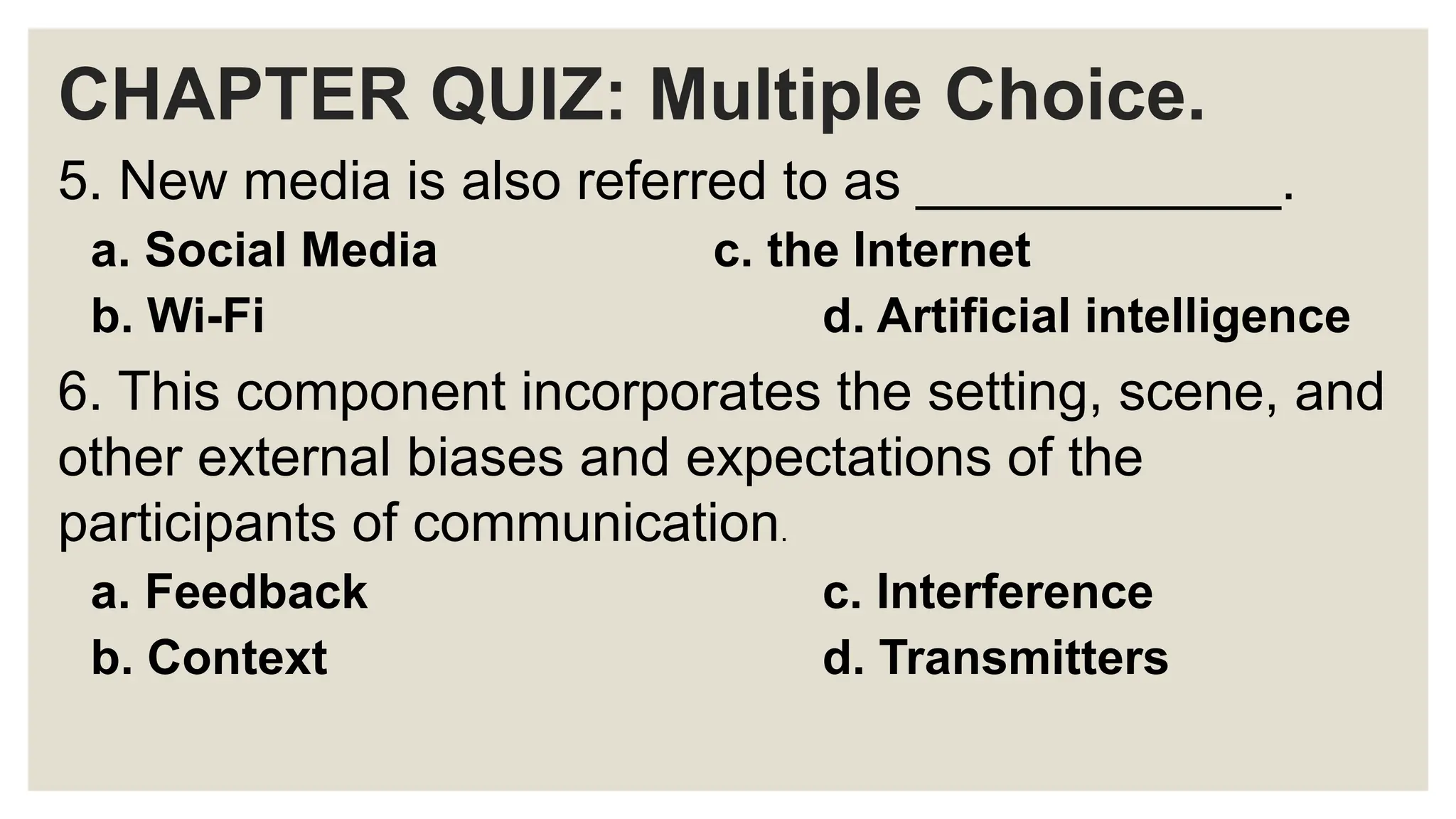
◦5. New media is also referred to as ____________.
a. Social Media c. the Internet
b. Wi-Fi d. Artificial intelligence
Eight essential components of communication
1.Source – a person, group, or entity that forms, creates,
sends, or forwards a message or information
2.Message – the stimulus or meaning produced by the source
for the receiver or audience (McLean, 2005)
3.Channel – the tool or manner in which the messages will be
carried through from the source to the receiver
4.Receiver – receives the message from the source,
analyzing and interpreting the message in ways both
intended and unintended by the source (McLean, 2005)
Eight essential components of communication
5. Feedback – the message or response of the receiver which is
sent back to the source
6. Environment – the atmosphere, physical and psychological,
where you send and receive messages (McLean, 2005)
7. Context – the communication interaction involves the setting,
scene, and expectations of the individuals involved (McLean,
2005)
8. Interference – anything that blocks or changes the source’s
intended meaning of the message (McLean, 2005)
Forms of Communication
1. Intrapersonal Communication
It is a form of communication with oneself using internal
vocalization or reflective thinking (Communication in the Real
World, 2010). We exercise intrapersonal communication more
often than we consciously remember. We do it every time we
quietly decide on what to, when we contemplate on what
decisions to make, or even make observations or formulate
opinions about the things around us which we keep to
ourselves.
Forms of Communication
2. Interpersonal Communication
Interpersonal communication is a form of communication
between two different people who may or may not have a
direct relationship with each other but are mutually and
actively part of the communication process. Interpersonal
communication can be planned or unplanned, but since it is
interactive, it is usually more structured and influenced by
social expectations (Communication in the Real World, 2010).
Forms of Communication
3. Group Communication
It is a type of communication between three or
more people interacting to achieve a specific objective
or certain goal. This form of communication happens
often during team-based tasks mostly done in school
works or organizational endeavors.
Forms of Communication
4. Public Communication
This is a sender-focused form of communication in which
one person is typically responsible for conveying information
to an audience. This form is usually seen during campaigns,
speeches, or other public speaking events. Among the other
forms of communication discussed so far, this is the most
formal, intentional, and goal-oriented type.
Forms of Communication
5. Mass Communication
Public communication becomes mass communication
when it is transmitted to many people through print or
electronic media. In the past, print media such as newspapers
and magazines and broadcast media like TV and radio have
been the most used channels for mass communication.
However, in the advent of technology, mass communication
has slowly and strategically shifted its medium to the internet
world through websites and social media.
Role of Media and Information in Communication
Media – is the plural form of medium
Media is an instrument for transmitting information.
Media – the vehicle for a message (books, films, songs, TV
Shows, poems, video games, magazines, radio podcasts,
music videos, vlogs, newspapers, emails, tweets, posts,
letters, traffic signs, graphics, Instagram stories).
It may range from print media, broadcast media, film or
cinema and new media or the internet (social media).
Information – the message we want to convey
Role of Media and Information in Communication
1. It makes the world a smaller place
Today, the world seemed like a smaller place than
before, as through digital media, a person can be connected
to anyone else in the world at any given time. Social media
platforms brings people from different locations, background,
culture, and race together. Today’s media also creates bridges
between countries and cultures without having the need to
travel physically, all we need is to look something up on the
web.
Role of Media and Information in Communication
2. It makes communication convenient
In the past, communicating to someone from far
away meant sending telegrams and snail mails. These
modes of transfer compel people to wait for days,
weeks, months, and even years before their intended
receivers obtain their message. Now, people may
communicate without having to wait long through the
existence of email and various messaging sites and
apps.
Role of Media and Information in Communication
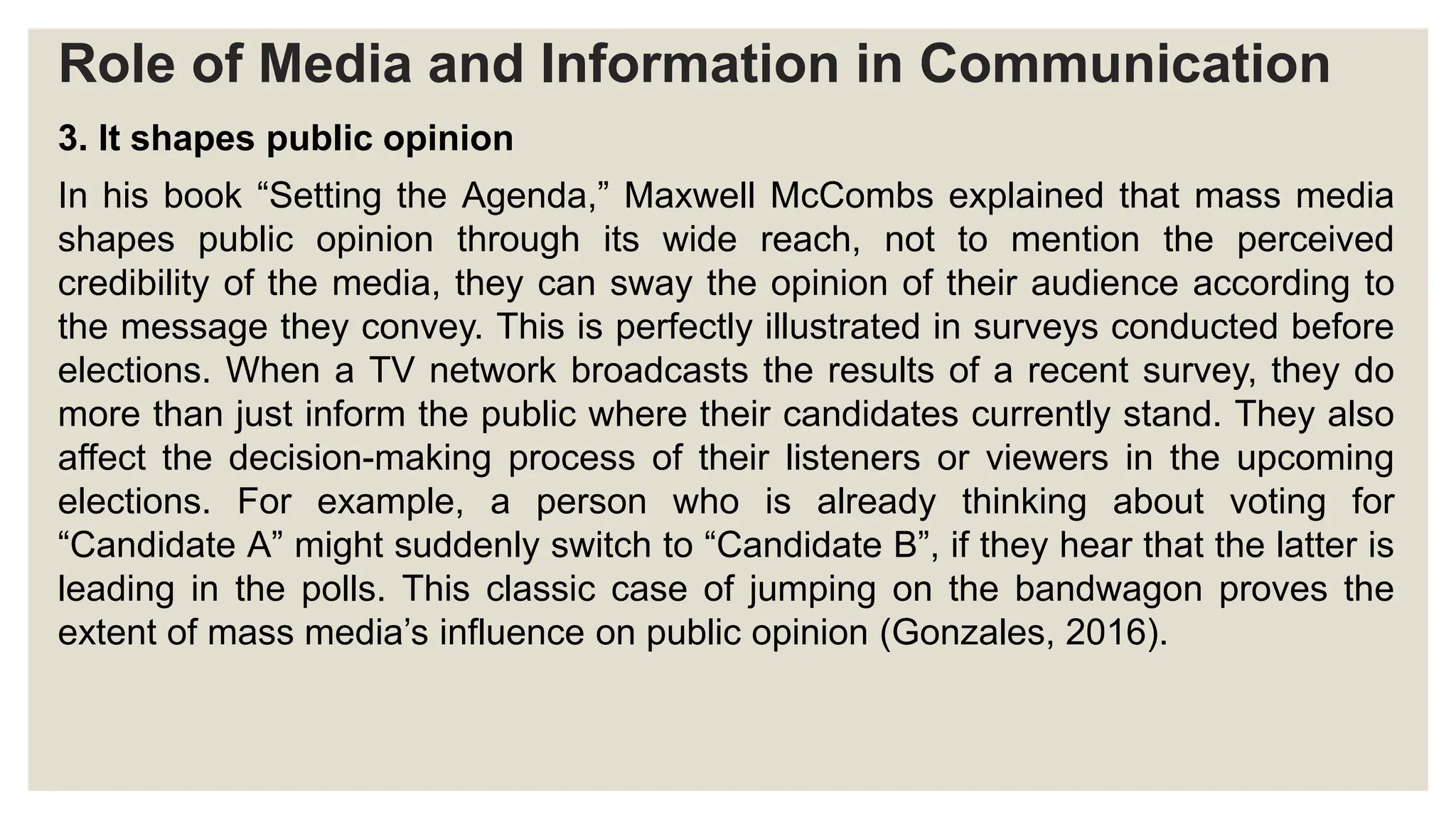
3. It shapes public opinion
In his book “Setting the Agenda,” Maxwell McCombs explained that mass media
shapes public opinion through its wide reach, not to mention the perceived
credibility of the media, they can sway the opinion of their audience according to
the message they convey. This is perfectly illustrated in surveys conducted before
elections. When a TV network broadcasts the results of a recent survey, they do
more than just inform the public where their candidates currently stand. They also
affect the decision-making process of their listeners or viewers in the upcoming
elections. For example, a person who is already thinking about voting for
“Candidate A” might suddenly switch to “Candidate B”, if they hear that the latter is
leading in the polls. This classic case of jumping on the bandwagon proves the
extent of mass media’s influence on public opinion (Gonzales, 2016).
Role of Media and Information in Communication
3. It shapes public opinion
In his book “Setting the Agenda,” Maxwell McCombs explained that mass media
shapes public opinion through its wide reach, not to mention the perceived
credibility of the media, they can sway the opinion of their audience according to
the message they convey. This is perfectly illustrated in surveys conducted before
elections. When a TV network broadcasts the results of a recent survey, they do
more than just inform the public where their candidates currently stand. They also
affect the decision-making process of their listeners or viewers in the upcoming
elections. For example, a person who is already thinking about voting for
“Candidate A” might suddenly switch to “Candidate B”, if they hear that the latter is
leading in the polls. This classic case of jumping on the bandwagon proves the
extent of mass media’s influence on public opinion (Gonzales, 2016).
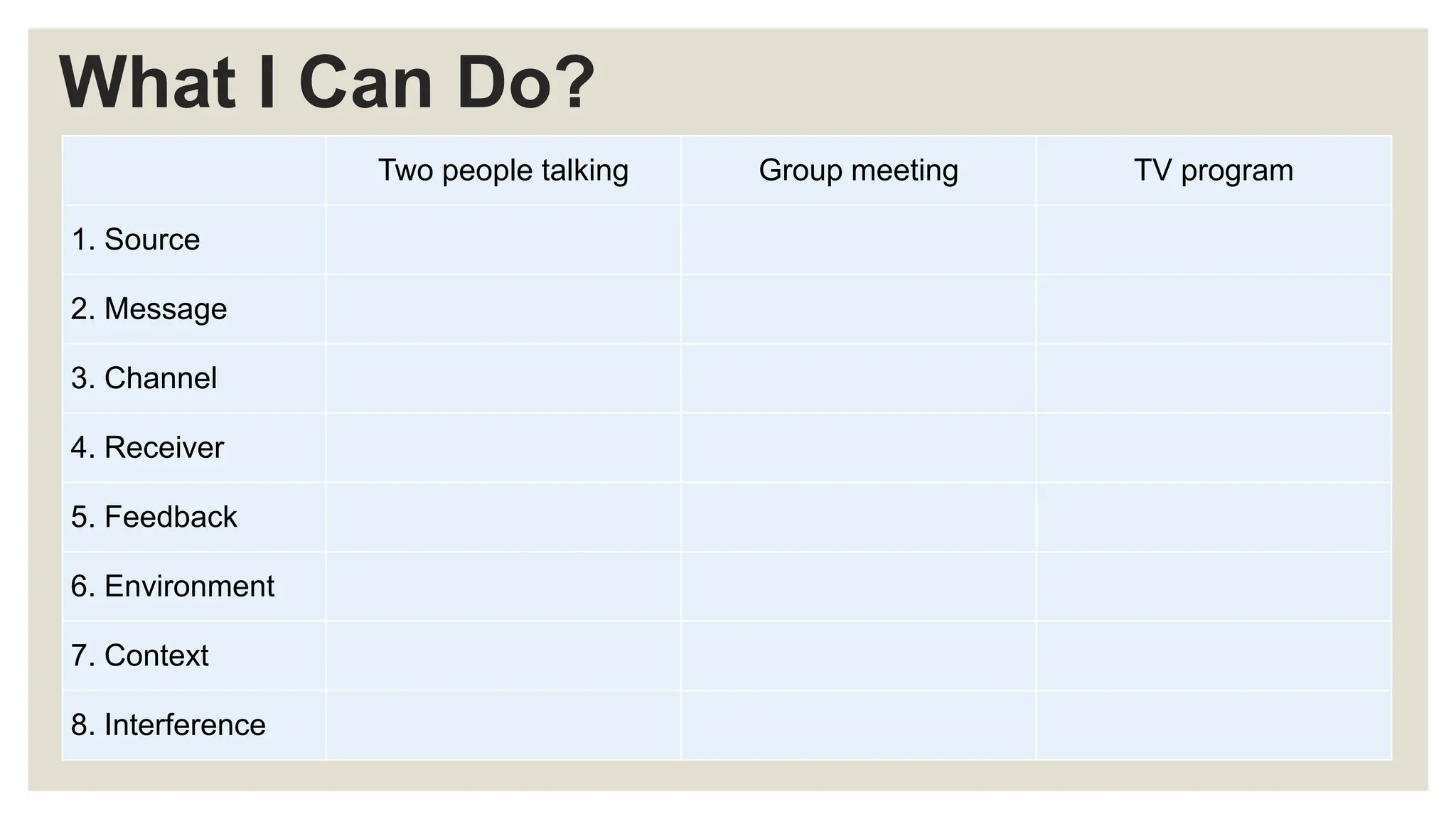
What I Can Do?
Two people talking Group meeting TV program
1. Source
2. Message
3. Channel
4. Receiver
5. Feedback
6. Environment
7. Context
8. Interference
CHAPTER QUIZ: Multiple Choice.
1. It refers to anything that blocks or changes the
source’s intended meaning of the message.
a. Medium c. Individual
b. Technology d. Interference
2. It refers to tools used by the source to disseminate
information to the receivers.
a. Media c. Literacy
b. Technology d. Information
CHAPTER QUIZ: Multiple Choice.
3. It pertains to any information that is passed on
through communication.
a. Receiver c. Message
b. Media d. Source
4. It refers to the atmosphere, physical and
psychological, where you send and receive messages.
a. Context c. Feedback
b. Environment d. Interference
CHAPTER QUIZ: Multiple Choice.
5. New media is also referred to as ____________.
a. Social Media c. the Internet
b. Wi-Fi d. Artificial intelligence
6. This component incorporates the setting, scene, and
other external biases and expectations of the
participants of communication.
a. Feedback c. Interference
b. Context d. Transmitters
CHAPTER QUIZ: Multiple Choice.
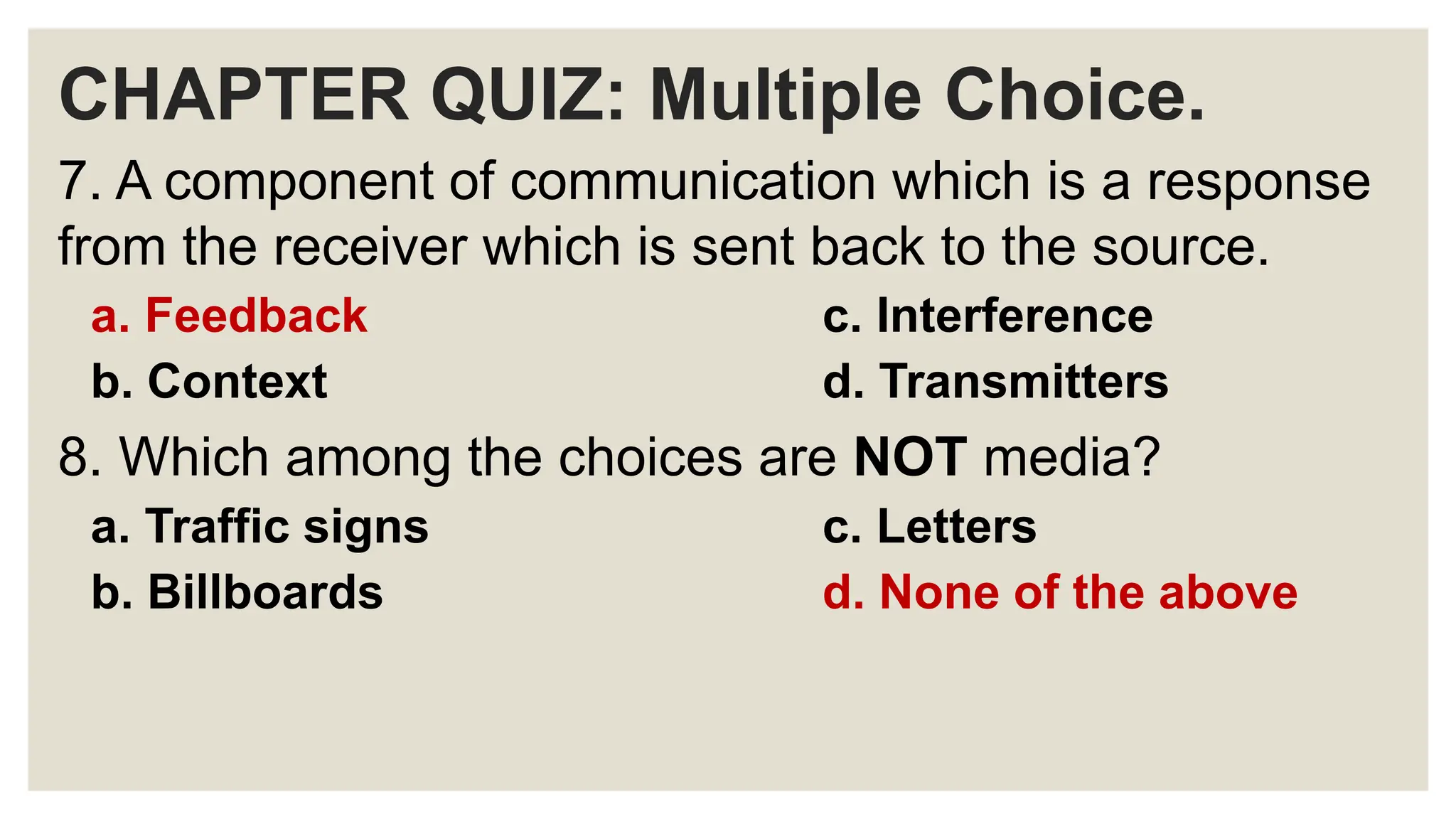
7. A component of communication which is a response
from the receiver which is sent back to the source.
a. Feedback c. Interference
b. Context d. Transmitters
8. Which among the choices are NOT media?
a. Traffic signs c. Letters
b. Billboards d. None of the above
CHAPTER QUIZ: Multiple Choice.
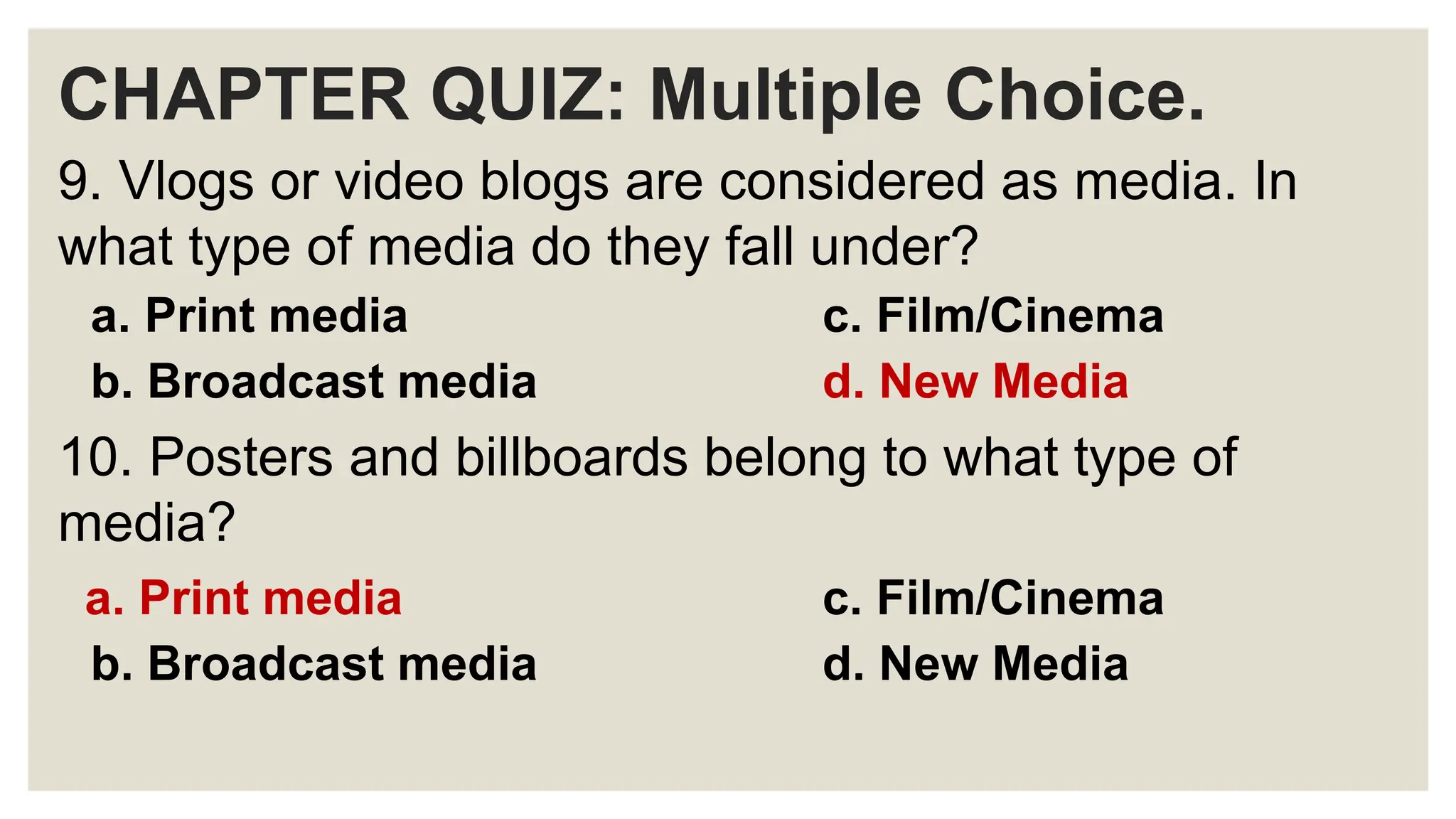
9. Vlogs or video blogs are considered as media. In
what type of media do they fall under?
a. Print media c. Film/Cinema
b. Broadcast media d. New Media
10. Posters and billboards belong to what type of
media?
a. Print media c. Film/Cinema
b. Broadcast media d. New Media
Enumerate the following:
11 – 18 Eight Essential Components of
Communication Process
19 – 23 Forms of Communication
24 – 26 Role of Media in
Communication
Fill in the blank
27. ________ – the message or response of the receiver which is
sent back to the source
28. ________ – the atmosphere, physical and psychological,
where you send and receive messages (McLean, 2005)
29. ________– the communication interaction involves the setting,
scene, and expectations of the individuals involved (McLean,
2005)
30. ________ – anything that blocks or changes the source’s
intended meaning of the message (McLean, 2005)
Fill in the blank
31.________ – a person, group, or entity that forms, creates,
sends, or forwards a message or information
32.________ – the stimulus or meaning produced by the
source for the receiver or audience (McLean, 2005)
33.________– the tool or manner in which the messages will
be carried through from the source to the receiver
34.________ – receives the message from the source,
analyzing and interpreting the message in ways both intended
and unintended by the source (McLean, 2005)
Fill in the blanks.
35. __________ Communication
A form of communication between two different people
who may or may not have a direct relationship with each other
but are mutually and actively part of the communication
process. It can be planned or unplanned, but since it is
interactive, it is usually more structured and influenced by
social expectations (Communication in the Real World, 2010).
Fill in the blanks.
36. _____________ Communication
It is a form of communication with oneself using internal
vocalization or reflective thinking. We do it every time we
quietly decide on what to, when we contemplate on what
decisions to make, or even make observations or formulate
opinions about the things around us which we keep to
ourselves.
Fill in the blanks.
37. _______________ Communication
This is a sender-focused form of communication in which
one person is typically responsible for conveying information
to an audience. This form is usually seen during campaigns,
speeches, or other public speaking events. Among the other
forms of communication discussed so far, this is the most
formal, intentional, and goal-oriented type.
Fill in the blanks.
38. ________ Communication
It is a type of communication between three or
more people interacting to achieve a specific objective
or certain goal. This form of communication happens
often during team-based tasks mostly done in school
works or organizational endeavors.
Fill in the blanks.
39. _______ Communication
Public communication becomes mass communication
when it is transmitted to many people through print or
electronic media. In the past, print media such as newspapers
and magazines and broadcast media like TV and radio have
been the most used channels for mass communication.
However, in the advent of technology, mass communication
has slowly and strategically shifted its medium to the internet
world through websites and social media.
Fill in the blanks.
40. ___________ – is the plural form of medium
___________ is an instrument for transmitting information.
___________– the vehicle for a message (books, films,
songs, TV Shows, poems, video games, magazines, radio
podcasts, music videos, vlogs, newspapers, emails, tweets,
posts, letters, traffic signs, graphics, Instagram stories).
CHAPTER QUIZ
Answer Key
CHAPTER QUIZ: Multiple Choice.
1. It refers to anything that blocks or changes the
source’s intended meaning of the message.
a. Medium c. Individual
b. Technology d. Interference
2. It refers to tools used by the source to disseminate
information to the receivers.
a. Media c. Literacy
b. Technology d. Information
CHAPTER QUIZ: Multiple Choice.
3. It pertains to any information that is passed on
through communication.
a. Receiver c. Message
b. Media d. Source
4. It refers to the atmosphere, physical and
psychological, where you send and receive messages.
a. Context c. Feedback
b. Environment d. Interference
CHAPTER QUIZ: Multiple Choice.
5. New media is also referred to as ____________.
a. Social Media c. the Internet
b. Wi-Fi d. Artificial intelligence
6. This component incorporates the setting, scene, and
other external biases and expectations of the
participants of communication.
a. Feedback c. Interference
b. Context d. Transmitters
CHAPTER QUIZ: Multiple Choice.
7. A component of communication which is a response
from the receiver which is sent back to the source.
a. Feedback c. Interference
b. Context d. Transmitters
8. Which among the choices are NOT media?
a. Traffic signs c. Letters
b. Billboards d. None of the above
CHAPTER QUIZ: Multiple Choice.
9. Vlogs or video blogs are considered as media. In
what type of media do they fall under?
a. Print media c. Film/Cinema
b. Broadcast media d. New Media
10. Posters and billboards belong to what type of
media?
a. Print media c. Film/Cinema
b. Broadcast media d. New Media
Enumerate the following:
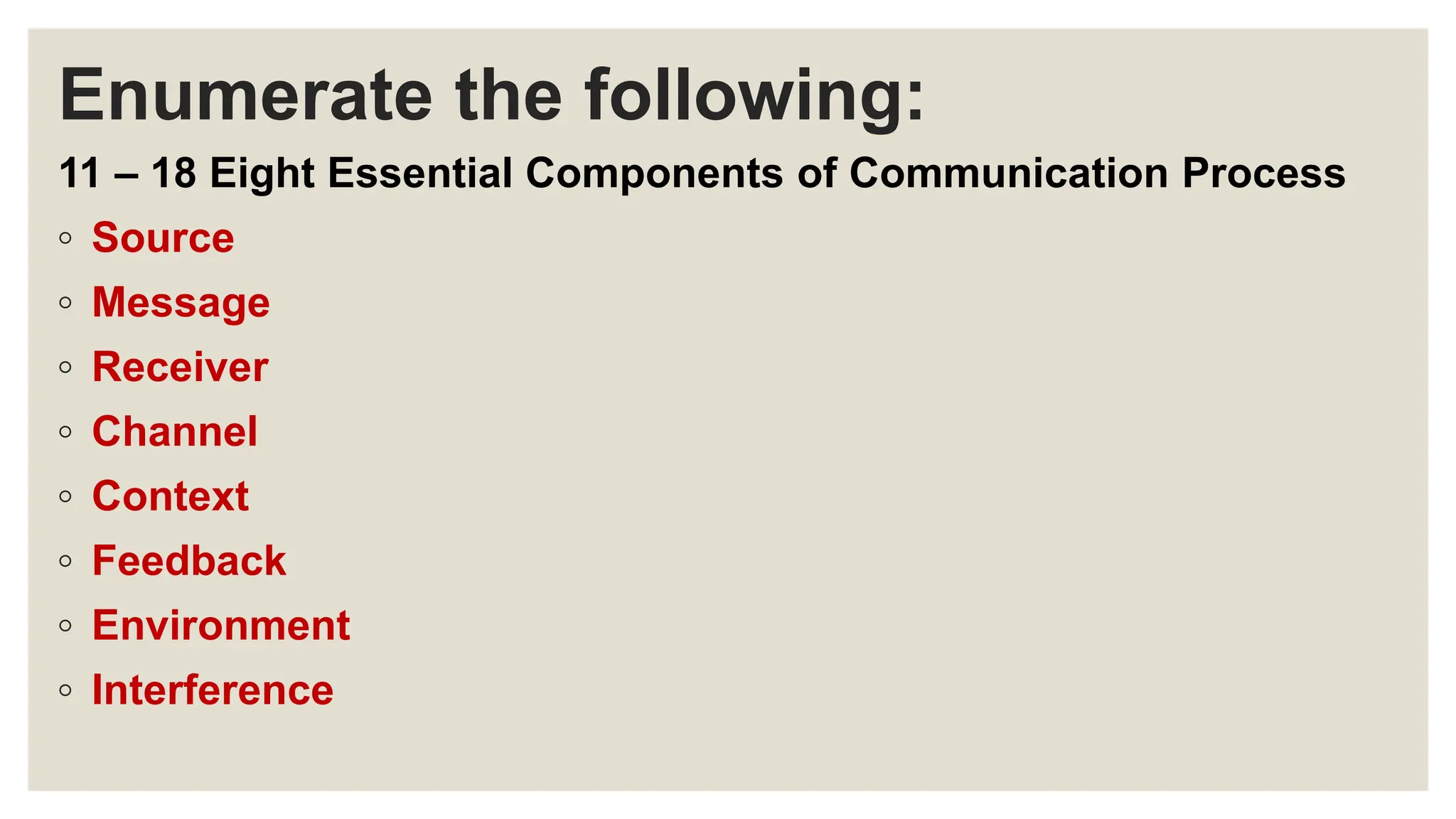
11 – 18 Eight Essential Components of Communication Process
◦ Source
◦ Message
◦ Receiver
◦ Channel
◦ Context
◦ Feedback
◦ Environment
◦ Interference
Enumerate the following:
19 – 23 Forms of Communication
◦ Intrapersonal Communication
◦ Interpersonal Communication
◦ Group Communication
◦ Public Communication
◦ Mass Communication
Enumerate the following:
24 – 26 Role of Media in
Communication
◦ It makes the world a smaller place
◦ It makes communication convenient
◦ It shapes public opinion
Fill in the blank
27. Feedback – the message or response of the receiver which is
sent back to the source
28. Environment – the atmosphere, physical and psychological,
where you send and receive messages (McLean, 2005)
29. Context – the communication interaction involves the setting,
scene, and expectations of the individuals involved (McLean,
2005)
30. Interference – anything that blocks or changes the source’s
intended meaning of the message (McLean, 2005)
Fill in the blank
31. Source – a person, group, or entity that forms, creates,
sends, or forwards a message or information
32. Message – the stimulus or meaning produced by the
source for the receiver or audience (McLean, 2005)
33. Channel – the tool or manner in which the messages will
be carried through from the source to the receiver
34. Receiver – receives the message from the source,
analyzing and interpreting the message in ways both intended
and unintended by the source (McLean, 2005)
Fill in the blanks.
35. Interpersonal Communication
A form of communication between two different people
who may or may not have a direct relationship with each other
but are mutually and actively part of the communication
process. It can be planned or unplanned, but since it is
interactive, it is usually more structured and influenced by
social expectations (Communication in the Real World, 2010).
Fill in the blanks.
36. Intrapersonal Communication
It is a form of communication with oneself using internal
vocalization or reflective thinking. We do it every time we
quietly decide on what to, when we contemplate on what
decisions to make, or even make observations or formulate
opinions about the things around us which we keep to
ourselves.
Fill in the blanks.
37. Public Communication
This is a sender-focused form of communication in which
one person is typically responsible for conveying information
to an audience. This form is usually seen during campaigns,
speeches, or other public speaking events. Among the other
forms of communication discussed so far, this is the most
formal, intentional, and goal-oriented type.
Fill in the blanks.
38. Group Communication
It is a type of communication between three or
more people interacting to achieve a specific objective
or certain goal. This form of communication happens
often during team-based tasks mostly done in school
works or organizational endeavors.
Fill in the blanks.
39. Mass Communication
Public communication becomes these type of
communication when it is transmitted to many people through
print or electronic media. In the past, print media such as
newspapers and magazines and broadcast media like TV and
radio have been the most used channels for mass
communication. However, in the advent of technology, mass
communication has slowly and strategically shifted its medium
to the internet world through websites and social media.
Fill in the blanks.
40. MEDIA – is the plural form of medium
___________ is an instrument for transmitting information.
___________– the vehicle for a message (books, films,
songs, TV Shows, poems, video games, magazines, radio
podcasts, music videos, vlogs, newspapers, emails, tweets,
posts, letters, traffic signs, graphics, Instagram stories).
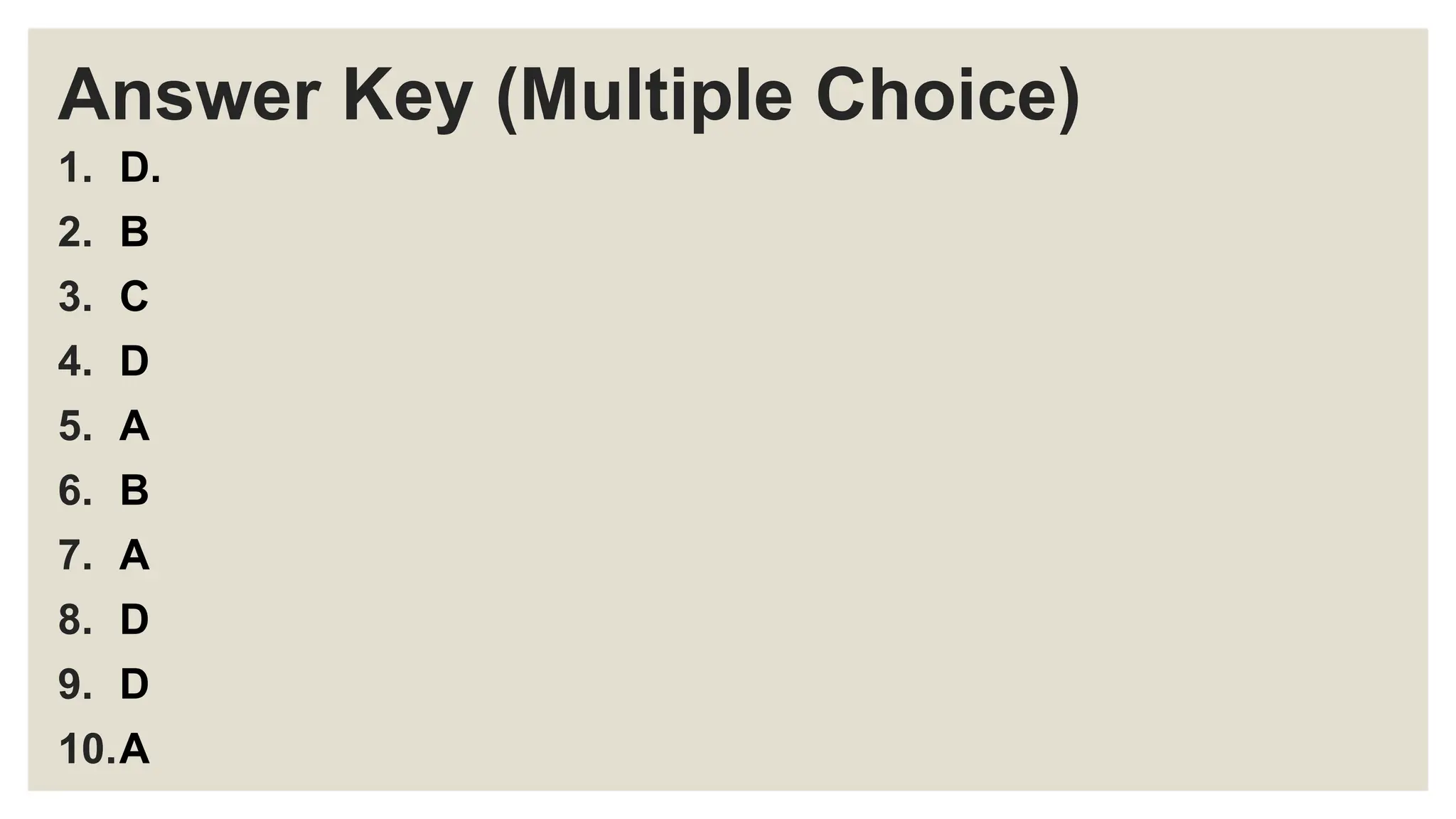
Answer Key (Multiple Choice)
1. D.
2. B
3. C
4. D
5. A
6. B
7. A
8. D
9. D
10.A
Enumerate the following:
1 – 8 Eight Essential Components of
Communication Process
9 – 13 Forms of Communication
14 – 16 Role of Media in
Communication

Module 1_Intro MEDIA & INFORMATION LITERACY (MIL) final.pptx

  • 1.
  • 2.
  • 3.
  • 4.
    CHECKING OF ATTENDANCE As Icall your name you will open your camera & microphone and greet your teacher and classmates.
  • 5.
    What I Needto Know? (Objectives) 1. Recognize the different components in the communication process. 2. Understand how these elements connect and influence each other; 3. Describe how communication is influenced by media and information; (MIL 11/12 IMIL-IIA-1)
  • 6.
    What I Know? (Pre-Test) 1. It refers to anything that blocks or changes the source’s intended meaning of the message. a. Medium c. Individual b. Technology d. Interference 2. It refers to tools used by the source to disseminate information to the receivers. a. Media c. Literacy b. Technology d. Information
  • 7.
    What I Know?(Pre-Test) 3. It pertains to any information that is passed on through communication. a. Receiver c. Message b. Media d. Source ◦4. It refers to the atmosphere, physical and psychological, where you send and receive messages. a. Context c. Feedback b. Environment d. Interference
  • 8.
    What I Know?(Pre-Test) ◦5. New media is also referred to as ____________. a. Social Media c. the Internet b. Wi-Fi d. Artificial intelligence
  • 9.
    Eight essential componentsof communication 1.Source – a person, group, or entity that forms, creates, sends, or forwards a message or information 2.Message – the stimulus or meaning produced by the source for the receiver or audience (McLean, 2005) 3.Channel – the tool or manner in which the messages will be carried through from the source to the receiver 4.Receiver – receives the message from the source, analyzing and interpreting the message in ways both intended and unintended by the source (McLean, 2005)
  • 10.
    Eight essential componentsof communication 5. Feedback – the message or response of the receiver which is sent back to the source 6. Environment – the atmosphere, physical and psychological, where you send and receive messages (McLean, 2005) 7. Context – the communication interaction involves the setting, scene, and expectations of the individuals involved (McLean, 2005) 8. Interference – anything that blocks or changes the source’s intended meaning of the message (McLean, 2005)
  • 11.
    Forms of Communication 1.Intrapersonal Communication It is a form of communication with oneself using internal vocalization or reflective thinking (Communication in the Real World, 2010). We exercise intrapersonal communication more often than we consciously remember. We do it every time we quietly decide on what to, when we contemplate on what decisions to make, or even make observations or formulate opinions about the things around us which we keep to ourselves.
  • 12.
    Forms of Communication 2.Interpersonal Communication Interpersonal communication is a form of communication between two different people who may or may not have a direct relationship with each other but are mutually and actively part of the communication process. Interpersonal communication can be planned or unplanned, but since it is interactive, it is usually more structured and influenced by social expectations (Communication in the Real World, 2010).
  • 13.
    Forms of Communication 3.Group Communication It is a type of communication between three or more people interacting to achieve a specific objective or certain goal. This form of communication happens often during team-based tasks mostly done in school works or organizational endeavors.
  • 14.
    Forms of Communication 4.Public Communication This is a sender-focused form of communication in which one person is typically responsible for conveying information to an audience. This form is usually seen during campaigns, speeches, or other public speaking events. Among the other forms of communication discussed so far, this is the most formal, intentional, and goal-oriented type.
  • 15.
    Forms of Communication 5.Mass Communication Public communication becomes mass communication when it is transmitted to many people through print or electronic media. In the past, print media such as newspapers and magazines and broadcast media like TV and radio have been the most used channels for mass communication. However, in the advent of technology, mass communication has slowly and strategically shifted its medium to the internet world through websites and social media.
  • 16.
    Role of Mediaand Information in Communication Media – is the plural form of medium Media is an instrument for transmitting information. Media – the vehicle for a message (books, films, songs, TV Shows, poems, video games, magazines, radio podcasts, music videos, vlogs, newspapers, emails, tweets, posts, letters, traffic signs, graphics, Instagram stories). It may range from print media, broadcast media, film or cinema and new media or the internet (social media). Information – the message we want to convey
  • 17.
    Role of Mediaand Information in Communication 1. It makes the world a smaller place Today, the world seemed like a smaller place than before, as through digital media, a person can be connected to anyone else in the world at any given time. Social media platforms brings people from different locations, background, culture, and race together. Today’s media also creates bridges between countries and cultures without having the need to travel physically, all we need is to look something up on the web.
  • 18.
    Role of Mediaand Information in Communication 2. It makes communication convenient In the past, communicating to someone from far away meant sending telegrams and snail mails. These modes of transfer compel people to wait for days, weeks, months, and even years before their intended receivers obtain their message. Now, people may communicate without having to wait long through the existence of email and various messaging sites and apps.
  • 19.
    Role of Mediaand Information in Communication 3. It shapes public opinion In his book “Setting the Agenda,” Maxwell McCombs explained that mass media shapes public opinion through its wide reach, not to mention the perceived credibility of the media, they can sway the opinion of their audience according to the message they convey. This is perfectly illustrated in surveys conducted before elections. When a TV network broadcasts the results of a recent survey, they do more than just inform the public where their candidates currently stand. They also affect the decision-making process of their listeners or viewers in the upcoming elections. For example, a person who is already thinking about voting for “Candidate A” might suddenly switch to “Candidate B”, if they hear that the latter is leading in the polls. This classic case of jumping on the bandwagon proves the extent of mass media’s influence on public opinion (Gonzales, 2016).
  • 20.
    Role of Mediaand Information in Communication 3. It shapes public opinion In his book “Setting the Agenda,” Maxwell McCombs explained that mass media shapes public opinion through its wide reach, not to mention the perceived credibility of the media, they can sway the opinion of their audience according to the message they convey. This is perfectly illustrated in surveys conducted before elections. When a TV network broadcasts the results of a recent survey, they do more than just inform the public where their candidates currently stand. They also affect the decision-making process of their listeners or viewers in the upcoming elections. For example, a person who is already thinking about voting for “Candidate A” might suddenly switch to “Candidate B”, if they hear that the latter is leading in the polls. This classic case of jumping on the bandwagon proves the extent of mass media’s influence on public opinion (Gonzales, 2016).
  • 21.
    What I CanDo? Two people talking Group meeting TV program 1. Source 2. Message 3. Channel 4. Receiver 5. Feedback 6. Environment 7. Context 8. Interference
  • 22.
    CHAPTER QUIZ: MultipleChoice. 1. It refers to anything that blocks or changes the source’s intended meaning of the message. a. Medium c. Individual b. Technology d. Interference 2. It refers to tools used by the source to disseminate information to the receivers. a. Media c. Literacy b. Technology d. Information
  • 23.
    CHAPTER QUIZ: MultipleChoice. 3. It pertains to any information that is passed on through communication. a. Receiver c. Message b. Media d. Source 4. It refers to the atmosphere, physical and psychological, where you send and receive messages. a. Context c. Feedback b. Environment d. Interference
  • 24.
    CHAPTER QUIZ: MultipleChoice. 5. New media is also referred to as ____________. a. Social Media c. the Internet b. Wi-Fi d. Artificial intelligence 6. This component incorporates the setting, scene, and other external biases and expectations of the participants of communication. a. Feedback c. Interference b. Context d. Transmitters
  • 25.
    CHAPTER QUIZ: MultipleChoice. 7. A component of communication which is a response from the receiver which is sent back to the source. a. Feedback c. Interference b. Context d. Transmitters 8. Which among the choices are NOT media? a. Traffic signs c. Letters b. Billboards d. None of the above
  • 26.
    CHAPTER QUIZ: MultipleChoice. 9. Vlogs or video blogs are considered as media. In what type of media do they fall under? a. Print media c. Film/Cinema b. Broadcast media d. New Media 10. Posters and billboards belong to what type of media? a. Print media c. Film/Cinema b. Broadcast media d. New Media
  • 27.
    Enumerate the following: 11– 18 Eight Essential Components of Communication Process 19 – 23 Forms of Communication 24 – 26 Role of Media in Communication
  • 28.
    Fill in theblank 27. ________ – the message or response of the receiver which is sent back to the source 28. ________ – the atmosphere, physical and psychological, where you send and receive messages (McLean, 2005) 29. ________– the communication interaction involves the setting, scene, and expectations of the individuals involved (McLean, 2005) 30. ________ – anything that blocks or changes the source’s intended meaning of the message (McLean, 2005)
  • 29.
    Fill in theblank 31.________ – a person, group, or entity that forms, creates, sends, or forwards a message or information 32.________ – the stimulus or meaning produced by the source for the receiver or audience (McLean, 2005) 33.________– the tool or manner in which the messages will be carried through from the source to the receiver 34.________ – receives the message from the source, analyzing and interpreting the message in ways both intended and unintended by the source (McLean, 2005)
  • 30.
    Fill in theblanks. 35. __________ Communication A form of communication between two different people who may or may not have a direct relationship with each other but are mutually and actively part of the communication process. It can be planned or unplanned, but since it is interactive, it is usually more structured and influenced by social expectations (Communication in the Real World, 2010).
  • 31.
    Fill in theblanks. 36. _____________ Communication It is a form of communication with oneself using internal vocalization or reflective thinking. We do it every time we quietly decide on what to, when we contemplate on what decisions to make, or even make observations or formulate opinions about the things around us which we keep to ourselves.
  • 32.
    Fill in theblanks. 37. _______________ Communication This is a sender-focused form of communication in which one person is typically responsible for conveying information to an audience. This form is usually seen during campaigns, speeches, or other public speaking events. Among the other forms of communication discussed so far, this is the most formal, intentional, and goal-oriented type.
  • 33.
    Fill in theblanks. 38. ________ Communication It is a type of communication between three or more people interacting to achieve a specific objective or certain goal. This form of communication happens often during team-based tasks mostly done in school works or organizational endeavors.
  • 34.
    Fill in theblanks. 39. _______ Communication Public communication becomes mass communication when it is transmitted to many people through print or electronic media. In the past, print media such as newspapers and magazines and broadcast media like TV and radio have been the most used channels for mass communication. However, in the advent of technology, mass communication has slowly and strategically shifted its medium to the internet world through websites and social media.
  • 35.
    Fill in theblanks. 40. ___________ – is the plural form of medium ___________ is an instrument for transmitting information. ___________– the vehicle for a message (books, films, songs, TV Shows, poems, video games, magazines, radio podcasts, music videos, vlogs, newspapers, emails, tweets, posts, letters, traffic signs, graphics, Instagram stories).
  • 36.
  • 37.
    CHAPTER QUIZ: MultipleChoice. 1. It refers to anything that blocks or changes the source’s intended meaning of the message. a. Medium c. Individual b. Technology d. Interference 2. It refers to tools used by the source to disseminate information to the receivers. a. Media c. Literacy b. Technology d. Information
  • 38.
    CHAPTER QUIZ: MultipleChoice. 3. It pertains to any information that is passed on through communication. a. Receiver c. Message b. Media d. Source 4. It refers to the atmosphere, physical and psychological, where you send and receive messages. a. Context c. Feedback b. Environment d. Interference
  • 39.
    CHAPTER QUIZ: MultipleChoice. 5. New media is also referred to as ____________. a. Social Media c. the Internet b. Wi-Fi d. Artificial intelligence 6. This component incorporates the setting, scene, and other external biases and expectations of the participants of communication. a. Feedback c. Interference b. Context d. Transmitters
  • 40.
    CHAPTER QUIZ: MultipleChoice. 7. A component of communication which is a response from the receiver which is sent back to the source. a. Feedback c. Interference b. Context d. Transmitters 8. Which among the choices are NOT media? a. Traffic signs c. Letters b. Billboards d. None of the above
  • 41.
    CHAPTER QUIZ: MultipleChoice. 9. Vlogs or video blogs are considered as media. In what type of media do they fall under? a. Print media c. Film/Cinema b. Broadcast media d. New Media 10. Posters and billboards belong to what type of media? a. Print media c. Film/Cinema b. Broadcast media d. New Media
  • 42.
    Enumerate the following: 11– 18 Eight Essential Components of Communication Process ◦ Source ◦ Message ◦ Receiver ◦ Channel ◦ Context ◦ Feedback ◦ Environment ◦ Interference
  • 43.
    Enumerate the following: 19– 23 Forms of Communication ◦ Intrapersonal Communication ◦ Interpersonal Communication ◦ Group Communication ◦ Public Communication ◦ Mass Communication
  • 44.
    Enumerate the following: 24– 26 Role of Media in Communication ◦ It makes the world a smaller place ◦ It makes communication convenient ◦ It shapes public opinion
  • 45.
    Fill in theblank 27. Feedback – the message or response of the receiver which is sent back to the source 28. Environment – the atmosphere, physical and psychological, where you send and receive messages (McLean, 2005) 29. Context – the communication interaction involves the setting, scene, and expectations of the individuals involved (McLean, 2005) 30. Interference – anything that blocks or changes the source’s intended meaning of the message (McLean, 2005)
  • 46.
    Fill in theblank 31. Source – a person, group, or entity that forms, creates, sends, or forwards a message or information 32. Message – the stimulus or meaning produced by the source for the receiver or audience (McLean, 2005) 33. Channel – the tool or manner in which the messages will be carried through from the source to the receiver 34. Receiver – receives the message from the source, analyzing and interpreting the message in ways both intended and unintended by the source (McLean, 2005)
  • 47.
    Fill in theblanks. 35. Interpersonal Communication A form of communication between two different people who may or may not have a direct relationship with each other but are mutually and actively part of the communication process. It can be planned or unplanned, but since it is interactive, it is usually more structured and influenced by social expectations (Communication in the Real World, 2010).
  • 48.
    Fill in theblanks. 36. Intrapersonal Communication It is a form of communication with oneself using internal vocalization or reflective thinking. We do it every time we quietly decide on what to, when we contemplate on what decisions to make, or even make observations or formulate opinions about the things around us which we keep to ourselves.
  • 49.
    Fill in theblanks. 37. Public Communication This is a sender-focused form of communication in which one person is typically responsible for conveying information to an audience. This form is usually seen during campaigns, speeches, or other public speaking events. Among the other forms of communication discussed so far, this is the most formal, intentional, and goal-oriented type.
  • 50.
    Fill in theblanks. 38. Group Communication It is a type of communication between three or more people interacting to achieve a specific objective or certain goal. This form of communication happens often during team-based tasks mostly done in school works or organizational endeavors.
  • 51.
    Fill in theblanks. 39. Mass Communication Public communication becomes these type of communication when it is transmitted to many people through print or electronic media. In the past, print media such as newspapers and magazines and broadcast media like TV and radio have been the most used channels for mass communication. However, in the advent of technology, mass communication has slowly and strategically shifted its medium to the internet world through websites and social media.
  • 52.
    Fill in theblanks. 40. MEDIA – is the plural form of medium ___________ is an instrument for transmitting information. ___________– the vehicle for a message (books, films, songs, TV Shows, poems, video games, magazines, radio podcasts, music videos, vlogs, newspapers, emails, tweets, posts, letters, traffic signs, graphics, Instagram stories).
  • 53.
    Answer Key (MultipleChoice) 1. D. 2. B 3. C 4. D 5. A 6. B 7. A 8. D 9. D 10.A
  • 54.
    Enumerate the following: 1– 8 Eight Essential Components of Communication Process 9 – 13 Forms of Communication 14 – 16 Role of Media in Communication