Chapter 7
Social Media innovation captures the imagination of the young
The PC and Internet revolution explosion of the past has come to our generation
in the form of social media
Pretty much everyone has a smartphone which turned into a breeding ground
for apps
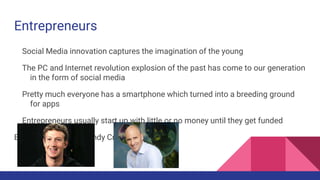
Entrepreneurs usually start up with little or no money until they get funded
Ex: Vine, Snapchat, Candy Crush
Entrepreneurs
Angel Investors and Start-ups
Start-ups “pitch” to investment groups with large sums of money
Risk vs Reward
Must weigh opportunity costs of what else to do with the money in case things
don’t work out
Start ups either issue public stock or sell out to a larger corporation
https://www.youtube.com/watch?v=N6Zz-Nkkaxc
Big Ideas & Business
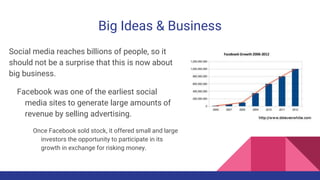
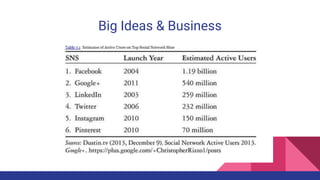
Social media reaches billions of people, so it
should not be a surprise that this is now about
big business.
Facebook was one of the earliest social
media sites to generate large amounts of
revenue by selling advertising.
Once Facebook sold stock, it offered small and large
investors the opportunity to participate in its
growth in exchange for risking money.
Big Ideas & Business
Crush It and the Thank You Economy
Gary Vaynerchuk was an early adopter of social media
platforms as a way to build brand identity. Vaynerchuk
reflected the entrepreneurial spirit embodied in the social
media shift.
The Internet lowered the entry barriers to monetizing.
Crush It and the Thank You Economy
Social media communication ushered in an era in which entrepreneurs
comfortable in social media spaces may be able to skyrocket in popularity and
become a rock star within the innovation culture.
This generates interest in potential funding of new ideas.
Crowdfunding
Relatively new way to fund a startup is by going to the public and using the
internet interest rather than angel investment. A social media start-up can capture
the interest of thousands of small investors through viral media rather than risking
the idea on an investment group that may want to control it.
Kickstarter.com pioneered the idea.
Emergence of New and Mobile Media
Researchers are starting to to take on the task of
understanding mobile access and use.
In South Korea, it’s possible to predict mobile
divides by measuring demographic and skill
variables.
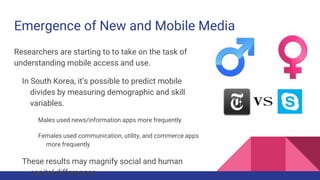
Males used news/information apps more frequently
Females used communication, utility, and commerce apps
more frequently
These results may magnify social and human
capital differences.
Emergence of New and Mobile Media (con’t…)
Social media is also beginning to drive mobile
video viewing.
67% of users found videos to watch through
social sharing
41% of survey respondents use search engines
to watch videos
35% of users watch videos on mobile devices
U.S. men more likely to watch mobile video
Implications of Revolutionary Mobile and Social
Media
The heart of social and mobile media are relationships, social
ties, social capital and motivation.
Social interaction, shared values and trust are important
predictors of future use.
There’s a complex process involving structure, cognition and
relational aspects.
President Obama was one of the first politicians to utilize the
power of social and mobile with a campaign app
The app tracked calls in which users were urged to encourage friends to
vote on election day
Implications of Revolutionary Mobile and Social
Media (con’t…)
It’s suggested that Facebook may fill a void in face-to-face conversation lost for social
or political reasons.
Online social networks may allow us to visualize “clear patterns” of affiliation and
communication.
Mobile and social media developed new media channels created and maintained by
new players (i.e Twitter functions with low bandwidth availability unlike Facebook).
Mobile apps VS Newspaper, Magazines & Books: smartphones and tablets offer more
options and extremely current content.
Social and mobile media used as tools of mobilization, revolution and international
awareness
Twitter Impact
Twitter can be a beneficial tool
By using popular hashtags and phrases they can stay on top of what people are
saying about their brand
One-on-one interactions
Be mindful
Mobile Geotagging
What is mobile geotagging?
Mobile geotagging is a function, where GPS-enabled devices can insert metadata
with geographical information (coordinates) into a file such as photo, associating
it with the geographic location it was taken at.
Benefits?
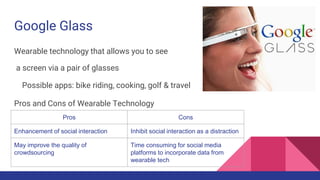
Google Glass
Wearable technology that allows you to see
a screen via a pair of glasses
Possible apps: bike riding, cooking, golf & travel
Pros and Cons of Wearable Technology
Pros Cons
Enhancement of social interaction Inhibit social interaction as a distraction
May improve the quality of
crowdsourcing
Time consuming for social media
platforms to incorporate data from
wearable tech
Discussion Questions: Strategies and Tactics
1. How is the push toward technological innovation changing your
life? How do you think it may impact work during your career?
2. What are the challenges of connecting mobile technologies to
social media communication?
3. What are the privacy concerns about geolocation and tagging
mobile social media services? How do you think these services
and concerns will evolve in the future?

Chapter7 Social Media

  • 1.
  • 2.
    Social Media innovationcaptures the imagination of the young The PC and Internet revolution explosion of the past has come to our generation in the form of social media Pretty much everyone has a smartphone which turned into a breeding ground for apps Entrepreneurs usually start up with little or no money until they get funded Ex: Vine, Snapchat, Candy Crush Entrepreneurs
  • 3.
    Angel Investors andStart-ups Start-ups “pitch” to investment groups with large sums of money Risk vs Reward Must weigh opportunity costs of what else to do with the money in case things don’t work out Start ups either issue public stock or sell out to a larger corporation https://www.youtube.com/watch?v=N6Zz-Nkkaxc
  • 4.
    Big Ideas &Business Social media reaches billions of people, so it should not be a surprise that this is now about big business. Facebook was one of the earliest social media sites to generate large amounts of revenue by selling advertising. Once Facebook sold stock, it offered small and large investors the opportunity to participate in its growth in exchange for risking money.
  • 5.
    Big Ideas &Business
  • 6.
    Crush It andthe Thank You Economy Gary Vaynerchuk was an early adopter of social media platforms as a way to build brand identity. Vaynerchuk reflected the entrepreneurial spirit embodied in the social media shift. The Internet lowered the entry barriers to monetizing.
  • 7.
    Crush It andthe Thank You Economy Social media communication ushered in an era in which entrepreneurs comfortable in social media spaces may be able to skyrocket in popularity and become a rock star within the innovation culture. This generates interest in potential funding of new ideas.
  • 8.
    Crowdfunding Relatively new wayto fund a startup is by going to the public and using the internet interest rather than angel investment. A social media start-up can capture the interest of thousands of small investors through viral media rather than risking the idea on an investment group that may want to control it. Kickstarter.com pioneered the idea.
  • 9.
    Emergence of Newand Mobile Media Researchers are starting to to take on the task of understanding mobile access and use. In South Korea, it’s possible to predict mobile divides by measuring demographic and skill variables. Males used news/information apps more frequently Females used communication, utility, and commerce apps more frequently These results may magnify social and human capital differences.
  • 10.
    Emergence of Newand Mobile Media (con’t…) Social media is also beginning to drive mobile video viewing. 67% of users found videos to watch through social sharing 41% of survey respondents use search engines to watch videos 35% of users watch videos on mobile devices U.S. men more likely to watch mobile video
  • 11.
    Implications of RevolutionaryMobile and Social Media The heart of social and mobile media are relationships, social ties, social capital and motivation. Social interaction, shared values and trust are important predictors of future use. There’s a complex process involving structure, cognition and relational aspects. President Obama was one of the first politicians to utilize the power of social and mobile with a campaign app The app tracked calls in which users were urged to encourage friends to vote on election day
  • 12.
    Implications of RevolutionaryMobile and Social Media (con’t…) It’s suggested that Facebook may fill a void in face-to-face conversation lost for social or political reasons. Online social networks may allow us to visualize “clear patterns” of affiliation and communication. Mobile and social media developed new media channels created and maintained by new players (i.e Twitter functions with low bandwidth availability unlike Facebook). Mobile apps VS Newspaper, Magazines & Books: smartphones and tablets offer more options and extremely current content. Social and mobile media used as tools of mobilization, revolution and international awareness
  • 13.
    Twitter Impact Twitter canbe a beneficial tool By using popular hashtags and phrases they can stay on top of what people are saying about their brand One-on-one interactions Be mindful
  • 14.
    Mobile Geotagging What ismobile geotagging? Mobile geotagging is a function, where GPS-enabled devices can insert metadata with geographical information (coordinates) into a file such as photo, associating it with the geographic location it was taken at. Benefits?
  • 15.
    Google Glass Wearable technologythat allows you to see a screen via a pair of glasses Possible apps: bike riding, cooking, golf & travel Pros and Cons of Wearable Technology Pros Cons Enhancement of social interaction Inhibit social interaction as a distraction May improve the quality of crowdsourcing Time consuming for social media platforms to incorporate data from wearable tech
  • 16.
    Discussion Questions: Strategiesand Tactics 1. How is the push toward technological innovation changing your life? How do you think it may impact work during your career? 2. What are the challenges of connecting mobile technologies to social media communication? 3. What are the privacy concerns about geolocation and tagging mobile social media services? How do you think these services and concerns will evolve in the future?