Chapter 2
Atoms, Molecules,
and Ions
Section 2.1
The Early History of Chemistry
Copyright © Cengage Learning. All rights reserved 2
 Greeks were the first to attempt to explain why
chemical changes occur.
 Alchemy dominated for 2000 years.
 Several elements discovered.
 Mineral acids prepared.
 Robert Boyle was the first “chemist”.
 Performed quantitative experiments.
 Developed first experimental definition of an
element.
Early History of Chemistry
Section 2.2
Fundamental Chemical Laws
Three Important Laws
 Law of conservation of mass (Lavoisier):
 Mass is neither created nor destroyed in a chemical
reaction.
 Law of definite proportion (Proust):
 A given compound always contains exactly the same
proportion of elements by mass.
Copyright © Cengage Learning. All rights reserved 3
Section 2.2
Fundamental Chemical Laws
Three Important Laws (continued)
 Law of multiple proportions (Dalton):
 When two elements form a series of compounds, the
ratios of the masses of the second element that
combine with 1 gram of the first element can always
be reduced to small whole numbers.
Copyright © Cengage Learning. All rights reserved 4
Section 2.3
Dalton’s Atomic Theory
Dalton’s Atomic Theory (1808)
 Each element is made up of tiny particles called atoms.
Copyright © Cengage Learning. All rights reserved 5
Section 2.3
Dalton’s Atomic Theory
Dalton’s Atomic Theory (continued)
 The atoms of a given element are identical; the atoms of
different elements are different in some fundamental
way or ways.
Copyright © Cengage Learning. All rights reserved 6
Section 2.3
Dalton’s Atomic Theory
Dalton’s Atomic Theory (continued)
 Chemical compounds are formed when atoms of
different elements combine with each other. A given
compound always has the same relative numbers and
types of atoms.
Copyright © Cengage Learning. All rights reserved 7
Section 2.3
Dalton’s Atomic Theory
Dalton’s Atomic Theory (continued)
 Chemical reactions involve reorganization of the
atoms—changes in the way they are bound together.
 The atoms themselves are not changed in a chemical
reaction.
Copyright © Cengage Learning. All rights reserved 8
Section 2.4
Early Experiments to Characterize the Atom
J. J. Thomson (1898—1903)
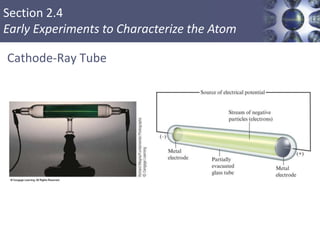
 Postulated the existence of negatively charged particles,
that we now call electrons, using cathode-ray tubes.
 Determined the charge-to-mass ratio of an electron.
 The atom must also contain positive particles that
balance exactly the negative charge carried by
electrons.
Copyright © Cengage Learning. All rights reserved 9
Section 2.4
Early Experiments to Characterize the Atom
Cathode-Ray Tube
Copyright © Cengage Learning. All rights reserved 10
Section 2.4
Early Experiments to Characterize the Atom
Robert Millikan (1909)
 Performed experiments involving charged oil drops.
 Determined the magnitude of the charge on a single
electron.
 Calculated the mass of the electron
 (9.11 × 10⁻³¹ kg).
Copyright © Cengage Learning. All rights reserved 11
Section 2.4
Early Experiments to Characterize the Atom
Henri Becquerel (1896)
 Discovered radioactivity by observing the
spontaneous emission of radiation by uranium.
 Three types of radioactive emission exist:
 Gamma rays (ϒ) – high energy light
 Beta particles (β) – a high speed electron
 Alpha particles (α) – a particle with a 2+ charge
Copyright © Cengage Learning. All rights reserved 12
Section 2.4
Early Experiments to Characterize the Atom
Ernest Rutherford (1911)
 Explained the nuclear atom.
 The atom has a dense center of positive charge called
the nucleus.
 Electrons travel around the nucleus at a large distance
relative to the nucleus.
Copyright © Cengage Learning. All rights reserved 13
Section 2.5
The Modern View of Atomic Structure:
An Introduction
 The atom contains:
 Electrons – found outside the nucleus; negatively
charged.
 Protons – found in the nucleus; positive charge equal
in magnitude to the electron’s negative charge.
 Neutrons – found in the nucleus; no charge; virtually
same mass as a proton.
Copyright © Cengage Learning. All rights reserved 14
Section 2.5
The Modern View of Atomic Structure:
An Introduction
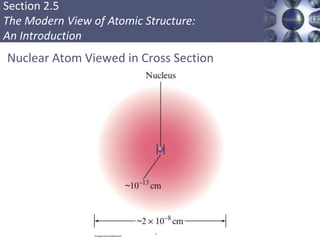
 The nucleus is:
 Small compared with the overall size of the atom.
The volume of nucleus (nuclear volume) is very small
compared to the volume of the atom (atomic
volume); Volume = space occupied.
 Extremely dense; accounts for almost all of the
atom’s mass. Density of the nucleus is much larger
than that of the atom. This is because the masses of
the nucleus and the atom are nearly the same but
their volumes are very different. Since the atomic
volume is much larger than the nuclear volume, the
atomic density is much smaller.
Copyright © Cengage Learning. All rights reserved 15
Section 2.5
The Modern View of Atomic Structure:
An Introduction
Nuclear Atom Viewed in Cross Section
Copyright © Cengage Learning. All rights reserved
Section 2.5
The Modern View of Atomic Structure:
An Introduction
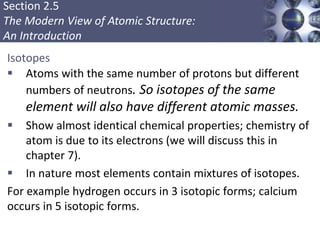
Isotopes
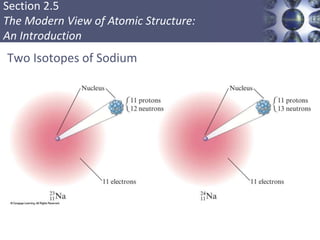
 Atoms with the same number of protons but different
numbers of neutrons. So isotopes of the same
element will also have different atomic masses.
 Show almost identical chemical properties; chemistry of
atom is due to its electrons (we will discuss this in
chapter 7).
 In nature most elements contain mixtures of isotopes.
For example hydrogen occurs in 3 isotopic forms; calcium
occurs in 5 isotopic forms.
Copyright © Cengage Learning. All rights reserved 17
Section 2.5
The Modern View of Atomic Structure:
An Introduction
Two Isotopes of Sodium
Copyright © Cengage Learning. All rights reserved
Section 2.5
The Modern View of Atomic Structure:
An Introduction
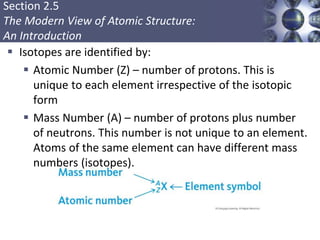
 Isotopes are identified by:
 Atomic Number (Z) – number of protons. This is
unique to each element irrespective of the isotopic
form
 Mass Number (A) – number of protons plus number
of neutrons. This number is not unique to an element.
Atoms of the same element can have different mass
numbers (isotopes).
Copyright © Cengage Learning. All rights reserved 19
Section 2.5
The Modern View of Atomic Structure:
An Introduction
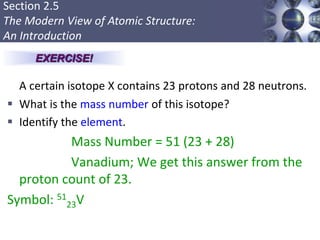
A certain isotope X contains 23 protons and 28 neutrons.
 What is the mass number of this isotope?
 Identify the element.
Mass Number = 51 (23 + 28)
Vanadium; We get this answer from the
proton count of 23.
Symbol: 51
23V
Copyright © Cengage Learning. All rights reserved 20
EXERCISE!
Section 2.6
Molecules and Ions
 Compounds are formed by chemical combinations of
atoms. They are either molecular compounds
(combinations of nonmetals or metalloids & nonmetals)
or they are ionic compounds (combinations of metals &
nonmetals).
 What holds atoms together in a compound are forces
called chemical bonds.
 In a molecular compounds these chemical bonds are
called covalent bonds and in an ionic compound they are
ionic bonds. (bond means attraction)
Copyright © Cengage Learning. All rights reserved 21
Section 2.6
Molecules and Ions
Covalent Bonds
 Covalent Bonds= attractive forces holding atoms
together in molecular (covalent) compounds
 Bonds form between atoms by sharing electrons.
This bond is a sharing of electron pairs between
atoms. (Discussed in detail in chapters 8, 9)
 Resulting collection of atoms is called a molecule.
Section 2.6
Molecules and Ions
Ionic Bonds
 Bonds formed due to force of attraction between
oppositely charged ions = ionic bonds
 Ion – atom or group of atoms that has a net positive
or negative charge.
 Ions may be monoatomic (consisting of a single
atom) or polyatomic (containing more than 1 atom)
 A Cation is a positively charged ion; A monoatomic
caltion is formed when electron(s) is (are) lost.
 An Anion is a negatively ion; A monoatomic anion is
formed when electron (s) is (are) gained.
Copyright © Cengage Learning. All rights reserved 23
Section 2.6
Molecules and Ions
 Metal atoms tend to lose electrons to form
monoatomic cations.
 The charge of cation = the number of electrons lost
 In reactions with metals, nonmetal atoms tend to
gain electrons to form monoatomic anions.
 The charge of the anion = the number of electrons
gained.
 All ionic compounds are charge neutral. They
contain cations & anions. The charge due to the
cations neutralizes the charge due to the anions
Section 2.6
Molecules and Ions
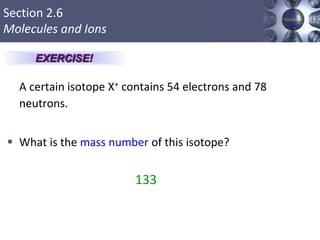
A certain isotope X+ contains 54 electrons and 78
neutrons.
 What is the mass number of this isotope?
133
Copyright © Cengage Learning. All rights reserved 25
EXERCISE!
Section 2.6
Molecules and Ions
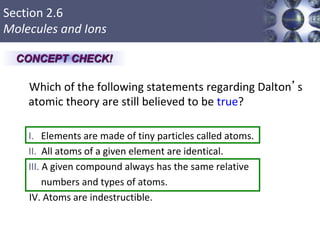
Which of the following statements regarding Dalton’s
atomic theory are still believed to be true?
I. Elements are made of tiny particles called atoms.
II. All atoms of a given element are identical.
III. A given compound always has the same relative
numbers and types of atoms.
IV. Atoms are indestructible.
Copyright © Cengage Learning. All rights reserved 26
CONCEPT CHECK!
Section 2.7
An Introduction to the Periodic Table
The Periodic Table
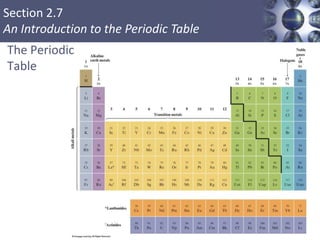
 Metals vs. Nonmetals
 Groups or Families – elements in the same vertical
columns; have similar chemical properties
 Periods – horizontal rows of elements
Copyright © Cengage Learning. All rights reserved 27
Section 2.7
An Introduction to the Periodic Table
The Periodic
Table
Section 2.7
An Introduction to the Periodic Table
Groups or Families
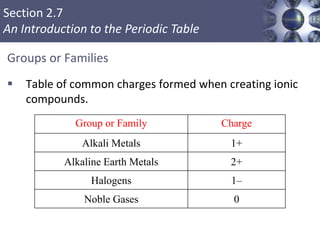
 Table of common charges formed when creating ionic
compounds.
Copyright © Cengage Learning. All rights reserved 29
Group or Family Charge
Alkali Metals 1+
Alkaline Earth Metals 2+
Halogens 1–
Noble Gases 0
Section 2.7
An Introduction to the Periodic Table
Labelling of Groups in Periodic Table
 IUPAC (International Union of Pure & Applied
Chemistry) Scheme: Groups labelled from left to
right from 1 to 18; Alkali metals = group 1; noble
gases = group 18
 North American Scheme: Number from I to VIII
followed by letter A (tall groups), or letter B (short
groups); Alkali metal = group IA; Noble Gases =
Group VIII A.
Section 2.8
Naming Simple Compounds
Naming Compounds: The naming rules depend on the
type of compound
 Binary Compounds
 Composed of two elements
 Ionic and covalent (molecular) compounds included
 Binary Ionic Compounds
 Metal—nonmetal (FeO, Fe2O3)
 Binary Covalent (Molecular) Compounds
 Nonmetal—nonmetal (HCl, Br2O3) or metalloid-
nonmetal (SiCl4)
Copyright © Cengage Learning. All rights reserved 31
Section 2.8
Naming Simple Compounds
Binary Ionic Compounds (Type I)
1. The cation is always named first and the anion second.
2. A monatomic cation takes its name from the name of
the parent element.
3. A monatomic anion is named by taking the root of the
element name and adding –ide.
Copyright © Cengage Learning. All rights reserved 32
Section 2.8
Naming Simple Compounds
Names & Formulas of Monoatomic Anions (Memorize)
 H-: Hydride C-4: Carbide
 F-: Fluoride
 Cl-: Chloride
 Br-: Bromide
 I-: Iodide
 O-2: Oxide
 S-2: Sulfide
 Se-2: Selenide
 N-3: Nitride
 P-3: Phosphide
Section 2.8
Naming Simple Compounds
Naming Cations
 Type I Metal Cations: Cations with fixed charges: Name of
cation = name of element. Example: Na+ = sodium ion;
Ca+2 = calcium ion; Al+3 = Aluminum ion. Alkali metals,
Alkaline earth metals, Al, Zn, Cd, Ag all form only one
cation
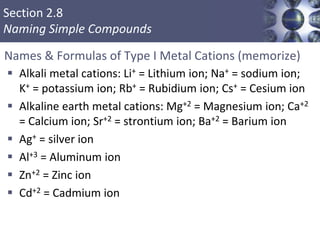
Section 2.8
Naming Simple Compounds
Names & Formulas of Type I Metal Cations (memorize)
 Alkali metal cations: Li+ = Lithium ion; Na+ = sodium ion;
K+ = potassium ion; Rb+ = Rubidium ion; Cs+ = Cesium ion
 Alkaline earth metal cations: Mg+2 = Magnesium ion; Ca+2
= Calcium ion; Sr+2 = strontium ion; Ba+2 = Barium ion
 Ag+ = silver ion
 Al+3 = Aluminum ion
 Zn+2 = Zinc ion
 Cd+2 = Cadmium ion
Section 2.8
Naming Simple Compounds
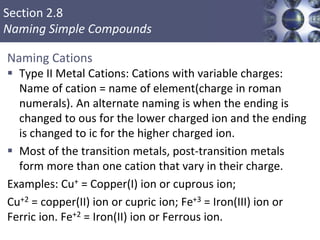
Naming Cations
 Type II Metal Cations: Cations with variable charges:
Name of cation = name of element(charge in roman
numerals). An alternate naming is when the ending is
changed to ous for the lower charged ion and the ending
is changed to ic for the higher charged ion.
 Most of the transition metals, post-transition metals
form more than one cation that vary in their charge.
Examples: Cu+ = Copper(I) ion or cuprous ion;
Cu+2 = copper(II) ion or cupric ion; Fe+3 = Iron(III) ion or
Ferric ion. Fe+2 = Iron(II) ion or Ferrous ion.
Section 2.8
Naming Simple Compounds
Names & Formulas of Type II Metal Cations (memorize)
Cu+ = Copper(I) ion or cuprous ion; Cu+2 = copper(II) ion or
cupric ion;
Fe+2 = Iron(II) ion or Ferrous ion.; Fe+3 = Iron(III) ion or Ferric
ion.
Sn+2 = Tin(II) ion or Stannous ion; Sn+4 = Tin(IV) ion or Stannic
ion.
Pb+2 = Lead(II) ion or Plumbous ion; Pb+4 = lead(IV) ion or
Plumbic ion.
Hg2
+2 = Mercury(I) ion or Mercurous ion; Hg+2 = Mercury(II) ion
or Mercuric ion.
Au+ = Gold(I) ion or Aurous ion; Au+3 = Gold(III) ion or Auric ion.
Section 2.8
Naming Simple Compounds
Formulas of Ionic Compounds
 The formula of an ionic compound is obtained by combining
cation & anion in that ratio that will make it charge neutral.
 If the magnitudes of the charges of the cation and anion
are the same, the ratio of cation:anion in the formula =
1:1
 If the magnitudes of charges of the cation and anion are
different, swap the charges to obtain the ratio of
cation:anion in the formula.
 Formula of cation is written first followed by that of the
anion;
 Do not write the charges of the ions when you write the
formula of the ionic compound
Section 2.8
Naming Simple Compounds
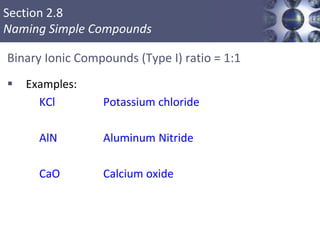
Binary Ionic Compounds (Type I) ratio = 1:1
 Examples:
KCl Potassium chloride
AlN Aluminum Nitride
CaO Calcium oxide
Copyright © Cengage Learning. All rights reserved 39
Section 2.8
Naming Simple Compounds
Binary Ionic Compound (Type I) ratio is not 1:1
 Combining Ag+ & S-2 : Compound formed = Ag2S = silver
sulfide
 Combining Ag+ & P-3 : Compound formed = Ag3P = silver
Phosphide
 Name the compound: Ba3N2: Barium Nitride
 Name the compound: Al2Se3: Aluminum Selenide
Section 2.8
Naming Simple Compounds
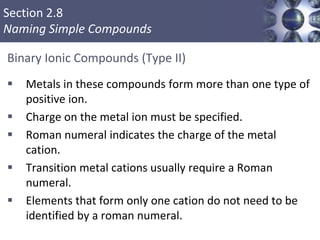
Binary Ionic Compounds (Type II)
 Metals in these compounds form more than one type of
positive ion.
 Charge on the metal ion must be specified.
 Roman numeral indicates the charge of the metal
cation.
 Transition metal cations usually require a Roman
numeral.
 Elements that form only one cation do not need to be
identified by a roman numeral.
Copyright © Cengage Learning. All rights reserved 41
Section 2.8
Naming Simple Compounds
Binary Ionic Compounds (Type II)
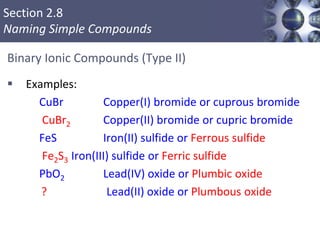
 Examples:
CuBr Copper(I) bromide or cuprous bromide
CuBr2 Copper(II) bromide or cupric bromide
FeS Iron(II) sulfide or Ferrous sulfide
Fe2S3 Iron(III) sulfide or Ferric sulfide
PbO2 Lead(IV) oxide or Plumbic oxide
? Lead(II) oxide or Plumbous oxide
Copyright © Cengage Learning. All rights reserved 42
Section 2.8
Naming Simple Compounds
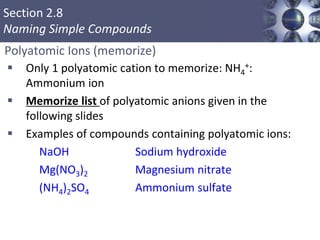
Polyatomic Ions (memorize)
 Only 1 polyatomic cation to memorize: NH4
+:
Ammonium ion
 Memorize list of polyatomic anions given in the
following slides
 Examples of compounds containing polyatomic ions:
NaOH Sodium hydroxide
Mg(NO3)2 Magnesium nitrate
(NH4)2SO4 Ammonium sulfate
Copyright © Cengage Learning. All rights reserved 43
Section 2.8
Naming Simple Compounds
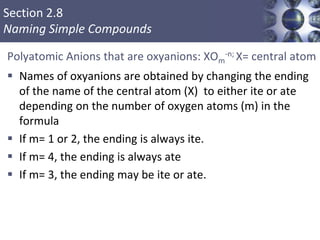
Polyatomic Anions that are oxyanions: XOm
-n; X= central atom
 Names of oxyanions are obtained by changing the ending
of the name of the central atom (X) to either ite or ate
depending on the number of oxygen atoms (m) in the
formula
 If m= 1 or 2, the ending is always ite.
 If m= 4, the ending is always ate
 If m= 3, the ending may be ite or ate.
Section 2.8
Naming Simple Compounds
Partial list of Oxyanions (memorize)
 CO3
-2: Carbonate
 NO3
-: Nitrate; NO2
-: Nitrite
 SO4
-2: Sulfate; SO3
-2: Sulfite
 PO4
-3: Phosphate; PO3
-3: Phosphite
 MnO4
-: Permanganate
Section 2.8
Naming Simple Compounds
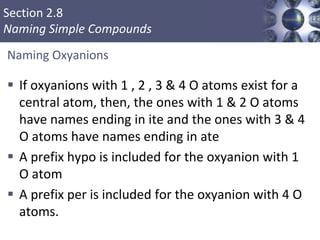
Naming Oxyanions
 If oxyanions with 1 , 2 , 3 & 4 O atoms exist for a
central atom, then, the ones with 1 & 2 O atoms
have names ending in ite and the ones with 3 & 4
O atoms have names ending in ate
 A prefix hypo is included for the oxyanion with 1
O atom
 A prefix per is included for the oxyanion with 4 O
atoms.
Section 2.8
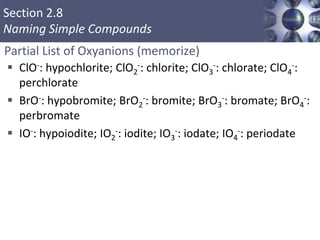
Naming Simple Compounds
Partial List of Oxyanions (memorize)
 ClO-: hypochlorite; ClO2
-: chlorite; ClO3
-: chlorate; ClO4
-:
perchlorate
 BrO-: hypobromite; BrO2
-: bromite; BrO3
-: bromate; BrO4
-:
perbromate
 IO-: hypoiodite; IO2
-: iodite; IO3
-: iodate; IO4
-: periodate
Section 2.8
Naming Simple Compounds
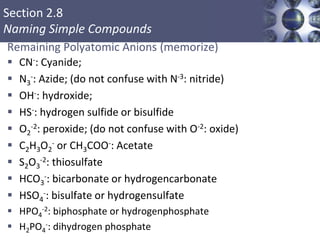
Remaining Polyatomic Anions (memorize)
 CN-: Cyanide;
 N3
-: Azide; (do not confuse with N-3: nitride)
 OH-: hydroxide;
 HS-: hydrogen sulfide or bisulfide
 O2
-2: peroxide; (do not confuse with O-2: oxide)
 C2H3O2
- or CH3COO-: Acetate
 S2O3
-2: thiosulfate
 HCO3
-: bicarbonate or hydrogencarbonate
 HSO4
-: bisulfate or hydrogensulfate
 HPO4
-2: biphosphate or hydrogenphosphate
 H2PO4
-: dihydrogen phosphate
Section 2.8
Naming Simple Compounds
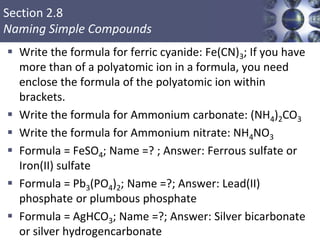
 Write the formula for ferric cyanide: Fe(CN)3; If you have
more than of a polyatomic ion in a formula, you need
enclose the formula of the polyatomic ion within
brackets.
 Write the formula for Ammonium carbonate: (NH4)2CO3
 Write the formula for Ammonium nitrate: NH4NO3
 Formula = FeSO4; Name =? ; Answer: Ferrous sulfate or
Iron(II) sulfate
 Formula = Pb3(PO4)2; Name =?; Answer: Lead(II)
phosphate or plumbous phosphate
 Formula = AgHCO3; Name =?; Answer: Silver bicarbonate
or silver hydrogencarbonate
Section 2.8
Naming Simple Compounds
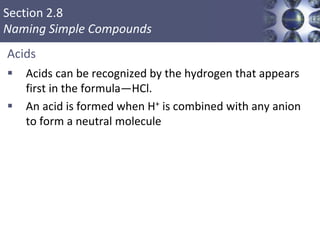
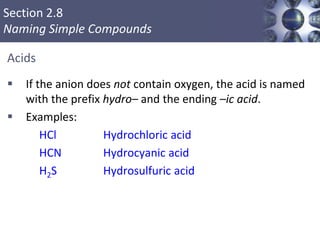
Acids
 Acids can be recognized by the hydrogen that appears
first in the formula—HCl.
 An acid is formed when H+ is combined with any anion
to form a neutral molecule
Copyright © Cengage Learning. All rights reserved 50
Section 2.8
Naming Simple Compounds
Acids
 If the anion does not contain oxygen, the acid is named
with the prefix hydro– and the ending –ic acid.
 Examples:
HCl Hydrochloric acid
HCN Hydrocyanic acid
H2S Hydrosulfuric acid
Copyright © Cengage Learning. All rights reserved 51
Section 2.8
Naming Simple Compounds
Acids
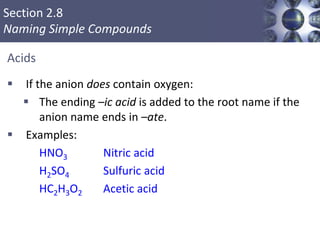
 If the anion does contain oxygen:
 The ending –ic acid is added to the root name if the
anion name ends in –ate.
 Examples:
HNO3 Nitric acid
H2SO4 Sulfuric acid
HC2H3O2 Acetic acid
Copyright © Cengage Learning. All rights reserved 52
Section 2.8
Naming Simple Compounds
Acids
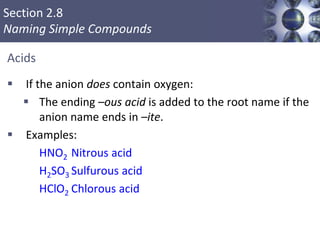
 If the anion does contain oxygen:
 The ending –ous acid is added to the root name if the
anion name ends in –ite.
 Examples:
HNO2 Nitrous acid
H2SO3 Sulfurous acid
HClO2 Chlorous acid
Copyright © Cengage Learning. All rights reserved 53
Section 2.8
Naming Simple Compounds
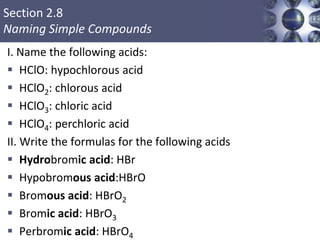
I. Name the following acids:
 HClO: hypochlorous acid
 HClO2: chlorous acid
 HClO3: chloric acid
 HClO4: perchloric acid
II. Write the formulas for the following acids
 Hydrobromic acid: HBr
 Hypobromous acid:HBrO
 Bromous acid: HBrO2
 Bromic acid: HBrO3
 Perbromic acid: HBrO4
Section 2.8
Naming Simple Compounds
Flowchart for Naming Acids
Copyright © Cengage Learning. All rights reserved
Section 2.8
Naming Simple Compounds
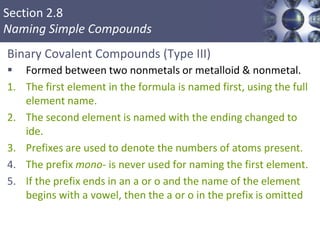
Binary Covalent Compounds (Type III)
 Formed between two nonmetals or metalloid & nonmetal.
1. The first element in the formula is named first, using the full
element name.
2. The second element is named with the ending changed to
ide.
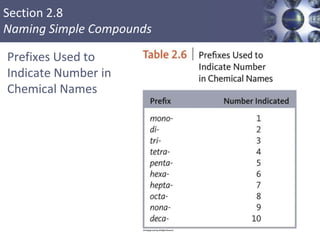
3. Prefixes are used to denote the numbers of atoms present.
4. The prefix mono- is never used for naming the first element.
5. If the prefix ends in an a or o and the name of the element
begins with a vowel, then the a or o in the prefix is omitted
Copyright © Cengage Learning. All rights reserved 56
Section 2.8
Naming Simple Compounds
Prefixes Used to
Indicate Number in
Chemical Names
Copyright © Cengage Learning. All rights reserved 57
Section 2.8
Naming Simple Compounds
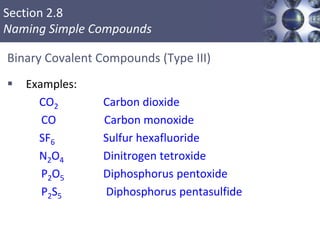
Binary Covalent Compounds (Type III)
 Examples:
CO2 Carbon dioxide
CO Carbon monoxide
SF6 Sulfur hexafluoride
N2O4 Dinitrogen tetroxide
P2O5 Diphosphorus pentoxide
P2S5 Diphosphorus pentasulfide
Copyright © Cengage Learning. All rights reserved 58
Section 2.8
Naming Simple Compounds
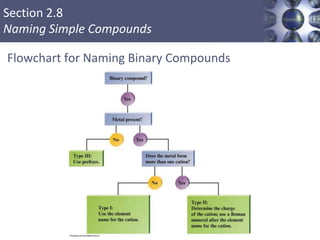
Flowchart for Naming Binary Compounds
Copyright © Cengage Learning. All rights reserved 59
Section 2.8
Naming Simple Compounds
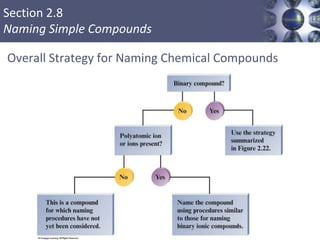
Overall Strategy for Naming Chemical Compounds
Copyright © Cengage Learning. All rights reserved 60
Section 2.8
Naming Simple Compounds
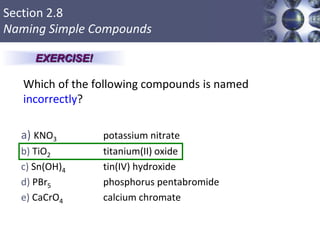
Which of the following compounds is named
incorrectly?
a) KNO3 potassium nitrate
b) TiO2 titanium(II) oxide
c) Sn(OH)4 tin(IV) hydroxide
d) PBr5 phosphorus pentabromide
e) CaCrO4 calcium chromate
Copyright © Cengage Learning. All rights reserved 61
EXERCISE!

chapter2-Atoms-Molecules-Ions.pp chemistry for pharmacyt

  • 1.
  • 2.
    Section 2.1 The EarlyHistory of Chemistry Copyright © Cengage Learning. All rights reserved 2  Greeks were the first to attempt to explain why chemical changes occur.  Alchemy dominated for 2000 years.  Several elements discovered.  Mineral acids prepared.  Robert Boyle was the first “chemist”.  Performed quantitative experiments.  Developed first experimental definition of an element. Early History of Chemistry
  • 3.
    Section 2.2 Fundamental ChemicalLaws Three Important Laws  Law of conservation of mass (Lavoisier):  Mass is neither created nor destroyed in a chemical reaction.  Law of definite proportion (Proust):  A given compound always contains exactly the same proportion of elements by mass. Copyright © Cengage Learning. All rights reserved 3
  • 4.
    Section 2.2 Fundamental ChemicalLaws Three Important Laws (continued)  Law of multiple proportions (Dalton):  When two elements form a series of compounds, the ratios of the masses of the second element that combine with 1 gram of the first element can always be reduced to small whole numbers. Copyright © Cengage Learning. All rights reserved 4
  • 5.
    Section 2.3 Dalton’s AtomicTheory Dalton’s Atomic Theory (1808)  Each element is made up of tiny particles called atoms. Copyright © Cengage Learning. All rights reserved 5
  • 6.
    Section 2.3 Dalton’s AtomicTheory Dalton’s Atomic Theory (continued)  The atoms of a given element are identical; the atoms of different elements are different in some fundamental way or ways. Copyright © Cengage Learning. All rights reserved 6
  • 7.
    Section 2.3 Dalton’s AtomicTheory Dalton’s Atomic Theory (continued)  Chemical compounds are formed when atoms of different elements combine with each other. A given compound always has the same relative numbers and types of atoms. Copyright © Cengage Learning. All rights reserved 7
  • 8.
    Section 2.3 Dalton’s AtomicTheory Dalton’s Atomic Theory (continued)  Chemical reactions involve reorganization of the atoms—changes in the way they are bound together.  The atoms themselves are not changed in a chemical reaction. Copyright © Cengage Learning. All rights reserved 8
  • 9.
    Section 2.4 Early Experimentsto Characterize the Atom J. J. Thomson (1898—1903)  Postulated the existence of negatively charged particles, that we now call electrons, using cathode-ray tubes.  Determined the charge-to-mass ratio of an electron.  The atom must also contain positive particles that balance exactly the negative charge carried by electrons. Copyright © Cengage Learning. All rights reserved 9
  • 10.
    Section 2.4 Early Experimentsto Characterize the Atom Cathode-Ray Tube Copyright © Cengage Learning. All rights reserved 10
  • 11.
    Section 2.4 Early Experimentsto Characterize the Atom Robert Millikan (1909)  Performed experiments involving charged oil drops.  Determined the magnitude of the charge on a single electron.  Calculated the mass of the electron  (9.11 × 10⁻³¹ kg). Copyright © Cengage Learning. All rights reserved 11
  • 12.
    Section 2.4 Early Experimentsto Characterize the Atom Henri Becquerel (1896)  Discovered radioactivity by observing the spontaneous emission of radiation by uranium.  Three types of radioactive emission exist:  Gamma rays (ϒ) – high energy light  Beta particles (β) – a high speed electron  Alpha particles (α) – a particle with a 2+ charge Copyright © Cengage Learning. All rights reserved 12
  • 13.
    Section 2.4 Early Experimentsto Characterize the Atom Ernest Rutherford (1911)  Explained the nuclear atom.  The atom has a dense center of positive charge called the nucleus.  Electrons travel around the nucleus at a large distance relative to the nucleus. Copyright © Cengage Learning. All rights reserved 13
  • 14.
    Section 2.5 The ModernView of Atomic Structure: An Introduction  The atom contains:  Electrons – found outside the nucleus; negatively charged.  Protons – found in the nucleus; positive charge equal in magnitude to the electron’s negative charge.  Neutrons – found in the nucleus; no charge; virtually same mass as a proton. Copyright © Cengage Learning. All rights reserved 14
  • 15.
    Section 2.5 The ModernView of Atomic Structure: An Introduction  The nucleus is:  Small compared with the overall size of the atom. The volume of nucleus (nuclear volume) is very small compared to the volume of the atom (atomic volume); Volume = space occupied.  Extremely dense; accounts for almost all of the atom’s mass. Density of the nucleus is much larger than that of the atom. This is because the masses of the nucleus and the atom are nearly the same but their volumes are very different. Since the atomic volume is much larger than the nuclear volume, the atomic density is much smaller. Copyright © Cengage Learning. All rights reserved 15
  • 16.
    Section 2.5 The ModernView of Atomic Structure: An Introduction Nuclear Atom Viewed in Cross Section Copyright © Cengage Learning. All rights reserved
  • 17.
    Section 2.5 The ModernView of Atomic Structure: An Introduction Isotopes  Atoms with the same number of protons but different numbers of neutrons. So isotopes of the same element will also have different atomic masses.  Show almost identical chemical properties; chemistry of atom is due to its electrons (we will discuss this in chapter 7).  In nature most elements contain mixtures of isotopes. For example hydrogen occurs in 3 isotopic forms; calcium occurs in 5 isotopic forms. Copyright © Cengage Learning. All rights reserved 17
  • 18.
    Section 2.5 The ModernView of Atomic Structure: An Introduction Two Isotopes of Sodium Copyright © Cengage Learning. All rights reserved
  • 19.
    Section 2.5 The ModernView of Atomic Structure: An Introduction  Isotopes are identified by:  Atomic Number (Z) – number of protons. This is unique to each element irrespective of the isotopic form  Mass Number (A) – number of protons plus number of neutrons. This number is not unique to an element. Atoms of the same element can have different mass numbers (isotopes). Copyright © Cengage Learning. All rights reserved 19
  • 20.
    Section 2.5 The ModernView of Atomic Structure: An Introduction A certain isotope X contains 23 protons and 28 neutrons.  What is the mass number of this isotope?  Identify the element. Mass Number = 51 (23 + 28) Vanadium; We get this answer from the proton count of 23. Symbol: 51 23V Copyright © Cengage Learning. All rights reserved 20 EXERCISE!
  • 21.
    Section 2.6 Molecules andIons  Compounds are formed by chemical combinations of atoms. They are either molecular compounds (combinations of nonmetals or metalloids & nonmetals) or they are ionic compounds (combinations of metals & nonmetals).  What holds atoms together in a compound are forces called chemical bonds.  In a molecular compounds these chemical bonds are called covalent bonds and in an ionic compound they are ionic bonds. (bond means attraction) Copyright © Cengage Learning. All rights reserved 21
  • 22.
    Section 2.6 Molecules andIons Covalent Bonds  Covalent Bonds= attractive forces holding atoms together in molecular (covalent) compounds  Bonds form between atoms by sharing electrons. This bond is a sharing of electron pairs between atoms. (Discussed in detail in chapters 8, 9)  Resulting collection of atoms is called a molecule.
  • 23.
    Section 2.6 Molecules andIons Ionic Bonds  Bonds formed due to force of attraction between oppositely charged ions = ionic bonds  Ion – atom or group of atoms that has a net positive or negative charge.  Ions may be monoatomic (consisting of a single atom) or polyatomic (containing more than 1 atom)  A Cation is a positively charged ion; A monoatomic caltion is formed when electron(s) is (are) lost.  An Anion is a negatively ion; A monoatomic anion is formed when electron (s) is (are) gained. Copyright © Cengage Learning. All rights reserved 23
  • 24.
    Section 2.6 Molecules andIons  Metal atoms tend to lose electrons to form monoatomic cations.  The charge of cation = the number of electrons lost  In reactions with metals, nonmetal atoms tend to gain electrons to form monoatomic anions.  The charge of the anion = the number of electrons gained.  All ionic compounds are charge neutral. They contain cations & anions. The charge due to the cations neutralizes the charge due to the anions
  • 25.
    Section 2.6 Molecules andIons A certain isotope X+ contains 54 electrons and 78 neutrons.  What is the mass number of this isotope? 133 Copyright © Cengage Learning. All rights reserved 25 EXERCISE!
  • 26.
    Section 2.6 Molecules andIons Which of the following statements regarding Dalton’s atomic theory are still believed to be true? I. Elements are made of tiny particles called atoms. II. All atoms of a given element are identical. III. A given compound always has the same relative numbers and types of atoms. IV. Atoms are indestructible. Copyright © Cengage Learning. All rights reserved 26 CONCEPT CHECK!
  • 27.
    Section 2.7 An Introductionto the Periodic Table The Periodic Table  Metals vs. Nonmetals  Groups or Families – elements in the same vertical columns; have similar chemical properties  Periods – horizontal rows of elements Copyright © Cengage Learning. All rights reserved 27
  • 28.
    Section 2.7 An Introductionto the Periodic Table The Periodic Table
  • 29.
    Section 2.7 An Introductionto the Periodic Table Groups or Families  Table of common charges formed when creating ionic compounds. Copyright © Cengage Learning. All rights reserved 29 Group or Family Charge Alkali Metals 1+ Alkaline Earth Metals 2+ Halogens 1– Noble Gases 0
  • 30.
    Section 2.7 An Introductionto the Periodic Table Labelling of Groups in Periodic Table  IUPAC (International Union of Pure & Applied Chemistry) Scheme: Groups labelled from left to right from 1 to 18; Alkali metals = group 1; noble gases = group 18  North American Scheme: Number from I to VIII followed by letter A (tall groups), or letter B (short groups); Alkali metal = group IA; Noble Gases = Group VIII A.
  • 31.
    Section 2.8 Naming SimpleCompounds Naming Compounds: The naming rules depend on the type of compound  Binary Compounds  Composed of two elements  Ionic and covalent (molecular) compounds included  Binary Ionic Compounds  Metal—nonmetal (FeO, Fe2O3)  Binary Covalent (Molecular) Compounds  Nonmetal—nonmetal (HCl, Br2O3) or metalloid- nonmetal (SiCl4) Copyright © Cengage Learning. All rights reserved 31
  • 32.
    Section 2.8 Naming SimpleCompounds Binary Ionic Compounds (Type I) 1. The cation is always named first and the anion second. 2. A monatomic cation takes its name from the name of the parent element. 3. A monatomic anion is named by taking the root of the element name and adding –ide. Copyright © Cengage Learning. All rights reserved 32
  • 33.
    Section 2.8 Naming SimpleCompounds Names & Formulas of Monoatomic Anions (Memorize)  H-: Hydride C-4: Carbide  F-: Fluoride  Cl-: Chloride  Br-: Bromide  I-: Iodide  O-2: Oxide  S-2: Sulfide  Se-2: Selenide  N-3: Nitride  P-3: Phosphide
  • 34.
    Section 2.8 Naming SimpleCompounds Naming Cations  Type I Metal Cations: Cations with fixed charges: Name of cation = name of element. Example: Na+ = sodium ion; Ca+2 = calcium ion; Al+3 = Aluminum ion. Alkali metals, Alkaline earth metals, Al, Zn, Cd, Ag all form only one cation
  • 35.
    Section 2.8 Naming SimpleCompounds Names & Formulas of Type I Metal Cations (memorize)  Alkali metal cations: Li+ = Lithium ion; Na+ = sodium ion; K+ = potassium ion; Rb+ = Rubidium ion; Cs+ = Cesium ion  Alkaline earth metal cations: Mg+2 = Magnesium ion; Ca+2 = Calcium ion; Sr+2 = strontium ion; Ba+2 = Barium ion  Ag+ = silver ion  Al+3 = Aluminum ion  Zn+2 = Zinc ion  Cd+2 = Cadmium ion
  • 36.
    Section 2.8 Naming SimpleCompounds Naming Cations  Type II Metal Cations: Cations with variable charges: Name of cation = name of element(charge in roman numerals). An alternate naming is when the ending is changed to ous for the lower charged ion and the ending is changed to ic for the higher charged ion.  Most of the transition metals, post-transition metals form more than one cation that vary in their charge. Examples: Cu+ = Copper(I) ion or cuprous ion; Cu+2 = copper(II) ion or cupric ion; Fe+3 = Iron(III) ion or Ferric ion. Fe+2 = Iron(II) ion or Ferrous ion.
  • 37.
    Section 2.8 Naming SimpleCompounds Names & Formulas of Type II Metal Cations (memorize) Cu+ = Copper(I) ion or cuprous ion; Cu+2 = copper(II) ion or cupric ion; Fe+2 = Iron(II) ion or Ferrous ion.; Fe+3 = Iron(III) ion or Ferric ion. Sn+2 = Tin(II) ion or Stannous ion; Sn+4 = Tin(IV) ion or Stannic ion. Pb+2 = Lead(II) ion or Plumbous ion; Pb+4 = lead(IV) ion or Plumbic ion. Hg2 +2 = Mercury(I) ion or Mercurous ion; Hg+2 = Mercury(II) ion or Mercuric ion. Au+ = Gold(I) ion or Aurous ion; Au+3 = Gold(III) ion or Auric ion.
  • 38.
    Section 2.8 Naming SimpleCompounds Formulas of Ionic Compounds  The formula of an ionic compound is obtained by combining cation & anion in that ratio that will make it charge neutral.  If the magnitudes of the charges of the cation and anion are the same, the ratio of cation:anion in the formula = 1:1  If the magnitudes of charges of the cation and anion are different, swap the charges to obtain the ratio of cation:anion in the formula.  Formula of cation is written first followed by that of the anion;  Do not write the charges of the ions when you write the formula of the ionic compound
  • 39.
    Section 2.8 Naming SimpleCompounds Binary Ionic Compounds (Type I) ratio = 1:1  Examples: KCl Potassium chloride AlN Aluminum Nitride CaO Calcium oxide Copyright © Cengage Learning. All rights reserved 39
  • 40.
    Section 2.8 Naming SimpleCompounds Binary Ionic Compound (Type I) ratio is not 1:1  Combining Ag+ & S-2 : Compound formed = Ag2S = silver sulfide  Combining Ag+ & P-3 : Compound formed = Ag3P = silver Phosphide  Name the compound: Ba3N2: Barium Nitride  Name the compound: Al2Se3: Aluminum Selenide
  • 41.
    Section 2.8 Naming SimpleCompounds Binary Ionic Compounds (Type II)  Metals in these compounds form more than one type of positive ion.  Charge on the metal ion must be specified.  Roman numeral indicates the charge of the metal cation.  Transition metal cations usually require a Roman numeral.  Elements that form only one cation do not need to be identified by a roman numeral. Copyright © Cengage Learning. All rights reserved 41
  • 42.
    Section 2.8 Naming SimpleCompounds Binary Ionic Compounds (Type II)  Examples: CuBr Copper(I) bromide or cuprous bromide CuBr2 Copper(II) bromide or cupric bromide FeS Iron(II) sulfide or Ferrous sulfide Fe2S3 Iron(III) sulfide or Ferric sulfide PbO2 Lead(IV) oxide or Plumbic oxide ? Lead(II) oxide or Plumbous oxide Copyright © Cengage Learning. All rights reserved 42
  • 43.
    Section 2.8 Naming SimpleCompounds Polyatomic Ions (memorize)  Only 1 polyatomic cation to memorize: NH4 +: Ammonium ion  Memorize list of polyatomic anions given in the following slides  Examples of compounds containing polyatomic ions: NaOH Sodium hydroxide Mg(NO3)2 Magnesium nitrate (NH4)2SO4 Ammonium sulfate Copyright © Cengage Learning. All rights reserved 43
  • 44.
    Section 2.8 Naming SimpleCompounds Polyatomic Anions that are oxyanions: XOm -n; X= central atom  Names of oxyanions are obtained by changing the ending of the name of the central atom (X) to either ite or ate depending on the number of oxygen atoms (m) in the formula  If m= 1 or 2, the ending is always ite.  If m= 4, the ending is always ate  If m= 3, the ending may be ite or ate.
  • 45.
    Section 2.8 Naming SimpleCompounds Partial list of Oxyanions (memorize)  CO3 -2: Carbonate  NO3 -: Nitrate; NO2 -: Nitrite  SO4 -2: Sulfate; SO3 -2: Sulfite  PO4 -3: Phosphate; PO3 -3: Phosphite  MnO4 -: Permanganate
  • 46.
    Section 2.8 Naming SimpleCompounds Naming Oxyanions  If oxyanions with 1 , 2 , 3 & 4 O atoms exist for a central atom, then, the ones with 1 & 2 O atoms have names ending in ite and the ones with 3 & 4 O atoms have names ending in ate  A prefix hypo is included for the oxyanion with 1 O atom  A prefix per is included for the oxyanion with 4 O atoms.
  • 47.
    Section 2.8 Naming SimpleCompounds Partial List of Oxyanions (memorize)  ClO-: hypochlorite; ClO2 -: chlorite; ClO3 -: chlorate; ClO4 -: perchlorate  BrO-: hypobromite; BrO2 -: bromite; BrO3 -: bromate; BrO4 -: perbromate  IO-: hypoiodite; IO2 -: iodite; IO3 -: iodate; IO4 -: periodate
  • 48.
    Section 2.8 Naming SimpleCompounds Remaining Polyatomic Anions (memorize)  CN-: Cyanide;  N3 -: Azide; (do not confuse with N-3: nitride)  OH-: hydroxide;  HS-: hydrogen sulfide or bisulfide  O2 -2: peroxide; (do not confuse with O-2: oxide)  C2H3O2 - or CH3COO-: Acetate  S2O3 -2: thiosulfate  HCO3 -: bicarbonate or hydrogencarbonate  HSO4 -: bisulfate or hydrogensulfate  HPO4 -2: biphosphate or hydrogenphosphate  H2PO4 -: dihydrogen phosphate
  • 49.
    Section 2.8 Naming SimpleCompounds  Write the formula for ferric cyanide: Fe(CN)3; If you have more than of a polyatomic ion in a formula, you need enclose the formula of the polyatomic ion within brackets.  Write the formula for Ammonium carbonate: (NH4)2CO3  Write the formula for Ammonium nitrate: NH4NO3  Formula = FeSO4; Name =? ; Answer: Ferrous sulfate or Iron(II) sulfate  Formula = Pb3(PO4)2; Name =?; Answer: Lead(II) phosphate or plumbous phosphate  Formula = AgHCO3; Name =?; Answer: Silver bicarbonate or silver hydrogencarbonate
  • 50.
    Section 2.8 Naming SimpleCompounds Acids  Acids can be recognized by the hydrogen that appears first in the formula—HCl.  An acid is formed when H+ is combined with any anion to form a neutral molecule Copyright © Cengage Learning. All rights reserved 50
  • 51.
    Section 2.8 Naming SimpleCompounds Acids  If the anion does not contain oxygen, the acid is named with the prefix hydro– and the ending –ic acid.  Examples: HCl Hydrochloric acid HCN Hydrocyanic acid H2S Hydrosulfuric acid Copyright © Cengage Learning. All rights reserved 51
  • 52.
    Section 2.8 Naming SimpleCompounds Acids  If the anion does contain oxygen:  The ending –ic acid is added to the root name if the anion name ends in –ate.  Examples: HNO3 Nitric acid H2SO4 Sulfuric acid HC2H3O2 Acetic acid Copyright © Cengage Learning. All rights reserved 52
  • 53.
    Section 2.8 Naming SimpleCompounds Acids  If the anion does contain oxygen:  The ending –ous acid is added to the root name if the anion name ends in –ite.  Examples: HNO2 Nitrous acid H2SO3 Sulfurous acid HClO2 Chlorous acid Copyright © Cengage Learning. All rights reserved 53
  • 54.
    Section 2.8 Naming SimpleCompounds I. Name the following acids:  HClO: hypochlorous acid  HClO2: chlorous acid  HClO3: chloric acid  HClO4: perchloric acid II. Write the formulas for the following acids  Hydrobromic acid: HBr  Hypobromous acid:HBrO  Bromous acid: HBrO2  Bromic acid: HBrO3  Perbromic acid: HBrO4
  • 55.
    Section 2.8 Naming SimpleCompounds Flowchart for Naming Acids Copyright © Cengage Learning. All rights reserved
  • 56.
    Section 2.8 Naming SimpleCompounds Binary Covalent Compounds (Type III)  Formed between two nonmetals or metalloid & nonmetal. 1. The first element in the formula is named first, using the full element name. 2. The second element is named with the ending changed to ide. 3. Prefixes are used to denote the numbers of atoms present. 4. The prefix mono- is never used for naming the first element. 5. If the prefix ends in an a or o and the name of the element begins with a vowel, then the a or o in the prefix is omitted Copyright © Cengage Learning. All rights reserved 56
  • 57.
    Section 2.8 Naming SimpleCompounds Prefixes Used to Indicate Number in Chemical Names Copyright © Cengage Learning. All rights reserved 57
  • 58.
    Section 2.8 Naming SimpleCompounds Binary Covalent Compounds (Type III)  Examples: CO2 Carbon dioxide CO Carbon monoxide SF6 Sulfur hexafluoride N2O4 Dinitrogen tetroxide P2O5 Diphosphorus pentoxide P2S5 Diphosphorus pentasulfide Copyright © Cengage Learning. All rights reserved 58
  • 59.
    Section 2.8 Naming SimpleCompounds Flowchart for Naming Binary Compounds Copyright © Cengage Learning. All rights reserved 59
  • 60.
    Section 2.8 Naming SimpleCompounds Overall Strategy for Naming Chemical Compounds Copyright © Cengage Learning. All rights reserved 60
  • 61.
    Section 2.8 Naming SimpleCompounds Which of the following compounds is named incorrectly? a) KNO3 potassium nitrate b) TiO2 titanium(II) oxide c) Sn(OH)4 tin(IV) hydroxide d) PBr5 phosphorus pentabromide e) CaCrO4 calcium chromate Copyright © Cengage Learning. All rights reserved 61 EXERCISE!