Copyright © 2016 Ramez Elmasri and Shamkant B. Navathe
CHAPTER 17
Indexing Structures for Files and
Physical Database Design
Copyright © 2016 Ramez Elmasri and Shamkant B. Navathe
Introduction
 Indexes used to speed up record retrieval in
response to certain search conditions
 Index structures provide secondary access paths
 Any field can be used to create an index
 Multiple indexes can be constructed
 Most indexes based on ordered files
 Tree data structures organize the index
Slide 17- 3
Copyright © 2016 Ramez Elmasri and Shamkant B. Navathe
17.1 Types of Single-Level Ordered
Indexes
 Ordered index similar to index in a textbook
 Indexing field (attribute)
 Index stores each value of the index field with list
of pointers to all disk blocks that contain records
with that field value
 Values in index are ordered
 Primary index
 Specified on the ordering key field of ordered file
of records
Slide 17- 4
Copyright © 2016 Ramez Elmasri and Shamkant B. Navathe
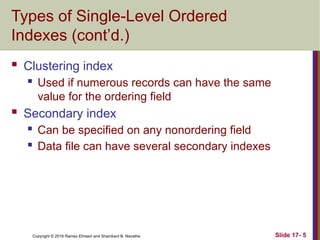
Types of Single-Level Ordered
Indexes (cont’d.)
 Clustering index
 Used if numerous records can have the same
value for the ordering field
 Secondary index
 Can be specified on any nonordering field
 Data file can have several secondary indexes
Slide 17- 5
Copyright © 2016 Ramez Elmasri and Shamkant B. Navathe
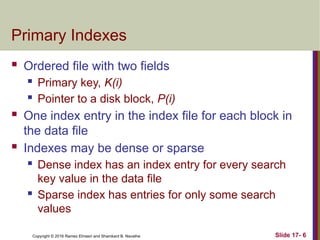
Primary Indexes
 Ordered file with two fields
 Primary key, K(i)
 Pointer to a disk block, P(i)
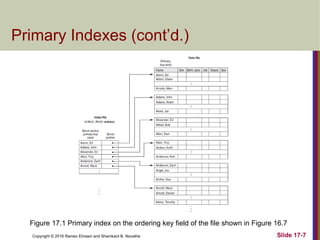
 One index entry in the index file for each block in
the data file
 Indexes may be dense or sparse
 Dense index has an index entry for every search
key value in the data file
 Sparse index has entries for only some search
values
Slide 17- 6
Copyright © 2016 Ramez Elmasri and Shamkant B. Navathe
Primary Indexes (cont’d.)
Slide 17-7
Figure 17.1 Primary index on the ordering key field of the file shown in Figure 16.7
Copyright © 2016 Ramez Elmasri and Shamkant B. Navathe
Primary Indexes (cont’d.)
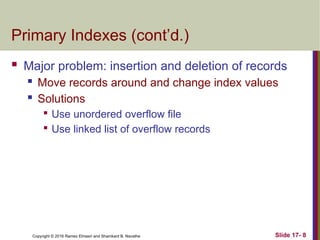
 Major problem: insertion and deletion of records
 Move records around and change index values
 Solutions

Use unordered overflow file

Use linked list of overflow records
Slide 17- 8
Copyright © 2016 Ramez Elmasri and Shamkant B. Navathe
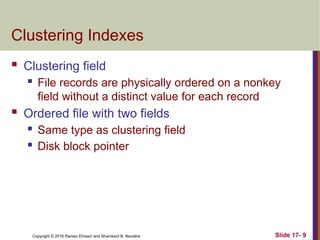
Clustering Indexes
 Clustering field
 File records are physically ordered on a nonkey
field without a distinct value for each record
 Ordered file with two fields
 Same type as clustering field
 Disk block pointer
Slide 17- 9
Copyright © 2016 Ramez Elmasri and Shamkant B. Navathe
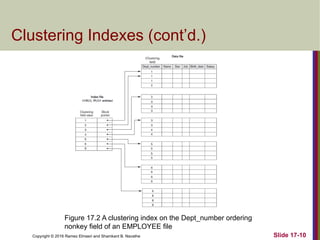
Clustering Indexes (cont’d.)
Slide 17-10
Figure 17.2 A clustering index on the Dept_number ordering
nonkey field of an EMPLOYEE file
Copyright © 2016 Ramez Elmasri and Shamkant B. Navathe
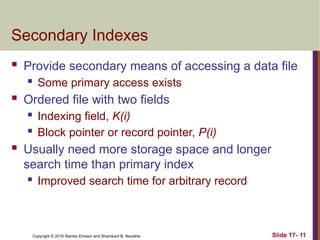
Secondary Indexes
 Provide secondary means of accessing a data file
 Some primary access exists
 Ordered file with two fields
 Indexing field, K(i)
 Block pointer or record pointer, P(i)
 Usually need more storage space and longer
search time than primary index
 Improved search time for arbitrary record
Slide 17- 11
Copyright © 2016 Ramez Elmasri and Shamkant B. Navathe
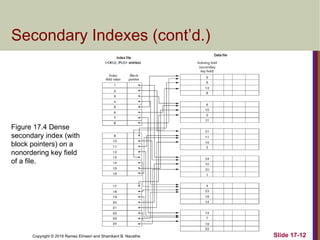
Secondary Indexes (cont’d.)
Slide 17-12
Figure 17.4 Dense
secondary index (with
block pointers) on a
nonordering key field
of a file.
Copyright © 2016 Ramez Elmasri and Shamkant B. Navathe
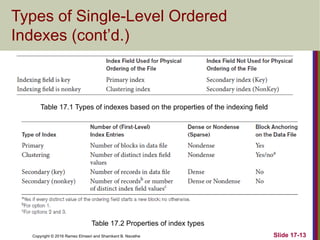
Types of Single-Level Ordered
Indexes (cont’d.)
Slide 17-13
Table 17.1 Types of indexes based on the properties of the indexing field
Table 17.2 Properties of index types
Copyright © 2016 Ramez Elmasri and Shamkant B. Navathe
17.2 Multilevel Indexes
 Designed to greatly reduce remaining search
space as search is conducted
 Index file
 Considered first (or base level) of a multilevel
index
 Second level
 Primary index to the first level
 Third level
 Primary index to the second level
Slide 17- 14
Copyright © 2016 Ramez Elmasri and Shamkant B. Navathe Slide 17-15
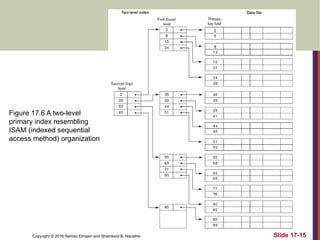
Figure 17.6 A two-level
primary index resembling
ISAM (indexed sequential
access method) organization
Copyright © 2016 Ramez Elmasri and Shamkant B. Navathe
17.3 Dynamic Multilevel Indexes
Using B-Trees and B+ -Trees
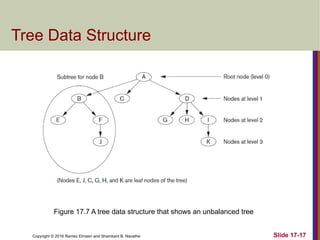
 Tree data structure terminology
 Tree is formed of nodes
 Each node (except root) has one parent and zero
or more child nodes
 Leaf node has no child nodes

Unbalanced if leaf nodes occur at different levels
 Nonleaf node called internal node
 Subtree of node consists of node and all
descendant nodes
Slide 17- 16
Copyright © 2016 Ramez Elmasri and Shamkant B. Navathe
Tree Data Structure
Slide 17-17
Figure 17.7 A tree data structure that shows an unbalanced tree
Copyright © 2016 Ramez Elmasri and Shamkant B. Navathe
Search Trees and B-Trees
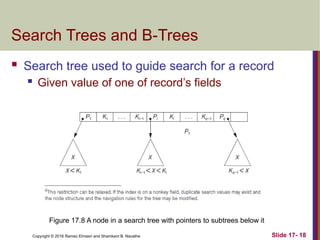
 Search tree used to guide search for a record
 Given value of one of record’s fields
Slide 17- 18
Figure 17.8 A node in a search tree with pointers to subtrees below it
Copyright © 2016 Ramez Elmasri and Shamkant B. Navathe
Search Trees and B-Trees (cont’d.)
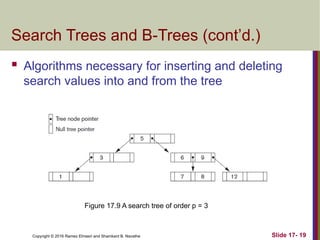
 Algorithms necessary for inserting and deleting
search values into and from the tree
Slide 17- 19
Figure 17.9 A search tree of order p = 3
Copyright © 2016 Ramez Elmasri and Shamkant B. Navathe
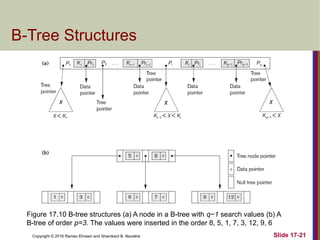
B-Trees
 Provide multi-level access structure
 Tree is always balanced
 Space wasted by deletion never becomes
excessive
 Each node is at least half-full
 Each node in a B-tree of order p can have at
most p-1 search values
Slide 17- 20
Copyright © 2016 Ramez Elmasri and Shamkant B. Navathe
B-Tree Structures
Slide 17-21
Figure 17.10 B-tree structures (a) A node in a B-tree with q−1 search values (b) A
B-tree of order p=3. The values were inserted in the order 8, 5, 1, 7, 3, 12, 9, 6
Copyright © 2016 Ramez Elmasri and Shamkant B. Navathe
B+ -Trees
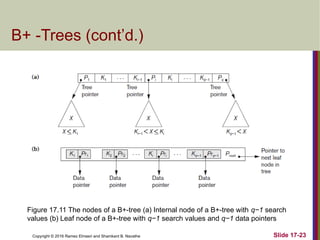
 Data pointers stored only at the leaf nodes
 Leaf nodes have an entry for every value of the
search field, and a data pointer to the record if
search field is a key field
 For a nonkey search field, the pointer points to a
block containing pointers to the data file records
 Internal nodes
 Some search field values from the leaf nodes
repeated to guide search
Slide 17- 22
Copyright © 2016 Ramez Elmasri and Shamkant B. Navathe
B+ -Trees (cont’d.)
Slide 17-23
Figure 17.11 The nodes of a B+-tree (a) Internal node of a B+-tree with q−1 search
values (b) Leaf node of a B+-tree with q−1 search values and q−1 data pointers
Copyright © 2016 Ramez Elmasri and Shamkant B. Navathe
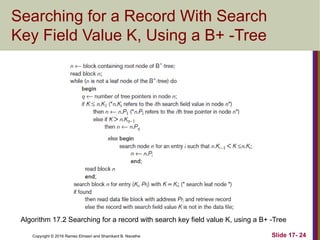
Searching for a Record With Search
Key Field Value K, Using a B+ -Tree
Slide 17- 24
Algorithm 17.2 Searching for a record with search key field value K, using a B+ -Tree
Copyright © 2016 Ramez Elmasri and Shamkant B. Navathe
17.4 Indexes on Multiple Keys
 Multiple attributes involved in many retrieval and
update requests
 Composite keys
 Access structure using key value that combines
attributes
 Partitioned hashing
 Suitable for equality comparisons
Slide 17- 25
Copyright © 2016 Ramez Elmasri and Shamkant B. Navathe
Indexes on Multiple Keys (cont’d.)
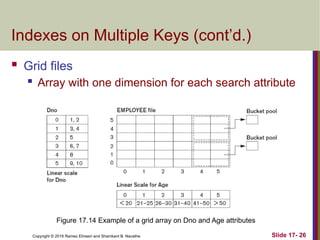
 Grid files
 Array with one dimension for each search attribute
Slide 17- 26
Figure 17.14 Example of a grid array on Dno and Age attributes
Copyright © 2016 Ramez Elmasri and Shamkant B. Navathe
17.5 Other Types of Indexes
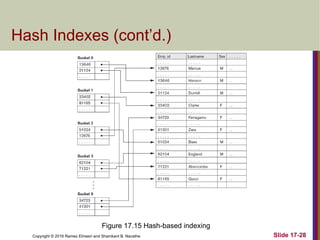
 Hash indexes
 Secondary structure for file access
 Uses hashing on a search key other than the one
used for the primary data file organization
 Index entries of form (K, Pr) or (K, P)
 Pr: pointer to the record containing the key

P: pointer to the block containing the record for that
key
Slide 17- 27
Copyright © 2016 Ramez Elmasri and Shamkant B. Navathe
Hash Indexes (cont’d.)
Slide 17-28
Figure 17.15 Hash-based indexing
Copyright © 2016 Ramez Elmasri and Shamkant B. Navathe
Bitmap Indexes
 Used with a large number of rows
 Creates an index for one or more columns
 Each value or value range in the column is
indexed
 Built on one particular value of a particular field
 Array of bits
 Existence bitmap
 Bitmaps for B+ -tree leaf nodes
Slide 17- 29
Copyright © 2016 Ramez Elmasri and Shamkant B. Navathe
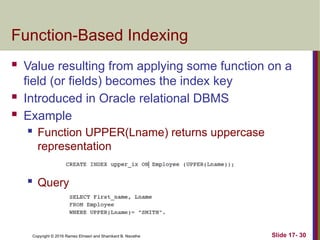
Function-Based Indexing
 Value resulting from applying some function on a
field (or fields) becomes the index key
 Introduced in Oracle relational DBMS
 Example
 Function UPPER(Lname) returns uppercase
representation
 Query
Slide 17- 30
Copyright © 2016 Ramez Elmasri and Shamkant B. Navathe
17.6 Some General Issues
Concerning Indexing
 Physical index
 Pointer specifies physical record address
 Disadvantage: pointer must be changed if record
is moved
 Logical index
 Used when physical record addresses expected to
change frequently
 Entries of the form (K, Kp)
Slide 17- 31
Copyright © 2016 Ramez Elmasri and Shamkant B. Navathe
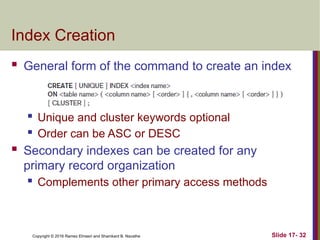
Index Creation
 General form of the command to create an index
 Unique and cluster keywords optional
 Order can be ASC or DESC
 Secondary indexes can be created for any
primary record organization
 Complements other primary access methods
Slide 17- 32
Copyright © 2016 Ramez Elmasri and Shamkant B. Navathe
Indexing of Strings
 Strings can be variable length
 Strings may be too long, limiting the fan-out
 Prefix compression
 Stores only the prefix of the search key adequate
to distinguish the keys that are being separated
and directed to the subtree
Slide 17- 33
Copyright © 2016 Ramez Elmasri and Shamkant B. Navathe
Tuning Indexes
 Tuning goals
 Dynamically evaluate requirements
 Reorganize indexes to yield best performance
 Reasons for revising initial index choice
 Certain queries may take too long to run due to
lack of an index
 Certain indexes may not get utilized
 Certain indexes may undergo too much updating if
based on an attribute that undergoes frequent
changes
Slide 17- 34
Copyright © 2016 Ramez Elmasri and Shamkant B. Navathe
Additional Issues Related to Storage
of Relations and Indexes
 Enforcing a key constraint on an attribute
 Reject insertion if new record has same key
attribute as existing record
 Duplicates occur if index is created on a nonkey
field
 Fully inverted file
 Has secondary index on every field
 Indexing hints in queries
 Suggestions used to expedite query execution
Slide 17- 35
Copyright © 2016 Ramez Elmasri and Shamkant B. Navathe
Additional Issues Related to Storage
of Relations and Indexes (cont’d.)
 Column-based storage of relations
 Alternative to traditional way of storing relations by
row
 Offers advantages for read-only queries
 Offers additional freedom in index creation
Slide 17- 36
Copyright © 2016 Ramez Elmasri and Shamkant B. Navathe
17.7 Physical Database Design in
Relational Databases
 Physical design goals
 Create appropriate structure for data in storage
 Guarantee good performance
 Must know job mix for particular set of database
system applications
 Analyzing the database queries and transactions
 Information about each retrieval query
 Information about each update transaction
Slide 17- 37
Copyright © 2016 Ramez Elmasri and Shamkant B. Navathe
Physical Database Design in
Relational Databases (cont’d.)
 Analyzing the expected frequency of invocation of
queries and transactions
 Expected frequency of using each attribute as a
selection or join attribute
 80-20 rule: 80 percent of processing accounted for
by only 20 percent of queries and transactions
 Analyzing the time constraints of queries and
transactions
 Selection attributes associated with time
constraints are candidates for primary access
structures
Slide 17- 38
Copyright © 2016 Ramez Elmasri and Shamkant B. Navathe
Physical Database Design in
Relational Databases (cont’d.)
 Analyzing the expected frequency of update
operations
 Minimize number of access paths for a frequently-
updated file

Updating the access paths themselves slows down
update operations
 Analyzing the uniqueness constraints on
attributes
 Access paths should be specified on all candidate
key attributes that are either the primary key of a
file or unique attributes
Slide 17- 39
Copyright © 2016 Ramez Elmasri and Shamkant B. Navathe
Physical Database Design Decisions
 Design decisions about indexing
 Whether to index an attribute

Attribute is a key or used by a query
 What attribute(s) to index on

Single or multiple
 Whether to set up a clustered index

One per table
 Whether to use a hash index over a tree index

Hash indexes do not support range queries
 Whether to use dynamic hashing

Appropriate for very volatile files
Slide 17- 40
Copyright © 2016 Ramez Elmasri and Shamkant B. Navathe
17.8 Summary
 Indexes are access structures that improve
efficiency of record retrieval from a data file
 Ordered single-level index types
 Primary, clustering, and secondary
 Multilevel indexes can be implemented as B-trees
and B+ -trees
 Dynamic structures
 Multiple key access methods
 Logical and physical indexes
Slide 17- 41

Chapter17.pptx data base management sysytetem

  • 1.
    Copyright © 2016Ramez Elmasri and Shamkant B. Navathe
  • 2.
    Copyright © 2016Ramez Elmasri and Shamkant B. Navathe CHAPTER 17 Indexing Structures for Files and Physical Database Design
  • 3.
    Copyright © 2016Ramez Elmasri and Shamkant B. Navathe Introduction  Indexes used to speed up record retrieval in response to certain search conditions  Index structures provide secondary access paths  Any field can be used to create an index  Multiple indexes can be constructed  Most indexes based on ordered files  Tree data structures organize the index Slide 17- 3
  • 4.
    Copyright © 2016Ramez Elmasri and Shamkant B. Navathe 17.1 Types of Single-Level Ordered Indexes  Ordered index similar to index in a textbook  Indexing field (attribute)  Index stores each value of the index field with list of pointers to all disk blocks that contain records with that field value  Values in index are ordered  Primary index  Specified on the ordering key field of ordered file of records Slide 17- 4
  • 5.
    Copyright © 2016Ramez Elmasri and Shamkant B. Navathe Types of Single-Level Ordered Indexes (cont’d.)  Clustering index  Used if numerous records can have the same value for the ordering field  Secondary index  Can be specified on any nonordering field  Data file can have several secondary indexes Slide 17- 5
  • 6.
    Copyright © 2016Ramez Elmasri and Shamkant B. Navathe Primary Indexes  Ordered file with two fields  Primary key, K(i)  Pointer to a disk block, P(i)  One index entry in the index file for each block in the data file  Indexes may be dense or sparse  Dense index has an index entry for every search key value in the data file  Sparse index has entries for only some search values Slide 17- 6
  • 7.
    Copyright © 2016Ramez Elmasri and Shamkant B. Navathe Primary Indexes (cont’d.) Slide 17-7 Figure 17.1 Primary index on the ordering key field of the file shown in Figure 16.7
  • 8.
    Copyright © 2016Ramez Elmasri and Shamkant B. Navathe Primary Indexes (cont’d.)  Major problem: insertion and deletion of records  Move records around and change index values  Solutions  Use unordered overflow file  Use linked list of overflow records Slide 17- 8
  • 9.
    Copyright © 2016Ramez Elmasri and Shamkant B. Navathe Clustering Indexes  Clustering field  File records are physically ordered on a nonkey field without a distinct value for each record  Ordered file with two fields  Same type as clustering field  Disk block pointer Slide 17- 9
  • 10.
    Copyright © 2016Ramez Elmasri and Shamkant B. Navathe Clustering Indexes (cont’d.) Slide 17-10 Figure 17.2 A clustering index on the Dept_number ordering nonkey field of an EMPLOYEE file
  • 11.
    Copyright © 2016Ramez Elmasri and Shamkant B. Navathe Secondary Indexes  Provide secondary means of accessing a data file  Some primary access exists  Ordered file with two fields  Indexing field, K(i)  Block pointer or record pointer, P(i)  Usually need more storage space and longer search time than primary index  Improved search time for arbitrary record Slide 17- 11
  • 12.
    Copyright © 2016Ramez Elmasri and Shamkant B. Navathe Secondary Indexes (cont’d.) Slide 17-12 Figure 17.4 Dense secondary index (with block pointers) on a nonordering key field of a file.
  • 13.
    Copyright © 2016Ramez Elmasri and Shamkant B. Navathe Types of Single-Level Ordered Indexes (cont’d.) Slide 17-13 Table 17.1 Types of indexes based on the properties of the indexing field Table 17.2 Properties of index types
  • 14.
    Copyright © 2016Ramez Elmasri and Shamkant B. Navathe 17.2 Multilevel Indexes  Designed to greatly reduce remaining search space as search is conducted  Index file  Considered first (or base level) of a multilevel index  Second level  Primary index to the first level  Third level  Primary index to the second level Slide 17- 14
  • 15.
    Copyright © 2016Ramez Elmasri and Shamkant B. Navathe Slide 17-15 Figure 17.6 A two-level primary index resembling ISAM (indexed sequential access method) organization
  • 16.
    Copyright © 2016Ramez Elmasri and Shamkant B. Navathe 17.3 Dynamic Multilevel Indexes Using B-Trees and B+ -Trees  Tree data structure terminology  Tree is formed of nodes  Each node (except root) has one parent and zero or more child nodes  Leaf node has no child nodes  Unbalanced if leaf nodes occur at different levels  Nonleaf node called internal node  Subtree of node consists of node and all descendant nodes Slide 17- 16
  • 17.
    Copyright © 2016Ramez Elmasri and Shamkant B. Navathe Tree Data Structure Slide 17-17 Figure 17.7 A tree data structure that shows an unbalanced tree
  • 18.
    Copyright © 2016Ramez Elmasri and Shamkant B. Navathe Search Trees and B-Trees  Search tree used to guide search for a record  Given value of one of record’s fields Slide 17- 18 Figure 17.8 A node in a search tree with pointers to subtrees below it
  • 19.
    Copyright © 2016Ramez Elmasri and Shamkant B. Navathe Search Trees and B-Trees (cont’d.)  Algorithms necessary for inserting and deleting search values into and from the tree Slide 17- 19 Figure 17.9 A search tree of order p = 3
  • 20.
    Copyright © 2016Ramez Elmasri and Shamkant B. Navathe B-Trees  Provide multi-level access structure  Tree is always balanced  Space wasted by deletion never becomes excessive  Each node is at least half-full  Each node in a B-tree of order p can have at most p-1 search values Slide 17- 20
  • 21.
    Copyright © 2016Ramez Elmasri and Shamkant B. Navathe B-Tree Structures Slide 17-21 Figure 17.10 B-tree structures (a) A node in a B-tree with q−1 search values (b) A B-tree of order p=3. The values were inserted in the order 8, 5, 1, 7, 3, 12, 9, 6
  • 22.
    Copyright © 2016Ramez Elmasri and Shamkant B. Navathe B+ -Trees  Data pointers stored only at the leaf nodes  Leaf nodes have an entry for every value of the search field, and a data pointer to the record if search field is a key field  For a nonkey search field, the pointer points to a block containing pointers to the data file records  Internal nodes  Some search field values from the leaf nodes repeated to guide search Slide 17- 22
  • 23.
    Copyright © 2016Ramez Elmasri and Shamkant B. Navathe B+ -Trees (cont’d.) Slide 17-23 Figure 17.11 The nodes of a B+-tree (a) Internal node of a B+-tree with q−1 search values (b) Leaf node of a B+-tree with q−1 search values and q−1 data pointers
  • 24.
    Copyright © 2016Ramez Elmasri and Shamkant B. Navathe Searching for a Record With Search Key Field Value K, Using a B+ -Tree Slide 17- 24 Algorithm 17.2 Searching for a record with search key field value K, using a B+ -Tree
  • 25.
    Copyright © 2016Ramez Elmasri and Shamkant B. Navathe 17.4 Indexes on Multiple Keys  Multiple attributes involved in many retrieval and update requests  Composite keys  Access structure using key value that combines attributes  Partitioned hashing  Suitable for equality comparisons Slide 17- 25
  • 26.
    Copyright © 2016Ramez Elmasri and Shamkant B. Navathe Indexes on Multiple Keys (cont’d.)  Grid files  Array with one dimension for each search attribute Slide 17- 26 Figure 17.14 Example of a grid array on Dno and Age attributes
  • 27.
    Copyright © 2016Ramez Elmasri and Shamkant B. Navathe 17.5 Other Types of Indexes  Hash indexes  Secondary structure for file access  Uses hashing on a search key other than the one used for the primary data file organization  Index entries of form (K, Pr) or (K, P)  Pr: pointer to the record containing the key  P: pointer to the block containing the record for that key Slide 17- 27
  • 28.
    Copyright © 2016Ramez Elmasri and Shamkant B. Navathe Hash Indexes (cont’d.) Slide 17-28 Figure 17.15 Hash-based indexing
  • 29.
    Copyright © 2016Ramez Elmasri and Shamkant B. Navathe Bitmap Indexes  Used with a large number of rows  Creates an index for one or more columns  Each value or value range in the column is indexed  Built on one particular value of a particular field  Array of bits  Existence bitmap  Bitmaps for B+ -tree leaf nodes Slide 17- 29
  • 30.
    Copyright © 2016Ramez Elmasri and Shamkant B. Navathe Function-Based Indexing  Value resulting from applying some function on a field (or fields) becomes the index key  Introduced in Oracle relational DBMS  Example  Function UPPER(Lname) returns uppercase representation  Query Slide 17- 30
  • 31.
    Copyright © 2016Ramez Elmasri and Shamkant B. Navathe 17.6 Some General Issues Concerning Indexing  Physical index  Pointer specifies physical record address  Disadvantage: pointer must be changed if record is moved  Logical index  Used when physical record addresses expected to change frequently  Entries of the form (K, Kp) Slide 17- 31
  • 32.
    Copyright © 2016Ramez Elmasri and Shamkant B. Navathe Index Creation  General form of the command to create an index  Unique and cluster keywords optional  Order can be ASC or DESC  Secondary indexes can be created for any primary record organization  Complements other primary access methods Slide 17- 32
  • 33.
    Copyright © 2016Ramez Elmasri and Shamkant B. Navathe Indexing of Strings  Strings can be variable length  Strings may be too long, limiting the fan-out  Prefix compression  Stores only the prefix of the search key adequate to distinguish the keys that are being separated and directed to the subtree Slide 17- 33
  • 34.
    Copyright © 2016Ramez Elmasri and Shamkant B. Navathe Tuning Indexes  Tuning goals  Dynamically evaluate requirements  Reorganize indexes to yield best performance  Reasons for revising initial index choice  Certain queries may take too long to run due to lack of an index  Certain indexes may not get utilized  Certain indexes may undergo too much updating if based on an attribute that undergoes frequent changes Slide 17- 34
  • 35.
    Copyright © 2016Ramez Elmasri and Shamkant B. Navathe Additional Issues Related to Storage of Relations and Indexes  Enforcing a key constraint on an attribute  Reject insertion if new record has same key attribute as existing record  Duplicates occur if index is created on a nonkey field  Fully inverted file  Has secondary index on every field  Indexing hints in queries  Suggestions used to expedite query execution Slide 17- 35
  • 36.
    Copyright © 2016Ramez Elmasri and Shamkant B. Navathe Additional Issues Related to Storage of Relations and Indexes (cont’d.)  Column-based storage of relations  Alternative to traditional way of storing relations by row  Offers advantages for read-only queries  Offers additional freedom in index creation Slide 17- 36
  • 37.
    Copyright © 2016Ramez Elmasri and Shamkant B. Navathe 17.7 Physical Database Design in Relational Databases  Physical design goals  Create appropriate structure for data in storage  Guarantee good performance  Must know job mix for particular set of database system applications  Analyzing the database queries and transactions  Information about each retrieval query  Information about each update transaction Slide 17- 37
  • 38.
    Copyright © 2016Ramez Elmasri and Shamkant B. Navathe Physical Database Design in Relational Databases (cont’d.)  Analyzing the expected frequency of invocation of queries and transactions  Expected frequency of using each attribute as a selection or join attribute  80-20 rule: 80 percent of processing accounted for by only 20 percent of queries and transactions  Analyzing the time constraints of queries and transactions  Selection attributes associated with time constraints are candidates for primary access structures Slide 17- 38
  • 39.
    Copyright © 2016Ramez Elmasri and Shamkant B. Navathe Physical Database Design in Relational Databases (cont’d.)  Analyzing the expected frequency of update operations  Minimize number of access paths for a frequently- updated file  Updating the access paths themselves slows down update operations  Analyzing the uniqueness constraints on attributes  Access paths should be specified on all candidate key attributes that are either the primary key of a file or unique attributes Slide 17- 39
  • 40.
    Copyright © 2016Ramez Elmasri and Shamkant B. Navathe Physical Database Design Decisions  Design decisions about indexing  Whether to index an attribute  Attribute is a key or used by a query  What attribute(s) to index on  Single or multiple  Whether to set up a clustered index  One per table  Whether to use a hash index over a tree index  Hash indexes do not support range queries  Whether to use dynamic hashing  Appropriate for very volatile files Slide 17- 40
  • 41.
    Copyright © 2016Ramez Elmasri and Shamkant B. Navathe 17.8 Summary  Indexes are access structures that improve efficiency of record retrieval from a data file  Ordered single-level index types  Primary, clustering, and secondary  Multilevel indexes can be implemented as B-trees and B+ -trees  Dynamic structures  Multiple key access methods  Logical and physical indexes Slide 17- 41