By: Zainab Almugbel
1
outline
 introduction
 Indexes as Access Paths
 Types of Single-Level Indexes
 Primary Index
 Clustering Index
 Secondary Index
 Multi-Level Indexes
2
Index file definition
Index file structure
3
Indexes as Access Paths
 A single-level index is an auxiliary file that makes it
more efficient to search for a record in the data file.
 The index is usually specified on one field of the file
(although it could be specified on several fields)
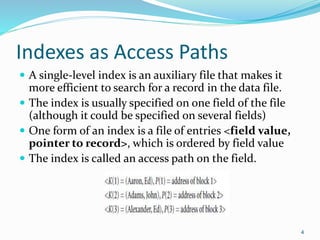
 One form of an index is a file of entries <field value,
pointer to record>, which is ordered by field value
 The index is called an access path on the field.
4
Indexes as Access Paths (cont.)
 The index file usually occupies considerably less disk
blocks than the data file because its entries are much
smaller
 A binary search on the index yields a pointer to the file
record
 Indexes can also be characterized as dense or sparse
 A dense index has an index entry for every search key value
(and hence every record) in the data file.
 A sparse (or nondense) index, on the other hand, has index
entries for only some of the search values
5
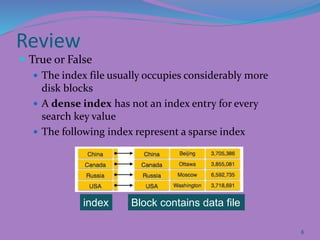
Review
 True or False
 The index file usually occupies considerably more
disk blocks
 A dense index has not an index entry for every
search key value
 The following index represent a sparse index
index Block contains data file
6
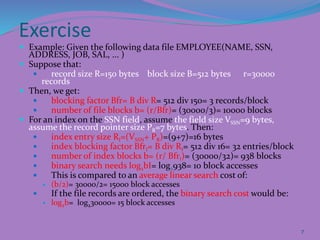
Exercise
 Example: Given the following data file EMPLOYEE(NAME, SSN,
ADDRESS, JOB, SAL, ... )
 Suppose that:
 record size R=150 bytes block size B=512 bytes r=30000
records
 Then, we get:
 blocking factor Bfr= B div R= 512 div 150= 3 records/block
 number of file blocks b= (r/Bfr)= (30000/3)= 10000 blocks
 For an index on the SSN field, assume the field size VSSN=9 bytes,
assume the record pointer size PR=7 bytes. Then:
 index entry size RI=(VSSN+ PR)=(9+7)=16 bytes
 index blocking factor BfrI= B div RI= 512 div 16= 32 entries/block
 number of index blocks b= (r/ BfrI)= (30000/32)= 938 blocks
 binary search needs log2bI= log2938= 10 block accesses
 This is compared to an average linear search cost of:
 (b/2)= 30000/2= 15000 block accesses
 If the file records are ordered, the binary search cost would be:
 log2b= log230000= 15 block accesses
7
Primary Index
Clustering Index
Secondary Index
8
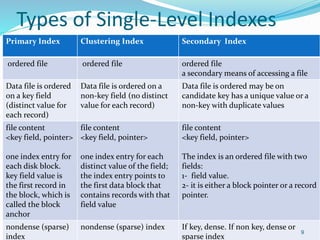
Types of Single-Level Indexes
Primary Index Clustering Index Secondary Index
ordered file ordered file ordered file
a secondary means of accessing a file
Data file is ordered
on a key field
(distinct value for
each record)
Data file is ordered on a
non-key field (no distinct
value for each record)
Data file is ordered may be on
candidate key has a unique value or a
non-key with duplicate values
file content
<key field, pointer>
one index entry for
each disk block.
key field value is
the first record in
the block, which is
called the block
anchor
file content
<key field, pointer>
one index entry for each
distinct value of the field;
the index entry points to
the first data block that
contains records with that
field value
file content
<key field, pointer>
The index is an ordered file with two
fields:
1- field value.
2- it is either a block pointer or a record
pointer.
nondense (sparse)
index
nondense (sparse) index If key, dense. If non key, dense or
sparse index
9
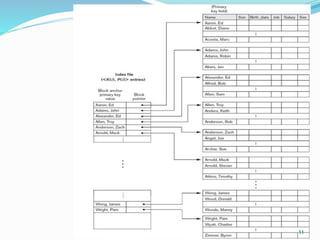
Review
 On the next slides, determine the type of single
level index
10
11
12
13
A Two-Level Primary Index
Dynamic Multilevel Indexes Using B-Trees and B+-Trees
14
Multi-Level Indexes
 Because a single-level index is an ordered file, we can create
a primary index to the index itself;
 In this case, the original index file is called the first-level
index and the index to the index is called the second-level
index.
 We can repeat the process, creating a third, fourth, ..., top
level until all entries of the top level fit in one disk block
 A multi-level index can be created for any type of first-level
index (primary, secondary, clustering) as long as the first-
level index consists of more than one disk block
15
A Two-Level
Primary Index
16
Multi-Level Indexes
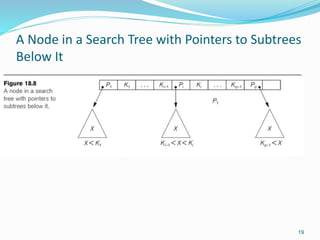
 Such a multi-level index is a form of search tree
 However, insertion and deletion of new index entries is a
severe problem because every level of the index is an
ordered file.
17
Multi-Level Indexes (Cont’d.)
 Tree structure
18
A Node in a Search Tree with Pointers to Subtrees
Below It
19
Dynamic Multilevel Indexes Using B-Trees and B+-
Trees
 Most multi-level indexes use B-tree or B+-tree data
structures because of the insertion and deletion problem
 This leaves space in each tree node (disk block) to allow for
new index entries
 These data structures are variations of search trees that
allow efficient insertion and deletion of new search values.
 In B-Tree and B+-Tree data structures, each node
corresponds to a disk block
 Each node is kept between half-full and completely full
20
Dynamic Multilevel Indexes Using B-Trees and B+-
Trees (cont.)
 An insertion into a node that is not full is quite
efficient
 If a node is full the insertion causes a split into two
nodes
 Splitting may propagate to other tree levels
 A deletion is quite efficient if a node does not become
less than half full
 If a deletion causes a node to become less than half
full, it must be merged with neighboring nodes
21
Difference between B-tree and B+-tree
 In a B-tree, pointers to data records exist at all levels of
the tree
 In a B+-tree, all pointers to data records exists at the
leaf-level nodes
 A B+-tree can have less levels (or higher capacity of
search values) than the corresponding B-tree
22
Similarities between B-tree and B+-tree
 All leaf nodes at the same level
 Nodes contents not less than the half
Example
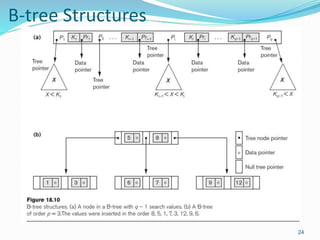
 Using a B-tree index of order p = 3. Insert the
following values in the order 8, 5, 1, 7, 3, 12, 9, 6.
23
Employee id name salary department
8 Saleh 10000 1
5 Ahmed 20000 1
1 Jasem 30000 2
7 Nader 15000 2
3 Saleh 13000 3
12 Waleed 8000 3
9 Salim 11000 4
6 Raed 8000 5
B-tree Structures
24
The Nodes of a B+-tree
25
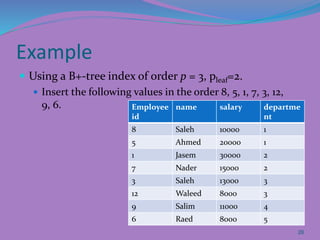
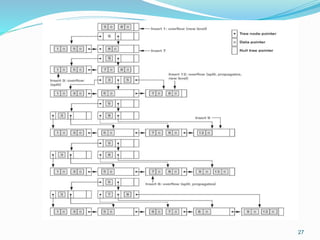
Example
 Using a B+-tree index of order p = 3, pleaf=2.
 Insert the following values in the order 8, 5, 1, 7, 3, 12,
9, 6.
26
Employee
id
name salary departme
nt
8 Saleh 10000 1
5 Ahmed 20000 1
1 Jasem 30000 2
7 Nader 15000 2
3 Saleh 13000 3
12 Waleed 8000 3
9 Salim 11000 4
6 Raed 8000 5
27
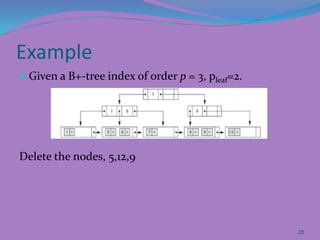
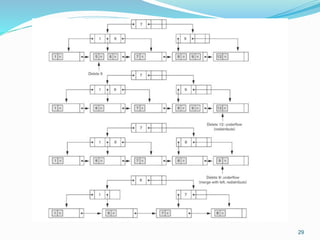
Example
 Given a B+-tree index of order p = 3, pleaf=2.
Delete the nodes, 5,12,9
28
29
Summary
 Types of Single-level Ordered Indexes
 Primary Indexes
 Clustering Indexes
 Secondary Indexes
 Multilevel Indexes
 Dynamic Multilevel Indexes Using B-Trees and B+-
Trees
30

indexingstructureforfiles-160728120658.pdf

  • 1.
  • 2.
    outline  introduction  Indexesas Access Paths  Types of Single-Level Indexes  Primary Index  Clustering Index  Secondary Index  Multi-Level Indexes 2
  • 3.
  • 4.
    Indexes as AccessPaths  A single-level index is an auxiliary file that makes it more efficient to search for a record in the data file.  The index is usually specified on one field of the file (although it could be specified on several fields)  One form of an index is a file of entries <field value, pointer to record>, which is ordered by field value  The index is called an access path on the field. 4
  • 5.
    Indexes as AccessPaths (cont.)  The index file usually occupies considerably less disk blocks than the data file because its entries are much smaller  A binary search on the index yields a pointer to the file record  Indexes can also be characterized as dense or sparse  A dense index has an index entry for every search key value (and hence every record) in the data file.  A sparse (or nondense) index, on the other hand, has index entries for only some of the search values 5
  • 6.
    Review  True orFalse  The index file usually occupies considerably more disk blocks  A dense index has not an index entry for every search key value  The following index represent a sparse index index Block contains data file 6
  • 7.
    Exercise  Example: Giventhe following data file EMPLOYEE(NAME, SSN, ADDRESS, JOB, SAL, ... )  Suppose that:  record size R=150 bytes block size B=512 bytes r=30000 records  Then, we get:  blocking factor Bfr= B div R= 512 div 150= 3 records/block  number of file blocks b= (r/Bfr)= (30000/3)= 10000 blocks  For an index on the SSN field, assume the field size VSSN=9 bytes, assume the record pointer size PR=7 bytes. Then:  index entry size RI=(VSSN+ PR)=(9+7)=16 bytes  index blocking factor BfrI= B div RI= 512 div 16= 32 entries/block  number of index blocks b= (r/ BfrI)= (30000/32)= 938 blocks  binary search needs log2bI= log2938= 10 block accesses  This is compared to an average linear search cost of:  (b/2)= 30000/2= 15000 block accesses  If the file records are ordered, the binary search cost would be:  log2b= log230000= 15 block accesses 7
  • 8.
  • 9.
    Types of Single-LevelIndexes Primary Index Clustering Index Secondary Index ordered file ordered file ordered file a secondary means of accessing a file Data file is ordered on a key field (distinct value for each record) Data file is ordered on a non-key field (no distinct value for each record) Data file is ordered may be on candidate key has a unique value or a non-key with duplicate values file content <key field, pointer> one index entry for each disk block. key field value is the first record in the block, which is called the block anchor file content <key field, pointer> one index entry for each distinct value of the field; the index entry points to the first data block that contains records with that field value file content <key field, pointer> The index is an ordered file with two fields: 1- field value. 2- it is either a block pointer or a record pointer. nondense (sparse) index nondense (sparse) index If key, dense. If non key, dense or sparse index 9
  • 10.
    Review  On thenext slides, determine the type of single level index 10
  • 11.
  • 12.
  • 13.
  • 14.
    A Two-Level PrimaryIndex Dynamic Multilevel Indexes Using B-Trees and B+-Trees 14
  • 15.
    Multi-Level Indexes  Becausea single-level index is an ordered file, we can create a primary index to the index itself;  In this case, the original index file is called the first-level index and the index to the index is called the second-level index.  We can repeat the process, creating a third, fourth, ..., top level until all entries of the top level fit in one disk block  A multi-level index can be created for any type of first-level index (primary, secondary, clustering) as long as the first- level index consists of more than one disk block 15
  • 16.
  • 17.
    Multi-Level Indexes  Sucha multi-level index is a form of search tree  However, insertion and deletion of new index entries is a severe problem because every level of the index is an ordered file. 17
  • 18.
  • 19.
    A Node ina Search Tree with Pointers to Subtrees Below It 19
  • 20.
    Dynamic Multilevel IndexesUsing B-Trees and B+- Trees  Most multi-level indexes use B-tree or B+-tree data structures because of the insertion and deletion problem  This leaves space in each tree node (disk block) to allow for new index entries  These data structures are variations of search trees that allow efficient insertion and deletion of new search values.  In B-Tree and B+-Tree data structures, each node corresponds to a disk block  Each node is kept between half-full and completely full 20
  • 21.
    Dynamic Multilevel IndexesUsing B-Trees and B+- Trees (cont.)  An insertion into a node that is not full is quite efficient  If a node is full the insertion causes a split into two nodes  Splitting may propagate to other tree levels  A deletion is quite efficient if a node does not become less than half full  If a deletion causes a node to become less than half full, it must be merged with neighboring nodes 21
  • 22.
    Difference between B-treeand B+-tree  In a B-tree, pointers to data records exist at all levels of the tree  In a B+-tree, all pointers to data records exists at the leaf-level nodes  A B+-tree can have less levels (or higher capacity of search values) than the corresponding B-tree 22 Similarities between B-tree and B+-tree  All leaf nodes at the same level  Nodes contents not less than the half
  • 23.
    Example  Using aB-tree index of order p = 3. Insert the following values in the order 8, 5, 1, 7, 3, 12, 9, 6. 23 Employee id name salary department 8 Saleh 10000 1 5 Ahmed 20000 1 1 Jasem 30000 2 7 Nader 15000 2 3 Saleh 13000 3 12 Waleed 8000 3 9 Salim 11000 4 6 Raed 8000 5
  • 24.
  • 25.
    The Nodes ofa B+-tree 25
  • 26.
    Example  Using aB+-tree index of order p = 3, pleaf=2.  Insert the following values in the order 8, 5, 1, 7, 3, 12, 9, 6. 26 Employee id name salary departme nt 8 Saleh 10000 1 5 Ahmed 20000 1 1 Jasem 30000 2 7 Nader 15000 2 3 Saleh 13000 3 12 Waleed 8000 3 9 Salim 11000 4 6 Raed 8000 5
  • 27.
  • 28.
    Example  Given aB+-tree index of order p = 3, pleaf=2. Delete the nodes, 5,12,9 28
  • 29.
  • 30.
    Summary  Types ofSingle-level Ordered Indexes  Primary Indexes  Clustering Indexes  Secondary Indexes  Multilevel Indexes  Dynamic Multilevel Indexes Using B-Trees and B+- Trees 30