Copyright © 2016 Ramez Elmasri and Shamkant B. Navathe
Types of Single-Level Ordered
Indexes (cont’d.)
 Clustering index
 Used if numerous records can have the same
value for the ordering field
 Secondary index
 Can be specified on any nonordering field
 Data file can have several secondary indexes
Slide 17- 1
Copyright © 2016 Ramez Elmasri and Shamkant B. Navathe
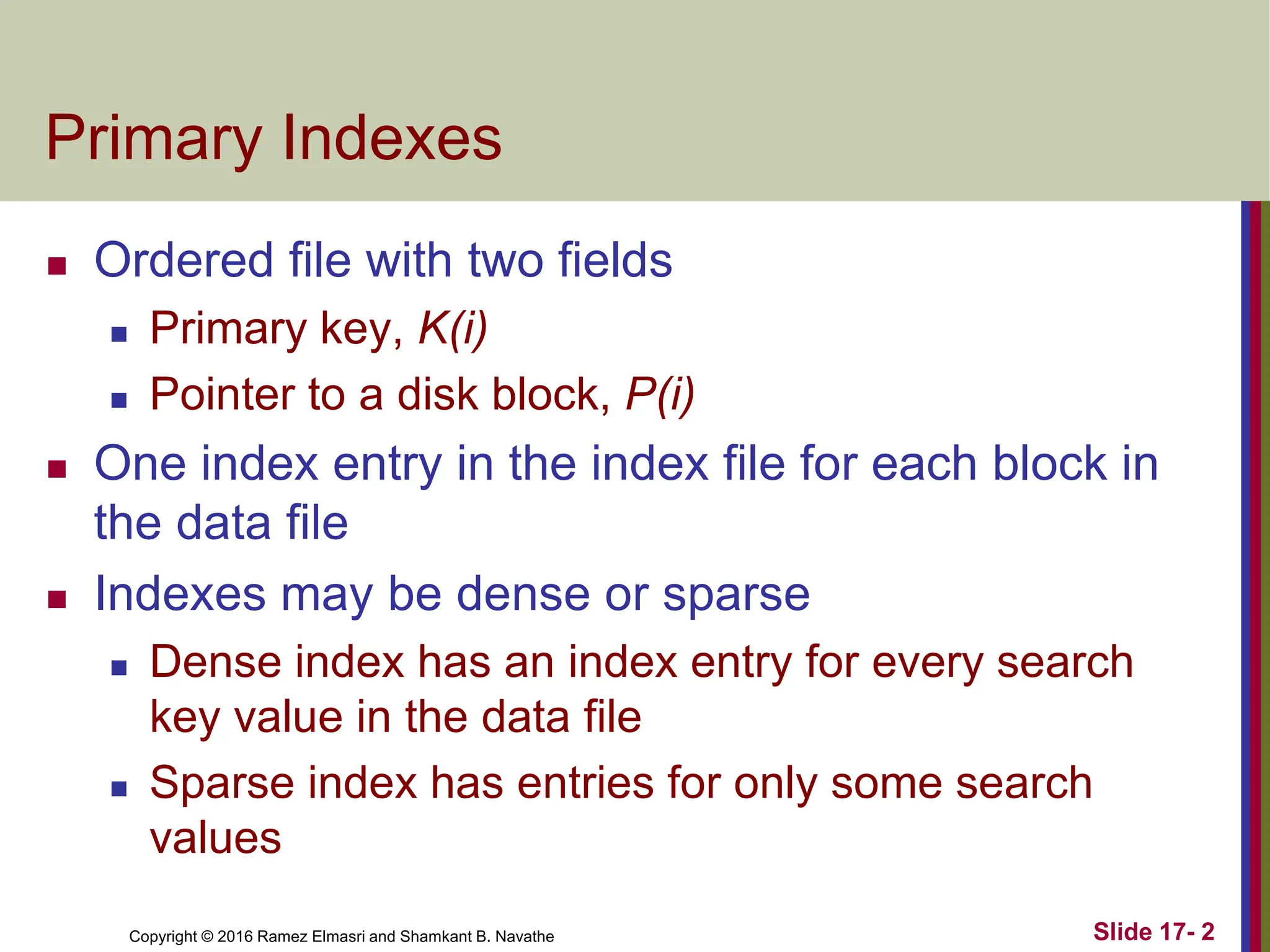
Primary Indexes
 Ordered file with two fields
 Primary key, K(i)
 Pointer to a disk block, P(i)
 One index entry in the index file for each block in
the data file
 Indexes may be dense or sparse
 Dense index has an index entry for every search
key value in the data file
 Sparse index has entries for only some search
values
Slide 17- 2
Copyright © 2016 Ramez Elmasri and Shamkant B. Navathe
Primary Indexes (cont’d.)
Slide 17-3
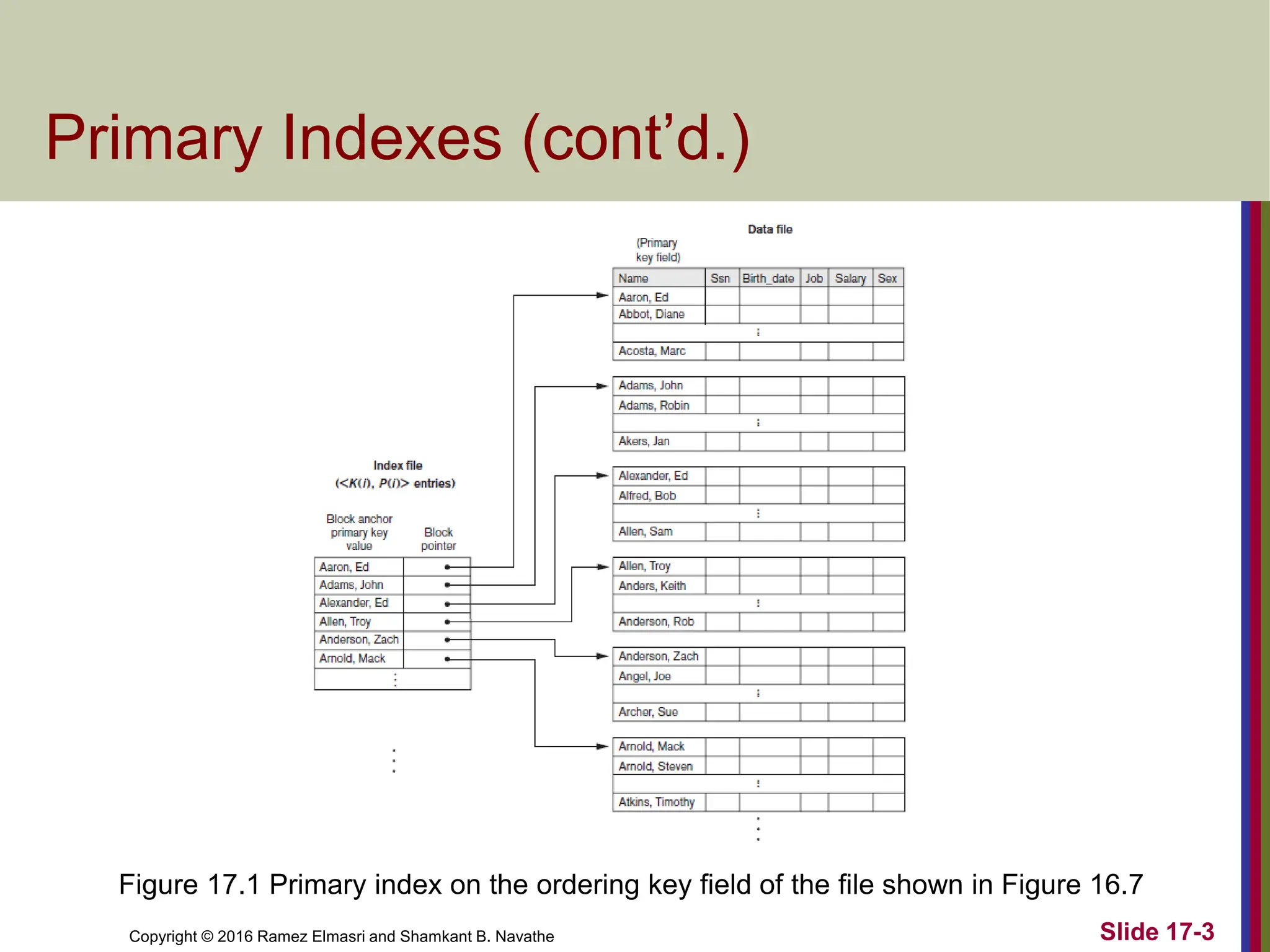
Figure 17.1 Primary index on the ordering key field of the file shown in Figure 16.7
Copyright © 2016 Ramez Elmasri and Shamkant B. Navathe
Clustering Indexes (cont’d.)
Slide 17-4
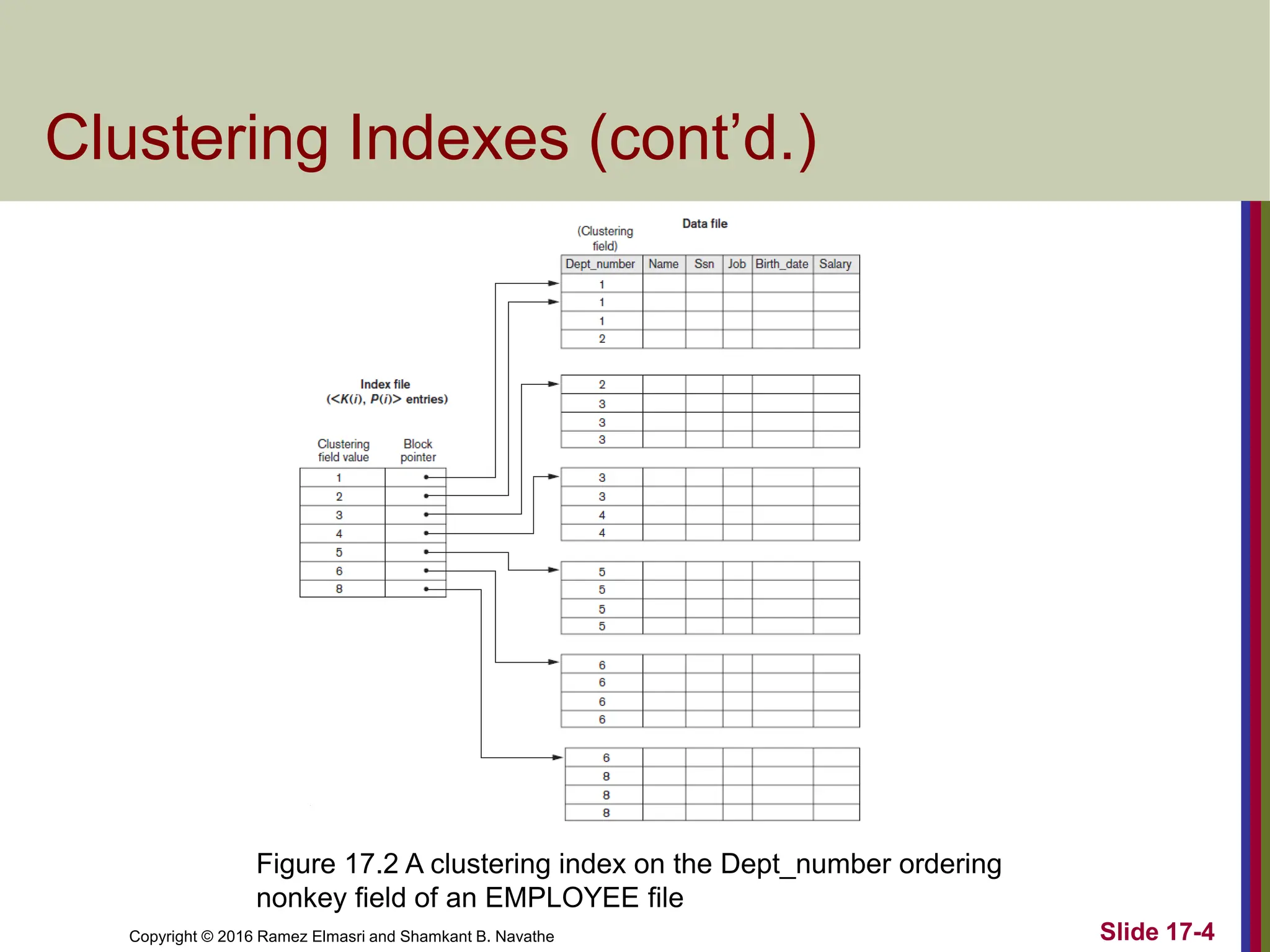
Figure 17.2 A clustering index on the Dept_number ordering
nonkey field of an EMPLOYEE file
Copyright © 2016 Ramez Elmasri and Shamkant B. Navathe
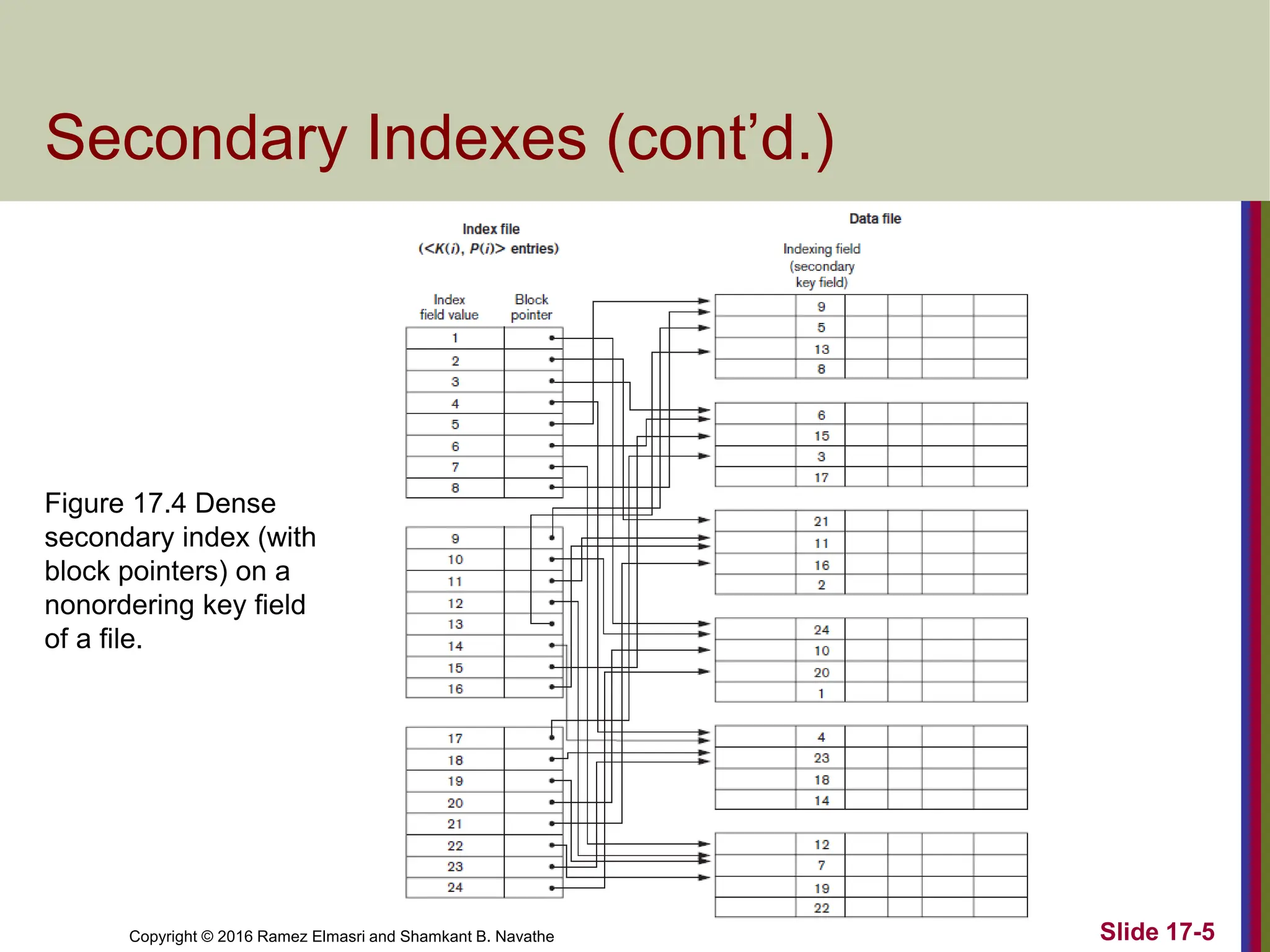
Secondary Indexes (cont’d.)
Slide 17-5
Figure 17.4 Dense
secondary index (with
block pointers) on a
nonordering key field
of a file.
Copyright © 2016 Ramez Elmasri and Shamkant B. Navathe
Types of Single-Level Ordered
Indexes (cont’d.)
Slide 17-6
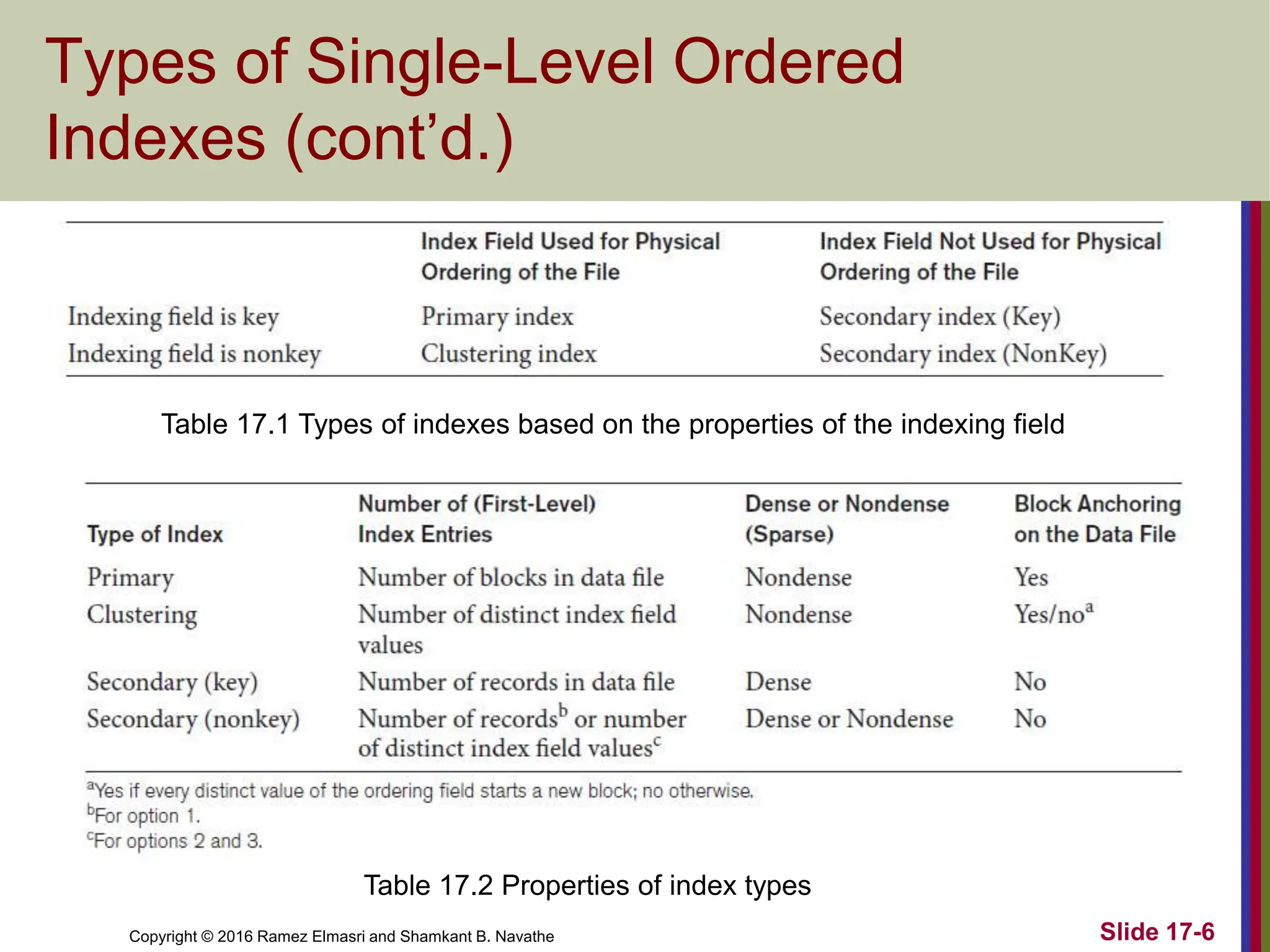
Table 17.1 Types of indexes based on the properties of the indexing field
Table 17.2 Properties of index types
Copyright © 2016 Ramez Elmasri and Shamkant B. Navathe Slide 17-7
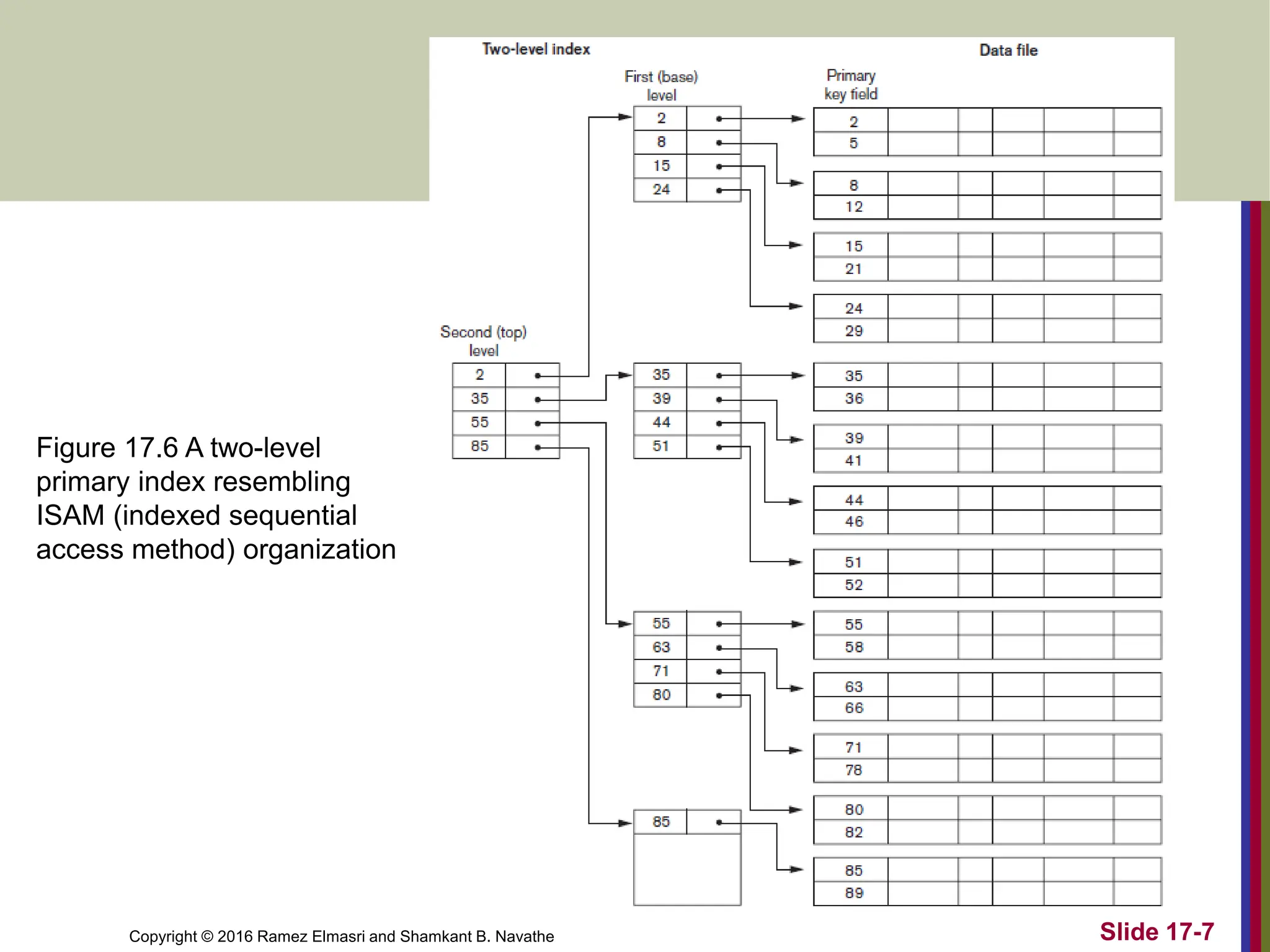
Figure 17.6 A two-level
primary index resembling
ISAM (indexed sequential
access method) organization
Copyright © 2016 Ramez Elmasri and Shamkant B. Navathe
Search Trees and B-Trees (cont’d.)
 Algorithms necessary for inserting and deleting
search values into and from the tree
Slide 17- 8
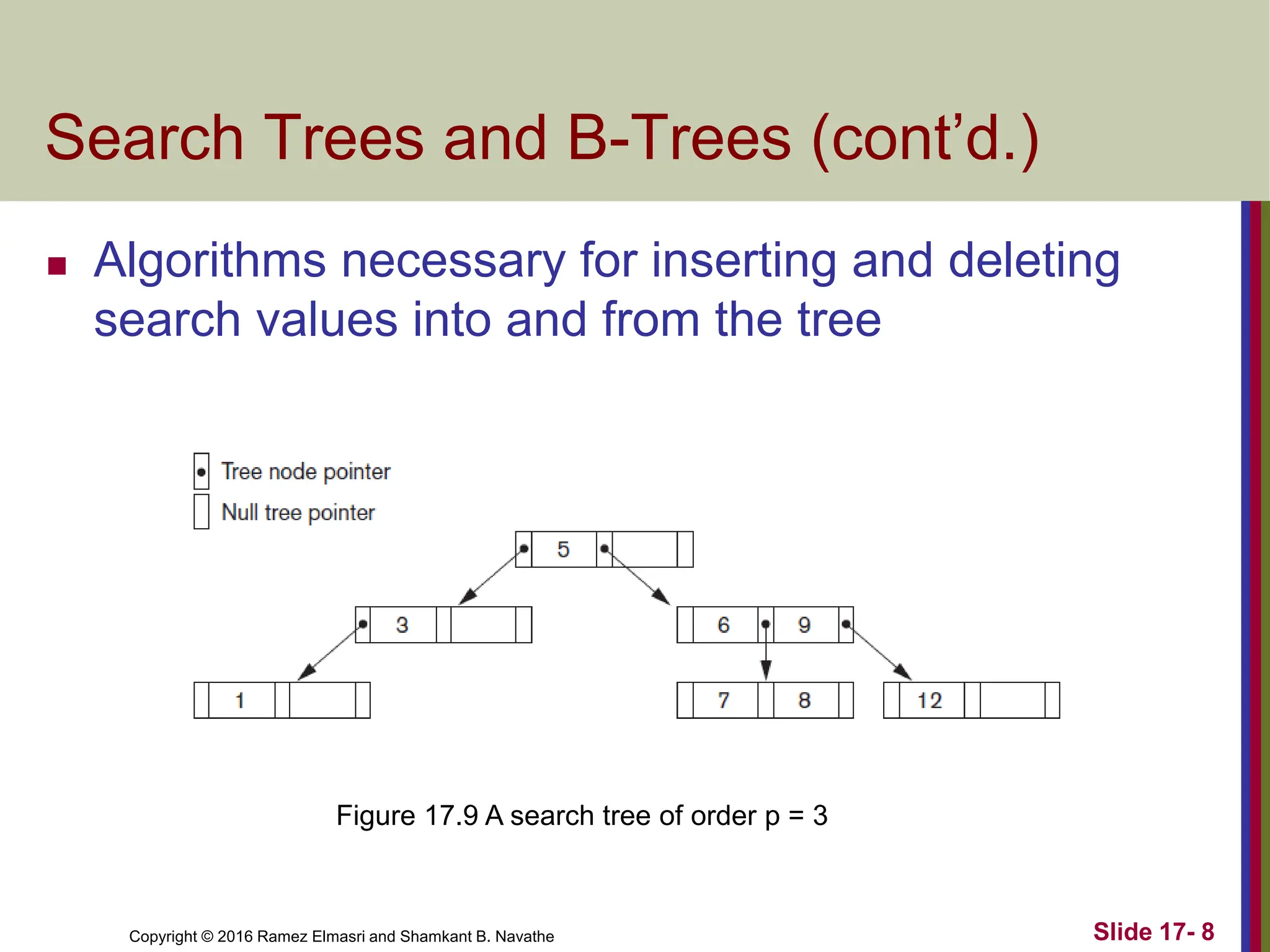
Figure 17.9 A search tree of order p = 3
Copyright © 2016 Ramez Elmasri and Shamkant B. Navathe
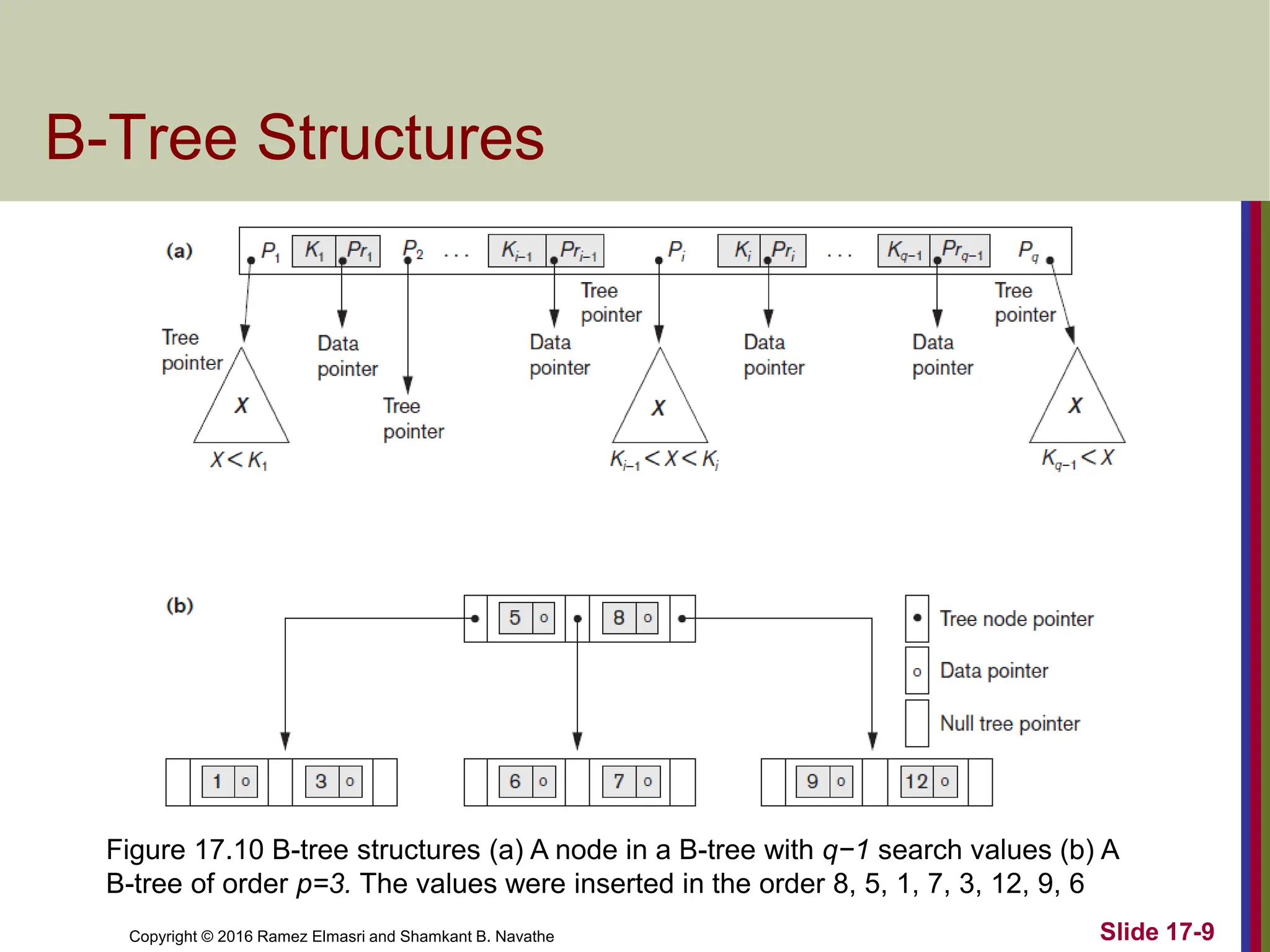
B-Tree Structures
Slide 17-9
Figure 17.10 B-tree structures (a) A node in a B-tree with q−1 search values (b) A
B-tree of order p=3. The values were inserted in the order 8, 5, 1, 7, 3, 12, 9, 6
Copyright © 2016 Ramez Elmasri and Shamkant B. Navathe
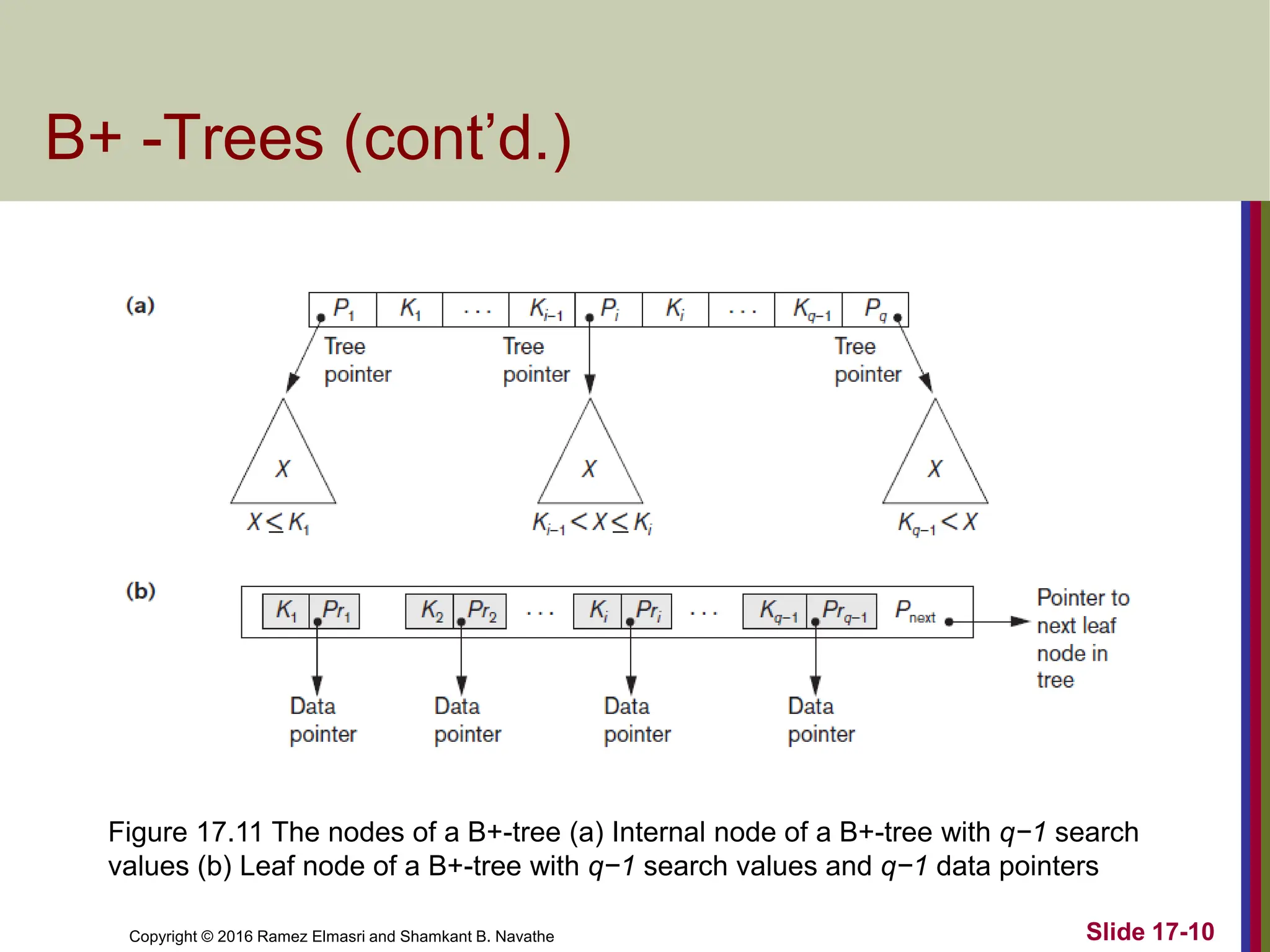
B+ -Trees (cont’d.)
Slide 17-10
Figure 17.11 The nodes of a B+-tree (a) Internal node of a B+-tree with q−1 search
values (b) Leaf node of a B+-tree with q−1 search values and q−1 data pointers
Copyright © 2016 Ramez Elmasri and Shamkant B. Navathe
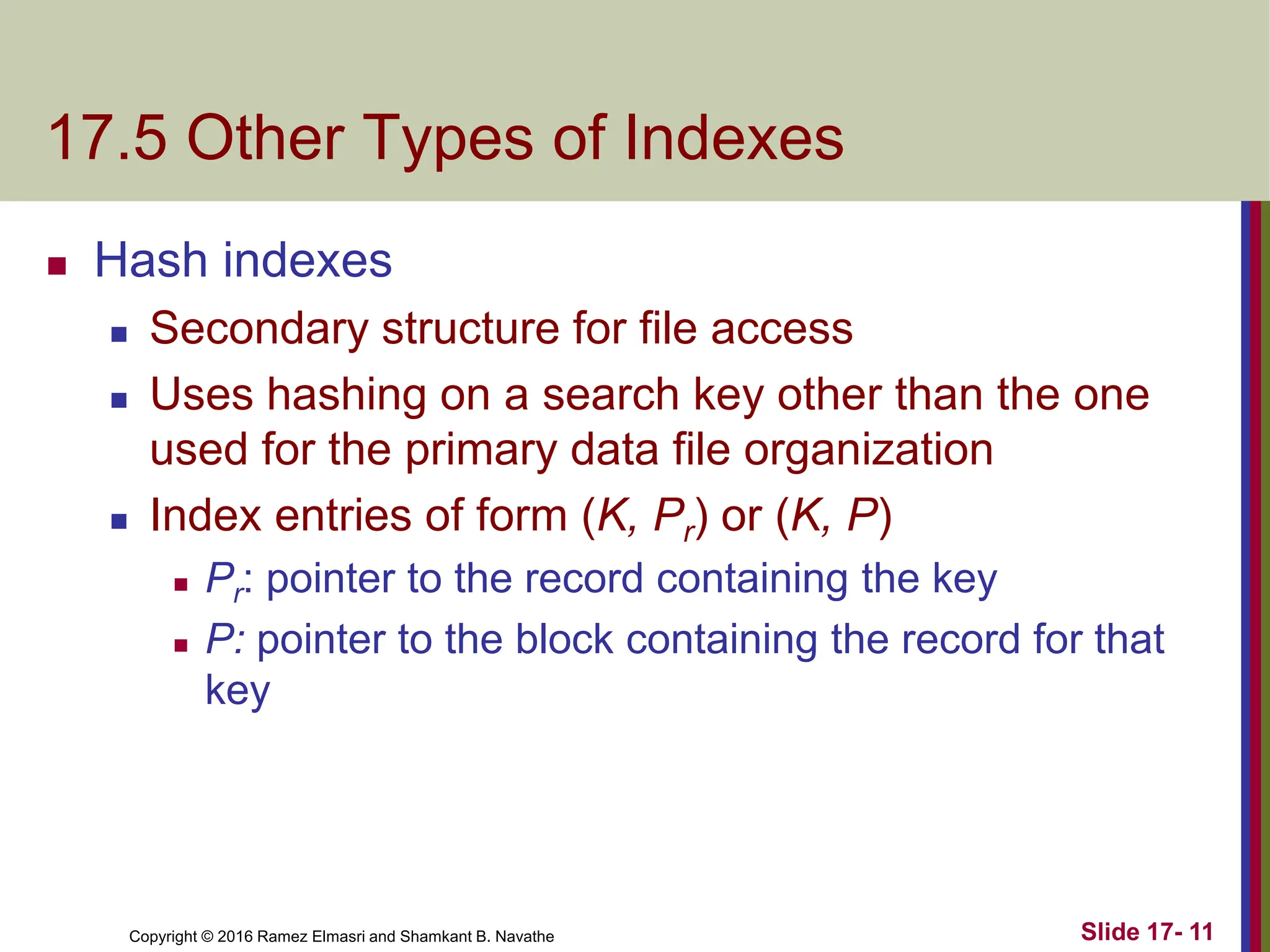
17.5 Other Types of Indexes
 Hash indexes
 Secondary structure for file access
 Uses hashing on a search key other than the one
used for the primary data file organization
 Index entries of form (K, Pr) or (K, P)
 Pr: pointer to the record containing the key
 P: pointer to the block containing the record for that
key
Slide 17- 11
Copyright © 2016 Ramez Elmasri and Shamkant B. Navathe
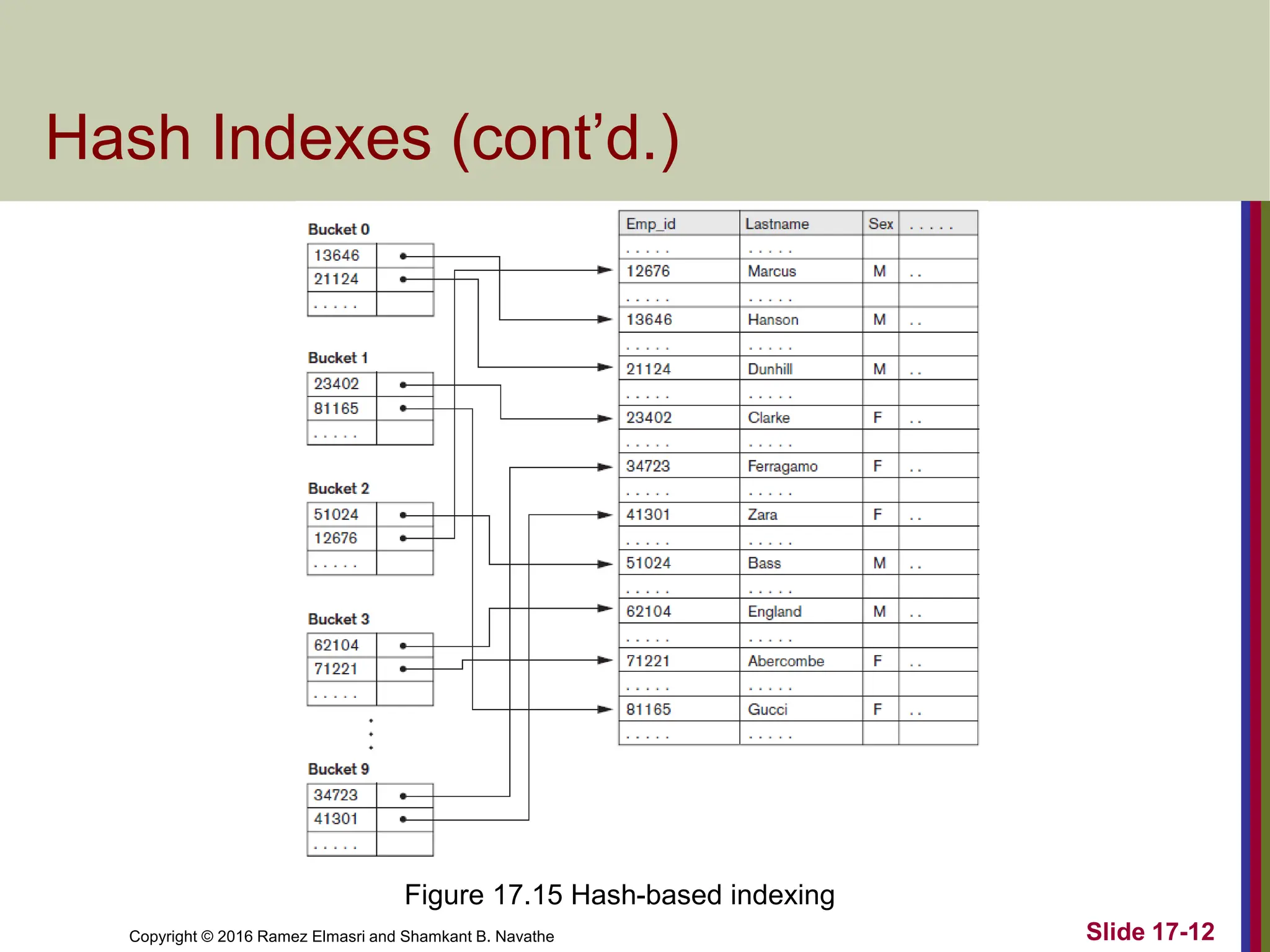
Hash Indexes (cont’d.)
Slide 17-12
Figure 17.15 Hash-based indexing
Copyright © 2016 Ramez Elmasri and Shamkant B. Navathe
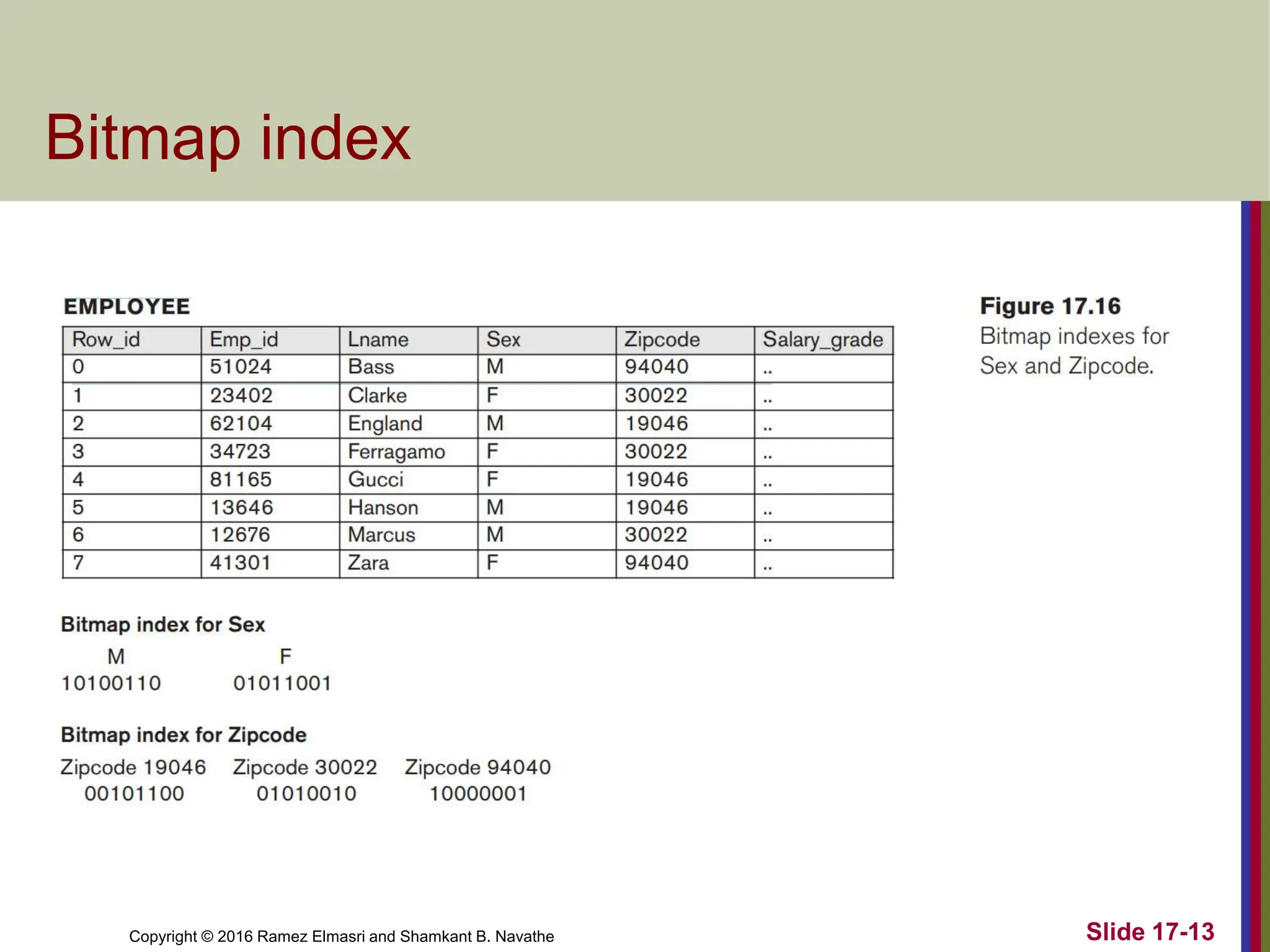
Bitmap index
Slide 17-13
Copyright © 2016 Ramez Elmasri and Shamkant B. Navathe
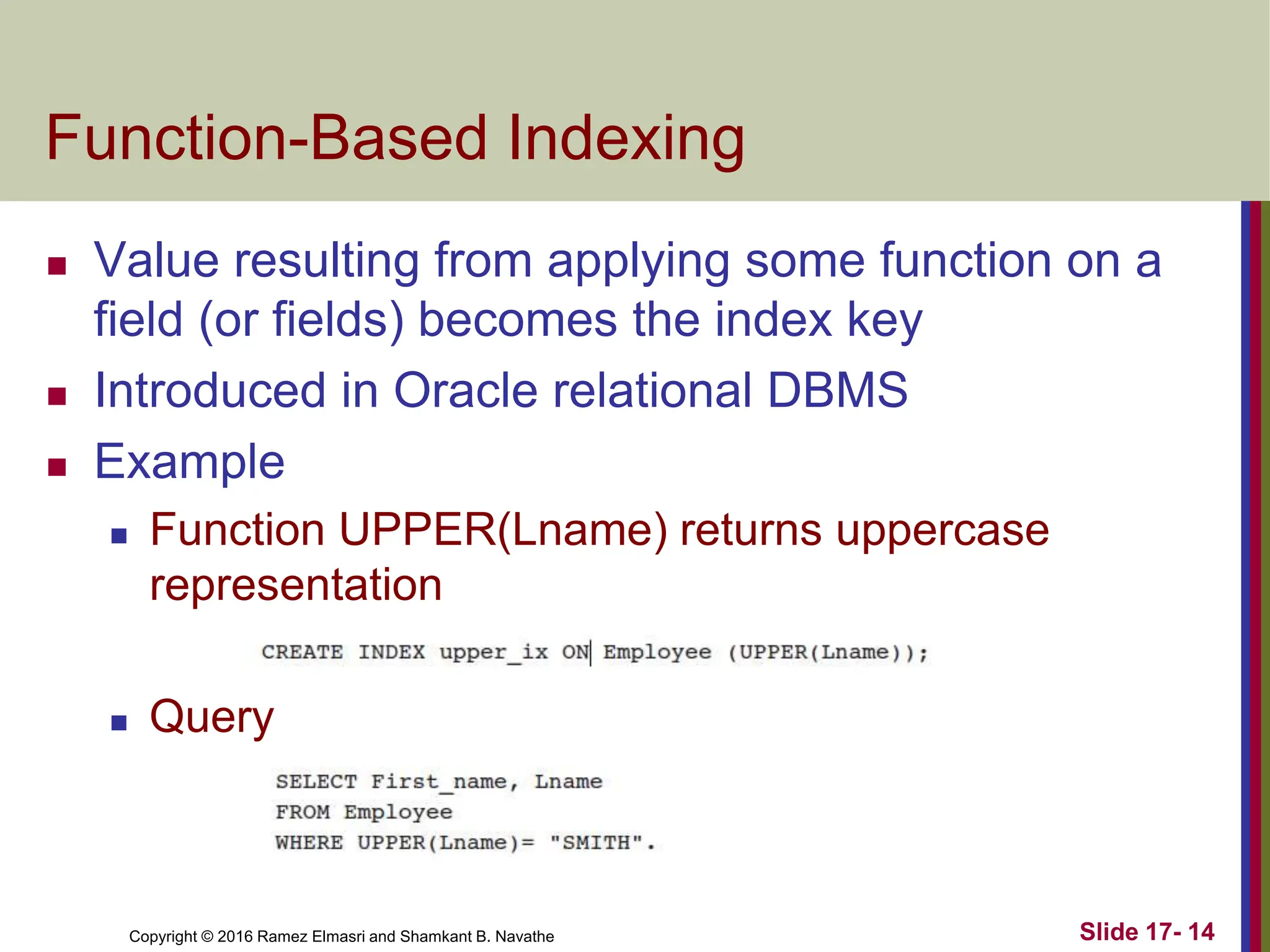
Function-Based Indexing
 Value resulting from applying some function on a
field (or fields) becomes the index key
 Introduced in Oracle relational DBMS
 Example
 Function UPPER(Lname) returns uppercase
representation
 Query
Slide 17- 14
Copyright © 2016 Ramez Elmasri and Shamkant B. Navathe
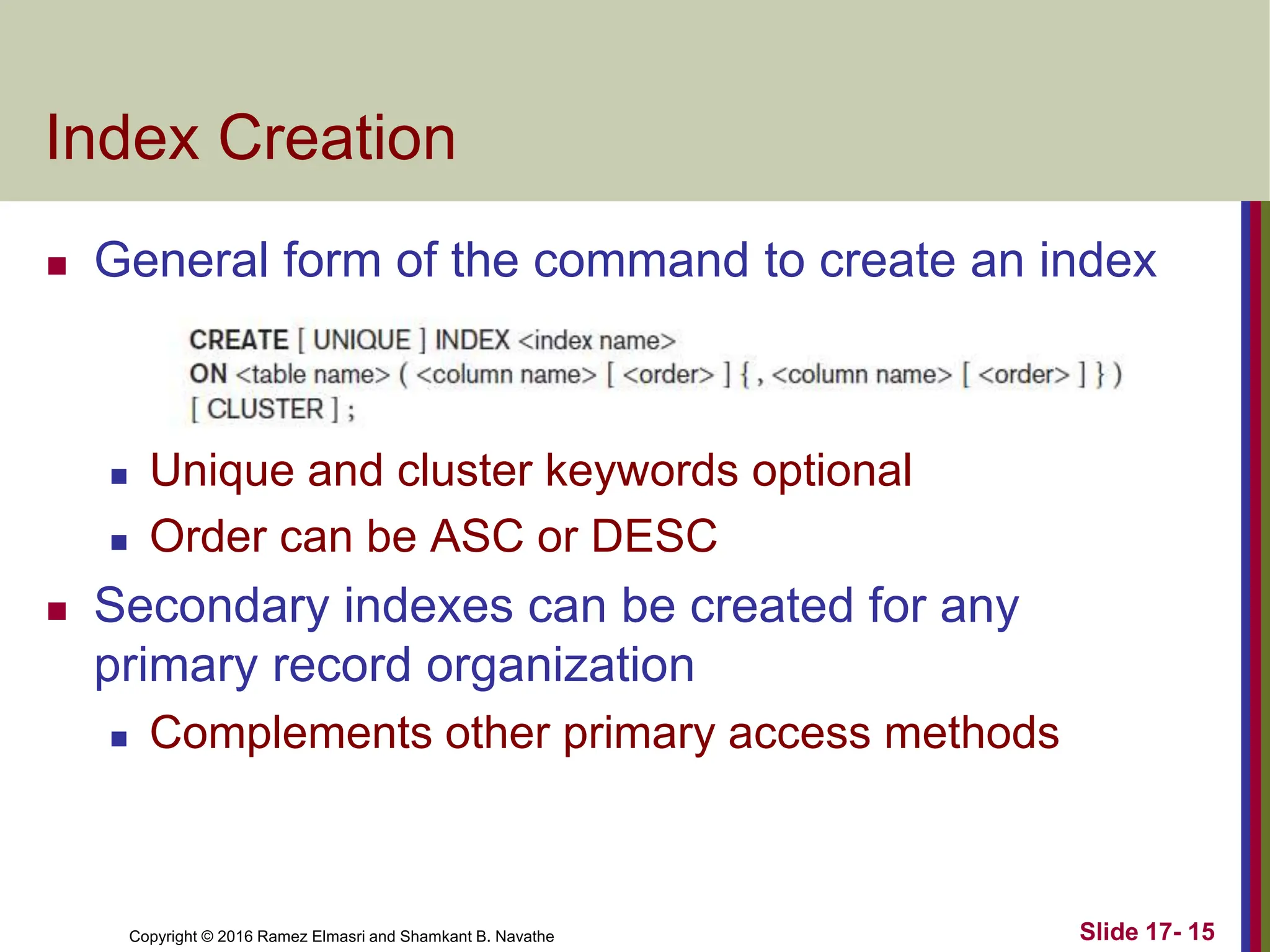
Index Creation
 General form of the command to create an index
 Unique and cluster keywords optional
 Order can be ASC or DESC
 Secondary indexes can be created for any
primary record organization
 Complements other primary access methods
Slide 17- 15

index examples.pptx

  • 1.
    Copyright © 2016Ramez Elmasri and Shamkant B. Navathe Types of Single-Level Ordered Indexes (cont’d.)  Clustering index  Used if numerous records can have the same value for the ordering field  Secondary index  Can be specified on any nonordering field  Data file can have several secondary indexes Slide 17- 1
  • 2.
    Copyright © 2016Ramez Elmasri and Shamkant B. Navathe Primary Indexes  Ordered file with two fields  Primary key, K(i)  Pointer to a disk block, P(i)  One index entry in the index file for each block in the data file  Indexes may be dense or sparse  Dense index has an index entry for every search key value in the data file  Sparse index has entries for only some search values Slide 17- 2
  • 3.
    Copyright © 2016Ramez Elmasri and Shamkant B. Navathe Primary Indexes (cont’d.) Slide 17-3 Figure 17.1 Primary index on the ordering key field of the file shown in Figure 16.7
  • 4.
    Copyright © 2016Ramez Elmasri and Shamkant B. Navathe Clustering Indexes (cont’d.) Slide 17-4 Figure 17.2 A clustering index on the Dept_number ordering nonkey field of an EMPLOYEE file
  • 5.
    Copyright © 2016Ramez Elmasri and Shamkant B. Navathe Secondary Indexes (cont’d.) Slide 17-5 Figure 17.4 Dense secondary index (with block pointers) on a nonordering key field of a file.
  • 6.
    Copyright © 2016Ramez Elmasri and Shamkant B. Navathe Types of Single-Level Ordered Indexes (cont’d.) Slide 17-6 Table 17.1 Types of indexes based on the properties of the indexing field Table 17.2 Properties of index types
  • 7.
    Copyright © 2016Ramez Elmasri and Shamkant B. Navathe Slide 17-7 Figure 17.6 A two-level primary index resembling ISAM (indexed sequential access method) organization
  • 8.
    Copyright © 2016Ramez Elmasri and Shamkant B. Navathe Search Trees and B-Trees (cont’d.)  Algorithms necessary for inserting and deleting search values into and from the tree Slide 17- 8 Figure 17.9 A search tree of order p = 3
  • 9.
    Copyright © 2016Ramez Elmasri and Shamkant B. Navathe B-Tree Structures Slide 17-9 Figure 17.10 B-tree structures (a) A node in a B-tree with q−1 search values (b) A B-tree of order p=3. The values were inserted in the order 8, 5, 1, 7, 3, 12, 9, 6
  • 10.
    Copyright © 2016Ramez Elmasri and Shamkant B. Navathe B+ -Trees (cont’d.) Slide 17-10 Figure 17.11 The nodes of a B+-tree (a) Internal node of a B+-tree with q−1 search values (b) Leaf node of a B+-tree with q−1 search values and q−1 data pointers
  • 11.
    Copyright © 2016Ramez Elmasri and Shamkant B. Navathe 17.5 Other Types of Indexes  Hash indexes  Secondary structure for file access  Uses hashing on a search key other than the one used for the primary data file organization  Index entries of form (K, Pr) or (K, P)  Pr: pointer to the record containing the key  P: pointer to the block containing the record for that key Slide 17- 11
  • 12.
    Copyright © 2016Ramez Elmasri and Shamkant B. Navathe Hash Indexes (cont’d.) Slide 17-12 Figure 17.15 Hash-based indexing
  • 13.
    Copyright © 2016Ramez Elmasri and Shamkant B. Navathe Bitmap index Slide 17-13
  • 14.
    Copyright © 2016Ramez Elmasri and Shamkant B. Navathe Function-Based Indexing  Value resulting from applying some function on a field (or fields) becomes the index key  Introduced in Oracle relational DBMS  Example  Function UPPER(Lname) returns uppercase representation  Query Slide 17- 14
  • 15.
    Copyright © 2016Ramez Elmasri and Shamkant B. Navathe Index Creation  General form of the command to create an index  Unique and cluster keywords optional  Order can be ASC or DESC  Secondary indexes can be created for any primary record organization  Complements other primary access methods Slide 17- 15