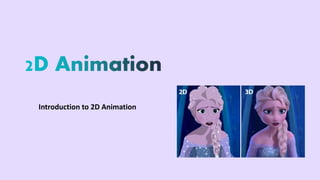
2D Animation
Introduction to 2D Animation
2D Animation
How can we define 2D animation ?
2D animation is the creation of moving pictures in a two-dimensional
environment This is achieved by sequencing images one after the other to
simulate movement .
The illusion of movement is created when individual drawings are sequenced
together over time. One second of time is usually divided into 24 frames.
Depending on the style of animation there can be as many as 24 unique
drawings in one second of animation (24fps).
This is different from 3D animation as 3D animation creates three dimensional
worlds that characters or objects can move around in .
History of 2D animation
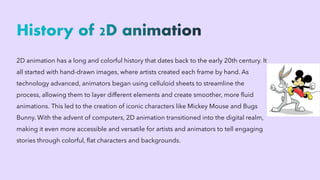
2D animation has a long and colorful history that dates back to the early 20th century. It
all started with hand-drawn images, where artists created each frame by hand. As
technology advanced, animators began using celluloid sheets to streamline the
process, allowing them to layer different elements and create smoother, more fluid
animations. This led to the creation of iconic characters like Mickey Mouse and Bugs
Bunny. With the advent of computers, 2D animation transitioned into the digital realm,
making it even more accessible and versatile for artists and animators to tell engaging
stories through colorful, flat characters and backgrounds.
Flick Books
• Flick Books are one of the simplest forms of creating
animation .
• A flick book, also known as a flip book, is a small booklet filled
with a series of pictures or drawings. When you flip through
the pages quickly with your thumb, the pictures appear to
move, creating the illusion of animation. Each page typically
contains a slight change from the previous one, so when you
flip them rapidly, it looks like the images are in motion.
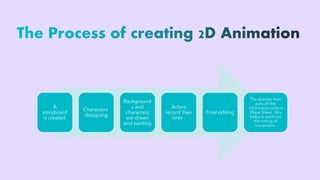
The Process of creating 2D Animation
A
storyboard
is created.
Characters
designing
Background
s and
characters
are drawn
and panting
Actors
record their
lines .
Final editing
The director then
puts all this
information onto a
Dope Sheet - this
helps to work out
the timing of
movement .
The Drawing Animation Process
• This is the most time-consuming part of creating the animation .
• A huge team of people work on drawing the outlines , inking
and then painting in the colors.
• These are then photographed according to the instructions on
the dope sheet .
2D animation types and techniques
• Stop-motion animation
• Frame-by-frame animation
• Cutout animation
• Rotoscoping
• Computer animation
Computer Animation
• Computer Animation is a branch of CGI (Computer-Generated Imagery) focused on
creating moving images.
• Includes both 2-D and 3-D digital animations.
• Used in blockbuster films for special effects (e.g., Transformers, Avatar).
• Nowadays most 2D animations are created with computers .
• Using computers allows animators to produce animation much quicker as they don't
have to redraw each frame .
Computer Animation
There are two main types of graphics used in 2D computer animations .
• Bitmap graphics are made of a set number of pixels in a grid . This
means if the image is resized it may distort and lose quality .
• Vector graphics are made up of mathematical equations . This means
that they are always at their highest quality no matter how their aspects
may change .
Computer Animation
What software is used to create animations ...
• Adobe After Effects
• Adobe Animate
• Anime Studio
• Toon Boom Studio
• PowerPoint
• Flash.
What is 2D animation used for ?
CINEMA ADVERTISING CHILDREN'S
TELEVISION
MUSIC VIDEOS COMPUTER
GAMES
MOBILE PHONE
INTERFACES
WEBSITES.
Summery
• Define 2D animation.
• History of 2D animation.
• Techniques and development of 2D animation.
• The Process of creating 2D Animation
• Computer Animation

Chapter.1 two- dimensional Animetion.pdf

  • 1.
  • 2.
    2D Animation How canwe define 2D animation ? 2D animation is the creation of moving pictures in a two-dimensional environment This is achieved by sequencing images one after the other to simulate movement . The illusion of movement is created when individual drawings are sequenced together over time. One second of time is usually divided into 24 frames. Depending on the style of animation there can be as many as 24 unique drawings in one second of animation (24fps). This is different from 3D animation as 3D animation creates three dimensional worlds that characters or objects can move around in .
  • 3.
    History of 2Danimation 2D animation has a long and colorful history that dates back to the early 20th century. It all started with hand-drawn images, where artists created each frame by hand. As technology advanced, animators began using celluloid sheets to streamline the process, allowing them to layer different elements and create smoother, more fluid animations. This led to the creation of iconic characters like Mickey Mouse and Bugs Bunny. With the advent of computers, 2D animation transitioned into the digital realm, making it even more accessible and versatile for artists and animators to tell engaging stories through colorful, flat characters and backgrounds.
  • 4.
    Flick Books • FlickBooks are one of the simplest forms of creating animation . • A flick book, also known as a flip book, is a small booklet filled with a series of pictures or drawings. When you flip through the pages quickly with your thumb, the pictures appear to move, creating the illusion of animation. Each page typically contains a slight change from the previous one, so when you flip them rapidly, it looks like the images are in motion.
  • 6.
    The Process ofcreating 2D Animation A storyboard is created. Characters designing Background s and characters are drawn and panting Actors record their lines . Final editing The director then puts all this information onto a Dope Sheet - this helps to work out the timing of movement .
  • 7.
    The Drawing AnimationProcess • This is the most time-consuming part of creating the animation . • A huge team of people work on drawing the outlines , inking and then painting in the colors. • These are then photographed according to the instructions on the dope sheet .
  • 8.
    2D animation typesand techniques • Stop-motion animation • Frame-by-frame animation • Cutout animation • Rotoscoping • Computer animation
  • 9.
    Computer Animation • ComputerAnimation is a branch of CGI (Computer-Generated Imagery) focused on creating moving images. • Includes both 2-D and 3-D digital animations. • Used in blockbuster films for special effects (e.g., Transformers, Avatar). • Nowadays most 2D animations are created with computers . • Using computers allows animators to produce animation much quicker as they don't have to redraw each frame .
  • 10.
    Computer Animation There aretwo main types of graphics used in 2D computer animations . • Bitmap graphics are made of a set number of pixels in a grid . This means if the image is resized it may distort and lose quality . • Vector graphics are made up of mathematical equations . This means that they are always at their highest quality no matter how their aspects may change .
  • 12.
    Computer Animation What softwareis used to create animations ... • Adobe After Effects • Adobe Animate • Anime Studio • Toon Boom Studio • PowerPoint • Flash.
  • 13.
    What is 2Danimation used for ? CINEMA ADVERTISING CHILDREN'S TELEVISION MUSIC VIDEOS COMPUTER GAMES MOBILE PHONE INTERFACES WEBSITES.
  • 14.
    Summery • Define 2Danimation. • History of 2D animation. • Techniques and development of 2D animation. • The Process of creating 2D Animation • Computer Animation