CHAPTER 03
SYNTHETIC FIBRES AND PLASTICS
The synthetic fibres, on the
other hand, are made by human
beings. That is why these are
called synthetic or man-made
fibres. A synthetic fibre is also a
chain of small units together.
Each joined small unit is
actually a chemical substance.
Many such small units combine
to form a large single unit called
a polymer.
INTRODUCTION
TYPES OF SYNTHETIC FIBRES
1. RAYON
2. NYLON
3. POLYESTER AND ACRYLIC
TYPES OF SYNTHETIC FIBRES
Fabric obtained from silk
fibre was very costly. But its
beautiful texture fascinated
everybody. Attempts were
made to make silk artificially.
Towards the end of the
nineteenth century,
scientists were successful in
obtaining a fibre having
properties similar to that of
silk.
RAYON
TYPES OF SYNTHETIC FIBRES
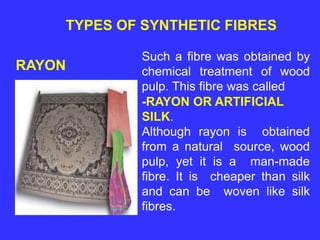
Such a fibre was obtained by
chemical treatment of wood
pulp. This fibre was called
-RAYON OR ARTIFICIAL
SILK.
Although rayon is obtained
from a natural source, wood
pulp, yet it is a man-made
fibre. It is cheaper than silk
and can be woven like silk
fibres.
RAYON
TYPES OF SYNTHETIC FIBRES
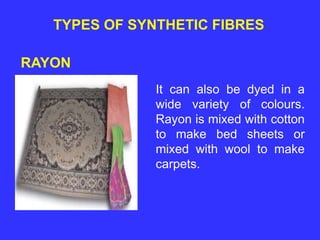
It can also be dyed in a
wide variety of colours.
Rayon is mixed with cotton
to make bed sheets or
mixed with wool to make
carpets.
RAYON
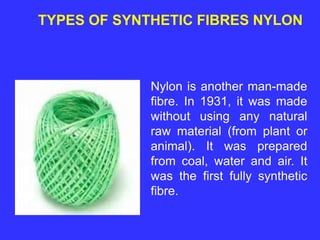
Nylon is another man-made
fibre. In 1931, it was made
without using any natural
raw material (from plant or
animal). It was prepared
from coal, water and air. It
was the first fully synthetic
fibre.
TYPES OF SYNTHETIC FIBRES NYLON
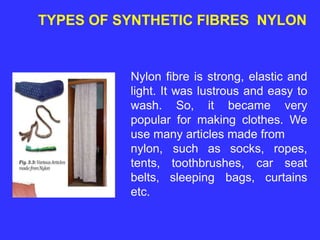
Nylon fibre is strong, elastic and
light. It was lustrous and easy to
wash. So, it became very
popular for making clothes. We
use many articles made from
toothbrushes, car
such as socks, ropes,
seat
sleeping bags, curtains
nylon,
tents,
belts,
etc.
TYPES OF SYNTHETIC FIBRES NYLON
Nylon fibre is strong, elastic and
light. It was lustrous and easy to
wash. So, it became very
popular for making clothes. We
use many articles made from
nylon, such as socks, ropes,
tents, toothbrushes, car seat
belts, sleeping bags, curtains
etc.
TYPES OF SYNTHETIC FIBRES
NYLON - CHARACTERSTICS
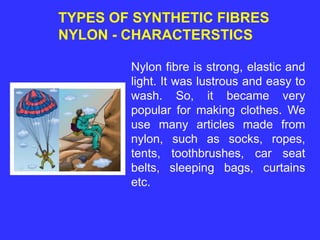
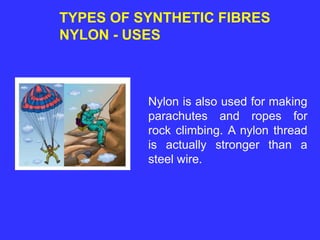
Nylon is also used for making
parachutes and ropes for
rock climbing. A nylon thread
is actually stronger than a
steel wire.
TYPES OF SYNTHETIC FIBRES
NYLON - USES
ACTIVITY - 1
Take an iron stand with a clamp. Take a cotton
thread of about 60 cm length. Tie it to the clamp so
that it hangs freely from it. At the free end suspand
a pan so that weights can be placed in it. Add
weights one by one till the thread breaks. Note
down the total weight required to break the thread.
This weight indicates the strength of the fibre.
Repeat the same activity with threads of wool,
polyester, silk and nylon. Tabulate the data as
shown in Table. Arrange the threads in order of
their increasing strength.
ACTIVITY - 1
Repeat the same
activity with threads of
wool, polyester, silk and
nylon. Tabulate the data
as shown in Table.
Arrange the threads in
order of their increasing
strength.
Precaution :
Note that all threads should be of the same
length and almost of the same thickness.

POLYESTER AND ACRYLIC
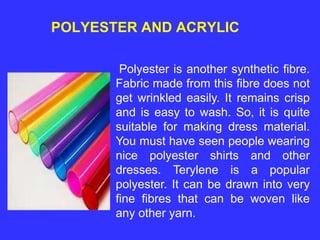
Polyester is another synthetic fibre.
Fabric made from this fibre does not
get wrinkled easily. It remains crisp
and is easy to wash. So, it is quite
suitable for making dress material.
You must have seen people wearing
nice polyester shirts and other
dresses. Terylene is a popular
polyester. It can be drawn into very
fine fibres that can be woven like
any other yarn.
POLYESTER AND ACRYLIC
PET is a very familiar form of polyester. It is used for
making bottles, utensils, films, wires and many other
useful products.
POLYESTER AND ACRYLIC
We wear sweaters and use
shawls or blankets in the winter.
Many of these are actually not
made from natural wool, though
they appear to resemble wool.
These are prepared from another
type of synthetic fibre called
Acrylic. The wool obtained from
natural sources is quite expensive,
whereas clothes made from acrylic
are relatively cheap.
POLYESTER AND ACRYLIC
They are available in a
variety of colours. Synthetic
fibres are more durable and
affordable which makes
them more popular natural
fibres.
CHARACTERISTICS OF SYNTHETIC
FIBRES
Synthetic fibres possess unique characteristics
which make them popular dress materials. They
dry up quickly, are durable, less expensive, readily
available and easy to maintain.
ACTIVITY - 2
Take two cloth pieces of the same
size, roughly half a metre square
each. One of these should be from
natural fibre. The other could be a
synthetic fibre. You can take help of
your parents in selecting these
pieces. Soak the pieces in different
mugs each containing the same
amount of water.
OBSERVE AND
ANSWER
Do synthetic fabrics soak in the
water less/more than natural
fabrics? Do they take
less/more time to dry? What
does this activity tell you about
the characteristics of the
synthetic fabrics?
ACTIVITY - 3
Take the pieces out of the
containers after five
minutes and spread them
in the sun for a few
minutes. Compare the
volume of the water
remaining in each
container.
PLASTICS
Plastic is also a polymer
like the synthetic fibre.
All plastics do not have
the same type of
arrangement of units. In
some it is linear,
whereas in others it is
cross-linked. Plastic
articles are available in
all possible shapes and
sizes.
PLASTICS
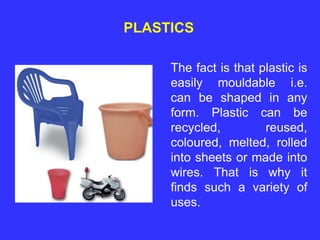
The fact is that plastic is
easily mouldable i.e.
can be shaped in any
form. Plastic can be
recycled, reused,
coloured, melted, rolled
into sheets or made into
wires. That is why it
finds such a variety of
uses.
PLASTICS
When we add hot water
to a plastic bottle, it gets
deformed. Such plastic
which gets deformed
easily on heating and
can be bent easily are
known as
THERMOPLASTICS.
Polythene and PVC are
some of the examples of
thermoplastics.
PLASTICS
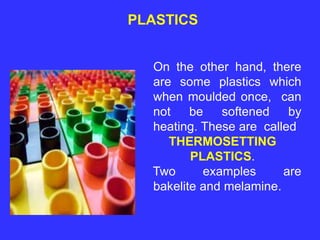
On the other hand, there
are some plastics which
when moulded once, can
not be softened by
heating. These are called
THERMOSETTING
PLASTICS.
Two examples are
bakelite and melamine.
BAKELITE
BAKELITE is a poor
conductor of heat and
electricity. It is used for
making electrical
switches, handles of
various utensils.
PLASTICS
Melamine is a versatile
material. It resists fire
and can tolerate heat better
than other plastics. It is
used for making floor tiles,
kitchenware and fabrics
which resist fire
PLASTICS
MELAMINE
PLASTICS AS MATERIALS OF CHOICE
Being lighter as compared to metals, plastics are
used in cars, aircrafts and spacecrafts, too. The
list is endless if we start counting articles like
slippers, furniture and decoration pieces, etc.
PLASTICS AS MATERIALS OF CHOICE
PLASTIC IS NON-REACTIVE
Metals like iron get rusted when left
exposed to moisture and air. But
plastics do not react with water and
air. They are not corroded easily.
That is why they are used to store
various kinds of material, including
many chemicals.
PLASTICS AS MATERIALS OF CHOICE
PLASTIC IS LIGHT, STRONG
AND DURABLE
Since plastic is very light,
strong, durable and can be
moulded into different shapes
and sizes, it is used for
various purposes. Plastics are
generally cheaper than
metals. They are widely used
in industry and for household
articles.
PLASTICS AS MATERIALS OF CHOICE
PLASTICS ARE POOR
CONDUCTORS
Plastics are poor conductors of
heat and electricity. That is why
electrical wires have plastic
covering, and handles of screw
drivers are made of plastic. As
mentioned above, handles of
frying pans are also made of
plastic.
PLASTICS AND THE ENVIRONMENT
A material which gets
decomposed through natural
processes, such as action by
bacteria, is called
BIODEGRADABLE. A material
which is not easily decomposed
by natural processes is termed
as NON-BIODEGRADABLE.
PLASTICS AND THE ENVIRONMENT
Since plastic takes several years
to decompose, it is not
environment friendly. It causes
environmental pollution. Besides,
the burning process in the
synthetic material is quite slow and
it does not get completely burnt
easily. In the process it releases
lots of poisonous fumes into the
atmosphere causing air pollution.
PLASTICS AND THE ENVIRONMENT
Avoid the use of plastics as far as
possible. Make use of bags made
of cotton or jute when you go for
shopping. The biodegradable and
non biodegradable wastes should
be collected separately and
disposed off separately. It is better
to recycle the plastic waste. Most of
the thermoplastics can be recycled.
Make a list of items that can be
recycled.
PLASTICS AND THE ENVIRONMENT
As a responsible citizen remember
the 4 R principle.
REUSE, RECYCLE, REDUCE,
AND RECOVER. Develop habits
which are environment friendly.
PLASTICS AND THE ENVIRONMENT
KEYWORDS
1. ACRYLIC
2. ARTIFICIAL SILK
3. NYLON
4. PLASTIC
5. POLYESTER
6. POLYMER
1. POLYTHENE
2. RAYON
3. SYNTHETIC FIBRES
4. TERYLENE
5. THERMOPLASTICS
6. THERMOSETTING
PLASTICS
Any Questions Please…
THANK
YOU

Chapter03_syntheticfibresplastics_CBSE_Class8

  • 2.
  • 3.
    The synthetic fibres,on the other hand, are made by human beings. That is why these are called synthetic or man-made fibres. A synthetic fibre is also a chain of small units together. Each joined small unit is actually a chemical substance. Many such small units combine to form a large single unit called a polymer. INTRODUCTION
  • 4.
    TYPES OF SYNTHETICFIBRES 1. RAYON 2. NYLON 3. POLYESTER AND ACRYLIC
  • 5.
    TYPES OF SYNTHETICFIBRES Fabric obtained from silk fibre was very costly. But its beautiful texture fascinated everybody. Attempts were made to make silk artificially. Towards the end of the nineteenth century, scientists were successful in obtaining a fibre having properties similar to that of silk. RAYON
  • 6.
    TYPES OF SYNTHETICFIBRES Such a fibre was obtained by chemical treatment of wood pulp. This fibre was called -RAYON OR ARTIFICIAL SILK. Although rayon is obtained from a natural source, wood pulp, yet it is a man-made fibre. It is cheaper than silk and can be woven like silk fibres. RAYON
  • 7.
    TYPES OF SYNTHETICFIBRES It can also be dyed in a wide variety of colours. Rayon is mixed with cotton to make bed sheets or mixed with wool to make carpets. RAYON
  • 8.
    Nylon is anotherman-made fibre. In 1931, it was made without using any natural raw material (from plant or animal). It was prepared from coal, water and air. It was the first fully synthetic fibre. TYPES OF SYNTHETIC FIBRES NYLON
  • 9.
    Nylon fibre isstrong, elastic and light. It was lustrous and easy to wash. So, it became very popular for making clothes. We use many articles made from toothbrushes, car such as socks, ropes, seat sleeping bags, curtains nylon, tents, belts, etc. TYPES OF SYNTHETIC FIBRES NYLON
  • 10.
    Nylon fibre isstrong, elastic and light. It was lustrous and easy to wash. So, it became very popular for making clothes. We use many articles made from nylon, such as socks, ropes, tents, toothbrushes, car seat belts, sleeping bags, curtains etc. TYPES OF SYNTHETIC FIBRES NYLON - CHARACTERSTICS
  • 11.
    Nylon is alsoused for making parachutes and ropes for rock climbing. A nylon thread is actually stronger than a steel wire. TYPES OF SYNTHETIC FIBRES NYLON - USES
  • 12.
    ACTIVITY - 1 Takean iron stand with a clamp. Take a cotton thread of about 60 cm length. Tie it to the clamp so that it hangs freely from it. At the free end suspand a pan so that weights can be placed in it. Add weights one by one till the thread breaks. Note down the total weight required to break the thread. This weight indicates the strength of the fibre. Repeat the same activity with threads of wool, polyester, silk and nylon. Tabulate the data as shown in Table. Arrange the threads in order of their increasing strength.
  • 13.
    ACTIVITY - 1 Repeatthe same activity with threads of wool, polyester, silk and nylon. Tabulate the data as shown in Table. Arrange the threads in order of their increasing strength. Precaution : Note that all threads should be of the same length and almost of the same thickness. 
  • 14.
    POLYESTER AND ACRYLIC Polyesteris another synthetic fibre. Fabric made from this fibre does not get wrinkled easily. It remains crisp and is easy to wash. So, it is quite suitable for making dress material. You must have seen people wearing nice polyester shirts and other dresses. Terylene is a popular polyester. It can be drawn into very fine fibres that can be woven like any other yarn.
  • 15.
    POLYESTER AND ACRYLIC PETis a very familiar form of polyester. It is used for making bottles, utensils, films, wires and many other useful products.
  • 16.
    POLYESTER AND ACRYLIC Wewear sweaters and use shawls or blankets in the winter. Many of these are actually not made from natural wool, though they appear to resemble wool. These are prepared from another type of synthetic fibre called Acrylic. The wool obtained from natural sources is quite expensive, whereas clothes made from acrylic are relatively cheap.
  • 17.
    POLYESTER AND ACRYLIC Theyare available in a variety of colours. Synthetic fibres are more durable and affordable which makes them more popular natural fibres.
  • 18.
    CHARACTERISTICS OF SYNTHETIC FIBRES Syntheticfibres possess unique characteristics which make them popular dress materials. They dry up quickly, are durable, less expensive, readily available and easy to maintain.
  • 19.
    ACTIVITY - 2 Taketwo cloth pieces of the same size, roughly half a metre square each. One of these should be from natural fibre. The other could be a synthetic fibre. You can take help of your parents in selecting these pieces. Soak the pieces in different mugs each containing the same amount of water.
  • 20.
    OBSERVE AND ANSWER Do syntheticfabrics soak in the water less/more than natural fabrics? Do they take less/more time to dry? What does this activity tell you about the characteristics of the synthetic fabrics?
  • 21.
    ACTIVITY - 3 Takethe pieces out of the containers after five minutes and spread them in the sun for a few minutes. Compare the volume of the water remaining in each container.
  • 22.
    PLASTICS Plastic is alsoa polymer like the synthetic fibre. All plastics do not have the same type of arrangement of units. In some it is linear, whereas in others it is cross-linked. Plastic articles are available in all possible shapes and sizes.
  • 23.
    PLASTICS The fact isthat plastic is easily mouldable i.e. can be shaped in any form. Plastic can be recycled, reused, coloured, melted, rolled into sheets or made into wires. That is why it finds such a variety of uses.
  • 24.
    PLASTICS When we addhot water to a plastic bottle, it gets deformed. Such plastic which gets deformed easily on heating and can be bent easily are known as THERMOPLASTICS. Polythene and PVC are some of the examples of thermoplastics.
  • 25.
    PLASTICS On the otherhand, there are some plastics which when moulded once, can not be softened by heating. These are called THERMOSETTING PLASTICS. Two examples are bakelite and melamine.
  • 26.
    BAKELITE BAKELITE is apoor conductor of heat and electricity. It is used for making electrical switches, handles of various utensils. PLASTICS
  • 27.
    Melamine is aversatile material. It resists fire and can tolerate heat better than other plastics. It is used for making floor tiles, kitchenware and fabrics which resist fire PLASTICS MELAMINE
  • 28.
    PLASTICS AS MATERIALSOF CHOICE Being lighter as compared to metals, plastics are used in cars, aircrafts and spacecrafts, too. The list is endless if we start counting articles like slippers, furniture and decoration pieces, etc.
  • 29.
    PLASTICS AS MATERIALSOF CHOICE PLASTIC IS NON-REACTIVE Metals like iron get rusted when left exposed to moisture and air. But plastics do not react with water and air. They are not corroded easily. That is why they are used to store various kinds of material, including many chemicals.
  • 30.
    PLASTICS AS MATERIALSOF CHOICE PLASTIC IS LIGHT, STRONG AND DURABLE Since plastic is very light, strong, durable and can be moulded into different shapes and sizes, it is used for various purposes. Plastics are generally cheaper than metals. They are widely used in industry and for household articles.
  • 31.
    PLASTICS AS MATERIALSOF CHOICE PLASTICS ARE POOR CONDUCTORS Plastics are poor conductors of heat and electricity. That is why electrical wires have plastic covering, and handles of screw drivers are made of plastic. As mentioned above, handles of frying pans are also made of plastic.
  • 32.
    PLASTICS AND THEENVIRONMENT A material which gets decomposed through natural processes, such as action by bacteria, is called BIODEGRADABLE. A material which is not easily decomposed by natural processes is termed as NON-BIODEGRADABLE.
  • 33.
    PLASTICS AND THEENVIRONMENT
  • 34.
    PLASTICS AND THEENVIRONMENT Since plastic takes several years to decompose, it is not environment friendly. It causes environmental pollution. Besides, the burning process in the synthetic material is quite slow and it does not get completely burnt easily. In the process it releases lots of poisonous fumes into the atmosphere causing air pollution.
  • 35.
    PLASTICS AND THEENVIRONMENT Avoid the use of plastics as far as possible. Make use of bags made of cotton or jute when you go for shopping. The biodegradable and non biodegradable wastes should be collected separately and disposed off separately. It is better to recycle the plastic waste. Most of the thermoplastics can be recycled. Make a list of items that can be recycled.
  • 36.
    PLASTICS AND THEENVIRONMENT As a responsible citizen remember the 4 R principle. REUSE, RECYCLE, REDUCE, AND RECOVER. Develop habits which are environment friendly.
  • 37.
    PLASTICS AND THEENVIRONMENT
  • 38.
    KEYWORDS 1. ACRYLIC 2. ARTIFICIALSILK 3. NYLON 4. PLASTIC 5. POLYESTER 6. POLYMER 1. POLYTHENE 2. RAYON 3. SYNTHETIC FIBRES 4. TERYLENE 5. THERMOPLASTICS 6. THERMOSETTING PLASTICS
  • 39.
  • 40.