Clothes that we wear on a daily basis are made of fabrics.
Fabrics are made of fibres which are obtained from natural and
artificial sources.
Wool, silk, and cotton are a few examples of natural fibres and
fibres like polyesters and terylene are a few examples of synthetic
fibres.
Synthetic Fibres And Plastics
Fibre
The clothes which we wear are made of
fabrics.
Fabrics are made from fibres obtained
from natural or artificial sources.
Fibres are also used for making a large
variety of household articles.
Polymer
The word ‘polymer’ comes from two
Greek words; poly meaning many and
meaning part/unit.
A polymer is a substance composed of
many repeated similar subunits.
Synthetic Fibre
Fibres that are made or created by humans are known
as synthetic or man-made fibres.
Humans have been able to make a variety of synthetic
fibres. Eg: rayon, nylon etc.
NATURAL FIBRE
The naturally occurring fibres that
humans derive from plants or animals
are known as natural fibres.
Eg: cotton, wool, silk, etc.
Silk fibre is obtained from the cocoon of a silkworm.
The process was discovered in China where it was kept as a closely
guarded secret for a long time.
Silk is costly due to the material quality and production process involved. It
is used in making sarees, ties, etc.
SYNTHETIC FIBRES
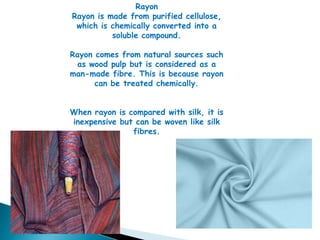
Rayon
Rayon is made from purified cellulose,
which is chemically converted into a
soluble compound.
Rayon comes from natural sources such
as wood pulp but is considered as a
man-made fibre. This is because rayon
can be treated chemically.
When rayon is compared with silk, it is
inexpensive but can be woven like silk
fibres.
Nylon
Nylon is a synthetic fibre obtained from
coal, water and air.
The first fully synthetic fibre obtained
was nylon.
The characteristic properties are that it
is light, strong, and elastic.
Nylon finds application in the
manufacturing of socks, ropes, tents, car
seat belts, sleeping bags, curtains etc.
Polyester
Polyester is made of repeating units of a
chemical called an ester.
It is a crease free synthetic fibre.
It is best suited for the making of dress
materials as it is crisp and is easy to
wash.
A popular polyester is Terylene.
Acrylic Fibre
Acrylic is a synthetic fibre that
resembles wool.
The wool obtained from natural
sources is quite expensive, whereas
clothes made from acrylic are
relatively cheap.
Synthetic fibres are more durable
and affordable which makes them
more popular than natural fibres.
Plastic Attack Alert
Plastic
Plastic is also a polymer like the synthetic
fibre.
All plastics do not have the same type of
arrangement of units. In some, it is linear
whereas in others it is cross-linked.
Plastic can be recycled, reused, coloured,
melted, rolled into sheets or made into
wires. That is why it finds such a variety of
uses.
Thermoplastics
Plastic which gets deformed easily on
heating and can be bent easily are known as
thermoplastics. Eg: polythene and PVC
Thermosetting Plastics
Plastics which when moulded once, can not
be softened by heating. Eg: bakelite and
melamine.
Characteristics of Plastics
– Plastic is non-reactive
– Plastic is light, strong and durable
– Plastic is a poor conductor
Biodegradable and Non-Biodegradable
Materials
A material that decomposes through natural
process is biodegradable and materials that
are not easily decomposed by natural
processes is termed as non-biodegradable.
Eg: Biodegradable – fruits, paper
Non Biodegradable – plastic, tin Environmental Effects on Plastic
Plastic takes several years to decompose, it
is not environmental friendly.
It causes pollution.
The burning process in the synthetic
material is quite slow and it does not get
completely burnt easily.
It releases lots of poisonous fumes into the
atmosphere causing air pollution in the
process.
Implement the 4 R principle in everyday life. Following are the 4Rs:
Reduce
Reuse
Recycle
Recover
These habits are environment-friendly.
THE END

PPT.pdf

  • 2.
    Clothes that wewear on a daily basis are made of fabrics. Fabrics are made of fibres which are obtained from natural and artificial sources. Wool, silk, and cotton are a few examples of natural fibres and fibres like polyesters and terylene are a few examples of synthetic fibres. Synthetic Fibres And Plastics
  • 3.
    Fibre The clothes whichwe wear are made of fabrics. Fabrics are made from fibres obtained from natural or artificial sources. Fibres are also used for making a large variety of household articles. Polymer The word ‘polymer’ comes from two Greek words; poly meaning many and meaning part/unit. A polymer is a substance composed of many repeated similar subunits.
  • 4.
    Synthetic Fibre Fibres thatare made or created by humans are known as synthetic or man-made fibres. Humans have been able to make a variety of synthetic fibres. Eg: rayon, nylon etc.
  • 5.
    NATURAL FIBRE The naturallyoccurring fibres that humans derive from plants or animals are known as natural fibres. Eg: cotton, wool, silk, etc.
  • 6.
    Silk fibre isobtained from the cocoon of a silkworm. The process was discovered in China where it was kept as a closely guarded secret for a long time. Silk is costly due to the material quality and production process involved. It is used in making sarees, ties, etc.
  • 7.
  • 8.
    Rayon Rayon is madefrom purified cellulose, which is chemically converted into a soluble compound. Rayon comes from natural sources such as wood pulp but is considered as a man-made fibre. This is because rayon can be treated chemically. When rayon is compared with silk, it is inexpensive but can be woven like silk fibres.
  • 9.
    Nylon Nylon is asynthetic fibre obtained from coal, water and air. The first fully synthetic fibre obtained was nylon. The characteristic properties are that it is light, strong, and elastic. Nylon finds application in the manufacturing of socks, ropes, tents, car seat belts, sleeping bags, curtains etc.
  • 10.
    Polyester Polyester is madeof repeating units of a chemical called an ester. It is a crease free synthetic fibre. It is best suited for the making of dress materials as it is crisp and is easy to wash. A popular polyester is Terylene.
  • 11.
    Acrylic Fibre Acrylic isa synthetic fibre that resembles wool. The wool obtained from natural sources is quite expensive, whereas clothes made from acrylic are relatively cheap. Synthetic fibres are more durable and affordable which makes them more popular than natural fibres.
  • 12.
    Plastic Attack Alert Plastic Plasticis also a polymer like the synthetic fibre. All plastics do not have the same type of arrangement of units. In some, it is linear whereas in others it is cross-linked. Plastic can be recycled, reused, coloured, melted, rolled into sheets or made into wires. That is why it finds such a variety of uses. Thermoplastics Plastic which gets deformed easily on heating and can be bent easily are known as thermoplastics. Eg: polythene and PVC Thermosetting Plastics Plastics which when moulded once, can not be softened by heating. Eg: bakelite and melamine.
  • 13.
    Characteristics of Plastics –Plastic is non-reactive – Plastic is light, strong and durable – Plastic is a poor conductor Biodegradable and Non-Biodegradable Materials A material that decomposes through natural process is biodegradable and materials that are not easily decomposed by natural processes is termed as non-biodegradable. Eg: Biodegradable – fruits, paper Non Biodegradable – plastic, tin Environmental Effects on Plastic Plastic takes several years to decompose, it is not environmental friendly. It causes pollution. The burning process in the synthetic material is quite slow and it does not get completely burnt easily. It releases lots of poisonous fumes into the atmosphere causing air pollution in the process.
  • 14.
    Implement the 4R principle in everyday life. Following are the 4Rs: Reduce Reuse Recycle Recover These habits are environment-friendly.
  • 15.