Steel design is a branch of structural engineering focused on the analysis and design of steel members and connections to safely resist applied loads throughout a structure’s service life. It uses the mechanical properties of steel—such as high strength, ductility, and uniformity—to create efficient, economical, and durable structures.
The design process involves determining loads (dead, live, wind, seismic, etc.), analyzing internal forces, and selecting appropriate steel sections that satisfy strength, stability, and serviceability requirements. Common elements include beams, columns, tension members, compression members, and connections (bolted or welded).
Modern steel design is typically based on limit state principles, such as Load and Resistance Factor Design (LRFD) or Allowable Stress Design (ASD), as specified in design codes (e.g., AISC, Eurocode). Key considerations include yielding, buckling, fatigue, deflection limits, fire resistance, and corrosion protection.
Steel design is widely used in buildings, bridges, industrial structures, towers, and trusses due to its speed of construction, adaptability, and recyclability.

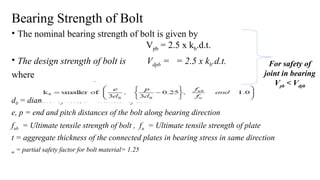
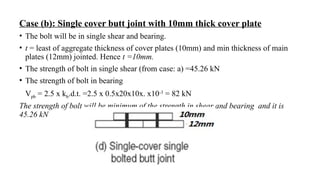
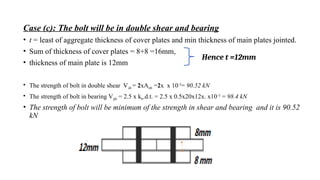
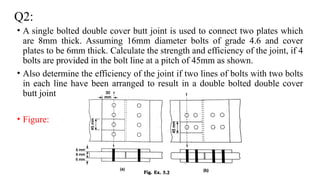
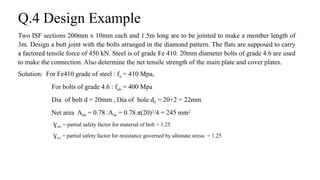
![Solution: For Fe410 grade of steel : fu = 400 Mpa,
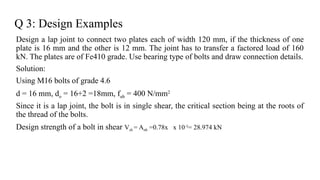
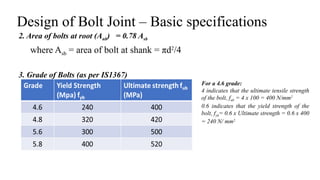
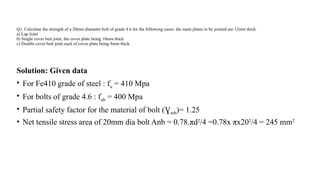
For bolts of grade 4.6 : fub = 400 Mpa
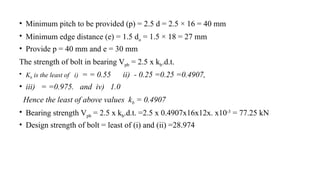
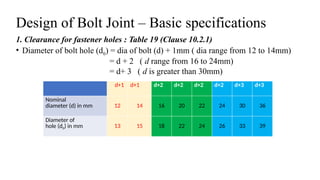
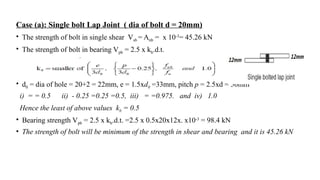
Dia of bolt d = 16mm , Dia of hole d0 = 16+2 = 18mm
Net area Anb = 0.78 . Asb = 0.78.π(16)2
/4 = 157mm2
Ɣmb = partial safety factor for material of bolt = 1.25
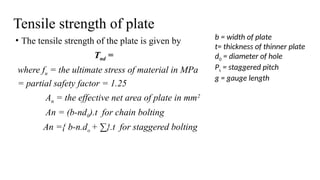
Ɣm1 = partial safety factor for resistance governed by ultimate stress = 1.25
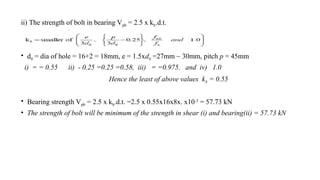
t = least of aggregate thickness of cover plates (6+6 =12mm) and minimum
thickness of main plates (8mm).
Hence take t = 8mm
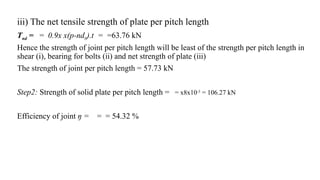
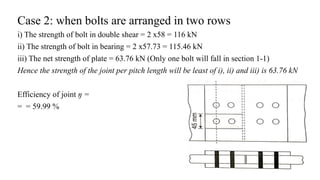
Step1: Strength of Bolt :
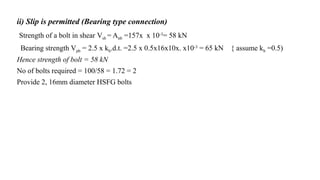
i) The strength of bolt in double shear Vsb = 2[Anb ]= x 10-3
= 58 kN
15](https://image.slidesharecdn.com/steeldesignpart-3-260207145058-094cefa7/85/Chapter-two-Steel-design-part-3-pptx-15-320.jpg)