1
Department of Civil Engineering
Course Name: Steel design
4-Year/8-Semester
Introduction to Design of Structural Steel Elements
Instructor: Abdishakur Abdullahi Mohamed
Email: sarmaale05@gmail.com
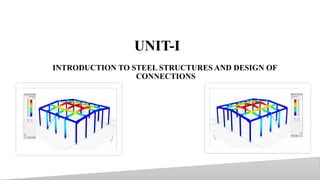
UNIT-I
INTRODUCTION TO STEEL STRUCTURES AND DESIGN OF
CONNECTIONS
2
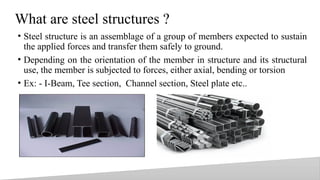
What are steel structures ?
• Steel structure is an assemblage of a group of members expected to sustain
the applied forces and transfer them safely to ground.
• Depending on the orientation of the member in structure and its structural
use, the member is subjected to forces, either axial, bending or torsion
• Ex: - I-Beam, Tee section, Channel section, Steel plate etc..
3
Common Steel structures
• Roof truss in factories, cinema halls, railways etc.,
• Crane girders, columns, beams
• Plate girders, bridges
• Transmission towers, water tank, chimney etc.,
4
5
Structural Steel
6
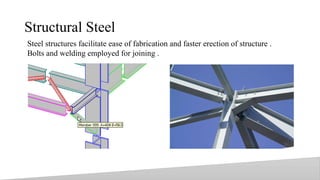
Steel structures facilitate ease of fabrication and faster erection of structure .
Bolts and welding employed for joining .
Advantages of steel as structural material
• High strength
• The high ratio of strength to weight (the strength per unit weight)
• Excellent ductility and seismic resistance
• Withstand extensive deformation without failure even under high
tensile stress.
• Elasticity, uniformity of material
• Predictability of properties, close to design assumption
• Ease of fabrication and speed of erection
7
Disadvantages of steel
• Susceptibility to corrosion
• High Initial cost and maintenance costs
• Loss of strength at elevated temperature
• Fireproofing costs
• Susceptibility to buckling
• Fatigue and brittle fracture
8
What Is Strength to Weight Ratio?
Know the strength to weight ratio of a material is important when you are working with various metals. It will
give you a better understanding of what you can and can’t do with the metal you are using.
The simplest way to explain the strength to weight ratio is that it is the strength of the material used divided by
its weight (or mass). This is also known as specific strength.
Why Is It Important?
It is important to understand the strength to weight ratio of materials so that you can use them to their
strengths and be prepared for any weakness that may be there.
When working with any material, strength and weight are often deciding factors in what is used, so this is
another good reason to be in the know. Especially in the aerospace and automotive industries, where you
need the material to be light but incredibly strong.
9
Which Metals Have High Strength to Weight Ratios?
Titanium, aluminum and magnesium are top choices when looking for metals with high strength to
weight ratio. Unfortunately, both of these are quite expensive to use and so are budget dependent.
Steel also has the same strength, and more cost-effective but it is much heavier so again you may be
limited to what you can do.
Often high strength metals are difficult to form correctly, and so require careful engineering to get
the required shapes, among other features needed.
Modern Material
With the weight and cost of materials being taken into consideration, there are many sheets of steel
being developed with high strength to weight ratios. Many companies also choose to go with a
selection of different steel to help with both strength and budget.
10
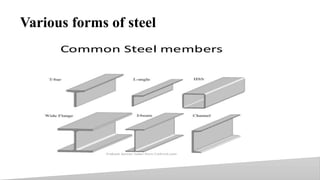
Various forms of steel
11
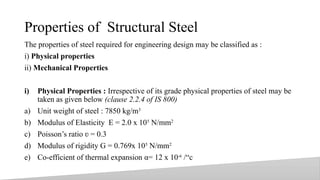
Properties of Structural Steel
The properties of steel required for engineering design may be classified as :
i) Physical properties
ii) Mechanical Properties
i) Physical Properties : Irrespective of its grade physical properties of steel may be
taken as given below (clause 2.2.4 of IS 800)
a) Unit weight of steel : 7850 kg/m3
b) Modulus of Elasticity E = 2.0 x 10⁵
N/mm2
c) Poisson’s ratio = 0.3
ʋ
d) Modulus of rigidity G = 0.769x 10⁵
N/mm2
e) Co-efficient of thermal expansion α= 12 x 10-6
/“c
12
13
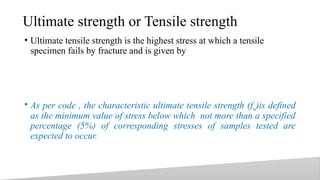
Ultimate strength or Tensile strength
• Ultimate tensile strength is the highest stress at which a tensile
specimen fails by fracture and is given by
• As per code , the characteristic ultimate tensile strength (fu)is defined
as the minimum value of stress below which not more than a specified
percentage (5%) of corresponding stresses of samples tested are
expected to occur.
14
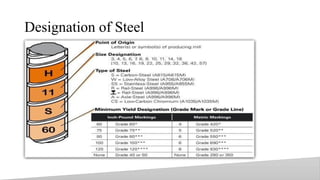
Designation of Steel
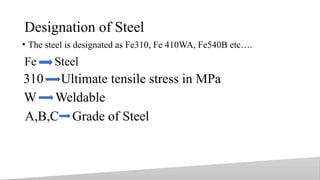
• The steel is designated as Fe310, Fe 410WA, Fe540B etc….
15
Steel
Fe
Ultimate tensile stress in MPa
310
Weldable
W
Grade of Steel
A,B,C
Designation of Steel
16
GRADES OF STEEL
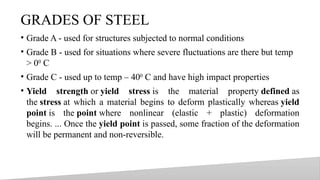
• Grade A - used for structures subjected to normal conditions
• Grade B - used for situations where severe fluctuations are there but temp
> 00
C
• Grade C - used up to temp – 400
C and have high impact properties
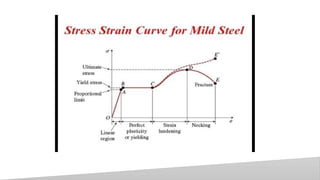
• Yield strength or yield stress is the material property defined as
the stress at which a material begins to deform plastically whereas yield
point is the point where nonlinear (elastic + plastic) deformation
begins. ... Once the yield point is passed, some fraction of the deformation
will be permanent and non-reversible.
17
Properties of steel
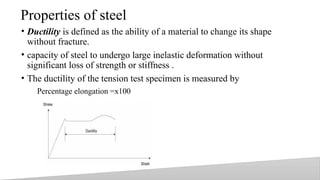
• Ductility is defined as the ability of a material to change its shape
without fracture.
• capacity of steel to undergo large inelastic deformation without
significant loss of strength or stiffness .
• The ductility of the tension test specimen is measured by
Percentage elongation =x100
18
Properties of steel
• Toughness: Capacity to absorb energy, measure of fracture resistance
under impact. Area under the stress-strain curve is a measure of toughness
• Hardness is a measure of the resistance of the material to indentations and
scratching.
• Corrosion resistance: Steel corrodes in moist air, sea water and acid.
Adopt Painting, metallic coating, plastic coating, using corrosion resistant
steel to resist corrosion.
• Fatigue Resistance: Damage of material to cyclic loading and it may
occurs due to moving loads, vibration in bridge etc.
19
STRUCTURAL STEEL
SECTIONS
20
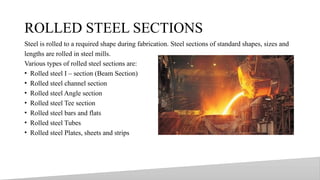
ROLLED STEEL SECTIONS
Steel is rolled to a required shape during fabrication. Steel sections of standard shapes, sizes and
lengths are rolled in steel mills.
Various types of rolled steel sections are:
• Rolled steel I – section (Beam Section)
• Rolled steel channel section
• Rolled steel Angle section
• Rolled steel Tee section
• Rolled steel bars and flats
• Rolled steel Tubes
• Rolled steel Plates, sheets and strips
21
Rolled I – Sections
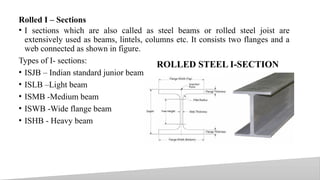
• I sections which are also called as steel beams or rolled steel joist are
extensively used as beams, lintels, columns etc. It consists two flanges and a
web connected as shown in figure.
Types of I- sections:
• ISJB – Indian standard junior beam
• ISLB –Light beam
• ISMB -Medium beam
• ISWB -Wide flange beam
• ISHB - Heavy beam
22
ROLLED STEEL I-SECTION
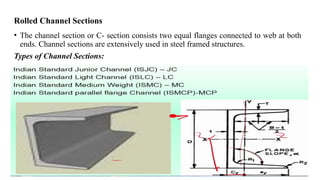
Rolled Channel Sections
• The channel section or C- section consists two equal flanges connected to web at both
ends. Channel sections are extensively used in steel framed structures.
Types of Channel Sections:
23
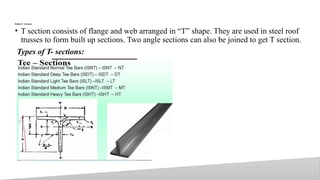
Rolled T- Sections
• T section consists of flange and web arranged in “T” shape. They are used in steel roof
trusses to form built up sections. Two angle sections can also be joined to get T section.
Types of T- sections:
24
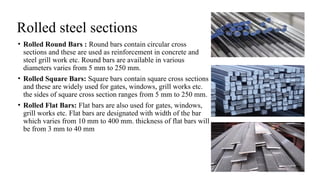
Rolled steel sections
• Rolled Round Bars : Round bars contain circular cross
sections and these are used as reinforcement in concrete and
steel grill work etc. Round bars are available in various
diameters varies from 5 mm to 250 mm.
• Rolled Square Bars: Square bars contain square cross sections
and these are widely used for gates, windows, grill works etc.
the sides of square cross section ranges from 5 mm to 250 mm.
• Rolled Flat Bars: Flat bars are also used for gates, windows,
grill works etc. Flat bars are designated with width of the bar
which varies from 10 mm to 400 mm. thickness of flat bars will
be from 3 mm to 40 mm
25
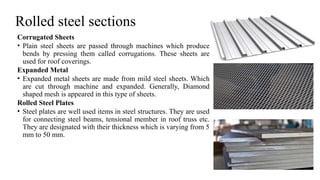
Rolled steel sections
Corrugated Sheets
• Plain steel sheets are passed through machines which produce
bends by pressing them called corrugations. These sheets are
used for roof coverings.
Expanded Metal
• Expanded metal sheets are made from mild steel sheets. Which
are cut through machine and expanded. Generally, Diamond
shaped mesh is appeared in this type of sheets.
Rolled Steel Plates
• Steel plates are well used items in steel structures. They are used
for connecting steel beams, tensional member in roof truss etc.
They are designated with their thickness which is varying from 5
mm to 50 mm.
26
Rolled steel sections
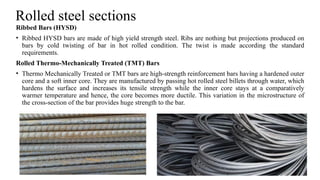
Ribbed Bars (HYSD)
• Ribbed HYSD bars are made of high yield strength steel. Ribs are nothing but projections produced on
bars by cold twisting of bar in hot rolled condition. The twist is made according the standard
requirements.
Rolled Thermo-Mechanically Treated (TMT) Bars
• Thermo Mechanically Treated or TMT bars are high-strength reinforcement bars having a hardened outer
core and a soft inner core. They are manufactured by passing hot rolled steel billets through water, which
hardens the surface and increases its tensile strength while the inner core stays at a comparatively
warmer temperature and hence, the core becomes more ductile. This variation in the microstructure of
the cross-section of the bar provides huge strength to the bar.
27

Chapter Four - Steel design part -1 -.pptx

  • 1.
    1 Department of CivilEngineering Course Name: Steel design 4-Year/8-Semester Introduction to Design of Structural Steel Elements Instructor: Abdishakur Abdullahi Mohamed Email: sarmaale05@gmail.com
  • 2.
    UNIT-I INTRODUCTION TO STEELSTRUCTURES AND DESIGN OF CONNECTIONS 2
  • 3.
    What are steelstructures ? • Steel structure is an assemblage of a group of members expected to sustain the applied forces and transfer them safely to ground. • Depending on the orientation of the member in structure and its structural use, the member is subjected to forces, either axial, bending or torsion • Ex: - I-Beam, Tee section, Channel section, Steel plate etc.. 3
  • 4.
    Common Steel structures •Roof truss in factories, cinema halls, railways etc., • Crane girders, columns, beams • Plate girders, bridges • Transmission towers, water tank, chimney etc., 4
  • 5.
  • 6.
    Structural Steel 6 Steel structuresfacilitate ease of fabrication and faster erection of structure . Bolts and welding employed for joining .
  • 7.
    Advantages of steelas structural material • High strength • The high ratio of strength to weight (the strength per unit weight) • Excellent ductility and seismic resistance • Withstand extensive deformation without failure even under high tensile stress. • Elasticity, uniformity of material • Predictability of properties, close to design assumption • Ease of fabrication and speed of erection 7
  • 8.
    Disadvantages of steel •Susceptibility to corrosion • High Initial cost and maintenance costs • Loss of strength at elevated temperature • Fireproofing costs • Susceptibility to buckling • Fatigue and brittle fracture 8
  • 9.
    What Is Strengthto Weight Ratio? Know the strength to weight ratio of a material is important when you are working with various metals. It will give you a better understanding of what you can and can’t do with the metal you are using. The simplest way to explain the strength to weight ratio is that it is the strength of the material used divided by its weight (or mass). This is also known as specific strength. Why Is It Important? It is important to understand the strength to weight ratio of materials so that you can use them to their strengths and be prepared for any weakness that may be there. When working with any material, strength and weight are often deciding factors in what is used, so this is another good reason to be in the know. Especially in the aerospace and automotive industries, where you need the material to be light but incredibly strong. 9
  • 10.
    Which Metals HaveHigh Strength to Weight Ratios? Titanium, aluminum and magnesium are top choices when looking for metals with high strength to weight ratio. Unfortunately, both of these are quite expensive to use and so are budget dependent. Steel also has the same strength, and more cost-effective but it is much heavier so again you may be limited to what you can do. Often high strength metals are difficult to form correctly, and so require careful engineering to get the required shapes, among other features needed. Modern Material With the weight and cost of materials being taken into consideration, there are many sheets of steel being developed with high strength to weight ratios. Many companies also choose to go with a selection of different steel to help with both strength and budget. 10
  • 11.
  • 12.
    Properties of StructuralSteel The properties of steel required for engineering design may be classified as : i) Physical properties ii) Mechanical Properties i) Physical Properties : Irrespective of its grade physical properties of steel may be taken as given below (clause 2.2.4 of IS 800) a) Unit weight of steel : 7850 kg/m3 b) Modulus of Elasticity E = 2.0 x 10⁵ N/mm2 c) Poisson’s ratio = 0.3 ʋ d) Modulus of rigidity G = 0.769x 10⁵ N/mm2 e) Co-efficient of thermal expansion α= 12 x 10-6 /“c 12
  • 13.
  • 14.
    Ultimate strength orTensile strength • Ultimate tensile strength is the highest stress at which a tensile specimen fails by fracture and is given by • As per code , the characteristic ultimate tensile strength (fu)is defined as the minimum value of stress below which not more than a specified percentage (5%) of corresponding stresses of samples tested are expected to occur. 14
  • 15.
    Designation of Steel •The steel is designated as Fe310, Fe 410WA, Fe540B etc…. 15 Steel Fe Ultimate tensile stress in MPa 310 Weldable W Grade of Steel A,B,C
  • 16.
  • 17.
    GRADES OF STEEL •Grade A - used for structures subjected to normal conditions • Grade B - used for situations where severe fluctuations are there but temp > 00 C • Grade C - used up to temp – 400 C and have high impact properties • Yield strength or yield stress is the material property defined as the stress at which a material begins to deform plastically whereas yield point is the point where nonlinear (elastic + plastic) deformation begins. ... Once the yield point is passed, some fraction of the deformation will be permanent and non-reversible. 17
  • 18.
    Properties of steel •Ductility is defined as the ability of a material to change its shape without fracture. • capacity of steel to undergo large inelastic deformation without significant loss of strength or stiffness . • The ductility of the tension test specimen is measured by Percentage elongation =x100 18
  • 19.
    Properties of steel •Toughness: Capacity to absorb energy, measure of fracture resistance under impact. Area under the stress-strain curve is a measure of toughness • Hardness is a measure of the resistance of the material to indentations and scratching. • Corrosion resistance: Steel corrodes in moist air, sea water and acid. Adopt Painting, metallic coating, plastic coating, using corrosion resistant steel to resist corrosion. • Fatigue Resistance: Damage of material to cyclic loading and it may occurs due to moving loads, vibration in bridge etc. 19
  • 20.
  • 21.
    ROLLED STEEL SECTIONS Steelis rolled to a required shape during fabrication. Steel sections of standard shapes, sizes and lengths are rolled in steel mills. Various types of rolled steel sections are: • Rolled steel I – section (Beam Section) • Rolled steel channel section • Rolled steel Angle section • Rolled steel Tee section • Rolled steel bars and flats • Rolled steel Tubes • Rolled steel Plates, sheets and strips 21
  • 22.
    Rolled I –Sections • I sections which are also called as steel beams or rolled steel joist are extensively used as beams, lintels, columns etc. It consists two flanges and a web connected as shown in figure. Types of I- sections: • ISJB – Indian standard junior beam • ISLB –Light beam • ISMB -Medium beam • ISWB -Wide flange beam • ISHB - Heavy beam 22 ROLLED STEEL I-SECTION
  • 23.
    Rolled Channel Sections •The channel section or C- section consists two equal flanges connected to web at both ends. Channel sections are extensively used in steel framed structures. Types of Channel Sections: 23
  • 24.
    Rolled T- Sections •T section consists of flange and web arranged in “T” shape. They are used in steel roof trusses to form built up sections. Two angle sections can also be joined to get T section. Types of T- sections: 24
  • 25.
    Rolled steel sections •Rolled Round Bars : Round bars contain circular cross sections and these are used as reinforcement in concrete and steel grill work etc. Round bars are available in various diameters varies from 5 mm to 250 mm. • Rolled Square Bars: Square bars contain square cross sections and these are widely used for gates, windows, grill works etc. the sides of square cross section ranges from 5 mm to 250 mm. • Rolled Flat Bars: Flat bars are also used for gates, windows, grill works etc. Flat bars are designated with width of the bar which varies from 10 mm to 400 mm. thickness of flat bars will be from 3 mm to 40 mm 25
  • 26.
    Rolled steel sections CorrugatedSheets • Plain steel sheets are passed through machines which produce bends by pressing them called corrugations. These sheets are used for roof coverings. Expanded Metal • Expanded metal sheets are made from mild steel sheets. Which are cut through machine and expanded. Generally, Diamond shaped mesh is appeared in this type of sheets. Rolled Steel Plates • Steel plates are well used items in steel structures. They are used for connecting steel beams, tensional member in roof truss etc. They are designated with their thickness which is varying from 5 mm to 50 mm. 26
  • 27.
    Rolled steel sections RibbedBars (HYSD) • Ribbed HYSD bars are made of high yield strength steel. Ribs are nothing but projections produced on bars by cold twisting of bar in hot rolled condition. The twist is made according the standard requirements. Rolled Thermo-Mechanically Treated (TMT) Bars • Thermo Mechanically Treated or TMT bars are high-strength reinforcement bars having a hardened outer core and a soft inner core. They are manufactured by passing hot rolled steel billets through water, which hardens the surface and increases its tensile strength while the inner core stays at a comparatively warmer temperature and hence, the core becomes more ductile. This variation in the microstructure of the cross-section of the bar provides huge strength to the bar. 27