Chapter 7 Cloud Computing:
Architecture and Services
University College of Cundinamarca
Management Information Systems
Juan Sebastian Segura- 6B
Origin of the Cloud
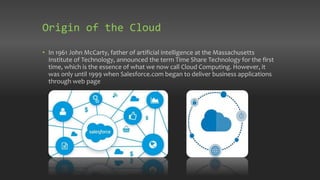
• In 1961 John McCarty, father of artificial intelligence at the Massachusetts
Institute of Technology, announced the term Time Share Technology for the first
time, which is the essence of what we now call Cloud Computing. However, it
was only until 1999 when Salesforce.com began to deliver business applications
through web page
• Currently Google, Amazon, Microsoft and several foreign companies dedicated to
offering a wide range of services related to the cloud, the term Cloud Computing
represents a new model in computing, because the cloud represents the evolution in
technologies in the construction of infrastructure for information technologies.
Composition of the Cloud
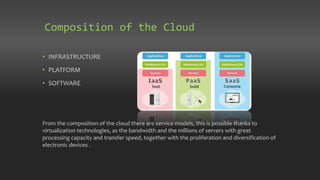
• INFRASTRUCTURE
• PLATFORM
• SOFTWARE
From the composition of the cloud there are service models, this is possible thanks to
virtualization technologies, as the bandwidth and the millions of servers with great
processing capacity and transfer speed, together with the proliferation and diversification of
electronic devices .
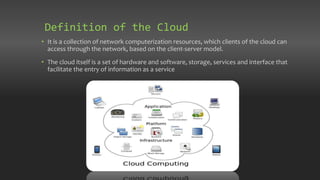
• It is a collection of network computerization resources, which clients of the cloud can
access through the network, based on the client-server model.
• The cloud itself is a set of hardware and software, storage, services and interface that
facilitate the entry of information as a service
Definition of the Cloud
• MODELS OF SERVICE:
• Software as a Service: The user lacks control over the cloud infrastructure, such as servers,
operating system, storage, even on their own applications, except for the customization
options to which users have access. An example of this is web emails like Gmail and Yahoo.
Cloud Models
• MODELS OF SERVICE:
• Platform as a Service: The user is allowed to deploy own applications created using
languages and tools supported by the provider, therefore the user has control over the
applications but not of the entire underlying infrastructure. Normally, the supplier offers tool
kits for the development of applications, distribution channels and payment of the same.
Cloud Models
• MODELS OF SERVICE:
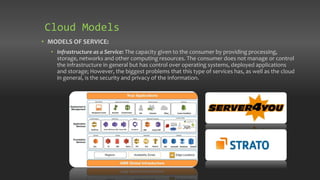
• Infrastructure as a Service: The capacity given to the consumer by providing processing,
storage, networks and other computing resources. The consumer does not manage or control
the infrastructure in general but has control over operating systems, deployed applications
and storage; However, the biggest problems that this type of services has, as well as the cloud
in general, is the security and privacy of the information.
Cloud Models
• MODELS OF DEPLOYMENT
• Public Cloud: It is operated, managed and hosted by a provider from one or more within data,
the management of security and operations is controlled by the provider of the services as
well as the offer also; This model obeys the standard model of cloud computing.
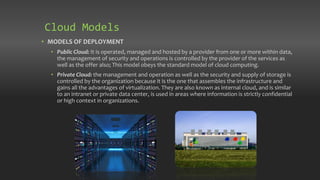
• Private Cloud: the management and operation as well as the security and supply of storage is
controlled by the organization because it is the one that assembles the infrastructure and
gains all the advantages of virtualization. They are also known as internal cloud, and is similar
to an intranet or private data center, is used in areas where information is strictly confidential
or high context in organizations.
Cloud Models
• MODELS OF DEPLOYMENT
• Hybrid Cloud: It is the combination of a public and private cloud where organizations share
information to the public and their employees as the case may be, but the sensitive data is
clearly charged to the private cloud.
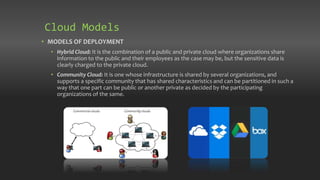
• Community Cloud: It is one whose infrastructure is shared by several organizations, and
supports a specific community that has shared characteristics and can be partitioned in such a
way that one part can be public or another private as decided by the participating
organizations of the same.
Cloud Models
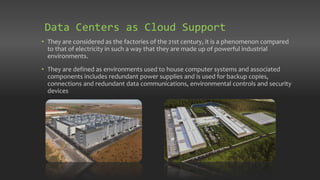
• They are considered as the factories of the 21st century, it is a phenomenon compared
to that of electricity in such a way that they are made up of powerful industrial
environments.
• They are defined as environments used to house computer systems and associated
components includes redundant power supplies and is used for backup copies,
connections and redundant data communications, environmental controls and security
devices
Data Centers as Cloud Support
• Joyanes Aguilar, L. (2015). Information systems in the company. Alfaomega Group
Editor.
Bibliography

Chapter "Cloud Computing Architecture and Services"

  • 1.
    Chapter 7 CloudComputing: Architecture and Services University College of Cundinamarca Management Information Systems Juan Sebastian Segura- 6B
  • 2.
    Origin of theCloud • In 1961 John McCarty, father of artificial intelligence at the Massachusetts Institute of Technology, announced the term Time Share Technology for the first time, which is the essence of what we now call Cloud Computing. However, it was only until 1999 when Salesforce.com began to deliver business applications through web page
  • 3.
    • Currently Google,Amazon, Microsoft and several foreign companies dedicated to offering a wide range of services related to the cloud, the term Cloud Computing represents a new model in computing, because the cloud represents the evolution in technologies in the construction of infrastructure for information technologies.
  • 4.
    Composition of theCloud • INFRASTRUCTURE • PLATFORM • SOFTWARE From the composition of the cloud there are service models, this is possible thanks to virtualization technologies, as the bandwidth and the millions of servers with great processing capacity and transfer speed, together with the proliferation and diversification of electronic devices .
  • 5.
    • It isa collection of network computerization resources, which clients of the cloud can access through the network, based on the client-server model. • The cloud itself is a set of hardware and software, storage, services and interface that facilitate the entry of information as a service Definition of the Cloud
  • 6.
    • MODELS OFSERVICE: • Software as a Service: The user lacks control over the cloud infrastructure, such as servers, operating system, storage, even on their own applications, except for the customization options to which users have access. An example of this is web emails like Gmail and Yahoo. Cloud Models
  • 7.
    • MODELS OFSERVICE: • Platform as a Service: The user is allowed to deploy own applications created using languages and tools supported by the provider, therefore the user has control over the applications but not of the entire underlying infrastructure. Normally, the supplier offers tool kits for the development of applications, distribution channels and payment of the same. Cloud Models
  • 8.
    • MODELS OFSERVICE: • Infrastructure as a Service: The capacity given to the consumer by providing processing, storage, networks and other computing resources. The consumer does not manage or control the infrastructure in general but has control over operating systems, deployed applications and storage; However, the biggest problems that this type of services has, as well as the cloud in general, is the security and privacy of the information. Cloud Models
  • 9.
    • MODELS OFDEPLOYMENT • Public Cloud: It is operated, managed and hosted by a provider from one or more within data, the management of security and operations is controlled by the provider of the services as well as the offer also; This model obeys the standard model of cloud computing. • Private Cloud: the management and operation as well as the security and supply of storage is controlled by the organization because it is the one that assembles the infrastructure and gains all the advantages of virtualization. They are also known as internal cloud, and is similar to an intranet or private data center, is used in areas where information is strictly confidential or high context in organizations. Cloud Models
  • 10.
    • MODELS OFDEPLOYMENT • Hybrid Cloud: It is the combination of a public and private cloud where organizations share information to the public and their employees as the case may be, but the sensitive data is clearly charged to the private cloud. • Community Cloud: It is one whose infrastructure is shared by several organizations, and supports a specific community that has shared characteristics and can be partitioned in such a way that one part can be public or another private as decided by the participating organizations of the same. Cloud Models
  • 11.
    • They areconsidered as the factories of the 21st century, it is a phenomenon compared to that of electricity in such a way that they are made up of powerful industrial environments. • They are defined as environments used to house computer systems and associated components includes redundant power supplies and is used for backup copies, connections and redundant data communications, environmental controls and security devices Data Centers as Cloud Support
  • 12.
    • Joyanes Aguilar,L. (2015). Information systems in the company. Alfaomega Group Editor. Bibliography