Objectives
Identify the following:
 Methods for denying pests access to an operation
 Methods for denying pests food and shelter
 Signs of pest infestation and activity
 How to correctly store pesticides
 How to select a pest control operator (PCO)
13-2
Integrated Pest Management (IPM) Programs
An IPM program:
 Uses prevention measures to keep pests
from entering the operation
 Uses control measures to eliminate any
pests that get inside
 Will be successful if you work closely
with a licensed pest control operator (PCO)
13-3
Integrated Pest Management (IPM) Programs
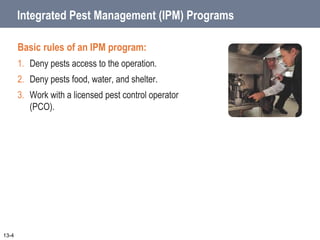
Basic rules of an IPM program:
1. Deny pests access to the operation.
2. Deny pests food, water, and shelter.
3. Work with a licensed pest control operator
(PCO).
13-4
Deny Pests Access
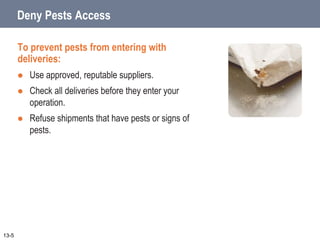
To prevent pests from entering with
deliveries:
 Use approved, reputable suppliers.
 Check all deliveries before they enter your
operation.
 Refuse shipments that have pests or signs of
pests.
13-5
Deny Pests Access
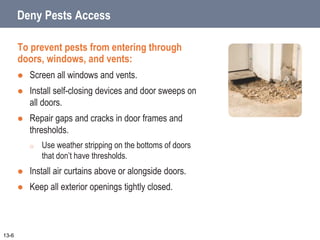
To prevent pests from entering through
doors, windows, and vents:
 Screen all windows and vents.
 Install self-closing devices and door sweeps on
all doors.
 Repair gaps and cracks in door frames and
thresholds.
o Use weather stripping on the bottoms of doors
that don’t have thresholds.
 Install air curtains above or alongside doors.
 Keep all exterior openings tightly closed.
13-6
Deny Pests Access
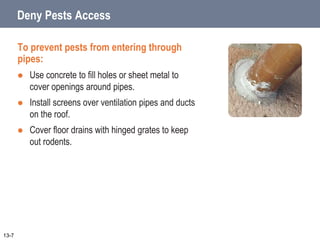
To prevent pests from entering through
pipes:
 Use concrete to fill holes or sheet metal to
cover openings around pipes.
 Install screens over ventilation pipes and ducts
on the roof.
 Cover floor drains with hinged grates to keep
out rodents.
13-7
Deny Pests Access
To prevent pests from entering through
floors and walls:
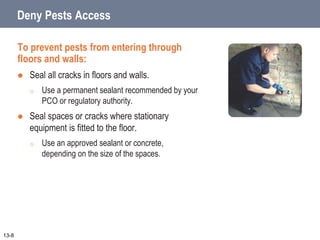
 Seal all cracks in floors and walls.
o Use a permanent sealant recommended by your
PCO or regulatory authority.
 Seal spaces or cracks where stationary
equipment is fitted to the floor.
o Use an approved sealant or concrete,
depending on the size of the spaces.
13-8
Deny Food and Shelter
Deny pests food and shelter in garbage:
 Throw out garbage quickly and correctly.
 Maintain garbage containers and storage areas.
o Keep containers clean and in good condition.
o Keep outdoor containers tightly covered.
o Clean up spills around containers immediately.
13-9
Deny Food and Shelter
Deny pests food and shelter in recyclables:
 Store recyclables correctly.
 Keep recyclables in clean, pest-proof containers.
 Keep containers as far away from the building as regulations allow.
13-10
Deny Food and Shelter
Deny pests food and shelter through good storage practices:
 Store food and supplies quickly and correctly.
 Keep them away from walls and at least six inches (15 cm) off the floor.
 Rotate products (FIFO) so pests cannot settle and breed.
13-11
Deny Food and Shelter
Deny pests food and shelter through good
cleaning practices:
 Clean up food and beverage spills immediately.
 Clean toilets and restrooms as often as
needed.
 Train staff to keep lockers and break areas
clean
 Keep cleaning tools and supplies clean and
dry.
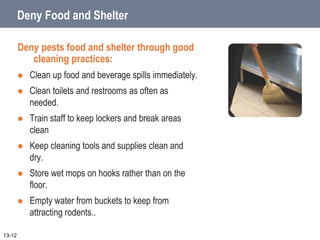
 Store wet mops on hooks rather than on the
floor.
 Empty water from buckets to keep from
attracting rodents..
13-12
Deny Food and Shelter
Deny pests food and shelter on the grounds and in outdoor dining
areas:
 Maintain the grounds.
o Mow the grass, pull weeds, get rid of standing water, and pick up litter.
 Cover all outdoor garbage containers.
 Remove uneaten food and dirty dishes from tables.
 Clean spills as quickly as possible.
 Do not feed birds or wildlife.
 Install electronic insect eliminators, or zappers, away from food, customers,
staff, and serving areas.
 Call your PCO to remove hives and nests.
13-13
Identifying Pests
Flies:
 Feed on garbage and waste
 Can spread pathogens such as Shigella spp.
13-14
Identifying Pests
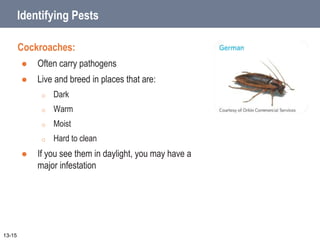
Cockroaches:
 Often carry pathogens
 Live and breed in places that are:
o Dark
o Warm
o Moist
o Hard to clean
 If you see them in daylight, you may have a
major infestation
13-15
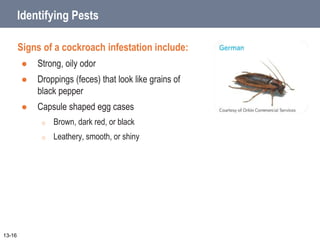
Identifying Pests
Signs of a cockroach infestation include:
 Strong, oily odor
 Droppings (feces) that look like grains of
black pepper
 Capsule shaped egg cases
o Brown, dark red, or black
o Leathery, smooth, or shiny
13-16
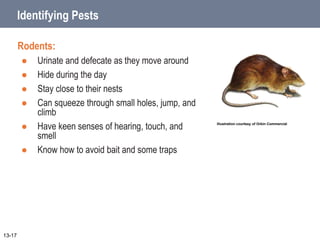
Identifying Pests
Rodents:
 Urinate and defecate as they move around
 Hide during the day
 Stay close to their nests
 Can squeeze through small holes, jump, and
climb
 Have keen senses of hearing, touch, and
smell
 Know how to avoid bait and some traps
Illustration courtesy of Orkin Commercial
13-17
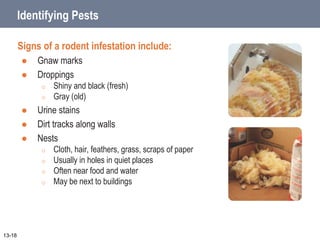
Identifying Pests
Signs of a rodent infestation include:
 Gnaw marks
 Droppings
o Shiny and black (fresh)
o Gray (old)
 Urine stains
 Dirt tracks along walls
 Nests
o Cloth, hair, feathers, grass, scraps of paper
o Usually in holes in quiet places
o Often near food and water
o May be next to buildings
13-18
Working with a Pest Control Operator (PCO)
Rely on your PCO to do the following:
 Develop an integrated approach to pest management.
 Stay current on new equipment and products.
 Provide prompt service to address problems as they occur.
 Keep records of all steps taken to prevent and control pests.
13-19
Working with a Pest Control Operator (PCO)
Before choosing a PCO:
 Check references.
 Make sure the PCO is licensed if required by your state.
 Require a written contract outlining work to be performed, which typically
includes the following.
o Description of services to be provided
o Period of service
o Your duties, including preventive measures and facility preparation before
and after treatment
o Records to be kept by the PCO
13-20
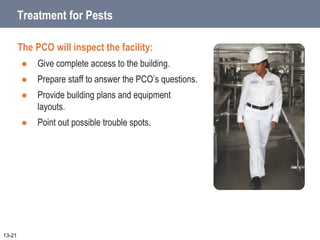
Treatment for Pests
The PCO will inspect the facility:
 Give complete access to the building.
 Prepare staff to answer the PCO’s questions.
 Provide building plans and equipment
layouts.
 Point out possible trouble spots.
13-21
Treatment for Pests
The treatment plan should include:
 Treatments used for each area or problem and the potential risks
 Dates and times of each treatment
o Staff should not be on-site during the treatment
 Steps you can take to control pests
 Building defects that hinder prevention and control
 Timing of follow-up visits
13-22
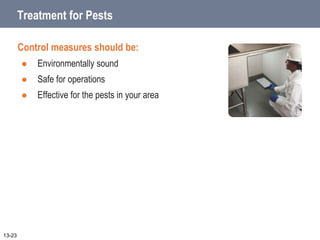
Treatment for Pests
Control measures should be:
 Environmentally sound
 Safe for operations
 Effective for the pests in your area
13-23
Using and Storing Pesticides
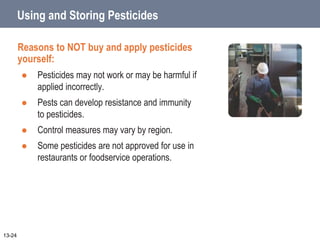
Reasons to NOT buy and apply pesticides
yourself:
 Pesticides may not work or may be harmful if
applied incorrectly.
 Pests can develop resistance and immunity
to pesticides.
 Control measures may vary by region.
 Some pesticides are not approved for use in
restaurants or foodservice operations.
13-24
Using and Storing Pesticides
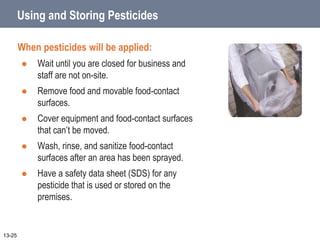
When pesticides will be applied:
 Wait until you are closed for business and
staff are not on-site.
 Remove food and movable food-contact
surfaces.
 Cover equipment and food-contact surfaces
that can’t be moved.
 Wash, rinse, and sanitize food-contact
surfaces after an area has been sprayed.
 Have a safety data sheet (SDS) for any
pesticide that is used or stored on the
premises.
13-25
Using and Storing Pesticides
If pesticides will be stored on the premises:
 Keep them in their original containers.
 Store them in a secure location away from food, utensils, and equipment.
To dispose of pesticides:
 Check local regulations.
 Follow manufacturers’ directions and regulatory requirements to dispose
of empty containers.
13-26

Chapter 13 (College HIA)

  • 2.
    Objectives Identify the following: Methods for denying pests access to an operation  Methods for denying pests food and shelter  Signs of pest infestation and activity  How to correctly store pesticides  How to select a pest control operator (PCO) 13-2
  • 3.
    Integrated Pest Management(IPM) Programs An IPM program:  Uses prevention measures to keep pests from entering the operation  Uses control measures to eliminate any pests that get inside  Will be successful if you work closely with a licensed pest control operator (PCO) 13-3
  • 4.
    Integrated Pest Management(IPM) Programs Basic rules of an IPM program: 1. Deny pests access to the operation. 2. Deny pests food, water, and shelter. 3. Work with a licensed pest control operator (PCO). 13-4
  • 5.
    Deny Pests Access Toprevent pests from entering with deliveries:  Use approved, reputable suppliers.  Check all deliveries before they enter your operation.  Refuse shipments that have pests or signs of pests. 13-5
  • 6.
    Deny Pests Access Toprevent pests from entering through doors, windows, and vents:  Screen all windows and vents.  Install self-closing devices and door sweeps on all doors.  Repair gaps and cracks in door frames and thresholds. o Use weather stripping on the bottoms of doors that don’t have thresholds.  Install air curtains above or alongside doors.  Keep all exterior openings tightly closed. 13-6
  • 7.
    Deny Pests Access Toprevent pests from entering through pipes:  Use concrete to fill holes or sheet metal to cover openings around pipes.  Install screens over ventilation pipes and ducts on the roof.  Cover floor drains with hinged grates to keep out rodents. 13-7
  • 8.
    Deny Pests Access Toprevent pests from entering through floors and walls:  Seal all cracks in floors and walls. o Use a permanent sealant recommended by your PCO or regulatory authority.  Seal spaces or cracks where stationary equipment is fitted to the floor. o Use an approved sealant or concrete, depending on the size of the spaces. 13-8
  • 9.
    Deny Food andShelter Deny pests food and shelter in garbage:  Throw out garbage quickly and correctly.  Maintain garbage containers and storage areas. o Keep containers clean and in good condition. o Keep outdoor containers tightly covered. o Clean up spills around containers immediately. 13-9
  • 10.
    Deny Food andShelter Deny pests food and shelter in recyclables:  Store recyclables correctly.  Keep recyclables in clean, pest-proof containers.  Keep containers as far away from the building as regulations allow. 13-10
  • 11.
    Deny Food andShelter Deny pests food and shelter through good storage practices:  Store food and supplies quickly and correctly.  Keep them away from walls and at least six inches (15 cm) off the floor.  Rotate products (FIFO) so pests cannot settle and breed. 13-11
  • 12.
    Deny Food andShelter Deny pests food and shelter through good cleaning practices:  Clean up food and beverage spills immediately.  Clean toilets and restrooms as often as needed.  Train staff to keep lockers and break areas clean  Keep cleaning tools and supplies clean and dry.  Store wet mops on hooks rather than on the floor.  Empty water from buckets to keep from attracting rodents.. 13-12
  • 13.
    Deny Food andShelter Deny pests food and shelter on the grounds and in outdoor dining areas:  Maintain the grounds. o Mow the grass, pull weeds, get rid of standing water, and pick up litter.  Cover all outdoor garbage containers.  Remove uneaten food and dirty dishes from tables.  Clean spills as quickly as possible.  Do not feed birds or wildlife.  Install electronic insect eliminators, or zappers, away from food, customers, staff, and serving areas.  Call your PCO to remove hives and nests. 13-13
  • 14.
    Identifying Pests Flies:  Feedon garbage and waste  Can spread pathogens such as Shigella spp. 13-14
  • 15.
    Identifying Pests Cockroaches:  Oftencarry pathogens  Live and breed in places that are: o Dark o Warm o Moist o Hard to clean  If you see them in daylight, you may have a major infestation 13-15
  • 16.
    Identifying Pests Signs ofa cockroach infestation include:  Strong, oily odor  Droppings (feces) that look like grains of black pepper  Capsule shaped egg cases o Brown, dark red, or black o Leathery, smooth, or shiny 13-16
  • 17.
    Identifying Pests Rodents:  Urinateand defecate as they move around  Hide during the day  Stay close to their nests  Can squeeze through small holes, jump, and climb  Have keen senses of hearing, touch, and smell  Know how to avoid bait and some traps Illustration courtesy of Orkin Commercial 13-17
  • 18.
    Identifying Pests Signs ofa rodent infestation include:  Gnaw marks  Droppings o Shiny and black (fresh) o Gray (old)  Urine stains  Dirt tracks along walls  Nests o Cloth, hair, feathers, grass, scraps of paper o Usually in holes in quiet places o Often near food and water o May be next to buildings 13-18
  • 19.
    Working with aPest Control Operator (PCO) Rely on your PCO to do the following:  Develop an integrated approach to pest management.  Stay current on new equipment and products.  Provide prompt service to address problems as they occur.  Keep records of all steps taken to prevent and control pests. 13-19
  • 20.
    Working with aPest Control Operator (PCO) Before choosing a PCO:  Check references.  Make sure the PCO is licensed if required by your state.  Require a written contract outlining work to be performed, which typically includes the following. o Description of services to be provided o Period of service o Your duties, including preventive measures and facility preparation before and after treatment o Records to be kept by the PCO 13-20
  • 21.
    Treatment for Pests ThePCO will inspect the facility:  Give complete access to the building.  Prepare staff to answer the PCO’s questions.  Provide building plans and equipment layouts.  Point out possible trouble spots. 13-21
  • 22.
    Treatment for Pests Thetreatment plan should include:  Treatments used for each area or problem and the potential risks  Dates and times of each treatment o Staff should not be on-site during the treatment  Steps you can take to control pests  Building defects that hinder prevention and control  Timing of follow-up visits 13-22
  • 23.
    Treatment for Pests Controlmeasures should be:  Environmentally sound  Safe for operations  Effective for the pests in your area 13-23
  • 24.
    Using and StoringPesticides Reasons to NOT buy and apply pesticides yourself:  Pesticides may not work or may be harmful if applied incorrectly.  Pests can develop resistance and immunity to pesticides.  Control measures may vary by region.  Some pesticides are not approved for use in restaurants or foodservice operations. 13-24
  • 25.
    Using and StoringPesticides When pesticides will be applied:  Wait until you are closed for business and staff are not on-site.  Remove food and movable food-contact surfaces.  Cover equipment and food-contact surfaces that can’t be moved.  Wash, rinse, and sanitize food-contact surfaces after an area has been sprayed.  Have a safety data sheet (SDS) for any pesticide that is used or stored on the premises. 13-25
  • 26.
    Using and StoringPesticides If pesticides will be stored on the premises:  Keep them in their original containers.  Store them in a secure location away from food, utensils, and equipment. To dispose of pesticides:  Check local regulations.  Follow manufacturers’ directions and regulatory requirements to dispose of empty containers. 13-26