CHAPTER ONE
1. INTRODUCTION TO FOOD AND BEVERAGE CONTROL
• Food and beverage control may be defined as the
guidance and regulation of the costs and revenue of
operating the catering activity in a food and beverage
establishment.
• A successful holistic food and beverage control is imperative
for any type of food and beverage operation regardless of
its size.
• The cost of food and beverage can range from 25% to up to
50% (even more) depending on the type of operation.
Con’t
• In restaurants, food and beverage can be the only source of revenue.
• The amount of control is related to the size of the operation.
• A large group operation would require much more precise, detailed, up-to-date
information, than a small operation.
• Additionally a larger operation will be able to support the control with a
computerized system
• When a smaller operation may not be able to afford it (however the cost of such
technology has
• In both instances the type and volume of data required needs to be selectively
determined if control is to be meaningful and effective.
It is important at this stage to clarify the limitations of a control system.
• A control system can only identify problem areas and trends in the
business.
• The system cannot automatically correct such problem areas.
• A control system will require constant management supervision to
ensure that it functions efficiently.
• A control system will need management action to evaluate the
information produced and to act upon it.
1.2 THE OBJECTIVES OF FOOD AND BEVERAGE CONTROL
1. Analysis of income and expenditure
 The analysis is solely concerned with the income and
expenditure related to food and beverage operations.
• The revenue analysis is usually by each selling outlet, of
such aspects as the volume of food and beverage
sales, the sales mix, the average spending power (ASP)
of customers at various times of the day, and the
number of customers served.
• The analysis of costs includes departmental food and
beverage costs, portion costs and labor costs
Con’t
• The performance of each outlet can then be expressed in terms of
the gross profit and the net margin
Revenue - Expenses= Profit
A. Revenue
• Revenue dollars are the result of units sold. These units may consist of individual
menu items, lunches, dinners, drinks, or any other item produced by your
operation.
You can increase revenue by increasing the number of guests you serve, by increasing
the amount each guest spends, or by a combination of both approaches.
B. Expenses
• There are four major food service expense categories that you must
learn to control.
• They are:
1. Food costs
2. Beverage costs
3. Labor costs
4. Other expenses
1. Food Costs
• Food costs are the costs associated with actually producing the
menu items a guest selects.
• They include the expense of meats, dairy, fruits, vegetables, and
other categories of food items produced by the foodservice
operation.
• In most cases, food costs will make up the largest or second largest
expense category you must learn to manage.
2. Beverage Costs
• Beverage costs are those related to the sale of alcoholic beverages and
nonalcoholic nature as an expense in the food cost category. Thus, milk, tea, coffee,
carbonated beverages, and other nonalcoholic beverage items are not generally
considered a beverage cost.
• Alcoholic beverages accounted for in the beverage cost category include beer,
wine, and liquor.
• This category may also include the costs of ingredients necessary to produce these
drinks, such as cherries, lemons, olives, limes, mixers like carbonated beverages and
juices, and other items commonly used in the production and service of alcoholic
beverages.
3. Labor Costs
• Labor costs include the cost of all employees necessary to
run the business.
• In most operations, however, labor costs are second only to
food costs in total dollars spent.
• If management is included as a labor cost rather than other
expense, then this category can well be even larger than the
food cost category.
4. Other Expenses (Overhead Cost)
• Other expenses include all expenses that are neither food, nor beverage, nor labor.
• Examples include franchise fees, utilities, rent, linen, and such items as china, glassware,
kitchen knives, and pots and pans.
• While this expense category is sometimes incorrectly referred to as ―minor expenses,‖
your ability to successfully control this expense area is critical to the
• overall profitability of your foodservice unit.
• Revenue - Expense = Profit
• $1,600 - $1,200 = $400
Con’t
:These numbers can also be expressed in terms of percent. If we want
to know what percent of our revenue went to expenses, we would
compute it as follows:
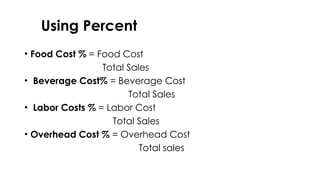
Using Percent
• Food Cost % = Food Cost
Total Sales
• Beverage Cost% = Beverage Cost
Total Sales
• Labor Costs % = Labor Cost
Total Sales
• Overhead Cost % = Overhead Cost
Total sales
2. Establishment and maintenance of standards :
• The basis for the operation of any food and beverage outlet is the
establishment of a set of standards which would be particular to an
operation.
• Unless standards are set no employee would know in detail the standards
to be achieved nor could the employee‘s performance be effectively
measured by management
• An efficient unit would have the set standards laid down in manuals often
known as SOPs (standard operational procedures) which should be readily
available to all staff for reference.
3.Pricing
• An important objective of food and beverage control is to provide a
sound basis for menu pricing including quotations for special functions.
• It is, therefore, important to determine food menu and beverage list
prices in the light of accurate food and beverage costs and other
main establishment costs; as well as general market considerations,
such as the average customer spending power
• the prices charged by competitors and the prices that the market will
accept .
Menu pricing
• Menu pricing needs to fulfill two needs, for the caterer the need to
make adequate profits and for the customer the need to satisfy
getting value for money.
• In both cases the requirement for accuracy is paramount. Customers
today are more sophisticated in their dining habits,
• more people eat out, many are well travelled and nearly all have
gained perceptions of quality and value for money from watching
celebrity chefs and other food profitability.
Factors
Influencing Menu Price
1. Local competition
2. Service levels
3. Guest type
4. Product quality
5. Portion size
6. Ambiance
7. Location
4. Prevention of Waste
• In order to achieve performance standards for an establishment, targets
are set for revenue, cost levels and profit margins.
• To achieve these levels of performance it is necessary to prevent
wastage of materials caused by such things as poor preparation, over-
production, failure to use standard recipes, etc.
• This can only be done with an efficient method of control, which covers
the complete cycle of food and beverage control, from the basic
policies of the organization to the management control after the
operation has been completed.
Perishables and Non perishables
• The types of foods to be purchased for any foodservice enterprise can be
divided into two categories: perishables and nonperishables.
• Perishable foods are those items, typically fresh foods that have a
comparatively short useful life after they have been received.
• Various kinds of lettuce and fresh fish, for example, begin to lose their
quality very quickly.
• Perishables, then, should be purchased for immediate use in order to take
advantage of the quality desired at the time of purchase
Con’t
• Nonperishable foods are those food items that have longer shelf lives.
• Frequently referred to as groceries or staples, they may be stored in the
packages or containers in which they are received, often on shelves
and at room temperature, for weeks or even months.
• Foods that typically fall into this category of nonperishable include salt,
sugar, canned fruits and vegetables, spices, and flavorings.
5. Prevention of fraud
• It is necessary for a control system to prevent or at least restrict the possible
areas of fraud by customers and staff.
• Typical areas of fraud by customers are such things as deliberately walking out
without paying; unjustified-ably claiming that the food or drink that they had
partly or totally consumed was unpalatable
• and indicating that they will not pay for it; disputing the number of drinks
served; making payments by stolen cheques or credit cards.
• Typical areas of fraud by staff are overcharging or undercharging for items
served and stealing of food, drink or cash.
6.Management information
• A system of control has an important task to fulfill in providing accurate
up-to-date information for the preparation of periodical reports for
management.
• This information should be sufficient so as to provide a complete analysis
of performance for each outlet of an establishment for
• comparison with set standards previously laid down (e.g. budget
standards).
Con’t
• It is therefore imperative that depending on the size of the
operation appropriate control is applied, for example,
• a small operation may not require daily, weekly and
periodic reports whilst
• a larger operation will probably require them so that
management may take both corrective and preventive
action quickly.
1.3 Special problems of food and beverage control
• Food and beverage control tends to be more difficult than the control of
materials in many other industries.
The main reasons for this are:
1. Perish ability of the product:
• Food, whether raw or cooked, is a perishable commodity and has a limited life.
• The caterer, therefore, has to ensure that she buys produce in the correct quality
and quantity in relation to estimated demand, and that it is correctly stored and
processed (beverages are less perishable and this contributes to easier control).
2.Business volume unpredictability
• Sales instability is typical of most catering establishments.
There is often a change in the volume of business from day
to day, and in many establishments from hour to hour.
• This causes basic problems with regard to the quantities of
commodities to be purchased and prepared as well as to
the staffing required
3. Menu mix unpredictability
• In order to be competitive and satisfy a particular market,
caterers must often offer a wide choice of menu items to the
customer.
• Predicting menu item preference on top of customer volume
can be a challenge.
• Effective forecasting as part of the total food and beverage
control system is therefore necessary.
4. Food and beverage operation short cycle
• The speed at which catering operations take place, relative to many
other industries, allows little time for many control tasks.
• It is not uncommon that items ordered one day are received, processed
and sold the same or next day.
• It is for this reason that in larger catering establishments cost reporting is
done daily or at least weekly.
• Further problems, particularly with perishable foods, are that with a short
life for produce, items cannot be bought very much in advance of their
need;
• and the problem of availability at times of produce relative to the price
that can be afforded in relation to the selling price
5. Departmentalization
• Many food and beverage operations have several production and
service departments, offering different products and operating under
different policies.
• It is, therefore, necessary to be able to produce separate trading
results for each of the production and selling.
1.4 The fundamentals of control
• Effective control systems and procedures consist of three
broad phases: planning, operational and management
control after the operation has taken place.
1.4.1 The planning phase
• It is difficult to run an effective catering operation without having
firstly defined the basic policies.
• Policies are pre-determined guidelines, laid down by the senior
management of an organization
• Which outline such matters as the market segment of the market
that is being aimed at, how it is to be catered for, and the level of
profitability/subsidy to be achieved.
• A catering operation should have its policies clearly defined before
it commences business, and re-defined whenever a major change
takes place,
• for example, when a new theme is chosen for a restaurant to aim
for a different market segment.
Con’t
• in a large organization the policies should be written down and
periodically reviewed in relation to the current business and future
trends;
• however, in smaller organizations there is not the communication
problem of
• a large organization and to formally draw up and commit policies
to paper is not so vital.
• There are three basic policies which need to be considered:
1.4.1.1 The financial policy
• The financial policy will determine the level of profitability, subsidy or
cost limits to be expected from the business a whole and the
contribution to the total profit, subsidy or cost limit
• that is to be expected from each unit, and then from the
departments within them.
• This involves the setting of targets for the business as a whole as well
as each unit and the departments within them
Con’t
• The financial policy for the catering department will set the
overall target for the department itself,
• which will be further divided into targets for the various
restaurants, bars and function facilities.
• Thus, the financial policy for a large hotel will set profit
targets for the hotel, and departmental profit targets for the
accommodation and catering as well as other departments
1.4.1.2 The marketing policy
• The marketing policy will identify the broad market the operation is
intended to serve and the particular segment(s) of the market upon
which it intends to concentrate.
• The broad market intended to be served by a large city hotel could
be broken down into the specific segments of the various types of
users of, for example, the coffee shop, the cocktail bar, the
banqueting rooms,each having specific and different consumer
requirements.
Con’t
• Generally, a commercial catering organization into a marketing plan
for the next year may include some or all of the following objectives:
• National identity – to achieve a better national identity for all units by
corporate design and by meeting consumer expectations of what a
‗popular restaurant‘ concept should be.
• Customer – the customer profile being the business person, shopper,
tourist of either sex, aged twenty-five years or more,
Con’t
• Market share – to achieve, maintain or increase the percentage of
‗our‘ market.
• Turnover – sales volume to be increased by x % on previous year.
• Profitability – profit to be increased by each unit by y % on previous
year.
• ASP per customer to be increased by z % – to achieve a new ASP of
not less than x$.
• Product – the product to be maintained at a consistently high
standard.
• Customer satisfaction – the net result must be the satisfaction of
every customer
1.4.1.3 The catering policy
The catering policy, which is normally evolved from the financial and marketing
policies, will define the main objectives of operating the food and beverage
facilities and describe the methods by which such objectives are to be
achieved.
It will usually include the following:
The type of customer , for example high spending business executive, low
spending
female shopper etc.
The type of menu ( s ), for example table d ‘ hôte, à la carte, fast food.
Con’t
• The food quality standards, for example fresh, frozen, canned, etc. and
the grade of Produce to be used.
• The method of buying, for example by contract, quotation, cash and
carry, etc.
• Type and quality of service, for example cafeteria, counter, waiter, etc.
• Degree of comfort and décor, for example square footage per
customer, type and Style of décor, of chairs, tables, etc.
• Hours of operation, for example twenty-four hours, seven days a week.
2. The operational phase
• Having defined the policies (i.e. pre-determined
guidelines), it is then necessary to outline how they are to
be interpreted into the day-to-day control activities of the
catering operation.
• The operational control is in five main stages of the
control cycle. These are:
1. Purchasing
• Product testing – to identify as a result of a series of taste panel evaluations
the particular products to be used.
• Yield testing – to identify as a result of tests the yield obtainable from all the
major commodities used.
• Purchase specifications – a specification is a concise description in writing of
the quality, size, weight, etc. for a particular food or beverage item.
• Method of buying – by contract, quotation, cash and carry, etc.
• Clerical procedures – it is necessary to determine who originates sanctions
and places orders and what documentation is required for control.
2. Receiving
• Quantity inspection – a person must be nominated to be responsible for physically
counting and weighing goods and checking that the quantity and size of items in
the delivery matches the purchase order.
• Quality inspection – this is particularly important with perishable foods where
inspection may be made by a senior chef.
• Clerical procedures – this is a very important aspect as all necessary
documentation must follow a set procedure.
• It includes the acknowledgement of the receipt of acceptable goods and the
delivery person‘s signature on a request for credit‘ note for returned goods and
short deliveries.
3. Storing and issuing
• Stock records – it is necessary to decide what records are to be kept.
• Pricing of items – the method of pricing of the various types of items must be
decided upon so that there is consistency within the operation.
• Stocktaking – the points to be considered here are the level of stock to be
held, rate of stock turnover, dealing with discrepancies, identification of slow-
moving items, etc.
• Clerical procedures – there is a need to determine what documentation is
necessary, for example requisitions, record cards, bin cards, stocktaking
reports, etc.
4. Preparing
• This is a critical stage in the control cycle, in particular for food. There are three
main points to be considered:
• Volume forecasting – a method of predicting the number of customers using
the catering facilities on a specific day, and also of predicting as accurately as
possible what items they will eat and drink.
• Pre-costing – a method of controlling food and beverage costs in advance of
the preparation and service stages.
• It is done by preparing and using standard recipes for all food and
beverage.items and also by using portion control equipment, for example
ladles, scales, optics, standard glassware, etc.
Con’t
• Clerical procedures – what documentation is required and the
distribution and destination of this information.
5. Selling
This important stage of operational control needs to take into consideration the
following points:
• A checking system – this is necessary to keep control of the number of covers sold
and of the items sold. This may be done through a standard type of waiter‘s check
system
• The control of cash – this is vitally important. It is necessary to ensure that all items sold
have been paid for and that the money is received or credit has been authorized.
• Clerical procedures – these would be necessary to control items sold and the money
received or credit entitled, and would often include a restaurant checking system,
meal and sales analysis, cashier ‘ s paying-in book, etc.
1.4.3 The post operation phase
• This final phase of food and beverage control is in three main stages:
1. Food and beverage cost reporting
• The cycle of production is very short and the product is perishable.
These factors together with the variations in demand for the product
necessitate up_x0002_to-date reporting at least weekly if not daily.
2. Assessment
• There is a need for someone from the food and beverage management team in the
case of a large unit, or the proprietor or manager of a small unit, to analyze the food
and beverage reports and to
• compare them with the budget for the period and against previous actual
performance.
3. Correction:
• A control system does not cure or prevent problems occurring. When the analysis
of the performance of a unit or department identifies that there is a problem,
• it is up to management to take the necessary steps to correct the problem as
quickly as possible.
1.5 The reality of control
• The larger the number of out lets within an operation, the
more sophisticated should be the level of control.
• How end we should realize that the extent to which any control
system can be totally efficient.
• No matter how effective a control system may be there are certain
realities that do not allow for any system to be 100% efficient.
The reasons for the deficiency of a system can be:
Con’t
• The material product (apart from purchased beverages) is very unlikely to be 100%
consistent as to quality or the final yield obtainable from it.
• The employees are unlikely to work to a level of 100% efficiency at all times, in spite of
the fact that operational standards may exist.
• The equipment used is also unlikely to work to the level of 100% efficiency at all times,
and this could well affect the yield obtainable.
• The customers‘ choice of dishes can well be different at times to some of the
budgeted sales mix, therefore affecting all forecasts. It is important that the staff
should see that
• control in some form is taking place and that on occasions there is a follow-up and
action is taken on irregularities to set standards.

Chapter 1. food and beverage control.pptx

  • 1.
    CHAPTER ONE 1. INTRODUCTIONTO FOOD AND BEVERAGE CONTROL • Food and beverage control may be defined as the guidance and regulation of the costs and revenue of operating the catering activity in a food and beverage establishment. • A successful holistic food and beverage control is imperative for any type of food and beverage operation regardless of its size. • The cost of food and beverage can range from 25% to up to 50% (even more) depending on the type of operation.
  • 2.
    Con’t • In restaurants,food and beverage can be the only source of revenue. • The amount of control is related to the size of the operation. • A large group operation would require much more precise, detailed, up-to-date information, than a small operation. • Additionally a larger operation will be able to support the control with a computerized system • When a smaller operation may not be able to afford it (however the cost of such technology has • In both instances the type and volume of data required needs to be selectively determined if control is to be meaningful and effective.
  • 3.
    It is importantat this stage to clarify the limitations of a control system. • A control system can only identify problem areas and trends in the business. • The system cannot automatically correct such problem areas. • A control system will require constant management supervision to ensure that it functions efficiently. • A control system will need management action to evaluate the information produced and to act upon it.
  • 4.
    1.2 THE OBJECTIVESOF FOOD AND BEVERAGE CONTROL 1. Analysis of income and expenditure  The analysis is solely concerned with the income and expenditure related to food and beverage operations. • The revenue analysis is usually by each selling outlet, of such aspects as the volume of food and beverage sales, the sales mix, the average spending power (ASP) of customers at various times of the day, and the number of customers served. • The analysis of costs includes departmental food and beverage costs, portion costs and labor costs
  • 5.
    Con’t • The performanceof each outlet can then be expressed in terms of the gross profit and the net margin Revenue - Expenses= Profit A. Revenue • Revenue dollars are the result of units sold. These units may consist of individual menu items, lunches, dinners, drinks, or any other item produced by your operation. You can increase revenue by increasing the number of guests you serve, by increasing the amount each guest spends, or by a combination of both approaches.
  • 6.
    B. Expenses • Thereare four major food service expense categories that you must learn to control. • They are: 1. Food costs 2. Beverage costs 3. Labor costs 4. Other expenses
  • 7.
    1. Food Costs •Food costs are the costs associated with actually producing the menu items a guest selects. • They include the expense of meats, dairy, fruits, vegetables, and other categories of food items produced by the foodservice operation. • In most cases, food costs will make up the largest or second largest expense category you must learn to manage.
  • 8.
    2. Beverage Costs •Beverage costs are those related to the sale of alcoholic beverages and nonalcoholic nature as an expense in the food cost category. Thus, milk, tea, coffee, carbonated beverages, and other nonalcoholic beverage items are not generally considered a beverage cost. • Alcoholic beverages accounted for in the beverage cost category include beer, wine, and liquor. • This category may also include the costs of ingredients necessary to produce these drinks, such as cherries, lemons, olives, limes, mixers like carbonated beverages and juices, and other items commonly used in the production and service of alcoholic beverages.
  • 9.
    3. Labor Costs •Labor costs include the cost of all employees necessary to run the business. • In most operations, however, labor costs are second only to food costs in total dollars spent. • If management is included as a labor cost rather than other expense, then this category can well be even larger than the food cost category.
  • 10.
    4. Other Expenses(Overhead Cost) • Other expenses include all expenses that are neither food, nor beverage, nor labor. • Examples include franchise fees, utilities, rent, linen, and such items as china, glassware, kitchen knives, and pots and pans. • While this expense category is sometimes incorrectly referred to as ―minor expenses,‖ your ability to successfully control this expense area is critical to the • overall profitability of your foodservice unit. • Revenue - Expense = Profit • $1,600 - $1,200 = $400
  • 11.
    Con’t :These numbers canalso be expressed in terms of percent. If we want to know what percent of our revenue went to expenses, we would compute it as follows:
  • 12.
    Using Percent • FoodCost % = Food Cost Total Sales • Beverage Cost% = Beverage Cost Total Sales • Labor Costs % = Labor Cost Total Sales • Overhead Cost % = Overhead Cost Total sales
  • 13.
    2. Establishment andmaintenance of standards : • The basis for the operation of any food and beverage outlet is the establishment of a set of standards which would be particular to an operation. • Unless standards are set no employee would know in detail the standards to be achieved nor could the employee‘s performance be effectively measured by management • An efficient unit would have the set standards laid down in manuals often known as SOPs (standard operational procedures) which should be readily available to all staff for reference.
  • 14.
    3.Pricing • An importantobjective of food and beverage control is to provide a sound basis for menu pricing including quotations for special functions. • It is, therefore, important to determine food menu and beverage list prices in the light of accurate food and beverage costs and other main establishment costs; as well as general market considerations, such as the average customer spending power • the prices charged by competitors and the prices that the market will accept .
  • 15.
    Menu pricing • Menupricing needs to fulfill two needs, for the caterer the need to make adequate profits and for the customer the need to satisfy getting value for money. • In both cases the requirement for accuracy is paramount. Customers today are more sophisticated in their dining habits, • more people eat out, many are well travelled and nearly all have gained perceptions of quality and value for money from watching celebrity chefs and other food profitability.
  • 16.
    Factors Influencing Menu Price 1.Local competition 2. Service levels 3. Guest type 4. Product quality 5. Portion size 6. Ambiance 7. Location
  • 17.
    4. Prevention ofWaste • In order to achieve performance standards for an establishment, targets are set for revenue, cost levels and profit margins. • To achieve these levels of performance it is necessary to prevent wastage of materials caused by such things as poor preparation, over- production, failure to use standard recipes, etc. • This can only be done with an efficient method of control, which covers the complete cycle of food and beverage control, from the basic policies of the organization to the management control after the operation has been completed.
  • 18.
    Perishables and Nonperishables • The types of foods to be purchased for any foodservice enterprise can be divided into two categories: perishables and nonperishables. • Perishable foods are those items, typically fresh foods that have a comparatively short useful life after they have been received. • Various kinds of lettuce and fresh fish, for example, begin to lose their quality very quickly. • Perishables, then, should be purchased for immediate use in order to take advantage of the quality desired at the time of purchase
  • 19.
    Con’t • Nonperishable foodsare those food items that have longer shelf lives. • Frequently referred to as groceries or staples, they may be stored in the packages or containers in which they are received, often on shelves and at room temperature, for weeks or even months. • Foods that typically fall into this category of nonperishable include salt, sugar, canned fruits and vegetables, spices, and flavorings.
  • 20.
    5. Prevention offraud • It is necessary for a control system to prevent or at least restrict the possible areas of fraud by customers and staff. • Typical areas of fraud by customers are such things as deliberately walking out without paying; unjustified-ably claiming that the food or drink that they had partly or totally consumed was unpalatable • and indicating that they will not pay for it; disputing the number of drinks served; making payments by stolen cheques or credit cards. • Typical areas of fraud by staff are overcharging or undercharging for items served and stealing of food, drink or cash.
  • 21.
    6.Management information • Asystem of control has an important task to fulfill in providing accurate up-to-date information for the preparation of periodical reports for management. • This information should be sufficient so as to provide a complete analysis of performance for each outlet of an establishment for • comparison with set standards previously laid down (e.g. budget standards).
  • 22.
    Con’t • It istherefore imperative that depending on the size of the operation appropriate control is applied, for example, • a small operation may not require daily, weekly and periodic reports whilst • a larger operation will probably require them so that management may take both corrective and preventive action quickly.
  • 23.
    1.3 Special problemsof food and beverage control • Food and beverage control tends to be more difficult than the control of materials in many other industries. The main reasons for this are: 1. Perish ability of the product: • Food, whether raw or cooked, is a perishable commodity and has a limited life. • The caterer, therefore, has to ensure that she buys produce in the correct quality and quantity in relation to estimated demand, and that it is correctly stored and processed (beverages are less perishable and this contributes to easier control).
  • 24.
    2.Business volume unpredictability •Sales instability is typical of most catering establishments. There is often a change in the volume of business from day to day, and in many establishments from hour to hour. • This causes basic problems with regard to the quantities of commodities to be purchased and prepared as well as to the staffing required
  • 25.
    3. Menu mixunpredictability • In order to be competitive and satisfy a particular market, caterers must often offer a wide choice of menu items to the customer. • Predicting menu item preference on top of customer volume can be a challenge. • Effective forecasting as part of the total food and beverage control system is therefore necessary.
  • 26.
    4. Food andbeverage operation short cycle • The speed at which catering operations take place, relative to many other industries, allows little time for many control tasks. • It is not uncommon that items ordered one day are received, processed and sold the same or next day. • It is for this reason that in larger catering establishments cost reporting is done daily or at least weekly. • Further problems, particularly with perishable foods, are that with a short life for produce, items cannot be bought very much in advance of their need; • and the problem of availability at times of produce relative to the price that can be afforded in relation to the selling price
  • 27.
    5. Departmentalization • Manyfood and beverage operations have several production and service departments, offering different products and operating under different policies. • It is, therefore, necessary to be able to produce separate trading results for each of the production and selling.
  • 28.
    1.4 The fundamentalsof control • Effective control systems and procedures consist of three broad phases: planning, operational and management control after the operation has taken place.
  • 29.
    1.4.1 The planningphase • It is difficult to run an effective catering operation without having firstly defined the basic policies. • Policies are pre-determined guidelines, laid down by the senior management of an organization • Which outline such matters as the market segment of the market that is being aimed at, how it is to be catered for, and the level of profitability/subsidy to be achieved. • A catering operation should have its policies clearly defined before it commences business, and re-defined whenever a major change takes place, • for example, when a new theme is chosen for a restaurant to aim for a different market segment.
  • 30.
    Con’t • in alarge organization the policies should be written down and periodically reviewed in relation to the current business and future trends; • however, in smaller organizations there is not the communication problem of • a large organization and to formally draw up and commit policies to paper is not so vital. • There are three basic policies which need to be considered:
  • 31.
    1.4.1.1 The financialpolicy • The financial policy will determine the level of profitability, subsidy or cost limits to be expected from the business a whole and the contribution to the total profit, subsidy or cost limit • that is to be expected from each unit, and then from the departments within them. • This involves the setting of targets for the business as a whole as well as each unit and the departments within them
  • 32.
    Con’t • The financialpolicy for the catering department will set the overall target for the department itself, • which will be further divided into targets for the various restaurants, bars and function facilities. • Thus, the financial policy for a large hotel will set profit targets for the hotel, and departmental profit targets for the accommodation and catering as well as other departments
  • 33.
    1.4.1.2 The marketingpolicy • The marketing policy will identify the broad market the operation is intended to serve and the particular segment(s) of the market upon which it intends to concentrate. • The broad market intended to be served by a large city hotel could be broken down into the specific segments of the various types of users of, for example, the coffee shop, the cocktail bar, the banqueting rooms,each having specific and different consumer requirements.
  • 34.
    Con’t • Generally, acommercial catering organization into a marketing plan for the next year may include some or all of the following objectives: • National identity – to achieve a better national identity for all units by corporate design and by meeting consumer expectations of what a ‗popular restaurant‘ concept should be. • Customer – the customer profile being the business person, shopper, tourist of either sex, aged twenty-five years or more,
  • 35.
    Con’t • Market share– to achieve, maintain or increase the percentage of ‗our‘ market. • Turnover – sales volume to be increased by x % on previous year. • Profitability – profit to be increased by each unit by y % on previous year. • ASP per customer to be increased by z % – to achieve a new ASP of not less than x$. • Product – the product to be maintained at a consistently high standard. • Customer satisfaction – the net result must be the satisfaction of every customer
  • 36.
    1.4.1.3 The cateringpolicy The catering policy, which is normally evolved from the financial and marketing policies, will define the main objectives of operating the food and beverage facilities and describe the methods by which such objectives are to be achieved. It will usually include the following: The type of customer , for example high spending business executive, low spending female shopper etc. The type of menu ( s ), for example table d ‘ hôte, à la carte, fast food.
  • 37.
    Con’t • The foodquality standards, for example fresh, frozen, canned, etc. and the grade of Produce to be used. • The method of buying, for example by contract, quotation, cash and carry, etc. • Type and quality of service, for example cafeteria, counter, waiter, etc. • Degree of comfort and décor, for example square footage per customer, type and Style of décor, of chairs, tables, etc. • Hours of operation, for example twenty-four hours, seven days a week.
  • 38.
    2. The operationalphase • Having defined the policies (i.e. pre-determined guidelines), it is then necessary to outline how they are to be interpreted into the day-to-day control activities of the catering operation. • The operational control is in five main stages of the control cycle. These are:
  • 39.
    1. Purchasing • Producttesting – to identify as a result of a series of taste panel evaluations the particular products to be used. • Yield testing – to identify as a result of tests the yield obtainable from all the major commodities used. • Purchase specifications – a specification is a concise description in writing of the quality, size, weight, etc. for a particular food or beverage item. • Method of buying – by contract, quotation, cash and carry, etc. • Clerical procedures – it is necessary to determine who originates sanctions and places orders and what documentation is required for control.
  • 40.
    2. Receiving • Quantityinspection – a person must be nominated to be responsible for physically counting and weighing goods and checking that the quantity and size of items in the delivery matches the purchase order. • Quality inspection – this is particularly important with perishable foods where inspection may be made by a senior chef. • Clerical procedures – this is a very important aspect as all necessary documentation must follow a set procedure. • It includes the acknowledgement of the receipt of acceptable goods and the delivery person‘s signature on a request for credit‘ note for returned goods and short deliveries.
  • 41.
    3. Storing andissuing • Stock records – it is necessary to decide what records are to be kept. • Pricing of items – the method of pricing of the various types of items must be decided upon so that there is consistency within the operation. • Stocktaking – the points to be considered here are the level of stock to be held, rate of stock turnover, dealing with discrepancies, identification of slow- moving items, etc. • Clerical procedures – there is a need to determine what documentation is necessary, for example requisitions, record cards, bin cards, stocktaking reports, etc.
  • 42.
    4. Preparing • Thisis a critical stage in the control cycle, in particular for food. There are three main points to be considered: • Volume forecasting – a method of predicting the number of customers using the catering facilities on a specific day, and also of predicting as accurately as possible what items they will eat and drink. • Pre-costing – a method of controlling food and beverage costs in advance of the preparation and service stages. • It is done by preparing and using standard recipes for all food and beverage.items and also by using portion control equipment, for example ladles, scales, optics, standard glassware, etc.
  • 43.
    Con’t • Clerical procedures– what documentation is required and the distribution and destination of this information.
  • 44.
    5. Selling This importantstage of operational control needs to take into consideration the following points: • A checking system – this is necessary to keep control of the number of covers sold and of the items sold. This may be done through a standard type of waiter‘s check system • The control of cash – this is vitally important. It is necessary to ensure that all items sold have been paid for and that the money is received or credit has been authorized. • Clerical procedures – these would be necessary to control items sold and the money received or credit entitled, and would often include a restaurant checking system, meal and sales analysis, cashier ‘ s paying-in book, etc.
  • 45.
    1.4.3 The postoperation phase • This final phase of food and beverage control is in three main stages: 1. Food and beverage cost reporting • The cycle of production is very short and the product is perishable. These factors together with the variations in demand for the product necessitate up_x0002_to-date reporting at least weekly if not daily.
  • 46.
    2. Assessment • Thereis a need for someone from the food and beverage management team in the case of a large unit, or the proprietor or manager of a small unit, to analyze the food and beverage reports and to • compare them with the budget for the period and against previous actual performance. 3. Correction: • A control system does not cure or prevent problems occurring. When the analysis of the performance of a unit or department identifies that there is a problem, • it is up to management to take the necessary steps to correct the problem as quickly as possible.
  • 47.
    1.5 The realityof control • The larger the number of out lets within an operation, the more sophisticated should be the level of control. • How end we should realize that the extent to which any control system can be totally efficient. • No matter how effective a control system may be there are certain realities that do not allow for any system to be 100% efficient. The reasons for the deficiency of a system can be:
  • 48.
    Con’t • The materialproduct (apart from purchased beverages) is very unlikely to be 100% consistent as to quality or the final yield obtainable from it. • The employees are unlikely to work to a level of 100% efficiency at all times, in spite of the fact that operational standards may exist. • The equipment used is also unlikely to work to the level of 100% efficiency at all times, and this could well affect the yield obtainable. • The customers‘ choice of dishes can well be different at times to some of the budgeted sales mix, therefore affecting all forecasts. It is important that the staff should see that • control in some form is taking place and that on occasions there is a follow-up and action is taken on irregularities to set standards.