What is reading?
Reading is a set of skills that
involves making sense and deriving
meaning from the printed word.
In order to read we must be able to
decode (sound out) the printed
words and also comprehend what
we read.
Elements that impact
reading
The child’s background
knowledge
The child’s linguistic
knowledge of the target
language
Strategies or techniques
the child uses to tackle the
text
Children who can
read in their native
language may also
know that reading
can be for both
pleasure and
information. By
developing strong
literacy skills in their
native language, it
will be easier for
young learners to
transfer those skills
into English.
Decoding
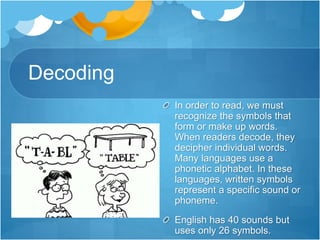
In order to read, we must
recognize the symbols that
form or make up words.
When readers decode, they
decipher individual words.
Many languages use a
phonetic alphabet. In these
languages, written symbols
represent a specific sound or
phoneme.
English has 40 sounds but
uses only 26 symbols.
Comprehension
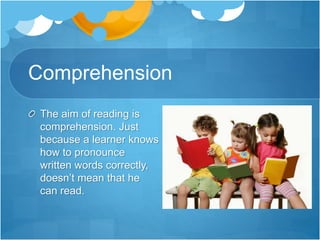
The aim of reading is
comprehension. Just
because a learner knows
how to pronounce
written words correctly,
doesn’t mean that he
can read.
Reading for pleasure
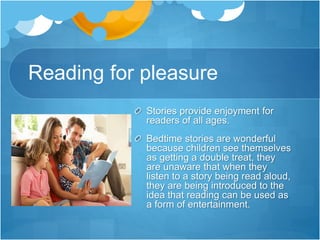
Stories provide enjoyment for
readers of all ages.
Bedtime stories are wonderful
because children see themselves
as getting a double treat, they
are unaware that when they
listen to a story being read aloud,
they are being introduced to the
idea that reading can be used as
a form of entertainment.
Reading for information
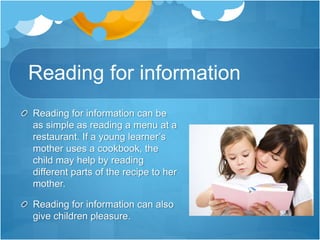
Reading for information can be
as simple as reading a menu at a
restaurant. If a young learner’s
mother uses a cookbook, the
child may help by reading
different parts of the recipe to her
mother.
Reading for information can also
give children pleasure.
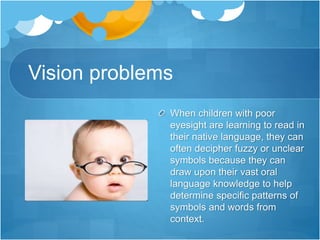
Vision problems
When children with poor
eyesight are learning to read in
their native language, they can
often decipher fuzzy or unclear
symbols because they can
draw upon their vast oral
language knowledge to help
determine specific patterns of
symbols and words from
context.
Behaviors that indicate
vision problems
Squints, closes/covers one eye
Holds a book close to the face
Holds a book far away from the face
Loses places while reading
Complains of headaches after reading
Complains of double vision
Tilts head to one side
The development of reading
skills
Phonics based instruction:
intended to teach students the
basic English-language phonics
rules so that they can easily
decode words. “The purpose of
phonics instruction is to teach
beginning readers that printed
letters represent speech sounds
head in words.”
Literature-based approach: It is
designed to help young learners
develop literacy skills within the
context of literature.
Currently, the value of picture books is
continuing to be acknowledged in ESL
and EFL programs.
Classroom techniques and
activities
Phonics: Introduce sounds and letters
that are associated with specific
nouns. There are many ways for YL to
learn the initial sounds of words.
Predictable stories and pattern books:
The predictable story contains
repetitive phrases and predictable
language.
Sight words: They are high-frequency
words children can recognize on sight
without having to decode the letters.
Example: The, all, an, and I.
Print-rich environment: Hudelson (1994) points out
that children who come from societies filled with print
are likely to learn at a very early age that print serves
different purposes or functions
Language experience
approach
It is used to help native English speaking, ESL, and
EFL children develop beginning literacy skills.
Learners participate in a group activity and then
describe what happened in their own words.
Reading in the classroom
Young learners should be taught
comprehension strategies when
they read pieces of text for
information. Children often enjoy
reading short magazine-style
articles in their ESL or EFL course
books.
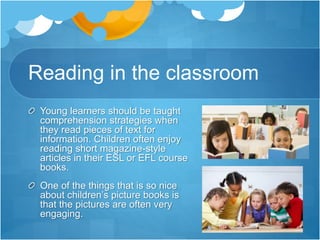
One of the things that is so nice
about children’s picture books is
that the pictures are often very
engaging.
Conclusion
The two main purposes of
reading were discussed-reading
for pleasure and reading for
information. The use of
authentic materials including
environmental print as well as
materials which are intended for
ESL and EFL learners.

Chapter 4 - Teaching Children

  • 2.
    What is reading? Readingis a set of skills that involves making sense and deriving meaning from the printed word. In order to read we must be able to decode (sound out) the printed words and also comprehend what we read.
  • 3.
    Elements that impact reading Thechild’s background knowledge The child’s linguistic knowledge of the target language Strategies or techniques the child uses to tackle the text
  • 4.
    Children who can readin their native language may also know that reading can be for both pleasure and information. By developing strong literacy skills in their native language, it will be easier for young learners to transfer those skills into English.
  • 5.
    Decoding In order toread, we must recognize the symbols that form or make up words. When readers decode, they decipher individual words. Many languages use a phonetic alphabet. In these languages, written symbols represent a specific sound or phoneme. English has 40 sounds but uses only 26 symbols.
  • 6.
    Comprehension The aim ofreading is comprehension. Just because a learner knows how to pronounce written words correctly, doesn’t mean that he can read.
  • 7.
    Reading for pleasure Storiesprovide enjoyment for readers of all ages. Bedtime stories are wonderful because children see themselves as getting a double treat, they are unaware that when they listen to a story being read aloud, they are being introduced to the idea that reading can be used as a form of entertainment.
  • 8.
    Reading for information Readingfor information can be as simple as reading a menu at a restaurant. If a young learner’s mother uses a cookbook, the child may help by reading different parts of the recipe to her mother. Reading for information can also give children pleasure.
  • 9.
    Vision problems When childrenwith poor eyesight are learning to read in their native language, they can often decipher fuzzy or unclear symbols because they can draw upon their vast oral language knowledge to help determine specific patterns of symbols and words from context.
  • 10.
    Behaviors that indicate visionproblems Squints, closes/covers one eye Holds a book close to the face Holds a book far away from the face Loses places while reading Complains of headaches after reading Complains of double vision Tilts head to one side
  • 11.
    The development ofreading skills Phonics based instruction: intended to teach students the basic English-language phonics rules so that they can easily decode words. “The purpose of phonics instruction is to teach beginning readers that printed letters represent speech sounds head in words.”
  • 12.
    Literature-based approach: Itis designed to help young learners develop literacy skills within the context of literature. Currently, the value of picture books is continuing to be acknowledged in ESL and EFL programs.
  • 13.
    Classroom techniques and activities Phonics:Introduce sounds and letters that are associated with specific nouns. There are many ways for YL to learn the initial sounds of words. Predictable stories and pattern books: The predictable story contains repetitive phrases and predictable language. Sight words: They are high-frequency words children can recognize on sight without having to decode the letters. Example: The, all, an, and I.
  • 14.
    Print-rich environment: Hudelson(1994) points out that children who come from societies filled with print are likely to learn at a very early age that print serves different purposes or functions
  • 15.
    Language experience approach It isused to help native English speaking, ESL, and EFL children develop beginning literacy skills. Learners participate in a group activity and then describe what happened in their own words.
  • 16.
    Reading in theclassroom Young learners should be taught comprehension strategies when they read pieces of text for information. Children often enjoy reading short magazine-style articles in their ESL or EFL course books. One of the things that is so nice about children’s picture books is that the pictures are often very engaging.
  • 17.
    Conclusion The two mainpurposes of reading were discussed-reading for pleasure and reading for information. The use of authentic materials including environmental print as well as materials which are intended for ESL and EFL learners.