ENVIRONMENT SCANNING
Environmental scanningis a necessary process for any organization in
order to steer itself through a constantly changing market. The process
requires data gathering from multiple sources of economic, social,
technological, and political environments and determining how they may
affect the business’s operations. It helps organizations anticipate change
and prepare themselves rather than simply reacting to changes.
Internal scanning
External Scanning
2.
Macro Environment
Themacro environment refers to the external and uncontrollable factors
that influence an organization’s performance, decisions, and strategies. These
are broad forces that affect not just one company, but the entire industry or
economy. Because companies cannot control these factors, they must
analyze them to adapt strategies, anticipate changes, and identify
opportunities or threats.The macro environment is the larger external
context in which a business operates. It includes the major external and
uncontrollable forces that affect an organization’s decision-making and
performance.
3.
Components
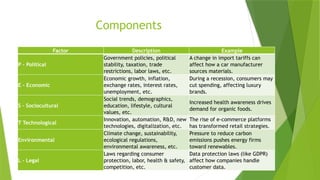
Factor Description Example
P– Political
Government policies, political
stability, taxation, trade
restrictions, labor laws, etc.
A change in import tariffs can
affect how a car manufacturer
sources materials.
E – Economic
Economic growth, inflation,
exchange rates, interest rates,
unemployment, etc.
During a recession, consumers may
cut spending, affecting luxury
brands.
S – Sociocultural
Social trends, demographics,
education, lifestyle, cultural
values, etc.
Increased health awareness drives
demand for organic foods.
T Technological
Innovation, automation, R&D, new
technologies, digitalization, etc.
The rise of e-commerce platforms
has transformed retail strategies.
Environmental
Climate change, sustainability,
ecological regulations,
environmental awareness, etc.
Pressure to reduce carbon
emissions pushes energy firms
toward renewables.
L – Legal
Laws regarding consumer
protection, labor, health & safety,
competition, etc.
Data protection laws (like GDPR)
affect how companies handle
customer data.
5.
Industrial Organisation
IndustrialOrganisation (IO) is a branch of economics that studies how firms
behave in markets, how industries are structured, and how this affects
competition, prices, profits, and consumer welfare.IO explains how
industries work, how firms compete, and how market structures influence
behaviour
6.
Resource-Based View (RBV)Analysis
Resource-Based View (RBV) is a strategic management approach that states:
An organization’s competitive advantage comes mainly from its internal
resources and capabilities, not only from external market conditions.RBV
says that companies succeed because of what they uniquely have and
what they can uniquely do.
These resources must be valuable, rare, hard to imitate, and well organized
to give long-term advantage.
7.
VRIO Framework
TheVRIO Framework is a tool used in strategic management to analyze a
firm’s internal resources and capabilities.It helps determine whether a
resource can provide: No advantage, Temporary advantage, Long-term /
sustained competitive advantage
VRIO stands for:
V – Valuable
R – Rare
I – Inimitable (hard to imitate)
O – Organized to capture value
If a resource meets all four criteria → Sustained competitive advantage.
8.
Value chain Analysis
Value Chain Analysis is a strategic management tool used to understand
how a firm creates value for customers and to identify ways to gain a
competitive advantage. It was introduced by Michael Porter.
10.
Strategy Formulation
Strategyformulation is the process of deciding what an organization should
do to achieve its goals. It involves analyzing the internal and external
environment and choosing the best strategic options. Strategy formulation is
planning the right path for the future success of a business.
11.
Competitive Strategy
Acompetitive strategy is the plan a company uses to beat its rivals in the
marketplace. It focuses on how the business will attract customers, defend its
position, and achieve long-term success compared to competitors.
Cost Leadership Strategy - Compete by offering lower prices than
competitors.
Differentiation Strategy- Compete by offering unique products or services
that customers see as better.
Focus Strategy (Niche Strategy)- Compete by serving a specific segment of
the market.
12.
Co- Operative Strategy
A co-operative strategy in strategic management refers to two or more
companies working together to achieve mutually beneficial goals. Instead of
competing, firms collaborate to gain advantages such as market access,
resource sharing, cost savings, innovation, or risk reduction.
A co-operative strategy is a strategic approach where organizations form
partnerships, alliances, or joint ventures to improve their competitive position
through collaboration rather than competition
13.
Types of CooperativeStrategy
Collusion alliances- collusion alliances refer to arrangements between firms
in which they coordinate their strategies to achieve mutual benefits, often
in competitive markets. However, there’s an important distinction between
legal alliances and illegal collusion. Collusion occurs when firms in an industry
cooperate secretly to reduce competition and maximize collective profits,
rather than competing independently.
Strategic Alliances - An alliance is a formal, legal partnership between firms
to collaborate strategically, often to share resources, expertise, or market
access.
14.
Directional strategy
DirectionalStrategy is a broad, long-term plan that sets the course for the
organization’s growth, stability, or retrenchment. It focuses on the scope of
the organization and the overall growth path rather than specific
operational tactics. It guides the firm in where it wants to go in the future
and how it plans to allocate resources to achieve its objectives.
15.
Types
Growth Strategy- Agrowth strategy is a type of directional strategy in strategic
management that focuses on expanding a company’s business, market share,
or operations over the long term. It is aimed at increasing revenue, profits,
and overall competitive position.
Stability Strategy- A stability strategy is a directional strategy where a
company maintains its current position, operations, and market share
without seeking major growth or reduction. The goal is to sustain existing
performance rather than expand aggressively or cut back.
Retrenchment Strategy- A retrenchment strategy is a directional strategy in
which a company reduces its operations, cuts costs, or withdraws from
certain markets or product lines to stabilize the organization or recover
from poor performance.
16.
Corporate Parenting
CPrefers to how a headquarters (the “parent”) manages, supports, and adds
value to its different business units (the “children”). The goal is to help
business units perform better than they would on their own.
17.
Functional strategy
A functionalstrategy is a detailed plan developed by a specific department
(function) of an organization—such as marketing, finance, HR, production, or
R&D—to support the company’s overall business and corporate strategies.
“How will this department contribute to achieving the organization’s goals?”
Functional strategies focus on using departmental resources efficiently,
improving operations, and ensuring each function works in alignment with the
overall strategic direction of the company.
18.
Outsourcing
Outsourcing isa strategic decision in which an organization assigns certain
tasks, processes, or services to an external company instead of performing
them internally. Outsourcing is used to strengthen the firm’s competitive
advantage by allowing it to focus resources on key strategic areas.
Outsourcing is the practice of contracting non-core activities or services to
external specialists to reduce cost and improve efficiency while the
company focuses on its core strategic activities.
19.
Offshoring
Offshoring refersto a company relocating certain business activities or
processes to another country—usually where labor, production, or operational
costs are lower.
In strategic management, offshoring is used as a deliberate strategy to
improve competitiveness, reduce costs, increase efficiency, or access
specialized skills and global markets.
20.
Strategic Choice
Strategic Choiceis the phase in strategic management where an organization
decides which strategy to pursue after analyzing its internal and external
environment (from the strategy analysis process).
“Given the opportunities, threats, strengths, and weaknesses, what is the best
course of action for the organization?” it’s the decision-making step that turns
analysis into action.
21.
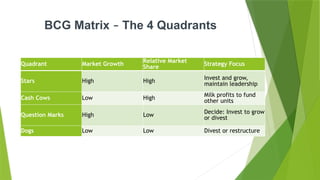
BCG Matrix
The BCGMatrix is a strategic tool used in portfolio management to help
companies analyze their business units or product lines based on:
Market Growth Rate – How fast the market is growing.
Relative Market Share – A company’s share compared to its largest
competitor.
It helps managers allocate resources effectively among different business units
or products.
22.
BCG Matrix –The 4 Quadrants
Quadrant Market Growth Relative Market
Share
Strategy Focus
Stars High High
Invest and grow,
maintain leadership
Cash Cows Low High
Milk profits to fund
other units
Question Marks High Low
Decide: Invest to grow
or divest
Dogs Low Low Divest or restructure
23.
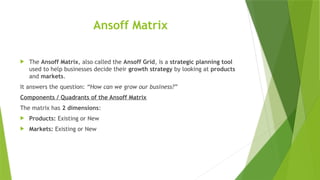
Ansoff Matrix
TheAnsoff Matrix, also called the Ansoff Grid, is a strategic planning tool
used to help businesses decide their growth strategy by looking at products
and markets.
It answers the question: “How can we grow our business?”
Components / Quadrants of the Ansoff Matrix
The matrix has 2 dimensions:
Products: Existing or New
Markets: Existing or New
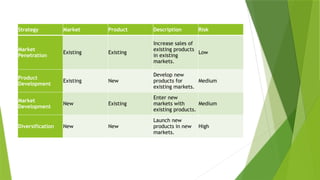
24.
Strategy Market ProductDescription Risk
Market
Penetration
Existing Existing
Increase sales of
existing products
in existing
markets.
Low
Product
Development
Existing New
Develop new
products for
existing markets.
Medium
Market
Development
New Existing
Enter new
markets with
existing products.
Medium
Diversification New New
Launch new
products in new
markets.
High
25.
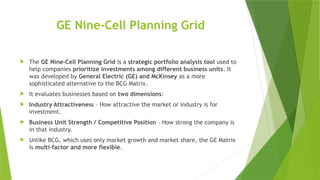
GE Nine-Cell PlanningGrid
The GE Nine-Cell Planning Grid is a strategic portfolio analysis tool used to
help companies prioritize investments among different business units. It
was developed by General Electric (GE) and McKinsey as a more
sophisticated alternative to the BCG Matrix.
It evaluates businesses based on two dimensions:
Industry Attractiveness – How attractive the market or industry is for
investment.
Business Unit Strength / Competitive Position – How strong the company is
in that industry.
Unlike BCG, which uses only market growth and market share, the GE Matrix
is multi-factor and more flexible.