Dr S.l Gupta18-1
Marketing Channels and Physical Distribution
Marketing Management Text and Cases
18-1
Marketing
Channels and
Physical
Distribution
4Chapter
Dr S.l Gupta18-2
Marketing Channels and Physical Distribution
Learning Outcomes
•What is a channel?
•Broad Perspective on Marketing
•Types of channels
•Examples
•Summary
Dr S.l Gupta18-3
Marketing Channels and Physical Distribution
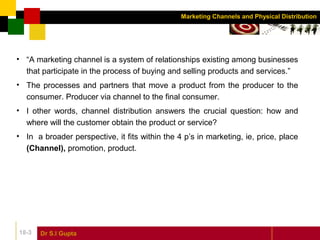
• “A marketing channel is a system of relationships existing among businesses
that participate in the process of buying and selling products and services.”
• The processes and partners that move a product from the producer to the
consumer. Producer via channel to the final consumer.
• I other words, channel distribution answers the crucial question: how and
where will the customer obtain the product or service?
• In a broader perspective, it fits within the 4 p’s in marketing, ie, price, place
(Channel), promotion, product.
Dr S.l Gupta18-4
Marketing Channels and Physical Distribution
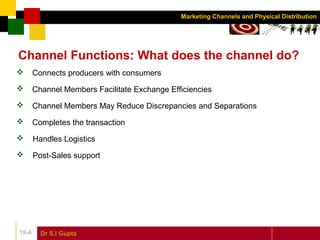
Channel Functions: What does the channel do?
 Connects producers with consumers
 Channel Members Facilitate Exchange Efficiencies
 Channel Members May Reduce Discrepancies and Separations
 Completes the transaction
 Handles Logistics
 Post-Sales support
Dr S.l Gupta18-5
Marketing Channels and Physical Distribution
Definition of Terms
• Place
• Marketing Channel
• Channel of Distribution
• Distribution
• Distribution System
• Channel
All the above mean the same thing.
Dr S.l Gupta18-6
Marketing Channels and Physical Distribution
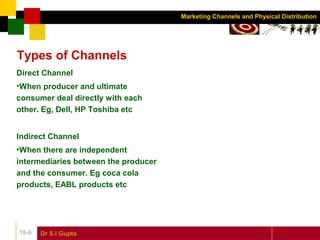
Types of Channels
Direct Channel
•When producer and ultimate
consumer deal directly with each
other. Eg, Dell, HP Toshiba etc
Indirect Channel
•When there are independent
intermediaries between the producer
and the consumer. Eg coca cola
products, EABL products etc
Dr S.l Gupta18-7
Marketing Channels and Physical Distribution
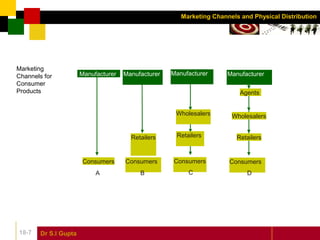
Marketing
Channels for
Consumer
Products
Manufacturer Manufacturer Manufacturer Manufacturer
Agents
Wholesalers Wholesalers
Retailers Retailers Retailers
Consumers Consumers Consumers Consumers
A B C D
Dr S.l Gupta18-8
Marketing Channels and Physical Distribution
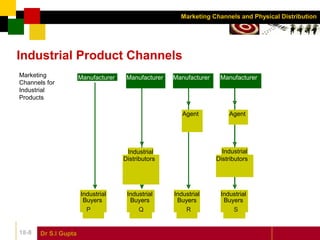
Industrial Product Channels
Marketing
Channels for
Industrial
Products
Manufacturer Manufacturer Manufacturer Manufacturer
Agent Agent
Industrial
Distributors
Industrial
Distributors
Industrial
Buyers
Industrial
Buyers
Industrial
Buyers
Industrial
Buyers
P Q R S
Dr S.l Gupta18-9
Marketing Channels and Physical Distribution
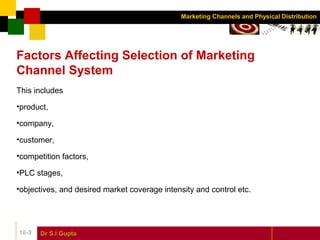
Factors Affecting Selection of Marketing
Channel System
This includes
•product,
•company,
•customer,
•competition factors,
•PLC stages,
•objectives, and desired market coverage intensity and control etc.
Dr S.l Gupta18-10
Marketing Channels and Physical Distribution
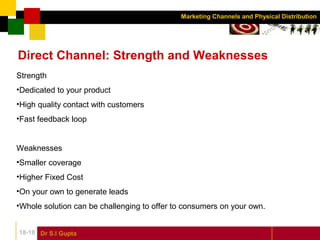
Direct Channel: Strength and Weaknesses
Strength
•Dedicated to your product
•High quality contact with customers
•Fast feedback loop
Weaknesses
•Smaller coverage
•Higher Fixed Cost
•On your own to generate leads
•Whole solution can be challenging to offer to consumers on your own.
Dr S.l Gupta18-11
Marketing Channels and Physical Distribution
Indirect Channel: Strength and Weaknesses
Strength
•Larger Coverage
•Reach new target segments
•Create solutions to consumer problems
•Lower fixed cost
Weaknesses
•Less focused on your products
•Smaller Margins since you have to split profits
•May limit customer information
Case study: Walt Disney.
Dr S.l Gupta18-12
Marketing Channels and Physical Distribution
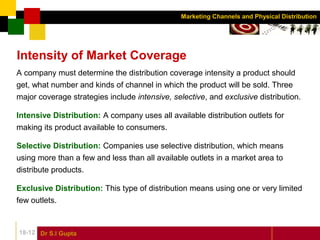
Intensity of Market Coverage
A company must determine the distribution coverage intensity a product should
get, what number and kinds of channel in which the product will be sold. Three
major coverage strategies include intensive, selective, and exclusive distribution.
Intensive Distribution: A company uses all available distribution outlets for
making its product available to consumers.
Selective Distribution: Companies use selective distribution, which means
using more than a few and less than all available outlets in a market area to
distribute products.
Exclusive Distribution: This type of distribution means using one or very limited
few outlets.
Dr S.l Gupta18-13
Marketing Channels and Physical Distribution
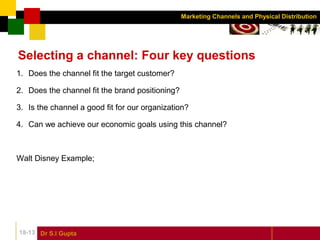
Selecting a channel: Four key questions
1. Does the channel fit the target customer?
2. Does the channel fit the brand positioning?
3. Is the channel a good fit for our organization?
4. Can we achieve our economic goals using this channel?
Walt Disney Example;
Dr S.l Gupta18-14
Marketing Channels and Physical Distribution
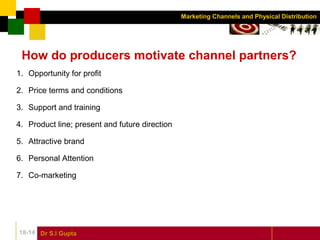
How do producers motivate channel partners?
1. Opportunity for profit
2. Price terms and conditions
3. Support and training
4. Product line; present and future direction
5. Attractive brand
6. Personal Attention
7. Co-marketing
Dr S.l Gupta18-15
Marketing Channels and Physical Distribution
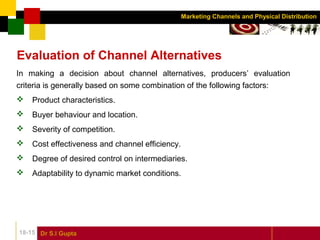
Evaluation of Channel Alternatives
In making a decision about channel alternatives, producers’ evaluation
criteria is generally based on some combination of the following factors:
 Product characteristics.
 Buyer behaviour and location.
 Severity of competition.
 Cost effectiveness and channel efficiency.
 Degree of desired control on intermediaries.
 Adaptability to dynamic market conditions.
Dr S.l Gupta18-16
Marketing Channels and Physical Distribution
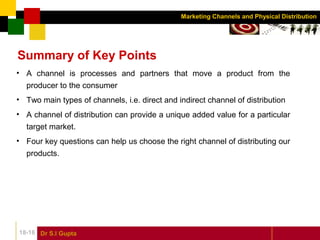
Summary of Key Points
• A channel is processes and partners that move a product from the
producer to the consumer
• Two main types of channels, i.e. direct and indirect channel of distribution
• A channel of distribution can provide a unique added value for a particular
target market.
• Four key questions can help us choose the right channel of distributing our
products.

Chapter 4

  • 1.
    Dr S.l Gupta18-1 MarketingChannels and Physical Distribution Marketing Management Text and Cases 18-1 Marketing Channels and Physical Distribution 4Chapter
  • 2.
    Dr S.l Gupta18-2 MarketingChannels and Physical Distribution Learning Outcomes •What is a channel? •Broad Perspective on Marketing •Types of channels •Examples •Summary
  • 3.
    Dr S.l Gupta18-3 MarketingChannels and Physical Distribution • “A marketing channel is a system of relationships existing among businesses that participate in the process of buying and selling products and services.” • The processes and partners that move a product from the producer to the consumer. Producer via channel to the final consumer. • I other words, channel distribution answers the crucial question: how and where will the customer obtain the product or service? • In a broader perspective, it fits within the 4 p’s in marketing, ie, price, place (Channel), promotion, product.
  • 4.
    Dr S.l Gupta18-4 MarketingChannels and Physical Distribution Channel Functions: What does the channel do?  Connects producers with consumers  Channel Members Facilitate Exchange Efficiencies  Channel Members May Reduce Discrepancies and Separations  Completes the transaction  Handles Logistics  Post-Sales support
  • 5.
    Dr S.l Gupta18-5 MarketingChannels and Physical Distribution Definition of Terms • Place • Marketing Channel • Channel of Distribution • Distribution • Distribution System • Channel All the above mean the same thing.
  • 6.
    Dr S.l Gupta18-6 MarketingChannels and Physical Distribution Types of Channels Direct Channel •When producer and ultimate consumer deal directly with each other. Eg, Dell, HP Toshiba etc Indirect Channel •When there are independent intermediaries between the producer and the consumer. Eg coca cola products, EABL products etc
  • 7.
    Dr S.l Gupta18-7 MarketingChannels and Physical Distribution Marketing Channels for Consumer Products Manufacturer Manufacturer Manufacturer Manufacturer Agents Wholesalers Wholesalers Retailers Retailers Retailers Consumers Consumers Consumers Consumers A B C D
  • 8.
    Dr S.l Gupta18-8 MarketingChannels and Physical Distribution Industrial Product Channels Marketing Channels for Industrial Products Manufacturer Manufacturer Manufacturer Manufacturer Agent Agent Industrial Distributors Industrial Distributors Industrial Buyers Industrial Buyers Industrial Buyers Industrial Buyers P Q R S
  • 9.
    Dr S.l Gupta18-9 MarketingChannels and Physical Distribution Factors Affecting Selection of Marketing Channel System This includes •product, •company, •customer, •competition factors, •PLC stages, •objectives, and desired market coverage intensity and control etc.
  • 10.
    Dr S.l Gupta18-10 MarketingChannels and Physical Distribution Direct Channel: Strength and Weaknesses Strength •Dedicated to your product •High quality contact with customers •Fast feedback loop Weaknesses •Smaller coverage •Higher Fixed Cost •On your own to generate leads •Whole solution can be challenging to offer to consumers on your own.
  • 11.
    Dr S.l Gupta18-11 MarketingChannels and Physical Distribution Indirect Channel: Strength and Weaknesses Strength •Larger Coverage •Reach new target segments •Create solutions to consumer problems •Lower fixed cost Weaknesses •Less focused on your products •Smaller Margins since you have to split profits •May limit customer information Case study: Walt Disney.
  • 12.
    Dr S.l Gupta18-12 MarketingChannels and Physical Distribution Intensity of Market Coverage A company must determine the distribution coverage intensity a product should get, what number and kinds of channel in which the product will be sold. Three major coverage strategies include intensive, selective, and exclusive distribution. Intensive Distribution: A company uses all available distribution outlets for making its product available to consumers. Selective Distribution: Companies use selective distribution, which means using more than a few and less than all available outlets in a market area to distribute products. Exclusive Distribution: This type of distribution means using one or very limited few outlets.
  • 13.
    Dr S.l Gupta18-13 MarketingChannels and Physical Distribution Selecting a channel: Four key questions 1. Does the channel fit the target customer? 2. Does the channel fit the brand positioning? 3. Is the channel a good fit for our organization? 4. Can we achieve our economic goals using this channel? Walt Disney Example;
  • 14.
    Dr S.l Gupta18-14 MarketingChannels and Physical Distribution How do producers motivate channel partners? 1. Opportunity for profit 2. Price terms and conditions 3. Support and training 4. Product line; present and future direction 5. Attractive brand 6. Personal Attention 7. Co-marketing
  • 15.
    Dr S.l Gupta18-15 MarketingChannels and Physical Distribution Evaluation of Channel Alternatives In making a decision about channel alternatives, producers’ evaluation criteria is generally based on some combination of the following factors:  Product characteristics.  Buyer behaviour and location.  Severity of competition.  Cost effectiveness and channel efficiency.  Degree of desired control on intermediaries.  Adaptability to dynamic market conditions.
  • 16.
    Dr S.l Gupta18-16 MarketingChannels and Physical Distribution Summary of Key Points • A channel is processes and partners that move a product from the producer to the consumer • Two main types of channels, i.e. direct and indirect channel of distribution • A channel of distribution can provide a unique added value for a particular target market. • Four key questions can help us choose the right channel of distributing our products.