Chapter 4:Internets of Things (IoT)
Jul 16, 2025 HU - IOT - Informatics
1
2
Content Outline:
4.1. Overview of IoT
4.2. How does it work?
4.3. IoT Tools and Platforms
Jul 16, 2025 HU - IOT - Informatics
3
Chapter Objectives:
 After accomplishing this chapter, Students will be able
to:
 Describe IoT
 Explain the history of IoT
 Describe the pros and cons of IoT
 Explain how IoT works
 Explain the architecture of IoT
 Describe IoT tools and platforms
 Describe some of the application areas of IoT
Jul 16, 2025 HU - IOT - Informatics
4
4.1. Overview of IoT
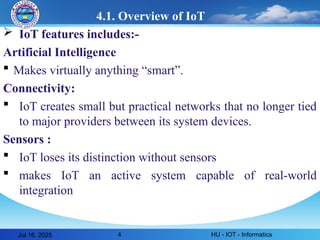
 IoT features includes:-
Artificial Intelligence
 Makes virtually anything “smart”.
Connectivity:
 IoT creates small but practical networks that no longer tied
to major providers between its system devices.
Sensors :
 IoT loses its distinction without sensors
 makes IoT an active system capable of real-world
integration
Jul 16, 2025 HU - IOT - Informatics
Active engagement
 IoT introduces a new paradigm for active content,
product, or service engagement.
small device use
 IoT exploits purpose-built small devices to deliver
its precision, scalability, and versatility
Jul 16, 2025 HU - IOT - Informatics
5
6
4.1.1. What is IoT?
1) IoT is the networking of smart objects
------ Internet Architecture Board’s (IAB)
2) IoT is the networking of smart objects in which smart
objects have some constraints such as limited
bandwidth, power, and processing accessibility for
achieving interoperability among smart objects.
------ Internet Engineering Task Force (IETF)
Jul 16, 2025 HU - IOT - Informatics
7
Cont’d…
3) IoT is a framework of all things that have a
representation in the presence of the internet in such a
way that new applications and services enable the
interaction in the physical and virtual world in the form of
Machine-to-Machine (M2M) communication in the cloud.
----Institute of Electrical and Electronics Engineers (IEEE)
Jul 16, 2025 HU - IOT - Informatics
4) IoT is the interaction of everyday object’s computing
devices through the Internet that enables the sending and
receiving of useful data.
----Oxford dictionary’s definition
5) IoT is expressed through a simple formula such as:
IoT= Services+ Data+ Networks + Sensors
-------IoT in 2020
Jul 16, 2025 HU - IOT - Informatics
8
9
Cont’d…
 Generally IoT is the network of physical objects or
"things" embedded with electronics, software, sensors,
and network connectivity, which enables objects to
collect and exchange data.
 It is a network of devices that can sense, accumulate
and transfer data over the internet without any human
intervention.
 It consists of any device with an on/off switch connected
to the Internet
 Applications: smart-city, smart-home, smart-energy,
connected car, smart agriculture, health care, logistics,
connected campus, building & industry etc.
Jul 16, 2025 HU - IOT - Informatics
Figure 4.1:- IoT domains
Jul 16, 2025 HU - IOT - Informatics
10
11
4.1.3. IoT − Advantages
 Improved Customer Engagement
 Technology Optimization
 Reduced Waste
 Enhanced Data Collection
4.1.4. IoT – Disadvantages
 Lack of Security.
 A bug in the system, could affect all connected device
Jul 16, 2025 HU - IOT - Informatics
12
 No international standard of compatibility for IoT,
 Heterogeneous devices couldn’t make communication.
 Collecting and managing the data from millions of IoT
devices will be challenging for a given Enterprise.
Jul 16, 2025 HU - IOT - Informatics
13
4.1.5. Challenges of IoT
 Security
 Privacy
 Complexity
 Flexibility
 Compliance
Jul 16, 2025 HU - IOT - Informatics
14
4.2. How does it work?
is a back
bone of IoT
IPV6
Help user to
control &
command their
devices ranging
from room
thermostat to jet
engines &
assembly lines
End-User
Mobile apps
Data is stored
and processed
securely using
Big data
analytics
Cloud/server
Gateway to
Internet
Bridge internal
Network to
external network
IoT
Gateway
Collecting,
sending, acting
on the data they
acquire
Share the data
through gateway
or cloud to be
analyzed locally
Sensors
Jul 16, 2025 HU - IOT - Informatics
15
4.2.1. Architecture of IoT
 Sensing Layer
 Network Layer
 Data Processing Layer
 Application Layer
Jul 16, 2025 HU - IOT - Informatics
16
4.2.2. Devices and Networks
 Devices can be
categorized into three main
groups:
1) Consumer
2) Enterprise
3) Industrial
Jul 16, 2025 HU - IOT - Informatics
17
Cont’d…
 IoT network devices has constrained resources
(power, processing, memory, etc.)
 The IoT network devices must be managed,
configured and monitored remotely to ensure their
correct functioning.
 IoT network and device management solution should
consider several elements
Jul 16, 2025 HU - IOT - Informatics
KAA
Key Features:
• Manage an unlimited number of connected devices
• Set up cross-device interoperability
• Perform real-time device monitoring
• Perform remote device provisioning & configuration
• Collect and analyze sensor data
• Analyze user behavior and deliver targeted
notifications
• Create cloud services for smart products
4.3. IoT Tools and Platforms
Jul 16, 2025 HU - IOT - Informatics
18
Site
Where
Key Features:
• Run any number of IoT applications on a single
SiteWhere instance
• Spring delivers the core configuration framework
• Add devices through self-registration
• Integrates with third-party integration frameworks
such as Mule any point
• Default database storage is MongoDB
• Eclipse Californium for CoAP messaging
• InfluxDB for event data storage
• Grafana to visualize SiteWhere data
Jul 16, 2025 HU - IOT - Informatics
19
Thing
Speak
Key Features:
• Collect data in private channels
• Share data with public channels
• MATLAB analytics and visualizations
• Alerts
• Event scheduling
• App integrations
• Worldwide community
Jul 16, 2025 HU - IOT - Informatics
20
Device
Hive
Key Features:
• Directly integrate with Alexa
• Visualization dashboard of your choice
• It supports Big data solutions such as Elastic Search,
Apache Spark, Cassandra and Kafka for real-time
and batch processing.
• Connect any device
• It comes with Apache Spark and Spark Streaming
support.
• Supports libraries written in various programming
languages, including Android and iOS libraries
• It allows running batch analytics and machine
learning on top of your device data
Jul 16, 2025 HU - IOT - Informatics
21
Zetta
Things
Board
Key Features:
• Supports a wide range of hacker boards
• Zetta allows you to assemble smartphone apps,
device apps, and cloud apps
Key Features:
• Real-time data visualization and remote device control
• Customizable rules, plugins, widgets and transport
implementations 76
• Allows monitoring client-side and provision server-
side device attributes.
• Support multi-tenant installations out-of-the-box.
• Supports transport encryption for both MQTT &
HTTP(s) protocols.
Jul 16, 2025
HU - IOT - Informatics
22
23
4.4. Applications of IoT
IoT is applicable in sectors :
 Agriculture
 Consumer Use
 Healthcare
 Insurance
 Manufacturing
 Retail
 Transportation
 Utilities
Jul 16, 2025 HU - IOT - Informatics
24
4.3.1. IoT Based Smart Home
 Remote Control
Appliances
 Weather Controlling
 Smart Home
Appliances
 Energy and Water
Use
 Intrusion Detection
Systems
 Safety Monitoring
Jul 16, 2025 HU - IOT - Informatics
25
4.3.2. IoT Based Smart City
 Structural Health
 Lightning
 Safety
 Transportation
 Waste Management
 Smart Parking
Img src: Google imag
Jul 16, 2025 HU - IOT - Informatics
26
4.3.3. IoT Based Smart Farming
 Green Houses
 Compost
 Animal
Farming/Tracking
 Offspring Care
 Field Monitoring
Jul 16, 2025 HU - IOT - Informatics
Chapter 5: Augmented Reality(AR)
Jul 16, 2025 HU - IOT - Informatics
27
Content outlines:
 Overview of Augmented Reality.
 The difference between VR,AR and MR
 Architecture of AR systems
 Application of AR systems
Jul 16, 2025 HU - IOT - Informatics
28
Chapter Objectives:
 After accomplishing this chapter, Students will be able to:
 Explain augmented reality
 Explain the features of augmented reality
 Explain the difference between AR, VR, and MR
 Explain the architecture of augmented reality systems
 Describe the application areas of augmented reality
Jul 16, 2025 HU - IOT - Informatics
29
Brainstorming
 What do you think about Augmented Reality?
 What are the common features of Augmented reality?
Jul 16, 2025 HU - IOT - Informatics
30
 The fundamental idea of AR is to combine , or mix, the
view of the real environment with additional, virtual
content that is presented through computer graphics.
 Its convincing effect is achieved by ensuring that the
virtual content is aligned and registered with the real
objects.
 As a person moves in an environment and their
perspective view of real objects changes, the virtual
content should also be presented from the same
perspective.
Jul 16, 2025 HU - IOT - Informatics
31
What is Augmented reality(AR)?
Definition
 Augmented reality (AR) is a form of emerging
technology that allows users to overlay computer
generated content in the real world.
 AR refers to a live view of a physical real-world
environment whose elements are merged with augmented
computer-generated images creating a mixed reality.
Jul 16, 2025 HU - IOT - Informatics
32
 Augmented Reality (AR) as a real-time direct or
indirect view of a physical real-world environment that
has been enhanced /augmented by adding virtual
computer-generated information to it.
 Augmented reality is the integration of digital
information with the user's environment in real time.
Jul 16, 2025 HU - IOT - Informatics
33
Virtual Reality (VR)
Virtual Reality (VR) is fully immersive, which tricks
your senses into thinking you’re in a different
environment or world apart from the real world.
Using a head-mounted display (HMD) or headset, you’ll
experience a computer-generated world of imagery and
sounds. you can manipulate objects and move around
using haptic controllers while tethered to a console or PC.
 It is also called a computer-simulated reality.
Jul 16, 2025 HU - IOT - Informatics
34
 It refers to computer technologies using reality headsets
to generate realistic sounds, images and other sensations
that replicate a real environment or create an imaginary
world.
 Advanced VR environment will engage all five senses
(taste, sight, smell, touch, sound) .
 Using VR devices such as HTC Vive, Oculus Rift or
Google Cardboard, users can be transported into a
number of real-world and imagined environments.
Jul 16, 2025 HU - IOT - Informatics
35
Jul 16, 2025 HU - IOT - Informatics
36
 Most VR headsets are connected to a computer (Oculus
Rift) or a gaming console (PlayStation VR)
 There are standalone devices (Google Cardboard is among
the most popular) as well.
 Most standalone VR headsets work in combination with
smartphones – you insert a smartphone, wear a
headset, and immerse in the virtual reality
Jul 16, 2025 HU - IOT - Informatics
37
Augmented Reality (AR)
 In augmented reality, users see and interact with the real
world while digital content is added to it.
 There’s a different way to experience augmented reality,
though – with special AR headsets, such as
 Google Glass, where digital content is displayed on a tiny
screen in front of a user’s eye.
 AR adds digital elements to a live view often by using the
camera on a smartphone.
 Examples of augmented reality experiences include
Snapchat lenses and the game Pokémon Go.
Jul 16, 2025 HU - IOT - Informatics
38
 Augmented Reality (AR) is a
live, direct or indirect view of a
physical, real-world environment
whose elements are augmented
(or supplemented) by computer-
generated sensory input such as
sound, video, graphics or GPS
data.
Jul 16, 2025 HU - IOT - Informatics
39
Mixed Reality (MR)
 Mixed Reality (MR) sometimes referred to as hybrid
reality.
 It is the merging of real and virtual worlds to produce new
environments and visualizations where physical and digital
objects co-exist and interact in real-time.
 For example, with MR, you can play a virtual video game,
grab your real-world water bottle, and smack an imaginary
character from the game with the bottle.
 Imagination and reality have never been so intermingled.
Jul 16, 2025 HU - IOT - Informatics
40
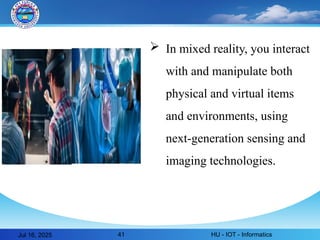
 In mixed reality, you interact
with and manipulate both
physical and virtual items
and environments, using
next-generation sensing and
imaging technologies.
Jul 16, 2025 HU - IOT - Informatics
41
 MR allows you to see and
immerse yourself in the
world around you even as
you interact with a virtual
environment using your
own hands.
Jul 16, 2025 HU - IOT - Informatics
42
VR Vs. AR Vs. MR
 The hardware requirements VR is content which is 100%
digital and can be enjoyed in a fully immersive
environment
 AR overlays digital content on top of the real-world.
 MR is a digital overlay that allows interactive virtual
elements to integrate and interact with the real-world
environment.
Jul 16, 2025 HU - IOT - Informatics
43
Jul 16, 2025 HU - IOT - Informatics
44
 Numerous augmented reality apps and games can run on
almost every smartphone on the market.
 virtual reality programs require specialized VR headsets,
noise-canceling headphones, cameras to track room space
and boundaries, and sometimes even motion capture
technology.
 Some of the biggest names in VR tech today are the Oculus
Rift, HTC Vive, and PlayStation VR.
 For the enjoyment of simple VR videos, there are
affordable makeshift VR headsets like the Google
Cardboard.
Jul 16, 2025 HU - IOT - Informatics
45
 Mixed reality hardware is still emerging and hasn’t quite
broken into the mainstream consumer market, most likely
due to the price.
 The consumer releases of the Microsoft HoloLens and
Magic Leap One retail for over $2000 USD .
 However, mixed reality applications sometimes require
exponentially more processing power and thus require
more powerful hardware.
Jul 16, 2025 HU - IOT - Informatics
46
Jul 16, 2025 HU - IOT - Informatics
47
Jul 16, 2025 HU - IOT - Informatics
48
The Microsoft HoloLens includes:
A built-in microphone array,
Binaural sound capabilities,
A built-in camera for recording,
A depth sensor,
Head-tracking cameras,
An inertial measurement unit which helps track head
movement
Jul 16, 2025 HU - IOT - Informatics
49
The architecture of AR Systems
 The first Augmented Reality Systems (ARS) were usually
designed with a basis on three main blocks
1. Infrastructure Tracker Unit,
2. Processing Unit, and
3. Visual Unit.
Jul 16, 2025 HU - IOT - Informatics
50
The Infrastructure Tracker Unit
 It is responsible for collecting data from the real world,
sending them to the Processing Unit,
Processing Unit
 Which mixed the virtual content with the real content and
sent the result to the Video Out module of the Visual Unit
Visual Unit
 Used to display
Jul 16, 2025 HU - IOT - Informatics
51
 Some designs used a
Video In, to acquire
required data for the
Infrastructure Tracker
Unit .
Jul 16, 2025 HU - IOT - Informatics
52
 The Visual Unit can be classified into two types of
system, depending on the followed visualization
technology:
1. Video see-through
 It uses a Head-Mounted Display (HMD) that employs
a video-mixing and displays the merged images on a
closed-view HMD.
2. Optical see-through:
 It uses an HMD that employs optical combiners to
merge the images within an open-view HMD.
Jul 16, 2025 HU - IOT - Informatics
53
HMDs shortcomings
 HMDs are currently the dominant display technology in the
AR field.
 However, they lack in several aspects, such as ergonomics,
high prices and relatively low mobility due to their sizes
and connectivity features.
 An additional problem involving HMD is the interaction
with the real environment, which places virtual interactive
zones to the user, making the collision with these zones
hard due to the difficulty to interact with multiple points in
different depths.
Jul 16, 2025 HU - IOT - Informatics
54
Applications of AR Systems
 Technology is ever-changing and ever-growing.
 One of the newest developing technologies is
augmented reality (AR), which can be applied to many
different disciplines such as
Education.
Medicine.
Entertainment.
Military, etc.
Jul 16, 2025 HU - IOT - Informatics
55
AR In education
 Augmented reality allows flexibility in use that is
attractive to education.
 AR technology can be utilized through a variety of
mediums including desktops, mobile devices, and
smartphones.
 AR can be used to enhance content and instruction within
the traditional classroom,
 supplement instruction in the special education classroom,
extend content into the world outside the classroom,
Jul 16, 2025 HU - IOT - Informatics
56
 More importantly, the following reasons for using
augmented reality in education:
 Affordable learning materials
 Interactive lessons
 Higher engagement
 Higher retention
 Boost intellectual curiosity
Jul 16, 2025 HU - IOT - Informatics
57
AR In Medicine
Augmented reality has the potential to play a big role in
improving the healthcare industry.
This new technology is enhancing medicine and healthcare
towards more safety and efficiency.
For now, augmented reality has already made significant
changes in the following medical areas:
Surgery(minimally invasive surgery);
Education of future doctors;
Diagnostics;
Jul 16, 2025 HU - IOT - Informatics
58
AR in health care
Jul 16, 2025 HU - IOT - Informatics
59
 AR tools aid to detect the signs of depression and other
mental illnesses by reading from
Facial expressions.
Voice tones.
Physical gestures
Jul 16, 2025 HU - IOT - Informatics
60
 In medicine, AR has the following applications:
Describing symptoms
Nursing care
Surgery
Ultrasounds
Diabetes management
 Navigation
Jul 16, 2025 HU - IOT - Informatics
61
 Generally, AR provides the following benefits to patients
and healthcare workers:
 Reduce the risks associated with minimally invasive
surgery.
 Better informed decisions about the right treatment and
illness prevention.
 Make procedures more tolerable.
 Better aftercare
 Medical training and education.
 Assistance in medical procedures and routine tasks.
Jul 16, 2025 HU - IOT - Informatics
62
AR In Entertainment
 AR in games :- such as Pokémon Go
 AR in music
 AR on TV
 AR in eSports
 AR in the theater
Jul 16, 2025 HU - IOT - Informatics
63
Review Questions
1. what is augmented, virtual and mixed reality and its
application?
2. what are good examples of augmented, virtual and mixed
reality?
3. what is the difference between augmented, virtual and
mixed reality?
4. How is augmented, virtual and mixed reality achieved?
5. What is the benefit of augmented, virtual and mixed reality?
Jul 16, 2025 HU - IOT - Informatics
64
6. How Can AR, VR, and MR improve engineering
instructions?
7. Can VR be a substitute for Real Life Experience?
8. What is the impact of VR on Educational Learning rather
than games?
9. What is the most technical challenge for MR?
Jul 16, 2025 HU - IOT - Informatics
65
CHAPTER 6:- ETHICS AND PROFESSIONALISM OF EMERGING
TECHNOLOGIES
Objectives of the chapters:
 Distinguish the link between ethics and technology.
 Understand general, professional and leadership ethical
questions.
 Explain what digital privacy is, its components and why it
is important.
 Know the importance of accountability and trust in
emerging technologies.
 Identify the threats and challenges we face in developing
and utilizing emerging technologies.
6.2. New ethical questions
6.1. Technology and ethics
Activity 6.1
 From your civic and ethical education course,
what do you understand about the word ethics?
6.1 Technology and ethics
 Importance of Internet as a technology:
 Provide new tools and new ways for people to interact.
 However brought a drawback Like:
 New concerns about privacy,
 spam and viruses,
 Digital divide across the universe.
 This takes us to the point that technology can promote or
restrict the human right.
6.1 Technology and ethics
 For the Information Society, the concerns lies on how
to maximize the benefits while minimizing the harms
in using ET.
 The compelling solution is to set up a proper legal or
regulatory system for enhanced gain of benefits for the
larger mass, that generally takes us to Ethical values.
6.1 Technology and ethics
 Ethics has become a crucial aspect of professional
accountability with the inclusion of five basic principles
Integrity
Objectivity
Competence and due care.
Confidentiality, and
Professional behavior.
However, the emergence of new technologies raises
some new challenges for the profession to address.
6.2. New ethical questions
Activity 6.2
What do you think the need for ethics in data science? Is it
really important to include ethical rules when dealing with
big data? If your answer is yes, why?
The increasing use of
Big data.
Algorithmic decision-making, and
Artificial intelligence can enable more
 consistent. ,
 evidence-based and
 accurate judgments or decisions.
 Nevertheless the concern still remains how we could possibly
and ethically use the emerging new technologies.
The concern here is:- If we deal with biased data, or data
based on personal preferences and activities, we would
come up with biased and discriminatory result that might
intern lead to unfair and unethical out come.
Activity 6.3
What do you think the need for ethics in data science? Is it
really important to include ethical rules when dealing with big
data? If your answer is yes, why?
6.2. New ethical questions
 On the contrary, Whatever the power of the machine, we should also
never undermine the role of human judgment or his impact on the
ultimate decision its explanation.
Activity 6.4
Do you think that integrating ethical rules with emerging
technologies is important? If your answer is yes, why?
What are the challenges of integrating ethical rules with the
new technologies?
 What makes ethics of Technology very difficult is early integration of
ethics into the technology life cycle.
 the future is un certain.
Ethics has traditionally not been well equipped to deal with issues of
uncertainty and, in particular, future uncertainty.
6.2.1. General ethical principles
Activity 6.5
➢ List down common ethical rules that must be
applied in all technologies?
6.2.1. General ethical principles
1) Contribute to society and to human well-being,
acknowledging that all people are stakeholders in
computing.
2) Avoid harm.
3) Be honest and trustworthy.
4) Be fair and take action not to discriminate.
5) Respect the work required to produce new ideas,
inventions, creative works, and computing artifacts.
6) Respect privacy.
7) Honor confidentiality
6.2.2. Professional responsibilities.
Activity 6.6
➢ List down ethical principles related to
professional responsibility?
6.2.2. Professional responsibilities.
1) Strive to achieve high quality in both the processes and products of
professional work.
2) Maintain high standards of professional competence, conduct, and
ethical practice.
3) Know and respect existing rules pertaining to professional work.
4) Accept and provide appropriate professional review.
5) Give comprehensive and thorough evaluations of computer systems
and their impacts, including analysis of possible risks.
6) Perform work only in areas of competence.
7) Foster public awareness and understanding of computing, related
technologies, and their consequences.
8) Access computing and communication resources only when
authorized or when compelled by the public good.
9) Design and implement systems that are robustly and usably secure.
6.2.3. Professional leadership principles.
Activity 6.7
➢ List down ethical principles related to
professional leadership?
6.2.3. Professional leadership principles.
1. Ensure that the public good is the central
concern during all professional computing
work.
2. Articulate, encourage acceptance of and
evaluate fulfillment of social responsibilities
by members of the organization or group.
3. Manage personnel and resources to
enhance the quality of working life.
4. Articulate, apply, and support policies and
processes that reflect the principles of the
Code.
6.2.3. Professional leadership principles.
5. Create opportunities for members of the
organization or group to grow as
professionals.
6. Use care when modifying or retiring systems.
Interface changes, the removal of features,
and even software updates have an impact
on the productivity of users and the quality of
their work.
7. Recognize and take special care of systems
that become integrated into the infrastructure
of society.
6.2.3. Professional leadership principles.
Activity 6.7
➢ List down ethical principles related to
professional leadership?
6.3. Digital privacy
What do you think about privacy in general? Is
it really important?
➢ In this digital world, what do you mean by
digital privacy? Give concrete examples?
6.3. Digital privacy
Digital Privacy is the protection of
personally identifiable or business
identifiable information that is collected
from respondents through information
collection activities or from other sources.
 includes three sub-related categories;
1. information privacy,
2. communication privacy, and
3. individual privacy
6.3.1. Information Privacy
Activity 6.10
➢ What do you think that private information
like passwords, PIN numbers, will be guarded or
shared with the public? Why?
CHAPTER 7: OTHER EMERGING
TECHNOLOGIES
Content Outlines:
Nanotechnology
Biotechnology
 Block-chain technology
 Cloud and quantum computing
 Autonomic computing
 Computer vision
 Embedded systems,
Cybersecurity and 3D printing.
Jul 16, 2025 HU - IOT - Informatics
87
Definitions :
Nano-science
 As the study of phenomena and manipulation of materials
at atomic, molecular and macromolecular scales, where
properties differ significantly from those at a larger scale.
Nanotechnologies
 As the design, characterization, production, and application
of structures, devices, and systems by controlling shape and
size at the nanometer scale.
7.1 Nanotechnology.
Jul 16, 2025 HU - IOT - Informatics
88
 Nanotechnology is science, engineering, and technology
conducted at the Nano-scale, which is about 1 to 100
nanometers.
 Nano science and nanotechnology are the study and
application of extremely small things and can be used across
all the other science fields, such as chemistry, biology,
physics, materials science, and engineering.
Jul 16, 2025 HU - IOT - Informatics
89
The ideas and concepts behind nanoscience and
nanotechnology started with a talk entitled “There’s plenty
of room at the bottom” by physicist
 Richard Feynman at an American Physical Society meeting
at the California Institute of Technology (Caltech) on
December 29, 1959, long before the term nanotechnology
was used.
Jul 16, 2025 HU - IOT - Informatics
90
 He described a process in which scientists would be
able to manipulate and control individual atoms and
molecules.
 Over a decade later, in his explorations of
ultraprecision machining,
 Professor Norio Taniguchi coined the term
nanotechnology.
It wasn't until 1981, with the development of the
scanning tunneling microscope that could "see"
individual atoms, that modern nanotechnology began.
Jul 16, 2025 HU - IOT - Informatics
91
Fundamental concepts
 It’s hard to imagine just how small nanotechnology is.
 One nanometer is a billionth of a meter or 10-9 of
meters.
For example:
 There are 25,400,000 nanometers in an inch.
 A sheet of newspaper is about 100,000 nanometers
thick.
Jul 16, 2025 HU - IOT - Informatics
92
On a comparative scale, if a marble were a nanometer, then
one meter would be the size of the Earth.
 Nano science and nanotechnology involve the ability to
see and to control individual atoms and molecules.
 Everything on Earth is made up of atoms—the food we
eat, the clothes we wear, the buildings and houses we live
in, and our own bodies.
Jul 16, 2025 HU - IOT - Informatics
93
 The microscopes needed to see things at the nanoscale
were invented relatively, recently about 30 years ago.
 An atom has a diameter of about 0.1 nm. An atom's nucleus
is much smaller about 0.00001 nm. Atoms are the building
blocks for all matter in our universe.
 The properties of materials can be different at the nanoscale
for two main reasons:
Jul 16, 2025 HU - IOT - Informatics
94
First,
 Nano-materials have a relatively larger surface area when
compared to the same mass of material produced in a larger
form.
This can make materials more chemically reactive (in some
cases materials that are inert in their larger form are reactive
when produced in their Nano-scale form), and affect their
strength or electrical properties.
Jul 16, 2025 HU - IOT - Informatics
95
Second:
 Quantum effects can begin to dominate the behavior of
matter at the nanoscale particularly at the lower end –
affecting the optical, electrical and magnetic behavior of
materials.
 Materials can be produced that are nanoscale in one
dimension (for example, nanowires, Nano rods, and
nanotubes), in two dimensions (plate-like shapes like
Nano coating, Nano layers, and graphene) or in all three
dimensions (for example, nanoparticles).
Jul 16, 2025 HU - IOT - Informatics
96
 Today's scientists and engineers are finding a wide
variety of ways to deliberately make materials at the
Nano scale to take advantage of their enhanced
properties such as higher strength, lighter weight,
increased control of light spectrum and greater chemical
reactivity than their larger-scale counterparts
Jul 16, 2025 HU - IOT - Informatics
97
7.1.3 Application of Nanotechnology
 Medicine: customized nanoparticles the size of molecules
that can deliver drugs directly to diseased cells in your body.
 Electronics: it has some answers for how we might increase
the capabilities of electronics devices while we reduce their
weight and power consumption.
 Food: it has an impact on several aspects of food science,
from how food is grown to how it is packaged.
Jul 16, 2025 HU - IOT - Informatics
98
 Agriculture: nanotechnology can possibly change the whole
agriculture part and nourishment industry anchor from
generation to preservation, handling, bundling,
transportation, and even waste treatment.
 Vehicle manufacturers: Much like aviation, lighter and
stronger materials will be valuable for making vehicles that
are both quicker and more secure.
Jul 16, 2025 HU - IOT - Informatics
99
7.2 Biotechnology
Definition:
 Biotechnology is a technology based on biology.
 It harnesses cellular and biomolecular processes to
develop technologies and products that help improve our
lives and the health of our planet.
 We have used the biological processes of microorganisms
for long time to make useful food products, such as bread
and cheese, and to preserve dairy products .
Jul 16, 2025 HU - IOT - Informatics
100
 Genetic engineering is the process of transferring
individual genes between organisms or modifying the
genes in an organism to remove or add a desired trait or
characteristic.
 In modern biotechnology, researchers modify DNA and
proteins to shape the capabilities of living cells, plants,
and animals into something useful for humans.
Jul 16, 2025 HU - IOT - Informatics
101
Application of biotechnology
 Agriculture (Green Biotechnology): Biotechnology had
contributed a lot to modify the genes of the organism
known as Genetically Modified Organisms such as Crops,
Animals, Plants, Fungi, Bacteria, etc. Genetically modified
crops are formed by the manipulation of DNA to introduce
a new trait into the crops.
Jul 16, 2025 HU - IOT - Informatics
102
 Medicine (Medicinal Biotechnology): This helps in the
formation of genetically modified insulin known as
humulin. This helps in the treatment of a large number of
diabetes patients. It has also given rise to a technique known
as gene therapy. Gene therapy is a technique to remove the
genetic defect in an embryo or child.
 Aquaculture Fisheries: It helps in improving the quality and
quantity of fishes. Through biotechnology, fishes are
induced to breed via gonadotropin-releasing hormone.
Jul 16, 2025 HU - IOT - Informatics
103
 Environment (Environmental biotechnology): is used in
waste treatment and pollution prevention. Environmental
biotechnology can more efficiently clean up many wastes
than conventional methods and greatly reduce our
dependence on methods for land-based disposal.
Jul 16, 2025 HU - IOT - Informatics
104
7.3.Blockchain technology
 A Blockchain is a time-stamped series of immutable
records of data that is managed by a cluster of computers
not owned by any single entity.
 Each of these Blocks of data (i.e. block) is secured and
bound to each other using cryptographic principles (i.e.
chain).
 “Blocks” on the Blockchain are made up of digital pieces
of information.
Jul 16, 2025 HU - IOT - Informatics
105
Specifically, they have three parts:
1. Blocks store information about transactions like the date,
time, and dollar amount of your most recent purchase
from Amazon.
2. Blocks store information about who is participating in
transactions. A block for your splurge purchase from
Amazon would record your name along with Amazon.
Instead of using your actual name, your purchase is
recorded without any identifying information using a
unique “digital signature,” sort of like a username.
Jul 16, 2025 HU - IOT - Informatics
106
3. Blocks store information that distinguishes them from
other blocks. Much like you and I have names to
distinguish us from one another, each block stores a unique
code called a “hash” that allows us to tell it apart from
every other block.
Jul 16, 2025 HU - IOT - Informatics
107
In order for a block to be added to the Blockchain, however,
four things must happen:
1. A transaction must occur.
2. That transaction must be verified.
3. That transaction must be stored in a block.
4. That block must be given a hash.
Jul 16, 2025 HU - IOT - Informatics
108
 By design, a blockchain is resistant to modification of the
data. It is "an open, distributed ledger that can record
transactions between two parties efficiently and in a
verifiable and permanent way".
 The blockchain network has no central authority; it is the
very definition of a democratized system. Since it is a
shared and immutable ledger, the information in it is open
for anyone and everyone to see
Jul 16, 2025 HU - IOT - Informatics
109
The Three Pillars of Blockchain Technology
1. Decentralization:
 In a decentralized system the information is not stored by
one single entity. In fact, everyone in the network owns
the information.
 In a decentralized network ,if you wanted to interact with
your friend then you can do so directly without going
through a third party. That was the main ideology behind
Bitcoins.
Jul 16, 2025 HU - IOT - Informatics
110
2. Transparency:
 One of the most interesting and misunderstood concepts in
blockchain technology is “transparency.” Some people say
that blockchain gives you privacy while some say that it is
transparent.
 A person’s identity is hidden via complex cryptography and
represented only by their public address. So, if you were to
look up a person’s transaction history, you will not see.
Jul 16, 2025 HU - IOT - Informatics
111
3. Immutability
 Immutability, in the context of the blockchain, means that
once something has been entered into the blockchain, it
cannot be tampered with.
 The reason why the blockchain gets this property is that of
the cryptographic hash function.
Jul 16, 2025 HU - IOT - Informatics
112
 In simple terms, hashing means taking an input string of
any length and giving out an output of a fixed length. In the
context of crypto currencies like bitcoin, the transactions
are taken as input and run through a hashing algorithm
(Bitcoin uses SHA-256) which gives an output of a fixed
length.
Jul 16, 2025 HU - IOT - Informatics
113
7.3.6. Application of blockchain
A. The sharing economy
 With companies like Uber and Airbnb flourishing, the
sharing economy is already a proven success .
B. Crowd funding
 Crowd funding initiatives like Kickstarter and
GoFundMe are doing the advance work for the
emerging peer-to-peer economy.
Jul 16, 2025 HU - IOT - Informatics
114
C. Governance
 By making the results fully transparent and publicly
accessible, distributed database technology could bring full
transparency to elections or any other kind of poll taking.
D. Supply chain auditing
 Consumers increasingly want to know that the ethical
claims companies make about their products are real.
Distributed ledgers provide an easy way to certify that the
backstories of the things we buy are genuine.
Jul 16, 2025 HU - IOT - Informatics
115
E. File storage
 Decentralizing file storage on the internet brings clear
benefits. Distributing data throughout the network protects
files from getting hacked or lost.
 Interplanetary File System (IPFS) makes it easy to
conceptualize how a distributed web might operate.
Jul 16, 2025 HU - IOT - Informatics
116
7.4.Cloud and quantum computing
 Cloud computing is a means of networking remote
servers that are hosted on the Internet. Rather than
storing and processing data on a local server, or a PC's
hard drive, one of the following three types of cloud
infrastructure is used .
 The first type is a public cloud. Here a third-party
provider manages the servers, applications, and storage
much like a public utility .
Jul 16, 2025 HU - IOT - Informatics
117
 A business or organization would typically use a private
cloud. This might be hosted on their on-site data center,
although some companies host through a third-party
provider instead.
 The third option is a hybrid cloud. Here private clouds are
connected to public clouds, allowing data and applications
to be shared between them.
Jul 16, 2025 HU - IOT - Informatics
118
Advantages of cloud computing
 Cheap computing power.
 No need for the initial costly capital investment.
 Energy costs are shared.
 Cloud providers have vast resources of computing power
at their fingertips.
 Allows you and multiple users to access your data from
any location.
 Smartphone, laptop, desktop, wherever you are, you can
access the data you need at any time.
Jul 16, 2025 HU - IOT - Informatics
119
7.4.3. Quantum computing
 Quantum computers truly do represent the next
generation of computing. Unlike classic computers, they
derive their computing power by harnessing the power
of quantum physics.
 Currently, the only organization which provides a
quantum computer in the cloud is IBM. They allow free
access to anyone who wishes to use their 5-qubit
machine. Earlier this year they installed a 17-qubit
machine.
 So far over 40,000 users have taken advantage of their
online service to run experiments .
Jul 16, 2025 HU - IOT - Informatics
120
Advantages of quantum computing:
 Getting a quantum computer to function usefully is an
exciting prospect for scientists.
 Their gargantuan computing power would allow them to
crunch very long numbers.
 They would be able to make complex calculations that
would only overwhelm classic computers.
Jul 16, 2025 HU - IOT - Informatics
121
7.5.Autonomic computing (AC)
 Autonomic computing (AC) is an approach to address the
complexity and evolution problems in software systems.
 It is a self-managing computing model named after, and
patterned on, the human body's autonomic nervous system.
 The goal of autonomic computing is to create systems that
run themselves, capable of high-level functioning while
keeping the system's complexity invisible to the user.
Jul 16, 2025 HU - IOT - Informatics
122
Characteristics of Autonomic Systems
 An autonomic system can self-configure at runtime to meet
changing operating environments, self-tune to optimize its
performance, self-heal when it encounters unexpected
obstacles during its operation, and of particular current
interest.
 Autonomic systems/applications exhibit eight defining
characteristics:
Jul 16, 2025 HU - IOT - Informatics
123
 Self-Awareness: An autonomic application/system
“knows itself” and is aware of its state and its behaviors.
 Self-Configuring: An autonomic application/system
should be able to configure and reconfigure itself under
varying and unpredictable conditions.
 Self-Optimizing: An autonomic application/system should
be able to detect suboptimal behaviors and optimize itself
to improve its execution.
Jul 16, 2025 HU - IOT - Informatics
124
 Self-Healing: An autonomic application/system should be
able to detect and recover from potential problems and
continue to function smoothly.
 Self-Protecting: An autonomic application/system should
be capable of detecting and protecting its resources from
both internal and external attacks and maintaining overall
system security and integrity.
Jul 16, 2025 HU - IOT - Informatics
125
 Context-Aware: An autonomic application/system should be
aware of its execution environment and be able to react to
changes in the environment.
 Open: An autonomic application/system must function in a
heterogeneous world and should be portable across multiple
hardware and software architectures. Consequently, it must
be built on standard and open protocols and interfaces.
 Anticipatory: An autonomic application/system should be
able to anticipate to the extent possible, its needs and
behaviors and those of its context, and be able to manage
itself proactively.
Jul 16, 2025 HU - IOT - Informatics
126
Definition :
 It is an interdisciplinary scientific field that deals with how
computers can be made to gain a high-level understanding
of digital images or videos.
 Computer vision tasks include methods for acquiring,
processing, analyzing and understanding digital images,
and extraction of high-dimensional data from the real
world in order to produce numerical or symbolic
information, e.g. in the forms of decisions
7.6.Computer vision
Jul 16, 2025 HU - IOT - Informatics
127
1. Acquiring an image: Images, even large sets, can be
acquired in real-time through video, photos or 3D technology
for analysis.
2. Processing the image: Deep learning models automate much
of this process, but the models are often trained by first being
fed thousands of labeled or pre-identified images.
3. Understanding the image: The final step is the interpretative
step, where an object is identified or classified.
Jul 16, 2025 HU - IOT - Informatics
128
There are many types of computer vision that are used in
different ways:
 Image segmentation partitions an image into multiple
regions or pieces to be examined separately.
 Object detection identifies a specific object in an image.
Advanced object detection recognizes many objects in a
single image: a football field, an offensive player, a
defensive player, a ball and so on. These models use an X,
Y coordinate to create a bounding box and identify
everything inside the box.
Jul 16, 2025 HU - IOT - Informatics
129
 Facial recognition is an advanced type of object detection
that not only recognizes a human face in an image but
identifies a specific individual.
 Edge detection is a technique used to identify the outside
edge of an object or landscape to better identify what is in
the image.
 Pattern detection is a process of recognizing repeated
shapes, colors and other visual indicators in images.
Jul 16, 2025 HU - IOT - Informatics
130
 Image classification groups images into different
categories.
 Feature matching is a type of pattern detection that
matches similarities in images to help classify them.
Jul 16, 2025 HU - IOT - Informatics
131
Applications of computer vision
 Computer vision is being used today in a wide variety of
real-world applications, which include:
 Optical character recognition (OCR): reading
handwritten postal codes on letters and automatic
number plate recognition (ANPR);
 Machine inspection: rapid parts inspection for quality
assurance using stereo vision with specialized
illumination to measure tolerances on aircraft wings or
auto body parts or looking for defects in steel castings
using X-ray vision;
Jul 16, 2025 HU - IOT - Informatics
132
 Retail: object recognition for automated checkout lanes
 Medical imaging: registering pre-operative and intra-
operative imagery or performing long-term studies of
people’s brain morphology as they age;
 Automotive safety: detecting unexpected obstacles such
as pedestrians on the street, under conditions where active
vision techniques such as radar or lidar do not work well.
 Surveillance: monitoring for intruders, analyzing
highway traffic and monitoring pools for drowning
victims;
 Fingerprint recognition and biometrics: for automatic
access authentication as well as forensic applications.
Jul 16, 2025 HU - IOT - Informatics
133
 It is a controller with a dedicated function within a larger
mechanical or electrical system, often with real-time
computing constraints. It is embedded as part of a
complete device often including hardware and
mechanical parts.
 Modern embedded systems are often based on
microcontrollers (i.e. microprocessors with integrated
memory and peripheral interfaces), but ordinary
microprocessors (using external chips for memory and
peripheral interface circuits) are also common, especially
in more complex systems.
7.7.Embedded systems
Jul 16, 2025 HU - IOT - Informatics
134
Advantages and disadvantages of embedded system
Advantages of Embedded:
 Easily Customizable.
 Low power consumption.
 Low cost.
 Enhanced performance
Disadvantages of Embedded systems:
 High development effort.
 Larger time to market
Jul 16, 2025 HU - IOT - Informatics
135
Basic Structure of an Embedded System:
 Sensor − It measures the physical quantity and converts it
to an electrical signal which can be read by an observer or
by any electronic instrument like an A2D converter. A
sensor stores the measured quantity to the memory.
 A-D Converter − An analog-to-digital converter converts
the analog signal sent by the sensor into a digital signal.
Jul 16, 2025 HU - IOT - Informatics
136
 Processor & ASICs − Processors process the data to
measure the output and store it to the memory.
 D-A Converter − A digital-to-analog converter converts the
digital data fed by the processor to analog data.
 Actuator − An actuator compares the output given by the D-
A Converter to the actual (expected) output stored in it and
stores the approved output.
Jul 16, 2025 HU - IOT - Informatics
137
7.8.Cybersecurity
Definition:
 It is the protection of computer systems from the theft of
or damage to their hardware, software, or electronic data,
as well as from the disruption or misdirection of the
services they provide.
 Cyber security is becoming more important due to
 Increased reliance on computer systems.
 The Internet and wireless network standards such as
Bluetooth and Wi-Fi.and due to the growth of smart
devices, including smartphones, televisions, and the
various devices that constitute the Internet of Things.
Jul 16, 2025 HU - IOT - Informatics
138
 Cybercrime is any criminal activity that involves a
computer, network devices or a network.
 It is often committed by the people of destructive and
criminal mindset either for revenge, greed or adventure.
Jul 16, 2025 HU - IOT - Informatics
139
Cyber security measures
 Some of cyber security measures to be taken to prevent
cybercrime .
 Staff awareness training: - Human error is the leading
cause of data breaches, so you need to equip staff with the
knowledge to deal with the threats they face.
 Application security: - Web application vulnerabilities are
a common point of intrusion for cybercriminals. As
applications play an increasingly critical role in business,
it is vital to focus on web application security.
Jul 16, 2025 HU - IOT - Informatics
140
 Network security: - is the process of protecting the usability
and integrity of network and data.
This is achieved by conducting a network penetration test,
which scans your network for vulnerabilities and security
issues .
 Leadership commitment: - is the key to cyber resilience.
Without it, it is very difficult to establish or enforce
effective processes .Top management must be prepared to
invest in appropriate cybersecurity resources, such as
awareness training.
 Password management :-provides guidance to ensure that
individuals or organizations create strong passwords and
keep them secure .
Jul 16, 2025 HU - IOT - Informatics
141
Types of cyber security threats
 Ransomware: - It is a type of malicious software. It is
designed to extort money by blocking access to files or the
computer system until the ransom is paid. Paying the
ransom does not guarantee that the files will be recovered
or the system restored.
 Malware:- it is a type of software designed to gain
unauthorized access or to cause damage to a computer.
Jul 16, 2025 HU - IOT - Informatics
142
 Social engineering: - it is a tactic that adversaries use to
trick you into revealing sensitive information. They can
solicit a monetary payment or gain access to your
confidential data.
 Phishing: - it is the practice of sending fraudulent emails
that resemble emails from reputable sources. The aim is to
steal sensitive data like credit card numbers and login
information. It’s the most common type of cyber-attack.
Jul 16, 2025 HU - IOT - Informatics
143
Benefits of utilizing cybersecurity include:
 Business protection against malware, ransomware,
phishing, and social engineering.
 Protection for data and networks.
 Prevention of unauthorized users.
 Improves recovery time after a breach.
 Protection for end-users.
 Improved confidence in the product for both developers
and customers.
Jul 16, 2025 HU - IOT - Informatics
144
Cyber security vendors
 Vendors in cybersecurity fields will typically use
endpoint, network and advanced threat protection security
as well as data loss prevention.
 Three commonly known cybersecurity vendors include
Cisco, McAfee, and Trend Micro.
Jul 16, 2025 HU - IOT - Informatics
145
Let’s start by considering what the experts have to say about
AM (3D printing )
 The American Society for Testing and Materials (ASTM)
equates the two terms in their definition: “Additive
manufacturing, also known as 3D printing, uses computer-
aided design to build objects layer by layer.”
 Wikipedia says, “Today, the precision, repeatability, and
material range has increased to the point that 3D printing is
considered as industrial production technology, with the
name of additive manufacturing.”
 Author Deve Turbide puts it simply, suggesting that additive
manufacturing is “the industrial version of 3D printing”.
7.9.Additive manufacturing (3D Printing)
Jul 16, 2025 HU - IOT - Informatics
146
3D Printing: It's All About the Printer
 When MIT invented binder jet printing in the 1980s, they
wrote: “three-dimensional printing is a process under
development at MIT for the rapid and flexible production
of prototype parts, end-use parts, and tools directly from a
CAD model.”
 Today our concept of “3D printing” is much broader, but
the term is often associated with filament-based plastic
printers .But there are also binder jet printers, laser metal
3D printers, as well as glass and clay 3D printers.
Jul 16, 2025 HU - IOT - Informatics
147
Additive Manufacturing:
 “Additive manufacturing” (AM) is a big-picture term
more at home in the boardroom than the factory floor or
garage. Naturally, AM separates itself from older,
subtractive technologies like milling.
 Additive manufacturing (AM) describes types of
advanced manufacturing that are used to create three-
dimensional structures out of plastics, metals, polymers
and other materials that can be sprayed through a nozzle
or aggregated in a vat .
Jul 16, 2025 HU - IOT - Informatics
148
Thank you
Jul 16, 2025 HU - IOT - Informatics
149

Chapter 4_7 Emerging Technology (1).pptx

  • 1.
    Chapter 4:Internets ofThings (IoT) Jul 16, 2025 HU - IOT - Informatics 1
  • 2.
    2 Content Outline: 4.1. Overviewof IoT 4.2. How does it work? 4.3. IoT Tools and Platforms Jul 16, 2025 HU - IOT - Informatics
  • 3.
    3 Chapter Objectives:  Afteraccomplishing this chapter, Students will be able to:  Describe IoT  Explain the history of IoT  Describe the pros and cons of IoT  Explain how IoT works  Explain the architecture of IoT  Describe IoT tools and platforms  Describe some of the application areas of IoT Jul 16, 2025 HU - IOT - Informatics
  • 4.
    4 4.1. Overview ofIoT  IoT features includes:- Artificial Intelligence  Makes virtually anything “smart”. Connectivity:  IoT creates small but practical networks that no longer tied to major providers between its system devices. Sensors :  IoT loses its distinction without sensors  makes IoT an active system capable of real-world integration Jul 16, 2025 HU - IOT - Informatics
  • 5.
    Active engagement  IoTintroduces a new paradigm for active content, product, or service engagement. small device use  IoT exploits purpose-built small devices to deliver its precision, scalability, and versatility Jul 16, 2025 HU - IOT - Informatics 5
  • 6.
    6 4.1.1. What isIoT? 1) IoT is the networking of smart objects ------ Internet Architecture Board’s (IAB) 2) IoT is the networking of smart objects in which smart objects have some constraints such as limited bandwidth, power, and processing accessibility for achieving interoperability among smart objects. ------ Internet Engineering Task Force (IETF) Jul 16, 2025 HU - IOT - Informatics
  • 7.
    7 Cont’d… 3) IoT isa framework of all things that have a representation in the presence of the internet in such a way that new applications and services enable the interaction in the physical and virtual world in the form of Machine-to-Machine (M2M) communication in the cloud. ----Institute of Electrical and Electronics Engineers (IEEE) Jul 16, 2025 HU - IOT - Informatics
  • 8.
    4) IoT isthe interaction of everyday object’s computing devices through the Internet that enables the sending and receiving of useful data. ----Oxford dictionary’s definition 5) IoT is expressed through a simple formula such as: IoT= Services+ Data+ Networks + Sensors -------IoT in 2020 Jul 16, 2025 HU - IOT - Informatics 8
  • 9.
    9 Cont’d…  Generally IoTis the network of physical objects or "things" embedded with electronics, software, sensors, and network connectivity, which enables objects to collect and exchange data.  It is a network of devices that can sense, accumulate and transfer data over the internet without any human intervention.  It consists of any device with an on/off switch connected to the Internet  Applications: smart-city, smart-home, smart-energy, connected car, smart agriculture, health care, logistics, connected campus, building & industry etc. Jul 16, 2025 HU - IOT - Informatics
  • 10.
    Figure 4.1:- IoTdomains Jul 16, 2025 HU - IOT - Informatics 10
  • 11.
    11 4.1.3. IoT −Advantages  Improved Customer Engagement  Technology Optimization  Reduced Waste  Enhanced Data Collection 4.1.4. IoT – Disadvantages  Lack of Security.  A bug in the system, could affect all connected device Jul 16, 2025 HU - IOT - Informatics
  • 12.
    12  No internationalstandard of compatibility for IoT,  Heterogeneous devices couldn’t make communication.  Collecting and managing the data from millions of IoT devices will be challenging for a given Enterprise. Jul 16, 2025 HU - IOT - Informatics
  • 13.
    13 4.1.5. Challenges ofIoT  Security  Privacy  Complexity  Flexibility  Compliance Jul 16, 2025 HU - IOT - Informatics
  • 14.
    14 4.2. How doesit work? is a back bone of IoT IPV6 Help user to control & command their devices ranging from room thermostat to jet engines & assembly lines End-User Mobile apps Data is stored and processed securely using Big data analytics Cloud/server Gateway to Internet Bridge internal Network to external network IoT Gateway Collecting, sending, acting on the data they acquire Share the data through gateway or cloud to be analyzed locally Sensors Jul 16, 2025 HU - IOT - Informatics
  • 15.
    15 4.2.1. Architecture ofIoT  Sensing Layer  Network Layer  Data Processing Layer  Application Layer Jul 16, 2025 HU - IOT - Informatics
  • 16.
    16 4.2.2. Devices andNetworks  Devices can be categorized into three main groups: 1) Consumer 2) Enterprise 3) Industrial Jul 16, 2025 HU - IOT - Informatics
  • 17.
    17 Cont’d…  IoT networkdevices has constrained resources (power, processing, memory, etc.)  The IoT network devices must be managed, configured and monitored remotely to ensure their correct functioning.  IoT network and device management solution should consider several elements Jul 16, 2025 HU - IOT - Informatics
  • 18.
    KAA Key Features: • Managean unlimited number of connected devices • Set up cross-device interoperability • Perform real-time device monitoring • Perform remote device provisioning & configuration • Collect and analyze sensor data • Analyze user behavior and deliver targeted notifications • Create cloud services for smart products 4.3. IoT Tools and Platforms Jul 16, 2025 HU - IOT - Informatics 18
  • 19.
    Site Where Key Features: • Runany number of IoT applications on a single SiteWhere instance • Spring delivers the core configuration framework • Add devices through self-registration • Integrates with third-party integration frameworks such as Mule any point • Default database storage is MongoDB • Eclipse Californium for CoAP messaging • InfluxDB for event data storage • Grafana to visualize SiteWhere data Jul 16, 2025 HU - IOT - Informatics 19
  • 20.
    Thing Speak Key Features: • Collectdata in private channels • Share data with public channels • MATLAB analytics and visualizations • Alerts • Event scheduling • App integrations • Worldwide community Jul 16, 2025 HU - IOT - Informatics 20
  • 21.
    Device Hive Key Features: • Directlyintegrate with Alexa • Visualization dashboard of your choice • It supports Big data solutions such as Elastic Search, Apache Spark, Cassandra and Kafka for real-time and batch processing. • Connect any device • It comes with Apache Spark and Spark Streaming support. • Supports libraries written in various programming languages, including Android and iOS libraries • It allows running batch analytics and machine learning on top of your device data Jul 16, 2025 HU - IOT - Informatics 21
  • 22.
    Zetta Things Board Key Features: • Supportsa wide range of hacker boards • Zetta allows you to assemble smartphone apps, device apps, and cloud apps Key Features: • Real-time data visualization and remote device control • Customizable rules, plugins, widgets and transport implementations 76 • Allows monitoring client-side and provision server- side device attributes. • Support multi-tenant installations out-of-the-box. • Supports transport encryption for both MQTT & HTTP(s) protocols. Jul 16, 2025 HU - IOT - Informatics 22
  • 23.
    23 4.4. Applications ofIoT IoT is applicable in sectors :  Agriculture  Consumer Use  Healthcare  Insurance  Manufacturing  Retail  Transportation  Utilities Jul 16, 2025 HU - IOT - Informatics
  • 24.
    24 4.3.1. IoT BasedSmart Home  Remote Control Appliances  Weather Controlling  Smart Home Appliances  Energy and Water Use  Intrusion Detection Systems  Safety Monitoring Jul 16, 2025 HU - IOT - Informatics
  • 25.
    25 4.3.2. IoT BasedSmart City  Structural Health  Lightning  Safety  Transportation  Waste Management  Smart Parking Img src: Google imag Jul 16, 2025 HU - IOT - Informatics
  • 26.
    26 4.3.3. IoT BasedSmart Farming  Green Houses  Compost  Animal Farming/Tracking  Offspring Care  Field Monitoring Jul 16, 2025 HU - IOT - Informatics
  • 27.
    Chapter 5: AugmentedReality(AR) Jul 16, 2025 HU - IOT - Informatics 27
  • 28.
    Content outlines:  Overviewof Augmented Reality.  The difference between VR,AR and MR  Architecture of AR systems  Application of AR systems Jul 16, 2025 HU - IOT - Informatics 28
  • 29.
    Chapter Objectives:  Afteraccomplishing this chapter, Students will be able to:  Explain augmented reality  Explain the features of augmented reality  Explain the difference between AR, VR, and MR  Explain the architecture of augmented reality systems  Describe the application areas of augmented reality Jul 16, 2025 HU - IOT - Informatics 29
  • 30.
    Brainstorming  What doyou think about Augmented Reality?  What are the common features of Augmented reality? Jul 16, 2025 HU - IOT - Informatics 30
  • 31.
     The fundamentalidea of AR is to combine , or mix, the view of the real environment with additional, virtual content that is presented through computer graphics.  Its convincing effect is achieved by ensuring that the virtual content is aligned and registered with the real objects.  As a person moves in an environment and their perspective view of real objects changes, the virtual content should also be presented from the same perspective. Jul 16, 2025 HU - IOT - Informatics 31
  • 32.
    What is Augmentedreality(AR)? Definition  Augmented reality (AR) is a form of emerging technology that allows users to overlay computer generated content in the real world.  AR refers to a live view of a physical real-world environment whose elements are merged with augmented computer-generated images creating a mixed reality. Jul 16, 2025 HU - IOT - Informatics 32
  • 33.
     Augmented Reality(AR) as a real-time direct or indirect view of a physical real-world environment that has been enhanced /augmented by adding virtual computer-generated information to it.  Augmented reality is the integration of digital information with the user's environment in real time. Jul 16, 2025 HU - IOT - Informatics 33
  • 34.
    Virtual Reality (VR) VirtualReality (VR) is fully immersive, which tricks your senses into thinking you’re in a different environment or world apart from the real world. Using a head-mounted display (HMD) or headset, you’ll experience a computer-generated world of imagery and sounds. you can manipulate objects and move around using haptic controllers while tethered to a console or PC.  It is also called a computer-simulated reality. Jul 16, 2025 HU - IOT - Informatics 34
  • 35.
     It refersto computer technologies using reality headsets to generate realistic sounds, images and other sensations that replicate a real environment or create an imaginary world.  Advanced VR environment will engage all five senses (taste, sight, smell, touch, sound) .  Using VR devices such as HTC Vive, Oculus Rift or Google Cardboard, users can be transported into a number of real-world and imagined environments. Jul 16, 2025 HU - IOT - Informatics 35
  • 36.
    Jul 16, 2025HU - IOT - Informatics 36
  • 37.
     Most VRheadsets are connected to a computer (Oculus Rift) or a gaming console (PlayStation VR)  There are standalone devices (Google Cardboard is among the most popular) as well.  Most standalone VR headsets work in combination with smartphones – you insert a smartphone, wear a headset, and immerse in the virtual reality Jul 16, 2025 HU - IOT - Informatics 37
  • 38.
    Augmented Reality (AR) In augmented reality, users see and interact with the real world while digital content is added to it.  There’s a different way to experience augmented reality, though – with special AR headsets, such as  Google Glass, where digital content is displayed on a tiny screen in front of a user’s eye.  AR adds digital elements to a live view often by using the camera on a smartphone.  Examples of augmented reality experiences include Snapchat lenses and the game Pokémon Go. Jul 16, 2025 HU - IOT - Informatics 38
  • 39.
     Augmented Reality(AR) is a live, direct or indirect view of a physical, real-world environment whose elements are augmented (or supplemented) by computer- generated sensory input such as sound, video, graphics or GPS data. Jul 16, 2025 HU - IOT - Informatics 39
  • 40.
    Mixed Reality (MR) Mixed Reality (MR) sometimes referred to as hybrid reality.  It is the merging of real and virtual worlds to produce new environments and visualizations where physical and digital objects co-exist and interact in real-time.  For example, with MR, you can play a virtual video game, grab your real-world water bottle, and smack an imaginary character from the game with the bottle.  Imagination and reality have never been so intermingled. Jul 16, 2025 HU - IOT - Informatics 40
  • 41.
     In mixedreality, you interact with and manipulate both physical and virtual items and environments, using next-generation sensing and imaging technologies. Jul 16, 2025 HU - IOT - Informatics 41
  • 42.
     MR allowsyou to see and immerse yourself in the world around you even as you interact with a virtual environment using your own hands. Jul 16, 2025 HU - IOT - Informatics 42
  • 43.
    VR Vs. ARVs. MR  The hardware requirements VR is content which is 100% digital and can be enjoyed in a fully immersive environment  AR overlays digital content on top of the real-world.  MR is a digital overlay that allows interactive virtual elements to integrate and interact with the real-world environment. Jul 16, 2025 HU - IOT - Informatics 43
  • 44.
    Jul 16, 2025HU - IOT - Informatics 44
  • 45.
     Numerous augmentedreality apps and games can run on almost every smartphone on the market.  virtual reality programs require specialized VR headsets, noise-canceling headphones, cameras to track room space and boundaries, and sometimes even motion capture technology.  Some of the biggest names in VR tech today are the Oculus Rift, HTC Vive, and PlayStation VR.  For the enjoyment of simple VR videos, there are affordable makeshift VR headsets like the Google Cardboard. Jul 16, 2025 HU - IOT - Informatics 45
  • 46.
     Mixed realityhardware is still emerging and hasn’t quite broken into the mainstream consumer market, most likely due to the price.  The consumer releases of the Microsoft HoloLens and Magic Leap One retail for over $2000 USD .  However, mixed reality applications sometimes require exponentially more processing power and thus require more powerful hardware. Jul 16, 2025 HU - IOT - Informatics 46
  • 47.
    Jul 16, 2025HU - IOT - Informatics 47
  • 48.
    Jul 16, 2025HU - IOT - Informatics 48
  • 49.
    The Microsoft HoloLensincludes: A built-in microphone array, Binaural sound capabilities, A built-in camera for recording, A depth sensor, Head-tracking cameras, An inertial measurement unit which helps track head movement Jul 16, 2025 HU - IOT - Informatics 49
  • 50.
    The architecture ofAR Systems  The first Augmented Reality Systems (ARS) were usually designed with a basis on three main blocks 1. Infrastructure Tracker Unit, 2. Processing Unit, and 3. Visual Unit. Jul 16, 2025 HU - IOT - Informatics 50
  • 51.
    The Infrastructure TrackerUnit  It is responsible for collecting data from the real world, sending them to the Processing Unit, Processing Unit  Which mixed the virtual content with the real content and sent the result to the Video Out module of the Visual Unit Visual Unit  Used to display Jul 16, 2025 HU - IOT - Informatics 51
  • 52.
     Some designsused a Video In, to acquire required data for the Infrastructure Tracker Unit . Jul 16, 2025 HU - IOT - Informatics 52
  • 53.
     The VisualUnit can be classified into two types of system, depending on the followed visualization technology: 1. Video see-through  It uses a Head-Mounted Display (HMD) that employs a video-mixing and displays the merged images on a closed-view HMD. 2. Optical see-through:  It uses an HMD that employs optical combiners to merge the images within an open-view HMD. Jul 16, 2025 HU - IOT - Informatics 53
  • 54.
    HMDs shortcomings  HMDsare currently the dominant display technology in the AR field.  However, they lack in several aspects, such as ergonomics, high prices and relatively low mobility due to their sizes and connectivity features.  An additional problem involving HMD is the interaction with the real environment, which places virtual interactive zones to the user, making the collision with these zones hard due to the difficulty to interact with multiple points in different depths. Jul 16, 2025 HU - IOT - Informatics 54
  • 55.
    Applications of ARSystems  Technology is ever-changing and ever-growing.  One of the newest developing technologies is augmented reality (AR), which can be applied to many different disciplines such as Education. Medicine. Entertainment. Military, etc. Jul 16, 2025 HU - IOT - Informatics 55
  • 56.
    AR In education Augmented reality allows flexibility in use that is attractive to education.  AR technology can be utilized through a variety of mediums including desktops, mobile devices, and smartphones.  AR can be used to enhance content and instruction within the traditional classroom,  supplement instruction in the special education classroom, extend content into the world outside the classroom, Jul 16, 2025 HU - IOT - Informatics 56
  • 57.
     More importantly,the following reasons for using augmented reality in education:  Affordable learning materials  Interactive lessons  Higher engagement  Higher retention  Boost intellectual curiosity Jul 16, 2025 HU - IOT - Informatics 57
  • 58.
    AR In Medicine Augmentedreality has the potential to play a big role in improving the healthcare industry. This new technology is enhancing medicine and healthcare towards more safety and efficiency. For now, augmented reality has already made significant changes in the following medical areas: Surgery(minimally invasive surgery); Education of future doctors; Diagnostics; Jul 16, 2025 HU - IOT - Informatics 58
  • 59.
    AR in healthcare Jul 16, 2025 HU - IOT - Informatics 59
  • 60.
     AR toolsaid to detect the signs of depression and other mental illnesses by reading from Facial expressions. Voice tones. Physical gestures Jul 16, 2025 HU - IOT - Informatics 60
  • 61.
     In medicine,AR has the following applications: Describing symptoms Nursing care Surgery Ultrasounds Diabetes management  Navigation Jul 16, 2025 HU - IOT - Informatics 61
  • 62.
     Generally, ARprovides the following benefits to patients and healthcare workers:  Reduce the risks associated with minimally invasive surgery.  Better informed decisions about the right treatment and illness prevention.  Make procedures more tolerable.  Better aftercare  Medical training and education.  Assistance in medical procedures and routine tasks. Jul 16, 2025 HU - IOT - Informatics 62
  • 63.
    AR In Entertainment AR in games :- such as Pokémon Go  AR in music  AR on TV  AR in eSports  AR in the theater Jul 16, 2025 HU - IOT - Informatics 63
  • 64.
    Review Questions 1. whatis augmented, virtual and mixed reality and its application? 2. what are good examples of augmented, virtual and mixed reality? 3. what is the difference between augmented, virtual and mixed reality? 4. How is augmented, virtual and mixed reality achieved? 5. What is the benefit of augmented, virtual and mixed reality? Jul 16, 2025 HU - IOT - Informatics 64
  • 65.
    6. How CanAR, VR, and MR improve engineering instructions? 7. Can VR be a substitute for Real Life Experience? 8. What is the impact of VR on Educational Learning rather than games? 9. What is the most technical challenge for MR? Jul 16, 2025 HU - IOT - Informatics 65
  • 66.
    CHAPTER 6:- ETHICSAND PROFESSIONALISM OF EMERGING TECHNOLOGIES Objectives of the chapters:  Distinguish the link between ethics and technology.  Understand general, professional and leadership ethical questions.  Explain what digital privacy is, its components and why it is important.  Know the importance of accountability and trust in emerging technologies.  Identify the threats and challenges we face in developing and utilizing emerging technologies.
  • 67.
    6.2. New ethicalquestions 6.1. Technology and ethics Activity 6.1  From your civic and ethical education course, what do you understand about the word ethics?
  • 68.
    6.1 Technology andethics  Importance of Internet as a technology:  Provide new tools and new ways for people to interact.  However brought a drawback Like:  New concerns about privacy,  spam and viruses,  Digital divide across the universe.  This takes us to the point that technology can promote or restrict the human right.
  • 69.
    6.1 Technology andethics  For the Information Society, the concerns lies on how to maximize the benefits while minimizing the harms in using ET.  The compelling solution is to set up a proper legal or regulatory system for enhanced gain of benefits for the larger mass, that generally takes us to Ethical values.
  • 70.
    6.1 Technology andethics  Ethics has become a crucial aspect of professional accountability with the inclusion of five basic principles Integrity Objectivity Competence and due care. Confidentiality, and Professional behavior. However, the emergence of new technologies raises some new challenges for the profession to address.
  • 71.
    6.2. New ethicalquestions 6.2. New ethical questions Activity 6.2 What do you think the need for ethics in data science? Is it really important to include ethical rules when dealing with big data? If your answer is yes, why?
  • 72.
    The increasing useof Big data. Algorithmic decision-making, and Artificial intelligence can enable more  consistent. ,  evidence-based and  accurate judgments or decisions.  Nevertheless the concern still remains how we could possibly and ethically use the emerging new technologies.
  • 73.
    The concern hereis:- If we deal with biased data, or data based on personal preferences and activities, we would come up with biased and discriminatory result that might intern lead to unfair and unethical out come. Activity 6.3 What do you think the need for ethics in data science? Is it really important to include ethical rules when dealing with big data? If your answer is yes, why?
  • 74.
    6.2. New ethicalquestions  On the contrary, Whatever the power of the machine, we should also never undermine the role of human judgment or his impact on the ultimate decision its explanation. Activity 6.4 Do you think that integrating ethical rules with emerging technologies is important? If your answer is yes, why? What are the challenges of integrating ethical rules with the new technologies?
  • 75.
     What makesethics of Technology very difficult is early integration of ethics into the technology life cycle.  the future is un certain. Ethics has traditionally not been well equipped to deal with issues of uncertainty and, in particular, future uncertainty.
  • 76.
    6.2.1. General ethicalprinciples Activity 6.5 ➢ List down common ethical rules that must be applied in all technologies?
  • 77.
    6.2.1. General ethicalprinciples 1) Contribute to society and to human well-being, acknowledging that all people are stakeholders in computing. 2) Avoid harm. 3) Be honest and trustworthy. 4) Be fair and take action not to discriminate. 5) Respect the work required to produce new ideas, inventions, creative works, and computing artifacts. 6) Respect privacy. 7) Honor confidentiality
  • 78.
    6.2.2. Professional responsibilities. Activity6.6 ➢ List down ethical principles related to professional responsibility?
  • 79.
    6.2.2. Professional responsibilities. 1)Strive to achieve high quality in both the processes and products of professional work. 2) Maintain high standards of professional competence, conduct, and ethical practice. 3) Know and respect existing rules pertaining to professional work. 4) Accept and provide appropriate professional review. 5) Give comprehensive and thorough evaluations of computer systems and their impacts, including analysis of possible risks. 6) Perform work only in areas of competence. 7) Foster public awareness and understanding of computing, related technologies, and their consequences. 8) Access computing and communication resources only when authorized or when compelled by the public good. 9) Design and implement systems that are robustly and usably secure.
  • 80.
    6.2.3. Professional leadershipprinciples. Activity 6.7 ➢ List down ethical principles related to professional leadership?
  • 81.
    6.2.3. Professional leadershipprinciples. 1. Ensure that the public good is the central concern during all professional computing work. 2. Articulate, encourage acceptance of and evaluate fulfillment of social responsibilities by members of the organization or group. 3. Manage personnel and resources to enhance the quality of working life. 4. Articulate, apply, and support policies and processes that reflect the principles of the Code.
  • 82.
    6.2.3. Professional leadershipprinciples. 5. Create opportunities for members of the organization or group to grow as professionals. 6. Use care when modifying or retiring systems. Interface changes, the removal of features, and even software updates have an impact on the productivity of users and the quality of their work. 7. Recognize and take special care of systems that become integrated into the infrastructure of society.
  • 83.
    6.2.3. Professional leadershipprinciples. Activity 6.7 ➢ List down ethical principles related to professional leadership?
  • 84.
    6.3. Digital privacy Whatdo you think about privacy in general? Is it really important? ➢ In this digital world, what do you mean by digital privacy? Give concrete examples?
  • 85.
    6.3. Digital privacy DigitalPrivacy is the protection of personally identifiable or business identifiable information that is collected from respondents through information collection activities or from other sources.  includes three sub-related categories; 1. information privacy, 2. communication privacy, and 3. individual privacy
  • 86.
    6.3.1. Information Privacy Activity6.10 ➢ What do you think that private information like passwords, PIN numbers, will be guarded or shared with the public? Why?
  • 87.
    CHAPTER 7: OTHEREMERGING TECHNOLOGIES Content Outlines: Nanotechnology Biotechnology  Block-chain technology  Cloud and quantum computing  Autonomic computing  Computer vision  Embedded systems, Cybersecurity and 3D printing. Jul 16, 2025 HU - IOT - Informatics 87
  • 88.
    Definitions : Nano-science  Asthe study of phenomena and manipulation of materials at atomic, molecular and macromolecular scales, where properties differ significantly from those at a larger scale. Nanotechnologies  As the design, characterization, production, and application of structures, devices, and systems by controlling shape and size at the nanometer scale. 7.1 Nanotechnology. Jul 16, 2025 HU - IOT - Informatics 88
  • 89.
     Nanotechnology isscience, engineering, and technology conducted at the Nano-scale, which is about 1 to 100 nanometers.  Nano science and nanotechnology are the study and application of extremely small things and can be used across all the other science fields, such as chemistry, biology, physics, materials science, and engineering. Jul 16, 2025 HU - IOT - Informatics 89
  • 90.
    The ideas andconcepts behind nanoscience and nanotechnology started with a talk entitled “There’s plenty of room at the bottom” by physicist  Richard Feynman at an American Physical Society meeting at the California Institute of Technology (Caltech) on December 29, 1959, long before the term nanotechnology was used. Jul 16, 2025 HU - IOT - Informatics 90
  • 91.
     He describeda process in which scientists would be able to manipulate and control individual atoms and molecules.  Over a decade later, in his explorations of ultraprecision machining,  Professor Norio Taniguchi coined the term nanotechnology. It wasn't until 1981, with the development of the scanning tunneling microscope that could "see" individual atoms, that modern nanotechnology began. Jul 16, 2025 HU - IOT - Informatics 91
  • 92.
    Fundamental concepts  It’shard to imagine just how small nanotechnology is.  One nanometer is a billionth of a meter or 10-9 of meters. For example:  There are 25,400,000 nanometers in an inch.  A sheet of newspaper is about 100,000 nanometers thick. Jul 16, 2025 HU - IOT - Informatics 92
  • 93.
    On a comparativescale, if a marble were a nanometer, then one meter would be the size of the Earth.  Nano science and nanotechnology involve the ability to see and to control individual atoms and molecules.  Everything on Earth is made up of atoms—the food we eat, the clothes we wear, the buildings and houses we live in, and our own bodies. Jul 16, 2025 HU - IOT - Informatics 93
  • 94.
     The microscopesneeded to see things at the nanoscale were invented relatively, recently about 30 years ago.  An atom has a diameter of about 0.1 nm. An atom's nucleus is much smaller about 0.00001 nm. Atoms are the building blocks for all matter in our universe.  The properties of materials can be different at the nanoscale for two main reasons: Jul 16, 2025 HU - IOT - Informatics 94
  • 95.
    First,  Nano-materials havea relatively larger surface area when compared to the same mass of material produced in a larger form. This can make materials more chemically reactive (in some cases materials that are inert in their larger form are reactive when produced in their Nano-scale form), and affect their strength or electrical properties. Jul 16, 2025 HU - IOT - Informatics 95
  • 96.
    Second:  Quantum effectscan begin to dominate the behavior of matter at the nanoscale particularly at the lower end – affecting the optical, electrical and magnetic behavior of materials.  Materials can be produced that are nanoscale in one dimension (for example, nanowires, Nano rods, and nanotubes), in two dimensions (plate-like shapes like Nano coating, Nano layers, and graphene) or in all three dimensions (for example, nanoparticles). Jul 16, 2025 HU - IOT - Informatics 96
  • 97.
     Today's scientistsand engineers are finding a wide variety of ways to deliberately make materials at the Nano scale to take advantage of their enhanced properties such as higher strength, lighter weight, increased control of light spectrum and greater chemical reactivity than their larger-scale counterparts Jul 16, 2025 HU - IOT - Informatics 97
  • 98.
    7.1.3 Application ofNanotechnology  Medicine: customized nanoparticles the size of molecules that can deliver drugs directly to diseased cells in your body.  Electronics: it has some answers for how we might increase the capabilities of electronics devices while we reduce their weight and power consumption.  Food: it has an impact on several aspects of food science, from how food is grown to how it is packaged. Jul 16, 2025 HU - IOT - Informatics 98
  • 99.
     Agriculture: nanotechnologycan possibly change the whole agriculture part and nourishment industry anchor from generation to preservation, handling, bundling, transportation, and even waste treatment.  Vehicle manufacturers: Much like aviation, lighter and stronger materials will be valuable for making vehicles that are both quicker and more secure. Jul 16, 2025 HU - IOT - Informatics 99
  • 100.
    7.2 Biotechnology Definition:  Biotechnologyis a technology based on biology.  It harnesses cellular and biomolecular processes to develop technologies and products that help improve our lives and the health of our planet.  We have used the biological processes of microorganisms for long time to make useful food products, such as bread and cheese, and to preserve dairy products . Jul 16, 2025 HU - IOT - Informatics 100
  • 101.
     Genetic engineeringis the process of transferring individual genes between organisms or modifying the genes in an organism to remove or add a desired trait or characteristic.  In modern biotechnology, researchers modify DNA and proteins to shape the capabilities of living cells, plants, and animals into something useful for humans. Jul 16, 2025 HU - IOT - Informatics 101
  • 102.
    Application of biotechnology Agriculture (Green Biotechnology): Biotechnology had contributed a lot to modify the genes of the organism known as Genetically Modified Organisms such as Crops, Animals, Plants, Fungi, Bacteria, etc. Genetically modified crops are formed by the manipulation of DNA to introduce a new trait into the crops. Jul 16, 2025 HU - IOT - Informatics 102
  • 103.
     Medicine (MedicinalBiotechnology): This helps in the formation of genetically modified insulin known as humulin. This helps in the treatment of a large number of diabetes patients. It has also given rise to a technique known as gene therapy. Gene therapy is a technique to remove the genetic defect in an embryo or child.  Aquaculture Fisheries: It helps in improving the quality and quantity of fishes. Through biotechnology, fishes are induced to breed via gonadotropin-releasing hormone. Jul 16, 2025 HU - IOT - Informatics 103
  • 104.
     Environment (Environmentalbiotechnology): is used in waste treatment and pollution prevention. Environmental biotechnology can more efficiently clean up many wastes than conventional methods and greatly reduce our dependence on methods for land-based disposal. Jul 16, 2025 HU - IOT - Informatics 104
  • 105.
    7.3.Blockchain technology  ABlockchain is a time-stamped series of immutable records of data that is managed by a cluster of computers not owned by any single entity.  Each of these Blocks of data (i.e. block) is secured and bound to each other using cryptographic principles (i.e. chain).  “Blocks” on the Blockchain are made up of digital pieces of information. Jul 16, 2025 HU - IOT - Informatics 105
  • 106.
    Specifically, they havethree parts: 1. Blocks store information about transactions like the date, time, and dollar amount of your most recent purchase from Amazon. 2. Blocks store information about who is participating in transactions. A block for your splurge purchase from Amazon would record your name along with Amazon. Instead of using your actual name, your purchase is recorded without any identifying information using a unique “digital signature,” sort of like a username. Jul 16, 2025 HU - IOT - Informatics 106
  • 107.
    3. Blocks storeinformation that distinguishes them from other blocks. Much like you and I have names to distinguish us from one another, each block stores a unique code called a “hash” that allows us to tell it apart from every other block. Jul 16, 2025 HU - IOT - Informatics 107
  • 108.
    In order fora block to be added to the Blockchain, however, four things must happen: 1. A transaction must occur. 2. That transaction must be verified. 3. That transaction must be stored in a block. 4. That block must be given a hash. Jul 16, 2025 HU - IOT - Informatics 108
  • 109.
     By design,a blockchain is resistant to modification of the data. It is "an open, distributed ledger that can record transactions between two parties efficiently and in a verifiable and permanent way".  The blockchain network has no central authority; it is the very definition of a democratized system. Since it is a shared and immutable ledger, the information in it is open for anyone and everyone to see Jul 16, 2025 HU - IOT - Informatics 109
  • 110.
    The Three Pillarsof Blockchain Technology 1. Decentralization:  In a decentralized system the information is not stored by one single entity. In fact, everyone in the network owns the information.  In a decentralized network ,if you wanted to interact with your friend then you can do so directly without going through a third party. That was the main ideology behind Bitcoins. Jul 16, 2025 HU - IOT - Informatics 110
  • 111.
    2. Transparency:  Oneof the most interesting and misunderstood concepts in blockchain technology is “transparency.” Some people say that blockchain gives you privacy while some say that it is transparent.  A person’s identity is hidden via complex cryptography and represented only by their public address. So, if you were to look up a person’s transaction history, you will not see. Jul 16, 2025 HU - IOT - Informatics 111
  • 112.
    3. Immutability  Immutability,in the context of the blockchain, means that once something has been entered into the blockchain, it cannot be tampered with.  The reason why the blockchain gets this property is that of the cryptographic hash function. Jul 16, 2025 HU - IOT - Informatics 112
  • 113.
     In simpleterms, hashing means taking an input string of any length and giving out an output of a fixed length. In the context of crypto currencies like bitcoin, the transactions are taken as input and run through a hashing algorithm (Bitcoin uses SHA-256) which gives an output of a fixed length. Jul 16, 2025 HU - IOT - Informatics 113
  • 114.
    7.3.6. Application ofblockchain A. The sharing economy  With companies like Uber and Airbnb flourishing, the sharing economy is already a proven success . B. Crowd funding  Crowd funding initiatives like Kickstarter and GoFundMe are doing the advance work for the emerging peer-to-peer economy. Jul 16, 2025 HU - IOT - Informatics 114
  • 115.
    C. Governance  Bymaking the results fully transparent and publicly accessible, distributed database technology could bring full transparency to elections or any other kind of poll taking. D. Supply chain auditing  Consumers increasingly want to know that the ethical claims companies make about their products are real. Distributed ledgers provide an easy way to certify that the backstories of the things we buy are genuine. Jul 16, 2025 HU - IOT - Informatics 115
  • 116.
    E. File storage Decentralizing file storage on the internet brings clear benefits. Distributing data throughout the network protects files from getting hacked or lost.  Interplanetary File System (IPFS) makes it easy to conceptualize how a distributed web might operate. Jul 16, 2025 HU - IOT - Informatics 116
  • 117.
    7.4.Cloud and quantumcomputing  Cloud computing is a means of networking remote servers that are hosted on the Internet. Rather than storing and processing data on a local server, or a PC's hard drive, one of the following three types of cloud infrastructure is used .  The first type is a public cloud. Here a third-party provider manages the servers, applications, and storage much like a public utility . Jul 16, 2025 HU - IOT - Informatics 117
  • 118.
     A businessor organization would typically use a private cloud. This might be hosted on their on-site data center, although some companies host through a third-party provider instead.  The third option is a hybrid cloud. Here private clouds are connected to public clouds, allowing data and applications to be shared between them. Jul 16, 2025 HU - IOT - Informatics 118
  • 119.
    Advantages of cloudcomputing  Cheap computing power.  No need for the initial costly capital investment.  Energy costs are shared.  Cloud providers have vast resources of computing power at their fingertips.  Allows you and multiple users to access your data from any location.  Smartphone, laptop, desktop, wherever you are, you can access the data you need at any time. Jul 16, 2025 HU - IOT - Informatics 119
  • 120.
    7.4.3. Quantum computing Quantum computers truly do represent the next generation of computing. Unlike classic computers, they derive their computing power by harnessing the power of quantum physics.  Currently, the only organization which provides a quantum computer in the cloud is IBM. They allow free access to anyone who wishes to use their 5-qubit machine. Earlier this year they installed a 17-qubit machine.  So far over 40,000 users have taken advantage of their online service to run experiments . Jul 16, 2025 HU - IOT - Informatics 120
  • 121.
    Advantages of quantumcomputing:  Getting a quantum computer to function usefully is an exciting prospect for scientists.  Their gargantuan computing power would allow them to crunch very long numbers.  They would be able to make complex calculations that would only overwhelm classic computers. Jul 16, 2025 HU - IOT - Informatics 121
  • 122.
    7.5.Autonomic computing (AC) Autonomic computing (AC) is an approach to address the complexity and evolution problems in software systems.  It is a self-managing computing model named after, and patterned on, the human body's autonomic nervous system.  The goal of autonomic computing is to create systems that run themselves, capable of high-level functioning while keeping the system's complexity invisible to the user. Jul 16, 2025 HU - IOT - Informatics 122
  • 123.
    Characteristics of AutonomicSystems  An autonomic system can self-configure at runtime to meet changing operating environments, self-tune to optimize its performance, self-heal when it encounters unexpected obstacles during its operation, and of particular current interest.  Autonomic systems/applications exhibit eight defining characteristics: Jul 16, 2025 HU - IOT - Informatics 123
  • 124.
     Self-Awareness: Anautonomic application/system “knows itself” and is aware of its state and its behaviors.  Self-Configuring: An autonomic application/system should be able to configure and reconfigure itself under varying and unpredictable conditions.  Self-Optimizing: An autonomic application/system should be able to detect suboptimal behaviors and optimize itself to improve its execution. Jul 16, 2025 HU - IOT - Informatics 124
  • 125.
     Self-Healing: Anautonomic application/system should be able to detect and recover from potential problems and continue to function smoothly.  Self-Protecting: An autonomic application/system should be capable of detecting and protecting its resources from both internal and external attacks and maintaining overall system security and integrity. Jul 16, 2025 HU - IOT - Informatics 125
  • 126.
     Context-Aware: Anautonomic application/system should be aware of its execution environment and be able to react to changes in the environment.  Open: An autonomic application/system must function in a heterogeneous world and should be portable across multiple hardware and software architectures. Consequently, it must be built on standard and open protocols and interfaces.  Anticipatory: An autonomic application/system should be able to anticipate to the extent possible, its needs and behaviors and those of its context, and be able to manage itself proactively. Jul 16, 2025 HU - IOT - Informatics 126
  • 127.
    Definition :  Itis an interdisciplinary scientific field that deals with how computers can be made to gain a high-level understanding of digital images or videos.  Computer vision tasks include methods for acquiring, processing, analyzing and understanding digital images, and extraction of high-dimensional data from the real world in order to produce numerical or symbolic information, e.g. in the forms of decisions 7.6.Computer vision Jul 16, 2025 HU - IOT - Informatics 127
  • 128.
    1. Acquiring animage: Images, even large sets, can be acquired in real-time through video, photos or 3D technology for analysis. 2. Processing the image: Deep learning models automate much of this process, but the models are often trained by first being fed thousands of labeled or pre-identified images. 3. Understanding the image: The final step is the interpretative step, where an object is identified or classified. Jul 16, 2025 HU - IOT - Informatics 128
  • 129.
    There are manytypes of computer vision that are used in different ways:  Image segmentation partitions an image into multiple regions or pieces to be examined separately.  Object detection identifies a specific object in an image. Advanced object detection recognizes many objects in a single image: a football field, an offensive player, a defensive player, a ball and so on. These models use an X, Y coordinate to create a bounding box and identify everything inside the box. Jul 16, 2025 HU - IOT - Informatics 129
  • 130.
     Facial recognitionis an advanced type of object detection that not only recognizes a human face in an image but identifies a specific individual.  Edge detection is a technique used to identify the outside edge of an object or landscape to better identify what is in the image.  Pattern detection is a process of recognizing repeated shapes, colors and other visual indicators in images. Jul 16, 2025 HU - IOT - Informatics 130
  • 131.
     Image classificationgroups images into different categories.  Feature matching is a type of pattern detection that matches similarities in images to help classify them. Jul 16, 2025 HU - IOT - Informatics 131
  • 132.
    Applications of computervision  Computer vision is being used today in a wide variety of real-world applications, which include:  Optical character recognition (OCR): reading handwritten postal codes on letters and automatic number plate recognition (ANPR);  Machine inspection: rapid parts inspection for quality assurance using stereo vision with specialized illumination to measure tolerances on aircraft wings or auto body parts or looking for defects in steel castings using X-ray vision; Jul 16, 2025 HU - IOT - Informatics 132
  • 133.
     Retail: objectrecognition for automated checkout lanes  Medical imaging: registering pre-operative and intra- operative imagery or performing long-term studies of people’s brain morphology as they age;  Automotive safety: detecting unexpected obstacles such as pedestrians on the street, under conditions where active vision techniques such as radar or lidar do not work well.  Surveillance: monitoring for intruders, analyzing highway traffic and monitoring pools for drowning victims;  Fingerprint recognition and biometrics: for automatic access authentication as well as forensic applications. Jul 16, 2025 HU - IOT - Informatics 133
  • 134.
     It isa controller with a dedicated function within a larger mechanical or electrical system, often with real-time computing constraints. It is embedded as part of a complete device often including hardware and mechanical parts.  Modern embedded systems are often based on microcontrollers (i.e. microprocessors with integrated memory and peripheral interfaces), but ordinary microprocessors (using external chips for memory and peripheral interface circuits) are also common, especially in more complex systems. 7.7.Embedded systems Jul 16, 2025 HU - IOT - Informatics 134
  • 135.
    Advantages and disadvantagesof embedded system Advantages of Embedded:  Easily Customizable.  Low power consumption.  Low cost.  Enhanced performance Disadvantages of Embedded systems:  High development effort.  Larger time to market Jul 16, 2025 HU - IOT - Informatics 135
  • 136.
    Basic Structure ofan Embedded System:  Sensor − It measures the physical quantity and converts it to an electrical signal which can be read by an observer or by any electronic instrument like an A2D converter. A sensor stores the measured quantity to the memory.  A-D Converter − An analog-to-digital converter converts the analog signal sent by the sensor into a digital signal. Jul 16, 2025 HU - IOT - Informatics 136
  • 137.
     Processor &ASICs − Processors process the data to measure the output and store it to the memory.  D-A Converter − A digital-to-analog converter converts the digital data fed by the processor to analog data.  Actuator − An actuator compares the output given by the D- A Converter to the actual (expected) output stored in it and stores the approved output. Jul 16, 2025 HU - IOT - Informatics 137
  • 138.
    7.8.Cybersecurity Definition:  It isthe protection of computer systems from the theft of or damage to their hardware, software, or electronic data, as well as from the disruption or misdirection of the services they provide.  Cyber security is becoming more important due to  Increased reliance on computer systems.  The Internet and wireless network standards such as Bluetooth and Wi-Fi.and due to the growth of smart devices, including smartphones, televisions, and the various devices that constitute the Internet of Things. Jul 16, 2025 HU - IOT - Informatics 138
  • 139.
     Cybercrime isany criminal activity that involves a computer, network devices or a network.  It is often committed by the people of destructive and criminal mindset either for revenge, greed or adventure. Jul 16, 2025 HU - IOT - Informatics 139
  • 140.
    Cyber security measures Some of cyber security measures to be taken to prevent cybercrime .  Staff awareness training: - Human error is the leading cause of data breaches, so you need to equip staff with the knowledge to deal with the threats they face.  Application security: - Web application vulnerabilities are a common point of intrusion for cybercriminals. As applications play an increasingly critical role in business, it is vital to focus on web application security. Jul 16, 2025 HU - IOT - Informatics 140
  • 141.
     Network security:- is the process of protecting the usability and integrity of network and data. This is achieved by conducting a network penetration test, which scans your network for vulnerabilities and security issues .  Leadership commitment: - is the key to cyber resilience. Without it, it is very difficult to establish or enforce effective processes .Top management must be prepared to invest in appropriate cybersecurity resources, such as awareness training.  Password management :-provides guidance to ensure that individuals or organizations create strong passwords and keep them secure . Jul 16, 2025 HU - IOT - Informatics 141
  • 142.
    Types of cybersecurity threats  Ransomware: - It is a type of malicious software. It is designed to extort money by blocking access to files or the computer system until the ransom is paid. Paying the ransom does not guarantee that the files will be recovered or the system restored.  Malware:- it is a type of software designed to gain unauthorized access or to cause damage to a computer. Jul 16, 2025 HU - IOT - Informatics 142
  • 143.
     Social engineering:- it is a tactic that adversaries use to trick you into revealing sensitive information. They can solicit a monetary payment or gain access to your confidential data.  Phishing: - it is the practice of sending fraudulent emails that resemble emails from reputable sources. The aim is to steal sensitive data like credit card numbers and login information. It’s the most common type of cyber-attack. Jul 16, 2025 HU - IOT - Informatics 143
  • 144.
    Benefits of utilizingcybersecurity include:  Business protection against malware, ransomware, phishing, and social engineering.  Protection for data and networks.  Prevention of unauthorized users.  Improves recovery time after a breach.  Protection for end-users.  Improved confidence in the product for both developers and customers. Jul 16, 2025 HU - IOT - Informatics 144
  • 145.
    Cyber security vendors Vendors in cybersecurity fields will typically use endpoint, network and advanced threat protection security as well as data loss prevention.  Three commonly known cybersecurity vendors include Cisco, McAfee, and Trend Micro. Jul 16, 2025 HU - IOT - Informatics 145
  • 146.
    Let’s start byconsidering what the experts have to say about AM (3D printing )  The American Society for Testing and Materials (ASTM) equates the two terms in their definition: “Additive manufacturing, also known as 3D printing, uses computer- aided design to build objects layer by layer.”  Wikipedia says, “Today, the precision, repeatability, and material range has increased to the point that 3D printing is considered as industrial production technology, with the name of additive manufacturing.”  Author Deve Turbide puts it simply, suggesting that additive manufacturing is “the industrial version of 3D printing”. 7.9.Additive manufacturing (3D Printing) Jul 16, 2025 HU - IOT - Informatics 146
  • 147.
    3D Printing: It'sAll About the Printer  When MIT invented binder jet printing in the 1980s, they wrote: “three-dimensional printing is a process under development at MIT for the rapid and flexible production of prototype parts, end-use parts, and tools directly from a CAD model.”  Today our concept of “3D printing” is much broader, but the term is often associated with filament-based plastic printers .But there are also binder jet printers, laser metal 3D printers, as well as glass and clay 3D printers. Jul 16, 2025 HU - IOT - Informatics 147
  • 148.
    Additive Manufacturing:  “Additivemanufacturing” (AM) is a big-picture term more at home in the boardroom than the factory floor or garage. Naturally, AM separates itself from older, subtractive technologies like milling.  Additive manufacturing (AM) describes types of advanced manufacturing that are used to create three- dimensional structures out of plastics, metals, polymers and other materials that can be sprayed through a nozzle or aggregated in a vat . Jul 16, 2025 HU - IOT - Informatics 148
  • 149.
    Thank you Jul 16,2025 HU - IOT - Informatics 149

Editor's Notes

  • #9 IoT systems allow users to achieve deeper automation, analysis, and integration within a system. They improve the reach of these areas and their accuracy.
  • #12 As the number of connected devices increases and more information is shared between devices, the potential that a hacker could steal confidential information also increases. If there’s a bug in the system, it’s likely that every connected device will become corrupted. Since there’s no international standard of compatibility for IoT, it’s difficult for devices from different manufacturers to communicate with each other. Enterprises may eventually have to deal with massive numbers maybe even millions of IoT devices and collecting and managing the data from all those devices will be challenging.
  • #15 For instance, environment sensors are used in many applications to improve user experience (e.g., home automation systems, smart locks, smart lights, etc.).
  • #16 In the enterprise, smart sensors located in a conference room can help an employee locate and schedule an available ro om for a meeting, ensuring the proper room type, size and features are available When meeting attendees enter the room, the temperature will adjust according to the occupancy, and the lights will dim as the appropriate PowerPoint loads on the screen and the speaker begins his presentation.
  • #23 "The Ultimate Goal of IOT is to Automate Human Life."