Bill Discounting
Factoring
Asset Liability Management
Short term and Long term perspective
Forfaiting
Basel accord
SARFAESI act
By,
Krishna Kumar Omer (2017MB20)
Ashish Yadav (2017MB41)
Chandraveer Singh (2017MB17)
Contents
• Bill Discounting
- Meaning
- Types of commercial Bills
• Asset Liability Management
- Meaning
- Some techniques
- It’s short term perspective
- It’s long term perspective
• Basel accord
• Factoring
- Meaning
- Process
• Forfaiting
- Meaning
- Pros
- Cons
• SARFAESI Act
- Definition
- Role
Bill Discounting
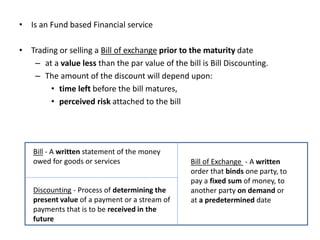
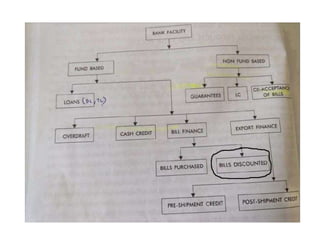
• Is an Fund based Financial service
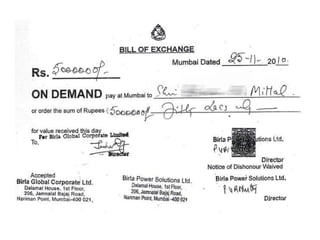
• Trading or selling a Bill of exchange prior to the maturity date
– at a value less than the par value of the bill is Bill Discounting.
– The amount of the discount will depend upon:
• time left before the bill matures,
• perceived risk attached to the bill
Bill - A printed or written statement of the money
Bill - A written statement of the money
owed for goods or services
Discounting - Process of determining the
present value of a payment or a stream of
payments that is to be received in the
future
Bill of Exchange - A written
order that binds one party, to
pay a fixed sum of money, to
another party on demand or
at a predetermined date
Types of Commercial Bills
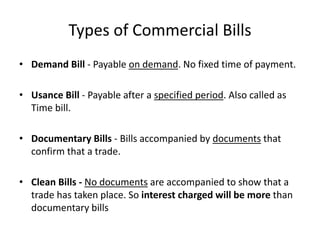
• Demand Bill - Payable on demand. No fixed time of payment.
• Usance Bill - Payable after a specified period. Also called as
Time bill.
• Documentary Bills - Bills accompanied by documents that
confirm that a trade.
• Clean Bills - No documents are accompanied to show that a
trade has taken place. So interest charged will be more than
documentary bills
Contd…
• Inland Bills - Drawn or made in India and must be payable in
India
• Foreign Bills:
– Drawn outside India and may be payable in or outside
India
– or Drawn in India and payable out side India.
• Hundi - Indigenous variety of Bill of Exchange, mainly for
movement of agricultural produce.
Contd…
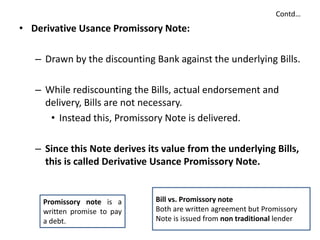
• Derivative Usance Promissory Note:
– Drawn by the discounting Bank against the underlying Bills.
– While rediscounting the Bills, actual endorsement and
delivery, Bills are not necessary.
• Instead this, Promissory Note is delivered.
– Since this Note derives its value from the underlying Bills,
this is called Derivative Usance Promissory Note.
Promissory note is a
written promise to pay
a debt.
Bill vs. Promissory note
Both are written agreement but Promissory
Note is issued from non traditional lender
Factoring
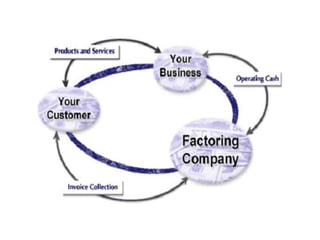
• aka receivables factoring or debtor financing
• Factoring is a process, whereby a business (Seller) sells its accounts
receivables to a third party (called factor), at a discount, in exchange of
money, to finance its running business.
• Factoring allows companies to quickly build up their cash flow, which
makes it easier for them
– to pay employees,
– handle customer orders
– add more business.
• Precisely, a factor will purchase the receivables of the client and will
manage
• Ownership of accounts is been transferred to another party
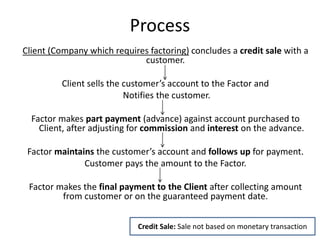
Process
Client (Company which requires factoring) concludes a credit sale with a
customer.
Client sells the customer’s account to the Factor and
Notifies the customer.
Factor makes part payment (advance) against account purchased to
Client, after adjusting for commission and interest on the advance.
Factor maintains the customer’s account and follows up for payment.
Customer pays the amount to the Factor.
Factor makes the final payment to the Client after collecting amount
from customer or on the guaranteed payment date.
Credit Sale: Sale not based on monetary transaction
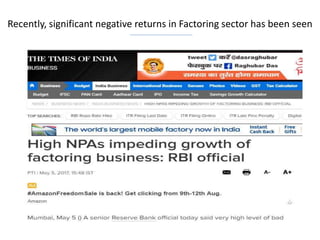
Recently, significant negative returns in Factoring sector has been seen
Bill discounting vs. Factoring
• Bill discounting is related to borrowing from the commercial
bank
• Factoring is associated with the management of book debts
Asset and Liability Management
Asset - Liability Management
• Process, of managing the use of assets and cash flows
– to meet a company's obligations, in order to
• reduce the firm’s risk of loss from not paying a liability on
time
• Practice of managing risks that arise due to mismatches between
the assets and liabilities
• It has the potential to:
– Decrease risk
– Build more assets
– Increase profitability Profitability - State of yielding profit
• Some techniques of Asset – Liability Management (ALM)
– Monitoring Asset Value - value changes over time and hence
needed to be monitored
– Standard Immunization - assets must produce income; liabilities
eat up part of that income. If asset income is out of balance
with liabilities then one may go for selling.
– Surplus Optimization - using surplus to increase income
Short term perspective of ALM
• Liquidity risk: The current and prospective risk arising when
the bank is unable to meet its obligations as they come due
without adversely affecting the bank's financial conditions.
From an ALM perspective, the focus is on the funding liquidity
risk of the bank, meaning its ability to meet its current and
future cash-flow obligations and collateral needs, both
expected and unexpected. This mission thus includes the bank
liquidity's benchmark price in the market.
• Interest rate risk: The risk of losses resulting from movements
in interest rates and their impact on future cash-flows.
Generally because a bank may have a disproportionate
amount of fixed or variable rates instruments on either side of
the balance-sheet. One of the primary causes are mismatches
in terms of bank deposits and loans.
Long term perspectives of ALM
• Capital markets risk: The risk from movements in equity or
credit on the balance sheet or the both. Risk is then mitigated
by options, futures, derivative overlays which may incorporate
tactical or strategic views
• Currency risk management: The risk of losses resulting from
movements in exchanges rates. To the extent that cash-flow
assets and liabilities are denominated in different currencies.
• Funding and capital management: As all the mechanism to
ensure the maintenance of adequate capital on a continuous
basis. It is a dynamic and ongoing process considering both
short- and longer-term capital needs and is coordinated with
a bank's overall strategy and planning cycles.
Forfaiting
Forfaiting
Meaning: Forfaiting is a means of financing exports, that enables the
exporter to receive immediate cash by selling their medium and long
term receivables.
Some terminologies:
Forfaiter:-The forfaiter is the individual or entity that purchases the
receivables, and the importer then pays the receivables amount to the forfaiter. A
forfaiter is typically a bank or a financial firm that specializes in export financing.
Discount rate:-2-5% margin that forfaiter earns.
*Forfaiting is most commonly used in large, international sales of commodities or
capital goods where the sale price exceeds $100,000.
**75-80% of receivable remitted and the further 20-25% when importer actually
pays the forfaiter.
Pros and Cons of Forfaiting
• Transfer of risk of default by importer
• Risk of foreign exchange rate and interest rate are also
transferred.
• Problem of cash flow or the requirement of liquidity solved
for seller.
• Can be used establish trade relations to those countries
where there is no export-import credit agency
Cons
• Higher cost of export
• Not applicable to every situation as the transaction should be
of minimum $100000 and should be of long & medium term
in nature.
• Higher cost may be pushed onto to the importers standard
pricing.
Basel Accords
Basel Accords
• Basel Accords are the set of recommendations for regulations in banking
industry.
• The Basel Accords are three series of banking regulations (Basel I, II and III)
– set by the Basel Committee on Bank Supervision (BCBS),
– a group comprising representatives from 27 major financial centers
which aims to regulate finance and banking practices on an
international level.
– provides recommendations on banking regulations in regards to:
• capital risk,
• market risk,
• operational risk
Basel l
• Issued in 1988 and focuses on the capital adequacy of financial institutions
• Capital adequacy risk is the risk that a financial institution will be have by an
unexpected loss,
– It categorizes the assets of financial institutions into five risk categories (0%,
10%, 20%, 50% and 100%)
The bank must maintain capital equal to at least 8% of its risk-weighted assets.
For example, if a bank has risk-weighted assets of $100 million, it is required to
maintain capital of at least $8 million.
Risk-weighted assets are used to determine the minimum amount of capital
that must be held by banks and other institutions to reduce the risk of
insolvency.
Basel ll
• Published initially in June 2004 and was intended to amend
international banking standards.
• Focuses on three main areas:
– Minimum capital requirements,
– Supervisory review of
• institution's capital adequacy and
• internal assessment process
– Effective use of disclosure as a lever to
• strengthen market discipline and
• encourage sound banking practices
Basel lll
• In the wake of the Lehman Brothers collapse of 2008 and the
ensuing financial crisis.
• Implementation of Basel III has been gradual and began in
January 2013. It is expected to be completed by Jan 01, 2019.
• Apart from Basel ll norms, it included
– banks to have minimum amount of equity,
– minimum liquidity ratio,
– additional requirements for ‘too big to fall’ kind of
financial institutions.
SARFAESI Act
SARFAESI Act 2002
“Securitisation and Reconstruction of Financial Assets and Enforcement of Security
Interest Act, it came into act in 2002” “It extended to the whole of India”
Objectives of SARFAESI Act, 2002
• Efficient or rapid recovery of non-performing assets (NPAs) of the banks and FIs.
• Allows banks and financial institutions to auction properties (say,
commercial/residential) when borrower fail to repay their loans.
• The first asset reconstruction company (ARC) of India, ARCIL, was set up under
this act.
SARFAESI act circulated to-
• regulate securitization and reconstruction of financial assets.
• enforcement of the security interest.
• for matters connected therewith or incidental thereto.
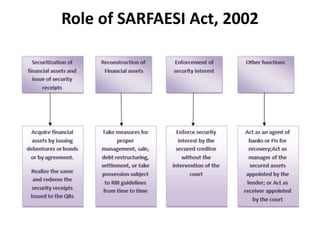
Role of SARFAESI Act, 2002
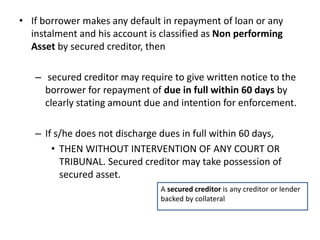
• If borrower makes any default in repayment of loan or any
instalment and his account is classified as Non performing
Asset by secured creditor, then
– secured creditor may require to give written notice to the
borrower for repayment of due in full within 60 days by
clearly stating amount due and intention for enforcement.
– If s/he does not discharge dues in full within 60 days,
• THEN WITHOUT INTERVENTION OF ANY COURT OR
TRIBUNAL. Secured creditor may take possession of
secured asset.
A secured creditor is any creditor or lender
backed by collateral
Queries???
Thank You…

Financial Services

  • 1.
    Bill Discounting Factoring Asset LiabilityManagement Short term and Long term perspective Forfaiting Basel accord SARFAESI act By, Krishna Kumar Omer (2017MB20) Ashish Yadav (2017MB41) Chandraveer Singh (2017MB17)
  • 2.
    Contents • Bill Discounting -Meaning - Types of commercial Bills • Asset Liability Management - Meaning - Some techniques - It’s short term perspective - It’s long term perspective • Basel accord • Factoring - Meaning - Process • Forfaiting - Meaning - Pros - Cons • SARFAESI Act - Definition - Role
  • 3.
  • 4.
    • Is anFund based Financial service • Trading or selling a Bill of exchange prior to the maturity date – at a value less than the par value of the bill is Bill Discounting. – The amount of the discount will depend upon: • time left before the bill matures, • perceived risk attached to the bill Bill - A printed or written statement of the money Bill - A written statement of the money owed for goods or services Discounting - Process of determining the present value of a payment or a stream of payments that is to be received in the future Bill of Exchange - A written order that binds one party, to pay a fixed sum of money, to another party on demand or at a predetermined date
  • 7.
    Types of CommercialBills • Demand Bill - Payable on demand. No fixed time of payment. • Usance Bill - Payable after a specified period. Also called as Time bill. • Documentary Bills - Bills accompanied by documents that confirm that a trade. • Clean Bills - No documents are accompanied to show that a trade has taken place. So interest charged will be more than documentary bills
  • 8.
    Contd… • Inland Bills- Drawn or made in India and must be payable in India • Foreign Bills: – Drawn outside India and may be payable in or outside India – or Drawn in India and payable out side India. • Hundi - Indigenous variety of Bill of Exchange, mainly for movement of agricultural produce.
  • 9.
    Contd… • Derivative UsancePromissory Note: – Drawn by the discounting Bank against the underlying Bills. – While rediscounting the Bills, actual endorsement and delivery, Bills are not necessary. • Instead this, Promissory Note is delivered. – Since this Note derives its value from the underlying Bills, this is called Derivative Usance Promissory Note. Promissory note is a written promise to pay a debt. Bill vs. Promissory note Both are written agreement but Promissory Note is issued from non traditional lender
  • 10.
  • 11.
    • aka receivablesfactoring or debtor financing • Factoring is a process, whereby a business (Seller) sells its accounts receivables to a third party (called factor), at a discount, in exchange of money, to finance its running business. • Factoring allows companies to quickly build up their cash flow, which makes it easier for them – to pay employees, – handle customer orders – add more business. • Precisely, a factor will purchase the receivables of the client and will manage • Ownership of accounts is been transferred to another party
  • 13.
    Process Client (Company whichrequires factoring) concludes a credit sale with a customer. Client sells the customer’s account to the Factor and Notifies the customer. Factor makes part payment (advance) against account purchased to Client, after adjusting for commission and interest on the advance. Factor maintains the customer’s account and follows up for payment. Customer pays the amount to the Factor. Factor makes the final payment to the Client after collecting amount from customer or on the guaranteed payment date. Credit Sale: Sale not based on monetary transaction
  • 14.
    Recently, significant negativereturns in Factoring sector has been seen
  • 15.
    Bill discounting vs.Factoring • Bill discounting is related to borrowing from the commercial bank • Factoring is associated with the management of book debts
  • 16.
  • 17.
    Asset - LiabilityManagement • Process, of managing the use of assets and cash flows – to meet a company's obligations, in order to • reduce the firm’s risk of loss from not paying a liability on time • Practice of managing risks that arise due to mismatches between the assets and liabilities • It has the potential to: – Decrease risk – Build more assets – Increase profitability Profitability - State of yielding profit
  • 18.
    • Some techniquesof Asset – Liability Management (ALM) – Monitoring Asset Value - value changes over time and hence needed to be monitored – Standard Immunization - assets must produce income; liabilities eat up part of that income. If asset income is out of balance with liabilities then one may go for selling. – Surplus Optimization - using surplus to increase income
  • 19.
    Short term perspectiveof ALM • Liquidity risk: The current and prospective risk arising when the bank is unable to meet its obligations as they come due without adversely affecting the bank's financial conditions. From an ALM perspective, the focus is on the funding liquidity risk of the bank, meaning its ability to meet its current and future cash-flow obligations and collateral needs, both expected and unexpected. This mission thus includes the bank liquidity's benchmark price in the market. • Interest rate risk: The risk of losses resulting from movements in interest rates and their impact on future cash-flows. Generally because a bank may have a disproportionate amount of fixed or variable rates instruments on either side of the balance-sheet. One of the primary causes are mismatches in terms of bank deposits and loans.
  • 20.
    Long term perspectivesof ALM • Capital markets risk: The risk from movements in equity or credit on the balance sheet or the both. Risk is then mitigated by options, futures, derivative overlays which may incorporate tactical or strategic views • Currency risk management: The risk of losses resulting from movements in exchanges rates. To the extent that cash-flow assets and liabilities are denominated in different currencies. • Funding and capital management: As all the mechanism to ensure the maintenance of adequate capital on a continuous basis. It is a dynamic and ongoing process considering both short- and longer-term capital needs and is coordinated with a bank's overall strategy and planning cycles.
  • 21.
  • 22.
    Forfaiting Meaning: Forfaiting isa means of financing exports, that enables the exporter to receive immediate cash by selling their medium and long term receivables. Some terminologies: Forfaiter:-The forfaiter is the individual or entity that purchases the receivables, and the importer then pays the receivables amount to the forfaiter. A forfaiter is typically a bank or a financial firm that specializes in export financing. Discount rate:-2-5% margin that forfaiter earns. *Forfaiting is most commonly used in large, international sales of commodities or capital goods where the sale price exceeds $100,000. **75-80% of receivable remitted and the further 20-25% when importer actually pays the forfaiter.
  • 23.
    Pros and Consof Forfaiting • Transfer of risk of default by importer • Risk of foreign exchange rate and interest rate are also transferred. • Problem of cash flow or the requirement of liquidity solved for seller. • Can be used establish trade relations to those countries where there is no export-import credit agency
  • 24.
    Cons • Higher costof export • Not applicable to every situation as the transaction should be of minimum $100000 and should be of long & medium term in nature. • Higher cost may be pushed onto to the importers standard pricing.
  • 25.
  • 26.
    Basel Accords • BaselAccords are the set of recommendations for regulations in banking industry. • The Basel Accords are three series of banking regulations (Basel I, II and III) – set by the Basel Committee on Bank Supervision (BCBS), – a group comprising representatives from 27 major financial centers which aims to regulate finance and banking practices on an international level. – provides recommendations on banking regulations in regards to: • capital risk, • market risk, • operational risk
  • 27.
    Basel l • Issuedin 1988 and focuses on the capital adequacy of financial institutions • Capital adequacy risk is the risk that a financial institution will be have by an unexpected loss, – It categorizes the assets of financial institutions into five risk categories (0%, 10%, 20%, 50% and 100%) The bank must maintain capital equal to at least 8% of its risk-weighted assets. For example, if a bank has risk-weighted assets of $100 million, it is required to maintain capital of at least $8 million. Risk-weighted assets are used to determine the minimum amount of capital that must be held by banks and other institutions to reduce the risk of insolvency.
  • 28.
    Basel ll • Publishedinitially in June 2004 and was intended to amend international banking standards. • Focuses on three main areas: – Minimum capital requirements, – Supervisory review of • institution's capital adequacy and • internal assessment process – Effective use of disclosure as a lever to • strengthen market discipline and • encourage sound banking practices
  • 29.
    Basel lll • Inthe wake of the Lehman Brothers collapse of 2008 and the ensuing financial crisis. • Implementation of Basel III has been gradual and began in January 2013. It is expected to be completed by Jan 01, 2019. • Apart from Basel ll norms, it included – banks to have minimum amount of equity, – minimum liquidity ratio, – additional requirements for ‘too big to fall’ kind of financial institutions.
  • 30.
  • 31.
    SARFAESI Act 2002 “Securitisationand Reconstruction of Financial Assets and Enforcement of Security Interest Act, it came into act in 2002” “It extended to the whole of India” Objectives of SARFAESI Act, 2002 • Efficient or rapid recovery of non-performing assets (NPAs) of the banks and FIs. • Allows banks and financial institutions to auction properties (say, commercial/residential) when borrower fail to repay their loans. • The first asset reconstruction company (ARC) of India, ARCIL, was set up under this act. SARFAESI act circulated to- • regulate securitization and reconstruction of financial assets. • enforcement of the security interest. • for matters connected therewith or incidental thereto.

  • 32.
  • 33.
    • If borrowermakes any default in repayment of loan or any instalment and his account is classified as Non performing Asset by secured creditor, then – secured creditor may require to give written notice to the borrower for repayment of due in full within 60 days by clearly stating amount due and intention for enforcement. – If s/he does not discharge dues in full within 60 days, • THEN WITHOUT INTERVENTION OF ANY COURT OR TRIBUNAL. Secured creditor may take possession of secured asset. A secured creditor is any creditor or lender backed by collateral
  • 34.
  • 35.