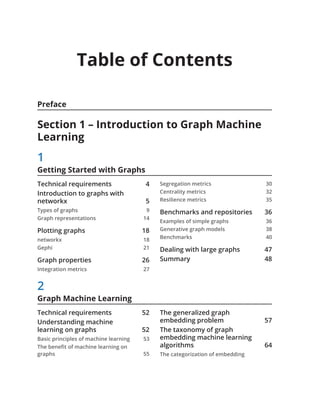
Table of Contents
Preface
Section 1 – Introduction to Graph Machine
Learning
1
Getting Started with Graphs
Technical requirements 4
Introduction to graphs with
networkx 5
Types of graphs 9
Graph representations 14
Plotting graphs 18
networkx 18
Gephi 21
Graph properties 26
Integration metrics 27
Segregation metrics 30
Centrality metrics 32
Resilience metrics 35
Benchmarks and repositories 36
Examples of simple graphs 36
Generative graph models 38
Benchmarks 40
Dealing with large graphs 47
Summary  48
2
Graph Machine Learning
Technical requirements 52
Understanding machine
learning on graphs 52
Basic principles of machine learning 53
Thebenefitofmachinelearningon
graphs 55
The generalized graph
embedding problem 57
The taxonomy of graph
embedding machine learning
algorithms 64
The categorization of embedding
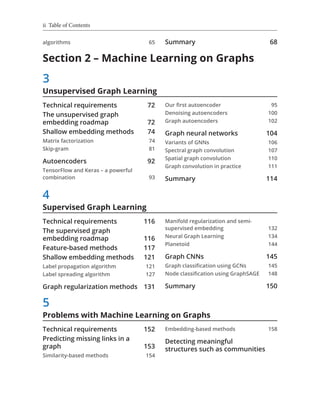
ii Table of Contents
algorithms 65 Summary  68
Section 2 – Machine Learning on Graphs
3
Unsupervised Graph Learning
Technical requirements 72
The unsupervised graph
embedding roadmap 72
Shallow embedding methods 74
Matrix factorization 74
Skip-gram 81
Autoencoders 92
TensorFlow and Keras – a powerful
combination 93
Ourfirstautoencoder 95
Denoising autoencoders 100
Graph autoencoders 102
Graph neural networks 104
Variants of GNNs 106
Spectral graph convolution 107
Spatial graph convolution 110
Graph convolution in practice 111
Summary  114
4
Supervised Graph Learning
Technical requirements 116
The supervised graph
embeddingroadmap  116
Feature-basedmethods  117
Shallowembeddingmethods  121
Label propagation algorithm 121
Label spreading algorithm 127
Graph regularization methods 131
Manifold regularization and semi-
supervised embedding 132
Neural Graph Learning 134
Planetoid 144
Graph CNNs 145
GraphclassificationusingGCNs 145
NodeclassificationusingGraphSAGE 148
Summary  150
5
Problems with Machine Learning on Graphs
Technical requirements 152
Predicting missing links in a
graph 153
Similarity-based methods 154
Embedding-based methods 158
Detecting meaningful
structures such as communities
Table of Contents iii
163
Embedding-based community
detection 164
Spectral methods and matrix
factorization 165
Probability models 166
Cost function minimization 167
Detecting graph similarities and
graph matching 169
Graph embedding-based methods 171
Graph kernel-based methods 171
GNN-based methods 171
Applications 172
Summary  173
Section 3 – Advanced Applications of Graph
Machine Learning
6
Social Network Graphs
Technical requirements 178
Overview of the dataset 178
Dataset download 179
Loading the dataset using networkx 180
Network topology and
community detection 181
Topology overview 182
Node centrality 183
Community detection 186
Embedding for supervised and
unsupervised tasks 188
Task preparation 189
node2vec-based link prediction 190
GraphSAGE-based link prediction 191
Hand-crafted features for link
prediction 197
Summary of results 199
Summary 200
7
Text Analytics and Natural Language Processing Using
Graphs
Technical requirements 202
Providing a quick overview of a
dataset 203
Understanding the main
concepts and tools used in NLP 204
Creating graphs from a corpus
of documents 209
Knowledge graphs 210
Bipartite document/entity graphs 212
Building a document topic
classifier 233
Shallow learning methods 234
Graph neural networks 238
Summary 249
iv Table of Contents
8
Graph Analysis for Credit Card Transactions
Technical requirements 252
Overview of the dataset 252
Loading the dataset and graph
building using networkx 254
Network topology and
community detection 260
Network topology 260
Community detection 264
Embedding for supervised and
unsupervised fraud detection 270
Supervised approach to fraudulent
transactionidentification 271
Unsupervised approach to fraudulent
transactionidentification 274
Summary 277
9
Building a Data-Driven Graph-Powered Application
Technical requirements 280
Overview of Lambda
architectures 280
Lambda architectures for
graph-powered applications 283
Graph processing engines 285
Graph querying layer 288
Selecting between Neo4j and GraphX 293
Summary 293
10
Novel Trends on Graphs
Technical requirements  296
Learning about data
augmentation for graphs 296
Sampling strategies 297
Exploring data augmentation
techniques 298
Learning about topological data
analysis 299
Topological machine learning 300
Applying graph theory in new
domains 302
Graph machine learning and
neuroscience 302
Graph theory and chemistry and
biology 304
Graph machine learning and computer
vision 304
Recommendation systems 305
Summary 305
Why subscribe? 307

Graph machine learning table of content

  • 1.
    Table of Contents Preface Section1 – Introduction to Graph Machine Learning 1 Getting Started with Graphs Technical requirements 4 Introduction to graphs with networkx 5 Types of graphs 9 Graph representations 14 Plotting graphs 18 networkx 18 Gephi 21 Graph properties 26 Integration metrics 27 Segregation metrics 30 Centrality metrics 32 Resilience metrics 35 Benchmarks and repositories 36 Examples of simple graphs 36 Generative graph models 38 Benchmarks 40 Dealing with large graphs 47 Summary  48 2 Graph Machine Learning Technical requirements 52 Understanding machine learning on graphs 52 Basic principles of machine learning 53 Thebenefitofmachinelearningon graphs 55 The generalized graph embedding problem 57 The taxonomy of graph embedding machine learning algorithms 64 The categorization of embedding
  • 2.
    ii Table ofContents algorithms 65 Summary  68 Section 2 – Machine Learning on Graphs 3 Unsupervised Graph Learning Technical requirements 72 The unsupervised graph embedding roadmap 72 Shallow embedding methods 74 Matrix factorization 74 Skip-gram 81 Autoencoders 92 TensorFlow and Keras – a powerful combination 93 Ourfirstautoencoder 95 Denoising autoencoders 100 Graph autoencoders 102 Graph neural networks 104 Variants of GNNs 106 Spectral graph convolution 107 Spatial graph convolution 110 Graph convolution in practice 111 Summary  114 4 Supervised Graph Learning Technical requirements 116 The supervised graph embeddingroadmap  116 Feature-basedmethods  117 Shallowembeddingmethods  121 Label propagation algorithm 121 Label spreading algorithm 127 Graph regularization methods 131 Manifold regularization and semi- supervised embedding 132 Neural Graph Learning 134 Planetoid 144 Graph CNNs 145 GraphclassificationusingGCNs 145 NodeclassificationusingGraphSAGE 148 Summary  150 5 Problems with Machine Learning on Graphs Technical requirements 152 Predicting missing links in a graph 153 Similarity-based methods 154 Embedding-based methods 158 Detecting meaningful structures such as communities
  • 3.
    Table of Contentsiii 163 Embedding-based community detection 164 Spectral methods and matrix factorization 165 Probability models 166 Cost function minimization 167 Detecting graph similarities and graph matching 169 Graph embedding-based methods 171 Graph kernel-based methods 171 GNN-based methods 171 Applications 172 Summary  173 Section 3 – Advanced Applications of Graph Machine Learning 6 Social Network Graphs Technical requirements 178 Overview of the dataset 178 Dataset download 179 Loading the dataset using networkx 180 Network topology and community detection 181 Topology overview 182 Node centrality 183 Community detection 186 Embedding for supervised and unsupervised tasks 188 Task preparation 189 node2vec-based link prediction 190 GraphSAGE-based link prediction 191 Hand-crafted features for link prediction 197 Summary of results 199 Summary 200 7 Text Analytics and Natural Language Processing Using Graphs Technical requirements 202 Providing a quick overview of a dataset 203 Understanding the main concepts and tools used in NLP 204 Creating graphs from a corpus of documents 209 Knowledge graphs 210 Bipartite document/entity graphs 212 Building a document topic classifier 233 Shallow learning methods 234 Graph neural networks 238 Summary 249
  • 4.
    iv Table ofContents 8 Graph Analysis for Credit Card Transactions Technical requirements 252 Overview of the dataset 252 Loading the dataset and graph building using networkx 254 Network topology and community detection 260 Network topology 260 Community detection 264 Embedding for supervised and unsupervised fraud detection 270 Supervised approach to fraudulent transactionidentification 271 Unsupervised approach to fraudulent transactionidentification 274 Summary 277 9 Building a Data-Driven Graph-Powered Application Technical requirements 280 Overview of Lambda architectures 280 Lambda architectures for graph-powered applications 283 Graph processing engines 285 Graph querying layer 288 Selecting between Neo4j and GraphX 293 Summary 293 10 Novel Trends on Graphs Technical requirements  296 Learning about data augmentation for graphs 296 Sampling strategies 297 Exploring data augmentation techniques 298 Learning about topological data analysis 299 Topological machine learning 300 Applying graph theory in new domains 302 Graph machine learning and neuroscience 302 Graph theory and chemistry and biology 304 Graph machine learning and computer vision 304 Recommendation systems 305 Summary 305 Why subscribe? 307