1
Adding and Subtracting
Decimals
NS11
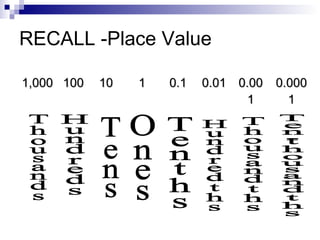
RECALL -Place Value
1,0001,000 100100 1010 11 0.10.1 0.010.01 0.000.00
11
0.0000.000
11
3
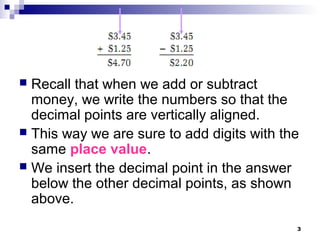
 Recall that when we add or subtract
money, we write the numbers so that the
decimal points are vertically aligned.
 This way we are sure to add digits with the
same place value.
 We insert the decimal point in the answer
below the other decimal points, as shown
above.
4
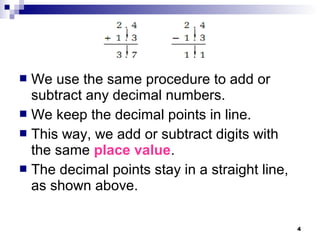
 We use the same procedure to add or
subtract any decimal numbers.
 We keep the decimal points in line.
 This way, we add or subtract digits with
the same place value.
 The decimal points stay in a straight line,
as shown above.
5
Let’s practice!
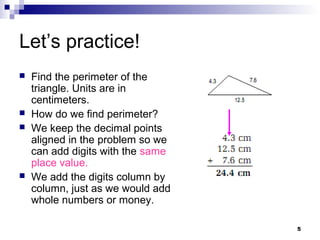
 Find the perimeter of the
triangle. Units are in
centimeters.
 How do we find perimeter?
 We keep the decimal points
aligned in the problem so we
can add digits with the same
place value.
 We add the digits column by
column, just as we would add
whole numbers or money.
6
Another Example:
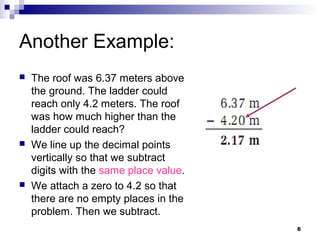
 The roof was 6.37 meters above
the ground. The ladder could
reach only 4.2 meters. The roof
was how much higher than the
ladder could reach?
 We line up the decimal points
vertically so that we subtract
digits with the same place value.
 We attach a zero to 4.2 so that
there are no empty places in the
problem. Then we subtract.
7
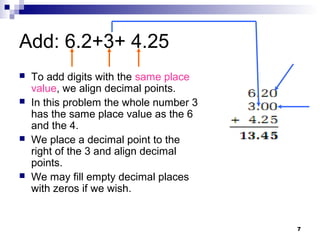
Add: 6.2+3+ 4.25
 To add digits with the same place
value, we align decimal points.
 In this problem the whole number 3
has the same place value as the 6
and the 4.
 We place a decimal point to the
right of the 3 and align decimal
points.
 We may fill empty decimal places
with zeros if we wish.
8
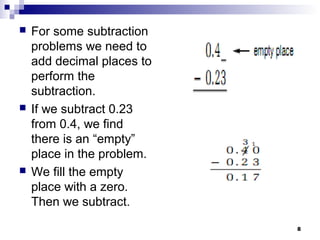
 For some subtraction
problems we need to
add decimal places to
perform the
subtraction.
 If we subtract 0.23
from 0.4, we find
there is an “empty”
place in the problem.
 We fill the empty
place with a zero.
Then we subtract.
9
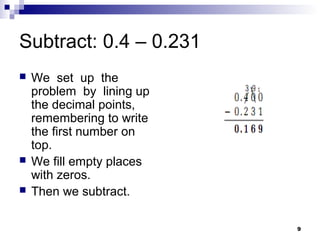
Subtract: 0.4 – 0.231
 We set up the
problem by lining up
the decimal points,
remembering to write
the first number on
top.
 We fill empty places
with zeros.
 Then we subtract.
10
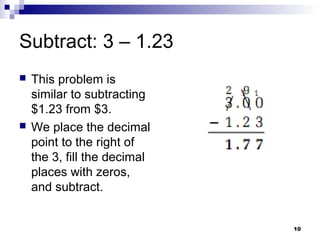
Subtract: 3 – 1.23
 This problem is
similar to subtracting
$1.23 from $3.
 We place the decimal
point to the right of
the 3, fill the decimal
places with zeros,
and subtract.
11
a. 4.5
b. 6.3
c. 4.1
d. 2.3
4.3 + 2
12
4 + 1.3 + 0.6
a.2.3
b.5.3
c.5.9
13
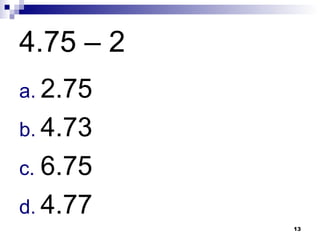
4.75 – 2
a. 2.75
b. 4.73
c. 6.75
d. 4.77
14
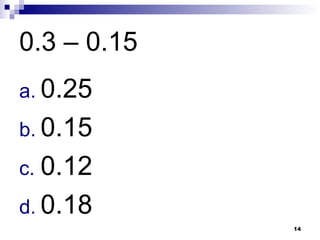
0.3 – 0.15
a. 0.25
b. 0.15
c. 0.12
d. 0.18
15
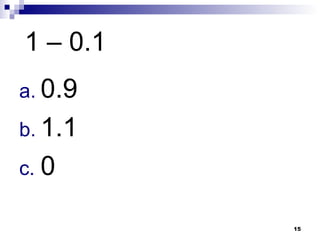
1 – 0.1
a. 0.9
b. 1.1
c. 0
16
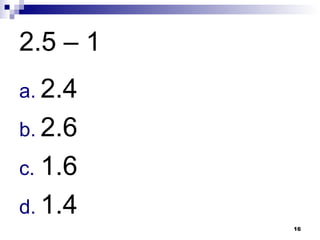
2.5 – 1
a. 2.4
b. 2.6
c. 1.6
d. 1.4
17
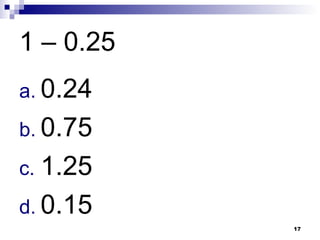
1 – 0.25
a. 0.24
b. 0.75
c. 1.25
d. 0.15
18
The end!

Chapter 3.2

  • 1.
  • 2.
    RECALL -Place Value 1,0001,000100100 1010 11 0.10.1 0.010.01 0.000.00 11 0.0000.000 11
  • 3.
    3  Recall thatwhen we add or subtract money, we write the numbers so that the decimal points are vertically aligned.  This way we are sure to add digits with the same place value.  We insert the decimal point in the answer below the other decimal points, as shown above.
  • 4.
    4  We usethe same procedure to add or subtract any decimal numbers.  We keep the decimal points in line.  This way, we add or subtract digits with the same place value.  The decimal points stay in a straight line, as shown above.
  • 5.
    5 Let’s practice!  Findthe perimeter of the triangle. Units are in centimeters.  How do we find perimeter?  We keep the decimal points aligned in the problem so we can add digits with the same place value.  We add the digits column by column, just as we would add whole numbers or money.
  • 6.
    6 Another Example:  Theroof was 6.37 meters above the ground. The ladder could reach only 4.2 meters. The roof was how much higher than the ladder could reach?  We line up the decimal points vertically so that we subtract digits with the same place value.  We attach a zero to 4.2 so that there are no empty places in the problem. Then we subtract.
  • 7.
    7 Add: 6.2+3+ 4.25 To add digits with the same place value, we align decimal points.  In this problem the whole number 3 has the same place value as the 6 and the 4.  We place a decimal point to the right of the 3 and align decimal points.  We may fill empty decimal places with zeros if we wish.
  • 8.
    8  For somesubtraction problems we need to add decimal places to perform the subtraction.  If we subtract 0.23 from 0.4, we find there is an “empty” place in the problem.  We fill the empty place with a zero. Then we subtract.
  • 9.
    9 Subtract: 0.4 –0.231  We set up the problem by lining up the decimal points, remembering to write the first number on top.  We fill empty places with zeros.  Then we subtract.
  • 10.
    10 Subtract: 3 –1.23  This problem is similar to subtracting $1.23 from $3.  We place the decimal point to the right of the 3, fill the decimal places with zeros, and subtract.
  • 11.
    11 a. 4.5 b. 6.3 c.4.1 d. 2.3 4.3 + 2
  • 12.
    12 4 + 1.3+ 0.6 a.2.3 b.5.3 c.5.9
  • 13.
    13 4.75 – 2 a.2.75 b. 4.73 c. 6.75 d. 4.77
  • 14.
    14 0.3 – 0.15 a.0.25 b. 0.15 c. 0.12 d. 0.18
  • 15.
    15 1 – 0.1 a.0.9 b. 1.1 c. 0
  • 16.
    16 2.5 – 1 a.2.4 b. 2.6 c. 1.6 d. 1.4
  • 17.
    17 1 – 0.25 a.0.24 b. 0.75 c. 1.25 d. 0.15
  • 18.