CHAPTER 3:
DANCE
APRRECIATION AND
COMPOSITION
Recreational
Dance
– is a social activity in which people of all ages can participate.
- come from all over the world and include folk, cultural, and historical
dances, and social dances from the past and present.
Dance fitness
– is a fun way to increase cardiovascular endurance,
strength, and flexibility, or various dance genres
that support fitness.
-Zumba, Fitness and Cardio Dance
- a lot of people enjoy using dance as a fitness
activity.
Choreography
&
choreographer
What makes a good
dance?
 Displays a significant meaning or conveys a message (portrays life
experience)
 Lifts and transport the audience from their seats
 Must have a shape or form for an effective choreography
 A good dance has a beginning, middle, and end/conclusion.
Beginning – the beginning of dance may come in a form of shape, a pose, or an entrance.
Middle – the middle of the dance where it consists of a development or the exploration
of the main idea.
Ending/Conclusion – it should be clear and may be in a form of shape, a pose, or an exit.
What is a form?
TERMS TO UNDERSTAND
Form is the instrument by which ideas and elements are arranged or combined into
a logical sequence which results in unity and consistency. It is the organizing factor
of any dance composition
What is a phrase?
A phrase is the smallest unit in the whole dance. It can be related to a sentence in
writing compositions.
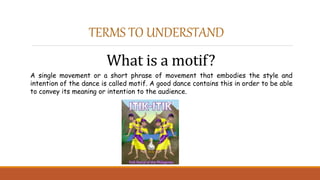
What is a motif?
TERMS TO UNDERSTAND
A single movement or a short phrase of movement that embodies the style and
intention of the dance is called motif. A good dance contains this in order to be able
to convey its meaning or intention to the audience.
CHARACTERISTIC
S OF GOOD
DANCE
01
UNITY
The interconnected phrases of the
dance are coherent and flow
smoothly. The movement flows
together and each plays an important
role that contributes to the entirety
of a dance
02
Continuity and
Development
The phrases of the dance that are organized
progressively, making each movement phrase
move naturally into the next. There is a
continuous development of the movement phrase
and the audience is swept along to the end.
03
Variety and contrast
Variety and contrast in movement phrases add
excitement and flavor to the dance. Changing the
direction, use of energy, timing of a movement
phrase, and avoiding repeating then in exact way
are ways to add variety to the dance.
04
Transition
This is the link between movements,
phrases, and sections of the dance. It
makes the logical progression of the
dance flow smoothly. Also, it is vital
because it keeps the unity and
continuity of dance.
05
repetition
It emphasizes movements and
phrases that are important to the
dance and gives a feeling of closure
to a work.
06
Climax
This is where the apex of
energy in the dance is
reached. It is similar to a
climax in a story where
series of events culminates.
CHOREOGRAPHIC FORMS IN
DANCE
Sequential Forms
Contrapuntal Forms
Episodic form
Other Compositional forms
Sequential Forms
these forms contains themes/motif which progress in
a specific order. They are arranged accordingly.
AB (two-part) form
ABA (three-part) form
Rondo form (ABACA)
Theme and Variations form
Contrapuntal Forms
Here, several themes are woven together in
choreography to form a complex structure. The main
theme is seen against itself or against one or more
other themes.
Ground bass
Round or Canon
Fugue or Accumulation
Suite
Episodic Form
Episodic forms are not musical forms. Instead, they
are found in literature. They tell a story through
connected and progressive sections called episodes.
Narrative form is an episodic form that tells a story
or conveys an idea and the sequence of the story
determines the structure of the dance.
Other Compositional forms
Natural structures
Collage
Tableau
Chance
EVALUATING
A GOOD
DANCE
How is the quality of the dance evaluated?
Evaluators’ roles are categorized as:
1. Choreographers – they will evaluate a part of an
ongoing process of developing a personal style which is
both spontaneous and organized.
2. Dancers – they will evaluate according to the specific
demands that the performance places on them.
3. Audiences – they will evaluate according to the
particular context of the dance.
Stages in
Assessing a
Dance
(Dance Critique)
DESCRIPTION
– involves close observation of all the elements, characteristics,
and components of a dance. Here, the evaluator/critic notes
down the composition of the dance in terms of the elements
and the characteristics of dance.
INTERPRETATION
– involves an appreciation of the ideas, content, images, and
style contained within the dance.
EVALUATION
– takes into consideration how effectively the features and the
context of the dance have been utilized in the actual
performance of the dancers to portray the content and the
quality of the dance.

CHAPTER 3 - LESSON 1.pptx

  • 1.
  • 2.
    Recreational Dance – is asocial activity in which people of all ages can participate. - come from all over the world and include folk, cultural, and historical dances, and social dances from the past and present.
  • 3.
    Dance fitness – isa fun way to increase cardiovascular endurance, strength, and flexibility, or various dance genres that support fitness. -Zumba, Fitness and Cardio Dance - a lot of people enjoy using dance as a fitness activity.
  • 4.
  • 6.
    What makes agood dance?  Displays a significant meaning or conveys a message (portrays life experience)  Lifts and transport the audience from their seats  Must have a shape or form for an effective choreography  A good dance has a beginning, middle, and end/conclusion. Beginning – the beginning of dance may come in a form of shape, a pose, or an entrance. Middle – the middle of the dance where it consists of a development or the exploration of the main idea. Ending/Conclusion – it should be clear and may be in a form of shape, a pose, or an exit.
  • 7.
    What is aform? TERMS TO UNDERSTAND Form is the instrument by which ideas and elements are arranged or combined into a logical sequence which results in unity and consistency. It is the organizing factor of any dance composition What is a phrase? A phrase is the smallest unit in the whole dance. It can be related to a sentence in writing compositions.
  • 8.
    What is amotif? TERMS TO UNDERSTAND A single movement or a short phrase of movement that embodies the style and intention of the dance is called motif. A good dance contains this in order to be able to convey its meaning or intention to the audience.
  • 9.
  • 10.
    01 UNITY The interconnected phrasesof the dance are coherent and flow smoothly. The movement flows together and each plays an important role that contributes to the entirety of a dance
  • 11.
    02 Continuity and Development The phrasesof the dance that are organized progressively, making each movement phrase move naturally into the next. There is a continuous development of the movement phrase and the audience is swept along to the end.
  • 12.
    03 Variety and contrast Varietyand contrast in movement phrases add excitement and flavor to the dance. Changing the direction, use of energy, timing of a movement phrase, and avoiding repeating then in exact way are ways to add variety to the dance.
  • 13.
    04 Transition This is thelink between movements, phrases, and sections of the dance. It makes the logical progression of the dance flow smoothly. Also, it is vital because it keeps the unity and continuity of dance.
  • 14.
    05 repetition It emphasizes movementsand phrases that are important to the dance and gives a feeling of closure to a work.
  • 15.
    06 Climax This is wherethe apex of energy in the dance is reached. It is similar to a climax in a story where series of events culminates.
  • 16.
    CHOREOGRAPHIC FORMS IN DANCE SequentialForms Contrapuntal Forms Episodic form Other Compositional forms
  • 17.
    Sequential Forms these formscontains themes/motif which progress in a specific order. They are arranged accordingly. AB (two-part) form ABA (three-part) form Rondo form (ABACA) Theme and Variations form
  • 18.
    Contrapuntal Forms Here, severalthemes are woven together in choreography to form a complex structure. The main theme is seen against itself or against one or more other themes. Ground bass Round or Canon Fugue or Accumulation Suite
  • 19.
    Episodic Form Episodic formsare not musical forms. Instead, they are found in literature. They tell a story through connected and progressive sections called episodes. Narrative form is an episodic form that tells a story or conveys an idea and the sequence of the story determines the structure of the dance.
  • 20.
    Other Compositional forms Naturalstructures Collage Tableau Chance
  • 21.
  • 22.
    How is thequality of the dance evaluated? Evaluators’ roles are categorized as: 1. Choreographers – they will evaluate a part of an ongoing process of developing a personal style which is both spontaneous and organized. 2. Dancers – they will evaluate according to the specific demands that the performance places on them. 3. Audiences – they will evaluate according to the particular context of the dance.
  • 23.
  • 24.
    DESCRIPTION – involves closeobservation of all the elements, characteristics, and components of a dance. Here, the evaluator/critic notes down the composition of the dance in terms of the elements and the characteristics of dance. INTERPRETATION – involves an appreciation of the ideas, content, images, and style contained within the dance. EVALUATION – takes into consideration how effectively the features and the context of the dance have been utilized in the actual performance of the dancers to portray the content and the quality of the dance.

Editor's Notes

  • #2 How can we appreciate dancing or any dance performances. Paano tayo magcocompose ng isang sayaw para maging maganda ang ating performances.
  • #3 Refers to any form of dancing that is done primarily for its social, educational or health benefits. The styles, performance and music related to the cultural roots and, historical eras, and geographic areas from which the dance originates. Example : hiphop dance, step dancing , jazz dancing
  • #5 the art of arranging the movements of dancers for a performance  a person who composes the sequence of steps and moves for a performance of dance.
  • #6 How then can a dance become a good dance? When a certain dance performance has a poor choreography, it is difficult for it to be understood and appreciated. When a dance fails to communicate its intended meaning or if it does not have a meaning or significance at all, it is hard for the audience to grasp the content of the performance.
  • #7 Dance may be presented abstractly and symbolically but still convey emotion and meaning.
  • #8 Form is use to organize dance composition or dance choreography. Wherein the ideas or the details in the dance and the elements of the dance are combined, magkakaroon ng magandang result sa isang dance composition. When you combine one movement with several others, they form a unit. When units were pieced together, they make up a section in the choreography and the sections together form a whole dance. Choreographers and dancers use movement phrasing when working on dances. Phrase is the smallest ideas or details in dance composition.
  • #9 It is east to identify the motif of this dance as it simply portrays the movements of an itik (duckling).
  • #11 Dito natin malalaman na yung movements na ginagamit ng mga dancers ay nagkakasaisa. Because every movements has a vital role sa pagsasayaw, nagbibigay ng aliw o buhay at also conveys messages when dancing.
  • #12 Pagdating sa dance performance ang movements ay mayrong progression at nadedevop yung mga movements phrase. Dito rin pumapasok yung mga gulat factor ng mga dancers.
  • #13 Examples of contrasting movements are slow to fast, short to long, and minimal to large movement phrase. Dito na pumapasok yung elements of dance, kapag naapply at naorganize natin yung elements na yun nagbibigay ito ng magandang result sa pagsasayaw.
  • #14 Transition is important in dance performance because this is the way of matching our movements and moods to the phrases itself.
  • #16 All these characteristics are organized to contribute to the development of a meaningful dance. It is easier to recognize a good dance when all these characteristics have been applied in the choreography
  • #17 .