FACTORS THAT AFFECT
FOODBORNE ILLNESS
HFOODSAFE M.Aldana
Learning Objectives
• Identify potential problems related to
temperature abuse of foods
• Describe how to properly measure and
maintain food temperatures to ensure that
foods are safe for consumption
• Identify potential problems related to a
food worker’s poor personal hygiene
Learning Objectives
• Explain how to improve personal hygiene
habits to reduce the risk of foodborne
illness
• Identify potential problems related to
cross-contamination
• Discuss procedures and methods to
prevent cross contamination.
Leading Factors That Cause
Foodborne Illness
• Time and Temperature Abuse
• Poor Personal Hygiene and Improper
Hand washing
• Cross Contamination
• Contaminated ready-to-eat foods such as
salad items and processed meats.
• “It is extremely important that you
recognize these as major contributors
to food contamination.”
Highly susceptible to foodborne
illness are the ff:
• The very young, infants
• The elderly
• Pregnant or lactating woman
• People with impaired immune systems
due to cancer, AIDS, diabetes, or
medications that suppress response to
infection
What Are Time and Temperature
Abuse?
• Controlling Temperature is perhaps the
most critical way to ensure food safety.
• Most cases of FBI can in some way be
linked to temperature abuse.
What Are Time and Temperature
Abuse?
• The term temperature abuse is used to
describe situations:
– When food is exposed to temperatures in the
danger zone for enough time to allow growth
of harmful microorganisms
– When food is not cooked or reheated
sufficiently to destroy microorganisms.
What should be done?
• “HOT FOODS HOT, KEEP COLD
FOODS COLD, or DON’T KEEP THE
FOOD AT ALL!!!”
– Keep food above the Temperature Danger
Zone (135’F) to prevent harmful microbes
from growing.
– High temperature kills/destroys the bacteria;
low temperature keeps it from growing or
multiplying/ slows down growth.
What should be done?
• Keep food temperatures below the
temperature danger zone 41o
F (5o
C) to
prevent most microbes may or may not be
affected by heat.
Unavoidable situations when
food must pass the TDZ
• Cooking
• Cooling
• Reheating
• Food Preparation (slicing, mixing, etc.)
“Minimize the amount of time foods are in TDZ;
minimize number of times food pass through
the TDZ!”
• Hot foods should be cooled and reheated only one
time
• Cooking and reheating are two very important
processes for safe food management.
Food Thermometers
• Maintaining safe food temperatures is an
essential and effective part of food safety
management.
• Food temperature measuring devices
typically measure food temperatures in
degree Fahrenheit (°F), degree Celsius
(°C), or both.
Temperature Conversion
• °F to °C
– Deduct 32, then multiply by 5, then divide by 9
• °C to °F
– Multiply by 9, then divide by 5, then add 32
HOW TO MEASURE FOOD
TEMPERATURE ACCURATELY
AND SAFELY?
• Parts: Head, Stem/Probe, Sensor
• Use a food thermometer that measures
temperature from 0F (-18C) to 220F (104C).
Do not use mercury-filled/glass thermometers
• Locate sensing portion of the measuring
device
HOW TO MEASURE FOOD
TEMPERATURE ACCURATELY
AND SAFELY?
• Calibrate using ice or boiling point method
• Clean and sanitize the probe before using it
• Measure internal temperature by inserting
probe into the center or thickest part of the
food, at least 2” deep
• Wait for the temperature to stabilize.
Types of Thermometers
• Dial Faced, Bi-metallic –
most common type of
thermometer used. Temp
range is from 0F-220F or –
18C-104C
Types of Thermometers
• Digital – displays
temperature numerically,
easier to read and
measures a wider range
of temp than dial face
Types of Thermometers
• Thermocouple –
provides digital readout
of temps; has different
interchangeable probes
for diff applications
Types of Thermometers
• Infrared – Measures
the surface
temperature without
actually touching the
food
Types of Thermometers
• T-Stick – Single-use
disposable thermometer
measures one only
temp. Wax coating
melts when the temp
reaches or exceeds a
set point
Types of Thermometers
• Built-In – Used to
check temp in
refrigerated and
frozen storage
Types of Thermometers
• Maximum
Registering (holding)
– Measures temp in
mechanical ware
washing machines
When and how to calibrate
Thermometers
• Before their first use
• At regular intervals
• If dropped
• If used to measure extreme
temperatures
• Whenever accuracy is in
question.
PREVENTING TEMPERATURE
ABUSE/FOLLOWING SAFE
TEMPERATURE GUIDELINES
• Receiving and Storing Frozen Foods
– Food should be maintained solidly frozen at
all times (below 0°F or -18°C all the time)
PREVENTING TEMPERATURE
ABUSE/FOLLOWING SAFE
TEMPERATURE GUIDELINES
• Receiving and Storing Refrigerated Foods
– Temperature should be at or below 41°F
(5°C)
PREVENTING TEMPERATURE
ABUSE/FOLLOWING SAFE
TEMPERATURE GUIDELINES
PREVENTING TEMPERATURE
ABUSE/FOLLOWING SAFE
TEMPERATURE GUIDELINES
• Receiving Foods (Frozen)
– Foods should be solidly frozen at all times
PREVENTING TEMPERATURE
ABUSE/FOLLOWING SAFE
TEMPERATURE GUIDELINES
• Receiving Foods (Refrigerated)
– Foods should received and stored so that
food is always at or below 41’F
– Raw shell eggs may be received at 45’F or
below
PREVENTING TEMPERATURE
ABUSE/FOLLOWING SAFE
TEMPERATURE GUIDELINES
• Cooking Foods
– Range of safe cooking temperature varies
from 145°F (63°C) to 190°F (74°C) depending
on the type of food
PREVENTING TEMPERATURE
ABUSE/FOLLOWING SAFE
TEMPERATURE GUIDELINES
• Cooling Foods
– Cool foods from 135°F (57°C) to 70°F (21°C)
within 2 hours and from 135’F (57’C) to 41’F
(5’C) within 6 hours
PREVENTING TEMPERATURE
ABUSE/FOLLOWING SAFE
TEMPERATURE GUIDELINES
• Reheating Foods
– Reheat to at least 165°F (74°C) within 2 hrs
PREVENTING TEMPERATURE
ABUSE/FOLLOWING SAFE
TEMPERATURE GUIDELINES
• Hot-Holding Foods
– Foods must be cooked to a safe temp and
held at greater that 135°F (57°C)
PREVENTING TEMPERATURE
ABUSE/FOLLOWING SAFE
TEMPERATURE GUIDELINES
• Cold-Holding Foods
– All foods that are held and served cold must
be held at 41°F (5°C) or below
PREVENTING TEMPERATURE
ABUSE/FOLLOWING SAFE
TEMPERATURE GUIDELINES
• Thawing Foods
– Ref – 41°F (5°C) or below
– Microwave
– Under cool running water - 70°F (21°C)
PREVENTING TEMPERATURE
ABUSE/FOLLOWING SAFE
TEMPERATURE GUIDELINES
• Food Preparation
– Within TDZ for a max time of 4 hrs.
THE IMPORTANCE OF
HANDWASHING & GOOD
PERSONAL HYGIENE
• PERSONAL HYGIENE means good
health habits.
• Desirable behaviors:
– Knowing when and how to properly wash
hands
– Wearing clean clothing
– Maintaining good personal habits
– Maintaining good health and reporting when
sick to avoid spreading of possible infection
Hand Washing Guidelines
• Wash hands –
• Before food preparation
• After touching human body parts
• After using the toilet
• After coughing, sneezing, using tissue or
handkerchief, smoking, eating or drinking
Hand Washing Guidelines
• Wash hands –
• During food preparation – when switching
between raw and RTE products
• After engaging in any activity that may
contaminate hands
• (taking out garbage, wiping tables,
handling cleaning chemicals)
• After caring for or touching animals
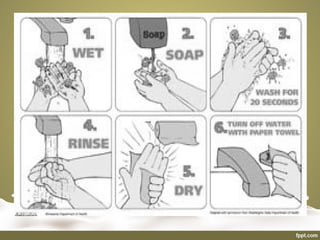
Handwashing
– Use soap and warm water and briskly rub
hands together.
– Thoroughly rinse under clean warm running
water
– Dry hands using electric hand dryer or
disposable tissue. DO NOT use apron or dish
towel!
PROPER HYGIENE
– Observe personal hygiene: taking a bath,
brushing teeth, wearing clean clothes, hand
washing
– NOT eating, chewing gum or smoking will
preparing food
– Minimal or no jewelry allowed
– Report illness ASAP
CROSS CONTAMINATION
• The transfer of germs from one food
item to another through contaminated
hands, equipment, or utensil
• From raw to RTE foods during food preparation
• When raw foods are stores above RTE in the ref
Keep this in mind….
• Always store cooked and ready to eat
foods over raw products
• Keep raw and RTE foods separate during
storage
• Use good personal hygiene and hand
washing
• Keep all food-contact surfaces clean and
sanitary
• Avoid bare hand contact with RTE foods
Preventive Measures to eliminate
the possibility of cross
contamination.
• Use separate equipment (color coding)
• Use of clean, sanitized equipment and utensils for
food production
• Preparation of RTE first before raw foods
• Preparation in separate areas of the kitchen
OTHER SOURCES OF
CONTAMINATION
– Foods such as fruits and vegetables (soil,
microorganisms, chemicals)
– Utensils used to dispense and serve foods
– Animals, rodents and pests
– Improper tasting of food

Chapter 3

  • 1.
    FACTORS THAT AFFECT FOODBORNEILLNESS HFOODSAFE M.Aldana
  • 2.
    Learning Objectives • Identifypotential problems related to temperature abuse of foods • Describe how to properly measure and maintain food temperatures to ensure that foods are safe for consumption • Identify potential problems related to a food worker’s poor personal hygiene
  • 3.
    Learning Objectives • Explainhow to improve personal hygiene habits to reduce the risk of foodborne illness • Identify potential problems related to cross-contamination • Discuss procedures and methods to prevent cross contamination.
  • 5.
    Leading Factors ThatCause Foodborne Illness • Time and Temperature Abuse • Poor Personal Hygiene and Improper Hand washing • Cross Contamination • Contaminated ready-to-eat foods such as salad items and processed meats.
  • 6.
    • “It isextremely important that you recognize these as major contributors to food contamination.”
  • 7.
    Highly susceptible tofoodborne illness are the ff: • The very young, infants • The elderly • Pregnant or lactating woman • People with impaired immune systems due to cancer, AIDS, diabetes, or medications that suppress response to infection
  • 8.
    What Are Timeand Temperature Abuse? • Controlling Temperature is perhaps the most critical way to ensure food safety. • Most cases of FBI can in some way be linked to temperature abuse.
  • 9.
    What Are Timeand Temperature Abuse? • The term temperature abuse is used to describe situations: – When food is exposed to temperatures in the danger zone for enough time to allow growth of harmful microorganisms – When food is not cooked or reheated sufficiently to destroy microorganisms.
  • 10.
    What should bedone? • “HOT FOODS HOT, KEEP COLD FOODS COLD, or DON’T KEEP THE FOOD AT ALL!!!” – Keep food above the Temperature Danger Zone (135’F) to prevent harmful microbes from growing. – High temperature kills/destroys the bacteria; low temperature keeps it from growing or multiplying/ slows down growth.
  • 11.
    What should bedone? • Keep food temperatures below the temperature danger zone 41o F (5o C) to prevent most microbes may or may not be affected by heat.
  • 12.
    Unavoidable situations when foodmust pass the TDZ • Cooking • Cooling • Reheating • Food Preparation (slicing, mixing, etc.) “Minimize the amount of time foods are in TDZ; minimize number of times food pass through the TDZ!” • Hot foods should be cooled and reheated only one time • Cooking and reheating are two very important processes for safe food management.
  • 13.
    Food Thermometers • Maintainingsafe food temperatures is an essential and effective part of food safety management. • Food temperature measuring devices typically measure food temperatures in degree Fahrenheit (°F), degree Celsius (°C), or both.
  • 14.
    Temperature Conversion • °Fto °C – Deduct 32, then multiply by 5, then divide by 9 • °C to °F – Multiply by 9, then divide by 5, then add 32
  • 15.
    HOW TO MEASUREFOOD TEMPERATURE ACCURATELY AND SAFELY? • Parts: Head, Stem/Probe, Sensor • Use a food thermometer that measures temperature from 0F (-18C) to 220F (104C). Do not use mercury-filled/glass thermometers • Locate sensing portion of the measuring device
  • 16.
    HOW TO MEASUREFOOD TEMPERATURE ACCURATELY AND SAFELY? • Calibrate using ice or boiling point method • Clean and sanitize the probe before using it • Measure internal temperature by inserting probe into the center or thickest part of the food, at least 2” deep • Wait for the temperature to stabilize.
  • 17.
    Types of Thermometers •Dial Faced, Bi-metallic – most common type of thermometer used. Temp range is from 0F-220F or – 18C-104C
  • 18.
    Types of Thermometers •Digital – displays temperature numerically, easier to read and measures a wider range of temp than dial face
  • 19.
    Types of Thermometers •Thermocouple – provides digital readout of temps; has different interchangeable probes for diff applications
  • 20.
    Types of Thermometers •Infrared – Measures the surface temperature without actually touching the food
  • 21.
    Types of Thermometers •T-Stick – Single-use disposable thermometer measures one only temp. Wax coating melts when the temp reaches or exceeds a set point
  • 22.
    Types of Thermometers •Built-In – Used to check temp in refrigerated and frozen storage
  • 23.
    Types of Thermometers •Maximum Registering (holding) – Measures temp in mechanical ware washing machines
  • 24.
    When and howto calibrate Thermometers • Before their first use • At regular intervals • If dropped • If used to measure extreme temperatures • Whenever accuracy is in question.
  • 25.
    PREVENTING TEMPERATURE ABUSE/FOLLOWING SAFE TEMPERATUREGUIDELINES • Receiving and Storing Frozen Foods – Food should be maintained solidly frozen at all times (below 0°F or -18°C all the time)
  • 26.
    PREVENTING TEMPERATURE ABUSE/FOLLOWING SAFE TEMPERATUREGUIDELINES • Receiving and Storing Refrigerated Foods – Temperature should be at or below 41°F (5°C)
  • 27.
  • 28.
    PREVENTING TEMPERATURE ABUSE/FOLLOWING SAFE TEMPERATUREGUIDELINES • Receiving Foods (Frozen) – Foods should be solidly frozen at all times
  • 29.
    PREVENTING TEMPERATURE ABUSE/FOLLOWING SAFE TEMPERATUREGUIDELINES • Receiving Foods (Refrigerated) – Foods should received and stored so that food is always at or below 41’F – Raw shell eggs may be received at 45’F or below
  • 30.
    PREVENTING TEMPERATURE ABUSE/FOLLOWING SAFE TEMPERATUREGUIDELINES • Cooking Foods – Range of safe cooking temperature varies from 145°F (63°C) to 190°F (74°C) depending on the type of food
  • 31.
    PREVENTING TEMPERATURE ABUSE/FOLLOWING SAFE TEMPERATUREGUIDELINES • Cooling Foods – Cool foods from 135°F (57°C) to 70°F (21°C) within 2 hours and from 135’F (57’C) to 41’F (5’C) within 6 hours
  • 32.
    PREVENTING TEMPERATURE ABUSE/FOLLOWING SAFE TEMPERATUREGUIDELINES • Reheating Foods – Reheat to at least 165°F (74°C) within 2 hrs
  • 33.
    PREVENTING TEMPERATURE ABUSE/FOLLOWING SAFE TEMPERATUREGUIDELINES • Hot-Holding Foods – Foods must be cooked to a safe temp and held at greater that 135°F (57°C)
  • 34.
    PREVENTING TEMPERATURE ABUSE/FOLLOWING SAFE TEMPERATUREGUIDELINES • Cold-Holding Foods – All foods that are held and served cold must be held at 41°F (5°C) or below
  • 35.
    PREVENTING TEMPERATURE ABUSE/FOLLOWING SAFE TEMPERATUREGUIDELINES • Thawing Foods – Ref – 41°F (5°C) or below – Microwave – Under cool running water - 70°F (21°C)
  • 36.
    PREVENTING TEMPERATURE ABUSE/FOLLOWING SAFE TEMPERATUREGUIDELINES • Food Preparation – Within TDZ for a max time of 4 hrs.
  • 37.
    THE IMPORTANCE OF HANDWASHING& GOOD PERSONAL HYGIENE • PERSONAL HYGIENE means good health habits.
  • 38.
    • Desirable behaviors: –Knowing when and how to properly wash hands – Wearing clean clothing – Maintaining good personal habits – Maintaining good health and reporting when sick to avoid spreading of possible infection
  • 39.
    Hand Washing Guidelines •Wash hands – • Before food preparation • After touching human body parts • After using the toilet • After coughing, sneezing, using tissue or handkerchief, smoking, eating or drinking
  • 40.
    Hand Washing Guidelines •Wash hands – • During food preparation – when switching between raw and RTE products • After engaging in any activity that may contaminate hands • (taking out garbage, wiping tables, handling cleaning chemicals) • After caring for or touching animals
  • 41.
    Handwashing – Use soapand warm water and briskly rub hands together. – Thoroughly rinse under clean warm running water – Dry hands using electric hand dryer or disposable tissue. DO NOT use apron or dish towel!
  • 43.
    PROPER HYGIENE – Observepersonal hygiene: taking a bath, brushing teeth, wearing clean clothes, hand washing – NOT eating, chewing gum or smoking will preparing food – Minimal or no jewelry allowed – Report illness ASAP
  • 44.
    CROSS CONTAMINATION • Thetransfer of germs from one food item to another through contaminated hands, equipment, or utensil • From raw to RTE foods during food preparation • When raw foods are stores above RTE in the ref
  • 45.
    Keep this inmind…. • Always store cooked and ready to eat foods over raw products • Keep raw and RTE foods separate during storage • Use good personal hygiene and hand washing • Keep all food-contact surfaces clean and sanitary • Avoid bare hand contact with RTE foods
  • 46.
    Preventive Measures toeliminate the possibility of cross contamination. • Use separate equipment (color coding) • Use of clean, sanitized equipment and utensils for food production • Preparation of RTE first before raw foods • Preparation in separate areas of the kitchen
  • 47.
    OTHER SOURCES OF CONTAMINATION –Foods such as fruits and vegetables (soil, microorganisms, chemicals) – Utensils used to dispense and serve foods – Animals, rodents and pests – Improper tasting of food