Chapter 2 Study Guide
       Review
1. Noble


R: A person of high rank by birth or title.
2. hierarchy


L: A system of organizing people into ranks, with
those of higher rank having more power and
privileges.
3. armor


C: A covering, usually made of metal or leather, worn
to protect the body during fighting.
4. pope


M: The bishop of Rome and the supreme leader of
the Roman Catholic Church.
5. Feudalism


J: The economic and political system that developed
in Europe during the Middle Ages.
6. knight


Q: An armored warrior...usually on horseback.
7. monarch


P: A ruler, such as a king or queen.
8. chivalry


B: The medieval knights’ code of behavior
9. fief


E: Land granted by a lord to a vassal in exchange for
loyalty and service.
10. divine right of kings


K: The belief that God gives monarch the right to rule
11. Roman Catholic Church


D: The Christian Church headed by the pope in
Rome.
12. lord


A: A ruler or a powerful landowner
13. Manor


F: A large estate, including farmland, villages, castle,
church, held by a lord.
14. peasant


I: In feudalism, a person who worked the land.
15. duke


H: The highest type of European noble, ranking just
below a prince.
16. Christianity


O: A religion based on the life of Jesus Christ.
17. moat


N: A deep, wide ditch, often filled with water.
18. barbarian


G: A person belonging to a tribe or group that is
considered uncivilized.
19. Using Einhard article given to you in class, write a well thought out explanation
how Einhard viewed Charlemagne as a leader. Use details from the article to help
                             make a strong statement.


  Answers will vary.
  My Opinion: Einhard had great admiration towards Charlemagne
  as a person as well as father. Einhard noted in his article that
  Charlemagne had the gift of ready and fluent speech, and could
  express whatever he had to say with the utmost clearness. This
  statement tells me that Charlemagne thought carefully of not
  only his speech, but how he was going to say it which is an
  excellent quality for a leader. Einhard also stated that
  Charlemagne was a great protector of his children and would
  often keep them close to him and have meals with them every
  day. I could envision that Charlemagne must act the same way
  towards his troops/advisors in a leadership role.
20. How many acres were usually given to a
                 lord/vassal?


A lord would get anywhere between 1200 to 1800
acres of land.
21. What is the role of the
        monarch?


A Monarch is expected to keep order and to provide
protection for his/her vassals. Vassals are the
monarch’s most important lords and the monarch
gives pieces of land to these lords in return for
protection IF the monarch gets into trouble.
22. What is the role of a
         lord/vassal?


It was the lord’s responsibility to manage and defend
his land.

The lord made sure that everyone within his land
were doing their jobs.
23. What is the role of a
           knight?


Knights were expected to be loyal to their church and
their lord, to be just and fair, and to protect the
helpless.

Knights main role was to train to fight.
24. What is the role of a
         peasant?


The peasants were required to work the land so this
freed up the lords and knights to prepare for war or
fighting.
25. Reviewing these terms: head money, tallage, merchet. How do these terms
                 define a peasant’s life on a feudal manor?


 Head money: Yearly Tax which was the same for
 every person.

 Tallage: A tax that the lord can demand if the lord
 needed money.

 Merchet: This is a tax when a woman married, this tax
 was paid by the bride’s father or her husband.

 My opinion: These terms tell me that the peasants
 were heavily taxed and that they were expected to
 give the lord not only a payment in physical labor, but
 also their payment in taxes as well.
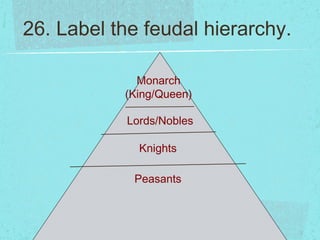
26. Label the feudal hierarchy.

             Monarch
           (King/Queen)

            Lords/Nobles

              Knights

             Peasants
27. What does this picture tell you about
             feudalism?
 This picture displays
 feudalism to me
 because it shows how a
 vassal (lesser lord) is
 showing loyalty and
 respect to the higher
 lord or monarch.
 Loyalty and respect are
 two qualities that are
 definitely needed in the
 feudal system.
28. Do you believe that feudalism worked in England?
Explain your answer with details from your notes in order
              to make a strong statement.
  Answers will vary.

  My Opinion: I believe that feudalism worked in
  England because it restored order during a time when
  there were many hostile invasions and it created a
  system of obtaining money at every level of the feudal
  hierarchy. The only thing that I did not like about the
  feudal system was the lack of advancement within the
  classes. It was unfortunate that many people stayed
  within their own social class their entire lives without
  hope of moving up the feudal ladder.

Chapter 2 study guide review-updated

  • 1.
    Chapter 2 StudyGuide Review
  • 2.
    1. Noble R: Aperson of high rank by birth or title.
  • 3.
    2. hierarchy L: Asystem of organizing people into ranks, with those of higher rank having more power and privileges.
  • 4.
    3. armor C: Acovering, usually made of metal or leather, worn to protect the body during fighting.
  • 5.
    4. pope M: Thebishop of Rome and the supreme leader of the Roman Catholic Church.
  • 6.
    5. Feudalism J: Theeconomic and political system that developed in Europe during the Middle Ages.
  • 7.
    6. knight Q: Anarmored warrior...usually on horseback.
  • 8.
    7. monarch P: Aruler, such as a king or queen.
  • 9.
    8. chivalry B: Themedieval knights’ code of behavior
  • 10.
    9. fief E: Landgranted by a lord to a vassal in exchange for loyalty and service.
  • 11.
    10. divine rightof kings K: The belief that God gives monarch the right to rule
  • 12.
    11. Roman CatholicChurch D: The Christian Church headed by the pope in Rome.
  • 13.
    12. lord A: Aruler or a powerful landowner
  • 14.
    13. Manor F: Alarge estate, including farmland, villages, castle, church, held by a lord.
  • 15.
    14. peasant I: Infeudalism, a person who worked the land.
  • 16.
    15. duke H: Thehighest type of European noble, ranking just below a prince.
  • 17.
    16. Christianity O: Areligion based on the life of Jesus Christ.
  • 18.
    17. moat N: Adeep, wide ditch, often filled with water.
  • 19.
    18. barbarian G: Aperson belonging to a tribe or group that is considered uncivilized.
  • 20.
    19. Using Einhardarticle given to you in class, write a well thought out explanation how Einhard viewed Charlemagne as a leader. Use details from the article to help make a strong statement. Answers will vary. My Opinion: Einhard had great admiration towards Charlemagne as a person as well as father. Einhard noted in his article that Charlemagne had the gift of ready and fluent speech, and could express whatever he had to say with the utmost clearness. This statement tells me that Charlemagne thought carefully of not only his speech, but how he was going to say it which is an excellent quality for a leader. Einhard also stated that Charlemagne was a great protector of his children and would often keep them close to him and have meals with them every day. I could envision that Charlemagne must act the same way towards his troops/advisors in a leadership role.
  • 21.
    20. How manyacres were usually given to a lord/vassal? A lord would get anywhere between 1200 to 1800 acres of land.
  • 22.
    21. What isthe role of the monarch? A Monarch is expected to keep order and to provide protection for his/her vassals. Vassals are the monarch’s most important lords and the monarch gives pieces of land to these lords in return for protection IF the monarch gets into trouble.
  • 23.
    22. What isthe role of a lord/vassal? It was the lord’s responsibility to manage and defend his land. The lord made sure that everyone within his land were doing their jobs.
  • 24.
    23. What isthe role of a knight? Knights were expected to be loyal to their church and their lord, to be just and fair, and to protect the helpless. Knights main role was to train to fight.
  • 25.
    24. What isthe role of a peasant? The peasants were required to work the land so this freed up the lords and knights to prepare for war or fighting.
  • 26.
    25. Reviewing theseterms: head money, tallage, merchet. How do these terms define a peasant’s life on a feudal manor? Head money: Yearly Tax which was the same for every person. Tallage: A tax that the lord can demand if the lord needed money. Merchet: This is a tax when a woman married, this tax was paid by the bride’s father or her husband. My opinion: These terms tell me that the peasants were heavily taxed and that they were expected to give the lord not only a payment in physical labor, but also their payment in taxes as well.
  • 27.
    26. Label thefeudal hierarchy. Monarch (King/Queen) Lords/Nobles Knights Peasants
  • 28.
    27. What doesthis picture tell you about feudalism? This picture displays feudalism to me because it shows how a vassal (lesser lord) is showing loyalty and respect to the higher lord or monarch. Loyalty and respect are two qualities that are definitely needed in the feudal system.
  • 29.
    28. Do youbelieve that feudalism worked in England? Explain your answer with details from your notes in order to make a strong statement. Answers will vary. My Opinion: I believe that feudalism worked in England because it restored order during a time when there were many hostile invasions and it created a system of obtaining money at every level of the feudal hierarchy. The only thing that I did not like about the feudal system was the lack of advancement within the classes. It was unfortunate that many people stayed within their own social class their entire lives without hope of moving up the feudal ladder.