Chapter 2
Motion in One
Dimension
Section 1
Displacement and Velocity
Motion
 Motion happens all around us in different directions and
different speeds.
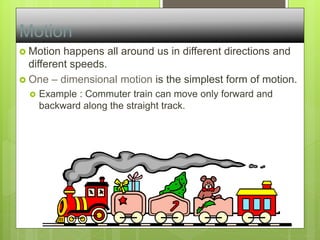
 One – dimensional motion is the simplest form of motion.
 Example : Commuter train can move only forward and
backward along the straight track.
Frame of Reference
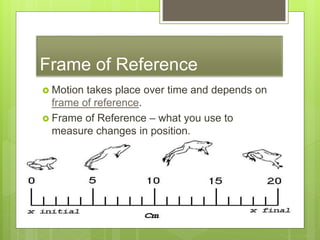
 Motion takes place over time and depends on
frame of reference.
 Frame of Reference – what you use to
measure changes in position.
Displacement
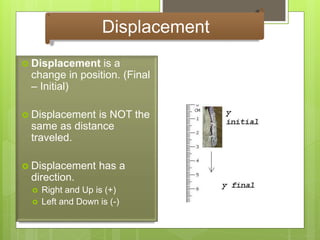
 Displacement is a
change in position. (Final
– Initial)
 Displacement is NOT the
same as distance
traveled.
 Displacement has a
direction.
 Right and Up is (+)
 Left and Down is (-)
Displacement
Displacement
Velocity
 Average Velocity is
displacement of an object
(Δx) divided by time
interval (Δt).
 Average Velocity can be
positive or negative
depending on the sign of
the displacement.
 If displacement is
negative, avg. velocity is
negative.
 Time interval is ALWAYS
positive
Guided Practice
 Open Books to pg. 44
 Velocity is not the same
as speed.
 Velocity describes motion
with direction and
magnitude (numerical
value);
 Speed ONLY has
magnitude.
 Ex: 55 m/s and 55 m/s
North
Velocity Vs. Speed
Velocity can be interpreted
graphically…
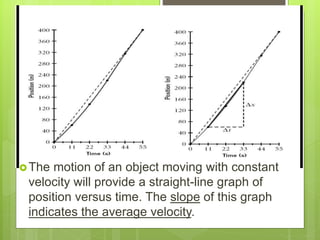
The motion of an object moving with constant
velocity will provide a straight-line graph of
position versus time. The slope of this graph
indicates the average velocity.
Section 2 Acceleration
Chapter 2
One
Dimensional
Motion
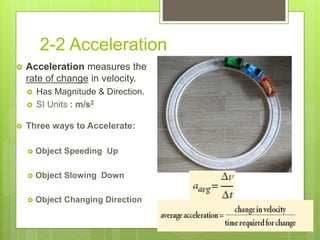
2-2 Acceleration
 Acceleration measures the
rate of change in velocity.
 Has Magnitude & Direction.
 SI Units : m/s2
 Three ways to Accelerate:
 Object Speeding Up
 Object Slowing Down
 Object Changing Direction
Let’s Practice with Average
Acceleration...
 Sample Problem 2B
 Pg. 49 in your books.
Acceleration
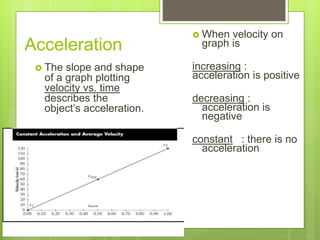
 The slope and shape
of a graph plotting
velocity vs. time
describes the
object’s acceleration.
 When velocity on
graph is
increasing :
acceleration is positive
decreasing :
acceleration is
negative
constant : there is no
acceleration
Velocity Vs. Time Graphs
Kinematic Formulas
Formulas in Textbook
on Pg. 58
Section 3
Falling Objects
Chapter 2
One Dimensional
Motion
Free Fall
 Free fall is acceleration due to gravity.
 Free fall acceleration is constant.
 Magnitude of free fall is 9.81 m/s2
 Direction of free fall is directed downward.
 negative direction (-)
 Free fall is denoted with the symbol g. (Sometimes may
be ‘a’ for acceleration due to gravity)
Free Fall
 In a vacuum, in the absence of air resistance, all objects
fall at the same rate.
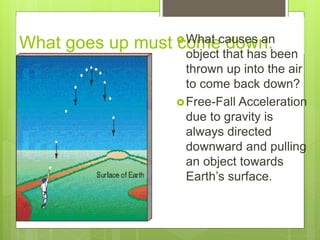
What goes up must come down.
What causes an
object that has been
thrown up into the air
to come back down?
Free-Fall Acceleration
due to gravity is
always directed
downward and pulling
an object towards
Earth’s surface.
Recall Information
 Remember we learned about a formula that can be
used to find final velocity at ANY displacement…
vf
2 = vi
2 + 2aΔx (time is not needed)
 We use this same formula but we change x to y
vf
2 = vi
2 + 2aΔy
Guided Practice
 Open books to pg. 63 Sample Problem 2F

Chapter 2 .ppt

  • 1.
    Chapter 2 Motion inOne Dimension Section 1 Displacement and Velocity
  • 2.
    Motion  Motion happensall around us in different directions and different speeds.  One – dimensional motion is the simplest form of motion.  Example : Commuter train can move only forward and backward along the straight track.
  • 3.
    Frame of Reference Motion takes place over time and depends on frame of reference.  Frame of Reference – what you use to measure changes in position.
  • 4.
    Displacement  Displacement isa change in position. (Final – Initial)  Displacement is NOT the same as distance traveled.  Displacement has a direction.  Right and Up is (+)  Left and Down is (-) Displacement
  • 5.
  • 6.
    Velocity  Average Velocityis displacement of an object (Δx) divided by time interval (Δt).  Average Velocity can be positive or negative depending on the sign of the displacement.  If displacement is negative, avg. velocity is negative.  Time interval is ALWAYS positive
  • 7.
    Guided Practice  OpenBooks to pg. 44
  • 8.
     Velocity isnot the same as speed.  Velocity describes motion with direction and magnitude (numerical value);  Speed ONLY has magnitude.  Ex: 55 m/s and 55 m/s North Velocity Vs. Speed
  • 9.
    Velocity can beinterpreted graphically…
  • 10.
    The motion ofan object moving with constant velocity will provide a straight-line graph of position versus time. The slope of this graph indicates the average velocity.
  • 11.
    Section 2 Acceleration Chapter2 One Dimensional Motion
  • 12.
    2-2 Acceleration  Accelerationmeasures the rate of change in velocity.  Has Magnitude & Direction.  SI Units : m/s2  Three ways to Accelerate:  Object Speeding Up  Object Slowing Down  Object Changing Direction
  • 13.
    Let’s Practice withAverage Acceleration...  Sample Problem 2B  Pg. 49 in your books.
  • 14.
    Acceleration  The slopeand shape of a graph plotting velocity vs. time describes the object’s acceleration.  When velocity on graph is increasing : acceleration is positive decreasing : acceleration is negative constant : there is no acceleration
  • 15.
  • 16.
  • 17.
  • 18.
    Section 3 Falling Objects Chapter2 One Dimensional Motion
  • 19.
    Free Fall  Freefall is acceleration due to gravity.  Free fall acceleration is constant.  Magnitude of free fall is 9.81 m/s2  Direction of free fall is directed downward.  negative direction (-)  Free fall is denoted with the symbol g. (Sometimes may be ‘a’ for acceleration due to gravity)
  • 20.
    Free Fall  Ina vacuum, in the absence of air resistance, all objects fall at the same rate.
  • 21.
    What goes upmust come down. What causes an object that has been thrown up into the air to come back down? Free-Fall Acceleration due to gravity is always directed downward and pulling an object towards Earth’s surface.
  • 22.
    Recall Information  Rememberwe learned about a formula that can be used to find final velocity at ANY displacement… vf 2 = vi 2 + 2aΔx (time is not needed)  We use this same formula but we change x to y vf 2 = vi 2 + 2aΔy
  • 23.
    Guided Practice  Openbooks to pg. 63 Sample Problem 2F