(0.25)


         Fire Prevention and Fire Fighting

                                    Chapter 2
                     Classification of fires
                     How Fire Spreads


         Sept 2007/chenck/May2002/V3   Chapter 2   1
Previous Chapter
   In chapter 1, you learn all about chemistry
    of fire and their properties

   In chapter 2, you will understand there are
    different types of fire e.g
      Wood fire

      Oil fire

      Electrical fire etc


Sept 2007/chenck/May2002/V3   Chapter 2           2
Classifications of fires
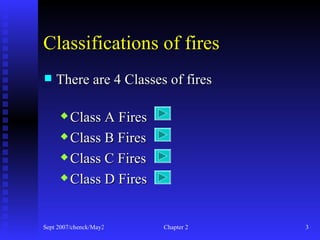
   There are 4 Classes of fires

      Class A Fires
      Class B Fires

      Class C Fires

      Class D Fires


Sept 2007/chenck/May2002/V3   Chapter 2   3
Classifications of fires
   Class A fires

        Class A fires are wood fires or
         carbonaceous fires


Sept 2007/chenck/May2002/V3   Chapter 2    4
Carbonaceous Fires
   Carbonaceous fires are fires that is made
    majorly of carbon or organic materials eg
     Coal

     Paper

     Clothes

     Ropes

     Rubber etc


Sept 2007/chenck/May2002/V3   Chapter 2         5
Class A Fires


Sept 2007/chenck/May2002/V3   Chapter 2   6
Classifications of fires
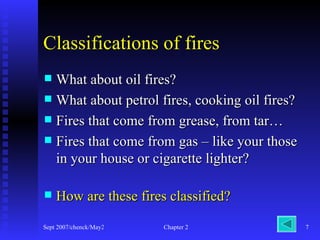
 What about oil fires?
 What about petrol fires, cooking oil fires?
 Fires that come from grease, from tar…
 Fires that come from gas – like your those
  in your house or cigarette lighter?

   How are these fires classified?

Sept 2007/chenck/May2002/V3   Chapter 2         7
Class B Fires
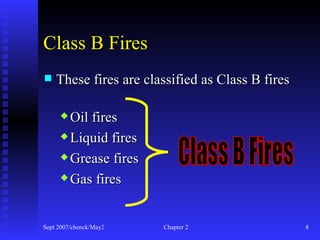
   These fires are classified as Class B fires

      Oil fires
      Liquid fires

      Grease fires

      Gas fires


Sept 2007/chenck/May2002/V3   Chapter 2           8
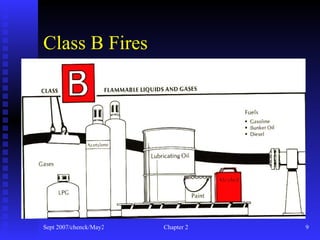
Class B Fires


Sept 2007/chenck/May2002/V3   Chapter 2   9
Class B Fires
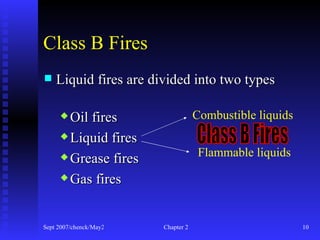
   Liquid fires are divided into two types

      Oil fires                          Combustible liquids
      Liquid fires

      Grease fires                        Flammable liquids
      Gas fires


Sept 2007/chenck/May2002/V3   Chapter 2                         10
Class B Fires
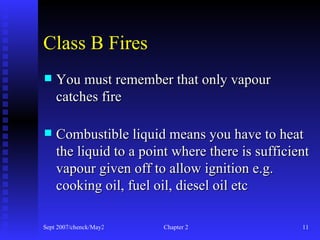
   You must remember that only vapour
    catches fire

   Combustible liquid means you have to heat
    the liquid to a point where there is sufficient
    vapour given off to allow ignition e.g.
    cooking oil, fuel oil, diesel oil etc

Sept 2007/chenck/May2002/V3   Chapter 2          11
Class B Fires
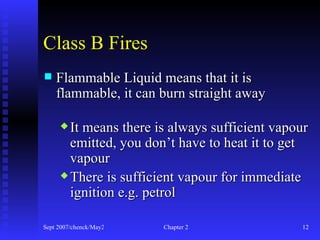
   Flammable Liquid means that it is
    flammable, it can burn straight away

      It means there is always sufficient vapour
       emitted, you don’t have to heat it to get
       vapour
      There is sufficient vapour for immediate

       ignition e.g. petrol

Sept 2007/chenck/May2002/V3   Chapter 2        12
Class B Fires
 Discussion
 A cook is cooking vegetable in a pan. He
  pours some liquid into the pan and it
  catches fire immediately . Explain why does
  the original oil in the pan does not ignite?
  What did he put into the pan to cause this
  effect?

Sept 2007/chenck/May2002/V3   Chapter 2     13
Class C fires
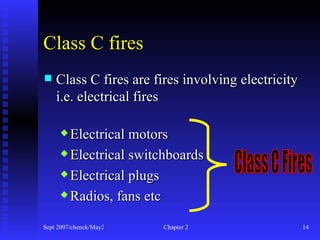
   Class C fires are fires involving electricity
    i.e. electrical fires

      Electrical motors
      Electrical switchboards

      Electrical plugs

      Radios, fans etc


Sept 2007/chenck/May2002/V3   Chapter 2             14
Class C Fires


Sept 2007/chenck/May2002/V3   Chapter 2   15
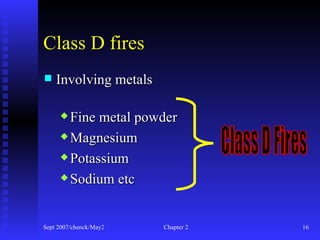
Class D fires
   Involving metals

      Fine metal powder
      Magnesium

      Potassium

      Sodium etc


Sept 2007/chenck/May2002/V3   Chapter 2   16
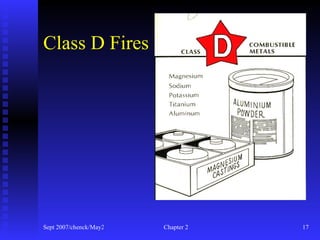
Class D Fires


Sept 2007/chenck/May2002/V3   Chapter 2   17
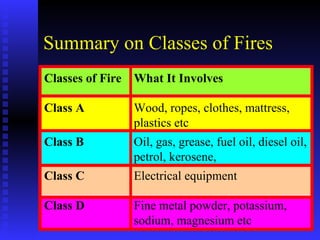
Summary on Classes of Fires
Classes of Fire What It Involves

Class A                       Wood, ropes, clothes, mattress,
                              plastics etc
Class B                       Oil, gas, grease, fuel oil, diesel oil,
                              petrol, kerosene,
Class C                       Electrical equipment

Class D                       Fine metal powder, potassium,
Sept 2007/chenck/May2002/V3
                              sodium, magnesium etc
                                   Chapter 2                        18
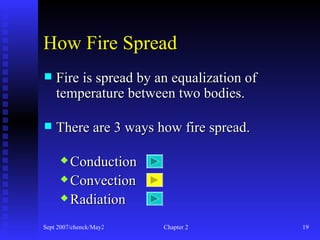
How Fire Spread
   Fire is spread by an equalization of
    temperature between two bodies.

   There are 3 ways how fire spread.

      Conduction
      Convection

      Radiation


Sept 2007/chenck/May2002/V3   Chapter 2    19
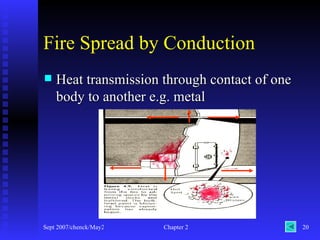
Fire Spread by Conduction
   Heat transmission through contact of one
    body to another e.g. metal


Sept 2007/chenck/May2002/V3   Chapter 2        20
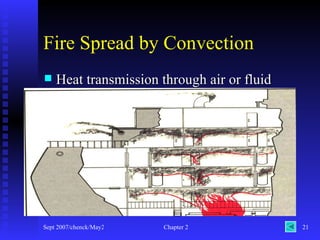
Fire Spread by Convection
   Heat transmission through air or fluid


Sept 2007/chenck/May2002/V3   Chapter 2      21
Fire Spread by Radiation
   Heat transmission through space


Sept 2007/chenck/May2002/V3   Chapter 2   22
Summary of how fire spread
                                 Conduction

                                 Convection

                                 Radiation


Sept 2007/chenck/May2002/V3         Chapter 2   23
Development of Fire
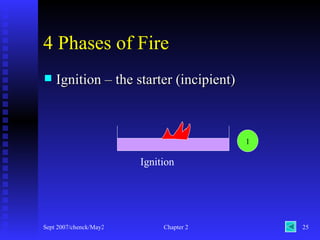
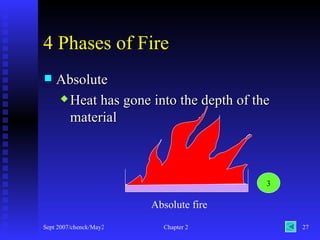
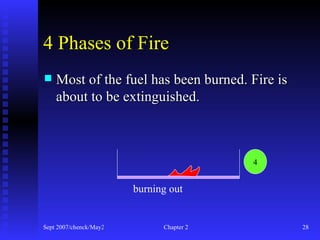
      There are 4 phases of fire

           Ignition
           Developing
           Absolute fire
           Burning out


Sept 2007/chenck/May2002/V3   Chapter 2   24
4 Phases of Fire
   Ignition – the starter (incipient)


                                               1

                              Ignition


Sept 2007/chenck/May2002/V3        Chapter 2       25
4 Phases of Fire
   Developing ( surface fires)


                                                  2


                              developing


Sept 2007/chenck/May2002/V3           Chapter 2       26
4 Phases of Fire
   Absolute
     Heat has gone into the depth of the

      material


                                              3

                              Absolute fire
Sept 2007/chenck/May2002/V3     Chapter 2         27
4 Phases of Fire
   Most of the fuel has been burned. Fire is
    about to be extinguished.


                                                4


                              burning out


Sept 2007/chenck/May2002/V3         Chapter 2       28
Summary of 4 Phases of Fire
           Ignition
           Developing
           Absolute fire
           Burning out


Sept 2007/chenck/May2002/V3   Chapter 2   29
End of Chapter


Sept 2007/chenck/May2002/V3   Chapter 2   30

Chapter 2 classes & spread

  • 1.
    (0.25) Fire Prevention and Fire Fighting Chapter 2  Classification of fires  How Fire Spreads Sept 2007/chenck/May2002/V3 Chapter 2 1
  • 2.
    Previous Chapter  In chapter 1, you learn all about chemistry of fire and their properties  In chapter 2, you will understand there are different types of fire e.g  Wood fire  Oil fire  Electrical fire etc Sept 2007/chenck/May2002/V3 Chapter 2 2
  • 3.
    Classifications of fires  There are 4 Classes of fires  Class A Fires  Class B Fires  Class C Fires  Class D Fires Sept 2007/chenck/May2002/V3 Chapter 2 3
  • 4.
    Classifications of fires  Class A fires  Class A fires are wood fires or carbonaceous fires Sept 2007/chenck/May2002/V3 Chapter 2 4
  • 5.
    Carbonaceous Fires  Carbonaceous fires are fires that is made majorly of carbon or organic materials eg  Coal  Paper  Clothes  Ropes  Rubber etc Sept 2007/chenck/May2002/V3 Chapter 2 5
  • 6.
    Class A Fires Sept2007/chenck/May2002/V3 Chapter 2 6
  • 7.
    Classifications of fires What about oil fires?  What about petrol fires, cooking oil fires?  Fires that come from grease, from tar…  Fires that come from gas – like your those in your house or cigarette lighter?  How are these fires classified? Sept 2007/chenck/May2002/V3 Chapter 2 7
  • 8.
    Class B Fires  These fires are classified as Class B fires  Oil fires  Liquid fires  Grease fires  Gas fires Sept 2007/chenck/May2002/V3 Chapter 2 8
  • 9.
    Class B Fires Sept2007/chenck/May2002/V3 Chapter 2 9
  • 10.
    Class B Fires  Liquid fires are divided into two types  Oil fires Combustible liquids  Liquid fires  Grease fires Flammable liquids  Gas fires Sept 2007/chenck/May2002/V3 Chapter 2 10
  • 11.
    Class B Fires  You must remember that only vapour catches fire  Combustible liquid means you have to heat the liquid to a point where there is sufficient vapour given off to allow ignition e.g. cooking oil, fuel oil, diesel oil etc Sept 2007/chenck/May2002/V3 Chapter 2 11
  • 12.
    Class B Fires  Flammable Liquid means that it is flammable, it can burn straight away  It means there is always sufficient vapour emitted, you don’t have to heat it to get vapour  There is sufficient vapour for immediate ignition e.g. petrol Sept 2007/chenck/May2002/V3 Chapter 2 12
  • 13.
    Class B Fires Discussion  A cook is cooking vegetable in a pan. He pours some liquid into the pan and it catches fire immediately . Explain why does the original oil in the pan does not ignite? What did he put into the pan to cause this effect? Sept 2007/chenck/May2002/V3 Chapter 2 13
  • 14.
    Class C fires  Class C fires are fires involving electricity i.e. electrical fires  Electrical motors  Electrical switchboards  Electrical plugs  Radios, fans etc Sept 2007/chenck/May2002/V3 Chapter 2 14
  • 15.
    Class C Fires Sept2007/chenck/May2002/V3 Chapter 2 15
  • 16.
    Class D fires  Involving metals  Fine metal powder  Magnesium  Potassium  Sodium etc Sept 2007/chenck/May2002/V3 Chapter 2 16
  • 17.
    Class D Fires Sept2007/chenck/May2002/V3 Chapter 2 17
  • 18.
    Summary on Classesof Fires Classes of Fire What It Involves Class A Wood, ropes, clothes, mattress, plastics etc Class B Oil, gas, grease, fuel oil, diesel oil, petrol, kerosene, Class C Electrical equipment Class D Fine metal powder, potassium, Sept 2007/chenck/May2002/V3 sodium, magnesium etc Chapter 2 18
  • 19.
    How Fire Spread  Fire is spread by an equalization of temperature between two bodies.  There are 3 ways how fire spread.  Conduction  Convection  Radiation Sept 2007/chenck/May2002/V3 Chapter 2 19
  • 20.
    Fire Spread byConduction  Heat transmission through contact of one body to another e.g. metal Sept 2007/chenck/May2002/V3 Chapter 2 20
  • 21.
    Fire Spread byConvection  Heat transmission through air or fluid Sept 2007/chenck/May2002/V3 Chapter 2 21
  • 22.
    Fire Spread byRadiation  Heat transmission through space Sept 2007/chenck/May2002/V3 Chapter 2 22
  • 23.
    Summary of howfire spread  Conduction  Convection  Radiation Sept 2007/chenck/May2002/V3 Chapter 2 23
  • 24.
    Development of Fire  There are 4 phases of fire  Ignition  Developing  Absolute fire  Burning out Sept 2007/chenck/May2002/V3 Chapter 2 24
  • 25.
    4 Phases ofFire  Ignition – the starter (incipient) 1 Ignition Sept 2007/chenck/May2002/V3 Chapter 2 25
  • 26.
    4 Phases ofFire  Developing ( surface fires) 2 developing Sept 2007/chenck/May2002/V3 Chapter 2 26
  • 27.
    4 Phases ofFire  Absolute  Heat has gone into the depth of the material 3 Absolute fire Sept 2007/chenck/May2002/V3 Chapter 2 27
  • 28.
    4 Phases ofFire  Most of the fuel has been burned. Fire is about to be extinguished. 4 burning out Sept 2007/chenck/May2002/V3 Chapter 2 28
  • 29.
    Summary of 4Phases of Fire  Ignition  Developing  Absolute fire  Burning out Sept 2007/chenck/May2002/V3 Chapter 2 29
  • 30.
    End of Chapter Sept2007/chenck/May2002/V3 Chapter 2 30