Income Tax Fundamentals  2010 edition  Gerald E. Whittenburg  Martha Altus-Buller 2010 Cengage Learning
Gross income is “All income from whatever source derived” All sources of income are included unless specifically excluded (see Table 2) Non-cash items included at fair market value Note: Income from illegal activities is includable in gross income 2009 Cengage Learning
Example Keeley’s income items for 2009 are: Wages   $45,000 Bonus (noncash)       8,000 Bond interest     1,200 Dividends     850 Limited partnership loss  (9,000) Rental real estate income   6,500 What is Keeley’s income  by category  and total gross income? 2009 Cengage Learning
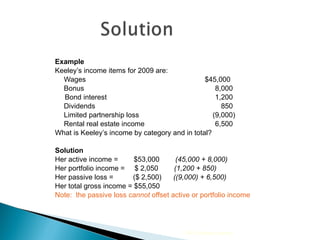
Example Keeley’s income items for 2009 are: Wages   $45,000 Bonus       8,000 Bond interest       1,200 Dividends     850 Limited partnership loss     (9,000) Rental real estate income     6,500 What is Keeley’s income by category and in total? Solution Her active income =  $53,000  (45,000 + 8,000) Her portfolio income =  $ 2,050  (1,200 + 850) Her passive loss =  ($ 2,500)  ((9,000) + 6,500) Her total gross income = $55,050 Note:  the passive loss  cannot  offset active or portfolio income 2009 Cengage Learning
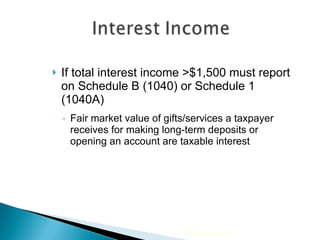
If total interest income >$1,500 must report on Schedule B (1040) or Schedule 1 (1040A) Fair market value of gifts/services a taxpayer receives for making long-term deposits or opening an account are taxable interest 2009 Cengage Learning
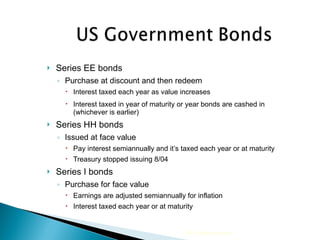
Series EE bonds Purchase at discount and then redeem Interest taxed each year as value increases  Interest taxed in year of maturity or year bonds are cashed in (whichever is earlier) Series HH bonds Issued at face value Pay interest semiannually and it’s taxed each year or at maturity Treasury stopped issuing 8/04 Series I bonds Purchase for face value Earnings are adjusted semiannually for inflation Interest taxed each year or at maturity 2009 Cengage Learning
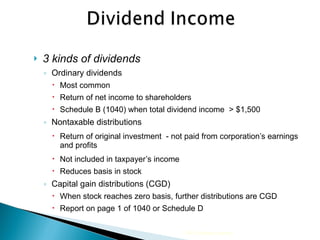
3 kinds of dividends Ordinary   dividends Most common Return of net income to shareholders Schedule B (1040) when total dividend income  > $1,500 Nontaxable   distributions Return of original investment  - not paid from corporation’s earnings and profits Not included in taxpayer’s income Reduces basis in stock  Capital gain distributions (CGD) When stock reaches zero basis, further distributions are CGD Report on page 1 of 1040 or Schedule D 2009 Cengage Learning
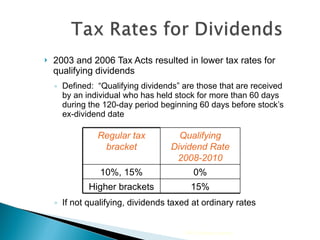
2003 and 2006 Tax Acts resulted in lower tax rates for qualifying dividends Defined:  “Qualifying dividends” are those that are received by an individual who has held stock for more than 60 days during the 120-day period beginning 60 days before stock’s ex-dividend date If not qualifying, dividends taxed at ordinary rates 2009 Cengage Learning Regular tax bracket Qualifying Dividend Rate 2008-2010 10%, 15% 0% Higher brackets 15%
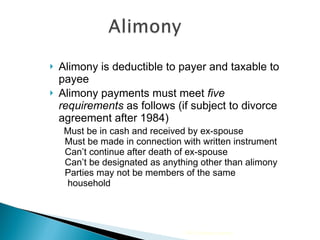
Alimony is deductible to payer and taxable to payee Alimony payments must meet  five requirements  as follows (if subject to divorce agreement after 1984)    Must be in cash and received by ex-spouse Must be made in connection with written instrument  Can’t continue after death of ex-spouse Can’t be designated as anything other than alimony Parties may not be members of the same  household 2009 Cengage Learning
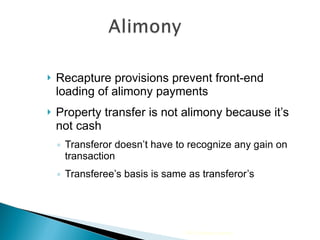
Recapture provisions prevent front-end loading of alimony payments  Property transfer is not alimony because it’s not cash Transferor doesn’t have to recognize any gain on transaction Transferee’s basis is same as transferor’s 2009 Cengage Learning
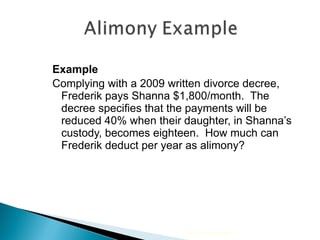
Example Complying with a 2009 written divorce decree, Frederik pays Shanna $1,800/month.  The decree specifies that the payments will be reduced 40% when their daughter, in Shanna’s custody, becomes eighteen.  How much can Frederik deduct per year as alimony? 2009 Cengage Learning
Example Complying with a 2009 written divorce decree, Frederik pays Shanna $1,800/month.  The decree specifies that the payments will be reduced 40% when their daughter, in Shanna’s custody, becomes eighteen.  How much can Frederik deduct per year as alimony? Solution 40% of each payment is considered nondeductible child support; therefore $1,800 x 12 months x 60% = $12,960/year deductible alimony. 2009 Cengage Learning
Child support is not deductible to payer and not taxable to payee  If payer falls behind on child support, must bring this current before any portion of payments considered alimony Rules differ for divorce agreements executed pre- and post-1985 2009 Cengage Learning
Taxable amount equal to cash prize or fair market value of property Exception:  Employee awards of tangible personal property (up to $400)received for recognition of length of service or safety achievement are excludable (or up to $1,600 if from award under a “qualified plan award”) Game show and reality TV show winners should be aware that prizes/awards are taxable 2009 Cengage Learning
Example Josef, an employee of Vesuvius Wind LLC, receives a clock for 20 years of service valued at $1,500 and the award is not considered a “qualified plan award”; how much is excludable from Josef’s gross income? 2009 Cengage Learning
Example Josef, an employee of Vesuvius Wind LLC, receives a clock for 20 years of service valued at $1,500 and the award is not considered a “qualified plan award”; how much is excludable from Josef’s gross income? Solution   $400 is excluded and $1,100 would have to be included in Josef’s gross income calculation 2009 Cengage Learning
An annuity is an instrument that a taxpayer buys (usually at retirement) in return for periodic payments for the remainder of his/her life  The taxable portion of these periodic payments  is calculated based on  mortality tables provided by IRS  and  the annuity purchase price 2009 Cengage Learning
General Rule Payments received are both taxable (income) and nontaxable (return of capital) Must calculate amount to exclude from income 1.  First calculate  exclusion ratio :  Investment in Contract / (Annual payment x Life expectancy) 2. Exclusion amount = Exclusion Ratio  x Amount of Annuity Received 2009 Cengage Learning
2009 Cengage Learning Example Din has saved $750,000 in his retirement account and uses it to purchase an annuity.  His annuity equals $4,800/month and the IRS tables show he is expected to live 19 years.  How much is excludable each year of retirement? Assume that Din is required to use the general rule.
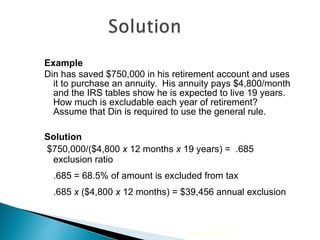
Example Din has saved $750,000 in his retirement account and uses it to purchase an annuity.  His annuity pays $4,800/month and the IRS tables show he is expected to live 19 years.  How much is excludable each year of retirement? Assume that Din is required to use the general rule. Solution $750,000/($4,800  x  12 months  x  19 years) =  .685 exclusion ratio .685 = 68.5% of amount is excluded from tax .685  x  ($4,800  x  12 months) = $39,456 annual exclusion 2009 Cengage Learning
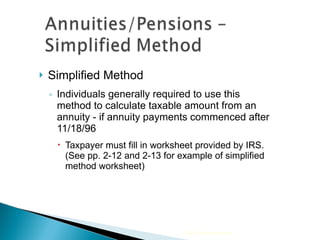
Simplified Method Individuals generally required to use this method to calculate taxable amount from an annuity - if annuity payments commenced after 11/18/96 Taxpayer must fill in worksheet provided by IRS.  (See pp. 2-12 and 2-13 for example of simplified method worksheet) 2009 Cengage Learning
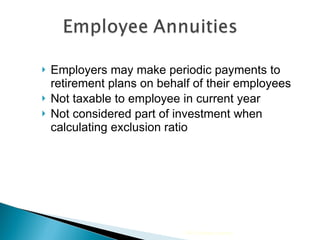
Employers may make periodic payments to retirement plans on behalf of their employees Not taxable to employee in current year Not considered part of investment when calculating exclusion ratio 2009 Cengage Learning
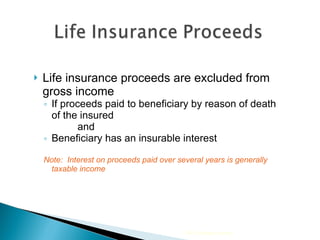
Life insurance proceeds are excluded from gross income  If proceeds paid to beneficiary by reason of death of the insured and Beneficiary has an insurable interest Note:  Interest on proceeds paid over several years is generally taxable income 2009 Cengage Learning
Example Karina dies on 6/15/09, leaving her husband, Dann, a $500,000 life insurance policy.  The proceeds will be paid to Dann $100,000 per year plus interest for 5 years.  In the current year, Dann receives $105,000 ($100,000 + $5,000 interest).  How much is taxable to Dann in the current year? 2009 Cengage Learning
Example Karina dies on 6/15/09, leaving her husband, Dann, a $500,000 life insurance policy.  The proceeds will be paid to Dann $100,000 per year plus interest for 5 years. In the current year, Dann receives $105,000 ($100,000 + $5,000 interest).  How much is taxable to Dann in the current year? Solution Dann must include the $5,000 of interest income in his gross income calculation; the face value of $100,000 is not taxable. 2009 Cengage Learning
Also known as accelerated death benefits Viatical settlements are excludable from gross income in certain situations as follows: Chronically or terminally ill taxpayer collects early payout from insurance company or sells/assigns policy to a viatical settlement provider Terminally ill  patient must have certification from MD stating that he/she reasonably expected to die within 24 months Chronically ill  must have certification from MD stating the he/she is unable to perform daily living activities unassisted 2009 Cengage Learning
If policy is transferred for value, then all or part of the proceeds may be taxable to recipient Taxable amount  =  Proceeds from death of insured     -  Cash surrender value (at time of transfer)     -  Premiums paid by purchaser to keep policy active Exception - If policy is transferred for value to partner of insured, a partnership in which insured is a partner or a corporation in which insured is an officer, then policy proceeds are  not  taxable 2009 Cengage Learning
Example Bianca transfers a life insurance policy with a face value of $25,000 and cash surrender value of $4,000 to Yvette as payment for services rendered.  Yvette pays premiums of $500 per year for a total of $1,500 in the ensuing 3 years; Bianca dies and Yvette collects the $25,000.  How much must Yvette include in her gross income?  How would this answer differ if Yvette and Bianca were partners in a partnership? 2009 Cengage Learning
Example Bianca transfers a life insurance policy with a face value of $25,000 and cash surrender value of $4,000 to Yvette as payment for services rendered.  Yvette pays premiums of $500 per year for a total of $1,500 in the ensuing 3 years ; Bianca dies and Yvette collects the $25,000.  How much must Yvette include in her gross income? How would this answer differ if Yvette and Bianca were partners in a partnership? Solution Yvette must include $22,500 in income [$25,000 – 4,000 - 1,500].  If Yvette and Bianca were partners in a partnership, the entire proceeds ($19,500) would be tax-free. 2009 Cengage Learning
Inheritances are   excluded from income Income generated from property received after transfer is taxable Estate may incur taxes Gifts received are excluded from income A gift is defined by the courts as a voluntary transfer of property without adequate consideration Gifts in business settings usually considered taxable income If recipient renders services for the gift, amount is taxable 2009 Cengage Learning
Scholarships received for fees, books, tuition, course-required supplies or equipment are excluded from income Must include scholarship amounts in income for:  Any amounts applied to room and board Any amounts received are compensation for required work 2009 Cengage Learning
Taxpayers may exclude from income the total amount received for  Payment of medical care  Payment for loss of a body member or function (called accidental death and dismemberment) Premiums paid by employer on employee’s behalf are excluded from income For medical insurance For Accidental death and dismemberment (AD&D) insurance 2009 Cengage Learning
Meals and lodging provided by employer are generally excluded from income  (if following tests are met) (1 ) meals   provided by employer on premises during working hours  solely for the benefit of the employer  because employee must be available for emergency calls or is limited to short meal periods (2) lodging provided by employer on premises and must be accepted as a requirement for employment 2009 Cengage Learning
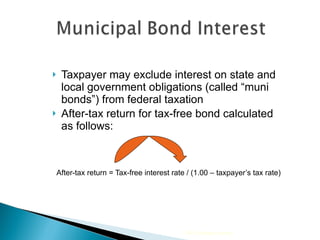
Taxpayer may exclude interest on state and local government obligations (called “muni bonds”) from federal taxation After-tax return for tax-free bond calculated as follows: After-tax return = Tax-free interest rate / (1.00 – taxpayer’s tax rate) 2009 Cengage Learning
Example Gopal is in the 33% federal income tax bracket and invests in a Nashville City Bond paying 6%. What taxable interest rate will yield the same after-tax return? 2009 Cengage Learning
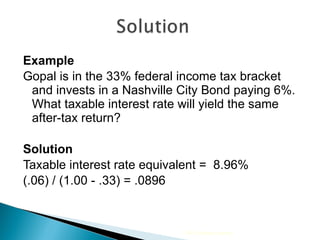
Example Gopal is in the 33% federal income tax bracket and invests in a Nashville City Bond paying 6%. What taxable interest rate will yield the same after-tax return? Solution Taxable interest rate equivalent =  8.96%  (.06) / (1.00 - .33) = .0896 2009 Cengage Learning
Part of Social Security benefits  may be  included in gross income Maximum inclusion amount = 85% Inclusion based on taxpayer’s Modified AGI (MAGI) MAGI = AGI + tax-exempt interest (and other items) If (MAGI + (50%)(SS benefits)) < base amount* then benefits are not includable *If this number exceeds base amount, must compute taxable portion, see p. 2-19 for worksheet on how to calculate includable amount 2009 Cengage Learning
2009 Cengage Learning If (MAGI + (50%)(SS benefits)) exceeds base amount as follows: Base Amount   Filing Status   $32,000  MFJ $  0  MFS $25,000  All others … then, the taxable amount is calculated by completing the Simplified Taxable Social Security Worksheet
Unemployment compensation payments are fully taxable in excess of $2,400 First $2,400 nontaxable as part of economic stimulus act passed in early 2009 These payments are deductible on some state’s income tax returns 2009 Cengage Learning
Employer-sponsored plan allowing employees to set aside pretax dollars for: Dependent care (up to $5,000/year) Medical/dental/optical care Health insurance co-pays and some OTC drugs Public transport/parking up to certain limits Can result in significant tax savings for employee “ Use-it-or-lose-it” provision  If amounts are left in plan after certain date, employee loses them 2009 Cengage Learning
May exclude certain fringe benefits from gross income, such as: ER- paid premiums for group term life insurance up to $50,000 Qualified Employee Discounts with exceptions Working Condition Fringe  If you could deduct item on your own as an employee, for example a subscription to professional journal, it is excludable De Minimis Fringe Benefits  These are immaterial and not worth tracking Tuition reduction Different rules for undergraduate vs. graduate Value of membership to athletic facilities Retirement planning services Other excludable fringes   2009 Cengage Learning
2009 Cengage Learning

Chapter 2

  • 1.
    Income Tax Fundamentals 2010 edition Gerald E. Whittenburg Martha Altus-Buller 2010 Cengage Learning
  • 2.
    Gross income is“All income from whatever source derived” All sources of income are included unless specifically excluded (see Table 2) Non-cash items included at fair market value Note: Income from illegal activities is includable in gross income 2009 Cengage Learning
  • 3.
    Example Keeley’s incomeitems for 2009 are: Wages $45,000 Bonus (noncash) 8,000 Bond interest 1,200 Dividends 850 Limited partnership loss (9,000) Rental real estate income 6,500 What is Keeley’s income by category and total gross income? 2009 Cengage Learning
  • 4.
    Example Keeley’s incomeitems for 2009 are: Wages $45,000 Bonus 8,000 Bond interest 1,200 Dividends 850 Limited partnership loss (9,000) Rental real estate income 6,500 What is Keeley’s income by category and in total? Solution Her active income = $53,000 (45,000 + 8,000) Her portfolio income = $ 2,050 (1,200 + 850) Her passive loss = ($ 2,500) ((9,000) + 6,500) Her total gross income = $55,050 Note: the passive loss cannot offset active or portfolio income 2009 Cengage Learning
  • 5.
    If total interestincome >$1,500 must report on Schedule B (1040) or Schedule 1 (1040A) Fair market value of gifts/services a taxpayer receives for making long-term deposits or opening an account are taxable interest 2009 Cengage Learning
  • 6.
    Series EE bondsPurchase at discount and then redeem Interest taxed each year as value increases Interest taxed in year of maturity or year bonds are cashed in (whichever is earlier) Series HH bonds Issued at face value Pay interest semiannually and it’s taxed each year or at maturity Treasury stopped issuing 8/04 Series I bonds Purchase for face value Earnings are adjusted semiannually for inflation Interest taxed each year or at maturity 2009 Cengage Learning
  • 7.
    3 kinds ofdividends Ordinary dividends Most common Return of net income to shareholders Schedule B (1040) when total dividend income > $1,500 Nontaxable distributions Return of original investment - not paid from corporation’s earnings and profits Not included in taxpayer’s income Reduces basis in stock Capital gain distributions (CGD) When stock reaches zero basis, further distributions are CGD Report on page 1 of 1040 or Schedule D 2009 Cengage Learning
  • 8.
    2003 and 2006Tax Acts resulted in lower tax rates for qualifying dividends Defined: “Qualifying dividends” are those that are received by an individual who has held stock for more than 60 days during the 120-day period beginning 60 days before stock’s ex-dividend date If not qualifying, dividends taxed at ordinary rates 2009 Cengage Learning Regular tax bracket Qualifying Dividend Rate 2008-2010 10%, 15% 0% Higher brackets 15%
  • 9.
    Alimony is deductibleto payer and taxable to payee Alimony payments must meet five requirements as follows (if subject to divorce agreement after 1984) Must be in cash and received by ex-spouse Must be made in connection with written instrument Can’t continue after death of ex-spouse Can’t be designated as anything other than alimony Parties may not be members of the same household 2009 Cengage Learning
  • 10.
    Recapture provisions preventfront-end loading of alimony payments Property transfer is not alimony because it’s not cash Transferor doesn’t have to recognize any gain on transaction Transferee’s basis is same as transferor’s 2009 Cengage Learning
  • 11.
    Example Complying witha 2009 written divorce decree, Frederik pays Shanna $1,800/month. The decree specifies that the payments will be reduced 40% when their daughter, in Shanna’s custody, becomes eighteen. How much can Frederik deduct per year as alimony? 2009 Cengage Learning
  • 12.
    Example Complying witha 2009 written divorce decree, Frederik pays Shanna $1,800/month. The decree specifies that the payments will be reduced 40% when their daughter, in Shanna’s custody, becomes eighteen. How much can Frederik deduct per year as alimony? Solution 40% of each payment is considered nondeductible child support; therefore $1,800 x 12 months x 60% = $12,960/year deductible alimony. 2009 Cengage Learning
  • 13.
    Child support isnot deductible to payer and not taxable to payee If payer falls behind on child support, must bring this current before any portion of payments considered alimony Rules differ for divorce agreements executed pre- and post-1985 2009 Cengage Learning
  • 14.
    Taxable amount equalto cash prize or fair market value of property Exception: Employee awards of tangible personal property (up to $400)received for recognition of length of service or safety achievement are excludable (or up to $1,600 if from award under a “qualified plan award”) Game show and reality TV show winners should be aware that prizes/awards are taxable 2009 Cengage Learning
  • 15.
    Example Josef, anemployee of Vesuvius Wind LLC, receives a clock for 20 years of service valued at $1,500 and the award is not considered a “qualified plan award”; how much is excludable from Josef’s gross income? 2009 Cengage Learning
  • 16.
    Example Josef, anemployee of Vesuvius Wind LLC, receives a clock for 20 years of service valued at $1,500 and the award is not considered a “qualified plan award”; how much is excludable from Josef’s gross income? Solution $400 is excluded and $1,100 would have to be included in Josef’s gross income calculation 2009 Cengage Learning
  • 17.
    An annuity isan instrument that a taxpayer buys (usually at retirement) in return for periodic payments for the remainder of his/her life The taxable portion of these periodic payments is calculated based on mortality tables provided by IRS and the annuity purchase price 2009 Cengage Learning
  • 18.
    General Rule Paymentsreceived are both taxable (income) and nontaxable (return of capital) Must calculate amount to exclude from income 1. First calculate exclusion ratio : Investment in Contract / (Annual payment x Life expectancy) 2. Exclusion amount = Exclusion Ratio x Amount of Annuity Received 2009 Cengage Learning
  • 19.
    2009 Cengage LearningExample Din has saved $750,000 in his retirement account and uses it to purchase an annuity. His annuity equals $4,800/month and the IRS tables show he is expected to live 19 years. How much is excludable each year of retirement? Assume that Din is required to use the general rule.
  • 20.
    Example Din hassaved $750,000 in his retirement account and uses it to purchase an annuity. His annuity pays $4,800/month and the IRS tables show he is expected to live 19 years. How much is excludable each year of retirement? Assume that Din is required to use the general rule. Solution $750,000/($4,800 x 12 months x 19 years) = .685 exclusion ratio .685 = 68.5% of amount is excluded from tax .685 x ($4,800 x 12 months) = $39,456 annual exclusion 2009 Cengage Learning
  • 21.
    Simplified Method Individualsgenerally required to use this method to calculate taxable amount from an annuity - if annuity payments commenced after 11/18/96 Taxpayer must fill in worksheet provided by IRS. (See pp. 2-12 and 2-13 for example of simplified method worksheet) 2009 Cengage Learning
  • 22.
    Employers may makeperiodic payments to retirement plans on behalf of their employees Not taxable to employee in current year Not considered part of investment when calculating exclusion ratio 2009 Cengage Learning
  • 23.
    Life insurance proceedsare excluded from gross income If proceeds paid to beneficiary by reason of death of the insured and Beneficiary has an insurable interest Note: Interest on proceeds paid over several years is generally taxable income 2009 Cengage Learning
  • 24.
    Example Karina dieson 6/15/09, leaving her husband, Dann, a $500,000 life insurance policy. The proceeds will be paid to Dann $100,000 per year plus interest for 5 years. In the current year, Dann receives $105,000 ($100,000 + $5,000 interest). How much is taxable to Dann in the current year? 2009 Cengage Learning
  • 25.
    Example Karina dieson 6/15/09, leaving her husband, Dann, a $500,000 life insurance policy. The proceeds will be paid to Dann $100,000 per year plus interest for 5 years. In the current year, Dann receives $105,000 ($100,000 + $5,000 interest). How much is taxable to Dann in the current year? Solution Dann must include the $5,000 of interest income in his gross income calculation; the face value of $100,000 is not taxable. 2009 Cengage Learning
  • 26.
    Also known asaccelerated death benefits Viatical settlements are excludable from gross income in certain situations as follows: Chronically or terminally ill taxpayer collects early payout from insurance company or sells/assigns policy to a viatical settlement provider Terminally ill patient must have certification from MD stating that he/she reasonably expected to die within 24 months Chronically ill must have certification from MD stating the he/she is unable to perform daily living activities unassisted 2009 Cengage Learning
  • 27.
    If policy istransferred for value, then all or part of the proceeds may be taxable to recipient Taxable amount = Proceeds from death of insured - Cash surrender value (at time of transfer) - Premiums paid by purchaser to keep policy active Exception - If policy is transferred for value to partner of insured, a partnership in which insured is a partner or a corporation in which insured is an officer, then policy proceeds are not taxable 2009 Cengage Learning
  • 28.
    Example Bianca transfersa life insurance policy with a face value of $25,000 and cash surrender value of $4,000 to Yvette as payment for services rendered. Yvette pays premiums of $500 per year for a total of $1,500 in the ensuing 3 years; Bianca dies and Yvette collects the $25,000. How much must Yvette include in her gross income? How would this answer differ if Yvette and Bianca were partners in a partnership? 2009 Cengage Learning
  • 29.
    Example Bianca transfersa life insurance policy with a face value of $25,000 and cash surrender value of $4,000 to Yvette as payment for services rendered. Yvette pays premiums of $500 per year for a total of $1,500 in the ensuing 3 years ; Bianca dies and Yvette collects the $25,000. How much must Yvette include in her gross income? How would this answer differ if Yvette and Bianca were partners in a partnership? Solution Yvette must include $22,500 in income [$25,000 – 4,000 - 1,500]. If Yvette and Bianca were partners in a partnership, the entire proceeds ($19,500) would be tax-free. 2009 Cengage Learning
  • 30.
    Inheritances are excluded from income Income generated from property received after transfer is taxable Estate may incur taxes Gifts received are excluded from income A gift is defined by the courts as a voluntary transfer of property without adequate consideration Gifts in business settings usually considered taxable income If recipient renders services for the gift, amount is taxable 2009 Cengage Learning
  • 31.
    Scholarships received forfees, books, tuition, course-required supplies or equipment are excluded from income Must include scholarship amounts in income for: Any amounts applied to room and board Any amounts received are compensation for required work 2009 Cengage Learning
  • 32.
    Taxpayers may excludefrom income the total amount received for Payment of medical care Payment for loss of a body member or function (called accidental death and dismemberment) Premiums paid by employer on employee’s behalf are excluded from income For medical insurance For Accidental death and dismemberment (AD&D) insurance 2009 Cengage Learning
  • 33.
    Meals and lodgingprovided by employer are generally excluded from income (if following tests are met) (1 ) meals provided by employer on premises during working hours solely for the benefit of the employer because employee must be available for emergency calls or is limited to short meal periods (2) lodging provided by employer on premises and must be accepted as a requirement for employment 2009 Cengage Learning
  • 34.
    Taxpayer may excludeinterest on state and local government obligations (called “muni bonds”) from federal taxation After-tax return for tax-free bond calculated as follows: After-tax return = Tax-free interest rate / (1.00 – taxpayer’s tax rate) 2009 Cengage Learning
  • 35.
    Example Gopal isin the 33% federal income tax bracket and invests in a Nashville City Bond paying 6%. What taxable interest rate will yield the same after-tax return? 2009 Cengage Learning
  • 36.
    Example Gopal isin the 33% federal income tax bracket and invests in a Nashville City Bond paying 6%. What taxable interest rate will yield the same after-tax return? Solution Taxable interest rate equivalent = 8.96% (.06) / (1.00 - .33) = .0896 2009 Cengage Learning
  • 37.
    Part of SocialSecurity benefits may be included in gross income Maximum inclusion amount = 85% Inclusion based on taxpayer’s Modified AGI (MAGI) MAGI = AGI + tax-exempt interest (and other items) If (MAGI + (50%)(SS benefits)) < base amount* then benefits are not includable *If this number exceeds base amount, must compute taxable portion, see p. 2-19 for worksheet on how to calculate includable amount 2009 Cengage Learning
  • 38.
    2009 Cengage LearningIf (MAGI + (50%)(SS benefits)) exceeds base amount as follows: Base Amount Filing Status $32,000 MFJ $ 0 MFS $25,000 All others … then, the taxable amount is calculated by completing the Simplified Taxable Social Security Worksheet
  • 39.
    Unemployment compensation paymentsare fully taxable in excess of $2,400 First $2,400 nontaxable as part of economic stimulus act passed in early 2009 These payments are deductible on some state’s income tax returns 2009 Cengage Learning
  • 40.
    Employer-sponsored plan allowingemployees to set aside pretax dollars for: Dependent care (up to $5,000/year) Medical/dental/optical care Health insurance co-pays and some OTC drugs Public transport/parking up to certain limits Can result in significant tax savings for employee “ Use-it-or-lose-it” provision If amounts are left in plan after certain date, employee loses them 2009 Cengage Learning
  • 41.
    May exclude certainfringe benefits from gross income, such as: ER- paid premiums for group term life insurance up to $50,000 Qualified Employee Discounts with exceptions Working Condition Fringe If you could deduct item on your own as an employee, for example a subscription to professional journal, it is excludable De Minimis Fringe Benefits These are immaterial and not worth tracking Tuition reduction Different rules for undergraduate vs. graduate Value of membership to athletic facilities Retirement planning services Other excludable fringes 2009 Cengage Learning
  • 42.

Editor's Notes

  • #2 Gross income is the initial point of tax computation. Gross income is composed of the following items: Compensation for services, including fees, commissions, fringe benefits, and similar items Gross income derived from business Gains derived from dealings in property Interest Rents Royalties Dividends Alimony and separate maintenance payments Annuities Income from life insurance and endowment contracts Pensions Income from discharge of indebtedness Distributive share of partnership gross income Income in respect of a decedent Income from an interest in an estate or trust The general rule is that anything a taxpayer received must be included in gross income unless specifically excluded. Noncash items should be reported at a fair market value.
  • #6 Interest and dividend income is part of gross income. If a taxpayer earns $1,500 or more in interest and dividends, the taxpayer must file a Schedule B with their return. Interest and dividends from cooperative banks, credit unions, domestic building and loan associations, domestic savings and loan associations, federal savings and loan associations and mutual savings banks are included. Savings bonds come in three different forms, Series EE, Series HH and Series I. Series EE bonds are issued at a discount. In other words, the bond sells for one value and is cashed in at a higher value. Series HH bonds are bonds that have interest paid semi-annually. Series I bonds do not pay interest until maturity, but earnings are adjusted for inflation on a semi-annual basis. Cash basis taxpayers report the increase in redemption value on a Series EE or Series I bond using one of the following methods: The interest may be reported in the year the bonds are cashed or in the year they mature, which ever is earlier, or The taxpayer may elect to report the increase in redemption value each year.
  • #10 Alimony payments are deductible by the individual making the payments and tax­able income to the person receiving the payments. The term &amp;quot;alimony,&amp;quot; for income tax purposes, includes separate or periodic maintenance payments made to a spouse or former spouse. Payments must meet certain requirements to be considered alimony. Rules for divorces prior to 1985 were different than they are now so consult the tax rules for that time period if reference to those particular rules is needed. To qualify as alimony, payments must: … be in cash and be received by spouse. … be made under decree of divorce/separation or associated written agreement … cease upon the death of the spouse … not be designated as anything other than alimony in the written agreement … not be made to members of the same household … not be child support payments Alimony payments should not change based on age of children or other such circumstances. Such payments are not alimony. Alimony paid by high-income spouse to low-income spouse will result in tax savings to high-income spouse. Payments made for child support are neither deductible by the taxpayer making them nor are they income to the recipient. They may be an important factor in determining which spouse is entitled to claim the dependency exemption for the child. Child support payments must be up to date before any amount paid may be treated as alimony.
  • #15 (c)(1)Definition of &amp;quot;employee achievement award&amp;quot; An employee achievement award is an item of tangible personal property given to an employee for a length of service or safety achievement, but only if awarded as part of a meaningful presentation. The award cannot be compensation for services or even be presented under conditions and circumstances that create a significant likelihood that the payment is disguised compensation. Since only awards of tangible personal property are qualify under this definition, awards of cash, gift certificates, intangible property, tickets to theater and sporting events, vacations, and real property must be included in the employee&apos;s gross income. PRACTICE TIP: In order to prevent the IRS from claiming that the award is a form of disguised compensation taxable to the employee, the award should not be made when annual salary adjustments take place, as a substitute for a prior program of awarding cash bonuses, or in a manner that discriminates in favor of highly compensated employees. Furthermore, if the cost of the award to the employer is disproportionate to its fair market value (e.g., the award is made in the form of a television set that cost the employer $350, but has a fair market value of $900) the IRS may claim that the award is disguised compensation
  • #16 (c)(1)Definition of &amp;quot;employee achievement award&amp;quot; An employee achievement award is an item of tangible personal property given to an employee for a length of service or safety achievement, but only if awarded as part of a meaningful presentation. The award cannot be compensation for services or even be presented under conditions and circumstances that create a significant likelihood that the payment is disguised compensation. Since only awards of tangible personal property are qualify under this definition, awards of cash, gift certificates, intangible property, tickets to theater and sporting events, vacations, and real property must be included in the employee&apos;s gross income. PRACTICE TIP: In order to prevent the IRS from claiming that the award is a form of disguised compensation taxable to the employee, the award should not be made when annual salary adjustments take place, as a substitute for a prior program of awarding cash bonuses, or in a manner that discriminates in favor of highly compensated employees. Furthermore, if the cost of the award to the employer is disproportionate to its fair market value (e.g., the award is made in the form of a television set that cost the employer $350, but has a fair market value of $900) the IRS may claim that the award is disguised compensation
  • #18 An annuity is a series of payments under a contract that are made regularly for more than one full year. In general, annuity payments must be included in gross income as ordinary income. However, under Code Section 72 , taxpayers can exclude from income amounts that are considered to represent a return of premiums or other consideration paid for the annuity contract
  • #22 Amounts received as an annuity from qualified employee plans under Code Section 401(a), employee annuities under Code Section 403(a), and annuity contracts under Code Section 403(b), must generally use a simplified method to compute the taxable and tax-free portion of the distributions. However, the simplified method does not apply if the annuitant is over age 75 and there are five or more years of guaranteed payments under the annuity. Instead, the regular annuity rules apply.