The Economics of Money, Banking, and
Financial Markets
Twelfth Edition, Global Edition
Chapter 18
The Foreign Exchange
Market
Copyright © 2019 Pearson Education, Ltd.
Preview
• This chapter outlines how the foreign exchange market
functions and how the value of different currencies is
determined.
Copyright © 2019 Pearson Education, Ltd.
Learning Objectives
• Explain how the foreign exchange market works and why
exchange rates are importance.
• Identify the main factors that affect exchange rates in the
long run.
• Draw the demand and supply curves for foreign exchange
market and interpret the equilibrium in the market for
foreign exchange.
• List and illustrate the factors that affect the exchange rates
in the short run.
Copyright © 2019 Pearson Education, Ltd.
Foreign Exchange Market(1 of 2)
• Exchange rate: price of one currency in terms of another
• Foreign exchange market: the financial market where
exchange rates are determined
• Spot transaction: immediate (two-day) exchange of bank
deposits
– Spot exchange rate
• Forward transaction: the exchange of bank deposits at
some specified future date
– Forward exchange rate
Copyright © 2019 Pearson Education, Ltd.
Foreign Exchange Market(2 of 2)
• Appreciation: a currency rises in value relative to another
currency
• Depreciation: a currency falls in value relative to another
currency
• When a country’s currency appreciates, the country’s
goods become more expensive to foreigners and foreign
goods in that country become less expensive to domestic
economic agents.
• Over-the-counter market mainly banks
Copyright © 2019 Pearson Education, Ltd.
Exchange Rates in the Long Run
• Law of one price: the prices of an identical good should be
the same throughout the world if trade barriers are low
• Theory of Purchasing Power Parity assumptions:
– All goods are identical in both countries
– Trade barriers and transportation costs are low
– Many goods and services are not traded across
borders
Copyright © 2019 Pearson Education, Ltd.
Nominal vs. Real Exchange Rate
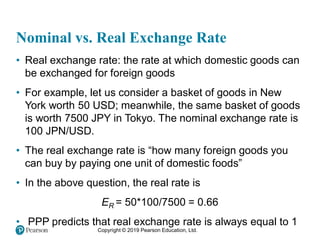
• Real exchange rate: the rate at which domestic goods can
be exchanged for foreign goods
• For example, let us consider a basket of goods in New
York worth 50 USD; meanwhile, the same basket of goods
is worth 7500 JPY in Tokyo. The nominal exchange rate is
100 JPN/USD.
• The real exchange rate is “how many foreign goods you
can buy by paying one unit of domestic foods”
• In the above question, the real rate is
ER = 50*100/7500 = 0.66
• PPP predicts that real exchange rate is always equal to 1
Copyright © 2019 Pearson Education, Ltd.
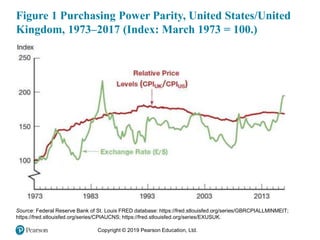
Figure 1 Purchasing Power Parity, United States/United
Kingdom, 1973–2017 (Index: March 1973 = 100.)
Source: Federal Reserve Bank of St. Louis FRED database: https://fred.stlouisfed.org/series/GBRCPIALLMINMEIT;
https://fred.stlouisfed.org/series/CPIAUCNS; https://fred.stlouisfed.org/series/EXUSUK.
Copyright © 2019 Pearson Education, Ltd.
Application:
Burgernomics: Big Macs and PPP
• Since 1986, The Economist magazine has published the
Big Mac index as a “light- hearted guide to whether
currencies are at their ‘correct’ level based on the theory of
purchasing power parity.” Big Macs are sold by
McDonald’s all around the world and are supposed to taste
the same wherever they are sold. The Economist collects
prices (in the local currency) of Big Macs sold in 56
different regions and countries, then uses these prices to
compare the exchange rate implied by PPP and the Big
Mac index.
Copyright © 2019 Pearson Education, Ltd.
Factors That Affect Exchange Rates in the
Long Run
• The basic rule: Anything that increases the demand for
domestically produced goods relative to foreign traded
goods tends to appreciates domestic currency
– Relative price levels
– Trade barriers
– Preferences for domestic versus foreign goods
– Productivity
Copyright © 2019 Pearson Education, Ltd.
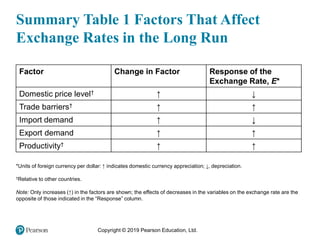
Summary Table 1 Factors That Affect
Exchange Rates in the Long Run
Factor Change in Factor Response of the
Exchange Rate, E*
Domestic price level† ↑ ↓
Trade barriers† ↑ ↑
Import demand ↑ ↓
Export demand ↑ ↑
Productivity† ↑ ↑
*Units of foreign currency per dollar: ↑ indicates domestic currency appreciation; ↓, depreciation.
†Relative to other countries.
Note: Only increases (↑) in the factors are shown; the effects of decreases in the variables on the exchange rate are the
opposite of those indicated in the “Response” column.
Copyright © 2019 Pearson Education, Ltd.
Exchange Rates in the Short Run: A Supply
and Demand Analysis
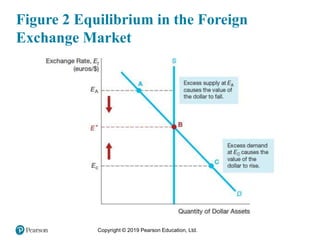
• An exchange rate is the price of domestic (dollar) assets in
terms of foreign assets
• Supply curve for domestic assets
– Assume amount of domestic assets is fixed (supply
curve is vertical)
• Demand curve for domestic assets
– Most important determinant is the relative expected
return of domestic assets
– At lower current values of the dollar (everything else
equal), the quantity demanded of dollar assets is
higher
Copyright © 2019 Pearson Education, Ltd.
Figure 2 Equilibrium in the Foreign
Exchange Market
Copyright © 2019 Pearson Education, Ltd.
Explaining Changes in Exchange Rates
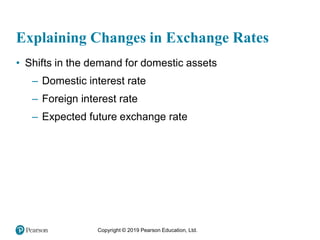
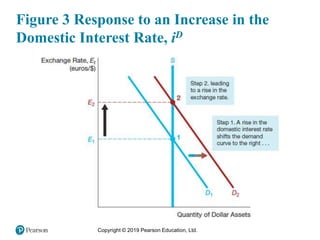
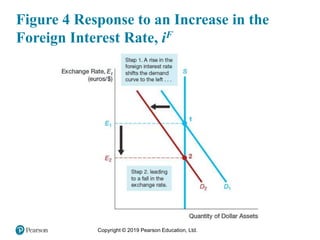
• Shifts in the demand for domestic assets
– Domestic interest rate
– Foreign interest rate
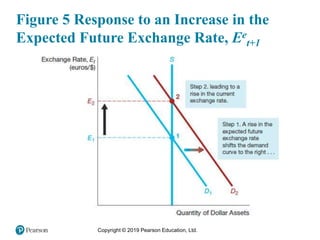
– Expected future exchange rate
Copyright © 2019 Pearson Education, Ltd.
Figure 3 Response to an Increase in the
Domestic Interest Rate, iD
Copyright © 2019 Pearson Education, Ltd.
Figure 4 Response to an Increase in the
Foreign Interest Rate, iF
Copyright © 2019 Pearson Education, Ltd.
Figure 5 Response to an Increase in the
Expected Future Exchange Rate, Ee
t+1
Copyright © 2019 Pearson Education, Ltd.
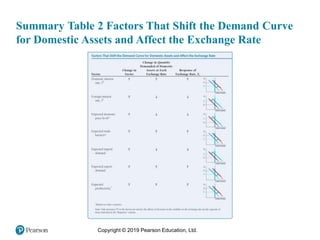
Summary Table 2 Factors That Shift the Demand Curve
for Domestic Assets and Affect the Exchange Rate
Copyright © 2019 Pearson Education, Ltd.
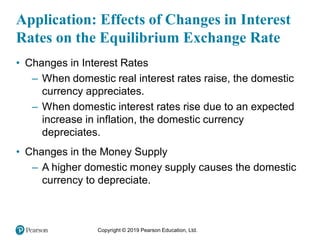
Application: Effects of Changes in Interest
Rates on the Equilibrium Exchange Rate
• Changes in Interest Rates
– When domestic real interest rates raise, the domestic
currency appreciates.
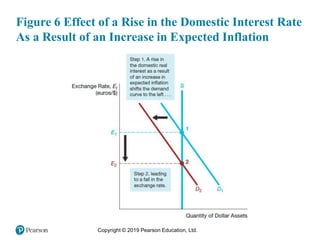
– When domestic interest rates rise due to an expected
increase in inflation, the domestic currency
depreciates.
• Changes in the Money Supply
– A higher domestic money supply causes the domestic
currency to depreciate.
Copyright © 2019 Pearson Education, Ltd.
Figure 6 Effect of a Rise in the Domestic Interest Rate
As a Result of an Increase in Expected Inflation
Copyright © 2019 Pearson Education, Ltd.
Application: The Global Financial Crisis
and the Dollar
• With the start of the global financial crisis in August 2007,
the dollar began an accelerated decline in value, falling by
9% against the euro until mid-July of 2008. After hitting an
all-time low against the euro on July 11, the value of the
dollar suddenly shot upward, by over 20% against the euro
by the end of October. What is the relationship between
the global financial crisis and these large swings in the
value of the dollar?
Copyright © 2019 Pearson Education, Ltd.
Application: Brexit and the British Pound
• As noted in the introduction, the Brexit vote in the United
Kingdom on June 23, 2016, led to nearly a 10%
depreciation in the British pound, from $1.48 to the pound
on June 23, just before the vote, to $1.36 per pound on
June 24. What explains the large one-day decline in the
exchange rate for the pound?
Copyright © 2019 Pearson Education, Ltd.
Appendix: The Interest Parity Condition
(1 of 3)
• Comparing Expected Returns on Domestic and Foreign
Assets
– Since the vast majority of real-world transactions in
currency markets involve economic agents buying and
selling currencies based on their value as assets, one
must develop an understanding of how these assets
are valued.
• From the perspective of an American economic agent, the
expected return on dollar-denominated assets is equal to
the domestic rate of interest.
Copyright © 2019 Pearson Education, Ltd.
Appendix: The Interest Parity Condition
(2 of 3)
• For a foreign economic agent, Francois the Foreigner, the
expected return on dollar-denominated assets is equal to
the rate of interest associated with those same assets,
adjusted for an expected appreciation or depreciation in
the value of the U.S. dollar relative to the Euro.
• If foreign and American bank deposits can be considered
perfect substitutes for one another and capital mobility
exists, then parity should exist between the interest rate on
dollar-denominated bank deposits and the interest rate on
Euro-denominated bank deposits.
Copyright © 2019 Pearson Education, Ltd.
Appendix: The Interest Parity Condition
(3 of 3)
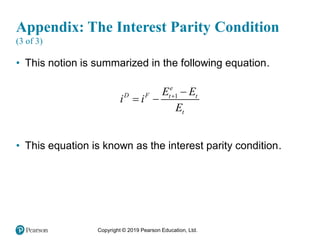
• This notion is summarized in the following equation.
1
e
D F t t
t
E E
i i
E
 
 
• This equation is known as the interest parity condition.

Chapter 19 - The Foreign Exchange Market

  • 1.
    The Economics ofMoney, Banking, and Financial Markets Twelfth Edition, Global Edition Chapter 18 The Foreign Exchange Market Copyright © 2019 Pearson Education, Ltd.
  • 2.
    Copyright © 2019Pearson Education, Ltd. Preview • This chapter outlines how the foreign exchange market functions and how the value of different currencies is determined.
  • 3.
    Copyright © 2019Pearson Education, Ltd. Learning Objectives • Explain how the foreign exchange market works and why exchange rates are importance. • Identify the main factors that affect exchange rates in the long run. • Draw the demand and supply curves for foreign exchange market and interpret the equilibrium in the market for foreign exchange. • List and illustrate the factors that affect the exchange rates in the short run.
  • 4.
    Copyright © 2019Pearson Education, Ltd. Foreign Exchange Market(1 of 2) • Exchange rate: price of one currency in terms of another • Foreign exchange market: the financial market where exchange rates are determined • Spot transaction: immediate (two-day) exchange of bank deposits – Spot exchange rate • Forward transaction: the exchange of bank deposits at some specified future date – Forward exchange rate
  • 5.
    Copyright © 2019Pearson Education, Ltd. Foreign Exchange Market(2 of 2) • Appreciation: a currency rises in value relative to another currency • Depreciation: a currency falls in value relative to another currency • When a country’s currency appreciates, the country’s goods become more expensive to foreigners and foreign goods in that country become less expensive to domestic economic agents. • Over-the-counter market mainly banks
  • 6.
    Copyright © 2019Pearson Education, Ltd. Exchange Rates in the Long Run • Law of one price: the prices of an identical good should be the same throughout the world if trade barriers are low • Theory of Purchasing Power Parity assumptions: – All goods are identical in both countries – Trade barriers and transportation costs are low – Many goods and services are not traded across borders
  • 7.
    Copyright © 2019Pearson Education, Ltd. Nominal vs. Real Exchange Rate • Real exchange rate: the rate at which domestic goods can be exchanged for foreign goods • For example, let us consider a basket of goods in New York worth 50 USD; meanwhile, the same basket of goods is worth 7500 JPY in Tokyo. The nominal exchange rate is 100 JPN/USD. • The real exchange rate is “how many foreign goods you can buy by paying one unit of domestic foods” • In the above question, the real rate is ER = 50*100/7500 = 0.66 • PPP predicts that real exchange rate is always equal to 1
  • 8.
    Copyright © 2019Pearson Education, Ltd. Figure 1 Purchasing Power Parity, United States/United Kingdom, 1973–2017 (Index: March 1973 = 100.) Source: Federal Reserve Bank of St. Louis FRED database: https://fred.stlouisfed.org/series/GBRCPIALLMINMEIT; https://fred.stlouisfed.org/series/CPIAUCNS; https://fred.stlouisfed.org/series/EXUSUK.
  • 9.
    Copyright © 2019Pearson Education, Ltd. Application: Burgernomics: Big Macs and PPP • Since 1986, The Economist magazine has published the Big Mac index as a “light- hearted guide to whether currencies are at their ‘correct’ level based on the theory of purchasing power parity.” Big Macs are sold by McDonald’s all around the world and are supposed to taste the same wherever they are sold. The Economist collects prices (in the local currency) of Big Macs sold in 56 different regions and countries, then uses these prices to compare the exchange rate implied by PPP and the Big Mac index.
  • 10.
    Copyright © 2019Pearson Education, Ltd. Factors That Affect Exchange Rates in the Long Run • The basic rule: Anything that increases the demand for domestically produced goods relative to foreign traded goods tends to appreciates domestic currency – Relative price levels – Trade barriers – Preferences for domestic versus foreign goods – Productivity
  • 11.
    Copyright © 2019Pearson Education, Ltd. Summary Table 1 Factors That Affect Exchange Rates in the Long Run Factor Change in Factor Response of the Exchange Rate, E* Domestic price level† ↑ ↓ Trade barriers† ↑ ↑ Import demand ↑ ↓ Export demand ↑ ↑ Productivity† ↑ ↑ *Units of foreign currency per dollar: ↑ indicates domestic currency appreciation; ↓, depreciation. †Relative to other countries. Note: Only increases (↑) in the factors are shown; the effects of decreases in the variables on the exchange rate are the opposite of those indicated in the “Response” column.
  • 12.
    Copyright © 2019Pearson Education, Ltd. Exchange Rates in the Short Run: A Supply and Demand Analysis • An exchange rate is the price of domestic (dollar) assets in terms of foreign assets • Supply curve for domestic assets – Assume amount of domestic assets is fixed (supply curve is vertical) • Demand curve for domestic assets – Most important determinant is the relative expected return of domestic assets – At lower current values of the dollar (everything else equal), the quantity demanded of dollar assets is higher
  • 13.
    Copyright © 2019Pearson Education, Ltd. Figure 2 Equilibrium in the Foreign Exchange Market
  • 14.
    Copyright © 2019Pearson Education, Ltd. Explaining Changes in Exchange Rates • Shifts in the demand for domestic assets – Domestic interest rate – Foreign interest rate – Expected future exchange rate
  • 15.
    Copyright © 2019Pearson Education, Ltd. Figure 3 Response to an Increase in the Domestic Interest Rate, iD
  • 16.
    Copyright © 2019Pearson Education, Ltd. Figure 4 Response to an Increase in the Foreign Interest Rate, iF
  • 17.
    Copyright © 2019Pearson Education, Ltd. Figure 5 Response to an Increase in the Expected Future Exchange Rate, Ee t+1
  • 18.
    Copyright © 2019Pearson Education, Ltd. Summary Table 2 Factors That Shift the Demand Curve for Domestic Assets and Affect the Exchange Rate
  • 19.
    Copyright © 2019Pearson Education, Ltd. Application: Effects of Changes in Interest Rates on the Equilibrium Exchange Rate • Changes in Interest Rates – When domestic real interest rates raise, the domestic currency appreciates. – When domestic interest rates rise due to an expected increase in inflation, the domestic currency depreciates. • Changes in the Money Supply – A higher domestic money supply causes the domestic currency to depreciate.
  • 20.
    Copyright © 2019Pearson Education, Ltd. Figure 6 Effect of a Rise in the Domestic Interest Rate As a Result of an Increase in Expected Inflation
  • 21.
    Copyright © 2019Pearson Education, Ltd. Application: The Global Financial Crisis and the Dollar • With the start of the global financial crisis in August 2007, the dollar began an accelerated decline in value, falling by 9% against the euro until mid-July of 2008. After hitting an all-time low against the euro on July 11, the value of the dollar suddenly shot upward, by over 20% against the euro by the end of October. What is the relationship between the global financial crisis and these large swings in the value of the dollar?
  • 22.
    Copyright © 2019Pearson Education, Ltd. Application: Brexit and the British Pound • As noted in the introduction, the Brexit vote in the United Kingdom on June 23, 2016, led to nearly a 10% depreciation in the British pound, from $1.48 to the pound on June 23, just before the vote, to $1.36 per pound on June 24. What explains the large one-day decline in the exchange rate for the pound?
  • 23.
    Copyright © 2019Pearson Education, Ltd. Appendix: The Interest Parity Condition (1 of 3) • Comparing Expected Returns on Domestic and Foreign Assets – Since the vast majority of real-world transactions in currency markets involve economic agents buying and selling currencies based on their value as assets, one must develop an understanding of how these assets are valued. • From the perspective of an American economic agent, the expected return on dollar-denominated assets is equal to the domestic rate of interest.
  • 24.
    Copyright © 2019Pearson Education, Ltd. Appendix: The Interest Parity Condition (2 of 3) • For a foreign economic agent, Francois the Foreigner, the expected return on dollar-denominated assets is equal to the rate of interest associated with those same assets, adjusted for an expected appreciation or depreciation in the value of the U.S. dollar relative to the Euro. • If foreign and American bank deposits can be considered perfect substitutes for one another and capital mobility exists, then parity should exist between the interest rate on dollar-denominated bank deposits and the interest rate on Euro-denominated bank deposits.
  • 25.
    Copyright © 2019Pearson Education, Ltd. Appendix: The Interest Parity Condition (3 of 3) • This notion is summarized in the following equation. 1 e D F t t t E E i i E     • This equation is known as the interest parity condition.