Global Pricing Objectivesand
Strategies
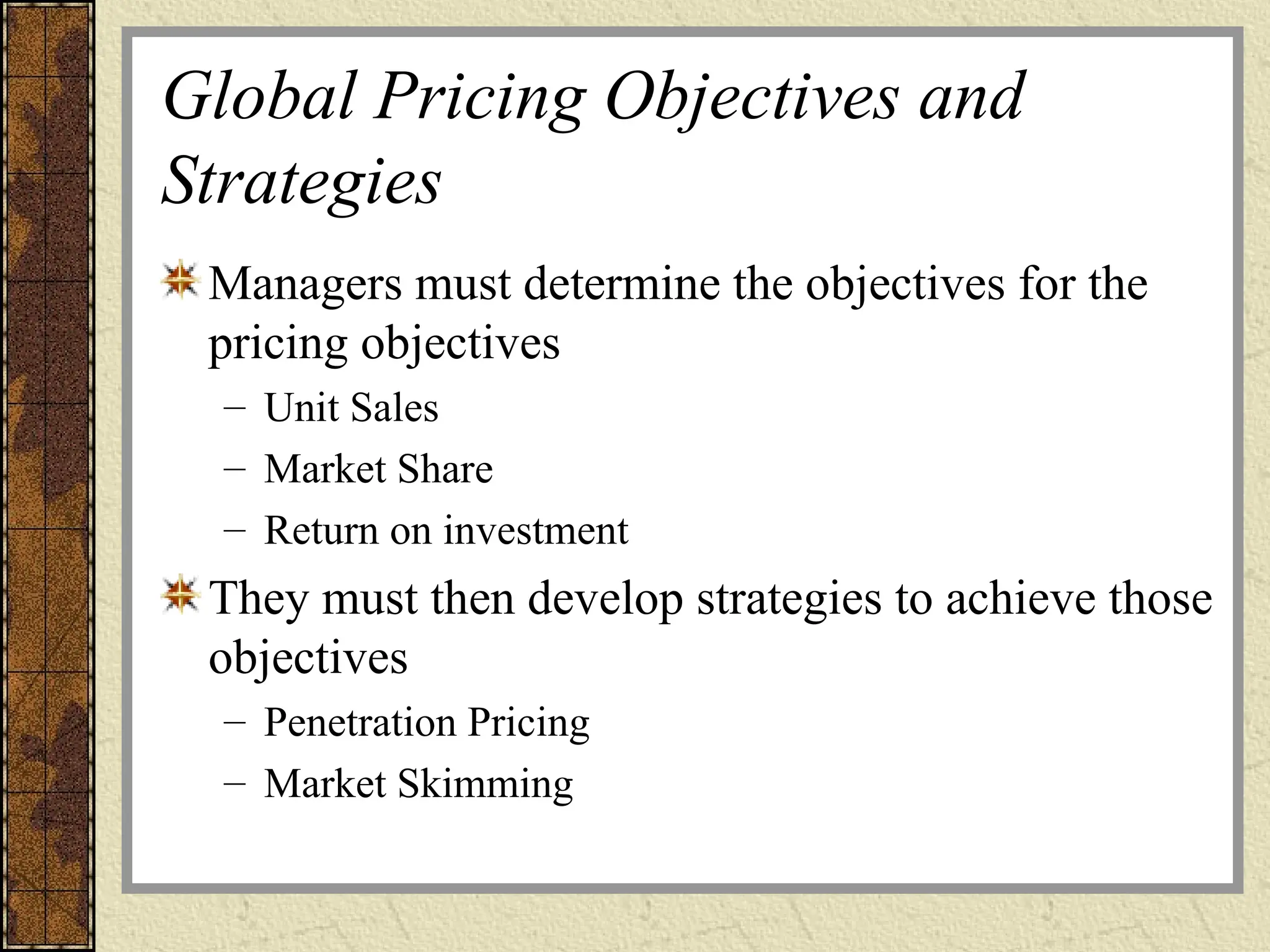
Managers must determine the objectives for the
pricing objectives
– Unit Sales
– Market Share
– Return on investment
They must then develop strategies to achieve those
objectives
– Penetration Pricing
– Market Skimming
4.
Market Skimming andFinancial
Objectives
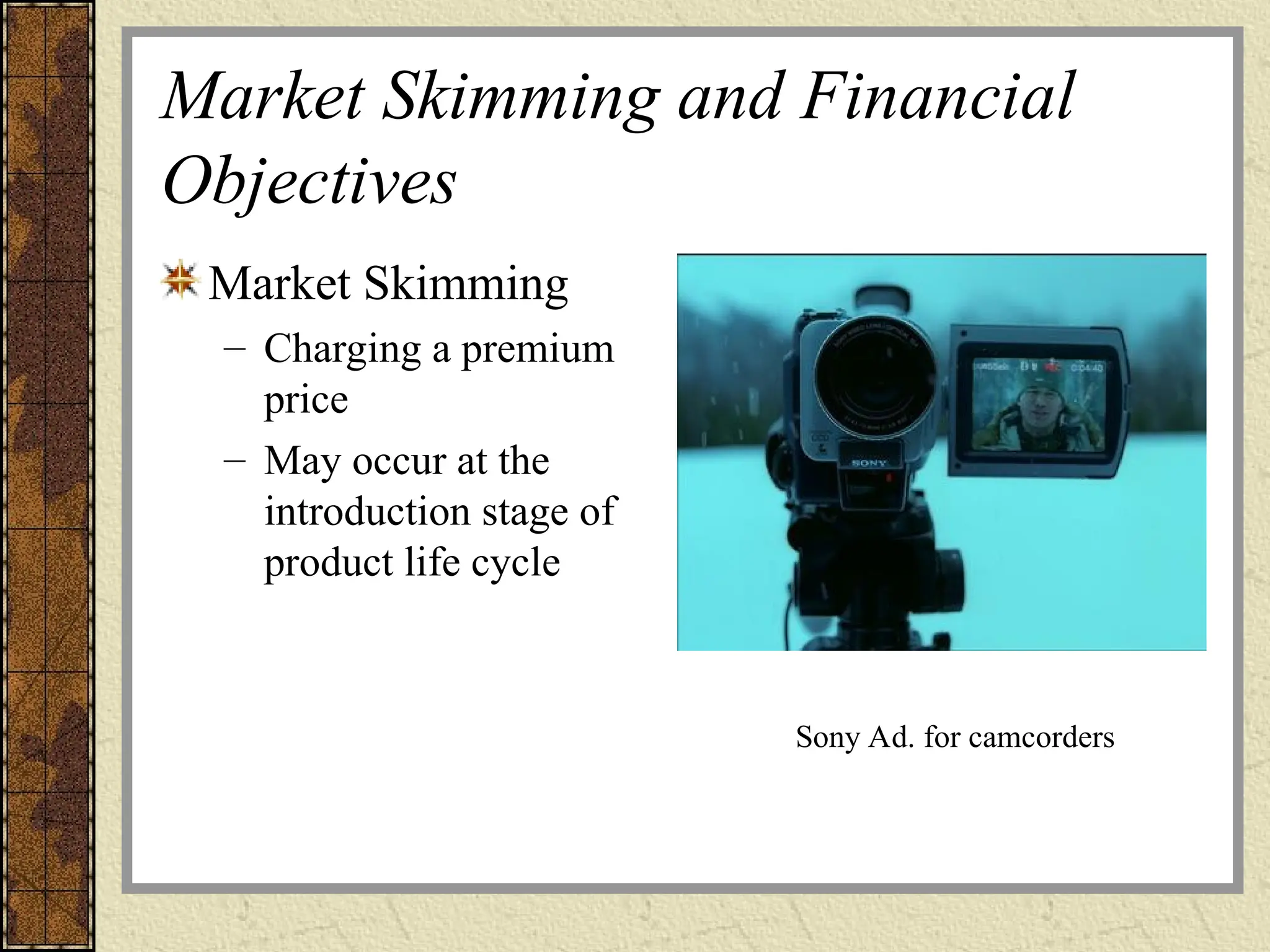
Market Skimming
– Charging a premium
price
– May occur at the
introduction stage of
product life cycle
Sony Ad. for camcorders
5.
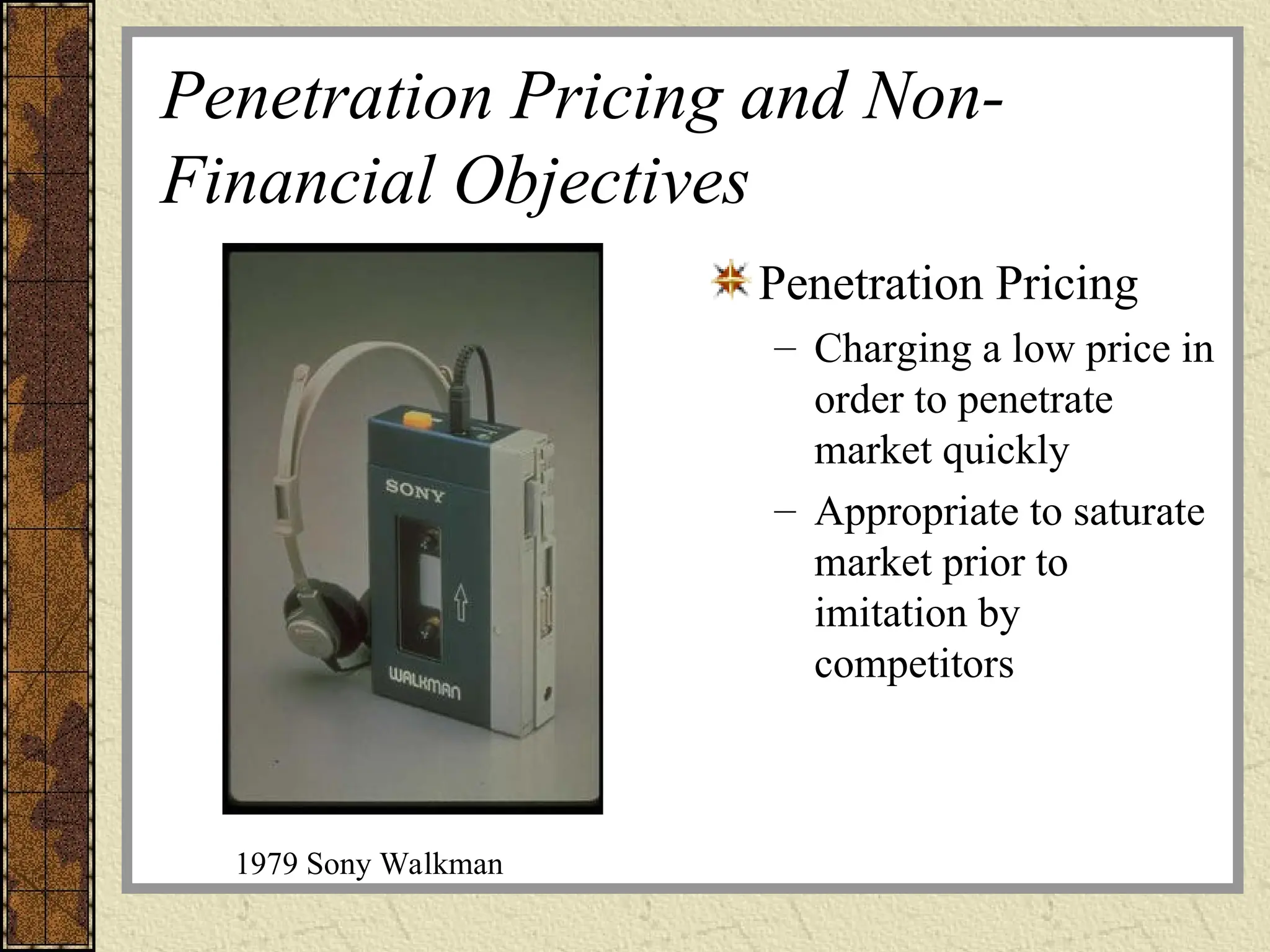
Penetration Pricing andNon-
Financial Objectives
Penetration Pricing
– Charging a low price in
order to penetrate
market quickly
– Appropriate to saturate
market prior to
imitation by
competitors
1979 Sony Walkman
6.
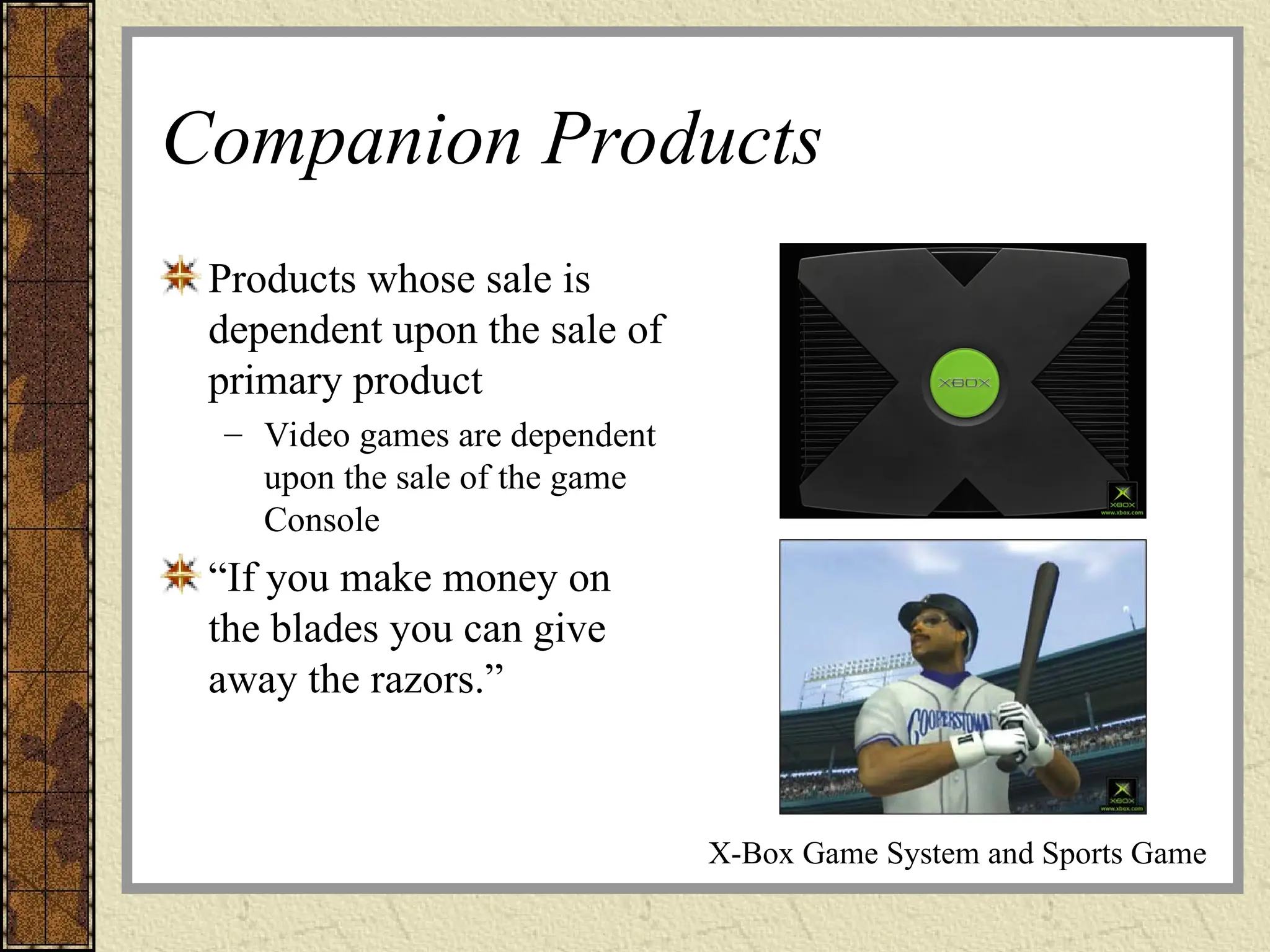
Companion Products
Products whosesale is
dependent upon the sale of
primary product
– Video games are dependent
upon the sale of the game
Console
“If you make money on
the blades you can give
away the razors.”
X-Box Game System and Sports Game
7.
Dumping
In international trade,this occurs when one
country exports a significant amount of
goods to another country at prices much
lower than in the domestic market
Extension
Ethnocentric
Per-unit price ofan item is the same no
matter where in the world the buyer is
located
Importer must absorb freight and import
duties
Fails to respond to each national market
Return
11.
Adaptation
Polycentric
Permits affiliate managersor independent
distributors to establish price as they feel is
most desirable in their circumstances
Sensitive to market conditions but creates
potential for gray marketing
Return
12.
Geocentric
Intermediate course ofaction
Recognizes that several factors are relevant
to pricing decision
– Local costs
– Income levels
– Competition
– Local marketing strategy
Return
13.
Inflationary Environment
Defined asa persistent upward change in
price levels
– Can be caused by an increase in the money
supply
– Can be caused by currency devaluation
Essential requirement for pricing is the
maintenance of operating margins
Return
14.
Government Controls, Subsidies,
andRegulations
The types of policies and regulations that
affect pricing decisions are:
– Dumping legislation
– Resale price maintenance legislation
– Price ceilings
– General reviews of price levels
Return
15.
Competitive Behavior
If competitorsdo not adjust their prices in
response to rising costs it is difficult to
adjust your pricing to maintain operating
margins
If competitors are manufacturing or
sourcing I a lower-cost country, it may be
necessary to cut prices to stay competitive
Return
16.
Using Sourcing asa Strategic
Pricing Tool
Marketers of
domestically
manufactured finished
products may move to
offshore sourcing of
certain components to
keep costs down and
prices competitive
Can you stay competitive
while staying local?
Editor's Notes
#4 By setting a deliberately high price, demand is limited to innovators and early adopters who are willing and able to pay the price. When the product enters the growth stage of the life cycle and competition increases, manufacturers start to cut prices. This strategy has been used consistently in the consumer electronics industry; for example, when Sony introduced the first consumer VCRs in the 1970s, the retail price exceeded $1,000. The same was true when compact disc players were launched in the early 1980s. Within a few years, prices for these products dropped well below $500. This pattern was evident in the fall of 1998, when HDTV sets went on sale in the United States with prices starting at about $7,000. This price both maximizes revenue on limited volume and matches demand to available supply.
#5 When Sony was developing the Walkman in 1979, initial plans called for a retail price of ¥50,000 ($249) to achieve breakeven. However, it was felt that a price of ¥35,000 ($170) was necessary to attract the all-important youth market segment. After the engineering team conceded that they could trim costs to achieve breakeven volume at a price of ¥40,000, Chairman Akio Morita pushed them further and insisted on a retail price of ¥33,000 ($165) to commemorate Sony’s 33rd anniversary. At that price, even if the initial production run of 60,000 units sold out, the company would lose $35 per unit.
It should be noted that a first-time exporter is unlikely to use penetration pricing. The reason is simple: Penetration pricing often means that the product may be sold at a loss for a certain length of time. Many companies, especially those in the food industry, launch new products that are not innovative enough to qualify for patent protection. When this occurs, penetration pricing is recommended as a means of achieving market saturation before competitors copy the product.
#6 The biggest profits in the video industry come from sales of game software; thus, even though prices are dropping for PlayStation 2, Xbox, and GameCube, sales of hit titles are generating substantial revenues and profits. This illustrates the notion of companion products: AOL software is worthless without a personal computer, a modem, and a telephone line; a video game player is worthless without games, a DVD player is worthless without movies, a razor handle is worthless without blades, a cellular phone is worthless without a calling plan, and so on.