Chapter 13 PresentationThe Eye and EarBy: Stacey Smith
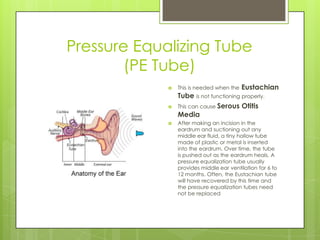
Pressure Equalizing Tube (PE Tube)This is needed when theEustachian Tubeis not functioning properly.This can cause Serous Otitis MediaAfter making an incision in the eardrum and suctioning out any middle ear fluid, a tiny hollow tube made of plastic or metal is inserted into the eardrum. Over time, the tube is pushed out as the eardrum heals. A pressure equalization tube usually provides middle ear ventilation for 6 to 12 months. Often, the Eustachian tube will have recovered by this time and the pressure equalization tubes need not be replaced
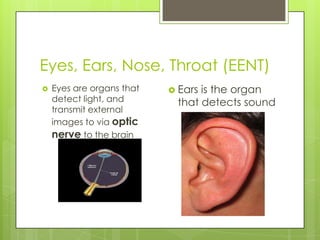
Eyes, Ears, Nose, Throat (EENT)Eyes are organs that detect light, and transmit external images to via optic nerveto the brainEars is the organ that detects sound
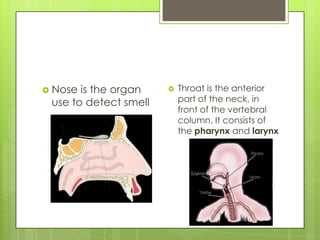
Nose is the organ use to detect smellThroat is the anterior part of the neck, in front of the vertebral column. It consists of the pharynx and larynx
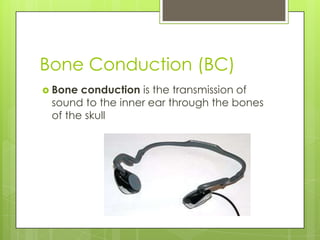
Bone Conduction (BC)Bone conduction is the transmission of sound to the inner ear through the bones of the skull
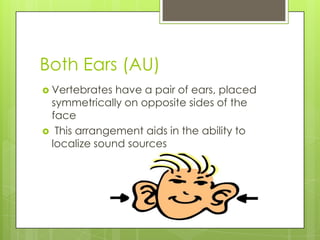
Both Ears (AU)Vertebrates have a pair of ears, placed symmetrically on opposite sides of the faceThis arrangement aids in the ability to localize sound sources
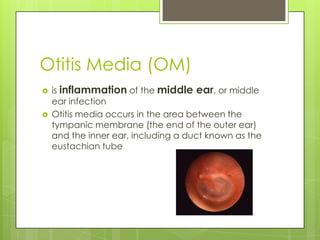
Otitis Media (OM)is inflammation of the middle ear, or middle ear infectionOtitis media occurs in the area between the tympanic membrane (the end of the outer ear) and the inner ear, including a duct known as the eustachian tube
Emmetropia (EM)Describes the state of vision where an object at infinity is in sharp focus with the eye lens in a neutral or relaxed stateThis condition of the normal eye is achieved when the refractive power of the cornea and the axial length of the eye balance out, which focuses rays exactly on the retina resulting in perfect visionAn eye in a state of emmetropia requires no correction
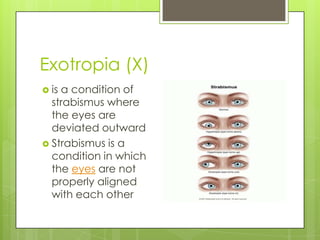
Exotropia (X)is a condition of strabismus where the eyes are deviated outwardStrabismus is a condition in which the eyes are not properly aligned with each other
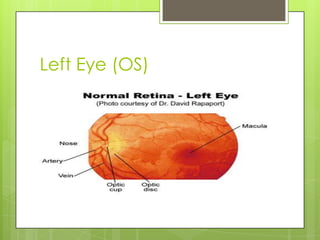
Left Eye (OS)
Extraocular Movement (EOM)The extraocular musclesare the six muscles that control the movements of the (human) eye. The actions of the extraocular muscles depend on the position of the eye at the time of muscle contraction.
Visual Acuityacuteness or clearness of vision, especially form vision, which is dependent on the sharpness of the retinal focus within the eye and the sensitivity of the interpretative faculty of the braina measure of the spatial resolution of the visual processing system and is usually tested in a manner to optimize and standardize the conditions
Refrences:Medical Terminology A Living Languagewww.summitmedicalgroup.comwww.kidshealth.org

Chapter 13 presentation

  • 1.
    Chapter 13 PresentationTheEye and EarBy: Stacey Smith
  • 2.
    Pressure Equalizing Tube(PE Tube)This is needed when theEustachian Tubeis not functioning properly.This can cause Serous Otitis MediaAfter making an incision in the eardrum and suctioning out any middle ear fluid, a tiny hollow tube made of plastic or metal is inserted into the eardrum. Over time, the tube is pushed out as the eardrum heals. A pressure equalization tube usually provides middle ear ventilation for 6 to 12 months. Often, the Eustachian tube will have recovered by this time and the pressure equalization tubes need not be replaced
  • 3.
    Eyes, Ears, Nose,Throat (EENT)Eyes are organs that detect light, and transmit external images to via optic nerveto the brainEars is the organ that detects sound
  • 4.
    Nose is theorgan use to detect smellThroat is the anterior part of the neck, in front of the vertebral column. It consists of the pharynx and larynx
  • 5.
    Bone Conduction (BC)Boneconduction is the transmission of sound to the inner ear through the bones of the skull
  • 6.
    Both Ears (AU)Vertebrateshave a pair of ears, placed symmetrically on opposite sides of the faceThis arrangement aids in the ability to localize sound sources
  • 7.
    Otitis Media (OM)isinflammation of the middle ear, or middle ear infectionOtitis media occurs in the area between the tympanic membrane (the end of the outer ear) and the inner ear, including a duct known as the eustachian tube
  • 8.
    Emmetropia (EM)Describes thestate of vision where an object at infinity is in sharp focus with the eye lens in a neutral or relaxed stateThis condition of the normal eye is achieved when the refractive power of the cornea and the axial length of the eye balance out, which focuses rays exactly on the retina resulting in perfect visionAn eye in a state of emmetropia requires no correction
  • 9.
    Exotropia (X)is acondition of strabismus where the eyes are deviated outwardStrabismus is a condition in which the eyes are not properly aligned with each other
  • 10.
  • 11.
    Extraocular Movement (EOM)Theextraocular musclesare the six muscles that control the movements of the (human) eye. The actions of the extraocular muscles depend on the position of the eye at the time of muscle contraction.
  • 12.
    Visual Acuityacuteness orclearness of vision, especially form vision, which is dependent on the sharpness of the retinal focus within the eye and the sensitivity of the interpretative faculty of the braina measure of the spatial resolution of the visual processing system and is usually tested in a manner to optimize and standardize the conditions
  • 13.
    Refrences:Medical Terminology ALiving Languagewww.summitmedicalgroup.comwww.kidshealth.org