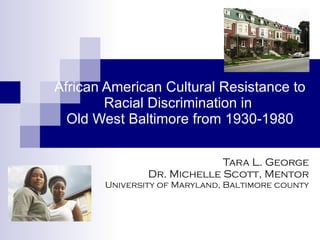
African American Cultural Resistance to Racial Discrimination in  Old West Baltimore from 1930-1980 Tara L. George Dr. Michelle Scott, Mentor University of Maryland, Baltimore county
 
Major research Questions  Why the time period 1930-1980? What is cultural resistance? Why study cultural forms of resistance? Why study Baltimore’s African American history at all?
Literature Review
Literature Review Black Culture and Consciousness Freedom’s Port From Mobtown to Charm City Blockbusting in Baltimore Baltimore: The Building of an American City
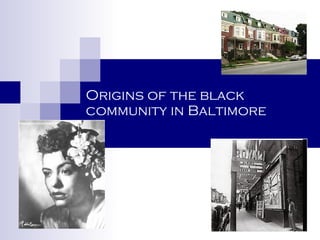
Origins of the black community in Baltimore
Segregation & racial discrimination Growing sense of fear and racism after emancipation 3 events heightened this fear and racism from 1865-1920’s Job busting Methodist Camp Fight Meeting Legalization of segregation
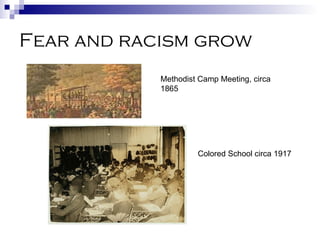
Fear and racism grow Methodist Camp Meeting, circa 1865 Colored School circa 1917
Old west Baltimore By 1904, over 50% of Baltimore’s black population lived in an area known as old west Baltimore South Baltimore was the second black neighborhood, but was contaminated with diseases (tuberculosis)  Old west Baltimore was the preferred neighborhood
Old West Baltimore
Music counterculture
The Music Counterculture Two distinct countercultural forms of music arose : Jazz (Billie Holiday, Louis Armstrong) Doo-wop (The Orioles)
The Royal Theater The Royal Theater circa 1920’s
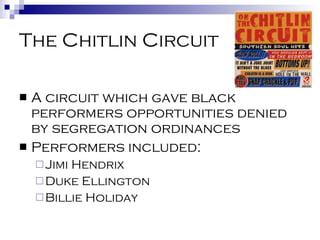
The Chitlin Circuit A circuit which gave black performers opportunities denied by segregation ordinances Performers included: Jimi Hendrix Duke Ellington Billie Holiday
Jimi Hendrix performs on the Chitlin Circuit
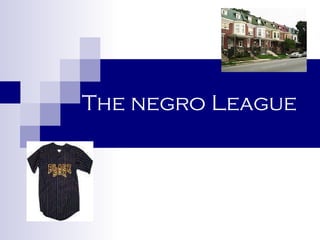
The negro League
the Negro League overview 1867: The National Association of Ball Players rejected the all black Pythian Clubs application 1885: Cuban Giants Form 1901: Baltimore Orioles deny John McGraw  a spot on the team 1916: Negro League Baseball comes to Baltimore
The Baltimore Black Sox The Black Sox circa 1929 Championship winners in 1929
The Baltimore Elite Giants The Giants circa 1949 Championship winners in 1939, 1949
The Black Church
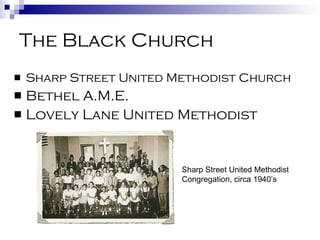
The Black Church Sharp Street United Methodist Church Bethel A.M.E. Lovely Lane United Methodist Sharp Street United Methodist Congregation, circa 1940’s
Community Devolution
Black Flight to the Suburbs NAACP Bethel A.M.E. Middle and Upper Class Black Families
Community Devolution INTEGRATION SUBURBAN FLIGHT CIVIL RIGHTS LEGISLATION COMMUNITY  DEVOLUTION
Community Devolution
Penn Ave. Today 1953: Destruction of Lafeyette Market 1968: Middle and Upper Class Blacks Begin to Flee the City 1970: The Royal Theater Closes 1980: Drug War Begins 1990-present: Urban Renewal Efforts Take Place
The Royal Theater today
Conclusions:  Perspectives on the Future
Reviving The Community How can cultural forms of resistance be useful to Baltimore's black population today?
Acknowledgements Dr. Michelle Scott  History Department, UMBC Mentor Dr. Michael Johnson History Department, UMBC Research Advisor The UMBC McNair Scholars Program & Staff
References Afro-American  “Factional Machine Politics” by Edward Rothman April 27, 1923 Afro American  “Don’t Buy Where You Can’t Work” 1933 Afro American  1968 Annapolis Gazette , 1866 Argersinger, Jo Ann.  Toward a New Deal in America: People and Government in the Great Depression . Baltimore American  November 11 1866 The Baltimore Evening Sun  “Jazz Greats Played at the Royal.” Februrary 3, 1971. Baltimore Gazette  June 12,1886 Baltimore Sun  1858, 1866, 1968 Brewington, Kelly and Andrew Green. “NAACP Ponders Suburb of DC”  The Baltimore   Sun  August 1, 2006 Bowdon, Mar. “Bossin’ Around: A history of how things got done in Baltimore”  The Baltimore CityPaper  June 29,1979. Cohen, Charles. “Charmed Life: The Old Ball Game”  The Baltimore CityPaper . March 26, 2003 “ Diplomas Court: An essential guide to graduation policies and rates”  Education Week  (2006) June 22, 2006 Volume 25 Issue 41S Elfenbein, Jessica, John Breihan and Thomas Hallowak, eds.  From Mobtown to Charm City: New Perspectives on Baltimore’s Past . Maryland Historical Society, 2005. Elfenbein, Jessica. “A Place of Resort and Help for Their Young Men: Baltimore’s Black YMCA 1885-1925.”  From Mobtown to Charm City: New Perspectives on Baltimore’s Past . Eds. Jessica Elfenbein, John Breihan, Thomas Hollowak. Maryland Historical Society, 2005. 149-171 Fuke, Richard Paul. “Race and Public Policy in Post-Emancipation Baltimore.”  From Mobtown to Charm City: New Perspectives on Baltimore’s Past . Eds. Jessica Elfenbein, John Breihan, Thomas Hollowak. Maryland Historical Society, 2005. 129-148. Fuller, Nicole. “Experienced Stressed to Convert Upland Apartments”  The Baltimore Sun  November 15, 2006. Griel, Marcus. “The Woman Who Created Rock and Roll.”  Rolling Stone  1993: 659.15, 120-140. Hogan, Lawrence.  Shades of Glory: The Negro Leagues and the Story of African American Baseball . National Geographic, 2006. Jackson, Lillie Mae.  The Crisis , April 1936 Levine, Lawrence.  Black Culture and Black Consciousness . New York: Oxford University Press, 1977. Lewis, Edward S. “Profiles: Baltimore”  Journal of Educational Psychology  17.5 (1944): 288-295. McDougall, Harold.  Black Baltimore:A New Theory of Community .   Philadelphia: Temple University Press, 1993. Negro Housing Patterns Report  Association for the Condition of the Poor, 1907. Olson, Karen. “Old West Baltimore: Segregation, African-American Culture, and the Struggle for Equality”  The Baltimore Book: New Views of Local History  Eds. Elizabeth Fee, Linda Shopes and Linda Zeidman. Temple University Press, 1991, 40-57. Olson, Sherry.  Baltimore: The Building of an American City . Johns Hopkins University Press, 1997. Orser, W. Edward.  Blockbusting in Baltimore: The Edmondson Village Story . University Press of Kentucky, 1997. Phillips, Christopher.  Freedom’s Port: The African American Community of Baltimore, 1790-1860 . University of Illinois Press, 1997. Power, Garrett. “Apartheid Baltimore Style: The Residential Segregation Ordinances of 1910-1913.”  Maryland Law Review  42.3 November 1983 Reddy, Sumathi and Gus Sentementes. “Interim Chief Taking Over at a Critical Time.”  The Baltimore Sun . July 17, 2007.  Royster-Hemby, Christina. “Street of Dreams: Pennsylvania Avenue was once the center of Black life and culture in Baltimore. Can it be again?”  The Baltimore City Paper  February 2, 2005. “ Tipping Point: Maryland’s Overuse of Incarceration and the Impact on Community Safety” Justice Policy Institute.  Towers, Frank. “Job Busting at Baltimore Shipyards: Racial Violence in the Civil War Era South”  The Journal of Southern History  66.2 (2000): 221-256. Wilerkson, Doxey. “The Negro Press”  The Journal of Negro Education  16.4 (1947)  Zeidman, Linda. “Sparrows Point, Dundalk, Highlandtown, Old West Baltimore: Home of Gold Dust and the Union Card”  The Baltimore Book: New Views of Local History  Eds. Elizabeth Fee, Linda Shopes and Linda Zeidman. Temple University Press, 1991, 155-175.
Any Questions? Tara George [email_address]

Historic Baltimore Presentation

  • 1.
    African American CulturalResistance to Racial Discrimination in Old West Baltimore from 1930-1980 Tara L. George Dr. Michelle Scott, Mentor University of Maryland, Baltimore county
  • 2.
  • 3.
    Major research Questions Why the time period 1930-1980? What is cultural resistance? Why study cultural forms of resistance? Why study Baltimore’s African American history at all?
  • 4.
  • 5.
    Literature Review BlackCulture and Consciousness Freedom’s Port From Mobtown to Charm City Blockbusting in Baltimore Baltimore: The Building of an American City
  • 6.
    Origins of theblack community in Baltimore
  • 7.
    Segregation & racialdiscrimination Growing sense of fear and racism after emancipation 3 events heightened this fear and racism from 1865-1920’s Job busting Methodist Camp Fight Meeting Legalization of segregation
  • 8.
    Fear and racismgrow Methodist Camp Meeting, circa 1865 Colored School circa 1917
  • 9.
    Old west BaltimoreBy 1904, over 50% of Baltimore’s black population lived in an area known as old west Baltimore South Baltimore was the second black neighborhood, but was contaminated with diseases (tuberculosis) Old west Baltimore was the preferred neighborhood
  • 10.
  • 11.
  • 12.
    The Music CountercultureTwo distinct countercultural forms of music arose : Jazz (Billie Holiday, Louis Armstrong) Doo-wop (The Orioles)
  • 13.
    The Royal TheaterThe Royal Theater circa 1920’s
  • 14.
    The Chitlin CircuitA circuit which gave black performers opportunities denied by segregation ordinances Performers included: Jimi Hendrix Duke Ellington Billie Holiday
  • 15.
    Jimi Hendrix performson the Chitlin Circuit
  • 16.
  • 17.
    the Negro Leagueoverview 1867: The National Association of Ball Players rejected the all black Pythian Clubs application 1885: Cuban Giants Form 1901: Baltimore Orioles deny John McGraw a spot on the team 1916: Negro League Baseball comes to Baltimore
  • 18.
    The Baltimore BlackSox The Black Sox circa 1929 Championship winners in 1929
  • 19.
    The Baltimore EliteGiants The Giants circa 1949 Championship winners in 1939, 1949
  • 20.
  • 21.
    The Black ChurchSharp Street United Methodist Church Bethel A.M.E. Lovely Lane United Methodist Sharp Street United Methodist Congregation, circa 1940’s
  • 22.
  • 23.
    Black Flight tothe Suburbs NAACP Bethel A.M.E. Middle and Upper Class Black Families
  • 24.
    Community Devolution INTEGRATIONSUBURBAN FLIGHT CIVIL RIGHTS LEGISLATION COMMUNITY DEVOLUTION
  • 25.
  • 26.
    Penn Ave. Today1953: Destruction of Lafeyette Market 1968: Middle and Upper Class Blacks Begin to Flee the City 1970: The Royal Theater Closes 1980: Drug War Begins 1990-present: Urban Renewal Efforts Take Place
  • 27.
  • 28.
  • 29.
    Reviving The CommunityHow can cultural forms of resistance be useful to Baltimore's black population today?
  • 30.
    Acknowledgements Dr. MichelleScott History Department, UMBC Mentor Dr. Michael Johnson History Department, UMBC Research Advisor The UMBC McNair Scholars Program & Staff
  • 31.
    References Afro-American “Factional Machine Politics” by Edward Rothman April 27, 1923 Afro American “Don’t Buy Where You Can’t Work” 1933 Afro American 1968 Annapolis Gazette , 1866 Argersinger, Jo Ann. Toward a New Deal in America: People and Government in the Great Depression . Baltimore American November 11 1866 The Baltimore Evening Sun “Jazz Greats Played at the Royal.” Februrary 3, 1971. Baltimore Gazette June 12,1886 Baltimore Sun 1858, 1866, 1968 Brewington, Kelly and Andrew Green. “NAACP Ponders Suburb of DC” The Baltimore Sun August 1, 2006 Bowdon, Mar. “Bossin’ Around: A history of how things got done in Baltimore” The Baltimore CityPaper June 29,1979. Cohen, Charles. “Charmed Life: The Old Ball Game” The Baltimore CityPaper . March 26, 2003 “ Diplomas Court: An essential guide to graduation policies and rates” Education Week (2006) June 22, 2006 Volume 25 Issue 41S Elfenbein, Jessica, John Breihan and Thomas Hallowak, eds. From Mobtown to Charm City: New Perspectives on Baltimore’s Past . Maryland Historical Society, 2005. Elfenbein, Jessica. “A Place of Resort and Help for Their Young Men: Baltimore’s Black YMCA 1885-1925.” From Mobtown to Charm City: New Perspectives on Baltimore’s Past . Eds. Jessica Elfenbein, John Breihan, Thomas Hollowak. Maryland Historical Society, 2005. 149-171 Fuke, Richard Paul. “Race and Public Policy in Post-Emancipation Baltimore.” From Mobtown to Charm City: New Perspectives on Baltimore’s Past . Eds. Jessica Elfenbein, John Breihan, Thomas Hollowak. Maryland Historical Society, 2005. 129-148. Fuller, Nicole. “Experienced Stressed to Convert Upland Apartments” The Baltimore Sun November 15, 2006. Griel, Marcus. “The Woman Who Created Rock and Roll.” Rolling Stone 1993: 659.15, 120-140. Hogan, Lawrence. Shades of Glory: The Negro Leagues and the Story of African American Baseball . National Geographic, 2006. Jackson, Lillie Mae. The Crisis , April 1936 Levine, Lawrence. Black Culture and Black Consciousness . New York: Oxford University Press, 1977. Lewis, Edward S. “Profiles: Baltimore” Journal of Educational Psychology 17.5 (1944): 288-295. McDougall, Harold. Black Baltimore:A New Theory of Community . Philadelphia: Temple University Press, 1993. Negro Housing Patterns Report Association for the Condition of the Poor, 1907. Olson, Karen. “Old West Baltimore: Segregation, African-American Culture, and the Struggle for Equality” The Baltimore Book: New Views of Local History Eds. Elizabeth Fee, Linda Shopes and Linda Zeidman. Temple University Press, 1991, 40-57. Olson, Sherry. Baltimore: The Building of an American City . Johns Hopkins University Press, 1997. Orser, W. Edward. Blockbusting in Baltimore: The Edmondson Village Story . University Press of Kentucky, 1997. Phillips, Christopher. Freedom’s Port: The African American Community of Baltimore, 1790-1860 . University of Illinois Press, 1997. Power, Garrett. “Apartheid Baltimore Style: The Residential Segregation Ordinances of 1910-1913.” Maryland Law Review 42.3 November 1983 Reddy, Sumathi and Gus Sentementes. “Interim Chief Taking Over at a Critical Time.” The Baltimore Sun . July 17, 2007. Royster-Hemby, Christina. “Street of Dreams: Pennsylvania Avenue was once the center of Black life and culture in Baltimore. Can it be again?” The Baltimore City Paper February 2, 2005. “ Tipping Point: Maryland’s Overuse of Incarceration and the Impact on Community Safety” Justice Policy Institute. Towers, Frank. “Job Busting at Baltimore Shipyards: Racial Violence in the Civil War Era South” The Journal of Southern History 66.2 (2000): 221-256. Wilerkson, Doxey. “The Negro Press” The Journal of Negro Education 16.4 (1947) Zeidman, Linda. “Sparrows Point, Dundalk, Highlandtown, Old West Baltimore: Home of Gold Dust and the Union Card” The Baltimore Book: New Views of Local History Eds. Elizabeth Fee, Linda Shopes and Linda Zeidman. Temple University Press, 1991, 155-175.
  • 32.
    Any Questions? TaraGeorge [email_address]