THE DEVELOPMENT OF
HUMAN RESOURCES
CHAPTER 1
● Define Human Resource Management;
● Discuss why Human Resource Management is both a science
and an art;
● Explain and differentiate the different roles of the Human
Resource Manager and his functions;
● Discuss the importance of the Human Resource Manager in a
business and his major contribution toward the development
of the organization; and
● Explain the career development of a Human Resource
Manager.
Learning Objectives:
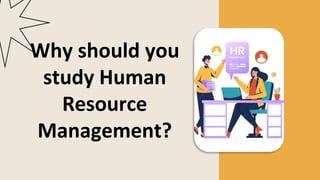
Why should you
study Human
Resource
Management?
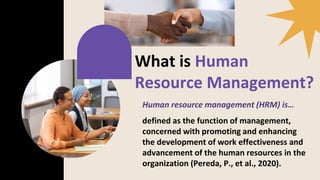
What is Human
Resource Management?
Human resource management (HRM) is…
defined as the function of management,
concerned with promoting and enhancing
the development of work effectiveness and
advancement of the human resources in the
organization (Pereda, P., et al., 2020).
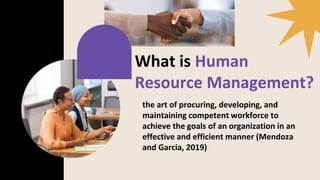
What is Human
Resource Management?
the art of procuring, developing, and
maintaining competent workforce to
achieve the goals of an organization in an
effective and efficient manner (Mendoza
and Garcia, 2019)
What is Human
Resource Management?
the process of managing human talent to
achieve an organization’s objectives (Snell,
Morris, and Bohlander, 2016)
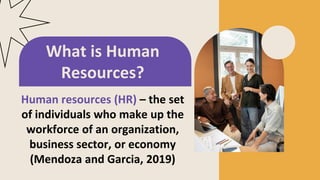
Human resources (HR) – the set
of individuals who make up the
workforce of an organization,
business sector, or economy
(Mendoza and Garcia, 2019)
What is Human
Resources?
Human capital – is the term
used to describe the
employees’ knowledge, skills,
abilities, and other attributes
(KSAOs) that have economic
value to an organization (Snell,
Morris, and Bohlander, 2016).
Human Capital
Human capital is the collective
value of the capabilities,
knowledge, skills, life
experiences, and motivation of
an organization’s workforce
Human Capital
● New field in the Philippines
● Early 1950s - gained acceptance and recognition
● Three conditions for its acceptance and recognition:
➢ Top management must be convinced that personnel management is
needed in its business operations
➢ Qualified personnel administrators must be available
➢ Personnel administrators must demonstrate their capacity to
contribute to company’s objectives and goals achievement.
Growth and Development of
Personnel/Human Resource Management
in the Philippines
01
03
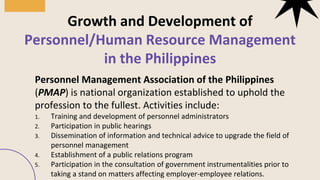
Personnel Management Association of the Philippines
(PMAP) is national organization established to uphold the
profession to the fullest. Activities include:
1. Training and development of personnel administrators
2. Participation in public hearings
3. Dissemination of information and technical advice to upgrade the field of
personnel management
4. Establishment of a public relations program
5. Participation in the consultation of government instrumentalities prior to
taking a stand on matters affecting employer-employee relations.
Growth and Development of
Personnel/Human Resource Management
in the Philippines
01
03
These government Instrumentalities include:
● Department of Labor and Employment (DOLE)
● Employees Compensation Commission (ECC)
● Social Securities System (SSS)
● Technical and Skills Development Administration
(TESDA), and
● Other government agencies.
Growth and Development of
Personnel/Human Resource Management
in the Philippines
01
03
● Human resources are crucial to the long-term survival
of the organization. They are human capital that can be
a source of competitive advantage to an organization.
● The organization is made up of people. The main goal of
any organization is to provide goods and services
effectively. It is the people who offer new ideas,
innovation, skills, and leadership to organizations.
● The effective utilization of manpower can help add and
create value to the organization.
Human Resources and the Organization
1. The Challenge of the Global Community
2. The Stockholders Challenge – meet investors’ and other
stakeholders’ needs.
3. The Challenge for Productivity – The global technology is
increasing. Thus, Human Resources become more “smarter
workers” with the aid of technology to produce high-quality
products.
● Human resource Management must face these challenges to
motivate and develop a well-trained and committed
workforce.
The Challenges of Human Resources
1. Increasing complexity of business operations
2. Government regularizations and labor laws promulgated in
recent years
3. Growth of labor unions – The Industrial Peace Act of 1953 or
the Magna Carta for Labor triggered the organization of labor
unions and strengthening the workers’ bargaining power.
4. Influx of new concepts in management
Contributing Factors to the Growth of
Personnel Management in the
Philippines
Personnel/Human
Resource
Management: A
Science and an Art
HRM: A Science and an Art
● A science because it involves the systematic gathering of
data derived from surveys, interviews, and observations.
● An art is a proficiency in the practical application of
knowledge acquired through study, experience, or
observation.
● HRM is an art because it needs to select the best from among
the alternative solutions. It involves the making of sound
decisions.
● The major tools of the personnel manager as a scientist and
an artist are his creative imagination and intelligence.
Roles and Functions
of an HR
Personnel/Human Resource
Manager
is a member of the top management
responsible for the formulation of
personnel policies and programs
which will facilitate an efficient
personnel administration for
individual and organizational goal
achievement.
HR: Functions
● Help management achieve company goals and objectives;
● Assist managers in formulating sound policies, programs and
rules, and implementing them fairly and efficiently;
● Assist in providing satisfactory work environment and
promote harmonious relationships with the employees and
the unions;
● Make managers and supervisors aware of their full
responsibilities in the management of HR;
● Help train and develop the human resources;
HR: Functions
● Help promote understanding and good relationship through
communication;
● Identify management problems that can be resolved and
opportunities that can be realized;
● Assist managements and supervisors in handling labor
relations and problems;
● Assist the company on promoting good morale and
motivation among its human resources;
● Assist in crisis management and organizational development
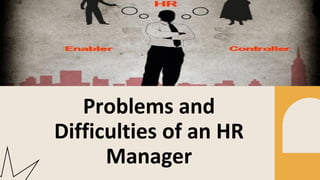
Problems and
Difficulties of an HR
Manager
HR: Problems and Difficulties
● Common misconception about his role and functions
○ Nothing more than a simple clerk
○ Power behind the throne
● Inadequate recognition by management of the proper
role of HR Manager in the organization
● In the area of labor relations – keep the labor unions
out, break or bust it
● Jealousy of other executives regarding his duty and
authority
The Role of HR in the New Millenium Organization
● Recruitment and employment
● Interviewing, testing, recruiting, and temporary employment
● Labor coordination
● Training and development
● Wage and salary administration
● Benefits Administration
● Employee service and recreation
● Community relations
● Record management
● Health and safety
● Strategic management
The Role of HR in the Company
● Supervisor - He plans, organizes, directs, controls, and
coordinates the activities of his departments. He delegates
some of his functions to his subordinates but checks on them
through follow-ups. He manages the work of the employees
in his department and trains them in developing their skills for
efficiency.
● Administrative Official - He or his staff conducts or directs
certain personnel activities as provided in the policies and
programs entrusted to the department. He sees to it that
labor laws and government regulations are properly complied
with. He should also know how a policy is made and
administered.
The Role of HR in the Company
● Adviser - He serves as a counselor, guide, and confidante to
management supervisors and employees. To be competent,
he must keep himself informed about employee attitudes and
behavior and be abreast of trends in the industrial relations
field which may affect his company.
● Coordinator - He brings into action all activities, regulates and
combines diverse efforts into a harmonious whole, and gets
together and harmonizes the work of various personnel in his
department and the related functions in other departments.
The Role of HR in the Company
● Negotiator - He is the representative of the management in
negotiating labor contracts or attending negotiations with
unions in an advisory capacity. As a negotiator and
administrator of the labor contract, he must understand the
nature, significance, and methods of collective bargaining.
● Educator – He conducts or administers the company’s
training program. He is very much involved in the
management of employee development programs of his
company.
The Role of HR in the Company
● Provider of Services - He provides services to all employees
and helps them obtain facilities with government agencies
like SSS, Medicare, etc., which can make their employment
more satisfying.
● Employee counselor - His knowledge and training in human
relations and the behavioral sciences plus his familiarity with
company operations, puts him in the best position to counsel
employees.
The Role of HR in the Company
● Promoter of Community Relations - He must be well
informed of the activities and developments in the
environment where the enterprise operates. He is called by
the management in helping the company project favorable
and positive image to the community.
● Public Relations Man - His functions require him to deal with
the general public, which includes the employees, the unions,
and the community.
Personal qualities of the Personnel Manager
● Effective communicator orally and in writing
● Above-average intelligence
● Enjoys working with people
● Understands a given situation, individual attitudes and the
problems of the employees and of the employer
● Aggressive, mature and capable of giving sound advice
● Has integrity, industry, and courage to earn the respect of the
employees and his employer
● Pleasing personality, personal warmth and approachable.
Skills Needed by Today’s HR Professionals
● A higher degree of knowledge on management practices
and processes.
● A high degree of human and public relations
● A working knowledge of labor laws and regulations
● A thorough knowledge of management
● A good community relations officer
● Knows how to develop greater linkages with government
and other stakeholder linkages
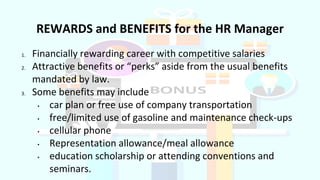
1. Financially rewarding career with competitive salaries
2. Attractive benefits or “perks” aside from the usual benefits
mandated by law.
3. Some benefits may include
• car plan or free use of company transportation
• free/limited use of gasoline and maintenance check-ups
• cellular phone
• Representation allowance/meal allowance
• education scholarship or attending conventions and
seminars.
REWARDS and BENEFITS for the HR Manager
Career Advancement/ Other
Professional Options for the
Personnel Manager?
• College professor
• Vice-president of the company
• Chief executive officer (CEO)
• Politician
• Entrepreneur
• Businessman
• And many more (a career intended for people
who love people)
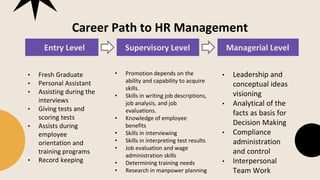
Career Path to HR Management
• Fresh Graduate
• Personal Assistant
• Assisting during the
interviews
• Giving tests and
scoring tests
• Assists during
employee
orientation and
training programs
• Record keeping
• Promotion depends on the
ability and capability to acquire
skills.
• Skills in writing job descriptions,
job analysis, and job
evaluations.
• Knowledge of employee
benefits
• Skills in interviewing
• Skills in interpreting test results
• Job evaluation and wage
administration skills
• Determining training needs
• Research in manpower planning
• Leadership and
conceptual ideas
visioning
• Analytical of the
facts as basis for
Decision Making
• Compliance
administration
and control
• Interpersonal
Team Work
Entry Level Supervisory Level Managerial Level
● Gaining competitive advantage through productive and
committed personnel
● The change in personnel values and orientation should
match the changes in technology
● Putting greater effort towards accelerating and retaining
talented personnel.
● Employees should be empowered toward productive
endeavor
● More productive efforts toward properly compensated
manpower resources
The Changing Landscape in HRM
Slidesgo
Flaticon Freepik
CREDITS: This presentation template was created by Slidesgo,
including icons by Flaticon and infographics & images by Freepik
Thanks!
● Instructions: Please form a team of 5 members. Please read and analyze the
case study as a team of consultants hired by the company. Your analysis should
use the format outlined below:
● Problem (State the problem in the case)
● Case Facts (Write a short paragraph of the facts given in the case)
● Analysis (Write bulleted statements of your analysis)
● Alternative Courses of Action (As hired consultants, propose three alternatives
or options that the company can do to solve the problem with the new HR
manager. Give the advantages and disadvantages of each alternative)
● Recommendation and Conclusion (Recommend which one from the three
options or alternatives your group proposed is the most appropriate. Justify
your choice).
● Implementation Plan (Give three to four steps or procedures you will take to put
into action your recommendation).
CASE STUDY: The New Human Resource Manager

Chapter 1 The Development of Human Resources.pdf

  • 1.
    THE DEVELOPMENT OF HUMANRESOURCES CHAPTER 1
  • 2.
    ● Define HumanResource Management; ● Discuss why Human Resource Management is both a science and an art; ● Explain and differentiate the different roles of the Human Resource Manager and his functions; ● Discuss the importance of the Human Resource Manager in a business and his major contribution toward the development of the organization; and ● Explain the career development of a Human Resource Manager. Learning Objectives:
  • 3.
    Why should you studyHuman Resource Management?
  • 4.
    What is Human ResourceManagement? Human resource management (HRM) is… defined as the function of management, concerned with promoting and enhancing the development of work effectiveness and advancement of the human resources in the organization (Pereda, P., et al., 2020).
  • 5.
    What is Human ResourceManagement? the art of procuring, developing, and maintaining competent workforce to achieve the goals of an organization in an effective and efficient manner (Mendoza and Garcia, 2019)
  • 6.
    What is Human ResourceManagement? the process of managing human talent to achieve an organization’s objectives (Snell, Morris, and Bohlander, 2016)
  • 7.
    Human resources (HR)– the set of individuals who make up the workforce of an organization, business sector, or economy (Mendoza and Garcia, 2019) What is Human Resources?
  • 8.
    Human capital –is the term used to describe the employees’ knowledge, skills, abilities, and other attributes (KSAOs) that have economic value to an organization (Snell, Morris, and Bohlander, 2016). Human Capital
  • 9.
    Human capital isthe collective value of the capabilities, knowledge, skills, life experiences, and motivation of an organization’s workforce Human Capital
  • 10.
    ● New fieldin the Philippines ● Early 1950s - gained acceptance and recognition ● Three conditions for its acceptance and recognition: ➢ Top management must be convinced that personnel management is needed in its business operations ➢ Qualified personnel administrators must be available ➢ Personnel administrators must demonstrate their capacity to contribute to company’s objectives and goals achievement. Growth and Development of Personnel/Human Resource Management in the Philippines 01 03
  • 11.
    Personnel Management Associationof the Philippines (PMAP) is national organization established to uphold the profession to the fullest. Activities include: 1. Training and development of personnel administrators 2. Participation in public hearings 3. Dissemination of information and technical advice to upgrade the field of personnel management 4. Establishment of a public relations program 5. Participation in the consultation of government instrumentalities prior to taking a stand on matters affecting employer-employee relations. Growth and Development of Personnel/Human Resource Management in the Philippines 01 03
  • 12.
    These government Instrumentalitiesinclude: ● Department of Labor and Employment (DOLE) ● Employees Compensation Commission (ECC) ● Social Securities System (SSS) ● Technical and Skills Development Administration (TESDA), and ● Other government agencies. Growth and Development of Personnel/Human Resource Management in the Philippines 01 03
  • 13.
    ● Human resourcesare crucial to the long-term survival of the organization. They are human capital that can be a source of competitive advantage to an organization. ● The organization is made up of people. The main goal of any organization is to provide goods and services effectively. It is the people who offer new ideas, innovation, skills, and leadership to organizations. ● The effective utilization of manpower can help add and create value to the organization. Human Resources and the Organization
  • 14.
    1. The Challengeof the Global Community 2. The Stockholders Challenge – meet investors’ and other stakeholders’ needs. 3. The Challenge for Productivity – The global technology is increasing. Thus, Human Resources become more “smarter workers” with the aid of technology to produce high-quality products. ● Human resource Management must face these challenges to motivate and develop a well-trained and committed workforce. The Challenges of Human Resources
  • 15.
    1. Increasing complexityof business operations 2. Government regularizations and labor laws promulgated in recent years 3. Growth of labor unions – The Industrial Peace Act of 1953 or the Magna Carta for Labor triggered the organization of labor unions and strengthening the workers’ bargaining power. 4. Influx of new concepts in management Contributing Factors to the Growth of Personnel Management in the Philippines
  • 16.
  • 17.
    HRM: A Scienceand an Art ● A science because it involves the systematic gathering of data derived from surveys, interviews, and observations. ● An art is a proficiency in the practical application of knowledge acquired through study, experience, or observation. ● HRM is an art because it needs to select the best from among the alternative solutions. It involves the making of sound decisions. ● The major tools of the personnel manager as a scientist and an artist are his creative imagination and intelligence.
  • 18.
  • 19.
    Personnel/Human Resource Manager is amember of the top management responsible for the formulation of personnel policies and programs which will facilitate an efficient personnel administration for individual and organizational goal achievement.
  • 20.
    HR: Functions ● Helpmanagement achieve company goals and objectives; ● Assist managers in formulating sound policies, programs and rules, and implementing them fairly and efficiently; ● Assist in providing satisfactory work environment and promote harmonious relationships with the employees and the unions; ● Make managers and supervisors aware of their full responsibilities in the management of HR; ● Help train and develop the human resources;
  • 21.
    HR: Functions ● Helppromote understanding and good relationship through communication; ● Identify management problems that can be resolved and opportunities that can be realized; ● Assist managements and supervisors in handling labor relations and problems; ● Assist the company on promoting good morale and motivation among its human resources; ● Assist in crisis management and organizational development
  • 22.
  • 23.
    HR: Problems andDifficulties ● Common misconception about his role and functions ○ Nothing more than a simple clerk ○ Power behind the throne ● Inadequate recognition by management of the proper role of HR Manager in the organization ● In the area of labor relations – keep the labor unions out, break or bust it ● Jealousy of other executives regarding his duty and authority
  • 24.
    The Role ofHR in the New Millenium Organization ● Recruitment and employment ● Interviewing, testing, recruiting, and temporary employment ● Labor coordination ● Training and development ● Wage and salary administration ● Benefits Administration ● Employee service and recreation ● Community relations ● Record management ● Health and safety ● Strategic management
  • 25.
    The Role ofHR in the Company ● Supervisor - He plans, organizes, directs, controls, and coordinates the activities of his departments. He delegates some of his functions to his subordinates but checks on them through follow-ups. He manages the work of the employees in his department and trains them in developing their skills for efficiency. ● Administrative Official - He or his staff conducts or directs certain personnel activities as provided in the policies and programs entrusted to the department. He sees to it that labor laws and government regulations are properly complied with. He should also know how a policy is made and administered.
  • 26.
    The Role ofHR in the Company ● Adviser - He serves as a counselor, guide, and confidante to management supervisors and employees. To be competent, he must keep himself informed about employee attitudes and behavior and be abreast of trends in the industrial relations field which may affect his company. ● Coordinator - He brings into action all activities, regulates and combines diverse efforts into a harmonious whole, and gets together and harmonizes the work of various personnel in his department and the related functions in other departments.
  • 27.
    The Role ofHR in the Company ● Negotiator - He is the representative of the management in negotiating labor contracts or attending negotiations with unions in an advisory capacity. As a negotiator and administrator of the labor contract, he must understand the nature, significance, and methods of collective bargaining. ● Educator – He conducts or administers the company’s training program. He is very much involved in the management of employee development programs of his company.
  • 28.
    The Role ofHR in the Company ● Provider of Services - He provides services to all employees and helps them obtain facilities with government agencies like SSS, Medicare, etc., which can make their employment more satisfying. ● Employee counselor - His knowledge and training in human relations and the behavioral sciences plus his familiarity with company operations, puts him in the best position to counsel employees.
  • 29.
    The Role ofHR in the Company ● Promoter of Community Relations - He must be well informed of the activities and developments in the environment where the enterprise operates. He is called by the management in helping the company project favorable and positive image to the community. ● Public Relations Man - His functions require him to deal with the general public, which includes the employees, the unions, and the community.
  • 30.
    Personal qualities ofthe Personnel Manager ● Effective communicator orally and in writing ● Above-average intelligence ● Enjoys working with people ● Understands a given situation, individual attitudes and the problems of the employees and of the employer ● Aggressive, mature and capable of giving sound advice ● Has integrity, industry, and courage to earn the respect of the employees and his employer ● Pleasing personality, personal warmth and approachable.
  • 31.
    Skills Needed byToday’s HR Professionals ● A higher degree of knowledge on management practices and processes. ● A high degree of human and public relations ● A working knowledge of labor laws and regulations ● A thorough knowledge of management ● A good community relations officer ● Knows how to develop greater linkages with government and other stakeholder linkages
  • 32.
    1. Financially rewardingcareer with competitive salaries 2. Attractive benefits or “perks” aside from the usual benefits mandated by law. 3. Some benefits may include • car plan or free use of company transportation • free/limited use of gasoline and maintenance check-ups • cellular phone • Representation allowance/meal allowance • education scholarship or attending conventions and seminars. REWARDS and BENEFITS for the HR Manager
  • 33.
    Career Advancement/ Other ProfessionalOptions for the Personnel Manager? • College professor • Vice-president of the company • Chief executive officer (CEO) • Politician • Entrepreneur • Businessman • And many more (a career intended for people who love people)
  • 34.
    Career Path toHR Management • Fresh Graduate • Personal Assistant • Assisting during the interviews • Giving tests and scoring tests • Assists during employee orientation and training programs • Record keeping • Promotion depends on the ability and capability to acquire skills. • Skills in writing job descriptions, job analysis, and job evaluations. • Knowledge of employee benefits • Skills in interviewing • Skills in interpreting test results • Job evaluation and wage administration skills • Determining training needs • Research in manpower planning • Leadership and conceptual ideas visioning • Analytical of the facts as basis for Decision Making • Compliance administration and control • Interpersonal Team Work Entry Level Supervisory Level Managerial Level
  • 35.
    ● Gaining competitiveadvantage through productive and committed personnel ● The change in personnel values and orientation should match the changes in technology ● Putting greater effort towards accelerating and retaining talented personnel. ● Employees should be empowered toward productive endeavor ● More productive efforts toward properly compensated manpower resources The Changing Landscape in HRM
  • 36.
    Slidesgo Flaticon Freepik CREDITS: Thispresentation template was created by Slidesgo, including icons by Flaticon and infographics & images by Freepik Thanks!
  • 37.
    ● Instructions: Pleaseform a team of 5 members. Please read and analyze the case study as a team of consultants hired by the company. Your analysis should use the format outlined below: ● Problem (State the problem in the case) ● Case Facts (Write a short paragraph of the facts given in the case) ● Analysis (Write bulleted statements of your analysis) ● Alternative Courses of Action (As hired consultants, propose three alternatives or options that the company can do to solve the problem with the new HR manager. Give the advantages and disadvantages of each alternative) ● Recommendation and Conclusion (Recommend which one from the three options or alternatives your group proposed is the most appropriate. Justify your choice). ● Implementation Plan (Give three to four steps or procedures you will take to put into action your recommendation). CASE STUDY: The New Human Resource Manager