ORGANIZATIONAL BEHAVIOR
1–1
Meaning of organization
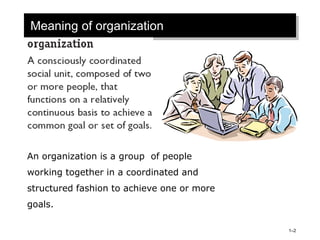
An organization is a group of people
working together in a coordinated and
structured fashion to achieve one or more
goals.
1–2
What are organisations?
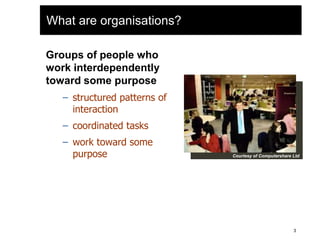
Groups of people who
work interdependently
toward some purpose
– structured patterns of
interaction
– coordinated tasks
– work toward some
purpose Courtesy of Computershare Ltd
3
Organizations and Management
 Organizations use management to accomplish the work that is
required to achieve the goals.
 Management is a process of planning, decision making,
organizing, leading, motivation and controlling the human
resources, financial, physical, and information resources of an
organization to reach its goals efficiently and effectively.
 Management involves coordinating and overseeing the work
activities of others so that their activities are completed
efficiently and effectively.
1–4
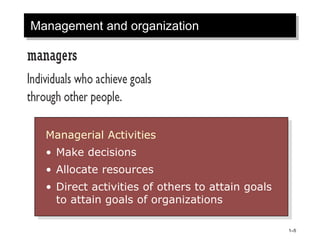
Management and organization
Managerial Activities
• Make decisions
• Allocate resources
• Direct activities of others to attain goals
to attain goals of organizations
1–5
1–6
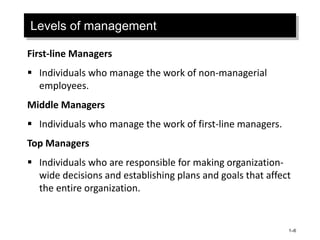
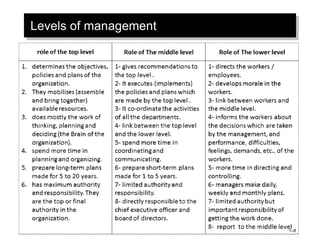
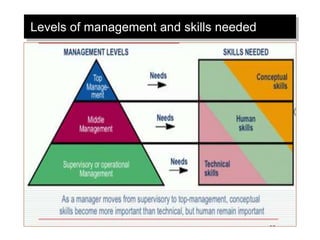
Levels of management
First-line Managers
 Individuals who manage the work of non-managerial
employees.
Middle Managers
 Individuals who manage the work of first-line managers.
Top Managers
 Individuals who are responsible for making organization-
wide decisions and establishing plans and goals that affect
the entire organization.
1–7
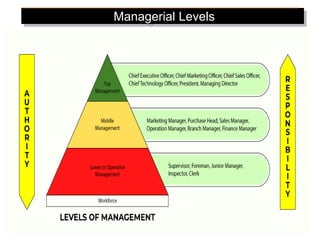
Managerial Levels
Levels of management
1–8
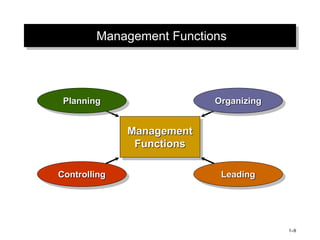
Management Functions
Management
Functions
Planning Organizing
Leading
Controlling
1–9
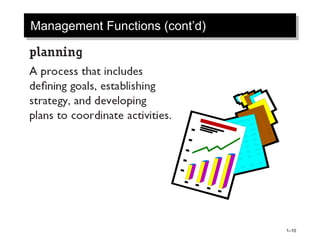
Management Functions (cont’d)
1–10
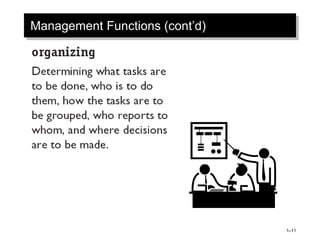
Management Functions (cont’d)
1–11
Management Functions (cont’d)
1–12
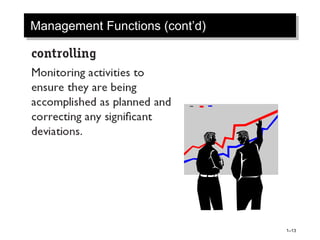
Management Functions (cont’d)
1–13
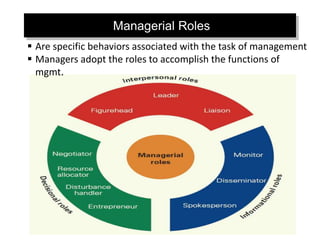
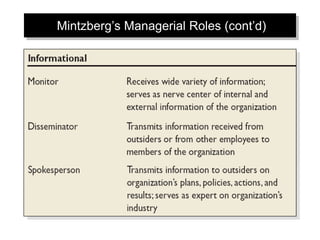
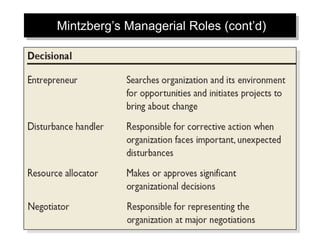
Managerial Roles
1–14
 Are specific behaviors associated with the task of management
 Managers adopt the roles to accomplish the functions of
mgmt.
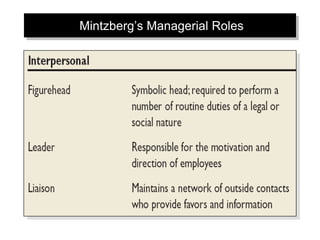
Mintzberg’s Managerial Roles
Mintzberg’s Managerial Roles (cont’d)
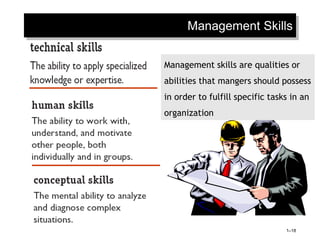
Management Skills
1–18
Management skills are qualities or
abilities that mangers should possess
in order to fulfill specific tasks in an
organization
Levels of management and skills needed
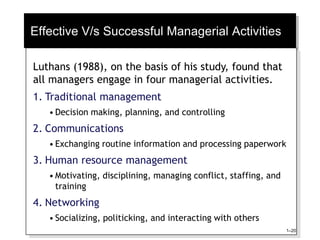
Effective V/s Successful Managerial Activities
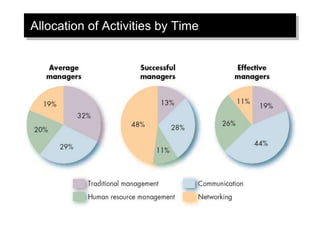
Luthans (1988), on the basis of his study, found that
all managers engage in four managerial activities.
1. Traditional management
• Decision making, planning, and controlling
2. Communications
• Exchanging routine information and processing paperwork
3. Human resource management
• Motivating, disciplining, managing conflict, staffing, and
training
4. Networking
• Socializing, politicking, and interacting with others
1–20
Allocation of Activities by Time
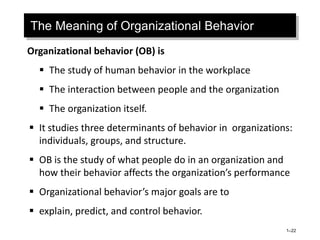
The Meaning of Organizational Behavior
Organizational behavior (OB) is
 The study of human behavior in the workplace
 The interaction between people and the organization
 The organization itself.
 It studies three determinants of behavior in organizations:
individuals, groups, and structure.
 OB is the study of what people do in an organization and
how their behavior affects the organization’s performance
 Organizational behavior’s major goals are to
 explain, predict, and control behavior.
1–22
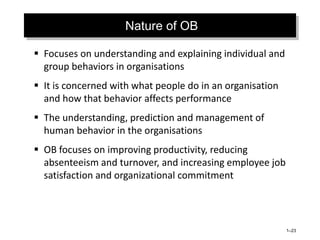
Nature of OB
 Focuses on understanding and explaining individual and
group behaviors in organisations
 It is concerned with what people do in an organisation
and how that behavior affects performance
 The understanding, prediction and management of
human behavior in the organisations
 OB focuses on improving productivity, reducing
absenteeism and turnover, and increasing employee job
satisfaction and organizational commitment
1–23
Enter Organizational Behavior
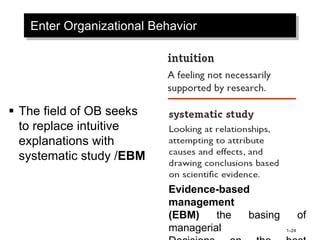
 The field of OB seeks
to replace intuitive
explanations with
systematic study /EBM
Evidence-based
management
(EBM) the basing of
managerial 1–24
 Why Do We Study OB?
 To learn about yourself and others
 To understand how the many organizations you encounter
work.
 To become familiar with team work
 To help you think about the people issues faced by
managers and entrepreneurs
1–25
OB includes
Core topics in OB
 Motivation
 Leader behavior and power
 Interpersonal communication
 Group structure and processes
 Learning
 Attitude development and perception
 Change processes
 Conflict
 Work design
 Work stress
1–26
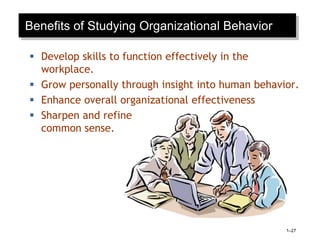
Benefits of Studying Organizational Behavior
 Develop skills to function effectively in the
workplace.
 Grow personally through insight into human behavior.
 Enhance overall organizational effectiveness
 Sharpen and refine
common sense.
1–27
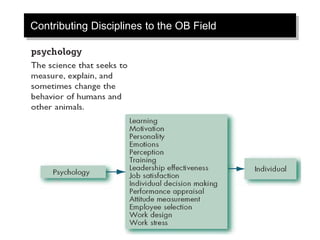
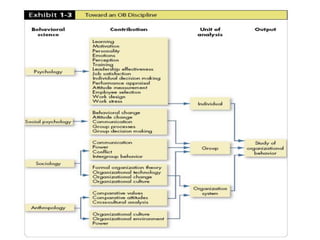
Contributing Disciplines to the OB Field
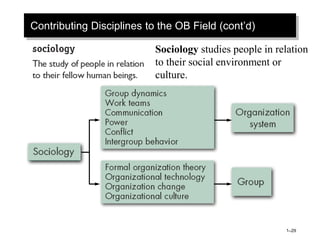
Contributing Disciplines to the OB Field (cont’d)
Sociology studies people in relation
to their social environment or
culture.
1–29
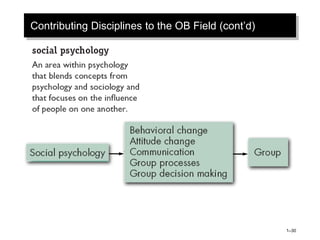
Contributing Disciplines to the OB Field (cont’d)
1–30
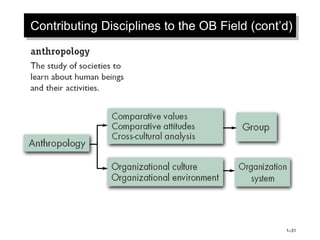
Contributing Disciplines to the OB Field (cont’d)
1–31
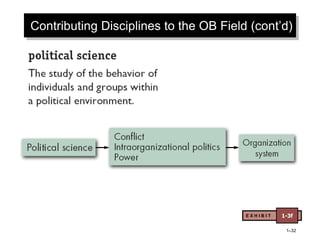
Contributing Disciplines to the OB Field (cont’d)
E X H I B I T 1-3f
1–32
Principles in OB
 Impossible to make simple and accurate generalizations
 Human beings are complex and diverse
 OB concepts must reflect situational conditions: Contingency
variables
1–34
There Are Few Absolutes in OB
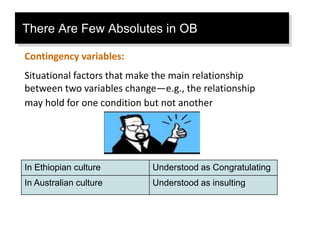
Contingency variables:
Situational factors that make the main relationship
between two variables change—e.g., the relationship
may hold for one condition but not another
In Ethiopian culture Understood as Congratulating
In Australian culture Understood as insulting
Dependent and independent variables in OB
1–36
 A dependent variable is the key factor that is explained
or predicted by some other (independent) factor.
 The key dependent variables in the model of
organizational behaviour are
• Productivity
• Absenteeism
• Turnover
• Deviant workplace behaviour
• Organizational citizenship behaviour, and
• Job satisfaction.
 Independent variables are those factors that are
directly related to the organization and determine its
overall success.
 Independent variables occur at the level of
• Individual
• Group, And
• Organization
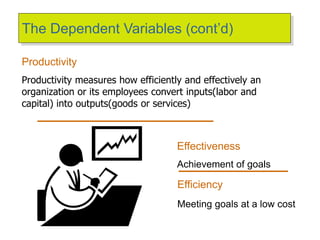
The Dependent Variables (cont’d)
Productivity
Productivity measures how efficiently and effectively an
organization or its employees convert inputs(labor and
capital) into outputs(goods or services)
Effectiveness
Achievement of goals
Efficiency
Meeting goals at a low cost
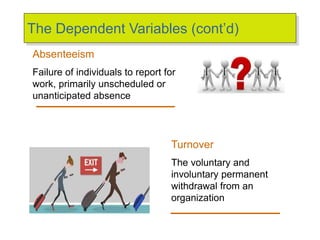
The Dependent Variables (cont’d)
Absenteeism
Failure of individuals to report for
work, primarily unscheduled or
unanticipated absence
Turnover
The voluntary and
involuntary permanent
withdrawal from an
organization
The Dependent Variables (cont’d)
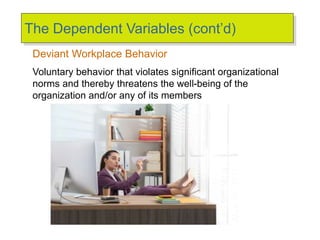
Deviant Workplace Behavior
Voluntary behavior that violates significant organizational
norms and thereby threatens the well-being of the
organization and/or any of its members
The Dependent Variables (cont’d)
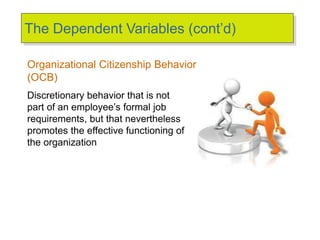
Organizational Citizenship Behavior
(OCB)
Discretionary behavior that is not
part of an employee’s formal job
requirements, but that nevertheless
promotes the effective functioning of
the organization
The Dependent Variables (cont’d)
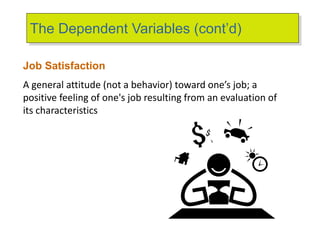
Job Satisfaction
A general attitude (not a behavior) toward one’s job; a
positive feeling of one's job resulting from an evaluation of
its characteristics
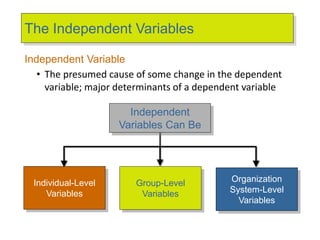
The Independent Variables
Independent
Variables Can Be
Individual-Level
Variables
Organization
System-Level
Variables
Group-Level
Variables
Independent Variable
• The presumed cause of some change in the dependent
variable; major determinants of a dependent variable
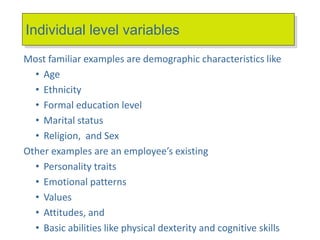
Individual level variables
Most familiar examples are demographic characteristics like
• Age
• Ethnicity
• Formal education level
• Marital status
• Religion, and Sex
Other examples are an employee’s existing
• Personality traits
• Emotional patterns
• Values
• Attitudes, and
• Basic abilities like physical dexterity and cognitive skills
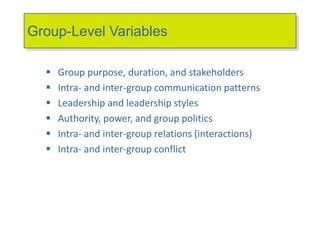
Group-Level Variables
 Group purpose, duration, and stakeholders
 Intra- and inter-group communication patterns
 Leadership and leadership styles
 Authority, power, and group politics
 Intra- and inter-group relations (interactions)
 Intra- and inter-group conflict
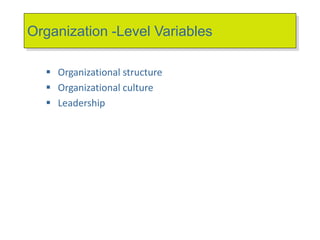
Organization -Level Variables
 Organizational structure
 Organizational culture
 Leadership
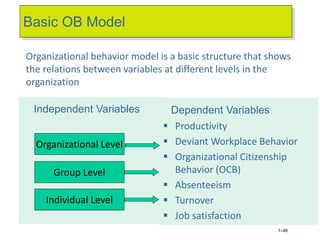
Basic OB Model
Independent Variables Dependent Variables
 Productivity
 Deviant Workplace Behavior
 Organizational Citizenship
Behavior (OCB)
 Absenteeism
 Turnover
 Job satisfaction
Organizational Level
Group Level
Individual Level
1–46
Organizational behavior model is a basic structure that shows
the relations between variables at different levels in the
organization

OB chapter 1 ppt.ppt

  • 1.
  • 2.
    Meaning of organization Anorganization is a group of people working together in a coordinated and structured fashion to achieve one or more goals. 1–2
  • 3.
    What are organisations? Groupsof people who work interdependently toward some purpose – structured patterns of interaction – coordinated tasks – work toward some purpose Courtesy of Computershare Ltd 3
  • 4.
    Organizations and Management Organizations use management to accomplish the work that is required to achieve the goals.  Management is a process of planning, decision making, organizing, leading, motivation and controlling the human resources, financial, physical, and information resources of an organization to reach its goals efficiently and effectively.  Management involves coordinating and overseeing the work activities of others so that their activities are completed efficiently and effectively. 1–4
  • 5.
    Management and organization ManagerialActivities • Make decisions • Allocate resources • Direct activities of others to attain goals to attain goals of organizations 1–5
  • 6.
    1–6 Levels of management First-lineManagers  Individuals who manage the work of non-managerial employees. Middle Managers  Individuals who manage the work of first-line managers. Top Managers  Individuals who are responsible for making organization- wide decisions and establishing plans and goals that affect the entire organization.
  • 7.
  • 8.
  • 9.
  • 10.
  • 11.
  • 12.
  • 13.
  • 14.
    Managerial Roles 1–14  Arespecific behaviors associated with the task of management  Managers adopt the roles to accomplish the functions of mgmt.
  • 15.
  • 16.
  • 17.
  • 18.
    Management Skills 1–18 Management skillsare qualities or abilities that mangers should possess in order to fulfill specific tasks in an organization
  • 19.
    Levels of managementand skills needed
  • 20.
    Effective V/s SuccessfulManagerial Activities Luthans (1988), on the basis of his study, found that all managers engage in four managerial activities. 1. Traditional management • Decision making, planning, and controlling 2. Communications • Exchanging routine information and processing paperwork 3. Human resource management • Motivating, disciplining, managing conflict, staffing, and training 4. Networking • Socializing, politicking, and interacting with others 1–20
  • 21.
  • 22.
    The Meaning ofOrganizational Behavior Organizational behavior (OB) is  The study of human behavior in the workplace  The interaction between people and the organization  The organization itself.  It studies three determinants of behavior in organizations: individuals, groups, and structure.  OB is the study of what people do in an organization and how their behavior affects the organization’s performance  Organizational behavior’s major goals are to  explain, predict, and control behavior. 1–22
  • 23.
    Nature of OB Focuses on understanding and explaining individual and group behaviors in organisations  It is concerned with what people do in an organisation and how that behavior affects performance  The understanding, prediction and management of human behavior in the organisations  OB focuses on improving productivity, reducing absenteeism and turnover, and increasing employee job satisfaction and organizational commitment 1–23
  • 24.
    Enter Organizational Behavior The field of OB seeks to replace intuitive explanations with systematic study /EBM Evidence-based management (EBM) the basing of managerial 1–24
  • 25.
     Why DoWe Study OB?  To learn about yourself and others  To understand how the many organizations you encounter work.  To become familiar with team work  To help you think about the people issues faced by managers and entrepreneurs 1–25
  • 26.
    OB includes Core topicsin OB  Motivation  Leader behavior and power  Interpersonal communication  Group structure and processes  Learning  Attitude development and perception  Change processes  Conflict  Work design  Work stress 1–26
  • 27.
    Benefits of StudyingOrganizational Behavior  Develop skills to function effectively in the workplace.  Grow personally through insight into human behavior.  Enhance overall organizational effectiveness  Sharpen and refine common sense. 1–27
  • 28.
  • 29.
    Contributing Disciplines tothe OB Field (cont’d) Sociology studies people in relation to their social environment or culture. 1–29
  • 30.
    Contributing Disciplines tothe OB Field (cont’d) 1–30
  • 31.
    Contributing Disciplines tothe OB Field (cont’d) 1–31
  • 32.
    Contributing Disciplines tothe OB Field (cont’d) E X H I B I T 1-3f 1–32
  • 34.
    Principles in OB Impossible to make simple and accurate generalizations  Human beings are complex and diverse  OB concepts must reflect situational conditions: Contingency variables 1–34
  • 35.
    There Are FewAbsolutes in OB Contingency variables: Situational factors that make the main relationship between two variables change—e.g., the relationship may hold for one condition but not another In Ethiopian culture Understood as Congratulating In Australian culture Understood as insulting
  • 36.
    Dependent and independentvariables in OB 1–36  A dependent variable is the key factor that is explained or predicted by some other (independent) factor.  The key dependent variables in the model of organizational behaviour are • Productivity • Absenteeism • Turnover • Deviant workplace behaviour • Organizational citizenship behaviour, and • Job satisfaction.  Independent variables are those factors that are directly related to the organization and determine its overall success.  Independent variables occur at the level of • Individual • Group, And • Organization
  • 37.
    The Dependent Variables(cont’d) Productivity Productivity measures how efficiently and effectively an organization or its employees convert inputs(labor and capital) into outputs(goods or services) Effectiveness Achievement of goals Efficiency Meeting goals at a low cost
  • 38.
    The Dependent Variables(cont’d) Absenteeism Failure of individuals to report for work, primarily unscheduled or unanticipated absence Turnover The voluntary and involuntary permanent withdrawal from an organization
  • 39.
    The Dependent Variables(cont’d) Deviant Workplace Behavior Voluntary behavior that violates significant organizational norms and thereby threatens the well-being of the organization and/or any of its members
  • 40.
    The Dependent Variables(cont’d) Organizational Citizenship Behavior (OCB) Discretionary behavior that is not part of an employee’s formal job requirements, but that nevertheless promotes the effective functioning of the organization
  • 41.
    The Dependent Variables(cont’d) Job Satisfaction A general attitude (not a behavior) toward one’s job; a positive feeling of one's job resulting from an evaluation of its characteristics
  • 42.
    The Independent Variables Independent VariablesCan Be Individual-Level Variables Organization System-Level Variables Group-Level Variables Independent Variable • The presumed cause of some change in the dependent variable; major determinants of a dependent variable
  • 43.
    Individual level variables Mostfamiliar examples are demographic characteristics like • Age • Ethnicity • Formal education level • Marital status • Religion, and Sex Other examples are an employee’s existing • Personality traits • Emotional patterns • Values • Attitudes, and • Basic abilities like physical dexterity and cognitive skills
  • 44.
    Group-Level Variables  Grouppurpose, duration, and stakeholders  Intra- and inter-group communication patterns  Leadership and leadership styles  Authority, power, and group politics  Intra- and inter-group relations (interactions)  Intra- and inter-group conflict
  • 45.
    Organization -Level Variables Organizational structure  Organizational culture  Leadership
  • 46.
    Basic OB Model IndependentVariables Dependent Variables  Productivity  Deviant Workplace Behavior  Organizational Citizenship Behavior (OCB)  Absenteeism  Turnover  Job satisfaction Organizational Level Group Level Individual Level 1–46 Organizational behavior model is a basic structure that shows the relations between variables at different levels in the organization