UHIS
1022
FALSAFAH
SEMASA
DAN
ISU
COURSE OUTCOMES
3
2
1
4
.
.
Explain definitions, meanings, concepts, goals and history
development of Philosophy
Analyze the relationship between National Philosophy of
Education and National Pillars in the Philosophy of Well-
Being using the Philosophical Approach
Explaining the role of the National Philosophy of Education as a vehicle for
preparing students to face the 21st century global challenges
Describe the position and role of the National Pillars as the Pillars or the
Pillars of the "Macro" level established under the principles or policies
of the National Education Philosophy as "Micro"
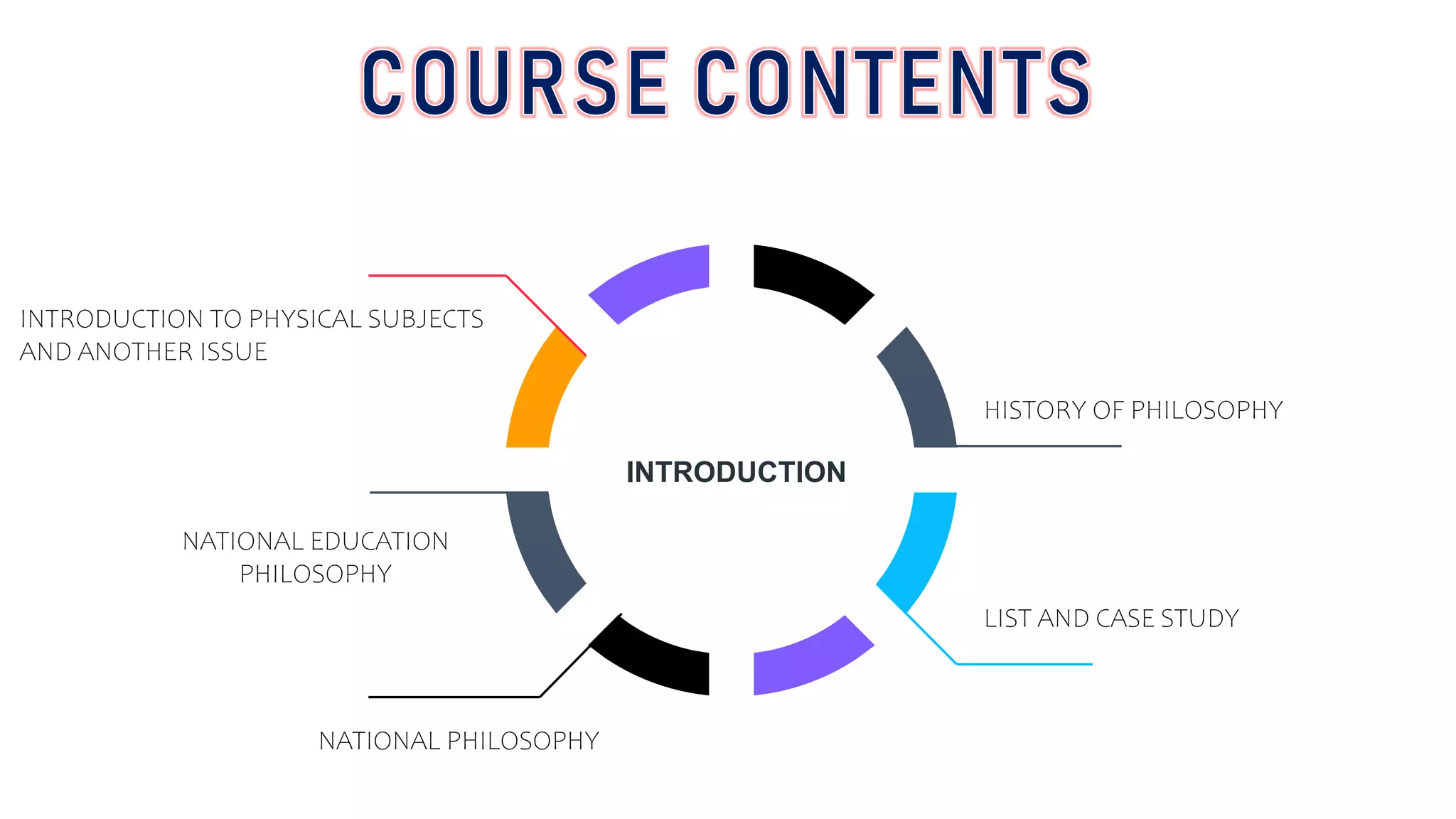
INTRODUCTION
INTRODUCTION TO PHYSICAL SUBJECTS
AND ANOTHER ISSUE
NATIONAL EDUCATION
PHILOSOPHY
NATIONAL PHILOSOPHY
HISTORY OF PHILOSOPHY
LIST AND CASE STUDY
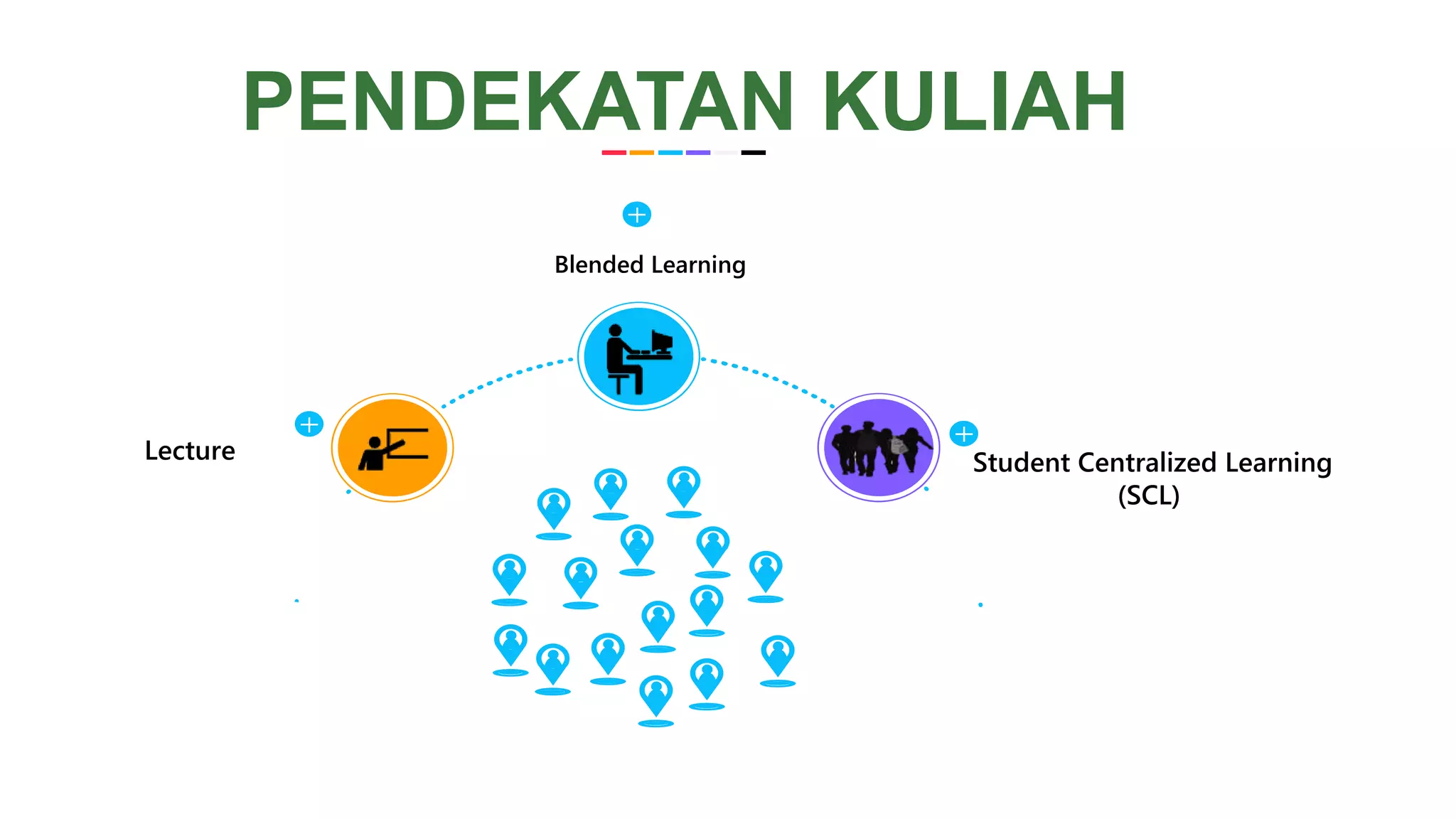
PENDEKATAN KULIAH
Lecture
Blended Learning
Student Centralized Learning
(SCL)
INTRODUCTION
PLEASE KNOW THERE IN THE CLASS.
SONG TITLE: “LOVED”
youtube.com/watch?v=1iLuUL07eVk
For the sake of your beloved country In rich loyalty
To the leaders of the people The service is given in
full cooperation In the pursuit of Faith serving all
Whatever sacrifices the trust of the nation preserves
We pledge our allegiance To religion, nation and
nation
OBJECTIVE
1. Explain the importance of the subject of 'Current
Philosophy and Issues' in the formation of Malaysia
(plural, other than other countries)
2. Explaining the role of the National Philosophy of
Education as a vehicle for preparing Students to face the
21st century global challenges
3. Analyze the relationship between the National
Philosophy of Education and the National Pillars
Introduce students to a stream
of classical and modern
philosophical thinking
Associate current
thinking with classical
philosophy.
Establish the right way
of thinking in the
formation of Malaysia.
The importance of the
subject of Philosophy
and Current Issues
(UHIS)
PHILOSOPHYOFSTATEEDUCATION
/NATIONALEDUCATION PHILOSOPHY
PILLARSOFTHECOUNTRY
IMPLEMENTATION
OF PHILOSOPHY IN
MALAYSIA
to organize,
coordinate and
facilitate the
educational process
SUPPORTEDVALUES
THEENDGOALOFEDUCATION
THEPATHTOTHATGOAL
EXPLAININGTHEPHILOSOPHYOFEDUCATION
THEFUNCTIONOFTHEPHILOSOPHYOFEDUCATIONINGENERAL
UNDERSTANDEDUCATIONINRIGHTCONTEXT
ANALYZECONCEPTSANDSTUDYOFEDUCATION
CRITICALEDUCATIONANDEDUCATIONFACTS
DEVELOPINGTHEBASISOFEDUCATIONIN
SELECTION,CONTINUINGANDDECISINGDECISION
ASSESSTHECHANGEINPOLICY
GUIDETEACHERS’ATTITUDE
INCREASEINDIALOGUEANDINQUIRY
EXPLAININGFUNCTIONSAND
CONFLICTSINEDUCATION
PROVIDENEWIDEA
THEFUNCTIONOFTHEPHILOSOPHYOFEDUCATIONINGENERAL
01
02
03
04
05
06
INSPIRATION
RATIONALDISCUSSION
EMPIRICALEVIDENCE
INTRODUCTION,VALUESAND
TRADITIONOFTHESOCIETY
RESEARCH
• Study similar Nations
• STUDY ABOUT TEACHING AND LEARNING
AUTHORITY
SOURCEOFTHEPHILOSOPHYOFEDUCATION
HISTORY OF FPN DEVELOPMENT
• BARNES REPORT ON ENGLISH
EDUCATION (1951)
• FENN-WU REPORT ON THE
EDUCATION OF CHINA MALAYA (1951)
1951
• STUDENT ORDINANCE 1952
• RAZAK STATEMENT (1956)
1952 &1956
• STUDENT ORDINANCE (1957)
• RAHMAN TALIB STATEMENT (1960)
1957 &1960
• STUDENT ACT 1961
• CABINET COMMITTEE REPORT 1974
1961 &1974
National Education Philosophy was
APPROVED IN 1987 AND IS
PROVIDED IN 1988 WHEN KBSM
APPLIED.
1987 &1988
NATIONAL PHILOSOPHY OF EDUCATION
1996
NATIONAL EDUCATION PHILOSOPHY
THINK
IDEA
LEARN
ACTIVITIES:
GROUP DISCUSSION
QUESTIONS
• Is FPN / FPK still relevant in the 21st century?
• Is the FPN / FPK equal to the international and
global agenda direction?
• How do FPN / FPK and Malaysia contribute to world
education?
• How relevant is FPN / FPK to IR4.0?
Function of FPN/FPK FOR EACH COUNTRY
• Each country has its own education system / different from other
countries.
• The main function of a national education is to build the human
capital mold that the country needs.
• Example: Malaysia in the next 15 years, what type of state / country
wants to develop
• Therefore, the education system needs to start from now on to form
the future state / type
CONTINUE….
• Another example: An industrial country that requires 1000 engineers,
architects over the next 5 years, it will be organized and broken down into the
appropriate institutions.
• Developing countries, developed countries.
• It can also change based on current needs and future targets.
• Countries that do not have / lack of social problems, so aspects of social
problems are not emphasized in the country's educational philosophy
(Example: Norway / Sweden)
THINK
IDEA
LEARN
ACTIVITY:
GROUP DISCUSSION 2
• Find another country's FPN / FPK.
• Compare the FPN / FPK of the
country with Malaysia
EXAMPLE: Singapore Curriculum Philosophy
Wisdom1 - National Education philosophy
Education in Malaysia is an ongoing (lifelong) effort
towards furthering the holistic potential of
individuals (holistic) and integrated ...
1>
Quality
The whole is greater than the sums
of its part = “complete person.”
DEMAND FOR SCIENCE
(eg. Martial arts)
[ ]
Appreciate
This term of wisdom has been used by
Tan Sri Prof. Dr. Dzulkifli Abdul Razak in
his dissemination of the National
Philosophy of Education on December
10, 2019 in Putrajaya.
2>
HUMANS
&
HARMONY
WISDOM 2 - National Education philosophy
…to create people who are intellectually and
spiritually, emotionally, and physically balanced …
Wisdom 3 - National Education philosophy
based on trust and obedience to God. This effort is to
produce Malaysians who are knowledgeable, skilled,
virtuous, responsible…
3>
HUMANS
&
HARMONY
360 degrees
Wisdom 4 - National Education philosophy
… and the ability to achieve personal well-being,
4>
MIND LINEAGE PROPERTY
SOUL RELIGION
Huraian 5 - National Education philosophy
…serta memberi sumbangan terhadap
keharmonian dan kemakmuran keluarga,
masyarakat dan negara.
5>
MIND LINEAGE PROPERTY
SOUL RELIGION
SOCIETY COMMUNITY COUNTRY
National Education philosophy (5 hikmah)
Education in Malaysia is an ongoing effort to further develop
the potential of a holistic and integrated individual to create
intellectually, spiritually, emotionally and physically balanced
people based on trust and obedience to God. This effort is to
produce Malaysians who are knowledgeable, skilled,
virtuous, responsible and capable of achieving personal well-
being, and contribute to the harmony and prosperity of their
families, communities and country.
(KPM, 1996)
1>
2>
3>
4>
5>
INSAN
SEIMBANG
&
HARMONIS
& 21st Century Education
MIND PROPERTY
SOUL TRUST
…prosperous…
01
BELIEF IN GOD
LOYALTY TO KING AND COUNTRY
02
SUPREMACY OF THE CONSTITUTION
03
RULE OF LAW
04
COURTESY AND MORALITY
05
COUNTRY’S PILLARS
INTRODUCTION TO COUNTRY’S PILLARS
• Malaysia is a multicultural country populated by
people of all races, religions, cultures and customs.
Religious differences, cultural diversity and ethnic
customs are not separate points for the people to
enjoy a harmonious and prosperous life. The success
of the government in developing a progressive
society for the sake of prosperity and political
stability dashed against the wisdom of the leaders to
instill a spirit of unity among the people.
WITHOUTUNITY,THECOUNTRY
WOULDBEWEAKENEDAND
COULDCAUSETHECOUNTRY'S
SOVEREIGNTYTOBE
COMPROMISED,GOVERNMENT
ADMINISTRATIONWOULD
COLLAPSE,CHAOS,RIOTS,CIVIL
STRIFEANDSOON.THEGREAT
PEOPLEOFMALAYSIAARETHE
PEOPLEWHOHOLDTOTHE
DOCTRINEOFTHECOUNTRY’S
PILLARS
Five principles of National
Pillars if appreciated,
practiced and held on a daily
basis can make a person
great and thus strengthen the
country's sovereignty.
ARRIVALOFTHEBRITISH
Policy of racial segregation by place (divide and rule)
1969
The rise of racial tension, the 1969 riots
MAGERAN
Established to address racial tension.
STATECONSULTATION
1970
Declaration of National Security by the YDPA on August 31, 1970.
HISTORY OF THE
FORMATION OFA
STATE OF
HARMONY
HISTORY OF SOCIAL HARMONY
• The arrival of the British colonialists changed the
pattern of society in this country. The management
approach the policies of divide and rule by the
United Colonies of Britain is to maintain the peace of
the manner and their glasses, the three ethnic
groups of Malays, Chinese and Indians have been
separated in terms of housing and work, this
situation led to the relationship between the limited.
This situation is more complex and has created
dissatisfaction among every race.
• Most Malays lived in the countryside and work in
agriculture. The Chinese lived in the city and engaged in
business while the Indians lived and worked in the
estates. Each race is also segregated in terms of education
by having its own stream school without the same
syllabus or curriculum.
• Racial relations were getting worse as political parties
provoke one another leading to quarrels. It became more
serious that it triggered the May 13, 1969. Bloody Events.
As a result, the government has come up with a formula
to tackle racial strife so that it can be prevented and it will
never happen again.
• Following this, the parliamentary system of government
was suspended and the National Movement Council
(MAGERAN) was set up to restore peace, uphold the
laws of the country and foster a sense of harmony and
trust among the multiracial community in the country
• The members of the National Consultative Council
consist of a Chairman (the late Tun Abdul Razak bin Dato
'Hussein and the Director of the Cabinet), three
ministers (the late Tun Dr. Ismail bin Dato' Abdul
Rahman, the late Tun Tan Siew Sin and the late Tun VT
Sambanthan) , representatives of the State Government
and representatives of religious leaders, professional
bodies, civil service, trade unions, journalists, teachers'
associations and representatives of small groups.
• After deliberating and studying it for several months,
the National Consultative Council has concluded that
an ideology that can overcome the racial divide must
be established in this country. Based on this decision,
the birth of the National Assembly declared by His
Majesty the late His Majesty Ismail Nasiruddin Shah
Ibni the late Sultan Zainal Abidin Yang Di-Pertuan
Agong IV on August 31, 1970, coincided with the
13th anniversary of the country's independence.
THEFEDERALCONSTITUTIONPROVIDESTHATISLAMISTHE
OFFICIALRELIGIONOFTHEFEDERATION
DISCRIMINATION AGAINST A CITIZEN FOR RELIGIOUS
REASONS IS STRICTLY PROHIBITED.
OTHERRELIGIONSANDBELIEFSCANBEPRACTICEDSECURELY
ANDPEACEFULLYINANYPARTOFTHEFEDERATION.
THISNATIONANDCOUNTRYISFOUNDEDONASTRONG
BELIEFINGOD.
ABSENCEOFRELIGIONCANUNDERMINEONE'S
PERSONALITYASWELLASTHATOFANATIONAND
COUNTRY.
PILLAR 1:
TRUST IN GOD
EVERYCITIZENSHOULDDEVOTEHIS
ENTIREALLEGIANCE,LOYALTYAND
SINCERITYTOHISMAJESTYTHEKING.
ATTHESTATELEVEL,THEPEOPLEARE
REQUIRED TOFOCUSTHEIRLOYALTYON
THEKINGWHO GOVERNSTHESTATEIN
WHICHTHEYRESIDEWITHOUTREDUCING
LOYALTYTOHISMAJESTYTHEKING.
PILLAR 2:
LOYALTY TO THE
KINGAND THE
COUNTRY
ITSFUNCTIONISTOPROVIDEPROTECTIONTOEVERYCITIZENOF
THISCOUNTRYFORTHEIRRIGHTSANDPRIVILEGESASCITIZENS
EVERYCITIZENOFMALAYSIAISREQUIREDTORESPECT,
APPRECIATE,UNDERSTANDTHEMEANINGANDCONTENTAND
HISTORICALBACKGROUND.
THECONSTITUTIONOFTHISCOUNTRYHASBEENFORMULATEDON
THEBASISOFALLPEOPLESANDALLPARTIESINTHISCOUNTRY.
ITISASOCIALCONTRACTOFTHEPEOPLETHATCANNOTBE
QUESTIONEDANDCHALLENGEDBYANYINDIVIDUALORPARTY.
ITISASOURCEOFREFERENCEONALLMATTERSPERTAININGTO
THESYSTEMOFGOVERNMENT,LEGISLATION,POSITIONAND
SOCIALRIGHTSOFTHEPEOPLE.
PILLAR 3:
CONSTITUTIONAL
SUPREMACY
ENSURINGTHELIVESOFMEMBERSOFTHECOMMUNITY
CANBESMOOTHANDORDERLYWITHOUTANYHASSLE,
MAKINGALLMEMBERSOFTHECOMMUNITYFEELSAFE.
THERIGHTSOFTHEPEOPLECANBEFREELYEXERCISED
ASLONGASTHEYDONOTVIOLATETHELAWANDTHINGS
ASGUARANTEEDBYTHECONSTITUTION
THERIGHTSANDFREEDOMSGUARANTEEDBYTHE
CONSTITUTIONDONOTINCLUDETHERIGHTTOOVERTHROW
THEGOVERNMENTEITHERBYVIOLENCEORINWAYSTHAT
ARENOTINACCORDANCEWITHTHECONSTITUTION.
PILLAR 4:
THE RULE OF LAW
FORMACITIZENOFGOODMANNERSANDMORALSINLINEWITHTHE
CAMPAIGNOFDIVERSITYANDPUREVALUES.ETHICSANDETHICAL
INDIVIDUALSAREVERYIMPORTANTINTHECONTEXTOFMULTI-
RACIALRELATIONSINTHISCOUNTRY
CURSINGBEHAVIORORARROGANTBEHAVIOROROFFENDING
SOMEONEORAGROUP.
THEPRINCIPLEISTHATTHEBEHAVIOROFTHEPEOPLESHOULD
ALWAYSBEMAINTAINEDANDDEVELOPEDINACCORDANCEWITH
THEPEOPLE'SPERSONALITYANDVALUES.
MODESTYANDDECENCYCANBESEENINONE'SBEHAVIORAND
SPEECH.
ESTABLISHADISCIPLINEDANDMORALINDIVIDUALWHOWILLHELP
TOCREATEAGOOD,ETHICAL,ETHICALANDETHICALSOCIETYAND
TOCREATEAHARMONIOUSANDUNITEDMALAYSIANSOCIETY.
PILLAR 5:
MODESTYAND
MORALITY
RACIALUNITYISASOLID
FOUNDATIONANDAN
IMPORTANTGOALTHATALL
COUNTRIES,INCLUDING
MALAYSIA,WANTTOACHIEVE.IT
ISIMPORTANTBECAUSE
WITHOUTUNITY,ACOUNTRY
CANBECOMEWEAK,DIFFICULT
TODEVELOPANDVULNERABLE
TOBOTHFOREIGNAND
DOMESTICPOWER.
The Pillars of the Nation were
created in the wake of the events of
May 13, 1969. The tragedy opened
our eyes and alerted all of us to the
importance of being united and
living in peace and peace and
avoiding suspicious suspicions of
one another.
United
goodwill regardless
of race
treat each other with
respect
PRACTICINGTHEPILLARSOFTHECOUNTRYWILLGIVEBIRTHTOASOCIETY
01 02
03
Enhanceandintensifythe
competitivenessofeconomicgrowth
Maintainingpoliticalstability
based on the mold set out in the
Pillars of the Country.
maintainingademocraticsystemof
government
THROUGHSUSTAINABLEUNITY
WILLHELPTHECOUNTRY
RELATIONSHIP BETWEEN:
I. PHILOSOPHY OF NATIONAL EDUCATION
II. STATE ORDER
III.APHILOSOPHY OF PROSPERITY
HISTORY
DIRI
FAMILY
MASYAR
AKAT
Country
intellectual
ethical
spiritual
cultural
cognitive
societal
economics
physico
-psycho
-logical
the
model
sejahtera
FPK
1-berterusan
2-menyeluruh
3-bersepadu
ecology
microcosm
macrocosm
emotional
FPN
RN
FS
PHILOSOPHY OF HISTORY AS A
NATIONAL INTERPRETATION
CONCLUSION
• The main goals of the FPN / FPN and the pillars of the country are for
the well-being of individuals, families, communities, countries and the
world.
REFERENCE
• Wan Abdul Halim Yaakub (ed). Rukun Negara. Jabatan Perpaduan
Negara dan Jabatan Penerangan Malaysia.
• Wan Mohd Zahid Mohd Noordin. 2019. Falsafah Pendidikan
Kebangsaan: Sejarah dan Matlamat, dalam Dzulkifli Abdul Razak dan
Rosnani Hashim, Pentafsiran Baharu Falsafah Pendidikan Kebangsaan
dan Pelaksanaannya Pasca 2020. Kuala Lumpur: IIUM Press, 3-20.
TERIMA KASIH

Chapter 01 - Introduction (1).pptx