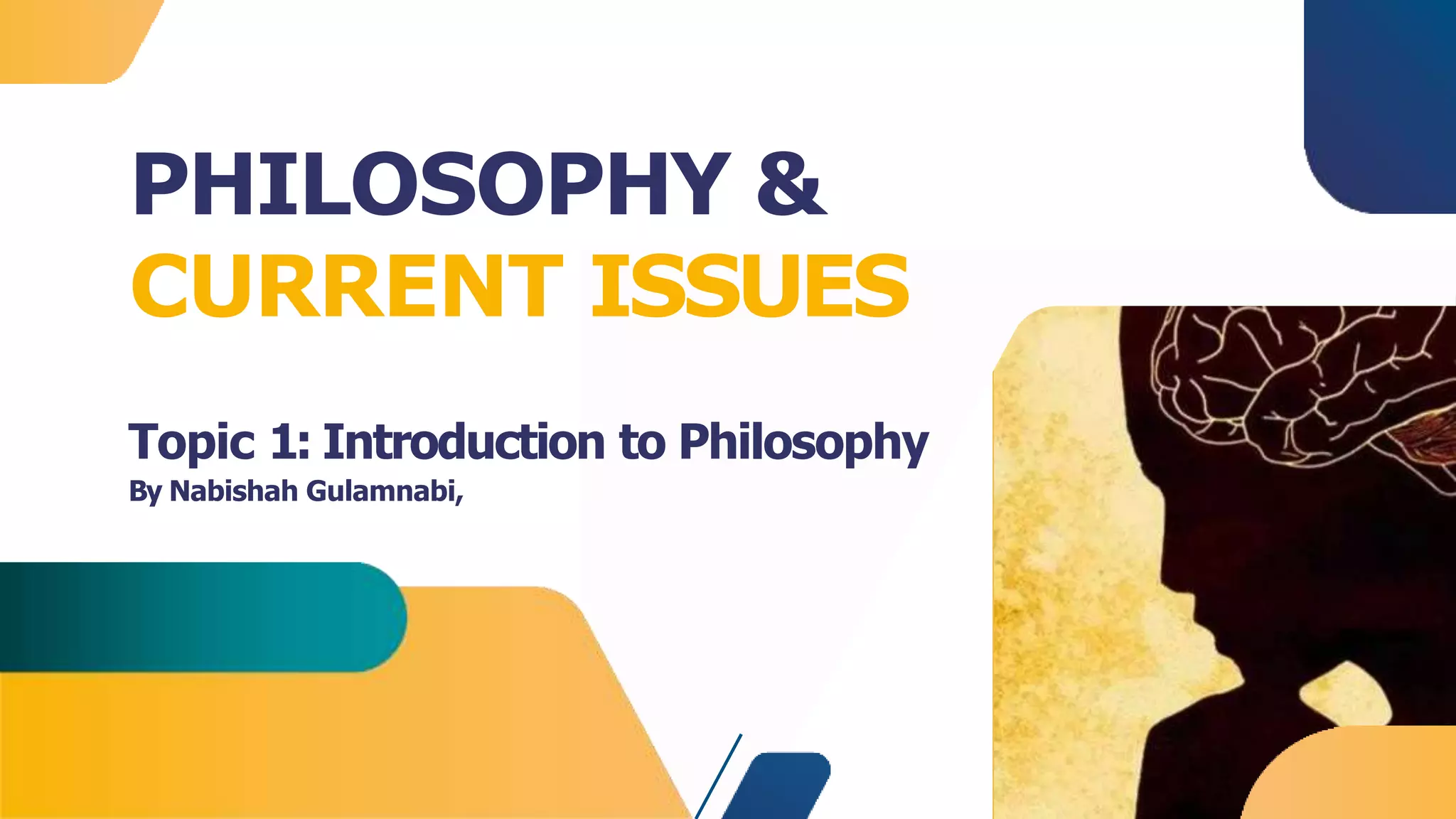
PHILOSOPHY &
CURRENT ISSUES
Topic 1: Introduction to Philosophy
By Nabishah Gulamnabi,
INTRODUCTION
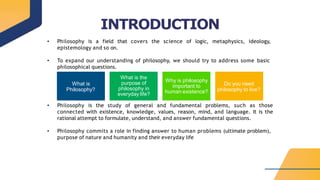
• Philosophy is a field that covers the science of logic, metaphysics, ideology,
epistemology and so on.
• To expand our understanding of philosophy, we should try to address some basic
philosophical questions.
• Philosophy is the study of general and fundamental problems, such as those
connected with existence, knowledge, values, reason, mind, and language. It is the
rational attempt to formulate, understand, and answer fundamental questions.
• Philosophy commits a role in finding answer to human problems (ultimate problem),
purpose of nature and humanity and their everyday life
What is
Philosophy?
What is the
purpose of
philosophy in
everyday life?
Why is philosophy
important to
human existence?
Do you need
philosophy to live?
INTRODUCTION
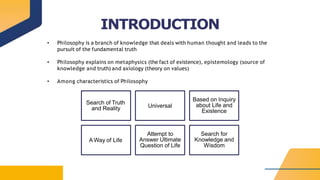
• Philosophy is a branch of knowledge that deals with human thought and leads to the
pursuit of the fundamental truth
• Philosophy explains on metaphysics (the fact of existence), epistemology (source of
knowledge and truth) and axiology (theory on values)
• Among characteristics of Philosophy
Search of Truth
and Reality Universal
Based on Inquiry
about Life and
Existence
A Way of Life
Attempt to
Answer Ultimate
Question of Life
Search for
Knowledge and
Wisdom
MEANING OF PHILOSOPHY
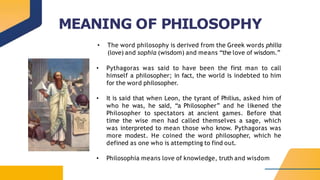
• The word philosophy is derived from the Greek words philia
(love) and sophia (wisdom) and means “the love of wisdom.”
• Pythagoras was said to have been the first man to call
himself a philosopher; in fact, the world is indebted to him
for the word philosopher.
• It is said that when Leon, the tyrant of Philius, asked him of
who he was, he said, “a Philosopher” and he likened the
Philosopher to spectators at ancient games. Before that
time the wise men had called themselves a sage, which
was interpreted to mean those who know. Pythagoras was
more modest. He coined the word philosopher, which he
defined as one who is attempting to find out.
• Philosophia means love of knowledge, truth and wisdom
MEANING OF PHILOSOPHY
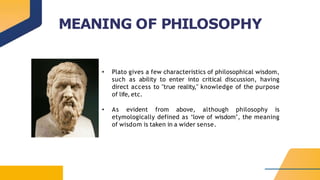
• Plato gives a few characteristics of philosophical wisdom,
such as ability to enter into critical discussion, having
direct access to "true reality," knowledge of the purpose
of life, etc.
• As evident from above, although philosophy is
etymologically defined as ‘love of wisdom’, the meaning
of wisdom is taken in a wider sense.
MEANING OF PHILOSOPHY
• Kamus Dewan (2005): Pengetahuan tentang pengertian yang
dianggap ilmu yang tertinggi yang menjadi dasar ilmu-ilmu
lain
• The word “Falsafah” in Malay comes from Arabic word ‫ة‬
َ
‫س‬
‫ف‬
َ
‫ل‬
َ
َ
‫ف‬
(Directly from the Greek word of Philosophy)
• Philosophy has a close relationship with religion; Eastern
philosophies were intimately tied to their respective
religious traditions of Hinduism, Buddhism, Confucianism
and Daoism.
CREDITS: This presentation template was created by
Slidesgo, including icons by Flaticon, infographics &
images by Freepik
IMPORTANCE OF PHILOSOPHY
Enable us to think
carefully and clearly
about important issues
Learn to explore the
deeper, bigger
question which
underpins our thought.
Learn not what to
believe, but how to
think.
Sharpens your
analytical abilities and
evaluate the strengths
and weaknesses in any
position.
Hones your ability to
construct and
articulate cogent
arguments
Prompts you to work
across disciplinary
boundaries and to think
flexibly and creatively
Develops your ability to
think and work
independently.
PHILOSOPHY &
NATION BUILDING OF MALAYSIA
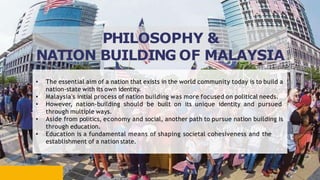
• The essential aim of a nation that exists in the world community today is to build a
nation-state with its own identity.
• Malaysia's initial process of nation building was more focused on political needs.
• However, nation-building should be built on its unique identity and pursued
through multiple ways.
• Aside from politics, economy and social, another path to pursue nation building is
through education.
• Education is a fundamental means of shaping societal cohesiveness and the
establishment of a nation state.
CREDITS: This presentation template was created by
Slidesgo, including icons by Flaticon, infographics &
images by Freepik
“Education in Malaysia is an on-going effort to further develop
the potential of individuals in a holistic and integrated manner,
so as to produce individuals who are intellectually, spiritually,
emotionally, and physically balanced and harmonious, based
on a firm belief in and devotion to God.
Such as effort is designed to produce Malaysia citizens of high
moral standards, knowledgeable and competent, and who are
responsible and capable of achieving a high level of personal
well-being as well as being able to contribute to the harmony
and betterment of the family, the society and the nation at
large”
VALUE OF NATIONAL
EDUCATION PHILOSOPHY (NEP)
The formation
of the Cabinet
Committee in
1974, was due
to the racial
riots of May 13,
1969, the
formation of
Rukun Negara
1970 and the
launch of the
New Economic
Policy 1970.
These events, have
prompted the
government to review
the previous national
education policy that
put less emphasis on
national unity and
development of
social, economic and
political aspects in
developing the nation
and country.
The Cabinet
Committee
Report, 1979,
which
emphasized the
value aspect
was formally
embodied
through the
Falsafah
Pendidikan
Negara in 1988.
The Falsafah
Pendidikan
Negara (FPN)
was then
replaced by
the Falsafah
Pendidikan
Kebangsaan
(FPK) in 1996.
FORMATION OF NEP
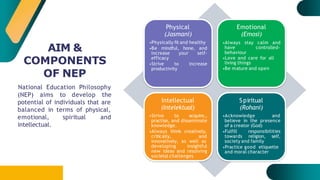
Physical
(Jasmani)
•Physically fit and healthy
•Be mindful, hone, and
increase your self-
efficacy
•Strive to increase
productivity
Emotional
(Emosi)
•Always stay calm and
have controlled-
behaviour
•Love and care for all
living things
•Be mature and open
Intellectual
(Intelektual)
•Strive to acquire,,
practise, and disseminate
knowledge.
•Always think creatively,
critically, and
innovatively, as well as
developing insightful
new ideas and resolving
societal challenges
Spiritual
(Rohani)
•Acknowledge and
believe in the presence
of a creator (God)
•Fulfill responsibilities
towards religion, self,
society and family
•Practice good etiquette
and moral character
(NEP) aims to develop the
potential of individuals that are
balanced in terms of physical,
emotional, spiritual and
intellectual.
AIM &
COMPONENTS
OF NEP
National Education Philosophy
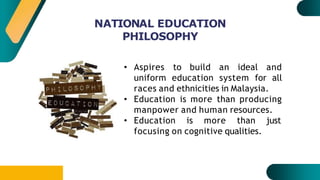
NATIONAL EDUCATION
PHILOSOPHY
• Aspires to build an ideal and
uniform education system for all
races and ethnicities in Malaysia.
• Education is more than producing
manpower and human resources.
• Education is more than just
focusing on cognitive qualities.
NATIONAL EDUCATION
PHILOSOPHY
• Each country has its own education system that is distinct
from those of other countries.
• The principal objective of national education is to
the
develop the human capital model required by
country.
• For example, in the next 15 years, what sort of country do
you want Malaysia to be?
• Therefore, education must begin today in order to
build/shape the country that we want Malaysia to be in
the future.
CLASS DISCUSSION
Compare the National Education
Philosophy of Malaysia with
TWO other countries
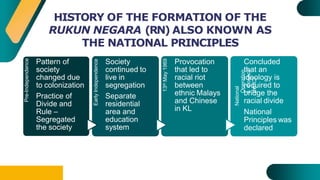
HISTORY OF THE FORMATION OF THE
RUKUN NEGARA (RN) ALSO KNOWN AS
THE NATIONAL PRINCIPLES
Pre-Independence
Pattern of
society
changed due
to colonization
Practice of
Divide and
Rule –
Segregated
the society
Early
Independence
Society
continued to
live in
segregation
Separate
residential
area and
education
system
13
th
May
1969
Provocation
that led to
racial riot
between
ethnic Malays
and Chinese
in KL
National
Operation
s
Council
(NOC)
Concluded
that an
ideology is
required to
bridge the
racial divide
National
Principles was
declared
RUKUN NEGARA
The National Principles was declared on
31 August 1970 to commemorate the
13th anniversary of the Independence of
Malaysia.It was introduced following the
May 13 incident in 1969 which weaken
unity among the races in Malaysia.
It was formed with the main purpose of
forming a strong unity. The principles
contained clearly the key to harmony
and unity for the sake of the success
and stability of the country.
Whereby Our Country, Malaysia nurtures the ambitions of:
1. Achieving and fostering better unity amongst the society;
2. Preserving a democratic way of life;
3. Creating a just society where the prosperity of the country can be
enjoyed together in a fair and equitable manner;
4. Ensuring a liberal approach towards the rich and varied cultural
traditions;
5. Building a progressive society that will make use of science and
modern technology.
NOW THEREFORE, we, the people of Malaysia, pledge to concentrate our
energy and efforts to achieve these ambitions based on the following
principles:
1. Belief in God
2. Loyalty to the King and Country
3. Supremacy of the Constitution
4. Rules of Law
5. Courtesy and Morality
RUKUN NEGARA
Belief in God
• Creating religious relationships so that society
can form ideas, speech, and deeds that benefit
both self and others, in light of the virtues
taught by all religions.
• This principle balances beliefs and avoids
controversy because belief in god is a belief
held by most members of society.
Loyalty to King and Country
• Based on the practice of the Parliamentary
Democracy and Constitutional Monarchy
• Cultivate a responsible, willing attitude to
sacrifice for the sake of the country and make a
contribution towards the development of the
country
Supremacy of Constitution
• Emphasize the importance of citizens accepting,
abiding by, and defending the supremacy or
dignity of the Constitution Country.
• Recognize the Constitution's value as a resource
for the highest law that must be followed for the
sake of country harmony.
Rules of Law
• Justice based on the rule of law demonstrates
that every citizen is equal on the side of the law.
• Creating a courteous and compliant society
through national law, because the law protects
all members of society
Courtesy and M orality
• Emphasizes personality development and the
behaviour of all individuals in order to produce polite
and moral citizens.
• Develop a noble personality in the circle society so as
not to offend the feelings of others who may affect the
country's harmony.
FALSAFAH
SEJAHTERA
Fadhilah Raihan Lokman
SLAS, Taylor’s University
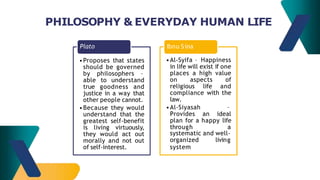
PHILOSOPHY & EVERYDAY HUMAN LIFE
Plato
•Proposes that states
should be governed
by philosophers –
able to understand
true goodness and
justice in a way that
other people cannot.
•Because they would
understand that the
greatest self-benefit
is living virtuously,
they would act out
morally and not out
of self-interest.
•Al-Syifa – Happiness
in life will exist if one
places a high value
on aspects of
religious life and
compliance with the
law.
•Al-Siyasah –
Provides an ideal
plan for a happy life
through a
systematic and well-
organized living
system
Ibnu Sina
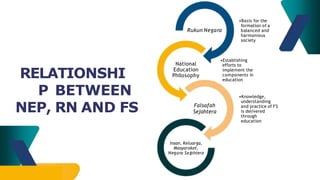
WHAT IS SEJAHTERA?
•Basis for the
formation of a
balanced and
harmonious
society
Rukun Negara
•Establishing
efforts to
implement the
components in
education
National
Education
Philosophy
•Knowledge,
understanding
and practice of FS
is delivered
through
education
Falsafah
Sejahtera
Insan, Keluarga,
Masyarakat,
Negara Sejahtera
RELATIONSHI
P BETWEEN
NEP, RN AND FS
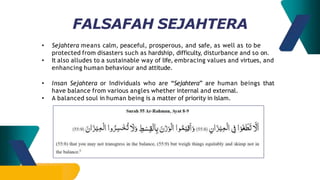
FALSAFAH SEJAHTERA
• Sejahtera means calm, peaceful, prosperous, and safe, as well as to be
protected from disasters such as hardship, difficulty, disturbance and so on.
• It also alludes to a sustainable way of life, embracing values and virtues, and
enhancing human behaviour and attitude.
• Insan Sejahtera or Individuals who are “Sejahtera” are human beings that
have balance from various angles whether internal and external.
• A balanced soul in human being is a matter of priority in Islam.
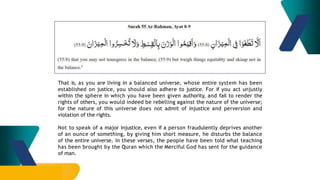
That is, as you are living in a balanced universe, whose entire system has been
established on justice, you should also adhere to justice. For if you act unjustly
within the sphere in which you have been given authority, and fail to render the
rights of others, you would indeed be rebelling against the nature of the universe;
for the nature of this universe does not admit of injustice and perversion and
violation of the rights.
Not to speak of a major injustice, even if a person fraudulently deprives another
of an ounce of something, by giving him short measure, he disturbs the balance
of the entire universe. In these verses, the people have been told what teaching
has been brought by the Quran which the Merciful God has sent for the guidance
of man.
FALSAFAH SEJAHTERA
• Insan Sejahtera also work side by side with the sustainable development and
fulfill peaceful and harmonious life. These people are qualified to lead their
dependents as blessings to the world as stipulated by Maqasid Syariah.
• Essentially, the goals of Rukun Negara and National Education Philosophy
are to build a citizen with a noble and respectable personality, a balance of
four NEP elements which are intellectual, spiritual, emotional and physical.
CONCLUSION
• The main objectives of Rukun Negara, National Education Philosophy and
Falsafah Sejahtera are for the Kesejahteraan or Prosperity of self, family, society,
country and world
• This topic provides understanding to the concept of philosophy and associate it
with the National Education Philosophy and Rukun Negara.
• This topic prepares students to grasp current and foreign issues in context and on
a bigger scale, as well as to be analytical in order to prepare for topics such as
decolonization.
THANK YOU

lesson 1.pptx

  • 1.
    PHILOSOPHY & CURRENT ISSUES Topic1: Introduction to Philosophy By Nabishah Gulamnabi,
  • 2.
    INTRODUCTION • Philosophy isa field that covers the science of logic, metaphysics, ideology, epistemology and so on. • To expand our understanding of philosophy, we should try to address some basic philosophical questions. • Philosophy is the study of general and fundamental problems, such as those connected with existence, knowledge, values, reason, mind, and language. It is the rational attempt to formulate, understand, and answer fundamental questions. • Philosophy commits a role in finding answer to human problems (ultimate problem), purpose of nature and humanity and their everyday life What is Philosophy? What is the purpose of philosophy in everyday life? Why is philosophy important to human existence? Do you need philosophy to live?
  • 3.
    INTRODUCTION • Philosophy isa branch of knowledge that deals with human thought and leads to the pursuit of the fundamental truth • Philosophy explains on metaphysics (the fact of existence), epistemology (source of knowledge and truth) and axiology (theory on values) • Among characteristics of Philosophy Search of Truth and Reality Universal Based on Inquiry about Life and Existence A Way of Life Attempt to Answer Ultimate Question of Life Search for Knowledge and Wisdom
  • 4.
    MEANING OF PHILOSOPHY •The word philosophy is derived from the Greek words philia (love) and sophia (wisdom) and means “the love of wisdom.” • Pythagoras was said to have been the first man to call himself a philosopher; in fact, the world is indebted to him for the word philosopher. • It is said that when Leon, the tyrant of Philius, asked him of who he was, he said, “a Philosopher” and he likened the Philosopher to spectators at ancient games. Before that time the wise men had called themselves a sage, which was interpreted to mean those who know. Pythagoras was more modest. He coined the word philosopher, which he defined as one who is attempting to find out. • Philosophia means love of knowledge, truth and wisdom
  • 5.
    MEANING OF PHILOSOPHY •Plato gives a few characteristics of philosophical wisdom, such as ability to enter into critical discussion, having direct access to "true reality," knowledge of the purpose of life, etc. • As evident from above, although philosophy is etymologically defined as ‘love of wisdom’, the meaning of wisdom is taken in a wider sense.
  • 6.
    MEANING OF PHILOSOPHY •Kamus Dewan (2005): Pengetahuan tentang pengertian yang dianggap ilmu yang tertinggi yang menjadi dasar ilmu-ilmu lain • The word “Falsafah” in Malay comes from Arabic word ‫ة‬ َ ‫س‬ ‫ف‬ َ ‫ل‬ َ َ ‫ف‬ (Directly from the Greek word of Philosophy) • Philosophy has a close relationship with religion; Eastern philosophies were intimately tied to their respective religious traditions of Hinduism, Buddhism, Confucianism and Daoism.
  • 7.
    CREDITS: This presentationtemplate was created by Slidesgo, including icons by Flaticon, infographics & images by Freepik IMPORTANCE OF PHILOSOPHY Enable us to think carefully and clearly about important issues Learn to explore the deeper, bigger question which underpins our thought. Learn not what to believe, but how to think. Sharpens your analytical abilities and evaluate the strengths and weaknesses in any position. Hones your ability to construct and articulate cogent arguments Prompts you to work across disciplinary boundaries and to think flexibly and creatively Develops your ability to think and work independently.
  • 8.
    PHILOSOPHY & NATION BUILDINGOF MALAYSIA • The essential aim of a nation that exists in the world community today is to build a nation-state with its own identity. • Malaysia's initial process of nation building was more focused on political needs. • However, nation-building should be built on its unique identity and pursued through multiple ways. • Aside from politics, economy and social, another path to pursue nation building is through education. • Education is a fundamental means of shaping societal cohesiveness and the establishment of a nation state.
  • 9.
    CREDITS: This presentationtemplate was created by Slidesgo, including icons by Flaticon, infographics & images by Freepik “Education in Malaysia is an on-going effort to further develop the potential of individuals in a holistic and integrated manner, so as to produce individuals who are intellectually, spiritually, emotionally, and physically balanced and harmonious, based on a firm belief in and devotion to God. Such as effort is designed to produce Malaysia citizens of high moral standards, knowledgeable and competent, and who are responsible and capable of achieving a high level of personal well-being as well as being able to contribute to the harmony and betterment of the family, the society and the nation at large” VALUE OF NATIONAL EDUCATION PHILOSOPHY (NEP)
  • 10.
    The formation of theCabinet Committee in 1974, was due to the racial riots of May 13, 1969, the formation of Rukun Negara 1970 and the launch of the New Economic Policy 1970. These events, have prompted the government to review the previous national education policy that put less emphasis on national unity and development of social, economic and political aspects in developing the nation and country. The Cabinet Committee Report, 1979, which emphasized the value aspect was formally embodied through the Falsafah Pendidikan Negara in 1988. The Falsafah Pendidikan Negara (FPN) was then replaced by the Falsafah Pendidikan Kebangsaan (FPK) in 1996. FORMATION OF NEP
  • 11.
    Physical (Jasmani) •Physically fit andhealthy •Be mindful, hone, and increase your self- efficacy •Strive to increase productivity Emotional (Emosi) •Always stay calm and have controlled- behaviour •Love and care for all living things •Be mature and open Intellectual (Intelektual) •Strive to acquire,, practise, and disseminate knowledge. •Always think creatively, critically, and innovatively, as well as developing insightful new ideas and resolving societal challenges Spiritual (Rohani) •Acknowledge and believe in the presence of a creator (God) •Fulfill responsibilities towards religion, self, society and family •Practice good etiquette and moral character (NEP) aims to develop the potential of individuals that are balanced in terms of physical, emotional, spiritual and intellectual. AIM & COMPONENTS OF NEP National Education Philosophy
  • 12.
    NATIONAL EDUCATION PHILOSOPHY • Aspiresto build an ideal and uniform education system for all races and ethnicities in Malaysia. • Education is more than producing manpower and human resources. • Education is more than just focusing on cognitive qualities.
  • 13.
    NATIONAL EDUCATION PHILOSOPHY • Eachcountry has its own education system that is distinct from those of other countries. • The principal objective of national education is to the develop the human capital model required by country. • For example, in the next 15 years, what sort of country do you want Malaysia to be? • Therefore, education must begin today in order to build/shape the country that we want Malaysia to be in the future.
  • 14.
    CLASS DISCUSSION Compare theNational Education Philosophy of Malaysia with TWO other countries
  • 15.
    HISTORY OF THEFORMATION OF THE RUKUN NEGARA (RN) ALSO KNOWN AS THE NATIONAL PRINCIPLES Pre-Independence Pattern of society changed due to colonization Practice of Divide and Rule – Segregated the society Early Independence Society continued to live in segregation Separate residential area and education system 13 th May 1969 Provocation that led to racial riot between ethnic Malays and Chinese in KL National Operation s Council (NOC) Concluded that an ideology is required to bridge the racial divide National Principles was declared
  • 16.
    RUKUN NEGARA The NationalPrinciples was declared on 31 August 1970 to commemorate the 13th anniversary of the Independence of Malaysia.It was introduced following the May 13 incident in 1969 which weaken unity among the races in Malaysia. It was formed with the main purpose of forming a strong unity. The principles contained clearly the key to harmony and unity for the sake of the success and stability of the country.
  • 17.
    Whereby Our Country,Malaysia nurtures the ambitions of: 1. Achieving and fostering better unity amongst the society; 2. Preserving a democratic way of life; 3. Creating a just society where the prosperity of the country can be enjoyed together in a fair and equitable manner; 4. Ensuring a liberal approach towards the rich and varied cultural traditions; 5. Building a progressive society that will make use of science and modern technology. NOW THEREFORE, we, the people of Malaysia, pledge to concentrate our energy and efforts to achieve these ambitions based on the following principles: 1. Belief in God 2. Loyalty to the King and Country 3. Supremacy of the Constitution 4. Rules of Law 5. Courtesy and Morality RUKUN NEGARA
  • 18.
    Belief in God •Creating religious relationships so that society can form ideas, speech, and deeds that benefit both self and others, in light of the virtues taught by all religions. • This principle balances beliefs and avoids controversy because belief in god is a belief held by most members of society. Loyalty to King and Country • Based on the practice of the Parliamentary Democracy and Constitutional Monarchy • Cultivate a responsible, willing attitude to sacrifice for the sake of the country and make a contribution towards the development of the country
  • 19.
    Supremacy of Constitution •Emphasize the importance of citizens accepting, abiding by, and defending the supremacy or dignity of the Constitution Country. • Recognize the Constitution's value as a resource for the highest law that must be followed for the sake of country harmony. Rules of Law • Justice based on the rule of law demonstrates that every citizen is equal on the side of the law. • Creating a courteous and compliant society through national law, because the law protects all members of society
  • 20.
    Courtesy and Morality • Emphasizes personality development and the behaviour of all individuals in order to produce polite and moral citizens. • Develop a noble personality in the circle society so as not to offend the feelings of others who may affect the country's harmony.
  • 21.
  • 22.
    PHILOSOPHY & EVERYDAYHUMAN LIFE Plato •Proposes that states should be governed by philosophers – able to understand true goodness and justice in a way that other people cannot. •Because they would understand that the greatest self-benefit is living virtuously, they would act out morally and not out of self-interest. •Al-Syifa – Happiness in life will exist if one places a high value on aspects of religious life and compliance with the law. •Al-Siyasah – Provides an ideal plan for a happy life through a systematic and well- organized living system Ibnu Sina
  • 23.
  • 24.
    •Basis for the formationof a balanced and harmonious society Rukun Negara •Establishing efforts to implement the components in education National Education Philosophy •Knowledge, understanding and practice of FS is delivered through education Falsafah Sejahtera Insan, Keluarga, Masyarakat, Negara Sejahtera RELATIONSHI P BETWEEN NEP, RN AND FS
  • 25.
    FALSAFAH SEJAHTERA • Sejahterameans calm, peaceful, prosperous, and safe, as well as to be protected from disasters such as hardship, difficulty, disturbance and so on. • It also alludes to a sustainable way of life, embracing values and virtues, and enhancing human behaviour and attitude. • Insan Sejahtera or Individuals who are “Sejahtera” are human beings that have balance from various angles whether internal and external. • A balanced soul in human being is a matter of priority in Islam.
  • 26.
    That is, asyou are living in a balanced universe, whose entire system has been established on justice, you should also adhere to justice. For if you act unjustly within the sphere in which you have been given authority, and fail to render the rights of others, you would indeed be rebelling against the nature of the universe; for the nature of this universe does not admit of injustice and perversion and violation of the rights. Not to speak of a major injustice, even if a person fraudulently deprives another of an ounce of something, by giving him short measure, he disturbs the balance of the entire universe. In these verses, the people have been told what teaching has been brought by the Quran which the Merciful God has sent for the guidance of man.
  • 27.
    FALSAFAH SEJAHTERA • InsanSejahtera also work side by side with the sustainable development and fulfill peaceful and harmonious life. These people are qualified to lead their dependents as blessings to the world as stipulated by Maqasid Syariah. • Essentially, the goals of Rukun Negara and National Education Philosophy are to build a citizen with a noble and respectable personality, a balance of four NEP elements which are intellectual, spiritual, emotional and physical.
  • 28.
    CONCLUSION • The mainobjectives of Rukun Negara, National Education Philosophy and Falsafah Sejahtera are for the Kesejahteraan or Prosperity of self, family, society, country and world • This topic provides understanding to the concept of philosophy and associate it with the National Education Philosophy and Rukun Negara. • This topic prepares students to grasp current and foreign issues in context and on a bigger scale, as well as to be analytical in order to prepare for topics such as decolonization.
  • 29.