
(EDU3093 TEACHER AND CURRENT CHALLENGES)
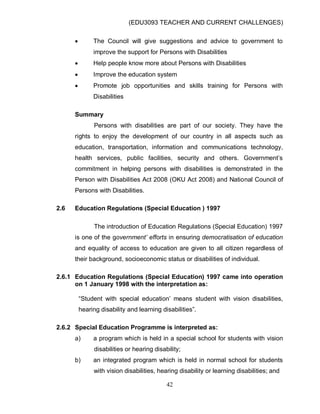
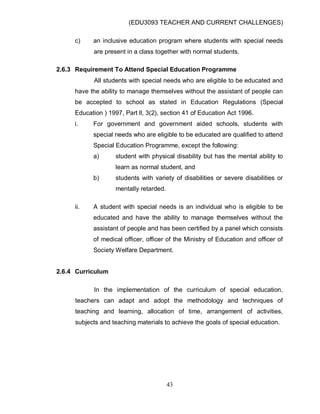
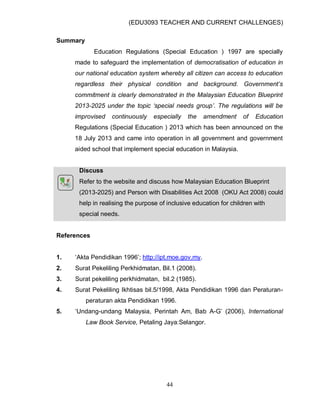
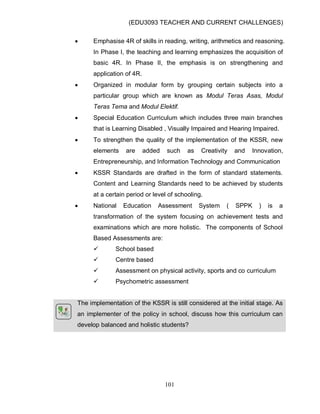
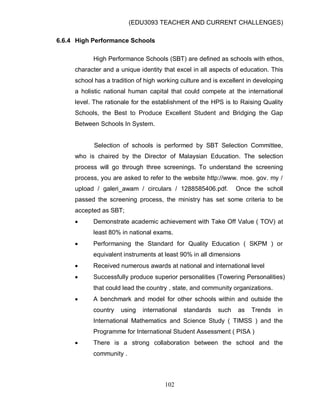
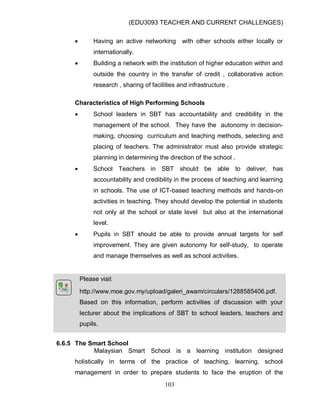
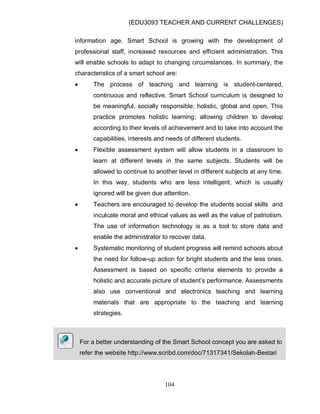
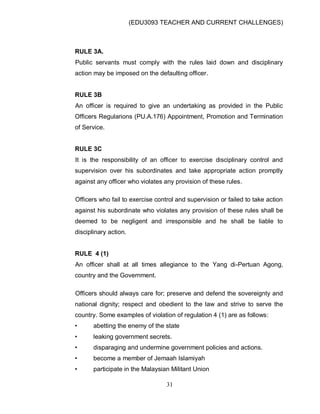
1
TOPIC 1 ISSUES AND CHALLENGES IN CURRENT EDUCATION
1.0 SYNOPSIS
This topic discusses on issues and challenges in current education;
which include National Integration, Democratization of Education,
UNESCO Four Pillars of Education, Globalization in Education, Cultural
Diversity, Influence of Information Communication Technology (ICT) and
Social Ills. Students need to identify and make reflections on ways to deal
with issues and challenges in current education.
1.1 LEARNING OUTCOMES
By the end of this topic you should be able to:
i. Identify issues and challenges in education.
ii. Elaborate National Integration based on examples.
iii. Explain Democratization of Education.
iv. Reflect on ways to deal with issues on National Integration and
Democratization of Education.
v. Identify UNESCO Four Pillars of Education.
vi. Discuss the characteristics of UNESCO Four Pillar of Education.
vii. Elaborate the advantages, impact and challenges of Globalisation in
Education.
viii. Identify the characteristics of Cultural Diversity.
ix. Elaborate the influences and impacts of Information Communication
Technology (ICT) in education.
x. Identify types of Social Ills in Malaysian society.
xi. Reflect on the ways to deal with Social Ills in the Malaysian society.
xii. Explain the roles of teachers in dealing with Social Ills.
(EDU3093 TEACHER AND CURRENT CHALLENGES)
2
1.2 TOPICS
1.3 Introduction- Issues and Challenges of Present Education
Malaysia is a country that put in a lot of emphasis on education.
This is because education is necessary for any country that aims to
develop and progress towards higher level of advancement and excellence.
Our government has made efforts in highlighting the importance of
education through implementing policies and plans such as Primary
School Standard Curriculum (KSSR), Malaysia Education Blueprint 2006-
2010, Malaysia Education Blueprint 2013-2025. However, the government,
schools and teachers have encountered many challenges in the process of
implementing the policies. The challenges are due to the fact that our
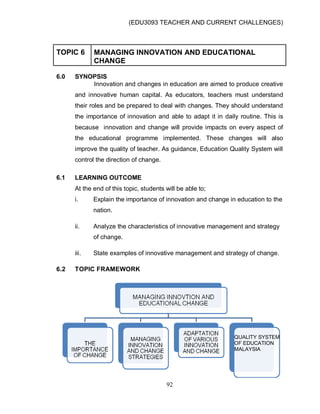
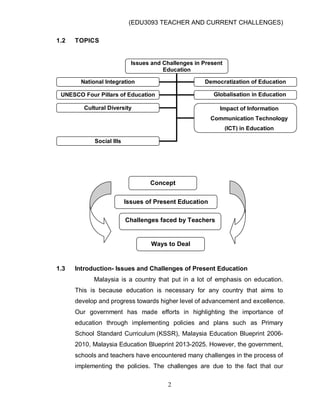
Issues and Challenges in Present
Education
National Integration Democratization of Education
UNESCO Four Pillars of Education Globalisation in Education
Cultural Diversity Impact of Information
Communication Technology
(ICT) in Education
Social Ills
Concept
Issues of Present Education
Challenges faced by Teachers
Ways to Deal
(EDU3093 TEACHER AND CURRENT CHALLENGES)
3
country is a multi cultural country and also due to rapid changes that occur
globally.
Teachers as the most important implementers in the education
system have encountered challenges in the aspects such as National
Integration, Democratization of Education, UNESCO Four Pillars of
Education, Globalization in Education, Cultural Diversity, Influence of
Information Communication Technology (ICT) and Social Ills. In order to
achieve the goals in Malaysia Education Blueprint 2013-2025 and Vision
2020, the nation needs teachers who are committed and dedicated; and
are able to face those challenges.
1.4 National Integration
1.4.1 Definition
What is national integration? According to Vyas (1993), National
Integration means “a process as well as a goal by which all the people
inhabiting in a particular territory irrespective of their religious, ethnic and
linguistic differences, on the basis of certain shared traditions, experiences,
common history and values strive to live together forever with honor and
dignity.”
1.4.2 Current Issues of National Integration
Malaysia consists of multi-ethnic groups population which
comprises of Malay, Chinese and Indian. This composition of population
has contributed to the diversity in language, customs, culture, and beliefs
in religions which gives challenges to the government to unite all the
ethnic groups. The tragedy of 13th May 1969 was an evidence of
prejudices and conflicts among the ethnic groups. This has given the
government awareness on the importance of bringing about national
integration in the country. In bridging the gaps of socioeconomic between
multi-ethnic groups and to create harmony and unity in the nation, our
government has introduced policies such as The New Economy Policy,
National Education Policy and National Cultural Policy. The
(EDU3093 TEACHER AND CURRENT CHALLENGES)
4
implementation of those policies could enhance the declaration of Rukun
Negara as the national ideology of Malaysia . Rukun Negara was formed
on 31 August 1970 by the National Operations Council (Department of
National Unity and National Integration, 2005).
Discussion
Discuss in groups how The New Economy Policy, National
Education Policy, National Cultural Policy and Rukun Negara can
develop Malaysia as a peaceful and harmonious country to live in.
1.4.3 Challenges to Teachers
In the process of integrating multi-ethnic groups in our country, the
government encounters obstacles in the following aspects:
 Differences in religions and culture
 British colonization policy
 Differences in education system and medium of instruction in
schools
 Involvement in economic section based on ethnic-groups
 Different geographical location among ethnic groups based on their
source of living
 Different political beliefs based on ethnic-groups
Discussion
Discuss in detail the effects and challenges of the aspects above
by using graphic organizer.
1.4.4 Ways to Deal with Issues of National Integration
Education plays an important role in the process of uniting all the
ethnic groups in our country. Education could produce a holistic and
balanced human capital in the aspects of physical, emotional, intellectual
and spiritual as aimed in the National Philosophy Of Education. Thus,
(EDU3093 TEACHER AND CURRENT CHALLENGES)
5
many steps have been taken by The Ministry of Education (MOE) to
produce future generations that are patriotic, tolerance, progressive and
united as to make Malaysia a country of excellence. Those steps are as
below:
 Implementation of national education system where a standardized
curriculum and examination are used in all schools
 Empowering the status of Sekolah Kebangsaan to foster unity
among the different ethnic groups
 Assimilate the values of positive self, morality and arts in all
subjects
 Introduction of Sivik dan Kewarganegraan subject in the primary
and secondary school in 2003
 Introduction of the concept of Sekolah Wawasan
1.4.4.1 Student Integration Plan for Unity (RIMUP)
Three types of schools, namely SK / SRK, SRJK (C) and SRJK (T)
are involved in this plan. The objectives of this plan are:
i. to enhance participation of students and teachers from these three
types of schools in certain activities
ii. to enhance interaction, understanding, cooperation, goodwill and
tolerance amongst the students from the three types of schools
iii. to share the facilities and equipments amongst the three types of
schools.
National integration can be achieved based on the activities
provided in the modules as listed below:
 Activity module for academic
 Activity module for sports and games
 Activity module for co-curriculum
 Activity module for social service
 Activity module to enhance patriotism

(EDU3093 TEACHER AND CURRENT CHALLENGES)
6
Discussion
Based on your experience as a teacher, discuss to what extent the
policies introduced by the Ministry of Education could form national
integration amongst the students.
1.4.4.2 1 Malaysia Concept
The concept of 1 Malaysia was introduced by the Prime Minister of
Malaysia, YAB Dato‟ Sri Najib Tun Razak. This is one of the most
significant steps taken by the prime minister in order to foster the unity and
to build close relationship between all ethnic groups including the people
from Sarawak and Sabah. According to the Prime Minister‟s personal
website, 1 Malaysia is a formula conceptualized as a precondition in
ensuring the aspirations of the country to secure a developed country by
2020 are met; if the concept of 1 Malaysia is inculcated in the minds of the
society. If the idea of “Bangsa Malaysia” which was engendered through
Vision 2020 becomes the final destination, then 1Malaysia is the roadmap
that guides us towards that destination.
There are eight noble values highlighted in the 1 Malaysia concept,
that is a culture of excellence, perseverance, humility, acceptance, loyalty,
meritocracy, education and integrity. The value of acceptance, loyalty,
meritocracy, education and integrity is the most important factor in the
development of national integration. Acceptance means people in the
country must be able to accept the strength of other ethnic groups and are
able to agree upon all matters for the betterment of the country. Loyalty is
important as all the Malaysians need to be loyal to the king and country
besides building the trusts to build the relationship between different ethnic
groups. Meritocracy is a crucial element for a democratic country where all
the qualified people in the country are given a chance to participate in any
field. Education will ensure the noble values to be instilled to the future
generations besides making them the first class human capital of the
(EDU3093 TEACHER AND CURRENT CHALLENGES)
7
country. The eight values act as the pillars in integrating and uniting all the
Malaysians as to achieve the vision of 2020.
1.5 Democratization of Education
1.5.1 Definition
Democratization of education refers to the equality of access and
opportunities that involves allocation of massive financial and materials
resources; development of policies designed to reduce social and
economic inequalities; to reduce the costs of school attendance such as
fees and costs of materials; and the development of relevant curriculum
and devising of appropriate selection procedures for higher level
educational opportunities (Kiyau, 1981). According to Dewey (1966),
democratization of education means opportunities provided for everyone to
be successful in education and using education as a main tool to be
successful in life and to enjoy better quality of life.
1.5.2 Current Issues of Democratization of Education
Many steps and policies have been made by the Ministry Of
Education in order to make sure that everyone in the country has a chance
to access to free quality education. At the same time, the government
must also ensure that students who are disabled are also taught based on
the same system and curriculum as the normal students. Government
efforts in achieving the goal of democratization of education are revealed
in the policies such as free compulsory primary and secondary education;
the implementation of vernacular schools (SJK Cina and Tamil), technical
schools, boarding schools, religious schools and special education schools.
Less student school (SKM) is to cater to the needs of the students from
the isolated areas. In order to provide opportunities for people to continue
their study to tertiary level, the government has formed online education;
private colleges and universities. On the other hand, multiple programs
(EDU3093 TEACHER AND CURRENT CHALLENGES)
8
such as Education Assistance Scheme, Textbook Loan Scheme and Food
Supplement Plan are implemented to help students of low income groups
to be able to be in the education system and be physically healthy.
1.5.3 Challenges in Democratization of Education
The government has encountered many challenges in implementing
democratization of education. The government has to make sure that
quality education is given to all students regardless of their ethnicity
background, socioeconomic status, location and equity. Students from the
rural schools should have the right to access to facilities and
infrastructure of the schools just like those from the urban schools.
Students from the rural schools must also be taught by trained and quality
teachers in order to facilitate them to achieve excellence in academic.
1.5.4 Teachers’ roles in Democratization of Education
Teachers play a role in realizing the goal of democratization of
education by ensuring that equal opportunities are given to all students
regardless of their ethnicity, gender, socioeconomic status, cultural
background, religions, and intelligences in order to enhance their
potentials and to excel in academic. At the same time, teachers need to be
fair and just in all aspects when interacting with students of multi-ethnic
groups.
Think
Based on your experience as a teacher, discuss to what extent are
the policies introduced by MOE can achieve their objectives in
democratization of education amongst the students.
Discuss
Discuss in groups, the factors that hinder the implementation of
democratization of education among the multi-ethnic groups
especially the indigenous groups in Sabah and Sarawak.
(EDU3093 TEACHER AND CURRENT CHALLENGES)
9
Discuss
Elaborate the roles of teachers in achieving the goal of
Democratization of education.
1.6 UNESCO Four Pillars of Education
1.6.1 Introduction
The United Nations Educational, Scientific and Cultural
Organization (UNESCO) is one of the agencies of United Nations with the
role of bringing peace, security and harmony to the world by promoting
collaboration in the field of education, scientific and cultural. Four pillars of
education as highlighted by UNESCO that need to be mastered by the
students are (1) learning to know, (2) learning to do, (3) learning to be and
(4) learning to live together.
1.6.2 Learning to Know
Learning to know is one of the important tools in the process of
learning. It is a cognitive tool that one must acquire in order to comprehend
the surrounding and its complexities and to maximize one‟s potential to
excel. It also functions as a base that can facilitate future learning. One
must also need to know the people around through communication and
interaction to attain success in life. Learning to know involves the process
of learning how to learn by developing one's concentration, memory skills
and ability to think. In the process of teaching and learning, teachers need
to make learning an enjoyable process, inculcates the interest and
curiosity amongst the students as to trigger them to get new and in-depth
knowledge. Besides that, teachers also should introduce skills to help
students to gain new knowledge.
1.6.3 Learning to Do
Learning to do means education must be able to equip one with the
necessary and important skills so that one can survive and participate
efficiently in the global world. One‟s potential will be polished in the
process of learning on how to do till one is able to bring changes to the
(EDU3093 TEACHER AND CURRENT CHALLENGES)
10
surrounding in the future. In other words, one is capable to create
innovation based on the knowledge that one has already acquired.
Professional and personal competence namely, interpersonal skills,
communication skills, team work and problem solving skills are vital in
making learning to do fruitful. The role of education in learning to do is to
enhance individual‟s initiatives to participate in future development based
on their theoretical and practical knowledge. The role of the schools and
teachers are to ensure that the students acquire personal competency and
could give the best performance.
1.6.4 Learning to Be
Learning to be emphasizes that education should be able to
develop a person holistically based on physical, intellectual, spiritual,
emotional and aesthetic as stated in the National Philosophy of Education.
Education must provide opportunities to let one develop his potential to the
fullest so that he can think and evaluate critically and independently; able
to make the best decision; take the most suitable action in their life and be
responsible for it. The essential task of education seems to be to make
sure that all people enjoy the freedom of thought, judgment, feeling and
imagination to develop their talents and in control in determining their lives.
The challenge faced by teacher is to ensure that all students are always
equipped with personal resources and intellectual tools to comprehend the
world and behave as a fair-minded and responsible human being. These
can be enhanced through group work activity, problem based learning and
project based learning.
1.6.5 Learning to Live Together
Learning to live together is another important pillar because nobody
can live alone in this world. Education has to give awareness to the
individual about the importance of having peace in the world. Individuals
must be exposed to the values on human rights, democracy principles,
understanding and respecting socio cultural diversity, tolerance and instill
(EDU3093 TEACHER AND CURRENT CHALLENGES)
11
peace in the society and human relationship regardless of background
differences so that all human are always living in peace and harmony.
Schools and teachers have to encourage and teach students to avoid
conflicts and solve problems in a peaceful manner. Two elements that
should be taught to students in the process of learning to live are to
discover individual differences and to work together with others towards a
common goal.
1.6.6 Challenges to Teachers
In the process of achieving the aims of four pillars of education as
highlighted in the UNESCO, schools and teachers faced challenges as
they must ensure that education should give individuals the chances to
explore, mix and interact with people of different background since early
stage. Individuals must be aware, understand and respect the differences
in gender, ethnicity, intellectual, socioeconomic status, beliefs and
religions.
1.6.7 Ways to deal with challenges
Teachers have to emphasize on the importance of being tolerant
and the needs of working together with others in achieving peace and
harmony in everyday life. On the other hand, education should also
develop a holistic individual who possesses skills and competencies that
enable him/her to survive in this globally challenged world.
Think
Based on your experience as a teacher, reflect teaching activities in
your subject matter that you have planned in order to achieve the
Four Pillars of Education UNESCO.
Exercise
Discuss in groups how the Four Pillars of Education UNESCO could
help the country to achieve Vision 2020.
(EDU3093 TEACHER AND CURRENT CHALLENGES)
12
1.7 Globalization in Education
1.7.1 Definition
Globalization refers to the process of enabling financial and
investment markets to operate internationally, largely as a result of
deregulation and improved communications (Collin dictionary, 2013).
According to Financial Time Lexicon (2013), globalization describes a
process by which national and regional economies, societies and cultures
have become integrated through the global network of trade,
communication, immigration and transportation.
Globalization also provides platform for all people in the world
regardless of their nationality, races, skin colour, status and background in
order for them to compete fairly in any field. Thus, globalization has
resulted both positive and negative impacts in many aspects of our life
especially education. This is because education is one of the fields that is
very much influenced by the environment and need to adapt to the world
wide rapid chances.
1.7.2 Current Issues on Globalization in Education
Impacts of globalization on the education sectors are as follows:
 Usage of English as a knowledge language and international
language
 Education in the country is open to outside world where foreign
universities are allowed to establish their branches here.
 Opportunities to further studies to tertiary level are increased when
many private colleges and universities are built
 Emphasis on assessing and using Information Communication
Technology (ICT) in the teaching and learning process is stressed
 Internet as a source of information and communication
(EDU3093 TEACHER AND CURRENT CHALLENGES)
13
 Roles of teachers in the classroom are more to facilitate the
students than to disseminate knowledge
 Teachers need to be ICT literate in carrying out administrative work
 Our students are able to compete in the global market
 Fair competition among all higher learning institutions
 Life-long learning can be achieved successfully as many learning
opportunities are provided
 Sharing of knowledge worldwide especially on new finding from
research
 Enable the aim of democratization of education to be achieved
when everyone has a chance to access to education
1.7.3 Challenges to Teachers
Globalization on education has challenged the process of
implementing the education system in Malaysia as we need to adapt
ourselves to the worldwide trend so that we could compete at international
level. The challenges are as below:
 The needs to practice continuous learning
 The use of Information Communication Technology
 Administration of education
 Development of student‟s identity
 Teachers‟ quality
 The needs to transform the curriculum in line with the global
opportunities
 Teachers are not well prepared with changes especially in the
aspect of using ICT in the teaching process
 Increase in workload
 Attitudes of the teachers in teaching in the global era
 The rapid changes in education due to globalization
 Negative influence on students identity
(EDU3093 TEACHER AND CURRENT CHALLENGES)
14
 The school culture does not support global learning opportunities
1.7.4 Ways to Deal with Globalization in Education
Schools and teachers are responsible in producing students that
are able to compete in the era of globalization. Students should practice
the culture of life-long learning and continuous learning in order for them to
be in line with the rapid changes. Teachers have to equip students with the
ability to communicate verbally and in written form using international
language such as English so that they can interact and communicate
internationally. In order to participate globally students have to master the
skills of using ICT as ICT is a fast changing field. Schools and teachers
have to ensure that the current curriculum would enable students to
acquire cognitive skills that are useful in completing complex and
challenging tasks, solving problems and generate new knowledge for
innovations. Besides that, it is the teacher‟s responsibility to emphasize on
the ethnic and moral aspects when using ICT and be aware of the
negative impact due to globalization.
Think
Based on your experience as a teacher, reflect teaching activities in
your subject matter that you have planned in order to help students to
utilize internet effectively.
Exercise
Discuss the negative impacts of globalization in the following aspects:
 Country
 Schools
 Teachers
 Students
 Individuals
(EDU3093 TEACHER AND CURRENT CHALLENGES)
15
1.8 Cultural Diversity
1.8.1 Definition
Malaysia is a country with multi-ethnic groups which includes the
Malays, Chinese and Indians. Cultural diversity refers to diversity in
customs and culture in a society that is made up of multiple ethnicity and
races. Stavenhagen (1996) states that cultural diversity includes cultural,
religions, ethnicity, practice of tradition which direct towards the tendency
of providing understanding among the ethnic groups.
According to Kymlicka (1999), cultural diversity can be explained as
differences that exist in a society which focus on the three perspectives
which are (1) universal perspective (understanding of changes each
society universally), (2) ethnicity perspectives (study problems and conflict
of each society), and (3) cultural perspectives (study ways on each
ethnicity express their culture).
1.8.2 Current Educational Issues
The phenomenon of cultural diversity in school has resulted many
impacts on the teaching and learning process in the classroom, particularly
the students.
Implications of cultural diversity on students:
Positive
 Chances to learn about cultural diversity
 Build good social interaction
 Develop talents
Negative
 Problems in group work
 Problems in communication and language
 Difficulties in mutual understanding
 Having low self-esteem and no self- confidence
(EDU3093 TEACHER AND CURRENT CHALLENGES)
16
1.8.3 Challenges to Teachers
Teachers need to have strong willingness and appreciation in
conducting ceremony/programme on cultural diversity that is conducted by
Ministry of Education/ school in order to act as role model to students. One
of the challenges in dealing with cultural diversity is to provide awareness
to the students on the issue. The awareness that need to be inculcated
into the students‟ minds is to :
i. accept and appreciate the identity of other ethnic groups
ii. respect cultural diversity (values, customs and ways of living)
iii. appreciate the cultural uniqueness
iv. possess the willingness to share similarities and prepare to work
together
v. unite to develop the nation
1.8.4 Ways to Deal with Issues of Cultural Diversity
When cultural diversity is discussed it is important to relate it with
national integration. Husein Ahmad (2000) and Zakaria Abd Wahab (2000)
explain national integration as a united society which displays the
characteristics of cultural understanding, social interaction, tolerances
between the ethnic groups, understanding and recognizing the similarities
and differences among the ethnic groups. Those characteristics are
fundamental in determining the presence of national integration in building
the Malaysian national identity.
Ways in which teacher can resolve cultural diversity problems are
as follows:
 Teachers need to make efforts in demonstrating friendliness
 Teachers need to be prepared to deal with students‟ different
abilities and attitudes
 Provide awareness on socio cultural diversity to students
(EDU3093 TEACHER AND CURRENT CHALLENGES)
17
 Apply different methodologies in teaching
 Encourage activities that involve all students
 Respect and understand the social aspects of the students
 Practice democracy in the classroom
Think
Based on your experience in school, provide one situation on
how your teacher deals with students of difference culture in
your class.
Exercise
You are required to form a group of three and complete the task
follow: Access information and produce a scrap book with „Arts &
Heritage of Multi-Ethnic Groups in Malaysia‟ as theme.
1.9 Influences of Information Communication Technology Development
1.9.1 Definition
The development of Information Communication and Technology
has resulted great influences in our life especially education. Application of
ICT in the teaching and learning process has produced a change in
teachers‟ pedagogy. The application of technology has caused revolution
to the techniques of teaching, students‟ learning methods and the whole
education system that is in line with the present era.
1.9.2 Current Education Issues
Assumption about integration of information technology will occur
automatically if there are facilities in school is quite inaccurate as teacher
is the major factor in determining the success or failure on application of
information technology in the teaching and learning process. To what
(EDU3093 TEACHER AND CURRENT CHALLENGES)
18
extent are the present teachers can deal with the challenges of using
information technology effectively in the teaching and learning process?
The impact of Information Communication Technology through
internet has exposed students to alternative resources in accessing
information such as virtual library besides using the text books or visiting
the library. If students are taught to use the internet effectively, teachers
are able to produce a generation that is dynamic and progressive because
they are equipped with knowledge and the latest skills.
1.9.3 Challenges to Teachers
Challenges faced by teachers in integrating information technology
during the process of teaching and learning will be discussed from the
aspects of teachers‟ readiness which include the level of skill, knowledge
and attitudes.
 Teachers’ Skills on Information Technology
Teacher is the important agent of change in realizing government‟s
aspiration to develop quality human capital. Thus, mastery of information
technology among the teachers is necessary. It is vital in enhancing the
effectiveness of teaching and learning process, administration and
management of the school. As a result, steps such as having workshop
and courses related to information technology for teachers should be
organized frequently to enhance their skills on using information
technology. Teachers must be prepared to deal with these challenges.
 Teachers’ Knowledge on Information Technology
Knowledge and attitude towards computer are influenced by the frequency
of using it. Knowledge on computer will increase if it is frequently being
used. Teachers‟ knowledge on computer will be enriched if they attend
(EDU3093 TEACHER AND CURRENT CHALLENGES)
19
courses on information technology. Thus, teachers must be prepared to
attend those courses and willingly sacrifice time with family.
 Teachers’ Attitude in Applying Information Technology during
Teaching and Learning
Attitude is an individual‟s internal description which refers to the tendency
to behave positively or negatively on a thing, situation, institution, concepts
or other people. Literature reviews reported that there is a close
relationship between attitude and the application of information technology
during teaching and learning in the classroom (Mohamad Nabzrim &
Mohamad Nayan, 1997; Adenan, 1999; Krishnan et al., 2007). Thus,
teachers especially those who are in the comfort zone need to change
their attitude towards the development of information technology so that
they can use information technology more frequently in the classroom.
 Information Technology Presentation Software
Information technology software is a productivity tool that can help
teachers during teaching and learning as well as in doing other tasks.
According to Chao et al. (2003), a competent teacher needs to acquire
the basic skills in using computer, word processor, database, spreadsheet,
statistics, power point, internet, website and possess knowledge on the
operating system of the computer. But, to what extent the teachers are
able to acquire those skills?
 Educate Students to Utilize Internet Effectively
Teachers also face the challenges on educating the young generation on
utilizing internet effectively. It is the teachers‟ responsibilities in ensuring
children are not exposed to negative influence from internet.
As a conclusion, apart from acquiring basic skills in using computer,
word processor, database, spreadsheet, statistics, power point and
(EDU3093 TEACHER AND CURRENT CHALLENGES)
20
internet; courses and training should also focus on other skills such as
accessing and selecting information from the internet, building of website
and designing educational software.
Lastly, the most important aspect is the ability to integrate those
skills in the teaching and learning process. This is because our aim is to
apply computer technology in education generally and in teaching and
learning process specifically. However, teachers need to know that
computer technology is just a tool in the teaching and learning process and
it can never replace the role of a teacher. Education for today is for the
excellence of tomorrow.
1.9.4 Ways to Deal with Issues on impacts of Information Communication
Technology Development
Ministry of education‟s effort will not be fruitful if teachers do not fully
utilize computers and Information Communication Technology.
Experiences from the advanced countries revealed that five criteria need
to be fulfilled in order to enhance the exposure and acceptance of teachers
on Information Communication Technology. The five criteria are:
 Teachers and students‟ attitudes must be positive and always be
prepared for changes
 Infrastructure of computer and communication networking must be
complete and sufficient
 Skilful human resources in introducing and developing Information
Communication Technology
 Financial allocation must be sufficient to develop Information
Communication Technology
 Close interpersonal relationship between the teachers and students
Think
To what extent are you prepared from the aspects of skills,
knowledge and attitudes towards Information Communication
Technology? Write your reflection and share with your course
mates.
(EDU3093 TEACHER AND CURRENT CHALLENGES)
21
Exercise
Discuss the positive and negative implications of the development
of Information Communication Technology on education by using
a suitable graphic organizer.
1.10 Social Ills
1.10.1 Definition
Social ills is a phenomenon of modernization phenomenon and
cultural shock that faced by the adolescents. During the adolescents stage,
the individual will face a series of identity crisis which is the formation and
development of self-identity. The failure of dealing with these challenges
will cause adolescents to experience confusion crisis. Confusion crisis
which are unresolved by the adolescents will result social ills. This
phenomenon is one of the threats to human resource which can be a loss
to the nation in the long term. Thus, all social problems that faced by
adolescents should be solved so that they will not continuously threaten
the development and progressiveness of the nation.
Social ills include various negative attitudes among the members of
the society that do not benefit the economic structure of a society, a
community or a nation. There are many factors that initiate the adolescents
to be involved in social ills. According to Abd. Rahim (2006), the
involvement of adolescents in social ills is caused by the internal aspects
such as the development of personality, failure in family structure and
influence from the peers. Zainal and Sharani (2004) stated that impacts
from the environment in schools also could be the cause to adolescents‟
misbehaviour.
(EDU3093 TEACHER AND CURRENT CHALLENGES)
22
1.10.2 Current issues on Education
At present, students and adolescents‟ behaviours are more
challenging to the nation. The immoral problems among the students such
as free sex, pregnancy before marriage, juvenile, drug addiction and
vandalism are increasing. Adolescents‟ involvement in social problems are
getting more serious due to internal and external factors, namely
 Family ecological factor
 School ecological factor
 Peers
 Mass media
 Modernization
Social ills are a serious illness and need to be cured immediately.
All parties must work together in order to overcome these social ills.
Teachers play an important role in directing the future of the children as to
mould them to become adolescents that can contribute to the
advancement of the nation.
1.10.3 Challenges to Teachers
To what extent are the teachers ready to deal with social ills among
their students? Teachers play a vital role in monitoring their students from
involving in social ills. Teachers need to build close relationship with
students besides understanding their problems. Teachers have to be
sensitive, open minded and always provide positive encouragement to the
students which would make them willing to discuss their problems with the
teacher. Besides that, the enforcement of discipline in school needs to be
well implemented. Close relationship between teachers and parents
should also be enhanced. Schools should provide counselling services to
students who face problems so that they do not experience isolation. All
the efforts mentioned are not easy to succeed. Thus, love and patience
from teachers are very important.
(EDU3093 TEACHER AND CURRENT CHALLENGES)
23
1.10.4 Ways to Deal with Social Ills Issues
Ways to deal with social ills can be concluded as follow:
Parents’ roles
 educate their children in a right manner
 spend more time with their children
 practice the religious values
Teachers’ roles
 plan teaching activities based on individual differences
 vary teaching and learning strategies and activities to motivate
students
 counsel students who face problems
 inculcate noble values
Peers’ Roles
 be a role model
 provide motivation
 listen and give supports
Individual’s roles
 change negative attitudes
 confident that they can make changes
 have faith in God
Police’ roles
 enforcement of laws
Think
As a teacher, are you sensitive to social ills that occur in your school?
List a few social ills that happened in your school; identify factors that
contribute to those social ills and suggest ways on how to overcome
them.
Exercise
You are required to read an article of your choice regarding social
ills. Produce a critical writing of it.
(EDU3093 TEACHER AND CURRENT CHALLENGES)
24
Refer to the following website for further reading
1. http://eprints.utm.my/6169/1/gejala_sosial.pdf
2. http://eprints.utm.my/12174/1/JEPC-2011-1-007.pdf
1.11 Report and Analysis of National Education Achievements - Local
1.11.1 Analysis of National Education Achievements
Among the goals to be achieved in the National Key Result Areas
(NKRA) is expanding access to quality and affordable education. Key
Performance Index (KPI) would be identified in each NKRA with specific
targets that can be measured. Guided by this KPI which focuses on
achievement, leadership in primary and secondary schools need to be
aware that they are leaders in producing human capital. In an effort to
improve educational achievement in the country, the ministry has
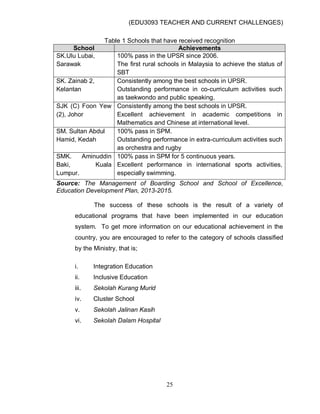
recognized 66 schools as High Performance Schools (SBT) based on
excellence in academic and non-academic. Among the schools that have
received recognitions are:
(EDU3093 TEACHER AND CURRENT CHALLENGES)
25
Table 1 Schools that have received recognition
School Achievements
SK.Ulu Lubai,
Sarawak
100% pass in the UPSR since 2006.
The first rural schools in Malaysia to achieve the status of
SBT
SK. Zainab 2,
Kelantan
Consistently among the best schools in UPSR.
Outstanding performance in co-curriculum activities such
as taekwondo and public speaking.
SJK (C) Foon Yew
(2), Johor
Consistently among the best schools in UPSR.
Excellent achievement in academic competitions in
Mathematics and Chinese at international level.
SM. Sultan Abdul
Hamid, Kedah
100% pass in SPM.
Outstanding performance in extra-curriculum activities such
as orchestra and rugby
SMK. Aminuddin
Baki, Kuala
Lumpur.
100% pass in SPM for 5 continuous years.
Excellent performance in international sports activities,
especially swimming.
Source: The Management of Boarding School and School of Excellence,
Education Development Plan, 2013-2015.
The success of these schools is the result of a variety of
educational programs that have been implemented in our education
system. To get more information on our educational achievement in the
country, you are encouraged to refer to the category of schools classified
by the Ministry, that is;
i. Integration Education
ii. Inclusive Education
iii. Sekolah Kurang Murid
iv. Cluster School
v. Sekolah Jalinan Kasih
vi. Sekolah Dalam Hospital
(EDU3093 TEACHER AND CURRENT CHALLENGES)
26
Discuss
Analyse the management style practiced in the school where you are
working. Compare and contrast the pattern of your school
management with any High Performance Schools (SBT). Discuss your
findings with the lecturer during lecture.
1.11.2Report and Analysis of National Education Achievements –
International
TIMSS 2011 results showed that Malaysian students failed to meet
the minimum skill level in Mathematics and Science. Not encouraging
results were also recorded among Malaysian students in the PISA
assessment in 2009. Although the TIMSS and PISA results show bad
performance among the Malaysian students (moe.gov.my/en/pelan-
development-education-malaysia-2013, ...). there are a lot of success
attained by the students and schools that were on par with the
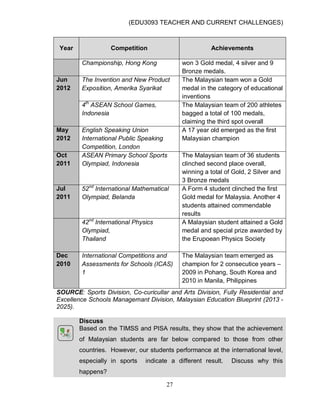
international standards. Below is the evidence of the success:
Table 2 Examples of Malaysian students‟ International achievements
Year Competition Achievements
Nov
2012
World Robot Olympiad(WRO
2012) Malaysia
Malaysian teams swept 9 medals,
making Malaysia the overall
champion fot the third time
Jul
2012
8th
International Exhibition for
Young Inventors, Thailand
The Malaysian team won a Gold
medal for their invention
Genius Olympiad 2012
International High School Project
Fair on Environment, New York
Two 14 year old student bagged
third proze in the competition
2nd
International Folk Song and
Dance Festival, Georgia
The Malaysian team of 15
performers won the Gold and Silver
Diploma prizes
5th
Asian Schools Badminton The Malaysian team of 16 players
(EDU3093 TEACHER AND CURRENT CHALLENGES)
27
Year Competition Achievements
Championship, Hong Kong won 3 Gold medal, 4 silver and 9
Bronze medals.
Jun
2012
The Invention and New Product
Exposition, Amerika Syarikat
The Malaysian team won a Gold
medal in the category of educational
inventions
4th
ASEAN School Games,
Indonesia
The Malaysian team of 200 athletes
bagged a total of 100 medals,
claiming the third spot overall
May
2012
English Speaking Union
International Public Speaking
Competition, London
A 17 year old emerged as the first
Malaysian champion
Oct
2011
ASEAN Primary School Sports
Olympiad, Indonesia
The Malaysian team of 36 students
clinched second place overall,
winning a total of Gold, 2 Silver and
3 Bronze medals
Jul
2011
52nd
International Mathematical
Olympiad, Belanda
A Form 4 student clinched the first
Gold medal for Malaysia. Another 4
students attained commendable
results
42nd
International Physics
Olympiad,
Thailand
A Malaysian student attained a Gold
medal and special prize awarded by
the Erupoean Physics Society
Dec
2010
International Competitions and
Assessments for Schools (ICAS)
1
The Malaysian team emerged as
champion for 2 consecutice years –
2009 in Pohang, South Korea and
2010 in Manila, Philippines
SOURCE: Sports Division, Co-curicullar and Arts Division, Fully Residential and
Excellence Schools Managemant Division, Malaysian Education Blueprint (2013 -
2025).
Discuss
Based on the TIMSS and PISA results, they show that the achievement
of Malaysian students are far below compared to those from other
countries. However, our students performance at the international level,
especially in sports indicate a different result. Discuss why this
happens?
(EDU3093 TEACHER AND CURRENT CHALLENGES)
28
References:
Department of National Unity and National Integration. (2005). Retrieved from
http:// www.jpnin.gov.my/en/isytihar_krn
Dewey, J. (1996). Democracy and education. Retrieved from http://
www.gutenberg.org/files/852/852-h/852-h.htm
Financial Times Lexicon. (2013). Globalisation Definition from Financial Times
Lexicon. Retrieved from :http://lexicon.ft.com/term?term=globalisation
Kiyao, R. (1981). Democratization of education: A Tanzania case. Retrieved
from http:// unesdoc.unesco.org/images/0004/000466/046603EB.pdf
Collin Dictionary. (2013).
Vyas, M. K. (1993). National integration and the law: Burning issues and
challenges. New Delhi: Deep & Deep Publications.
(EDU3093 TEACHER AND CURRENT CHALLENGES)
29
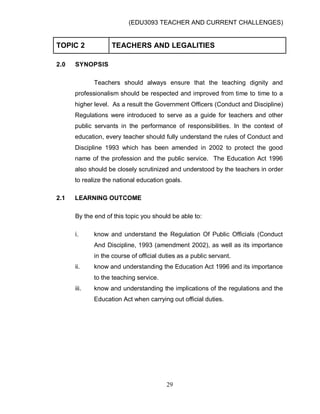
TOPIC 2 TEACHERS AND LEGALITIES
2.0 SYNOPSIS
Teachers should always ensure that the teaching dignity and
professionalism should be respected and improved from time to time to a
higher level. As a result the Government Officers (Conduct and Discipline)
Regulations were introduced to serve as a guide for teachers and other
public servants in the performance of responsibilities. In the context of
education, every teacher should fully understand the rules of Conduct and
Discipline 1993 which has been amended in 2002 to protect the good
name of the profession and the public service. The Education Act 1996
also should be closely scrutinized and understood by the teachers in order
to realize the national education goals.
2.1 LEARNING OUTCOME
By the end of this topic you should be able to:
i. know and understand the Regulation Of Public Officials (Conduct
And Discipline, 1993 (amendment 2002), as well as its importance
in the course of official duties as a public servant.
ii. know and understanding the Education Act 1996 and its importance
to the teaching service.
iii. know and understanding the implications of the regulations and the
Education Act when carrying out official duties.
(EDU3093 TEACHER AND CURRENT CHALLENGES)
30
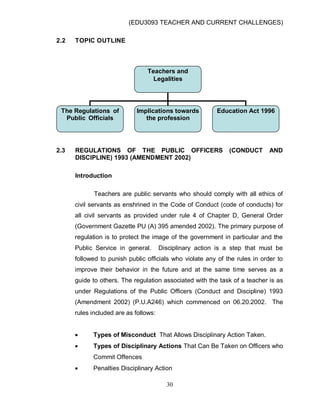
2.2 TOPIC OUTLINE
2.3 REGULATIONS OF THE PUBLIC OFFICERS (CONDUCT AND
DISCIPLINE) 1993 (AMENDMENT 2002)
Introduction
Teachers are public servants who should comply with all ethics of
civil servants as enshrined in the Code of Conduct (code of conducts) for
all civil servants as provided under rule 4 of Chapter D, General Order
(Government Gazette PU (A) 395 amended 2002). The primary purpose of
regulation is to protect the image of the government in particular and the
Public Service in general. Disciplinary action is a step that must be
followed to punish public officials who violate any of the rules in order to
improve their behavior in the future and at the same time serves as a
guide to others. The regulation associated with the task of a teacher is as
under Regulations of the Public Officers (Conduct and Discipline) 1993
(Amendment 2002) (P.U.A246) which commenced on 06.20.2002. The
rules included are as follows:
 Types of Misconduct That Allows Disciplinary Action Taken.
 Types of Disciplinary Actions That Can Be Taken on Officers who
Commit Offences
 Penalties Disciplinary Action
Teachers and
Legalities
The Regulations of
Public Officials
Implications towards
the profession
Education Act 1996
(EDU3093 TEACHER AND CURRENT CHALLENGES)
31
RULE 3A.
Public servants must comply with the rules laid down and disciplinary
action may be imposed on the defaulting officer.
RULE 3B
An officer is required to give an undertaking as provided in the Public
Officers Regularions (PU.A.176) Appointment, Promotion and Termination
of Service.
RULE 3C
It is the responsibility of an officer to exercise disciplinary control and
supervision over his subordinates and take appropriate action promptly
against any officer who violates any provision of these rules.
Officers who fail to exercise control and supervision or failed to take action
against his subordinate who violates any provision of these rules shall be
deemed to be negligent and irresponsible and he shall be liable to
disciplinary action.
RULE 4 (1)
An officer shall at all times allegiance to the Yang di-Pertuan Agong,
country and the Government.
Officers should always care for; preserve and defend the sovereignty and
national dignity; respect and obedient to the law and strive to serve the
country. Some examples of violation of regulation 4 (1) are as follows:
• abetting the enemy of the state
• leaking government secrets.
• disparaging and undermine government policies and actions.
• become a member of Jemaah Islamiyah
• participate in the Malaysian Militant Union
(EDU3093 TEACHER AND CURRENT CHALLENGES)
32
RULE 4 (2)
An officer is not allowed to:
 prioritize personal interest to public duty
 behave in such a manner that may cause personal interests
conflicting with public duties
 behave in any manner that is likely to cause reasonable suspicion
 behave in a way that can worsen / discredit the public service
 be inefficient or having lack of effort
 be dishonest
 be irresponsible
 take or attempt to take any form of outside influence or pressure
 disobey or against the superiors
 negligent in performing its duties
RULE 7: Drug abuse, officer can be terminated for public interest
[Rule 49]
If the officer has reached Retirement Age Options. Example; the violation
of Rule 7 is taking marijuana, morphine, heroin or drugs.
RULE 9 : Providing and receiving gifts
A civil servant can not receive / provide any forms of gifts that can be in
any way affect the official duties as it is conflicting with Rule 4. Examples
of violation of Rule 9 is like a contractor celebrating the head of
department that has become the member of the tender board
[entertainment = meals, hotels, airfares and others].
RULE 11 : Maintain living standards over emoluments / valid income
An officer is not allowed to:
 maintain living standards over emoluments / valid income
 acquire / own any financial resources or property disproportionate
or unreasonable to emoluments / legitimate income
(EDU3093 TEACHER AND CURRENT CHALLENGES)
33
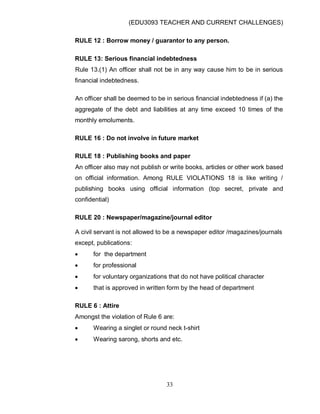
RULE 12 : Borrow money / guarantor to any person.
RULE 13: Serious financial indebtedness
Rule 13.(1) An officer shall not be in any way cause him to be in serious
financial indebtedness.
An officer shall be deemed to be in serious financial indebtedness if (a) the
aggregate of the debt and liabilities at any time exceed 10 times of the
monthly emoluments.
RULE 16 : Do not involve in future market
RULE 18 : Publishing books and paper
An officer also may not publish or write books, articles or other work based
on official information. Among RULE VIOLATIONS 18 is like writing /
publishing books using official information (top secret, private and
confidential)
RULE 20 : Newspaper/magazine/journal editor
A civil servant is not allowed to be a newspaper editor /magazines/journals
except, publications:
 for the department
 for professional
 for voluntary organizations that do not have political character
 that is approved in written form by the head of department
RULE 6 : Attire
Amongst the violation of Rule 6 are:
 Wearing a singlet or round neck t-shirt
 Wearing sarong, shorts and etc.
(EDU3093 TEACHER AND CURRENT CHALLENGES)
34
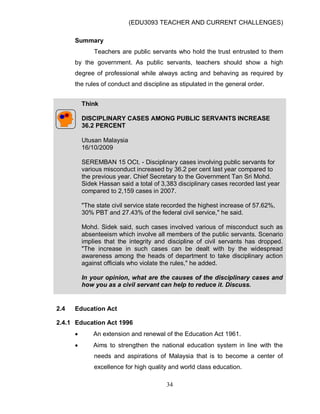
Summary
Teachers are public servants who hold the trust entrusted to them
by the government. As public servants, teachers should show a high
degree of professional while always acting and behaving as required by
the rules of conduct and discipline as stipulated in the general order.
Think
DISCIPLINARY CASES AMONG PUBLIC SERVANTS INCREASE
36.2 PERCENT
Utusan Malaysia
16/10/2009
SEREMBAN 15 OCt. - Disciplinary cases involving public servants for
various misconduct increased by 36.2 per cent last year compared to
the previous year. Chief Secretary to the Government Tan Sri Mohd.
Sidek Hassan said a total of 3,383 disciplinary cases recorded last year
compared to 2,159 cases in 2007.
"The state civil service state recorded the highest increase of 57.62%,
30% PBT and 27.43% of the federal civil service," he said.
Mohd. Sidek said, such cases involved various of misconduct such as
absenteeism which involve all members of the public servants. Scenario
implies that the integrity and discipline of civil servants has dropped.
"The increase in such cases can be dealt with by the widespread
awareness among the heads of department to take disciplinary action
against officials who violate the rules," he added.
In your opinion, what are the causes of the disciplinary cases and
how you as a civil servant can help to reduce it. Discuss.
2.4 Education Act
2.4.1 Education Act 1996
 An extension and renewal of the Education Act 1961.
 Aims to strengthen the national education system in line with the
needs and aspirations of Malaysia that is to become a center of
excellence for high quality and world class education.
(EDU3093 TEACHER AND CURRENT CHALLENGES)
35
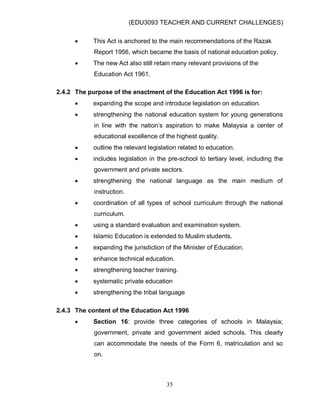
 This Act is anchored to the main recommendations of the Razak
Report 1956, which became the basis of national education policy.
 The new Act also still retain many relevant provisions of the
Education Act 1961.
2.4.2 The purpose of the enactment of the Education Act 1996 is for:
 expanding the scope and introduce legislation on education.
 strengthening the national education system for young generations
in line with the nation‟s aspiration to make Malaysia a center of
educational excellence of the highest quality.
 outline the relevant legislation related to education.
 includes legislation in the pre-school to tertiary level, including the
government and private sectors.
 strengthening the national language as the main medium of
instruction.
 coordination of all types of school curriculum through the national
curriculum.
 using a standard evaluation and examination system.
 Islamic Education is extended to Muslim students.
 expanding the jurisdiction of the Minister of Education.
 enhance technical education.
 strengthening teacher training.
 systematic private education
 strengthening the tribal language
2.4.3 The content of the Education Act 1996
 Section 16: provide three categories of schools in Malaysia;
government, private and government aided schools. This clearly
can accommodate the needs of the Form 6, matriculation and so
on.
(EDU3093 TEACHER AND CURRENT CHALLENGES)
36
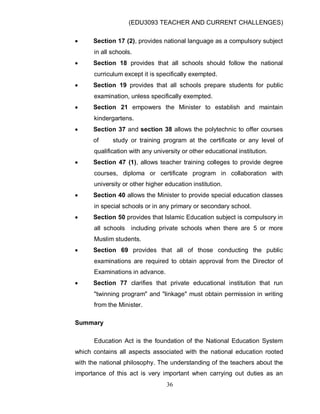
 Section 17 (2), provides national language as a compulsory subject
in all schools.
 Section 18 provides that all schools should follow the national
curriculum except it is specifically exempted.
 Section 19 provides that all schools prepare students for public
examination, unless specifically exempted.
 Section 21 empowers the Minister to establish and maintain
kindergartens.
 Section 37 and section 38 allows the polytechnic to offer courses
of study or training program at the certificate or any level of
qualification with any university or other educational institution.
 Section 47 (1), allows teacher training colleges to provide degree
courses, diploma or certificate program in collaboration with
university or other higher education institution.
 Section 40 allows the Minister to provide special education classes
in special schools or in any primary or secondary school.
 Section 50 provides that Islamic Education subject is compulsory in
all schools including private schools when there are 5 or more
Muslim students.
 Section 69 provides that all of those conducting the public
examinations are required to obtain approval from the Director of
Examinations in advance.
 Section 77 clarifies that private educational institution that run
"twinning program" and "linkage" must obtain permission in writing
from the Minister.
Summary
Education Act is the foundation of the National Education System
which contains all aspects associated with the national education rooted
with the national philosophy. The understanding of the teachers about the
importance of this act is very important when carrying out duties as an
(EDU3093 TEACHER AND CURRENT CHALLENGES)
37
educator so that they could be in line with the vision and mission of the
ministry of education and government in general.
Think
Study and analyse the content of the sections in the Education Act
1996 (Act 550) which has been allocated to your group. You are
required to state the implications of the section to pupils, teachers,
schools, curriculum or the National Education System.
Exercise 1
Discuss why a teacher as a public servant needs to comply with all the rules
and regulations of public officials (conduct and discipline) while performing his
official duties.
Rest
Rest a while...before you proceed to the next exercise.
Exercise 2
Make a comparison between the 1961 Act and the Education Act
1996 and discuss its implications on the national education system.
Surf the web
Surf the web for more information.
End
Happy Trying...
(EDU3093 TEACHER AND CURRENT CHALLENGES)
38
2.5. Person with Disabilities Act 2008 (OKU Act 2008)
Persons with disabilities are considered as part of our society. They
contribute to the development and growth of our country. Therefore it is the
responsibility of government to ensure that the welfare and well being of
this group of people are being taken care of.
Person with Disabilities Act 2008 (OKU Act 2008) was introduced
based on the concept of human right which means people with difficulty to
move (physical), see, hear, speak (speech) and learn also have rights in
doing whatever is done by a person without disabilities. It is an act to
provide for the registration, protection, rehabilitation, development and
wellbeing of persons with disabilities, and the establishment of the National
Council for Persons with Disabilities. The Persons with Disabilities Act was
passed on 10th December 2007 in the Malaysian Parliament. The act
came into operation on 7 July 2008. The ministry has targeted two areas,
mainly accessibility and employment as priorities.
2.5.1 The Purpose of Person with Disabilities Act 2008
National disability legislation is regarded as a prerequisite for an
effective national disability policy. It should not only protect the human
rights of persons with disabilities but also provide for the implementation of
those rights, aiming at their full integration in society.
 “Persons with disabilities” according to Person with Disabilities Act
2008 include those who have long term physical, mental, intellectual
or sensory impairments which in interaction with various barriers
may hinder their full and effective participation in society
 Person with Disabilities Act 2008 is a law which protects the rights
of persons with disabilities. The law says that persons with
disabilities will have same opportunity as other people. The act also
(EDU3093 TEACHER AND CURRENT CHALLENGES)
39
provides good quality of life of persons with disabilities by facilitating
easy access to the following:
 Places and services
 Persons with disabilities shall have the right to access to
and use of, public facilities, amenities, services and
buildings open or provided to the public on equal basis with
persons without disabilities.
 Government has to ensure that such public facilities,
amenities, services and buildings are of universal design in
order to facilitate their access and used by persons with
disabilities.
 Public transport
 Persons with disabilities shall have the right to access to
public transport easily. Government has to ensure that the
design of public transport enable everyone to use.
 Education
 Persons with disabilities shall not be excluded from the
general education system on the basis of disabilities, and
children with disabilities shall not be excluded from pre-
school, primary, secondary and higher education including
vocational training and lifelong learning.
 The government and institutions must provide teaching
materials and good support such as sign Language and the
use of braille.
 Employment
 Persons with disabilities shall have the right to access to
employment on equal basis.
 Employer shall protect the rights of persons with disabilities,
on equal basis with persons without disabilities, including
equal opportunities and equal remuneration for work of
(EDU3093 TEACHER AND CURRENT CHALLENGES)
40
equal value, safe and healthy working conditions, protection
from harassment and the redress of grievances.
 Computer and IT
 The government and provider of IT should make sure the
rights to access computer and information technology (IT) of
persons without disabilities are the same as other people.
 The Government and the provider of information,
communication and technology shall provide the information,
communication and technology in accessible formats and
technologies appropriate to different kind of disabilities in a
timely manner and without additional cost in order to
enable persons with disabilities to have such access .
 The Government and the private sector shall accept and
facilitate the use of Malaysia Sign Language, Braille,
augmentative and alternative communication, and all other
accessible means, modes and formats of communication.
 Cultural life
 Develop the potential of persons with disabilities in art or
other areas
 Persons with disabilities have the right to be known for own
culture and language, to enjoy the way of life in society
same as other people and to enjoy TV, movie, theatre,
museum, library and holiday
 Habilitation and Rehabilitation
 Private healthcare service provider and non-governmental
organization shall take effective and appropriate measures
to enable persons with disabilities to attain and maintain
maximum independence, full physical, mental, social and
vocational ability and full inclusion and participation in all
aspects of life.
(EDU3093 TEACHER AND CURRENT CHALLENGES)
41
 The government should promote and strengthen
community-based rehabilitation programme to provide early
intervention, rehabilitation and training
 Health
 The government has to ensure persons with disabilities to
have access to health services, including health related
rehabilitation.
 The government shall have in its employment speech
therapist, physiotherapist and occupational therapist
 The government must provide prevention of further
occurrence of disabilities, immunization, nutrition and
genetic counseling.
 Protection of Persons with Severe Disabilities
 The government will provide protection and support to
ensure that persons with severe disabilities have a good
quality of life after their caregivers passed away
 Non-governmental organization intending to provide
institutional care for persons with severe disabilities or the
caregivers for persons with severe disabilities may make an
application for an incentive for providing such care to the
council.
 Help during Emergency
 Persons with disabilities have the right to have assistance
on equal basis with persons without disabilities in situations
of risk including during war or natural disaster
2.5.2 National Council of Persons with Disabilities.
Besides that, the government also has formed the National Council
of Persons with Disabilities. The roles of the councils are as followed:
 The Council will work together with government, organisations and
companies to carry out plans.
(EDU3093 TEACHER AND CURRENT CHALLENGES)
42
 The Council will give suggestions and advice to government to
improve the support for Persons with Disabilities
 Help people know more about Persons with Disabilities
 Improve the education system
 Promote job opportunities and skills training for Persons with
Disabilities
Summary
Persons with disabilities are part of our society. They have the
rights to enjoy the development of our country in all aspects such as
education, transportation, information and communications technology,
health services, public facilities, security and others. Government‟s
commitment in helping persons with disabilities is demonstrated in the
Person with Disabilities Act 2008 (OKU Act 2008) and National Council of
Persons with Disabilities.
2.6 Education Regulations (Special Education ) 1997
The introduction of Education Regulations (Special Education) 1997
is one of the government’ efforts in ensuring democratisation of education
and equality of access to education are given to all citizen regardless of
their background, socioeconomic status or disabilities of individual.
2.6.1 Education Regulations (Special Education) 1997 came into operation
on 1 January 1998 with the interpretation as:
“Student with special education‟ means student with vision disabilities,
hearing disability and learning disabilities”.
2.6.2 Special Education Programme is interpreted as:
a) a program which is held in a special school for students with vision
disabilities or hearing disability;
b) an integrated program which is held in normal school for students
with vision disabilities, hearing disability or learning disabilities; and
(EDU3093 TEACHER AND CURRENT CHALLENGES)
43
c) an inclusive education program where students with special needs
are present in a class together with normal students.
2.6.3 Requirement To Attend Special Education Programme
All students with special needs who are eligible to be educated and
have the ability to manage themselves without the assistant of people can
be accepted to school as stated in Education Regulations (Special
Education ) 1997, Part ll, 3(2), section 41 of Education Act 1996.
i. For government and government aided schools, students with
special needs who are eligible to be educated are qualified to attend
Special Education Programme, except the following:
a) student with physical disability but has the mental ability to
learn as normal student, and
b) students with variety of disabilities or severe disabilities or
mentally retarded.
ii. A student with special needs is an individual who is eligible to be
educated and have the ability to manage themselves without the
assistant of people and has been certified by a panel which consists
of medical officer, officer of the Ministry of Education and officer of
Society Welfare Department.
2.6.4 Curriculum
In the implementation of the curriculum of special education,
teachers can adapt and adopt the methodology and techniques of
teaching and learning, allocation of time, arrangement of activities,
subjects and teaching materials to achieve the goals of special education.
(EDU3093 TEACHER AND CURRENT CHALLENGES)
44
Summary
Education Regulations (Special Education ) 1997 are specially
made to safeguard the implementation of democratisation of education in
our national education system whereby all citizen can access to education
regardless their physical condition and background. Government’s
commitment is clearly demonstrated in the Malaysian Education Blueprint
2013-2025 under the topic ‘special needs group’. The regulations will be
improvised continuously especially the amendment of Education
Regulations (Special Education ) 2013 which has been announced on the
18 July 2013 and came into operation in all government and government
aided school that implement special education in Malaysia.
Discuss
Refer to the website and discuss how Malaysian Education Blueprint
(2013-2025) and Person with Disabilities Act 2008 (OKU Act 2008) could
help in realising the purpose of inclusive education for children with
special needs.
References
1. „Akta Pendidikan 1996‟; http://ipt.moe.gov.my.
2. Surat Pekeliling Perkhidmatan, Bil.1 (2008).
3. Surat pekeliling perkhidmatan, bil.2 (1985).
4. Surat Pekeliling Ikhtisas bil.5/1998, Akta Pendidikan 1996 dan Peraturan-
peraturan akta Pendidikan 1996.
5. „Undang-undang Malaysia, Perintah Am, Bab A-G‟ (2006), International
Law Book Service, Petaling Jaya:Selangor.
(EDU3093 TEACHER AND CURRENT CHALLENGES)
45
TOPIC 3 EMOTIONAL STRESS AMONG STUDENTS
3.0 SYNOPSIS
Emotional stress does not only exist among adults, but children also
experience emotional stress. The impact of emotional stress on children is
greater than on adults, because children have less experience and ability
to cope with emotional stress. Thus, emotional stress among children,
especially school children cannot be overlooked.
3.1 LEARNING OUTCOMES
By the end of this topic you should be able to:
 explain emotional disturbance among children
 explain the causes of students‟ emotional disturbance
 identify measures to overcome the problem of emotional
disturbance among students.
 explain child rights based on Convention on the Rights of the
Child 1989
 states efforts to protect children in Malaysia
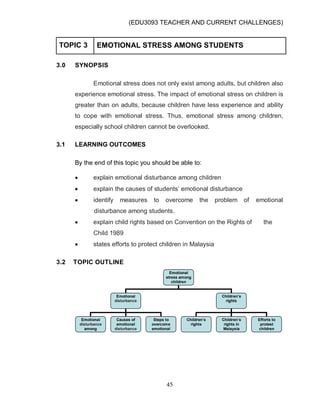
3.2 TOPIC OUTLINE
Emotional
stress among
children
Emotional
disturbance
Children’s
rights
Emotional
disturbance
among
children
Causes of
emotional
disturbance
Steps to
overcome
emotional
disturbance
among
students
Children’s
rights
Children’s
rights in
Malaysia
Efforts to
protest
children
(EDU3093 TEACHER AND CURRENT CHALLENGES)
46
3.3 EMOTIONAL DISTURBANCE AMONG CHILDREN
3.3.1 Emotional disturbance among students
Emotional disturbance is a situation where an individual suffers
internal conflicts that are difficult to overcome. Dewan Bahasa and
Pustaka Dictionary explains emotional disturbance as resulted from
conflicts which are not resolved and they are characterized by anxiety
either through speech or certain behavior. Conflict or internal disturbances
will have an impact on a person's behavior. Emotional disturbances occur
when situations or problems encountered by individuals are beyond their
ability to overcome it. Emotional disturbances can be experienced by
anyone, including children, especially students.
3.3.2 Signs of emotional disturbances among students
Emotional disturbances which are unsolved will lead to mental
disturbances, various changes in behavior such as fear, anxiety and
depression. Students with emotional disturbances can be identified by
several symptoms. Among the signs of emotional disturbance among the
students are:
 Lack of appetite
 Throat Nausea and vomiting
 Like to be alone/ isolate themselves
 Frequent stomach pain / headaches
 Depression
 Appears sad / frustrated
 Lack of confidence
 Frequent crying for no reason
 Bedwetting
 Like biting nails
 Irritable
(EDU3093 TEACHER AND CURRENT CHALLENGES)
47
 Acting aggressive / impulsive
 Excessive fear and anxiety
 Lethargic / tired and always sleepy
 Frequent outbreaks of disease
 Strange behavior
3.3.3 Causes of emotional disturbance
There are many causes to emotional disturbance among students at
school. The causes can be categorized into family, peer, teachers, school
and environment. School environment, events happened in family, peers
and others can caused emotional disturbance to students (Terri Mouro
(2004).
 Family
 Inharmonious family, quarrels and divorce of parents
 Instability of the family economic status and financial
problems
 Dysfunctional relationship between family members,and
frequent quarrels among sibling
 Less attention, appreciation and affection from their parents.
 Abused by parents or guardian
 Parental favoritism
 Peer Factors
 Peers‟ aggressiveness and often fight
 Ridiculed and humiliated by peers
 Threatened and bulled by peers
 Peers who like to show off
Discussion
Discuss with your classmates steps that you can perform to identify
students who are experiencing emotional disturbance.
(EDU3093 TEACHER AND CURRENT CHALLENGES)
48
 Neglected and not accepted by peers
 Teacher Factor
 Teacher who practices favoritism / discrimination
 Leadership style and teaching methods that are less
appropriate
 Teacher‟s communication skills
 Teacher‟s behavior is harsh and aggressive
 Lack of closeness between teacher and students
 Autocratic leadership style
 School Factors
 School environment is not conducive
 Lack of school facilities
 Attitude of school administrators
 Culture of the school that emphasize academic excellence
 School discipline and rules are too strict
 Environmental factors
 Members of the society are materialistic
 Jealousy and prejudice of the members of the society
 Lack of understanding among members of the society
 Discrimination in the society
Activity 1
Individually, you are required to make a mind map on the
causes of emotional disturbance among students.
(EDU3093 TEACHER AND CURRENT CHALLENGES)
49
3.3.4 Steps to overcome the emotional disturbances of students
Emotional disturbances among children should not be taken lightly
by teachers and parents. Teachers who are professional and responsible
should be aware and sensitive to changes in students who experience
emotional disturbances. Then the teacher should take appropriate steps to
help students to overcome their emotional disturbances. Among the steps
that can be implemented are:
 discuss individually with the student to identify the cause of his
emotional disturbances
 provide appropriate attention and appreciation to students
 provide motivation, encouragement and positive support to
enhance self-confidence and self-concept
 refer students to school counselor
 talk to the students „parents or guardians
 teachers and administrators practice democratic leadership
 vary teaching methods and strategies to meet the needs and
requirements of students
 creating a conducive learning environment
3.4 CHILDREN’S RIGHT
 Children are important human capital of a country. Human capital
can be developed to an optimum level by providing a safe and
conducive environment.
 Therefore, the protection of children from being neglected, abused,
violence and exploitation is an important aspect and should be
given priority.
Let’s Think
How could you help children who suffer from emotional disturbances
due to stress caused by teacher in your school.
(EDU3093 TEACHER AND CURRENT CHALLENGES)
50
 Assembly of the United Nations (UN) on 20 November 1989
adopted the Convention on Rights of the Child to provide protection
to children of the world. Based on the document of this convention,
children are given protection from being neglected, abused,
exploited and to have certain rights. Malaysia has adopted the
convention.
 Based on this convention, all children regardless of gender,
background, socio-economic status, religious beliefs and abilities
are recognized as individuals with rights to grow up and being
protected of their life.
3.4.1 Principles of the Convention
This Convention has established several principles, namely:
 No discrimination against children
All children regardless of race, color, sex, language, religion,
political opinion, national origin, ethnic group or society, property,
disability, birth or status, or parent / guardian have the same rights.
 The best interests of the child
The primary consideration in all cases is the best interest of the
child.
 The right to life and grow
Children have the right to life and develop in all aspects of their
lives, including physical, emotional, psycho-social, cognitive, social
and culture
 Right to participation
Children should be allowed to participate actively in all events that
involved their life and are free to give their views and opinions. They
have a right to be heard and taken seriously
3.4.2 Definition of a child
Article 1 : a child is recognized as a person under 18, unless the national
laws recognize the majority age earlier
(EDU3093 TEACHER AND CURRENT CHALLENGES)
51
3.4.3 Childrens’ right
 The right to life
 The right to protection
 The right to development
 The right to participation
The right to life
Children have the right to basic needs such as food, clean water, shelter
and health care. Parent or guardian are responsible to ensure children‟s
right to life is fulfilled.
Article 6: All children have the inherent right to life and the state has an
obligation to ensure the existence of the child's development
The right to Protection
Rights to protection of children include protection from discrimination,
abuse and neglect. Parents or guardians must provide care and protection
to children. Children without families or refugees should be given
appropriate protection. At the same time, protection from sexual, physical,
and exploitation, neglect, drug abuse and discrimination are parts of
children's rights. The State shall provide protection to children if they are
neglected by their parents or guardians.
Article 3: The State shall provide adequate care to children through
relevant local authority if children are being neglected by parents or
guardians.
Article 8: The State has an obligation to protect, and if necessary
strengthen the fundamental aspects of identity, including nationality and
family ties.
(EDU3093 TEACHER AND CURRENT CHALLENGES)
52
The right to development
Parents, members of the extended family or guardians are responsible to
ensure that children are developed in the aspects of physical, mental,
emotion, spiritual, moral and social. Education should be given to children
for them to develop.
Article 5: The State must respect the responsibility of parents or members
of the extended family in providing guidance to children based on their
abilities.
The right to participation
Children are also given the freedom of expression, giving opinions,
association and play with their peers. The children‟s views and opinions
relating to their affairs must be heard and adopted. They are also entitled
to participate in activities or programs of society and clubs.
Article 12: All children have the right to express their views freely in all
matters relating to children.
3.5 CHILDREN'S RIGHTS IN MALAYSIA
Malaysia has shown a strong commitment to the Convention on
Rights of the Child,(1989) by providing environment, opportunities and
platform for the rights of the child to be implemented. Among Malaysia's
commitment to the recognition of children's rights, the Malaysian
Government has confirmed and signed the following conventions:
 Convention on Rights of Children: March 19, 1995
Visit the Web site: http://www.scribd.com/doc/101029420/528-
konvensyen-Mengenai-Hak-Kanak-kanak-Versi-Bergambar
Read carefully the information contained in the Convention on the
Rights of the Child. Identify the rights included therein. Discuss with
your lecturer and classmates.
(EDU3093 TEACHER AND CURRENT CHALLENGES)
53
 Convention on the Elimination of All Forms of Discrimination against
Women: August 4, 1995
 International Labour Organisation Convention 138 (minimum age for
employment): 1997
 International Labour Organisation Convention 182 (forms of child
labor the most severe) on 10 November 2000.
Malaysian children‟s rights are always given attention by the
government. Malaysia Children's Rights include the right to life, right to
protection, right to development and right to participation.
 The right to life
Parents or guardians of children in Malaysia must provide for the basic
needs of children within their means. Children need a shelter which is nice
and conducive, balanced diet and clean water. It can assure the survival of
a positive and cheerful life. Balanced diet and clean water are needed to
enable children to have healthy body for a more positive and active life.
 The right to protection
Children in Malaysia are valuable asset for the future of this country.
Therefore, children in Malaysia are protected from any types of negative
acts such as abuse, neglect , exploitation and slavery . Protection will be
given to children who have been abused either physically, emotionally or
sexually. Issues of abuse, molestation, neglect and exploitation by
caregivers is a continuous phenomenon and need to be combated. The
Malaysian government is looking at these issues as a disaster and threat
to the national development. Those who commit abuse, neglect and
exploitation of children will be severely punished .
 The right to development
In line with the aspirations of the Children's Rights Convention, Malaysia
has given serious focus in the holistic development of children which
(EDU3093 TEACHER AND CURRENT CHALLENGES)
54
includes physical, emotional, spiritual, intellectual and social. Parents must
provide children with formal education by sending children to school and
informal education such as religious knowledge and moral value.
Children„s interest and love for knowledge must be nurtured since
childhood to ensure children‟s development in various aspects.
 The right to participation
Children in Malaysia are given the right to associate and play with their
peers freely without restrictions. Through play they can interact with their
peers, thus enhance their social skills. They can associate freely
regardless of race, ethnicity, color of the skin, religion and others . Children
in Malaysia are not prohibited to join and become members of associations
and clubs.
3.6 THE EFFORTS IN PROTECTING CHILDREN
In order to ensure that children in Malaysia have adequate
protection, a number of efforts and legislative acts have been developed.
Among them;
3.6.1 Protection of Children Act 1991 (Act 468)
This Act is related to the conservation and protection of children
who needed protection from abuse, neglect, exploitation and slavery.
Section 2 in relation to a child in need of protection if:
 Children are most likely being assaulted or abused from the aspects
of physical, emotional and sexual.
 Caregivers of children are not eligible or have no ability to care for
and protect the child adequately.
 Caregivers of children have committed negligence or unwilling to
take care of and provide children‟s needs adequately.
(EDU3093 TEACHER AND CURRENT CHALLENGES)
55
 There are no guardians willing to take care of the abandoned
children ; no other person qualified to take care of.
 Neglect performed on children in need of inspection, investigation or
treatment.
 Children‟s behavior that could hurt himself or someone else or
no one is willing to take care or improve the situation.
 There is conflict between children and guardian or between
guardians. The dispute resulted in the affected family relationships
and caused emotional disorders in children.
 Children who are involved with any of the offenses in Chapter XVI
of the Penal Code.
3.6.2 The Park Childcare 1984 [Act 308]
 The Act is related to the registration, regulation and inspection of
child care or nursery
 The Act provides protection to children under the age of 4 years.
 This Act is to assure health, safety and education of children under
4 years.
 Control, supervision and inspection can be carried out by
enforcement gardens registration for childcare
 Related parties have the authority to enter and examine the
childcare parks for the health, safety and education of
children.
3.6.3 Adoption Act 1952 (Act 257)
 To protect children from being abused, neglected and exploited.
 The Act is designed to regulate the procedures of adoption and
ensure the welfare of children.
 Legal provisions of this act is as enacted in Ordinance to adopt
a child in 1960.
(EDU3093 TEACHER AND CURRENT CHALLENGES)
56
3.6.4 Children Act 2001 (amended in 2002)
 Children Act 2001 (amended in 2002) effective on August 1, 2002
is a combination of three previous law of the Child Protection Act
1991, the Women and Girls Protection Act 1973 and the Juvenile
Court Act.
 It is the law relating to the preservation, protection and rehabilitation
of children in order to protect the welfare and interests of children.
 Among the points highlighted by this Act is the duty and
responsibility of parents or guardians in maintaining the well-being
of children, the responsibility to inform the cases of child abuse, the
establishment of the Court For Children, trial procedures,
sentencing and so on.
 The term children pursuant to this act are those aged less than 18
years.
 The Act provides for the duties and responsibilities of the legal
parents or guardians to care for their children's condition.
 In addition, the Act imposes duties to members of the child's family
to inform the patron if they have reasonable grounds that a child
has been harmed physically or emotionally as a result of being ill-
treated, neglected, abandoned or exposed, or sexually abused.
 Rationale for family members of children subject to a duty to inform
about the possibility that a child is abused is because they are
among the closest to the child . They are also likely to find out why
a child is being abused.
 If a child is accused of any offense, the Court For Children shall
order the mother and father of the child to be presented in court
unless the court is satisfied that it would be unreasonable to
require their presence.
 The Act also provides that if the guardian abuses, neglects,
abandons or exposes the child or causing or permitting the child to
be abused, neglected, abandoned or exposed to any cause of
(EDU3093 TEACHER AND CURRENT CHALLENGES)
57
physical injury, emotional injury or sexual abuse, then the person
has committed an offense under section 31 of the Children Act
2001.
 The parent or guardian of the child is considered to neglect the child
if he does not provide the children food, clothing, medical or
dental treatment, accommodation or care. Parent or guardian can
be sentenced or fined not more than RM 10,000.00 or imprisonment
not exceeding ten years or to both. In addition, the court also may
order the person to execute a bond of good behavior.
3.6.5 Prevention programs and rehabilitation of children
Pprotection team and children's activity center have been
established at the state and district levels aimed at providing services to
families and children who are exposed to violence, sexual abuse, torture
and so on.
3.6.6 Establishment Detect Child Abuse
The team was established in district hospitals and the state to
supervise and monitor cases of abuse and neglect of children referred to
hospital.
3.6.7 The involvement of children and the National Action Plan
Children in Malaysia are given the right to speak and be heard.
Children's voices are heard through their participation in the evaluation of
the First National Action Plan and the drafting of Second National Action
Plan. The elements of the Convention on Rights of the Child are taken into
account in the drafting of the Second National Action Plan.
Discussion
Discuss with your course mates, efforts that have been
implemented in fulfilling the rights to development among the
children in Malaysia.
(EDU3093 TEACHER AND CURRENT CHALLENGES)
58
1. Malia, a student of Year 4 Melor is active and cheerful in school.
Recently, she is always dreamy and moody in school. Her academic
achievement is declining. Discuss the problems faced by Maria and
explain steps that can be taken by a teacher in helping Malia to solve
her problems.
2. Jazli is a student of Cikgu Ahmad. He likes to bully, tease and disturb
his peers in class. Cikgu Ahmad finds that Jazli lives in the slum areas
and his father is a labour. His mother is working at a factory. Identify
the causes to Jazli behaviour and discuss children‟s rights that are not
attained by Jazli.
References
Lori Lite, (2014). Stress Free Kids: A Parent's Guide to Helping Build Self-Esteem,
Manage Stress, and Reduce Anxiety in Children, Massachuset, USA,
Adam Media.
Marion, M. (2003). Guidance of young children, 6th Ed. Columbus, Ohio:
Merrill/Prentice-Hall.
Robert J. Haggerty, (1996).Stress, Risk, and Resilience in Children and
Adolescents: Processes, Mechanismes and Interventions, Cambridge, UK,
Cambridge University Press.
See Ching Mey dan Lee Siew Siew , (2005). Kemurungan Di kalangan pelajar:
Satu Kajian Kes , Jurnal Pendidik dan Pendidikan,Jil. 20, 113–129
http://www.heartmath.org/free-services/downloads/helping-children-manage-
stress.html
http://pubs.ext.vt.edu/350/350-054/350-054_pdf.pd
http://www.earlychildhoodnews.com/earlychildhood/article_view.aspx?ArticleID
Exercises
(EDU3093 TEACHER AND CURRENT CHALLENGES)
59
TOPIC 4 EMOTIONAL STRESS AMONG TEACHERS
4.0 SYNOPSIS
Teacher‟s responsibilities at present are getting more challenging
not only because of the teaching profession itself but it is also due to the
high expectation from the society towards teachers and schools. Thus, the
stability of the teachers‟ emotions are needed to avoid stress in carrying
out their responsibilities. Duly a teacher should have the ability to carry out
all the given responsibilities without having any stress. This is because a
teacher plays an important role to develop a balanced human capital in the
aspects of physical, emotion, spiritual, intellect and social. Therefore, it is
very important for a teacher to manage the tasks and responsibilities given
to them without any stress and pressure. If a teacher fails to manage
his/her emotion and stress it will be difficult for him/her to develop human
capital as what is aspired in the National Education Policy.
4.1 LEARNING OUTCOMES
At the end of this topic you should be able to:
i. identify the causes of stress and burnout
ii. explain the signs of stress and burnout
iii. discuss the implications of burnout to individual specifically to
teachers
iv. differentiate between stress and burnout
v. discuss measures to be taken to deal with emotional stress among
teachers.
(EDU3093 TEACHER AND CURRENT CHALLENGES)
60
4.2 TOPICS OUTLINE
4.3 STRESS
4.3.1 Concept of stress
Stress is a kind of disease which is always associated with mental
health and often attack the present society. Stress means pressure which
is very common in life (Harunssani, 2004 in Mohd Taib and Hamdan,
2006). According to Mohd Salleh (1994) stress is one‟s physical and
mental response towards a situation that could cause discomfort in life.
This discomfort could give two different effects which is either positive or
negative. Stress at low rate is positive as it can motivate an individual to
achieve what he wants to achieve. Instead stress at high rate could cause
harm such as falling ill or having bad relationship.
In Malaysia, stress problem among teachers have been greatly
discussed and many studies have been conducted to look into this issue.
According to Kyriacou (2000) stress among teachers are what they
experience on their negative emotions such as stress, frustration, anxiety,
anger and depression due to their commitment as teachers. Teacher‟s
workload and changes in the education system are among the factors that
contribute to stress among teachers.
Emotional Stress
Among Teachers
Stress Burn out Measures to manage
stress
(EDU3093 TEACHER AND CURRENT CHALLENGES)
61
4.3.2 Types of Stress
According to Cockburn (1996), there are five types of stress
amongst teachers, that is:
‘Here and Now’ Stress
„Here and now‟ stress is defined as stress that occurs at that
particular time. For example; during exam, when you are in an argument
or when you have an accident.
‘Anticipation’ Stress
„Anticipation‟ stress refers to a situation when a teacher reacts to an
expected situation. For example; when a novice teacher is assigned to be
a class teacher and he has to meet the parents at the PTO meeting. As a
novice teacher with no experience, this kind of situation could cause
„anticipation‟ stress.
Imaginative Stress
Imaginative stress occurs when an individual imagines of a negative
or frightful things. For example; you are alone in your house and you hear
noises outside your house. Consequently you would imagine that a thief is
trying to break into your house.
Reactive Stress
Reactive stress occurs due to our past experiences and events. It
happens naturally. For example; when you experience the loss of your
loved ones. The process of reminiscing the past could cause the reactive
stress to occur.
(EDU3093 TEACHER AND CURRENT CHALLENGES)
62
Negative Stress
Negative stress is a feeling that could reach at its peak at certain
duration; either days, weeks, months or years. It could be due to financial
or marriage problems.
4.3.3 Causes of Stress
According to Faizah dan Mazlan (2010), the causes of life stress
comprise of these eight factors :
Life Style
a. Unhealthy eating discipline.
b. Loves to shop using credit cards for unnecessary things.
c. Unable to manage time for work and time spent for the family.
d. Lack in exercising for self-health.
e. Unable to manage systematic sleep pattern.
Financial
a. Having a bad financial discipline problem.
b. Do not plan before spending money.
c. Insufficient salary to accommodate with self and family expenses.
d. Bad financial planning.
e. Always having financial problems.
Personality
a. Having difficulty to express the feeling of joy.
b. Having the attitude to talk more than listen to others.
c. Always in a hurry to complete the task given.
d. Always making decisions without thinking rationally.
e. Gets angry easily even on trivial things.
(EDU3093 TEACHER AND CURRENT CHALLENGES)
63
Spiritual.
a. Do not easily accept things that happen to oneself.
b. Easily blaming others.
c. Find difficulty to feel calm when faced with problems or obstacles.
d. Find difficulty to have relationship with others.
e. Lack of patience in dealing with difficulties.
Life Events
a. Feeling useless. This happens because one always looks at self
weaknesses rather than on their strengths.
b. One who has bad memories that keep haunting his life.
c. Feeling that God is not being fair.
d. Always feeling lonely. This situation would cause one to feel bored
and stress.
e. Separation with the loved ones that could cause unhappiness and
stress.
Environment
a. Feeling suffocate because too many family members living in the
same house.
b. Having problems with neighbours.
c. Uncomfortable and unfitting bedroom for rest.
d. Having a noisy family that could cause tangled mind.
e. A crowded and uncomfortable place to live in.
Relationship
a. Having problems to communicate with working colleagues.
b. Feeling that friends are unable to listen to the problems that one
wants to share.
c. Having difficulty to feel happy with friends.
d. Feeling that your close acquaintance cannot understand you.
e. Feeling uncomfortable to mix around with the community.
(EDU3093 TEACHER AND CURRENT CHALLENGES)
64
Occupation
a. Likes to procrastinate work.
b. Having problems to control students while teaching.
c. Feels that the class time table given is burdening.
d. Having lack of recognition from the school.
e. Feels that the education policy is making lots of changes and too
burdening.
4.3.4 Signs of Stress
Psychological
Characteristics
 Easily worried, pressured, confused and angry.
 A feeling of frustration, anger and hatred.
 Emotionally sensitive and passive.
 Keep things to oneself, self withdrawal and depression.
 Lack of effective communication.
 Do not like to socialize and like to seclude oneself from others.
 Feel bored and does not experience any job satisfaction.
 Mentally tired, a decline in intellectual function and lose of focus.
 Loss of spontaneity and creativity.
 Decreased self-esteem.
Behaviour
Characteristics
 Likes to procrastinate, avoid from doing any work and playing truant.
 Decreased performance and productivity.
 Increased use of alcohol, drug and banned substances.
 Always shows the behaviour of sabotage in working.
 Bad eating habits and weight gain.
(EDU3093 TEACHER AND CURRENT CHALLENGES)
65
 Abnormal eating behaviour as a form of self-withdrawal and a
sudden weight loss; and a combination of depression.
 Increased high risked behaviour, including getting careless in
driving; and gambling.
 Increased aggressive behaviour, vandalism and crime.
 Declining quality of relationships with family and friends.
 Suicide or attempted suicide.
Physical Signs
Characteristics
 Increased heart rate, blood pressure and tendency of suffering from
cardiovascular disease.
 Increased secretion of stress hormones (example, adrenaline and
nonadrenaline)
 May experience interference of gastrointestinal including irritable
bowel syndrome, inflammation and ulceration of colon wall.
 Increased injuries and accidents in the body.
 Physical fatigue and likely to suffer from chronic fatigue syndrome.
 Respiratory disorders.
 Disorders of the skin
 Headache, pain in the lower buttocks and muscle tension.
 Failure in immune function, including high risk for cancer
Summary
Stress can affect many aspects of an individual‟s life. To avoid
stress the individual should be able to identify the situation that could
cause stress and how one could cope with it. The more one understands
about oneself then he can handle the situations better.
(EDU3093 TEACHER AND CURRENT CHALLENGES)
66
4.4 BURNOUT AMONG TEACHERS
4.4.1 Introduction
Burnout was introduced by Freudenberger (Wood, 2000). Burnout
is defined as a condition caused by depersonalization, fatigue and a
declining achievement. It has been an emotional, physical and mentally
fatigue due to extreme and prolonged stress. This situation will result in an
individual becoming lost interest and motivation to continue to perform the
duties and tasks of everyday life.
4.4.2 Implications of burnout
Burnout will cause an individual to become :
- Temperamental
- Cynical
- Faint hearted
- Feeling useless
- Feeling helpless
- Lack of productivity
Have you experienced the above situations? If yes, you might be
among those who experience burnout. Discuss in pairs on how you
can avoid burn out.
The last effect which is more severe is the individual is not able to
function properly anymore.
Physical signs
- feeling tired all the time, low immunity, changes in sleeping and eating
time, headache, backache and muscle ache.
(EDU3093 TEACHER AND CURRENT CHALLENGES)
67
Behaviour signs
– pull out of responsibilities, isolate themselves from others, defer the task
given and take a long time to complete the task, using drugs or alcohol to
solve problems, transfer frustration to others, ignoring work and coming to
work late but going back from work early.
Emotion signs
– feel themselves fail, having self-doubt, lack of motivation, lack of
satisfaction, self-withdrawal, negative image and cynical.
4.4.3 Causes of Teacher’s Burnout
After reading this part you will know the causes of burnout. Some of
the causes are:
- feels not appreciated even though you have given your full commitment
in work.
- experiencing stress at a long term
- requirements exceeds the capabilities of teachers,example:
the pressure to meet the target of exam is very high whereas the
numbers of teachers are small.
- lack of mentoring culture – new teachers usually will need guidance
from the senior teachers. But poor guiding culture in schools because
each teacher is burdened with various clerical work.
- no recognition and awards given, unclear job expectations ,
unsystematic working environment .
- in the social aspect, one works so hard without rest, having no time to
socialize, given lots of work without getting any assistance, lack of sleep
and support.
- teacher‟s personality is also the cause of burnout.
(EDU3093 TEACHER AND CURRENT CHALLENGES)
68
Table 4.11 Differences Between Stress and Burnout
STRESS BURNOUT
Excessive involvement in activities Refuse to get involved
Would cause anxiety and hyperactive Produce disability and despair
Lose energy Decline one‟s motivation and hope
Resulting anxiety Cause isolation and depression
Physical injury Hurt feelings
Would cause an early death May feel like life is meaningless
4.4.5 Ways To Overcome Burnout
Professional development in stress management should be
implemented. Among the activities that can be implemented are:
 time management workshop
 stress management workshop
 financial management workshop
 nutrition and recreational training
 increased levels of self-endurance
 create a culture of mutual understanding
 create a conducive working environment
 enhance teacher‟s emotional intelligence
 celebrate festivals of the different races
Summary
By reading this module it has helped you to understand on the
concept of burnout, its signs, the causes of burnout, its implications and
how to overcome burnout. Effective teachers are those who can deal with
their own problems and continue to move forward to carry out
responsibilities excellently as well as making themselves happy.
(EDU3093 TEACHER AND CURRENT CHALLENGES)
69
4.5 STEPS FOR EMOTIONAL STRESS MANAGEMENT
Below are measures on how to deal with emotional stress :
Effective time management
Daily business and routine need planning and scheduling. Make
sure that we have time for ourselves and time to do activities that
could lessen stress. Prioritize your activity.
Avoid drugs and alcohol
Drugs and alcohol are just to get rid of the symptoms of stress but
when you stop taking them, stress would definitely be back.
Rest a while
When doing a job make sure to stop for a while to minimize stress.
Perform stretching, walk or make a call to a friend. Upon returning
to continue the work make sure you can do the job more
effectively.
Reduce interference
When doing an important work make sure that you are not
disturbed. For example; turn off the sound of the phone, close the
door of the room or go to a place where people cannot find you.
(EDU3093 TEACHER AND CURRENT CHALLENGES)
70
Eat healthy food
Avoid food that is high in fat, sugar and sodium. If planning to go
out during the day make sure you pick up and eat healthy food. If
not, it will lead to low energy levels.
Do meditation
Meditation is a good and healthy workout. This includes deep
breathing that can increase the relaxation of the body muscles.
Do not forget to imagine any situation that could calm the mind.
Positive thinking and learn to control fear
Avoid focusing from negative things and thoughts. Instead focus
and say something positive about yourself every day. Do not
waste time over things that cannot be changed or achieved.
Get advice
Asking for help, advice and insights does not mean you are
weak. There are many resources that can help to resolve stress.
So take the opportunity to meet and listen to motivational advice
by experts or counsellors.
Learn to say ‘NO’
Do not feel guilty for saying no. Doing and adding projects or
other work when you are busy will cause increased stress. Talk
to your supervisor if you have any problems regarding work.
(EDU3093 TEACHER AND CURRENT CHALLENGES)
71
Get enough sleep
Sleep at least 6-8 hours a day. However a person will suffer from
sleep problems when they are too stressed thinking and completing
the piling work.
Do exercise or work out
Physical activity is the best way to deal with stress. This will secrete
endorphins and provide natural freshness. The simplest stress
management technique can be done anywhere. Breathing rapidly
will increase the stress response. Breathe in deeply and slowly.
Summary
As a whole, stress is very common and unavoidable. Stress can be
a pressure that could bring benefits but it can also be the cause of failure
in life. If stress is not dealt and controlled in a wise manner it could bring
unhealthy effect and cause harm. Thus, a simple approach on how to deal
with stress should be emphasized so that we can have a better life.
References
Cockburn, A. (1996). Teaching under pressure: Looking at primary teachers‟
stress. London:Falmer Press
Kyriacous, C. & Sutcliffe, J. (1978a). A model of teacher stress. Educational
Studies, 4,hlmn 1-6
Mohd Salleh Lebar (1994) Asas Psikologi Perkembangan. Kuala
Lumpur:Publications and Distributors Sdn. Bhd.
Mohd Taib Dora dan Hamdan Abd Kadir (2006). Mengurus Stres Selangor :
PTS Wood
(EDU3093 TEACHER AND CURRENT CHALLENGES)
72
TOPIC 5 INNOVATION AND EDUCATIONAL CHANGES
5.0 SYNOPSIS
Our country is moving forward to achieve goals of Wawasan
2020 using our own mould. As an educator, we must prepare
ourselves to face the innovation and education changes. Teachers
have to be wise in dealing with all the changes in the education system;
identify and adapt various innovative strategies and methods in
education; skilful in using all technology in teaching and prepare one
self for education changes. Teachers also need to be good in planning
innovative resource design; and assessment and evaluation design.
Hopefully with the teacher's ability in facing all the changes in
the current education system they will be able to put Malaysia on par
with developed countries during the year 2020.
5.1 LEARNING OUTCOMES
At the end of this topic you should be able to:
i. Explain innovative and changes in education
ii. Identify various innovative teaching strategies
iii. Apply innovative strategies in teaching and learning
iv. Elaborate various use of technology in teaching
v. Identify characteristics in the development of learning environments
vi. Adapt and prepare oneself for educational changes
vii. Explain characteristics in the development of resource design in
education
viii. Planning and designing innovative resource design
(EDU3093 TEACHER AND CURRENT CHALLENGES)
73
5.2 TOPIC OUTLINE
5.3 INNOVATIVE TEACHING STRATEGIES
5.3.1 Project Based Learning/ PBL
Definition
This learning process focuses on collection and analysis of data
and preparation of a complete and accurate report. Based on the real
situation and authentic problems, students will have a complex learning
experience. Learning process requires students to apply various sources
of information, define and manage resources, time management and
learning materials. Students have autonomy in developing their own
learning and this will develop their sense of responsibility .
Figure 5.1 Characteristics of PBL
INNOVATION AND
EDUCATIONAL
CHANGES
INNOVATIVE
TEACHING
STRATEGIES
USE OF
TECHNOLOGY IN
TEACHING
DEVELOPMENT
OF LEARNING
ENVIRONMENT
INNOVATIVE
ASSESSMENT
AND
EVALUATION
DESIGN
RESOURCE
DESIGN
Assignment based on curriculum with
challenging questions and
constructive.
Evaluation is carried out at each stage
of the process until to the end. Long-
time project; few weeks
Teacher-student interaction in the form
of guidance and consultation at every
stage of the process; cooperative and
collaborative techniques.
Group-based implementation
procedures; involves the collection,
processing and reporting - material,
information, data and self-reflection.
Characteristics of
PBL
(EDU3093 TEACHER AND CURRENT CHALLENGES)
74
Figure 5.2: PBL Procedure
PBL Project Selection Criteria
Projects must be interesting and useful to build up new skills; but could still
focus on learning rather than assessment activities.
Examples of PBL activities: Learning in the classroom - My
School Uniform
2. Analysis the problem:
Identify the difficulties,
the solution, determine
the work schedule.
Make sure in a small
group.
1.Giving assignments:
Pose curriculum problems.
Assignments should
take into account the capacity
and ability of students.
3. Venture problem: Investigate
collectively, collect information,
data, ideas, learning issues.
Project planning and
implementation actions should be
gradual.
4. Create relevance: formulas,
comparisons, linkages with similar
problems.
Assessment should be carried out
during the project.
5. Reflection: presentation,
coordination and refinement of the
project.
Ensure learners to reflect - what
works, that did not work and the
modified.
(EDU3093 TEACHER AND CURRENT CHALLENGES)
75
Role of Teachers in PBL
 Help students to identify appropriate learning strategies
 Apply methods of inquiry - to generate hypotheses, make
predictions and solve problems
 Ensure that students have knowledge of the project to be carried
out
 Informal measurement tools
 Application of the latest management techniques
 Create an environment for learning and exploration
 Attract students „attention on a specific topic
What are the advantages of PBL?
 Provide opportunities for students to generate ideas about a topic.
 Teach them to accept and respect individual differences.
 Encourage them to get ready to bear the risk of sharing ideas and
views respectively.
 Shows that their ideas are appreciated.
5.3.2 Problem Based Learning (PBL)
Concept
Problem-based learning is supported by the concept of self-learning
to facilitate the learning process more effectively. PBL includes problems
in the real situations related to the topic being discussed; involves the use
of reasoning and critical thinking, relevant problem solving skills, and
discipline of work, self-study, team efforts and mastering communication
skills, and be responsible and persistent in resolving any related problems.
(EDU3093 TEACHER AND CURRENT CHALLENGES)
76
What skills acquired from PBL?
As a result of problem-based learning approach, students will be
able to:
i. learn to solve problems based on the reality of the real problem.
ii. master higher-order thinking skills
iii. problem-solving skills.
iv. information searching skills from various study.
v. Self-Directed Learning Skills
vi. Team work skills.
vii. Effective communication skills.
Figure 5.3 Characteristics of Problem-Based Learning
(EDU3093 TEACHER AND CURRENT CHALLENGES)
77
Procedure of Problem Based Learning
i. Submit a problem
ii. Describe the learning outcomes
iii. Provide a safe learning environment
iv. Provide guidance & strategy "coaching appreticeship" and
"scaffolding"
v. Prepare learning resource (learning modules, enrichment /
remedial source, multimedia)
vi. "Debriefing"
vii. Assessment - group and individual
Exercise
Suggest three learning activities conducted in PBL.
i. _______________________________________________
ii. _______________________________________________
iii. _______________________________________________
5.3.3 Electronic Learning
Concept
Dimensions of collaborative learning through face to face
discussion or interaction can be further extended and expanded online
either parallel (synchronous) or non-parallel. Through this approach,
students have a more flexible learning time to interact with each other or
with the lecturer. Students can save time in the process of strengthening
information-fact discussion via the internet without having to leave the
online discussion. ICT info structure aspects of e-learning consists of three
main components of computer hardware (server systems, network
systems and computer users), software and e-learning applications and
various categories of users (teachers, students, instructional designers,
content developers, and staff technical).
(EDU3093 TEACHER AND CURRENT CHALLENGES)
78
Electronic Learning Approach
› Online learning >Technology based learning
› Web based learning >Web based training
› Computer based training >Computer based learning
› Technology enhanced learning >Computer supported collaborative
learning
Presentation form of teaching and Learning
i. Print as journal articles, articles, magazines, e-books
ii. Videos such as video clips, video recordings, satellite broadcasts
iii. Such as audio recording and audio podcasts
Electronic Learning feature
i. Self-proportion of students
ii. To suit the needs of students
iii. Meet the diverse learning styles
iv. Easier access and wide
v. Need a computer and internet skills
5.3.4. Web-Based Learning (SESCO)
Concept
SESCO uses a combination of streaming video, power point
descriptions, audio description and other presentations in the teaching and
learning process. Therefore learning becomes more wide and rich with
variety of learning resources. Information learning, assessment and
sharing of ideas and views become more simple, accessible and can
spread rapidly through the website.
7 applications in SESCO
i. Real time announcement.
ii. Text, html, spread sheets, video, powerpoint, audio files
iii. Real time grade book
(EDU3093 TEACHER AND CURRENT CHALLENGES)
79
iv. External links
v. Chat rooms
vi. Automatic quiz
vii. E-mail
Take a break.....
5.4 USE OF TECHNOLOGY IN TEACHING
5.4.1 Use of Technology in Teaching
The use of technology in teaching and learning has improved the
quality of teaching. The existence of information technology and
multimedia technology has a strong impact to change the teaching
methods and techniques. Among them are:
i. PowerPoint, video, film and interactive boards. The use of
multimedia in teaching helped teachers to achieve learning
objectives.
ii. Internet in teaching - the use of email, blogs, portals and web sites
help teachers to guide and reinforce learning.
iii. Virtual Library - E-journals and e-books. Virtual library allows
students to access the database for information.
iv. Web-based learning – Teaching and learning materials can easily
be displayed on the website. Therefore students can easily get the
materials.
v. Learning on-line - The existence of an effective educational network
that enable distance education.
vi. The use of ICT in teaching- The best approach is using ICT that
suits students needs and could generate expected outcomes in
reasonable time frame. (PPK, 2001).
(EDU3093 TEACHER AND CURRENT CHALLENGES)
80
5.4.2 Impact of technology in teaching
1. Improve the efficiency and effectiveness of learning outcomes.
2. Can be used as teaching aids that make teaching and learning
more interesting and effective.
3. The learning process can be more simple, and compact.
4. Students will not be easily tired and bored.
5. Make teaching and learning process more active and create fun
learning environment.
6. Teachers can diversify the teaching and learning process.
7. Improve the quality of teaching.
8. Allows teachers and students to get the latest information and
knowledge faster and efficiently.
Discussion
Try to share your experience in the use of new technologies in
teaching.
5.5 DEVELOPMENT OF LEARNING ENVIRONMENT
Think
Do you know what is meant by the development of the learning
environment?
Nowadays teachers are facing with students who are known as a
smart internet user. They are more comfortable with the internet and they
can acquire the skills quickly and efficiently. Therefore the formal
Making notes
Make reference / advanced search on the concept of technology in
teaching
(EDU3093 TEACHER AND CURRENT CHALLENGES)
81
classrooms have to change to be virtual classroom, and the learning
environment will change to be more personal learning.
Browse the Internet
Have you ever heard of the term Personalised Learning Environment
(PLE), Virtual Learning Environment, Intelligent Learning Environment
(ITL) and Open Learning Environment (OLE).
Look for the above information from internet.
(EDU3093 TEACHER AND CURRENT CHALLENGES)
82
Table 5.1 Comparison between PLE, VLE, ILE and OLE
Personalised
Learning
Environment
Virtual Learning
Environment
Intelligent Learning
Environment
Open Learning
Environment
Online learning
occurs in many
different forms
----------------------------
learning formal and
informal can occur
----------------------------
learning content
obtained through
various media
software
----------------------------
Students themselves
determine the
direction of learning
----------------------------
Social interaction
occurs through the
use of various media
and social software
----------------------------
Word processor,
E-mail, Audio,
weblogs,Photo
Sharing Service,
Web browser-
Firefox, windows,
Skype instant
messaging etc.
Learning takes place
entirely online or in a
combination of online
and formal meetings -
known as blended
-----------------------------
Students must be
registered
-----------------------------
Information and
learning activities
included in the
learning portal and
bulletin board
-----------------------------
Control by Learning
Management System
(LMS) and Virtual
Learning Environment
-----------------------------
No social interaction
Problem-solving
situations
--------------------------------
constructivism
--------------------------------
Discovery learning
A learning approach
that provides
flexibility and choices
to students about
'what', 'when', 'rate',
'where' and 'how'
they want to learn
----------------------------
e-learning
----------------------------
encourage different
thinking from different
perspectives
----------------------------
provides self-learning
and give autonomy to
students
----------------------------
The electronic media
(databases,
computer tutorials,
videos, etc.), print
media (textbooks,
journal articles), or
humans (experts,
parents, teachers,
peers)
(EDU3093 TEACHER AND CURRENT CHALLENGES)
83
Take a break
5.6 Resource Design
Concept
Resource design is used to develop a variety of teaching and
learning materials such as traditional resources like printed material, 2-D
and 3-D materials or latest resources such as computer-aided materials
with a variety of audio-visual media, access information, online learning
and social networking.
Purpose of Resource Design
 Encourage independence while exploring their own knowledge.
 Student-centered learning.
 Using the concept of Mastery Learning.
 Improve the quality and effectiveness of the education system.
 Computer-aided teaching materials on the market could not meet
the objectives of the National philosophy of Education because
those producers of teaching and learning materials are not experts
in pedagogy.
Exercise
Get more information via internet on the different characteristics
between virtual learning environment and personalized learning
environment.
(EDU3093 TEACHER AND CURRENT CHALLENGES)
84
Figure 5.4 Types of resource design
Resource Design model
1. Classroom Oriented Model
Teachers plan one or two hours lesson and provide instructional
design before entering the classroom. Examples of classroom oriented
model is the model of Gerlach and Ely (1980), ASSURE model (1996),
Kemp model (1985) and models of Dick and Reiser (1989).
2. Product Oriented Model
Examples of product-oriented model are the model of Van Patten
(1989), the model of Leshin, Pollock and Reigeluth (1990) and Bergman
and Moore's model (1990).
3. Systems Oriented Model
Examples of system-oriented model are the model IDI (1973),
IPISD model (1975), Dick and Carey model (1979), models of Diamond
(1989) and model of Seels and Glasgow (1990).
Types of
Resource
Design
ICT-BASED
TECHNOLOGY
NOT ICT
BASED
2-D materiale- book e-magazine e-portfolio Blogs and
Forums
3-D material
(EDU3093 TEACHER AND CURRENT CHALLENGES)
85
Levels of Resource Design
To implement a good teaching, the design of appropriate teaching
resource should be considered. The levels of resource design are:
1. Pupil analysis: Consists of three things: general characteristics,
specific competency level and learning style. General
characteristics include age, level, and socioeconomic backgrounds.
2. Objective: Stated objective helps teachers in planning teaching
resources. Selection of methods, media and materials are based on
students‟ abilities, and teaching objectives. Because of a diversity
of students‟ abilities, groups and class teaching the use of various
media and materials are necessary.
At this stage there are several steps that need to be considered
such as:
 provide an initial overview of the material to be used
 prepare materials
 provide an environment that is suitable to the use of teaching
materials selected
 prepare students through set induction or objectives statement
 provide learning experiences so that teaching can be implemented
effectively
3. Student participation: Activities that can be done such as drilling,
exercises, quizzes and so on. Teachers can also involve students in
group teaching methods.
4. Evaluation: It is important to evaluate and check the effectiveness
of the lesson . Assessment includes students‟ achievement in skills,
attitudes and objectives.
(EDU3093 TEACHER AND CURRENT CHALLENGES)
86
Characteristics of Resource Design
 Reasonable Costs (can also use recyclable materials)
 Having a national identity
 Fulfil the instructions and curriculum
 In accordance with the students' performance
 Accuracy decorative technique
Advantages in Resource Design
 Diversify teaching and learning
 Teachers and students can access information from variety of
sources
 Easy to get information
 Save time
 Systematic in managing and updating material
 Students and teachers are not bored
5.7 DESIGN ASSESSMENT AND EVALUATION OF INNOVATIVE
Evaluation Concept
Assessment is a process to produce quantitative values for
determining the position of learning and achievement. It is a systematic
procedure to interpret the results of measurements for providing
information on academic achievement, skills or attitudes. It is included
testing and measurement
Evaluation Purpose
i. Help teachers discover students abilities
ii. Make comparisons among students or between a class with another
class.
iii. To compare students‟ achievement among subjects.
iv. Determine the ability of students with low achievement.
(EDU3093 TEACHER AND CURRENT CHALLENGES)
87
v. Help teachers to do enrichment and remedial activities.
vi. Enable teachers to evaluate teaching materials, methods and
techniques
vii. Increase the effectiveness of teaching
Assessment of Learning
The purpose of the assessment is to ensure that learning takes
place as planned, and assists teachers to plan teaching and learning
activities. Assessment can provide feedback to teachers and students to
improve teaching and learning.
Developments in the Assessment of Learning
A. Performance Assessment
Assess the development of students learning to clarify what can be
made and how is the process of learning and learning experience. This
process is assessing students' ability to do something or use a skill in
creating something new. Assessments made by observation of what is
actually experienced and produced by students. Performance assessment
is also known as authentic assessment.
Advantages of Performance Assessment.
i. Record of what is known and done by students
ii. Assess students' ability to think, analyze, synthesize and evaluation
iii. Help teachers make individual assessments based on continuous
observation.
iv. Help teachers plan instruction based on students abilities.
v. Facilitate the school, parents and others to acquire detailed
information on students‟ learning.
vi. Help teachers manage teaching and learning more meaningful.
(EDU3093 TEACHER AND CURRENT CHALLENGES)
88
Performance Assessment components:
i. Development checklist
ii. Learning portfolio
iii. Learning report
Characteristics of Performance Assessment
i. Students are involved in authentic activities
ii. Assignments will be more meaningful; application of skills,
knowledge and integration of creative and critical thinking skills
iii. Use proper language and grammar to provide good assignments
iv. Two forms of performance assignment: project-based assignments
and product-based assignments
v. Emphasis on good understanding in the report assignment
The teacher in the Performance Assessment
i. Define the task goal
ii. Provide explicit learning outcome.
iii. Prepare assignments based on real world
iv. Provide a complete task execution steps to guide students
v. Build evaluation in contextual form of assignments
vi. Use evaluation forms so that the assessment is done in a fair and
accurate way
B. Portfolio Assessment
Portfolio is a form of evidence of learning development process.
Preparation of portfolio is a requirement in the performance assessment.
Provision of systematic portfolio contains the following features:
(EDU3093 TEACHER AND CURRENT CHALLENGES)
89
CRADLE
Collecting
Reflecting
Assessing
Documenting
Linking
Evaluating
Characteristics of systematically Portfolio
i. Comprehensive: Various and accurate data collection
ii. Planned and systematic: Contains good planning before execution.
iii. Informative: Information must be meaningful to the teachers.
iv. Specific: Meet the purpose and goals of development.
v. Authentic: The information included is related to the authentic task.
Portfolio assessment procedures
i. Identify the purpose and focus
ii. Plan contents
iii. Design analysis
iv. Prepare delivery procedures
v. Identify verification procedures
vi. Perform an assessment model
C. Self Assessment
Self assessment involves students assessing themselves; what
they have learned and how they learned it. Students will monitor their
development and their learning progress based on the objectives and
learning outcomes.
Procedures of Self Assessment
i. To reflect on past experiences
ii. Recall what happened
iii. Describe the ideas they have learned
(EDU3093 TEACHER AND CURRENT CHALLENGES)
90
iv. Keep a record of the actions taken
v. Determine the direction of future
Self Assessment strategy
i. Modelling - use good assignment as an example
ii. Questioning skills - students are asked to construct questions to
obtain additional information
iii. Graphic organizer - to help students structure their thoughts in the
form of diagrams
iv. Learning reflection - journal entries about what is experienced
v. Peer assessment - feedback from their peers
vi. A checklist - to assess students' attitudes, behaviours and actions
during the learning process
vii. Digital portfolio - the use of ICT in learning assessment
viii. Application of classroom assessment techniques - use a variety of
assessment activities for learning
D. Computer Based Assessment
i. This assessment is an assessment provided, administered and
reviewed by computer.
ii. There is a special software for teachers.
iii. Assessment of learning is more interesting and can get direct
feedback
iv. Performance will be determined by a computer program based on
the level of difficulty of the questions
v. Electronic votting system allows teachers to make teaching and
learning assessment after completion
vi. The level of student learning can be measured quickly and action
can be made.
(EDU3093 TEACHER AND CURRENT CHALLENGES)
91
Think
How innovative assessment now different with traditional
assessment?
FINISH
References:
Jarvela, S. (2006). Personalised Learning? New Insights into Fostering Learning
Capacity. Persinalising Education – ISBN-92-64-03659-8© OECD 2006.
Mohd Izham Mohd Hamzah & Noraini Atan (2007). Tahap kesediaan guru Sains
dalam penggunaan teknologi maklumat berasaskan komputer dalam
proses pengajaran dan pembelajaran. Jurnal Teknologi. 46(E) Jun 2007;
45-60.
(EDU3093 TEACHER AND CURRENT CHALLENGES)
92
TOPIC 6 MANAGING INNOVATION AND EDUCATIONAL
CHANGE
6.0 SYNOPSIS
Innovation and changes in education are aimed to produce creative
and innovative human capital. As educators, teachers must understand
their roles and be prepared to deal with changes. They should understand
the importance of innovation and able to adapt it in daily routine. This is
because innovation and change will provide impacts on every aspect of
the educational programme implemented. These changes will also
improve the quality of teacher. As guidance, Education Quality System will
control the direction of change.
6.1 LEARNING OUTCOME
At the end of this topic, students will be able to;
i. Explain the importance of innovation and change in education to the
nation.
ii. Analyze the characteristics of innovative management and strategy
of change.
iii. State examples of innovative management and strategy of change.
6.2 TOPIC FRAMEWORK
QUALITY SYSTEM
OF EDUCATION
MALAYSIA
(EDU3093 TEACHER AND CURRENT CHALLENGES)
93
6.3 INTRODUCTION
Innovation and change will happen from time to time. The ultimate
goal is to contribute to organizational change, growth and development. In
the context of education, each unit or individuals in the organization must
be willing to make a move and make changes in order to improve the
quality of education.
In this topic, the discussion will focus on innovation and the
changes that occur in education. Change is to provide quality human
capital that could compete globally. As educators, how do you adapt to
these changes?
6.4 The Importance of Innovation and Change in Education
According to Noriati (2010), innovation is the latest approach in
implementing anything beneficial to human‟s life. The goal of innovation is
to make our life better which could lead to higher productivity. Change
refers to a society that is experiencing globalization should always make a
difference in education to ensure that the practices adopted are relevant
and acceptable (Swenson, 1997 in Noriati).
If you look at today's developments in the field of Information
Technology is very rapid. The use of laptop computers have become a
necessity, while the desktop is considered outdated. Borderless world
concept has spread in the world of education. Today students can obtain a
variety of information and data from a virtual library. It is clear that the goal
of innovation today will produce positive changes such as;
 Able to create a creative society and country.
 To make teaching more attractive by using various and creative
teaching aids
(EDU3093 TEACHER AND CURRENT CHALLENGES)
94
 Able to develop students‟ talents & potentials
 The values of teaching and learning can be carried out effectively.
 Improve the quality of education and the efficiency of educators.
 Generate students‟ creative ideas and make them to be interested
to learn.
Review and discuss the speech by Dato 'Seri Hishamuddin Tun
Hussien presented below.
“...... is becoming a necessity for us to accelerate excellent education
system, making it relevant not only to meet current demand, but having
capacity building to face the challenges of the future.”
(Speech by Dato 'Seri Hishamuddin Tun Hussien (2007), Minister of
Education)
6.5 Strategies for managing innovation and change
Change management means something has changed from existing
to new. You have undoubtedly heard the phrase "today should be better
than yesterday " . In order to realize a change , we often expect the
change to occur compared to working hard to make it happen . There are
some of us who would rather maintain the status quo where as the world is
already changing . We should accept these changes with open hearts for
the sake of betterment.
In education changes will continue to occur as education field is
dynamic. Curriculum is always changing and having improvements from
time to time. For example , MS ISO 9000 once is only practiced in the
corporate sector but now it is already implemented in the educational
organizations . Similarly, the use of ICT in learning and filling in students‟
marks online have been introduced in schools . If we reflect on the history
of education our school had gone through many changes.
(EDU3093 TEACHER AND CURRENT CHALLENGES)
95
6.5.1 Strategy of Change
Among the strategy of change in an organization is;
 Power Strategy
The administration will use formal authority and control to force the
members to comply with all rules and regulations. For example, the
enforcement of working time. Various methods are used such as punch
cards or fingerprints (thumb print). To ensure that this rule is followed, the
concept of reward and discipline is practiced.
 Persuasion Strategy
In implementing this strategy, a leader should own an interpersonal skills
to convince the members of the organization. Any changes you want to do
must be planned carefully and be accepted by them. For example, the
practice of paper or electricity conservation in the organization. There is no
obligation to do so. So, the success of the practice is highly depending on
how the leader as an agent of change could influence the subordinates.
 Re-Education Strategy
As a leader, he should encourage the group to do reflection on the
success and failure of the actions taken. For example, we take the same
as above. Members of the group should create a culture of reflection about
the implications of the paper or electricity savings to the organization.
Does it bring more benefits or not?
 Facilitation Strategy
In this case, the target group will determine their plans and the agent of
change will provide the necessary resources. This action is to ensure that
there is no impediment to the target group to continue the planned
changes. For example, teachers in special education classes for the
(EDU3093 TEACHER AND CURRENT CHALLENGES)
96
Visually Impaired students choose to use computer in teaching writing
composition; then the school should strive to get the facility.
Analyse the innovation management strategies and changes that
occur in your school. Analyse the strategies often adopted by using
the Plus, Minus and Interesting.
6.6 Innovation Adaptation and Change Education
Along with the changing times various innovations and changes
have taken place in the education system in our country. The program
considered appropriate in the past, now is no longer relevant to the current
situation. In order to produce human capital who are competitive, a new
policy should be adopted in the education system in our country.
Adaptation practice covers the following aspects:
6.6.1 Teacher Training
The formation of human capital quality teachers depend on teacher
training system Among the changes in teacher training is to upgrade
Teachers Colleges to Teacher Education Institute.
Changes from the Teachers College to Teacher Education Institute
 In 2004, 27 colleges and 1 English Language Teaching Centre was
changed to Teacher Education Institute after upgraded.
 In 2005 the Cabinet approved the 27 Teacher Training Colleges
upgraded to Institut Pendidikan Guru (IPG) that confer a Bachelor of
Education and B.Ed. on 13 July,2005.
 In 2006, the declaration that upgrades Teachers College to Teacher
Education Institute . This declaration allows IPG Graduate Teachers
Programme as Graduate Programme Primary School ( PGSR ) ,
pre-service training to primary school teachers through the Teacher
(EDU3093 TEACHER AND CURRENT CHALLENGES)
97
Training Course SPM ( KPLSM ) such as the Bachelor of Teaching
( PISMP ) and B.Ed TESL .
 In 2009 the Honorable Minister of Education , Dato ' Hishammuddin
Tun Hussein has officially declared all teacher training institution in
Malaysia to be known as the Malaysian Institute of Teacher
Education ( IPGMs).
On the separation of functions between IPGMs and BPG, IPGMs
will focus on pre-service training, while BPG will focus on in-service
training. IPGMs also is placed under the direct supervision of the MOE and
remain under the supervision of the TKPPM (Teaching Professional).
Bachelor of Education (PISMP) With Honours
The program is open to prospective teachers consists of students
from SPM Teaching Course (KPLSPM). Students are selected by BPG
based on a number of interviews and tests. Students who pass the
preparatory stage would only be offered to pursue the Bachelor of
Education (PISMP) at IPG.
PISMP is a pre-service teacher training programs to train primary
school teachers who graduated under the national education system. This
program offers 15 courses in 27 IPGs. This program initially offered to
2000 students in June 2005. They are required to attend a preparatory
course for three semesters at IPG set as a prerequisite for the program.
Officially the first cohort PISMP program began in January 2007. The
students will be awarded the degree with honors after studying at least 8
semesters in IPGMs
The goal of this program is to produce a quality primary school
teachers who acquire knowledge, skills and competencies in their
respective areas in accordance with the National Education Philosophy
(EDU3093 TEACHER AND CURRENT CHALLENGES)
98
and Philosophy of Teacher Education. During the period of study, students
will be exposed to a curriculum that will shape an individual teacher who is;
 Dynamic, relevant, futuristic, responsive, holistic, and integrated
 Has the concept of the personhood of teachers and focus on
humanistic approach.
 The application of theory to build human teacher who can handle
the challenges of being an educator.
 Is coherent between effective learning and clinical experience
 Promote lifelong learning
Teacher Education Curriculum was enacted to prioritize soft skills
and various other skills. Global Perspectives related to education are also
considered as Education For All (EFA), Education for International
Understanding (EIU), Education for Sustainable Development (ESD), and
also the four pillars of UNESCO's education (Pillars of Education). Below
are the focus of the learning outcomes to be achieved over the four years
of study:
 Professional Ethics
 Knowledge and Understanding
 Intellectual Skills
 Practical Skills
 Transmissibility Skills
 Appreciation and Practice Value
For better understanding on this program, please read Handbook
Bachelor of Education with Honours or screen website
http://www.edu.my/download/panduan_pismp.pdf
Compare the form of teacher training that you have undergone with
PISMP Program.
(EDU3093 TEACHER AND CURRENT CHALLENGES)
99
6.6.2 Program Graduate Teachers
Program Pensiswazahan Guru Sekolah Rendah (PGSR)
Staff Development Committee of Ministry of Education meeting
dated February 5, 2007 has approved PGSR program in IPG mode
Graduate School Based Training (LPBS) where teachers will undergo
training in the institutes on weekends or holidays without leaving school;
receiving full salary; not charged with any fees and will be awarded a
Bachelor of Education at the end of the study. PGSR program is a key
channel for non-graduate teachers to upgrade their education at the
tertiary level. The degree will enable to be appointed DG 41.
For better understanding of this program, you are asked to refer to PGSR
Handbook or screen website
http://www.edu.my/uploaded/ModulPGSR/PRA3105.pdf.
Graduate Teacher Program (PPG)
The Ministry of Education in conjunction with the Economic
Planning Unit (EPU), Prime Minister's Office has recommended that all
eligible teachers will graduate in the 10th Plan period (2011-2015) through
the Graduate Teacher Programme (PPG). BPG is responsible for the
implementation of the program.
Management Meeting of MOE. 16/2010 on 29th September 2010
approved the Proposed Implementation of PPG under the 10 MP. MOE
targets to ensure that 60% of primary school teachers and 90% of
secondary school teachers are graduate teachers by 2015. All PPLD
under the age of 47 are eligible to apply and follow the PPG. It is
estimated that the number of teachers who will join the program is nearly
100,000 people consisting of 8,686 primary school teachers and 91,171
secondary school teachers.
(EDU3093 TEACHER AND CURRENT CHALLENGES)
100
PPG will receive scholarships to a binding contract and using the
mode of Distance Education (DE). The study will take between three and a
half years to four years. 40% students of this program will be studying at
the Teacher Education Institute Campus (IPGK), 40% at the Institute of
Higher Education (IPTA) and 20% at Private Higher Education Institutes
(HEIs). Award of degree will be awarded by the respective institutions.
For better understanding of this program please refer to
http://apps.moe.gov.my/kdp/ppg2013/permohonan/template/BUKU_GA
RIS_PANDUAN_PPG2013.pdf
6.6.3 Curriculum Transformation
In this discussion it will focus on the Standard Curriculum for
Primary Schools (KSSR), which was implemented in 2011. The
transformation of the primary school curriculum is the restructuring and
upgrading of the existing primary school curriculum. The purpose of the
transformation is to ensure that students are provided with the knowledge,
skills and values that are relevant to the current needs to meet the
challenges of 21 century. KSSR could be summarized as follows;
 The aspiration of KSSR is based on National Education Philosophy
and the National Education Policy . KSSR also adopted four pillars
of UNESCO's education , which is learning to know, learning to do,
learning to live together and learning to be.
 Principles of the KSSR are based on the principles of KBSR that is
Integrated Approach, Comprehensive Individual Development,
Equal Education For All Students and Education for Life
 Concepts introduced in the KSSR is a form of classification of
knowledge, skills and values. This concept focuses on a balanced
development of human capital in terms of physical, emotional,
spiritual, intellectual and social.
(EDU3093 TEACHER AND CURRENT CHALLENGES)
101
 Emphasise 4R of skills in reading, writing, arithmetics and reasoning.
In Phase I, the teaching and learning emphasizes the acquisition of
basic 4R. In Phase II, the emphasis is on strengthening and
application of 4R.
 Organized in modular form by grouping certain subjects into a
particular group which are known as Modul Teras Asas, Modul
Teras Tema and Modul Elektif.
 Special Education Curriculum which includes three main branches
that is Learning Disabled , Visually Impaired and Hearing Impaired.
 To strengthen the quality of the implementation of the KSSR, new
elements are added such as Creativity and Innovation,
Entrepreneurship, and Information Technology and Communication
 KSSR Standards are drafted in the form of standard statements.
Content and Learning Standards need to be achieved by students
at a certain period or level of schooling.
 National Education Assessment System ( SPPK ) is a
transformation of the system focusing on achievement tests and
examinations which are more holistic. The components of School
Based Assessments are:
 School based
 Centre based
 Assessment on physical activity, sports and co curriculum
 Psychometric assessment
The implementation of the KSSR is still considered at the initial stage. As
an implementer of the policy in school, discuss how this curriculum can
develop balanced and holistic students?
(EDU3093 TEACHER AND CURRENT CHALLENGES)
102
6.6.4 High Performance Schools
High Performance Schools (SBT) are defined as schools with ethos,
character and a unique identity that excel in all aspects of education. This
school has a tradition of high working culture and is excellent in developing
a holistic national human capital that could compete at the international
level. The rationale for the establishment of the HPS is to Raising Quality
Schools, the Best to Produce Excellent Student and Bridging the Gap
Between Schools In System.
Selection of schools is performed by SBT Selection Committee,
who is chaired by the Director of Malaysian Education. The selection
process will go through three screenings. To understand the screening
process, you are asked to refer to the website http://www. moe. gov. my /
upload / galeri_awam / circulars / 1288585406.pdf. Once the scholl
passed the screening process, the ministry has set some criteria to be
accepted as SBT;
 Demonstrate academic achievement with Take Off Value ( TOV) at
least 80% in national exams.
 Performaning the Standard for Quality Education ( SKPM ) or
equivalent instruments at least 90% in all dimensions
 Received numerous awards at national and international level
 Successfully produce superior personalities (Towering Personalities)
that could lead the country , state, and community organizations.
 A benchmark and model for other schools within and outside the
country using international standards such as Trends in
International Mathematics and Science Study ( TIMSS ) and the
Programme for International Student Assessment ( PISA )
 There is a strong collaboration between the school and the
community .
(EDU3093 TEACHER AND CURRENT CHALLENGES)
103
 Having an active networking with other schools either locally or
internationally.
 Building a network with the institution of higher education within and
outside the country in the transfer of credit , collaborative action
research , sharing of facilities and infrastructure .
Characteristics of High Performing Schools
 School leaders in SBT has accountability and credibility in the
management of the school. They have the autonomy in decision-
making, choosing curriculum and teaching methods, selecting and
placing of teachers. The administrator must also provide strategic
planning in determining the direction of the school .
 School Teachers in SBT should be able to deliver, has
accountability and credibility in the process of teaching and learning
in schools. The use of ICT-based teaching methods and hands-on
activities in teaching. They should develop the potential in students
not only at the school or state level but also at the international
level.
 Pupils in SBT should be able to provide annual targets for self
improvement. They are given autonomy for self-study, to operate
and manage themselves as well as school activities.
Please visit
http://www.moe.gov.my/upload/galeri_awam/circulars/1288585406.pdf.
Based on this information, perform activities of discussion with your
lecturer about the implications of SBT to school leaders, teachers and
pupils.
6.6.5 The Smart School
Malaysian Smart School is a learning institution designed
holistically in terms of the practice of teaching, learning, school
management in order to prepare students to face the eruption of the
(EDU3093 TEACHER AND CURRENT CHALLENGES)
104
information age. Smart School is growing with the development of
professional staff, increased resources and efficient administration. This
will enable schools to adapt to changing circumstances. In summary, the
characteristics of a smart school are:
 The process of teaching and learning is student-centered,
continuous and reflective. Smart School curriculum is designed to
be meaningful, socially responsible, holistic, global and open. This
practice promotes holistic learning; allowing children to develop
according to their levels of achievement and to take into account the
capabilities, interests and needs of different students.
 Flexible assessment system will allow students in a classroom to
learn at different levels in the same subjects. Students will be
allowed to continue to another level in different subjects at any time.
In this way, students who are less intelligent, which is usually
ignored will be given due attention.
 Teachers are encouraged to develop the students social skills and
inculcate moral and ethical values as well as the value of patriotism.
The use of information technology is as a tool to store data and
enable the administrator to recover data.
 Systematic monitoring of student progress will remind schools about
the need for follow-up action for bright students and the less ones.
Assessment is based on specific criteria elements to provide a
holistic and accurate picture of student‟s performance. Assessments
also use conventional and electronics teaching and learning
materials that are appropriate to the teaching and learning
strategies.
For a better understanding of the Smart School concept you are asked to
refer the website http://www.scribd.com/doc/71317341/Sekolah-Bestari
(EDU3093 TEACHER AND CURRENT CHALLENGES)
105
6.7 Malaysian Education Quality System (SKPM)
6.7.1 Background
To ensure the quality of education in educational institutions to rise
steadily the School Inspectorate has introduced a mechanism of Higher
Education Quality Standards Now, it is known as Education Quality
System. Implementation of this standard gives the opportunity to the Chief
Inspector of Schools to ensure that the standard of teaching is developed
and maintained in educational institutions. The system is outlined in three
documents namely;
 SKPM 1 : Statement of Standards
 SKPM 2 : Instruments Assurance Standard
 SKPM 3 : School Development Plan
6.7.2 Principles SQEM
Based on the following principles ;
 Schools are able to develop to a higher level in a systematic
manner based on its potential
 School is responsible for the overall potential of the individual in
accordance with the National Education Philosophy.
 School leadership plays a very important role in improving the
quality of education.
 Students excellence in academics, co-curricular and personal
development is a key indicator of the success of the school in
producing a high quality education .
 School as an educational organization governed based on the
theory and practice of management.
 The process of education at micro level is based on learning theory ,
effective teaching methods and based on experience and expert
opinions in the field of education .
 Planning and decision-making processes of educational programs
are based on accurate information and facts .
(EDU3093 TEACHER AND CURRENT CHALLENGES)
106
 The programs organized by the Department and the Division of the
Ministry of Education , the State Education Department , Office of
the Division of Education and District Education Office is a joint -
venture line with the Education Quality System.
 Schools are able to use all the input provided by the procedure.
To understand more clearly on the the concept please refer to this
website http://www.scribd.com/doc/3227456/-SKPM-standard-kualiti-
pendidikan-malaysia
After studying and understanding the concept of this topic, how do you
realize this while teaching?
Summary
Innovation and changes that occur in the field of education aims to
produce creative and innovative human capital. As educators, they must
understand their roles and prepared for these changes. This is due to
innovation and change will have implications in every aspect of the
educational program in place. These changes will improve the quality of
teacher human capital produced. As guidance, Education Quality System
will control the direction of change.
6.8 Malaysia Education Blueprint
6.8.1 Background
In October 2011, The Ministry of Education has launched a
comprehensive review of the education system in Malaysia in order to
develop a new national Education Blueprint. The decision was made in the
context of raising international education standards, the Government‟s
(EDU3093 TEACHER AND CURRENT CHALLENGES)
107
aspiration of better preparing Malaysia‟s children for the needs of 21st
century, and increased public and parental expectations of education
policy.
6.8.2 Objectives
The Blueprint was developed with three specific objectives:
1. Understanding the current performance and challenges of the
Malaysian education system, with a focus on improving access to
education, raising standards, closing achievement gaps, fostering
unity amongst students, and maximising system efficiency.
2. Establishing a clear vision and aspirations for individual students
and the education system as a whole over the next 13 years.
3. Outlining a comprehensive transformation programme for the
system, including key changers to the Ministry which will allow it
to meet new demands and rising expectations, and to ignite and
support overall civil service transformation.
6.8.3 The Education System Aspiration
1. Access
100% enrolment across all levels from preschool to upper
secondary by 2020.
2. Quality
To be top third of countries in international assessments such as
PISA and TIMMS in 15 years.
3. Equity
50% reduction in achievement gaps (urban-rural, socio-economic,
gender ) by 2020
4. Unity
An education system that gives children shared values and
experiences by embracing diversity
5. Efficiency
A system which maximises student outcomes within current budget
(EDU3093 TEACHER AND CURRENT CHALLENGES)
108
6.8.4 Student aspirations
Looking ahead, the Blueprint will continue to use the National
Education Philosophy‟s vision of a balanced education as its foundation for
individual student aspirations. It has also drawn on learnings from other
high-performing systems to develop a refined articulation of the specific
skills and attributes that students would need to thrive in
tomorrow‟s economy and globalised world.
This blueprint has proposed six key characteristics that form the
basic of each student‟s aspirations.
Every Student will have.....
… aligned with the National Education Philosophy
Figure 6.1 Students aspirations
 Knowledge
At the most basic level, every child will be fully literate and numerate.
Beyond this, it is important that students master core subjects such as
Mathematics and Science, and are informed with a rounded general
knowledge of Malaysia, Asia, and the world. This would include their
histories, people, and geography. Students will also be encouraged to
develop their knowledge and skills in other areas such as the arts, music,
and sports.
Knowledge
Thinking
Skills
Leadership
Skills
Bilingual
proficienc
y
Ethics and
Spirituality
National
Identity
(EDU3093 TEACHER AND CURRENT CHALLENGES)
109
 Thinking skills
Every child will learn how to continue acquiring knowledge throughout their
lives (instilling a love for inquiry and lifelong learning), to be able to connect
different pieces of knowledge, and to create new knowledge. Every child
will master a range of important cognitive skills, including critical thinking,
reasoning, creative thinking, and innovation. This is an area where the
system has historically fallen short, with students being less able than they
should be in applying knowledge and thinking critically outside familiar
academic contexts.
 Leadership skills
In our increasingly inter-connected world, being able to lead and work
effectively with others is critical. The education system will help every
student reach his or her full potential by creating formal and informal
opportunities for students to work in teams, and to take on leadership roles.
In the context of the education system, leadership encompasses four
dimensions: entrepreneurship, resilience, emotional intelligence, and
strong communication skills.
 Bilingual Proficiency
Every child will be, at minimum, operationally proficient in Bahasa
Malaysia as the national language and language of unity, and in English
as the international language of communication. This means that upon
leaving school, the student should be able to work in both Bahasa
Malaysia and English language environment. The Ministry will also
encourage all students to learn an additional language.
 Ethics and Spirituality
The education system will inculcate strong ethics and spirituality in every
child to prepare them to rise to the challenges they will inevitably face in
adult life, to resolve conflicts peacefully, to employ sound judgement and
(EDU3093 TEACHER AND CURRENT CHALLENGES)
110
principles during critical moments, and to have the courage to do what is
right. The education system also seeks to nurture caring individuals who
gainfully contribute to the betterment of the community.
 National identity
An unshakeable sense of national identity, tied to the principles of the
Rukun Negara, is necessary for Malaysia‟s success and future. Every child
will proudly identify as Malaysian, irrespective of ethnicity, religion or
socio-economic status. Achieving this patriotism requires that every child
understands the country‟s history, and shares common aspirations for the
future. Establishing a true national identity also requires a strong sense of
inclusiveness. This can be achieved through not only learning to
understand and accept diversity, but to embrace it.
Discuss in groups, the actions that a teacher could do to meet the
aspirations of the main characteristics of each students.
6.8.5 Eleven shifts to transform the system
The Ministry has identified 11 shifts that will need to occur to deliver
the step change in outcomes envisioned by all Malaysians. Each shift will
address at least one of the five system outcomes of access, quality, equity,
unity, and efficiency, with quality as the common underlying focus across
all shifts due to the fact that this is the dimension which requires the most
urgent attention. Some of these shifts represent a change in strategy and
direction. Others represent operational changes in the way the Ministry
and schools have historically implemented existing policies. Regardless of
whether it is a strategic or operational shift, they all represent a move away
from current practices. The eleven shifts is:
Shift 1: Provide equal access to quality education of an international
standard
(EDU3093 TEACHER AND CURRENT CHALLENGES)
111
Shift 2: Ensure every child is proficient in Bahasa Malaysia and English
language and is encouraged to learn an additional language
Shift 3: Develop values-driven Malaysians
Shift 4: Transform teaching into the profession of choice
Shift 5: Ensure high-performing school leaders in every school
Shift 6: Empower JPNs, PPDs, and schools to customise solutions based
on need
Shift 7: Leverage ICT to scale up quality learning across Malaysia
Shift 8: Transform Ministry delivery capabilities and capacity
Shift 9: Partner with parents, community, and private sector at scale
Shift 10: Maximise student outcomes for every ringgit
Shift 11: Increase transparency for direct public accountability
Please refer to the website http://www.moe.gov.my/en/pelan-
pembangunan-pendidikan-malaysia-2013-2025. You are required to
make some notes by using a graphic organizer on the shifts in the
transformation of the education system
6.8.6 Sequencing the transformation
Given the need to build the system‟s capacity and capability
successively, the Ministry has sequenced the transformation to occur in
three waves, which is wave 1, wave 2 and waves.
(EDU3093 TEACHER AND CURRENT CHALLENGES)
112
Figure 6.2 Waves of transformation
The Ministry‟s focus during this phase will be on delivering a rapid
turnaround programme. During this period, the focus will be on raising
teaching quality by upskilling the existing pool of teachers, raising school
leadership quality by improving how the education system appoints and
trains principals, and improving student literacy (in both Bahasa Malaysia
and English language) and numeracy through intensive remedial
programmes. The Ministry will also strengthen and empower state and
district offices to improve the quality of frontline support provided to all
schools. By the end of Wave 1, the Ministry will ensure that all teachers,
principals, and schools have achieved a minimum quality standard. Among
initiatives in wave 1 is:
Wave 1 (2013-2015)
(EDU3093 TEACHER AND CURRENT CHALLENGES)
113
 Raising teaching standards through tailored on-the-ground
teacher coaching, particularly in core subjects (Bahasa Malaysia,
English Language, Mathematics and Science)
 Revamping examination questions to include greater focus on
higher-order thinking skills
 Strengthen quality of STEM education through an enhanced
curriculum, the testing and training of teachers, and the use of
blended learning models
 Rolling out National-type school Bahasa Malaysia Primary
School Standard Curriculum designed for students whose mother
tongue is not Bahasa Malaysia
 Strengthening English language proficiency through testing and
retraining of teachers, expansion of LINUS and remedial support as
well as blended learning models
 Rolling out 1BestariNet to all schools to integrate ICT into day-to-
day learning
 Rolling out District Transformation Programme, focused on
under-performing schools, including those for students with specific
needs, to accelerate school improvement
 Revamping the IPG and pre-service training, and raising entry
standards for new teachers
 Rolling out dedicated principal coaches for Band 5,6 and 7 schools
and enhanced selection criteria for principals to improve quality of
school leadership
 Transforming the Ministry by placing the best leaders in pivotal
JPN and PPD positions to improve delivery
 Increasing preschool and secondary school enrolment through
enrolment drives, greater parental involvement, and better
vocational programmes
 Enhancing practicum in vocational programmes through greater
private sector collaboration
(EDU3093 TEACHER AND CURRENT CHALLENGES)
114
 Rolling out secondary (KSSM) and revised primary (KSSR)
curriculum to raise content and learning standards to international
benchmarks
 Increasing public interest and awareness in STEM through
campaigns and partnerships
 Piloting options to increase English language exposure, and
strengthening additional language provision to improve overall
language proficiency
 Enhancing programmes for groups with specific needs such as
indigenous and other minority groups, gifted, and special needs
 Accelerating ICT innovations especially for distance and self-
paced learning
 Enhancing teacher coaching and support to improve delivery of
knowledge, skills, and values across all academic and non-
academic aspects of curriculum
 Enhancing competency and performance based progressions
and career pathways for teachers to revitalise the teaching
profession
 Strengthening core divisions, streamlining federal, state and
district roles, and restructuring the Ministry to improve delivery
capacity and capabilities
 Obtaining international accreditation and enhancing
curriculum for the matriculation programme to better equip
students for university
 Expanding vocational education options through off-take
agreements with private vocational
Wave 2 (2016-2020)
(EDU3093 TEACHER AND CURRENT CHALLENGES)
115
 Scaling up innovations and options to continuously raise BM and
English language proficiency and providing more choices of
additional languages
 Rolling out ICT innovations and programmes for groups with
specific needs to continuously raise learning standards nationally
 Cultivating a peer-led culture of professional excellence, where
teachers and principals mentor one another, share best practices
and hold peers accountable for meeting professional standards
 Creating greater school-based management and autonomy
around curriculum implementation and budget allocation for most, if
not all schools
 Strengthening the Ministry and institution transformation with
enhanced career progression for Ministry officials
 Reviewing school structure to determine if further optimum of
pathways and schooling options are necessary
Think on what is the impact of the transformation of the education
system to:
• Pupils
• Teachers
• School leaders
• Parents
References
Wave 3 (2021-2025)
(EDU3093 TEACHER AND CURRENT CHALLENGES)
116
Abdullah Sani bin Yahaya. (1997). Mengurus Sekolah. Kuala Lumpur : PTS
Profesional Publishing Sdn. Bhd.
Ishak Sin. (2003). Gaya Kepimpinan Transformasi dan Pengajaran: Gaya
manakah yang diperlukan Oleh Pengetua. Jurnal Pengurusan Dan
Kepimpinan Pendidikan. 02(13). IAB. Genting Highlands. Pp 01 – 11.
Kamaruddin Hj. Husin.(1994). Asas Pendidikan III: Perkembangan dan
Perlaksanaan Kurikulum. Kuala Lumpur: Longman.
Kementerian Pendidikan Malaysia. (2006). “Pelan Induk Pembangunan
Pendidikan 2006-2010”.
Kementerian Pendidikan Malaysia. (1981). Kurikulum baru sekolah rendah:
Matlamat, rasional, bidang pelajaran dan strategi pengajaran dan
pembelajaran. Kuala Lumpur : Pusat Perkembangan Kurikulum.
Kementerian Pelajaran Malaysia. (1993). “Falsafah Pendidikan Negara”.
http://www.moe.gov.my/tayang.php?laman=falsafah&bhs=my. Tarikh
capaian 18hb Februari 2007
Kementerian Pelajaran Malaysia. (1993). “Misi Pendidikan Negara”
http://www.moe.gov.my/tayang.php?laman=misi&bhs=my.Tarikh capaian
18hb Februari 2007
Kurikulum Baru Sekolah Rendah. (1986). Buku Panduan Am. Kuala Lumpur:
Dewan Bahasa dan Pustaka
Mohamed Nor. (1990). Asas-Asas Pendidikan: Satu Pengenalan. Kuala Lumpur:
Flo Enterprise.
Mohd Salleh Lebar. (2002). Perancangan pendidikan: Peringkat sekolah dan IPT.
Kuala Lumpur. Utusan Publication dan Distributor Sdn. Bhd.
Pelan Pembangunan Pendidikan Malaysia, (2013), Kementerian Pendidikan
Malaysia.
Pusat Perkembangan Kurikulum. (2000). Kurikulum Bersepadu Sekolah Rendah:
Pendidikan Moral. Kuala Lumpur: Kementerian Pelajaran Malaysia
http://www.moe.gov.my/v/pelan-pembangunan-pendidikan-malaysia-2013-
2025
Abdul Sukor Abdullah. (Jun 2004). Kepimpinan Unggul Tonggak Pengurusan
Pendidikan Cemerlang. Jurnal Pengurusan Dan Kepimpinan Pendidikan
14(01). IAB, Genting Highlands : Pp 18 – 20

Modul edu3093 versi bi

  • 1.
    (EDU3093 TEACHER ANDCURRENT CHALLENGES) 1 TOPIC 1 ISSUES AND CHALLENGES IN CURRENT EDUCATION 1.0 SYNOPSIS This topic discusses on issues and challenges in current education; which include National Integration, Democratization of Education, UNESCO Four Pillars of Education, Globalization in Education, Cultural Diversity, Influence of Information Communication Technology (ICT) and Social Ills. Students need to identify and make reflections on ways to deal with issues and challenges in current education. 1.1 LEARNING OUTCOMES By the end of this topic you should be able to: i. Identify issues and challenges in education. ii. Elaborate National Integration based on examples. iii. Explain Democratization of Education. iv. Reflect on ways to deal with issues on National Integration and Democratization of Education. v. Identify UNESCO Four Pillars of Education. vi. Discuss the characteristics of UNESCO Four Pillar of Education. vii. Elaborate the advantages, impact and challenges of Globalisation in Education. viii. Identify the characteristics of Cultural Diversity. ix. Elaborate the influences and impacts of Information Communication Technology (ICT) in education. x. Identify types of Social Ills in Malaysian society. xi. Reflect on the ways to deal with Social Ills in the Malaysian society. xii. Explain the roles of teachers in dealing with Social Ills.
  • 2.
    (EDU3093 TEACHER ANDCURRENT CHALLENGES) 2 1.2 TOPICS 1.3 Introduction- Issues and Challenges of Present Education Malaysia is a country that put in a lot of emphasis on education. This is because education is necessary for any country that aims to develop and progress towards higher level of advancement and excellence. Our government has made efforts in highlighting the importance of education through implementing policies and plans such as Primary School Standard Curriculum (KSSR), Malaysia Education Blueprint 2006- 2010, Malaysia Education Blueprint 2013-2025. However, the government, schools and teachers have encountered many challenges in the process of implementing the policies. The challenges are due to the fact that our Issues and Challenges in Present Education National Integration Democratization of Education UNESCO Four Pillars of Education Globalisation in Education Cultural Diversity Impact of Information Communication Technology (ICT) in Education Social Ills Concept Issues of Present Education Challenges faced by Teachers Ways to Deal
  • 3.
    (EDU3093 TEACHER ANDCURRENT CHALLENGES) 3 country is a multi cultural country and also due to rapid changes that occur globally. Teachers as the most important implementers in the education system have encountered challenges in the aspects such as National Integration, Democratization of Education, UNESCO Four Pillars of Education, Globalization in Education, Cultural Diversity, Influence of Information Communication Technology (ICT) and Social Ills. In order to achieve the goals in Malaysia Education Blueprint 2013-2025 and Vision 2020, the nation needs teachers who are committed and dedicated; and are able to face those challenges. 1.4 National Integration 1.4.1 Definition What is national integration? According to Vyas (1993), National Integration means “a process as well as a goal by which all the people inhabiting in a particular territory irrespective of their religious, ethnic and linguistic differences, on the basis of certain shared traditions, experiences, common history and values strive to live together forever with honor and dignity.” 1.4.2 Current Issues of National Integration Malaysia consists of multi-ethnic groups population which comprises of Malay, Chinese and Indian. This composition of population has contributed to the diversity in language, customs, culture, and beliefs in religions which gives challenges to the government to unite all the ethnic groups. The tragedy of 13th May 1969 was an evidence of prejudices and conflicts among the ethnic groups. This has given the government awareness on the importance of bringing about national integration in the country. In bridging the gaps of socioeconomic between multi-ethnic groups and to create harmony and unity in the nation, our government has introduced policies such as The New Economy Policy, National Education Policy and National Cultural Policy. The
  • 4.
    (EDU3093 TEACHER ANDCURRENT CHALLENGES) 4 implementation of those policies could enhance the declaration of Rukun Negara as the national ideology of Malaysia . Rukun Negara was formed on 31 August 1970 by the National Operations Council (Department of National Unity and National Integration, 2005). Discussion Discuss in groups how The New Economy Policy, National Education Policy, National Cultural Policy and Rukun Negara can develop Malaysia as a peaceful and harmonious country to live in. 1.4.3 Challenges to Teachers In the process of integrating multi-ethnic groups in our country, the government encounters obstacles in the following aspects:  Differences in religions and culture  British colonization policy  Differences in education system and medium of instruction in schools  Involvement in economic section based on ethnic-groups  Different geographical location among ethnic groups based on their source of living  Different political beliefs based on ethnic-groups Discussion Discuss in detail the effects and challenges of the aspects above by using graphic organizer. 1.4.4 Ways to Deal with Issues of National Integration Education plays an important role in the process of uniting all the ethnic groups in our country. Education could produce a holistic and balanced human capital in the aspects of physical, emotional, intellectual and spiritual as aimed in the National Philosophy Of Education. Thus,
  • 5.
    (EDU3093 TEACHER ANDCURRENT CHALLENGES) 5 many steps have been taken by The Ministry of Education (MOE) to produce future generations that are patriotic, tolerance, progressive and united as to make Malaysia a country of excellence. Those steps are as below:  Implementation of national education system where a standardized curriculum and examination are used in all schools  Empowering the status of Sekolah Kebangsaan to foster unity among the different ethnic groups  Assimilate the values of positive self, morality and arts in all subjects  Introduction of Sivik dan Kewarganegraan subject in the primary and secondary school in 2003  Introduction of the concept of Sekolah Wawasan 1.4.4.1 Student Integration Plan for Unity (RIMUP) Three types of schools, namely SK / SRK, SRJK (C) and SRJK (T) are involved in this plan. The objectives of this plan are: i. to enhance participation of students and teachers from these three types of schools in certain activities ii. to enhance interaction, understanding, cooperation, goodwill and tolerance amongst the students from the three types of schools iii. to share the facilities and equipments amongst the three types of schools. National integration can be achieved based on the activities provided in the modules as listed below:  Activity module for academic  Activity module for sports and games  Activity module for co-curriculum  Activity module for social service  Activity module to enhance patriotism 
  • 6.
    (EDU3093 TEACHER ANDCURRENT CHALLENGES) 6 Discussion Based on your experience as a teacher, discuss to what extent the policies introduced by the Ministry of Education could form national integration amongst the students. 1.4.4.2 1 Malaysia Concept The concept of 1 Malaysia was introduced by the Prime Minister of Malaysia, YAB Dato‟ Sri Najib Tun Razak. This is one of the most significant steps taken by the prime minister in order to foster the unity and to build close relationship between all ethnic groups including the people from Sarawak and Sabah. According to the Prime Minister‟s personal website, 1 Malaysia is a formula conceptualized as a precondition in ensuring the aspirations of the country to secure a developed country by 2020 are met; if the concept of 1 Malaysia is inculcated in the minds of the society. If the idea of “Bangsa Malaysia” which was engendered through Vision 2020 becomes the final destination, then 1Malaysia is the roadmap that guides us towards that destination. There are eight noble values highlighted in the 1 Malaysia concept, that is a culture of excellence, perseverance, humility, acceptance, loyalty, meritocracy, education and integrity. The value of acceptance, loyalty, meritocracy, education and integrity is the most important factor in the development of national integration. Acceptance means people in the country must be able to accept the strength of other ethnic groups and are able to agree upon all matters for the betterment of the country. Loyalty is important as all the Malaysians need to be loyal to the king and country besides building the trusts to build the relationship between different ethnic groups. Meritocracy is a crucial element for a democratic country where all the qualified people in the country are given a chance to participate in any field. Education will ensure the noble values to be instilled to the future generations besides making them the first class human capital of the
  • 7.
    (EDU3093 TEACHER ANDCURRENT CHALLENGES) 7 country. The eight values act as the pillars in integrating and uniting all the Malaysians as to achieve the vision of 2020. 1.5 Democratization of Education 1.5.1 Definition Democratization of education refers to the equality of access and opportunities that involves allocation of massive financial and materials resources; development of policies designed to reduce social and economic inequalities; to reduce the costs of school attendance such as fees and costs of materials; and the development of relevant curriculum and devising of appropriate selection procedures for higher level educational opportunities (Kiyau, 1981). According to Dewey (1966), democratization of education means opportunities provided for everyone to be successful in education and using education as a main tool to be successful in life and to enjoy better quality of life. 1.5.2 Current Issues of Democratization of Education Many steps and policies have been made by the Ministry Of Education in order to make sure that everyone in the country has a chance to access to free quality education. At the same time, the government must also ensure that students who are disabled are also taught based on the same system and curriculum as the normal students. Government efforts in achieving the goal of democratization of education are revealed in the policies such as free compulsory primary and secondary education; the implementation of vernacular schools (SJK Cina and Tamil), technical schools, boarding schools, religious schools and special education schools. Less student school (SKM) is to cater to the needs of the students from the isolated areas. In order to provide opportunities for people to continue their study to tertiary level, the government has formed online education; private colleges and universities. On the other hand, multiple programs
  • 8.
    (EDU3093 TEACHER ANDCURRENT CHALLENGES) 8 such as Education Assistance Scheme, Textbook Loan Scheme and Food Supplement Plan are implemented to help students of low income groups to be able to be in the education system and be physically healthy. 1.5.3 Challenges in Democratization of Education The government has encountered many challenges in implementing democratization of education. The government has to make sure that quality education is given to all students regardless of their ethnicity background, socioeconomic status, location and equity. Students from the rural schools should have the right to access to facilities and infrastructure of the schools just like those from the urban schools. Students from the rural schools must also be taught by trained and quality teachers in order to facilitate them to achieve excellence in academic. 1.5.4 Teachers’ roles in Democratization of Education Teachers play a role in realizing the goal of democratization of education by ensuring that equal opportunities are given to all students regardless of their ethnicity, gender, socioeconomic status, cultural background, religions, and intelligences in order to enhance their potentials and to excel in academic. At the same time, teachers need to be fair and just in all aspects when interacting with students of multi-ethnic groups. Think Based on your experience as a teacher, discuss to what extent are the policies introduced by MOE can achieve their objectives in democratization of education amongst the students. Discuss Discuss in groups, the factors that hinder the implementation of democratization of education among the multi-ethnic groups especially the indigenous groups in Sabah and Sarawak.
  • 9.
    (EDU3093 TEACHER ANDCURRENT CHALLENGES) 9 Discuss Elaborate the roles of teachers in achieving the goal of Democratization of education. 1.6 UNESCO Four Pillars of Education 1.6.1 Introduction The United Nations Educational, Scientific and Cultural Organization (UNESCO) is one of the agencies of United Nations with the role of bringing peace, security and harmony to the world by promoting collaboration in the field of education, scientific and cultural. Four pillars of education as highlighted by UNESCO that need to be mastered by the students are (1) learning to know, (2) learning to do, (3) learning to be and (4) learning to live together. 1.6.2 Learning to Know Learning to know is one of the important tools in the process of learning. It is a cognitive tool that one must acquire in order to comprehend the surrounding and its complexities and to maximize one‟s potential to excel. It also functions as a base that can facilitate future learning. One must also need to know the people around through communication and interaction to attain success in life. Learning to know involves the process of learning how to learn by developing one's concentration, memory skills and ability to think. In the process of teaching and learning, teachers need to make learning an enjoyable process, inculcates the interest and curiosity amongst the students as to trigger them to get new and in-depth knowledge. Besides that, teachers also should introduce skills to help students to gain new knowledge. 1.6.3 Learning to Do Learning to do means education must be able to equip one with the necessary and important skills so that one can survive and participate efficiently in the global world. One‟s potential will be polished in the process of learning on how to do till one is able to bring changes to the
  • 10.
    (EDU3093 TEACHER ANDCURRENT CHALLENGES) 10 surrounding in the future. In other words, one is capable to create innovation based on the knowledge that one has already acquired. Professional and personal competence namely, interpersonal skills, communication skills, team work and problem solving skills are vital in making learning to do fruitful. The role of education in learning to do is to enhance individual‟s initiatives to participate in future development based on their theoretical and practical knowledge. The role of the schools and teachers are to ensure that the students acquire personal competency and could give the best performance. 1.6.4 Learning to Be Learning to be emphasizes that education should be able to develop a person holistically based on physical, intellectual, spiritual, emotional and aesthetic as stated in the National Philosophy of Education. Education must provide opportunities to let one develop his potential to the fullest so that he can think and evaluate critically and independently; able to make the best decision; take the most suitable action in their life and be responsible for it. The essential task of education seems to be to make sure that all people enjoy the freedom of thought, judgment, feeling and imagination to develop their talents and in control in determining their lives. The challenge faced by teacher is to ensure that all students are always equipped with personal resources and intellectual tools to comprehend the world and behave as a fair-minded and responsible human being. These can be enhanced through group work activity, problem based learning and project based learning. 1.6.5 Learning to Live Together Learning to live together is another important pillar because nobody can live alone in this world. Education has to give awareness to the individual about the importance of having peace in the world. Individuals must be exposed to the values on human rights, democracy principles, understanding and respecting socio cultural diversity, tolerance and instill
  • 11.
    (EDU3093 TEACHER ANDCURRENT CHALLENGES) 11 peace in the society and human relationship regardless of background differences so that all human are always living in peace and harmony. Schools and teachers have to encourage and teach students to avoid conflicts and solve problems in a peaceful manner. Two elements that should be taught to students in the process of learning to live are to discover individual differences and to work together with others towards a common goal. 1.6.6 Challenges to Teachers In the process of achieving the aims of four pillars of education as highlighted in the UNESCO, schools and teachers faced challenges as they must ensure that education should give individuals the chances to explore, mix and interact with people of different background since early stage. Individuals must be aware, understand and respect the differences in gender, ethnicity, intellectual, socioeconomic status, beliefs and religions. 1.6.7 Ways to deal with challenges Teachers have to emphasize on the importance of being tolerant and the needs of working together with others in achieving peace and harmony in everyday life. On the other hand, education should also develop a holistic individual who possesses skills and competencies that enable him/her to survive in this globally challenged world. Think Based on your experience as a teacher, reflect teaching activities in your subject matter that you have planned in order to achieve the Four Pillars of Education UNESCO. Exercise Discuss in groups how the Four Pillars of Education UNESCO could help the country to achieve Vision 2020.
  • 12.
    (EDU3093 TEACHER ANDCURRENT CHALLENGES) 12 1.7 Globalization in Education 1.7.1 Definition Globalization refers to the process of enabling financial and investment markets to operate internationally, largely as a result of deregulation and improved communications (Collin dictionary, 2013). According to Financial Time Lexicon (2013), globalization describes a process by which national and regional economies, societies and cultures have become integrated through the global network of trade, communication, immigration and transportation. Globalization also provides platform for all people in the world regardless of their nationality, races, skin colour, status and background in order for them to compete fairly in any field. Thus, globalization has resulted both positive and negative impacts in many aspects of our life especially education. This is because education is one of the fields that is very much influenced by the environment and need to adapt to the world wide rapid chances. 1.7.2 Current Issues on Globalization in Education Impacts of globalization on the education sectors are as follows:  Usage of English as a knowledge language and international language  Education in the country is open to outside world where foreign universities are allowed to establish their branches here.  Opportunities to further studies to tertiary level are increased when many private colleges and universities are built  Emphasis on assessing and using Information Communication Technology (ICT) in the teaching and learning process is stressed  Internet as a source of information and communication
  • 13.
    (EDU3093 TEACHER ANDCURRENT CHALLENGES) 13  Roles of teachers in the classroom are more to facilitate the students than to disseminate knowledge  Teachers need to be ICT literate in carrying out administrative work  Our students are able to compete in the global market  Fair competition among all higher learning institutions  Life-long learning can be achieved successfully as many learning opportunities are provided  Sharing of knowledge worldwide especially on new finding from research  Enable the aim of democratization of education to be achieved when everyone has a chance to access to education 1.7.3 Challenges to Teachers Globalization on education has challenged the process of implementing the education system in Malaysia as we need to adapt ourselves to the worldwide trend so that we could compete at international level. The challenges are as below:  The needs to practice continuous learning  The use of Information Communication Technology  Administration of education  Development of student‟s identity  Teachers‟ quality  The needs to transform the curriculum in line with the global opportunities  Teachers are not well prepared with changes especially in the aspect of using ICT in the teaching process  Increase in workload  Attitudes of the teachers in teaching in the global era  The rapid changes in education due to globalization  Negative influence on students identity
  • 14.
    (EDU3093 TEACHER ANDCURRENT CHALLENGES) 14  The school culture does not support global learning opportunities 1.7.4 Ways to Deal with Globalization in Education Schools and teachers are responsible in producing students that are able to compete in the era of globalization. Students should practice the culture of life-long learning and continuous learning in order for them to be in line with the rapid changes. Teachers have to equip students with the ability to communicate verbally and in written form using international language such as English so that they can interact and communicate internationally. In order to participate globally students have to master the skills of using ICT as ICT is a fast changing field. Schools and teachers have to ensure that the current curriculum would enable students to acquire cognitive skills that are useful in completing complex and challenging tasks, solving problems and generate new knowledge for innovations. Besides that, it is the teacher‟s responsibility to emphasize on the ethnic and moral aspects when using ICT and be aware of the negative impact due to globalization. Think Based on your experience as a teacher, reflect teaching activities in your subject matter that you have planned in order to help students to utilize internet effectively. Exercise Discuss the negative impacts of globalization in the following aspects:  Country  Schools  Teachers  Students  Individuals
  • 15.
    (EDU3093 TEACHER ANDCURRENT CHALLENGES) 15 1.8 Cultural Diversity 1.8.1 Definition Malaysia is a country with multi-ethnic groups which includes the Malays, Chinese and Indians. Cultural diversity refers to diversity in customs and culture in a society that is made up of multiple ethnicity and races. Stavenhagen (1996) states that cultural diversity includes cultural, religions, ethnicity, practice of tradition which direct towards the tendency of providing understanding among the ethnic groups. According to Kymlicka (1999), cultural diversity can be explained as differences that exist in a society which focus on the three perspectives which are (1) universal perspective (understanding of changes each society universally), (2) ethnicity perspectives (study problems and conflict of each society), and (3) cultural perspectives (study ways on each ethnicity express their culture). 1.8.2 Current Educational Issues The phenomenon of cultural diversity in school has resulted many impacts on the teaching and learning process in the classroom, particularly the students. Implications of cultural diversity on students: Positive  Chances to learn about cultural diversity  Build good social interaction  Develop talents Negative  Problems in group work  Problems in communication and language  Difficulties in mutual understanding  Having low self-esteem and no self- confidence
  • 16.
    (EDU3093 TEACHER ANDCURRENT CHALLENGES) 16 1.8.3 Challenges to Teachers Teachers need to have strong willingness and appreciation in conducting ceremony/programme on cultural diversity that is conducted by Ministry of Education/ school in order to act as role model to students. One of the challenges in dealing with cultural diversity is to provide awareness to the students on the issue. The awareness that need to be inculcated into the students‟ minds is to : i. accept and appreciate the identity of other ethnic groups ii. respect cultural diversity (values, customs and ways of living) iii. appreciate the cultural uniqueness iv. possess the willingness to share similarities and prepare to work together v. unite to develop the nation 1.8.4 Ways to Deal with Issues of Cultural Diversity When cultural diversity is discussed it is important to relate it with national integration. Husein Ahmad (2000) and Zakaria Abd Wahab (2000) explain national integration as a united society which displays the characteristics of cultural understanding, social interaction, tolerances between the ethnic groups, understanding and recognizing the similarities and differences among the ethnic groups. Those characteristics are fundamental in determining the presence of national integration in building the Malaysian national identity. Ways in which teacher can resolve cultural diversity problems are as follows:  Teachers need to make efforts in demonstrating friendliness  Teachers need to be prepared to deal with students‟ different abilities and attitudes  Provide awareness on socio cultural diversity to students
  • 17.
    (EDU3093 TEACHER ANDCURRENT CHALLENGES) 17  Apply different methodologies in teaching  Encourage activities that involve all students  Respect and understand the social aspects of the students  Practice democracy in the classroom Think Based on your experience in school, provide one situation on how your teacher deals with students of difference culture in your class. Exercise You are required to form a group of three and complete the task follow: Access information and produce a scrap book with „Arts & Heritage of Multi-Ethnic Groups in Malaysia‟ as theme. 1.9 Influences of Information Communication Technology Development 1.9.1 Definition The development of Information Communication and Technology has resulted great influences in our life especially education. Application of ICT in the teaching and learning process has produced a change in teachers‟ pedagogy. The application of technology has caused revolution to the techniques of teaching, students‟ learning methods and the whole education system that is in line with the present era. 1.9.2 Current Education Issues Assumption about integration of information technology will occur automatically if there are facilities in school is quite inaccurate as teacher is the major factor in determining the success or failure on application of information technology in the teaching and learning process. To what
  • 18.
    (EDU3093 TEACHER ANDCURRENT CHALLENGES) 18 extent are the present teachers can deal with the challenges of using information technology effectively in the teaching and learning process? The impact of Information Communication Technology through internet has exposed students to alternative resources in accessing information such as virtual library besides using the text books or visiting the library. If students are taught to use the internet effectively, teachers are able to produce a generation that is dynamic and progressive because they are equipped with knowledge and the latest skills. 1.9.3 Challenges to Teachers Challenges faced by teachers in integrating information technology during the process of teaching and learning will be discussed from the aspects of teachers‟ readiness which include the level of skill, knowledge and attitudes.  Teachers’ Skills on Information Technology Teacher is the important agent of change in realizing government‟s aspiration to develop quality human capital. Thus, mastery of information technology among the teachers is necessary. It is vital in enhancing the effectiveness of teaching and learning process, administration and management of the school. As a result, steps such as having workshop and courses related to information technology for teachers should be organized frequently to enhance their skills on using information technology. Teachers must be prepared to deal with these challenges.  Teachers’ Knowledge on Information Technology Knowledge and attitude towards computer are influenced by the frequency of using it. Knowledge on computer will increase if it is frequently being used. Teachers‟ knowledge on computer will be enriched if they attend
  • 19.
    (EDU3093 TEACHER ANDCURRENT CHALLENGES) 19 courses on information technology. Thus, teachers must be prepared to attend those courses and willingly sacrifice time with family.  Teachers’ Attitude in Applying Information Technology during Teaching and Learning Attitude is an individual‟s internal description which refers to the tendency to behave positively or negatively on a thing, situation, institution, concepts or other people. Literature reviews reported that there is a close relationship between attitude and the application of information technology during teaching and learning in the classroom (Mohamad Nabzrim & Mohamad Nayan, 1997; Adenan, 1999; Krishnan et al., 2007). Thus, teachers especially those who are in the comfort zone need to change their attitude towards the development of information technology so that they can use information technology more frequently in the classroom.  Information Technology Presentation Software Information technology software is a productivity tool that can help teachers during teaching and learning as well as in doing other tasks. According to Chao et al. (2003), a competent teacher needs to acquire the basic skills in using computer, word processor, database, spreadsheet, statistics, power point, internet, website and possess knowledge on the operating system of the computer. But, to what extent the teachers are able to acquire those skills?  Educate Students to Utilize Internet Effectively Teachers also face the challenges on educating the young generation on utilizing internet effectively. It is the teachers‟ responsibilities in ensuring children are not exposed to negative influence from internet. As a conclusion, apart from acquiring basic skills in using computer, word processor, database, spreadsheet, statistics, power point and
  • 20.
    (EDU3093 TEACHER ANDCURRENT CHALLENGES) 20 internet; courses and training should also focus on other skills such as accessing and selecting information from the internet, building of website and designing educational software. Lastly, the most important aspect is the ability to integrate those skills in the teaching and learning process. This is because our aim is to apply computer technology in education generally and in teaching and learning process specifically. However, teachers need to know that computer technology is just a tool in the teaching and learning process and it can never replace the role of a teacher. Education for today is for the excellence of tomorrow. 1.9.4 Ways to Deal with Issues on impacts of Information Communication Technology Development Ministry of education‟s effort will not be fruitful if teachers do not fully utilize computers and Information Communication Technology. Experiences from the advanced countries revealed that five criteria need to be fulfilled in order to enhance the exposure and acceptance of teachers on Information Communication Technology. The five criteria are:  Teachers and students‟ attitudes must be positive and always be prepared for changes  Infrastructure of computer and communication networking must be complete and sufficient  Skilful human resources in introducing and developing Information Communication Technology  Financial allocation must be sufficient to develop Information Communication Technology  Close interpersonal relationship between the teachers and students Think To what extent are you prepared from the aspects of skills, knowledge and attitudes towards Information Communication Technology? Write your reflection and share with your course mates.
  • 21.
    (EDU3093 TEACHER ANDCURRENT CHALLENGES) 21 Exercise Discuss the positive and negative implications of the development of Information Communication Technology on education by using a suitable graphic organizer. 1.10 Social Ills 1.10.1 Definition Social ills is a phenomenon of modernization phenomenon and cultural shock that faced by the adolescents. During the adolescents stage, the individual will face a series of identity crisis which is the formation and development of self-identity. The failure of dealing with these challenges will cause adolescents to experience confusion crisis. Confusion crisis which are unresolved by the adolescents will result social ills. This phenomenon is one of the threats to human resource which can be a loss to the nation in the long term. Thus, all social problems that faced by adolescents should be solved so that they will not continuously threaten the development and progressiveness of the nation. Social ills include various negative attitudes among the members of the society that do not benefit the economic structure of a society, a community or a nation. There are many factors that initiate the adolescents to be involved in social ills. According to Abd. Rahim (2006), the involvement of adolescents in social ills is caused by the internal aspects such as the development of personality, failure in family structure and influence from the peers. Zainal and Sharani (2004) stated that impacts from the environment in schools also could be the cause to adolescents‟ misbehaviour.
  • 22.
    (EDU3093 TEACHER ANDCURRENT CHALLENGES) 22 1.10.2 Current issues on Education At present, students and adolescents‟ behaviours are more challenging to the nation. The immoral problems among the students such as free sex, pregnancy before marriage, juvenile, drug addiction and vandalism are increasing. Adolescents‟ involvement in social problems are getting more serious due to internal and external factors, namely  Family ecological factor  School ecological factor  Peers  Mass media  Modernization Social ills are a serious illness and need to be cured immediately. All parties must work together in order to overcome these social ills. Teachers play an important role in directing the future of the children as to mould them to become adolescents that can contribute to the advancement of the nation. 1.10.3 Challenges to Teachers To what extent are the teachers ready to deal with social ills among their students? Teachers play a vital role in monitoring their students from involving in social ills. Teachers need to build close relationship with students besides understanding their problems. Teachers have to be sensitive, open minded and always provide positive encouragement to the students which would make them willing to discuss their problems with the teacher. Besides that, the enforcement of discipline in school needs to be well implemented. Close relationship between teachers and parents should also be enhanced. Schools should provide counselling services to students who face problems so that they do not experience isolation. All the efforts mentioned are not easy to succeed. Thus, love and patience from teachers are very important.
  • 23.
    (EDU3093 TEACHER ANDCURRENT CHALLENGES) 23 1.10.4 Ways to Deal with Social Ills Issues Ways to deal with social ills can be concluded as follow: Parents’ roles  educate their children in a right manner  spend more time with their children  practice the religious values Teachers’ roles  plan teaching activities based on individual differences  vary teaching and learning strategies and activities to motivate students  counsel students who face problems  inculcate noble values Peers’ Roles  be a role model  provide motivation  listen and give supports Individual’s roles  change negative attitudes  confident that they can make changes  have faith in God Police’ roles  enforcement of laws Think As a teacher, are you sensitive to social ills that occur in your school? List a few social ills that happened in your school; identify factors that contribute to those social ills and suggest ways on how to overcome them. Exercise You are required to read an article of your choice regarding social ills. Produce a critical writing of it.
  • 24.
    (EDU3093 TEACHER ANDCURRENT CHALLENGES) 24 Refer to the following website for further reading 1. http://eprints.utm.my/6169/1/gejala_sosial.pdf 2. http://eprints.utm.my/12174/1/JEPC-2011-1-007.pdf 1.11 Report and Analysis of National Education Achievements - Local 1.11.1 Analysis of National Education Achievements Among the goals to be achieved in the National Key Result Areas (NKRA) is expanding access to quality and affordable education. Key Performance Index (KPI) would be identified in each NKRA with specific targets that can be measured. Guided by this KPI which focuses on achievement, leadership in primary and secondary schools need to be aware that they are leaders in producing human capital. In an effort to improve educational achievement in the country, the ministry has recognized 66 schools as High Performance Schools (SBT) based on excellence in academic and non-academic. Among the schools that have received recognitions are:
  • 25.
    (EDU3093 TEACHER ANDCURRENT CHALLENGES) 25 Table 1 Schools that have received recognition School Achievements SK.Ulu Lubai, Sarawak 100% pass in the UPSR since 2006. The first rural schools in Malaysia to achieve the status of SBT SK. Zainab 2, Kelantan Consistently among the best schools in UPSR. Outstanding performance in co-curriculum activities such as taekwondo and public speaking. SJK (C) Foon Yew (2), Johor Consistently among the best schools in UPSR. Excellent achievement in academic competitions in Mathematics and Chinese at international level. SM. Sultan Abdul Hamid, Kedah 100% pass in SPM. Outstanding performance in extra-curriculum activities such as orchestra and rugby SMK. Aminuddin Baki, Kuala Lumpur. 100% pass in SPM for 5 continuous years. Excellent performance in international sports activities, especially swimming. Source: The Management of Boarding School and School of Excellence, Education Development Plan, 2013-2015. The success of these schools is the result of a variety of educational programs that have been implemented in our education system. To get more information on our educational achievement in the country, you are encouraged to refer to the category of schools classified by the Ministry, that is; i. Integration Education ii. Inclusive Education iii. Sekolah Kurang Murid iv. Cluster School v. Sekolah Jalinan Kasih vi. Sekolah Dalam Hospital
  • 26.
    (EDU3093 TEACHER ANDCURRENT CHALLENGES) 26 Discuss Analyse the management style practiced in the school where you are working. Compare and contrast the pattern of your school management with any High Performance Schools (SBT). Discuss your findings with the lecturer during lecture. 1.11.2Report and Analysis of National Education Achievements – International TIMSS 2011 results showed that Malaysian students failed to meet the minimum skill level in Mathematics and Science. Not encouraging results were also recorded among Malaysian students in the PISA assessment in 2009. Although the TIMSS and PISA results show bad performance among the Malaysian students (moe.gov.my/en/pelan- development-education-malaysia-2013, ...). there are a lot of success attained by the students and schools that were on par with the international standards. Below is the evidence of the success: Table 2 Examples of Malaysian students‟ International achievements Year Competition Achievements Nov 2012 World Robot Olympiad(WRO 2012) Malaysia Malaysian teams swept 9 medals, making Malaysia the overall champion fot the third time Jul 2012 8th International Exhibition for Young Inventors, Thailand The Malaysian team won a Gold medal for their invention Genius Olympiad 2012 International High School Project Fair on Environment, New York Two 14 year old student bagged third proze in the competition 2nd International Folk Song and Dance Festival, Georgia The Malaysian team of 15 performers won the Gold and Silver Diploma prizes 5th Asian Schools Badminton The Malaysian team of 16 players
  • 27.
    (EDU3093 TEACHER ANDCURRENT CHALLENGES) 27 Year Competition Achievements Championship, Hong Kong won 3 Gold medal, 4 silver and 9 Bronze medals. Jun 2012 The Invention and New Product Exposition, Amerika Syarikat The Malaysian team won a Gold medal in the category of educational inventions 4th ASEAN School Games, Indonesia The Malaysian team of 200 athletes bagged a total of 100 medals, claiming the third spot overall May 2012 English Speaking Union International Public Speaking Competition, London A 17 year old emerged as the first Malaysian champion Oct 2011 ASEAN Primary School Sports Olympiad, Indonesia The Malaysian team of 36 students clinched second place overall, winning a total of Gold, 2 Silver and 3 Bronze medals Jul 2011 52nd International Mathematical Olympiad, Belanda A Form 4 student clinched the first Gold medal for Malaysia. Another 4 students attained commendable results 42nd International Physics Olympiad, Thailand A Malaysian student attained a Gold medal and special prize awarded by the Erupoean Physics Society Dec 2010 International Competitions and Assessments for Schools (ICAS) 1 The Malaysian team emerged as champion for 2 consecutice years – 2009 in Pohang, South Korea and 2010 in Manila, Philippines SOURCE: Sports Division, Co-curicullar and Arts Division, Fully Residential and Excellence Schools Managemant Division, Malaysian Education Blueprint (2013 - 2025). Discuss Based on the TIMSS and PISA results, they show that the achievement of Malaysian students are far below compared to those from other countries. However, our students performance at the international level, especially in sports indicate a different result. Discuss why this happens?
  • 28.
    (EDU3093 TEACHER ANDCURRENT CHALLENGES) 28 References: Department of National Unity and National Integration. (2005). Retrieved from http:// www.jpnin.gov.my/en/isytihar_krn Dewey, J. (1996). Democracy and education. Retrieved from http:// www.gutenberg.org/files/852/852-h/852-h.htm Financial Times Lexicon. (2013). Globalisation Definition from Financial Times Lexicon. Retrieved from :http://lexicon.ft.com/term?term=globalisation Kiyao, R. (1981). Democratization of education: A Tanzania case. Retrieved from http:// unesdoc.unesco.org/images/0004/000466/046603EB.pdf Collin Dictionary. (2013). Vyas, M. K. (1993). National integration and the law: Burning issues and challenges. New Delhi: Deep & Deep Publications.
  • 29.
    (EDU3093 TEACHER ANDCURRENT CHALLENGES) 29 TOPIC 2 TEACHERS AND LEGALITIES 2.0 SYNOPSIS Teachers should always ensure that the teaching dignity and professionalism should be respected and improved from time to time to a higher level. As a result the Government Officers (Conduct and Discipline) Regulations were introduced to serve as a guide for teachers and other public servants in the performance of responsibilities. In the context of education, every teacher should fully understand the rules of Conduct and Discipline 1993 which has been amended in 2002 to protect the good name of the profession and the public service. The Education Act 1996 also should be closely scrutinized and understood by the teachers in order to realize the national education goals. 2.1 LEARNING OUTCOME By the end of this topic you should be able to: i. know and understand the Regulation Of Public Officials (Conduct And Discipline, 1993 (amendment 2002), as well as its importance in the course of official duties as a public servant. ii. know and understanding the Education Act 1996 and its importance to the teaching service. iii. know and understanding the implications of the regulations and the Education Act when carrying out official duties.
  • 30.
    (EDU3093 TEACHER ANDCURRENT CHALLENGES) 30 2.2 TOPIC OUTLINE 2.3 REGULATIONS OF THE PUBLIC OFFICERS (CONDUCT AND DISCIPLINE) 1993 (AMENDMENT 2002) Introduction Teachers are public servants who should comply with all ethics of civil servants as enshrined in the Code of Conduct (code of conducts) for all civil servants as provided under rule 4 of Chapter D, General Order (Government Gazette PU (A) 395 amended 2002). The primary purpose of regulation is to protect the image of the government in particular and the Public Service in general. Disciplinary action is a step that must be followed to punish public officials who violate any of the rules in order to improve their behavior in the future and at the same time serves as a guide to others. The regulation associated with the task of a teacher is as under Regulations of the Public Officers (Conduct and Discipline) 1993 (Amendment 2002) (P.U.A246) which commenced on 06.20.2002. The rules included are as follows:  Types of Misconduct That Allows Disciplinary Action Taken.  Types of Disciplinary Actions That Can Be Taken on Officers who Commit Offences  Penalties Disciplinary Action Teachers and Legalities The Regulations of Public Officials Implications towards the profession Education Act 1996
  • 31.
    (EDU3093 TEACHER ANDCURRENT CHALLENGES) 31 RULE 3A. Public servants must comply with the rules laid down and disciplinary action may be imposed on the defaulting officer. RULE 3B An officer is required to give an undertaking as provided in the Public Officers Regularions (PU.A.176) Appointment, Promotion and Termination of Service. RULE 3C It is the responsibility of an officer to exercise disciplinary control and supervision over his subordinates and take appropriate action promptly against any officer who violates any provision of these rules. Officers who fail to exercise control and supervision or failed to take action against his subordinate who violates any provision of these rules shall be deemed to be negligent and irresponsible and he shall be liable to disciplinary action. RULE 4 (1) An officer shall at all times allegiance to the Yang di-Pertuan Agong, country and the Government. Officers should always care for; preserve and defend the sovereignty and national dignity; respect and obedient to the law and strive to serve the country. Some examples of violation of regulation 4 (1) are as follows: • abetting the enemy of the state • leaking government secrets. • disparaging and undermine government policies and actions. • become a member of Jemaah Islamiyah • participate in the Malaysian Militant Union
  • 32.
    (EDU3093 TEACHER ANDCURRENT CHALLENGES) 32 RULE 4 (2) An officer is not allowed to:  prioritize personal interest to public duty  behave in such a manner that may cause personal interests conflicting with public duties  behave in any manner that is likely to cause reasonable suspicion  behave in a way that can worsen / discredit the public service  be inefficient or having lack of effort  be dishonest  be irresponsible  take or attempt to take any form of outside influence or pressure  disobey or against the superiors  negligent in performing its duties RULE 7: Drug abuse, officer can be terminated for public interest [Rule 49] If the officer has reached Retirement Age Options. Example; the violation of Rule 7 is taking marijuana, morphine, heroin or drugs. RULE 9 : Providing and receiving gifts A civil servant can not receive / provide any forms of gifts that can be in any way affect the official duties as it is conflicting with Rule 4. Examples of violation of Rule 9 is like a contractor celebrating the head of department that has become the member of the tender board [entertainment = meals, hotels, airfares and others]. RULE 11 : Maintain living standards over emoluments / valid income An officer is not allowed to:  maintain living standards over emoluments / valid income  acquire / own any financial resources or property disproportionate or unreasonable to emoluments / legitimate income
  • 33.
    (EDU3093 TEACHER ANDCURRENT CHALLENGES) 33 RULE 12 : Borrow money / guarantor to any person. RULE 13: Serious financial indebtedness Rule 13.(1) An officer shall not be in any way cause him to be in serious financial indebtedness. An officer shall be deemed to be in serious financial indebtedness if (a) the aggregate of the debt and liabilities at any time exceed 10 times of the monthly emoluments. RULE 16 : Do not involve in future market RULE 18 : Publishing books and paper An officer also may not publish or write books, articles or other work based on official information. Among RULE VIOLATIONS 18 is like writing / publishing books using official information (top secret, private and confidential) RULE 20 : Newspaper/magazine/journal editor A civil servant is not allowed to be a newspaper editor /magazines/journals except, publications:  for the department  for professional  for voluntary organizations that do not have political character  that is approved in written form by the head of department RULE 6 : Attire Amongst the violation of Rule 6 are:  Wearing a singlet or round neck t-shirt  Wearing sarong, shorts and etc.
  • 34.
    (EDU3093 TEACHER ANDCURRENT CHALLENGES) 34 Summary Teachers are public servants who hold the trust entrusted to them by the government. As public servants, teachers should show a high degree of professional while always acting and behaving as required by the rules of conduct and discipline as stipulated in the general order. Think DISCIPLINARY CASES AMONG PUBLIC SERVANTS INCREASE 36.2 PERCENT Utusan Malaysia 16/10/2009 SEREMBAN 15 OCt. - Disciplinary cases involving public servants for various misconduct increased by 36.2 per cent last year compared to the previous year. Chief Secretary to the Government Tan Sri Mohd. Sidek Hassan said a total of 3,383 disciplinary cases recorded last year compared to 2,159 cases in 2007. "The state civil service state recorded the highest increase of 57.62%, 30% PBT and 27.43% of the federal civil service," he said. Mohd. Sidek said, such cases involved various of misconduct such as absenteeism which involve all members of the public servants. Scenario implies that the integrity and discipline of civil servants has dropped. "The increase in such cases can be dealt with by the widespread awareness among the heads of department to take disciplinary action against officials who violate the rules," he added. In your opinion, what are the causes of the disciplinary cases and how you as a civil servant can help to reduce it. Discuss. 2.4 Education Act 2.4.1 Education Act 1996  An extension and renewal of the Education Act 1961.  Aims to strengthen the national education system in line with the needs and aspirations of Malaysia that is to become a center of excellence for high quality and world class education.
  • 35.
    (EDU3093 TEACHER ANDCURRENT CHALLENGES) 35  This Act is anchored to the main recommendations of the Razak Report 1956, which became the basis of national education policy.  The new Act also still retain many relevant provisions of the Education Act 1961. 2.4.2 The purpose of the enactment of the Education Act 1996 is for:  expanding the scope and introduce legislation on education.  strengthening the national education system for young generations in line with the nation‟s aspiration to make Malaysia a center of educational excellence of the highest quality.  outline the relevant legislation related to education.  includes legislation in the pre-school to tertiary level, including the government and private sectors.  strengthening the national language as the main medium of instruction.  coordination of all types of school curriculum through the national curriculum.  using a standard evaluation and examination system.  Islamic Education is extended to Muslim students.  expanding the jurisdiction of the Minister of Education.  enhance technical education.  strengthening teacher training.  systematic private education  strengthening the tribal language 2.4.3 The content of the Education Act 1996  Section 16: provide three categories of schools in Malaysia; government, private and government aided schools. This clearly can accommodate the needs of the Form 6, matriculation and so on.
  • 36.
    (EDU3093 TEACHER ANDCURRENT CHALLENGES) 36  Section 17 (2), provides national language as a compulsory subject in all schools.  Section 18 provides that all schools should follow the national curriculum except it is specifically exempted.  Section 19 provides that all schools prepare students for public examination, unless specifically exempted.  Section 21 empowers the Minister to establish and maintain kindergartens.  Section 37 and section 38 allows the polytechnic to offer courses of study or training program at the certificate or any level of qualification with any university or other educational institution.  Section 47 (1), allows teacher training colleges to provide degree courses, diploma or certificate program in collaboration with university or other higher education institution.  Section 40 allows the Minister to provide special education classes in special schools or in any primary or secondary school.  Section 50 provides that Islamic Education subject is compulsory in all schools including private schools when there are 5 or more Muslim students.  Section 69 provides that all of those conducting the public examinations are required to obtain approval from the Director of Examinations in advance.  Section 77 clarifies that private educational institution that run "twinning program" and "linkage" must obtain permission in writing from the Minister. Summary Education Act is the foundation of the National Education System which contains all aspects associated with the national education rooted with the national philosophy. The understanding of the teachers about the importance of this act is very important when carrying out duties as an
  • 37.
    (EDU3093 TEACHER ANDCURRENT CHALLENGES) 37 educator so that they could be in line with the vision and mission of the ministry of education and government in general. Think Study and analyse the content of the sections in the Education Act 1996 (Act 550) which has been allocated to your group. You are required to state the implications of the section to pupils, teachers, schools, curriculum or the National Education System. Exercise 1 Discuss why a teacher as a public servant needs to comply with all the rules and regulations of public officials (conduct and discipline) while performing his official duties. Rest Rest a while...before you proceed to the next exercise. Exercise 2 Make a comparison between the 1961 Act and the Education Act 1996 and discuss its implications on the national education system. Surf the web Surf the web for more information. End Happy Trying...
  • 38.
    (EDU3093 TEACHER ANDCURRENT CHALLENGES) 38 2.5. Person with Disabilities Act 2008 (OKU Act 2008) Persons with disabilities are considered as part of our society. They contribute to the development and growth of our country. Therefore it is the responsibility of government to ensure that the welfare and well being of this group of people are being taken care of. Person with Disabilities Act 2008 (OKU Act 2008) was introduced based on the concept of human right which means people with difficulty to move (physical), see, hear, speak (speech) and learn also have rights in doing whatever is done by a person without disabilities. It is an act to provide for the registration, protection, rehabilitation, development and wellbeing of persons with disabilities, and the establishment of the National Council for Persons with Disabilities. The Persons with Disabilities Act was passed on 10th December 2007 in the Malaysian Parliament. The act came into operation on 7 July 2008. The ministry has targeted two areas, mainly accessibility and employment as priorities. 2.5.1 The Purpose of Person with Disabilities Act 2008 National disability legislation is regarded as a prerequisite for an effective national disability policy. It should not only protect the human rights of persons with disabilities but also provide for the implementation of those rights, aiming at their full integration in society.  “Persons with disabilities” according to Person with Disabilities Act 2008 include those who have long term physical, mental, intellectual or sensory impairments which in interaction with various barriers may hinder their full and effective participation in society  Person with Disabilities Act 2008 is a law which protects the rights of persons with disabilities. The law says that persons with disabilities will have same opportunity as other people. The act also
  • 39.
    (EDU3093 TEACHER ANDCURRENT CHALLENGES) 39 provides good quality of life of persons with disabilities by facilitating easy access to the following:  Places and services  Persons with disabilities shall have the right to access to and use of, public facilities, amenities, services and buildings open or provided to the public on equal basis with persons without disabilities.  Government has to ensure that such public facilities, amenities, services and buildings are of universal design in order to facilitate their access and used by persons with disabilities.  Public transport  Persons with disabilities shall have the right to access to public transport easily. Government has to ensure that the design of public transport enable everyone to use.  Education  Persons with disabilities shall not be excluded from the general education system on the basis of disabilities, and children with disabilities shall not be excluded from pre- school, primary, secondary and higher education including vocational training and lifelong learning.  The government and institutions must provide teaching materials and good support such as sign Language and the use of braille.  Employment  Persons with disabilities shall have the right to access to employment on equal basis.  Employer shall protect the rights of persons with disabilities, on equal basis with persons without disabilities, including equal opportunities and equal remuneration for work of
  • 40.
    (EDU3093 TEACHER ANDCURRENT CHALLENGES) 40 equal value, safe and healthy working conditions, protection from harassment and the redress of grievances.  Computer and IT  The government and provider of IT should make sure the rights to access computer and information technology (IT) of persons without disabilities are the same as other people.  The Government and the provider of information, communication and technology shall provide the information, communication and technology in accessible formats and technologies appropriate to different kind of disabilities in a timely manner and without additional cost in order to enable persons with disabilities to have such access .  The Government and the private sector shall accept and facilitate the use of Malaysia Sign Language, Braille, augmentative and alternative communication, and all other accessible means, modes and formats of communication.  Cultural life  Develop the potential of persons with disabilities in art or other areas  Persons with disabilities have the right to be known for own culture and language, to enjoy the way of life in society same as other people and to enjoy TV, movie, theatre, museum, library and holiday  Habilitation and Rehabilitation  Private healthcare service provider and non-governmental organization shall take effective and appropriate measures to enable persons with disabilities to attain and maintain maximum independence, full physical, mental, social and vocational ability and full inclusion and participation in all aspects of life.
  • 41.
    (EDU3093 TEACHER ANDCURRENT CHALLENGES) 41  The government should promote and strengthen community-based rehabilitation programme to provide early intervention, rehabilitation and training  Health  The government has to ensure persons with disabilities to have access to health services, including health related rehabilitation.  The government shall have in its employment speech therapist, physiotherapist and occupational therapist  The government must provide prevention of further occurrence of disabilities, immunization, nutrition and genetic counseling.  Protection of Persons with Severe Disabilities  The government will provide protection and support to ensure that persons with severe disabilities have a good quality of life after their caregivers passed away  Non-governmental organization intending to provide institutional care for persons with severe disabilities or the caregivers for persons with severe disabilities may make an application for an incentive for providing such care to the council.  Help during Emergency  Persons with disabilities have the right to have assistance on equal basis with persons without disabilities in situations of risk including during war or natural disaster 2.5.2 National Council of Persons with Disabilities. Besides that, the government also has formed the National Council of Persons with Disabilities. The roles of the councils are as followed:  The Council will work together with government, organisations and companies to carry out plans.
  • 42.
    (EDU3093 TEACHER ANDCURRENT CHALLENGES) 42  The Council will give suggestions and advice to government to improve the support for Persons with Disabilities  Help people know more about Persons with Disabilities  Improve the education system  Promote job opportunities and skills training for Persons with Disabilities Summary Persons with disabilities are part of our society. They have the rights to enjoy the development of our country in all aspects such as education, transportation, information and communications technology, health services, public facilities, security and others. Government‟s commitment in helping persons with disabilities is demonstrated in the Person with Disabilities Act 2008 (OKU Act 2008) and National Council of Persons with Disabilities. 2.6 Education Regulations (Special Education ) 1997 The introduction of Education Regulations (Special Education) 1997 is one of the government’ efforts in ensuring democratisation of education and equality of access to education are given to all citizen regardless of their background, socioeconomic status or disabilities of individual. 2.6.1 Education Regulations (Special Education) 1997 came into operation on 1 January 1998 with the interpretation as: “Student with special education‟ means student with vision disabilities, hearing disability and learning disabilities”. 2.6.2 Special Education Programme is interpreted as: a) a program which is held in a special school for students with vision disabilities or hearing disability; b) an integrated program which is held in normal school for students with vision disabilities, hearing disability or learning disabilities; and
  • 43.
    (EDU3093 TEACHER ANDCURRENT CHALLENGES) 43 c) an inclusive education program where students with special needs are present in a class together with normal students. 2.6.3 Requirement To Attend Special Education Programme All students with special needs who are eligible to be educated and have the ability to manage themselves without the assistant of people can be accepted to school as stated in Education Regulations (Special Education ) 1997, Part ll, 3(2), section 41 of Education Act 1996. i. For government and government aided schools, students with special needs who are eligible to be educated are qualified to attend Special Education Programme, except the following: a) student with physical disability but has the mental ability to learn as normal student, and b) students with variety of disabilities or severe disabilities or mentally retarded. ii. A student with special needs is an individual who is eligible to be educated and have the ability to manage themselves without the assistant of people and has been certified by a panel which consists of medical officer, officer of the Ministry of Education and officer of Society Welfare Department. 2.6.4 Curriculum In the implementation of the curriculum of special education, teachers can adapt and adopt the methodology and techniques of teaching and learning, allocation of time, arrangement of activities, subjects and teaching materials to achieve the goals of special education.
  • 44.
    (EDU3093 TEACHER ANDCURRENT CHALLENGES) 44 Summary Education Regulations (Special Education ) 1997 are specially made to safeguard the implementation of democratisation of education in our national education system whereby all citizen can access to education regardless their physical condition and background. Government’s commitment is clearly demonstrated in the Malaysian Education Blueprint 2013-2025 under the topic ‘special needs group’. The regulations will be improvised continuously especially the amendment of Education Regulations (Special Education ) 2013 which has been announced on the 18 July 2013 and came into operation in all government and government aided school that implement special education in Malaysia. Discuss Refer to the website and discuss how Malaysian Education Blueprint (2013-2025) and Person with Disabilities Act 2008 (OKU Act 2008) could help in realising the purpose of inclusive education for children with special needs. References 1. „Akta Pendidikan 1996‟; http://ipt.moe.gov.my. 2. Surat Pekeliling Perkhidmatan, Bil.1 (2008). 3. Surat pekeliling perkhidmatan, bil.2 (1985). 4. Surat Pekeliling Ikhtisas bil.5/1998, Akta Pendidikan 1996 dan Peraturan- peraturan akta Pendidikan 1996. 5. „Undang-undang Malaysia, Perintah Am, Bab A-G‟ (2006), International Law Book Service, Petaling Jaya:Selangor.
  • 45.
    (EDU3093 TEACHER ANDCURRENT CHALLENGES) 45 TOPIC 3 EMOTIONAL STRESS AMONG STUDENTS 3.0 SYNOPSIS Emotional stress does not only exist among adults, but children also experience emotional stress. The impact of emotional stress on children is greater than on adults, because children have less experience and ability to cope with emotional stress. Thus, emotional stress among children, especially school children cannot be overlooked. 3.1 LEARNING OUTCOMES By the end of this topic you should be able to:  explain emotional disturbance among children  explain the causes of students‟ emotional disturbance  identify measures to overcome the problem of emotional disturbance among students.  explain child rights based on Convention on the Rights of the Child 1989  states efforts to protect children in Malaysia 3.2 TOPIC OUTLINE Emotional stress among children Emotional disturbance Children’s rights Emotional disturbance among children Causes of emotional disturbance Steps to overcome emotional disturbance among students Children’s rights Children’s rights in Malaysia Efforts to protest children
  • 46.
    (EDU3093 TEACHER ANDCURRENT CHALLENGES) 46 3.3 EMOTIONAL DISTURBANCE AMONG CHILDREN 3.3.1 Emotional disturbance among students Emotional disturbance is a situation where an individual suffers internal conflicts that are difficult to overcome. Dewan Bahasa and Pustaka Dictionary explains emotional disturbance as resulted from conflicts which are not resolved and they are characterized by anxiety either through speech or certain behavior. Conflict or internal disturbances will have an impact on a person's behavior. Emotional disturbances occur when situations or problems encountered by individuals are beyond their ability to overcome it. Emotional disturbances can be experienced by anyone, including children, especially students. 3.3.2 Signs of emotional disturbances among students Emotional disturbances which are unsolved will lead to mental disturbances, various changes in behavior such as fear, anxiety and depression. Students with emotional disturbances can be identified by several symptoms. Among the signs of emotional disturbance among the students are:  Lack of appetite  Throat Nausea and vomiting  Like to be alone/ isolate themselves  Frequent stomach pain / headaches  Depression  Appears sad / frustrated  Lack of confidence  Frequent crying for no reason  Bedwetting  Like biting nails  Irritable
  • 47.
    (EDU3093 TEACHER ANDCURRENT CHALLENGES) 47  Acting aggressive / impulsive  Excessive fear and anxiety  Lethargic / tired and always sleepy  Frequent outbreaks of disease  Strange behavior 3.3.3 Causes of emotional disturbance There are many causes to emotional disturbance among students at school. The causes can be categorized into family, peer, teachers, school and environment. School environment, events happened in family, peers and others can caused emotional disturbance to students (Terri Mouro (2004).  Family  Inharmonious family, quarrels and divorce of parents  Instability of the family economic status and financial problems  Dysfunctional relationship between family members,and frequent quarrels among sibling  Less attention, appreciation and affection from their parents.  Abused by parents or guardian  Parental favoritism  Peer Factors  Peers‟ aggressiveness and often fight  Ridiculed and humiliated by peers  Threatened and bulled by peers  Peers who like to show off Discussion Discuss with your classmates steps that you can perform to identify students who are experiencing emotional disturbance.
  • 48.
    (EDU3093 TEACHER ANDCURRENT CHALLENGES) 48  Neglected and not accepted by peers  Teacher Factor  Teacher who practices favoritism / discrimination  Leadership style and teaching methods that are less appropriate  Teacher‟s communication skills  Teacher‟s behavior is harsh and aggressive  Lack of closeness between teacher and students  Autocratic leadership style  School Factors  School environment is not conducive  Lack of school facilities  Attitude of school administrators  Culture of the school that emphasize academic excellence  School discipline and rules are too strict  Environmental factors  Members of the society are materialistic  Jealousy and prejudice of the members of the society  Lack of understanding among members of the society  Discrimination in the society Activity 1 Individually, you are required to make a mind map on the causes of emotional disturbance among students.
  • 49.
    (EDU3093 TEACHER ANDCURRENT CHALLENGES) 49 3.3.4 Steps to overcome the emotional disturbances of students Emotional disturbances among children should not be taken lightly by teachers and parents. Teachers who are professional and responsible should be aware and sensitive to changes in students who experience emotional disturbances. Then the teacher should take appropriate steps to help students to overcome their emotional disturbances. Among the steps that can be implemented are:  discuss individually with the student to identify the cause of his emotional disturbances  provide appropriate attention and appreciation to students  provide motivation, encouragement and positive support to enhance self-confidence and self-concept  refer students to school counselor  talk to the students „parents or guardians  teachers and administrators practice democratic leadership  vary teaching methods and strategies to meet the needs and requirements of students  creating a conducive learning environment 3.4 CHILDREN’S RIGHT  Children are important human capital of a country. Human capital can be developed to an optimum level by providing a safe and conducive environment.  Therefore, the protection of children from being neglected, abused, violence and exploitation is an important aspect and should be given priority. Let’s Think How could you help children who suffer from emotional disturbances due to stress caused by teacher in your school.
  • 50.
    (EDU3093 TEACHER ANDCURRENT CHALLENGES) 50  Assembly of the United Nations (UN) on 20 November 1989 adopted the Convention on Rights of the Child to provide protection to children of the world. Based on the document of this convention, children are given protection from being neglected, abused, exploited and to have certain rights. Malaysia has adopted the convention.  Based on this convention, all children regardless of gender, background, socio-economic status, religious beliefs and abilities are recognized as individuals with rights to grow up and being protected of their life. 3.4.1 Principles of the Convention This Convention has established several principles, namely:  No discrimination against children All children regardless of race, color, sex, language, religion, political opinion, national origin, ethnic group or society, property, disability, birth or status, or parent / guardian have the same rights.  The best interests of the child The primary consideration in all cases is the best interest of the child.  The right to life and grow Children have the right to life and develop in all aspects of their lives, including physical, emotional, psycho-social, cognitive, social and culture  Right to participation Children should be allowed to participate actively in all events that involved their life and are free to give their views and opinions. They have a right to be heard and taken seriously 3.4.2 Definition of a child Article 1 : a child is recognized as a person under 18, unless the national laws recognize the majority age earlier
  • 51.
    (EDU3093 TEACHER ANDCURRENT CHALLENGES) 51 3.4.3 Childrens’ right  The right to life  The right to protection  The right to development  The right to participation The right to life Children have the right to basic needs such as food, clean water, shelter and health care. Parent or guardian are responsible to ensure children‟s right to life is fulfilled. Article 6: All children have the inherent right to life and the state has an obligation to ensure the existence of the child's development The right to Protection Rights to protection of children include protection from discrimination, abuse and neglect. Parents or guardians must provide care and protection to children. Children without families or refugees should be given appropriate protection. At the same time, protection from sexual, physical, and exploitation, neglect, drug abuse and discrimination are parts of children's rights. The State shall provide protection to children if they are neglected by their parents or guardians. Article 3: The State shall provide adequate care to children through relevant local authority if children are being neglected by parents or guardians. Article 8: The State has an obligation to protect, and if necessary strengthen the fundamental aspects of identity, including nationality and family ties.
  • 52.
    (EDU3093 TEACHER ANDCURRENT CHALLENGES) 52 The right to development Parents, members of the extended family or guardians are responsible to ensure that children are developed in the aspects of physical, mental, emotion, spiritual, moral and social. Education should be given to children for them to develop. Article 5: The State must respect the responsibility of parents or members of the extended family in providing guidance to children based on their abilities. The right to participation Children are also given the freedom of expression, giving opinions, association and play with their peers. The children‟s views and opinions relating to their affairs must be heard and adopted. They are also entitled to participate in activities or programs of society and clubs. Article 12: All children have the right to express their views freely in all matters relating to children. 3.5 CHILDREN'S RIGHTS IN MALAYSIA Malaysia has shown a strong commitment to the Convention on Rights of the Child,(1989) by providing environment, opportunities and platform for the rights of the child to be implemented. Among Malaysia's commitment to the recognition of children's rights, the Malaysian Government has confirmed and signed the following conventions:  Convention on Rights of Children: March 19, 1995 Visit the Web site: http://www.scribd.com/doc/101029420/528- konvensyen-Mengenai-Hak-Kanak-kanak-Versi-Bergambar Read carefully the information contained in the Convention on the Rights of the Child. Identify the rights included therein. Discuss with your lecturer and classmates.
  • 53.
    (EDU3093 TEACHER ANDCURRENT CHALLENGES) 53  Convention on the Elimination of All Forms of Discrimination against Women: August 4, 1995  International Labour Organisation Convention 138 (minimum age for employment): 1997  International Labour Organisation Convention 182 (forms of child labor the most severe) on 10 November 2000. Malaysian children‟s rights are always given attention by the government. Malaysia Children's Rights include the right to life, right to protection, right to development and right to participation.  The right to life Parents or guardians of children in Malaysia must provide for the basic needs of children within their means. Children need a shelter which is nice and conducive, balanced diet and clean water. It can assure the survival of a positive and cheerful life. Balanced diet and clean water are needed to enable children to have healthy body for a more positive and active life.  The right to protection Children in Malaysia are valuable asset for the future of this country. Therefore, children in Malaysia are protected from any types of negative acts such as abuse, neglect , exploitation and slavery . Protection will be given to children who have been abused either physically, emotionally or sexually. Issues of abuse, molestation, neglect and exploitation by caregivers is a continuous phenomenon and need to be combated. The Malaysian government is looking at these issues as a disaster and threat to the national development. Those who commit abuse, neglect and exploitation of children will be severely punished .  The right to development In line with the aspirations of the Children's Rights Convention, Malaysia has given serious focus in the holistic development of children which
  • 54.
    (EDU3093 TEACHER ANDCURRENT CHALLENGES) 54 includes physical, emotional, spiritual, intellectual and social. Parents must provide children with formal education by sending children to school and informal education such as religious knowledge and moral value. Children„s interest and love for knowledge must be nurtured since childhood to ensure children‟s development in various aspects.  The right to participation Children in Malaysia are given the right to associate and play with their peers freely without restrictions. Through play they can interact with their peers, thus enhance their social skills. They can associate freely regardless of race, ethnicity, color of the skin, religion and others . Children in Malaysia are not prohibited to join and become members of associations and clubs. 3.6 THE EFFORTS IN PROTECTING CHILDREN In order to ensure that children in Malaysia have adequate protection, a number of efforts and legislative acts have been developed. Among them; 3.6.1 Protection of Children Act 1991 (Act 468) This Act is related to the conservation and protection of children who needed protection from abuse, neglect, exploitation and slavery. Section 2 in relation to a child in need of protection if:  Children are most likely being assaulted or abused from the aspects of physical, emotional and sexual.  Caregivers of children are not eligible or have no ability to care for and protect the child adequately.  Caregivers of children have committed negligence or unwilling to take care of and provide children‟s needs adequately.
  • 55.
    (EDU3093 TEACHER ANDCURRENT CHALLENGES) 55  There are no guardians willing to take care of the abandoned children ; no other person qualified to take care of.  Neglect performed on children in need of inspection, investigation or treatment.  Children‟s behavior that could hurt himself or someone else or no one is willing to take care or improve the situation.  There is conflict between children and guardian or between guardians. The dispute resulted in the affected family relationships and caused emotional disorders in children.  Children who are involved with any of the offenses in Chapter XVI of the Penal Code. 3.6.2 The Park Childcare 1984 [Act 308]  The Act is related to the registration, regulation and inspection of child care or nursery  The Act provides protection to children under the age of 4 years.  This Act is to assure health, safety and education of children under 4 years.  Control, supervision and inspection can be carried out by enforcement gardens registration for childcare  Related parties have the authority to enter and examine the childcare parks for the health, safety and education of children. 3.6.3 Adoption Act 1952 (Act 257)  To protect children from being abused, neglected and exploited.  The Act is designed to regulate the procedures of adoption and ensure the welfare of children.  Legal provisions of this act is as enacted in Ordinance to adopt a child in 1960.
  • 56.
    (EDU3093 TEACHER ANDCURRENT CHALLENGES) 56 3.6.4 Children Act 2001 (amended in 2002)  Children Act 2001 (amended in 2002) effective on August 1, 2002 is a combination of three previous law of the Child Protection Act 1991, the Women and Girls Protection Act 1973 and the Juvenile Court Act.  It is the law relating to the preservation, protection and rehabilitation of children in order to protect the welfare and interests of children.  Among the points highlighted by this Act is the duty and responsibility of parents or guardians in maintaining the well-being of children, the responsibility to inform the cases of child abuse, the establishment of the Court For Children, trial procedures, sentencing and so on.  The term children pursuant to this act are those aged less than 18 years.  The Act provides for the duties and responsibilities of the legal parents or guardians to care for their children's condition.  In addition, the Act imposes duties to members of the child's family to inform the patron if they have reasonable grounds that a child has been harmed physically or emotionally as a result of being ill- treated, neglected, abandoned or exposed, or sexually abused.  Rationale for family members of children subject to a duty to inform about the possibility that a child is abused is because they are among the closest to the child . They are also likely to find out why a child is being abused.  If a child is accused of any offense, the Court For Children shall order the mother and father of the child to be presented in court unless the court is satisfied that it would be unreasonable to require their presence.  The Act also provides that if the guardian abuses, neglects, abandons or exposes the child or causing or permitting the child to be abused, neglected, abandoned or exposed to any cause of
  • 57.
    (EDU3093 TEACHER ANDCURRENT CHALLENGES) 57 physical injury, emotional injury or sexual abuse, then the person has committed an offense under section 31 of the Children Act 2001.  The parent or guardian of the child is considered to neglect the child if he does not provide the children food, clothing, medical or dental treatment, accommodation or care. Parent or guardian can be sentenced or fined not more than RM 10,000.00 or imprisonment not exceeding ten years or to both. In addition, the court also may order the person to execute a bond of good behavior. 3.6.5 Prevention programs and rehabilitation of children Pprotection team and children's activity center have been established at the state and district levels aimed at providing services to families and children who are exposed to violence, sexual abuse, torture and so on. 3.6.6 Establishment Detect Child Abuse The team was established in district hospitals and the state to supervise and monitor cases of abuse and neglect of children referred to hospital. 3.6.7 The involvement of children and the National Action Plan Children in Malaysia are given the right to speak and be heard. Children's voices are heard through their participation in the evaluation of the First National Action Plan and the drafting of Second National Action Plan. The elements of the Convention on Rights of the Child are taken into account in the drafting of the Second National Action Plan. Discussion Discuss with your course mates, efforts that have been implemented in fulfilling the rights to development among the children in Malaysia.
  • 58.
    (EDU3093 TEACHER ANDCURRENT CHALLENGES) 58 1. Malia, a student of Year 4 Melor is active and cheerful in school. Recently, she is always dreamy and moody in school. Her academic achievement is declining. Discuss the problems faced by Maria and explain steps that can be taken by a teacher in helping Malia to solve her problems. 2. Jazli is a student of Cikgu Ahmad. He likes to bully, tease and disturb his peers in class. Cikgu Ahmad finds that Jazli lives in the slum areas and his father is a labour. His mother is working at a factory. Identify the causes to Jazli behaviour and discuss children‟s rights that are not attained by Jazli. References Lori Lite, (2014). Stress Free Kids: A Parent's Guide to Helping Build Self-Esteem, Manage Stress, and Reduce Anxiety in Children, Massachuset, USA, Adam Media. Marion, M. (2003). Guidance of young children, 6th Ed. Columbus, Ohio: Merrill/Prentice-Hall. Robert J. Haggerty, (1996).Stress, Risk, and Resilience in Children and Adolescents: Processes, Mechanismes and Interventions, Cambridge, UK, Cambridge University Press. See Ching Mey dan Lee Siew Siew , (2005). Kemurungan Di kalangan pelajar: Satu Kajian Kes , Jurnal Pendidik dan Pendidikan,Jil. 20, 113–129 http://www.heartmath.org/free-services/downloads/helping-children-manage- stress.html http://pubs.ext.vt.edu/350/350-054/350-054_pdf.pd http://www.earlychildhoodnews.com/earlychildhood/article_view.aspx?ArticleID Exercises
  • 59.
    (EDU3093 TEACHER ANDCURRENT CHALLENGES) 59 TOPIC 4 EMOTIONAL STRESS AMONG TEACHERS 4.0 SYNOPSIS Teacher‟s responsibilities at present are getting more challenging not only because of the teaching profession itself but it is also due to the high expectation from the society towards teachers and schools. Thus, the stability of the teachers‟ emotions are needed to avoid stress in carrying out their responsibilities. Duly a teacher should have the ability to carry out all the given responsibilities without having any stress. This is because a teacher plays an important role to develop a balanced human capital in the aspects of physical, emotion, spiritual, intellect and social. Therefore, it is very important for a teacher to manage the tasks and responsibilities given to them without any stress and pressure. If a teacher fails to manage his/her emotion and stress it will be difficult for him/her to develop human capital as what is aspired in the National Education Policy. 4.1 LEARNING OUTCOMES At the end of this topic you should be able to: i. identify the causes of stress and burnout ii. explain the signs of stress and burnout iii. discuss the implications of burnout to individual specifically to teachers iv. differentiate between stress and burnout v. discuss measures to be taken to deal with emotional stress among teachers.
  • 60.
    (EDU3093 TEACHER ANDCURRENT CHALLENGES) 60 4.2 TOPICS OUTLINE 4.3 STRESS 4.3.1 Concept of stress Stress is a kind of disease which is always associated with mental health and often attack the present society. Stress means pressure which is very common in life (Harunssani, 2004 in Mohd Taib and Hamdan, 2006). According to Mohd Salleh (1994) stress is one‟s physical and mental response towards a situation that could cause discomfort in life. This discomfort could give two different effects which is either positive or negative. Stress at low rate is positive as it can motivate an individual to achieve what he wants to achieve. Instead stress at high rate could cause harm such as falling ill or having bad relationship. In Malaysia, stress problem among teachers have been greatly discussed and many studies have been conducted to look into this issue. According to Kyriacou (2000) stress among teachers are what they experience on their negative emotions such as stress, frustration, anxiety, anger and depression due to their commitment as teachers. Teacher‟s workload and changes in the education system are among the factors that contribute to stress among teachers. Emotional Stress Among Teachers Stress Burn out Measures to manage stress
  • 61.
    (EDU3093 TEACHER ANDCURRENT CHALLENGES) 61 4.3.2 Types of Stress According to Cockburn (1996), there are five types of stress amongst teachers, that is: ‘Here and Now’ Stress „Here and now‟ stress is defined as stress that occurs at that particular time. For example; during exam, when you are in an argument or when you have an accident. ‘Anticipation’ Stress „Anticipation‟ stress refers to a situation when a teacher reacts to an expected situation. For example; when a novice teacher is assigned to be a class teacher and he has to meet the parents at the PTO meeting. As a novice teacher with no experience, this kind of situation could cause „anticipation‟ stress. Imaginative Stress Imaginative stress occurs when an individual imagines of a negative or frightful things. For example; you are alone in your house and you hear noises outside your house. Consequently you would imagine that a thief is trying to break into your house. Reactive Stress Reactive stress occurs due to our past experiences and events. It happens naturally. For example; when you experience the loss of your loved ones. The process of reminiscing the past could cause the reactive stress to occur.
  • 62.
    (EDU3093 TEACHER ANDCURRENT CHALLENGES) 62 Negative Stress Negative stress is a feeling that could reach at its peak at certain duration; either days, weeks, months or years. It could be due to financial or marriage problems. 4.3.3 Causes of Stress According to Faizah dan Mazlan (2010), the causes of life stress comprise of these eight factors : Life Style a. Unhealthy eating discipline. b. Loves to shop using credit cards for unnecessary things. c. Unable to manage time for work and time spent for the family. d. Lack in exercising for self-health. e. Unable to manage systematic sleep pattern. Financial a. Having a bad financial discipline problem. b. Do not plan before spending money. c. Insufficient salary to accommodate with self and family expenses. d. Bad financial planning. e. Always having financial problems. Personality a. Having difficulty to express the feeling of joy. b. Having the attitude to talk more than listen to others. c. Always in a hurry to complete the task given. d. Always making decisions without thinking rationally. e. Gets angry easily even on trivial things.
  • 63.
    (EDU3093 TEACHER ANDCURRENT CHALLENGES) 63 Spiritual. a. Do not easily accept things that happen to oneself. b. Easily blaming others. c. Find difficulty to feel calm when faced with problems or obstacles. d. Find difficulty to have relationship with others. e. Lack of patience in dealing with difficulties. Life Events a. Feeling useless. This happens because one always looks at self weaknesses rather than on their strengths. b. One who has bad memories that keep haunting his life. c. Feeling that God is not being fair. d. Always feeling lonely. This situation would cause one to feel bored and stress. e. Separation with the loved ones that could cause unhappiness and stress. Environment a. Feeling suffocate because too many family members living in the same house. b. Having problems with neighbours. c. Uncomfortable and unfitting bedroom for rest. d. Having a noisy family that could cause tangled mind. e. A crowded and uncomfortable place to live in. Relationship a. Having problems to communicate with working colleagues. b. Feeling that friends are unable to listen to the problems that one wants to share. c. Having difficulty to feel happy with friends. d. Feeling that your close acquaintance cannot understand you. e. Feeling uncomfortable to mix around with the community.
  • 64.
    (EDU3093 TEACHER ANDCURRENT CHALLENGES) 64 Occupation a. Likes to procrastinate work. b. Having problems to control students while teaching. c. Feels that the class time table given is burdening. d. Having lack of recognition from the school. e. Feels that the education policy is making lots of changes and too burdening. 4.3.4 Signs of Stress Psychological Characteristics  Easily worried, pressured, confused and angry.  A feeling of frustration, anger and hatred.  Emotionally sensitive and passive.  Keep things to oneself, self withdrawal and depression.  Lack of effective communication.  Do not like to socialize and like to seclude oneself from others.  Feel bored and does not experience any job satisfaction.  Mentally tired, a decline in intellectual function and lose of focus.  Loss of spontaneity and creativity.  Decreased self-esteem. Behaviour Characteristics  Likes to procrastinate, avoid from doing any work and playing truant.  Decreased performance and productivity.  Increased use of alcohol, drug and banned substances.  Always shows the behaviour of sabotage in working.  Bad eating habits and weight gain.
  • 65.
    (EDU3093 TEACHER ANDCURRENT CHALLENGES) 65  Abnormal eating behaviour as a form of self-withdrawal and a sudden weight loss; and a combination of depression.  Increased high risked behaviour, including getting careless in driving; and gambling.  Increased aggressive behaviour, vandalism and crime.  Declining quality of relationships with family and friends.  Suicide or attempted suicide. Physical Signs Characteristics  Increased heart rate, blood pressure and tendency of suffering from cardiovascular disease.  Increased secretion of stress hormones (example, adrenaline and nonadrenaline)  May experience interference of gastrointestinal including irritable bowel syndrome, inflammation and ulceration of colon wall.  Increased injuries and accidents in the body.  Physical fatigue and likely to suffer from chronic fatigue syndrome.  Respiratory disorders.  Disorders of the skin  Headache, pain in the lower buttocks and muscle tension.  Failure in immune function, including high risk for cancer Summary Stress can affect many aspects of an individual‟s life. To avoid stress the individual should be able to identify the situation that could cause stress and how one could cope with it. The more one understands about oneself then he can handle the situations better.
  • 66.
    (EDU3093 TEACHER ANDCURRENT CHALLENGES) 66 4.4 BURNOUT AMONG TEACHERS 4.4.1 Introduction Burnout was introduced by Freudenberger (Wood, 2000). Burnout is defined as a condition caused by depersonalization, fatigue and a declining achievement. It has been an emotional, physical and mentally fatigue due to extreme and prolonged stress. This situation will result in an individual becoming lost interest and motivation to continue to perform the duties and tasks of everyday life. 4.4.2 Implications of burnout Burnout will cause an individual to become : - Temperamental - Cynical - Faint hearted - Feeling useless - Feeling helpless - Lack of productivity Have you experienced the above situations? If yes, you might be among those who experience burnout. Discuss in pairs on how you can avoid burn out. The last effect which is more severe is the individual is not able to function properly anymore. Physical signs - feeling tired all the time, low immunity, changes in sleeping and eating time, headache, backache and muscle ache.
  • 67.
    (EDU3093 TEACHER ANDCURRENT CHALLENGES) 67 Behaviour signs – pull out of responsibilities, isolate themselves from others, defer the task given and take a long time to complete the task, using drugs or alcohol to solve problems, transfer frustration to others, ignoring work and coming to work late but going back from work early. Emotion signs – feel themselves fail, having self-doubt, lack of motivation, lack of satisfaction, self-withdrawal, negative image and cynical. 4.4.3 Causes of Teacher’s Burnout After reading this part you will know the causes of burnout. Some of the causes are: - feels not appreciated even though you have given your full commitment in work. - experiencing stress at a long term - requirements exceeds the capabilities of teachers,example: the pressure to meet the target of exam is very high whereas the numbers of teachers are small. - lack of mentoring culture – new teachers usually will need guidance from the senior teachers. But poor guiding culture in schools because each teacher is burdened with various clerical work. - no recognition and awards given, unclear job expectations , unsystematic working environment . - in the social aspect, one works so hard without rest, having no time to socialize, given lots of work without getting any assistance, lack of sleep and support. - teacher‟s personality is also the cause of burnout.
  • 68.
    (EDU3093 TEACHER ANDCURRENT CHALLENGES) 68 Table 4.11 Differences Between Stress and Burnout STRESS BURNOUT Excessive involvement in activities Refuse to get involved Would cause anxiety and hyperactive Produce disability and despair Lose energy Decline one‟s motivation and hope Resulting anxiety Cause isolation and depression Physical injury Hurt feelings Would cause an early death May feel like life is meaningless 4.4.5 Ways To Overcome Burnout Professional development in stress management should be implemented. Among the activities that can be implemented are:  time management workshop  stress management workshop  financial management workshop  nutrition and recreational training  increased levels of self-endurance  create a culture of mutual understanding  create a conducive working environment  enhance teacher‟s emotional intelligence  celebrate festivals of the different races Summary By reading this module it has helped you to understand on the concept of burnout, its signs, the causes of burnout, its implications and how to overcome burnout. Effective teachers are those who can deal with their own problems and continue to move forward to carry out responsibilities excellently as well as making themselves happy.
  • 69.
    (EDU3093 TEACHER ANDCURRENT CHALLENGES) 69 4.5 STEPS FOR EMOTIONAL STRESS MANAGEMENT Below are measures on how to deal with emotional stress : Effective time management Daily business and routine need planning and scheduling. Make sure that we have time for ourselves and time to do activities that could lessen stress. Prioritize your activity. Avoid drugs and alcohol Drugs and alcohol are just to get rid of the symptoms of stress but when you stop taking them, stress would definitely be back. Rest a while When doing a job make sure to stop for a while to minimize stress. Perform stretching, walk or make a call to a friend. Upon returning to continue the work make sure you can do the job more effectively. Reduce interference When doing an important work make sure that you are not disturbed. For example; turn off the sound of the phone, close the door of the room or go to a place where people cannot find you.
  • 70.
    (EDU3093 TEACHER ANDCURRENT CHALLENGES) 70 Eat healthy food Avoid food that is high in fat, sugar and sodium. If planning to go out during the day make sure you pick up and eat healthy food. If not, it will lead to low energy levels. Do meditation Meditation is a good and healthy workout. This includes deep breathing that can increase the relaxation of the body muscles. Do not forget to imagine any situation that could calm the mind. Positive thinking and learn to control fear Avoid focusing from negative things and thoughts. Instead focus and say something positive about yourself every day. Do not waste time over things that cannot be changed or achieved. Get advice Asking for help, advice and insights does not mean you are weak. There are many resources that can help to resolve stress. So take the opportunity to meet and listen to motivational advice by experts or counsellors. Learn to say ‘NO’ Do not feel guilty for saying no. Doing and adding projects or other work when you are busy will cause increased stress. Talk to your supervisor if you have any problems regarding work.
  • 71.
    (EDU3093 TEACHER ANDCURRENT CHALLENGES) 71 Get enough sleep Sleep at least 6-8 hours a day. However a person will suffer from sleep problems when they are too stressed thinking and completing the piling work. Do exercise or work out Physical activity is the best way to deal with stress. This will secrete endorphins and provide natural freshness. The simplest stress management technique can be done anywhere. Breathing rapidly will increase the stress response. Breathe in deeply and slowly. Summary As a whole, stress is very common and unavoidable. Stress can be a pressure that could bring benefits but it can also be the cause of failure in life. If stress is not dealt and controlled in a wise manner it could bring unhealthy effect and cause harm. Thus, a simple approach on how to deal with stress should be emphasized so that we can have a better life. References Cockburn, A. (1996). Teaching under pressure: Looking at primary teachers‟ stress. London:Falmer Press Kyriacous, C. & Sutcliffe, J. (1978a). A model of teacher stress. Educational Studies, 4,hlmn 1-6 Mohd Salleh Lebar (1994) Asas Psikologi Perkembangan. Kuala Lumpur:Publications and Distributors Sdn. Bhd. Mohd Taib Dora dan Hamdan Abd Kadir (2006). Mengurus Stres Selangor : PTS Wood
  • 72.
    (EDU3093 TEACHER ANDCURRENT CHALLENGES) 72 TOPIC 5 INNOVATION AND EDUCATIONAL CHANGES 5.0 SYNOPSIS Our country is moving forward to achieve goals of Wawasan 2020 using our own mould. As an educator, we must prepare ourselves to face the innovation and education changes. Teachers have to be wise in dealing with all the changes in the education system; identify and adapt various innovative strategies and methods in education; skilful in using all technology in teaching and prepare one self for education changes. Teachers also need to be good in planning innovative resource design; and assessment and evaluation design. Hopefully with the teacher's ability in facing all the changes in the current education system they will be able to put Malaysia on par with developed countries during the year 2020. 5.1 LEARNING OUTCOMES At the end of this topic you should be able to: i. Explain innovative and changes in education ii. Identify various innovative teaching strategies iii. Apply innovative strategies in teaching and learning iv. Elaborate various use of technology in teaching v. Identify characteristics in the development of learning environments vi. Adapt and prepare oneself for educational changes vii. Explain characteristics in the development of resource design in education viii. Planning and designing innovative resource design
  • 73.
    (EDU3093 TEACHER ANDCURRENT CHALLENGES) 73 5.2 TOPIC OUTLINE 5.3 INNOVATIVE TEACHING STRATEGIES 5.3.1 Project Based Learning/ PBL Definition This learning process focuses on collection and analysis of data and preparation of a complete and accurate report. Based on the real situation and authentic problems, students will have a complex learning experience. Learning process requires students to apply various sources of information, define and manage resources, time management and learning materials. Students have autonomy in developing their own learning and this will develop their sense of responsibility . Figure 5.1 Characteristics of PBL INNOVATION AND EDUCATIONAL CHANGES INNOVATIVE TEACHING STRATEGIES USE OF TECHNOLOGY IN TEACHING DEVELOPMENT OF LEARNING ENVIRONMENT INNOVATIVE ASSESSMENT AND EVALUATION DESIGN RESOURCE DESIGN Assignment based on curriculum with challenging questions and constructive. Evaluation is carried out at each stage of the process until to the end. Long- time project; few weeks Teacher-student interaction in the form of guidance and consultation at every stage of the process; cooperative and collaborative techniques. Group-based implementation procedures; involves the collection, processing and reporting - material, information, data and self-reflection. Characteristics of PBL
  • 74.
    (EDU3093 TEACHER ANDCURRENT CHALLENGES) 74 Figure 5.2: PBL Procedure PBL Project Selection Criteria Projects must be interesting and useful to build up new skills; but could still focus on learning rather than assessment activities. Examples of PBL activities: Learning in the classroom - My School Uniform 2. Analysis the problem: Identify the difficulties, the solution, determine the work schedule. Make sure in a small group. 1.Giving assignments: Pose curriculum problems. Assignments should take into account the capacity and ability of students. 3. Venture problem: Investigate collectively, collect information, data, ideas, learning issues. Project planning and implementation actions should be gradual. 4. Create relevance: formulas, comparisons, linkages with similar problems. Assessment should be carried out during the project. 5. Reflection: presentation, coordination and refinement of the project. Ensure learners to reflect - what works, that did not work and the modified.
  • 75.
    (EDU3093 TEACHER ANDCURRENT CHALLENGES) 75 Role of Teachers in PBL  Help students to identify appropriate learning strategies  Apply methods of inquiry - to generate hypotheses, make predictions and solve problems  Ensure that students have knowledge of the project to be carried out  Informal measurement tools  Application of the latest management techniques  Create an environment for learning and exploration  Attract students „attention on a specific topic What are the advantages of PBL?  Provide opportunities for students to generate ideas about a topic.  Teach them to accept and respect individual differences.  Encourage them to get ready to bear the risk of sharing ideas and views respectively.  Shows that their ideas are appreciated. 5.3.2 Problem Based Learning (PBL) Concept Problem-based learning is supported by the concept of self-learning to facilitate the learning process more effectively. PBL includes problems in the real situations related to the topic being discussed; involves the use of reasoning and critical thinking, relevant problem solving skills, and discipline of work, self-study, team efforts and mastering communication skills, and be responsible and persistent in resolving any related problems.
  • 76.
    (EDU3093 TEACHER ANDCURRENT CHALLENGES) 76 What skills acquired from PBL? As a result of problem-based learning approach, students will be able to: i. learn to solve problems based on the reality of the real problem. ii. master higher-order thinking skills iii. problem-solving skills. iv. information searching skills from various study. v. Self-Directed Learning Skills vi. Team work skills. vii. Effective communication skills. Figure 5.3 Characteristics of Problem-Based Learning
  • 77.
    (EDU3093 TEACHER ANDCURRENT CHALLENGES) 77 Procedure of Problem Based Learning i. Submit a problem ii. Describe the learning outcomes iii. Provide a safe learning environment iv. Provide guidance & strategy "coaching appreticeship" and "scaffolding" v. Prepare learning resource (learning modules, enrichment / remedial source, multimedia) vi. "Debriefing" vii. Assessment - group and individual Exercise Suggest three learning activities conducted in PBL. i. _______________________________________________ ii. _______________________________________________ iii. _______________________________________________ 5.3.3 Electronic Learning Concept Dimensions of collaborative learning through face to face discussion or interaction can be further extended and expanded online either parallel (synchronous) or non-parallel. Through this approach, students have a more flexible learning time to interact with each other or with the lecturer. Students can save time in the process of strengthening information-fact discussion via the internet without having to leave the online discussion. ICT info structure aspects of e-learning consists of three main components of computer hardware (server systems, network systems and computer users), software and e-learning applications and various categories of users (teachers, students, instructional designers, content developers, and staff technical).
  • 78.
    (EDU3093 TEACHER ANDCURRENT CHALLENGES) 78 Electronic Learning Approach › Online learning >Technology based learning › Web based learning >Web based training › Computer based training >Computer based learning › Technology enhanced learning >Computer supported collaborative learning Presentation form of teaching and Learning i. Print as journal articles, articles, magazines, e-books ii. Videos such as video clips, video recordings, satellite broadcasts iii. Such as audio recording and audio podcasts Electronic Learning feature i. Self-proportion of students ii. To suit the needs of students iii. Meet the diverse learning styles iv. Easier access and wide v. Need a computer and internet skills 5.3.4. Web-Based Learning (SESCO) Concept SESCO uses a combination of streaming video, power point descriptions, audio description and other presentations in the teaching and learning process. Therefore learning becomes more wide and rich with variety of learning resources. Information learning, assessment and sharing of ideas and views become more simple, accessible and can spread rapidly through the website. 7 applications in SESCO i. Real time announcement. ii. Text, html, spread sheets, video, powerpoint, audio files iii. Real time grade book
  • 79.
    (EDU3093 TEACHER ANDCURRENT CHALLENGES) 79 iv. External links v. Chat rooms vi. Automatic quiz vii. E-mail Take a break..... 5.4 USE OF TECHNOLOGY IN TEACHING 5.4.1 Use of Technology in Teaching The use of technology in teaching and learning has improved the quality of teaching. The existence of information technology and multimedia technology has a strong impact to change the teaching methods and techniques. Among them are: i. PowerPoint, video, film and interactive boards. The use of multimedia in teaching helped teachers to achieve learning objectives. ii. Internet in teaching - the use of email, blogs, portals and web sites help teachers to guide and reinforce learning. iii. Virtual Library - E-journals and e-books. Virtual library allows students to access the database for information. iv. Web-based learning – Teaching and learning materials can easily be displayed on the website. Therefore students can easily get the materials. v. Learning on-line - The existence of an effective educational network that enable distance education. vi. The use of ICT in teaching- The best approach is using ICT that suits students needs and could generate expected outcomes in reasonable time frame. (PPK, 2001).
  • 80.
    (EDU3093 TEACHER ANDCURRENT CHALLENGES) 80 5.4.2 Impact of technology in teaching 1. Improve the efficiency and effectiveness of learning outcomes. 2. Can be used as teaching aids that make teaching and learning more interesting and effective. 3. The learning process can be more simple, and compact. 4. Students will not be easily tired and bored. 5. Make teaching and learning process more active and create fun learning environment. 6. Teachers can diversify the teaching and learning process. 7. Improve the quality of teaching. 8. Allows teachers and students to get the latest information and knowledge faster and efficiently. Discussion Try to share your experience in the use of new technologies in teaching. 5.5 DEVELOPMENT OF LEARNING ENVIRONMENT Think Do you know what is meant by the development of the learning environment? Nowadays teachers are facing with students who are known as a smart internet user. They are more comfortable with the internet and they can acquire the skills quickly and efficiently. Therefore the formal Making notes Make reference / advanced search on the concept of technology in teaching
  • 81.
    (EDU3093 TEACHER ANDCURRENT CHALLENGES) 81 classrooms have to change to be virtual classroom, and the learning environment will change to be more personal learning. Browse the Internet Have you ever heard of the term Personalised Learning Environment (PLE), Virtual Learning Environment, Intelligent Learning Environment (ITL) and Open Learning Environment (OLE). Look for the above information from internet.
  • 82.
    (EDU3093 TEACHER ANDCURRENT CHALLENGES) 82 Table 5.1 Comparison between PLE, VLE, ILE and OLE Personalised Learning Environment Virtual Learning Environment Intelligent Learning Environment Open Learning Environment Online learning occurs in many different forms ---------------------------- learning formal and informal can occur ---------------------------- learning content obtained through various media software ---------------------------- Students themselves determine the direction of learning ---------------------------- Social interaction occurs through the use of various media and social software ---------------------------- Word processor, E-mail, Audio, weblogs,Photo Sharing Service, Web browser- Firefox, windows, Skype instant messaging etc. Learning takes place entirely online or in a combination of online and formal meetings - known as blended ----------------------------- Students must be registered ----------------------------- Information and learning activities included in the learning portal and bulletin board ----------------------------- Control by Learning Management System (LMS) and Virtual Learning Environment ----------------------------- No social interaction Problem-solving situations -------------------------------- constructivism -------------------------------- Discovery learning A learning approach that provides flexibility and choices to students about 'what', 'when', 'rate', 'where' and 'how' they want to learn ---------------------------- e-learning ---------------------------- encourage different thinking from different perspectives ---------------------------- provides self-learning and give autonomy to students ---------------------------- The electronic media (databases, computer tutorials, videos, etc.), print media (textbooks, journal articles), or humans (experts, parents, teachers, peers)
  • 83.
    (EDU3093 TEACHER ANDCURRENT CHALLENGES) 83 Take a break 5.6 Resource Design Concept Resource design is used to develop a variety of teaching and learning materials such as traditional resources like printed material, 2-D and 3-D materials or latest resources such as computer-aided materials with a variety of audio-visual media, access information, online learning and social networking. Purpose of Resource Design  Encourage independence while exploring their own knowledge.  Student-centered learning.  Using the concept of Mastery Learning.  Improve the quality and effectiveness of the education system.  Computer-aided teaching materials on the market could not meet the objectives of the National philosophy of Education because those producers of teaching and learning materials are not experts in pedagogy. Exercise Get more information via internet on the different characteristics between virtual learning environment and personalized learning environment.
  • 84.
    (EDU3093 TEACHER ANDCURRENT CHALLENGES) 84 Figure 5.4 Types of resource design Resource Design model 1. Classroom Oriented Model Teachers plan one or two hours lesson and provide instructional design before entering the classroom. Examples of classroom oriented model is the model of Gerlach and Ely (1980), ASSURE model (1996), Kemp model (1985) and models of Dick and Reiser (1989). 2. Product Oriented Model Examples of product-oriented model are the model of Van Patten (1989), the model of Leshin, Pollock and Reigeluth (1990) and Bergman and Moore's model (1990). 3. Systems Oriented Model Examples of system-oriented model are the model IDI (1973), IPISD model (1975), Dick and Carey model (1979), models of Diamond (1989) and model of Seels and Glasgow (1990). Types of Resource Design ICT-BASED TECHNOLOGY NOT ICT BASED 2-D materiale- book e-magazine e-portfolio Blogs and Forums 3-D material
  • 85.
    (EDU3093 TEACHER ANDCURRENT CHALLENGES) 85 Levels of Resource Design To implement a good teaching, the design of appropriate teaching resource should be considered. The levels of resource design are: 1. Pupil analysis: Consists of three things: general characteristics, specific competency level and learning style. General characteristics include age, level, and socioeconomic backgrounds. 2. Objective: Stated objective helps teachers in planning teaching resources. Selection of methods, media and materials are based on students‟ abilities, and teaching objectives. Because of a diversity of students‟ abilities, groups and class teaching the use of various media and materials are necessary. At this stage there are several steps that need to be considered such as:  provide an initial overview of the material to be used  prepare materials  provide an environment that is suitable to the use of teaching materials selected  prepare students through set induction or objectives statement  provide learning experiences so that teaching can be implemented effectively 3. Student participation: Activities that can be done such as drilling, exercises, quizzes and so on. Teachers can also involve students in group teaching methods. 4. Evaluation: It is important to evaluate and check the effectiveness of the lesson . Assessment includes students‟ achievement in skills, attitudes and objectives.
  • 86.
    (EDU3093 TEACHER ANDCURRENT CHALLENGES) 86 Characteristics of Resource Design  Reasonable Costs (can also use recyclable materials)  Having a national identity  Fulfil the instructions and curriculum  In accordance with the students' performance  Accuracy decorative technique Advantages in Resource Design  Diversify teaching and learning  Teachers and students can access information from variety of sources  Easy to get information  Save time  Systematic in managing and updating material  Students and teachers are not bored 5.7 DESIGN ASSESSMENT AND EVALUATION OF INNOVATIVE Evaluation Concept Assessment is a process to produce quantitative values for determining the position of learning and achievement. It is a systematic procedure to interpret the results of measurements for providing information on academic achievement, skills or attitudes. It is included testing and measurement Evaluation Purpose i. Help teachers discover students abilities ii. Make comparisons among students or between a class with another class. iii. To compare students‟ achievement among subjects. iv. Determine the ability of students with low achievement.
  • 87.
    (EDU3093 TEACHER ANDCURRENT CHALLENGES) 87 v. Help teachers to do enrichment and remedial activities. vi. Enable teachers to evaluate teaching materials, methods and techniques vii. Increase the effectiveness of teaching Assessment of Learning The purpose of the assessment is to ensure that learning takes place as planned, and assists teachers to plan teaching and learning activities. Assessment can provide feedback to teachers and students to improve teaching and learning. Developments in the Assessment of Learning A. Performance Assessment Assess the development of students learning to clarify what can be made and how is the process of learning and learning experience. This process is assessing students' ability to do something or use a skill in creating something new. Assessments made by observation of what is actually experienced and produced by students. Performance assessment is also known as authentic assessment. Advantages of Performance Assessment. i. Record of what is known and done by students ii. Assess students' ability to think, analyze, synthesize and evaluation iii. Help teachers make individual assessments based on continuous observation. iv. Help teachers plan instruction based on students abilities. v. Facilitate the school, parents and others to acquire detailed information on students‟ learning. vi. Help teachers manage teaching and learning more meaningful.
  • 88.
    (EDU3093 TEACHER ANDCURRENT CHALLENGES) 88 Performance Assessment components: i. Development checklist ii. Learning portfolio iii. Learning report Characteristics of Performance Assessment i. Students are involved in authentic activities ii. Assignments will be more meaningful; application of skills, knowledge and integration of creative and critical thinking skills iii. Use proper language and grammar to provide good assignments iv. Two forms of performance assignment: project-based assignments and product-based assignments v. Emphasis on good understanding in the report assignment The teacher in the Performance Assessment i. Define the task goal ii. Provide explicit learning outcome. iii. Prepare assignments based on real world iv. Provide a complete task execution steps to guide students v. Build evaluation in contextual form of assignments vi. Use evaluation forms so that the assessment is done in a fair and accurate way B. Portfolio Assessment Portfolio is a form of evidence of learning development process. Preparation of portfolio is a requirement in the performance assessment. Provision of systematic portfolio contains the following features:
  • 89.
    (EDU3093 TEACHER ANDCURRENT CHALLENGES) 89 CRADLE Collecting Reflecting Assessing Documenting Linking Evaluating Characteristics of systematically Portfolio i. Comprehensive: Various and accurate data collection ii. Planned and systematic: Contains good planning before execution. iii. Informative: Information must be meaningful to the teachers. iv. Specific: Meet the purpose and goals of development. v. Authentic: The information included is related to the authentic task. Portfolio assessment procedures i. Identify the purpose and focus ii. Plan contents iii. Design analysis iv. Prepare delivery procedures v. Identify verification procedures vi. Perform an assessment model C. Self Assessment Self assessment involves students assessing themselves; what they have learned and how they learned it. Students will monitor their development and their learning progress based on the objectives and learning outcomes. Procedures of Self Assessment i. To reflect on past experiences ii. Recall what happened iii. Describe the ideas they have learned
  • 90.
    (EDU3093 TEACHER ANDCURRENT CHALLENGES) 90 iv. Keep a record of the actions taken v. Determine the direction of future Self Assessment strategy i. Modelling - use good assignment as an example ii. Questioning skills - students are asked to construct questions to obtain additional information iii. Graphic organizer - to help students structure their thoughts in the form of diagrams iv. Learning reflection - journal entries about what is experienced v. Peer assessment - feedback from their peers vi. A checklist - to assess students' attitudes, behaviours and actions during the learning process vii. Digital portfolio - the use of ICT in learning assessment viii. Application of classroom assessment techniques - use a variety of assessment activities for learning D. Computer Based Assessment i. This assessment is an assessment provided, administered and reviewed by computer. ii. There is a special software for teachers. iii. Assessment of learning is more interesting and can get direct feedback iv. Performance will be determined by a computer program based on the level of difficulty of the questions v. Electronic votting system allows teachers to make teaching and learning assessment after completion vi. The level of student learning can be measured quickly and action can be made.
  • 91.
    (EDU3093 TEACHER ANDCURRENT CHALLENGES) 91 Think How innovative assessment now different with traditional assessment? FINISH References: Jarvela, S. (2006). Personalised Learning? New Insights into Fostering Learning Capacity. Persinalising Education – ISBN-92-64-03659-8© OECD 2006. Mohd Izham Mohd Hamzah & Noraini Atan (2007). Tahap kesediaan guru Sains dalam penggunaan teknologi maklumat berasaskan komputer dalam proses pengajaran dan pembelajaran. Jurnal Teknologi. 46(E) Jun 2007; 45-60.
  • 92.
    (EDU3093 TEACHER ANDCURRENT CHALLENGES) 92 TOPIC 6 MANAGING INNOVATION AND EDUCATIONAL CHANGE 6.0 SYNOPSIS Innovation and changes in education are aimed to produce creative and innovative human capital. As educators, teachers must understand their roles and be prepared to deal with changes. They should understand the importance of innovation and able to adapt it in daily routine. This is because innovation and change will provide impacts on every aspect of the educational programme implemented. These changes will also improve the quality of teacher. As guidance, Education Quality System will control the direction of change. 6.1 LEARNING OUTCOME At the end of this topic, students will be able to; i. Explain the importance of innovation and change in education to the nation. ii. Analyze the characteristics of innovative management and strategy of change. iii. State examples of innovative management and strategy of change. 6.2 TOPIC FRAMEWORK QUALITY SYSTEM OF EDUCATION MALAYSIA
  • 93.
    (EDU3093 TEACHER ANDCURRENT CHALLENGES) 93 6.3 INTRODUCTION Innovation and change will happen from time to time. The ultimate goal is to contribute to organizational change, growth and development. In the context of education, each unit or individuals in the organization must be willing to make a move and make changes in order to improve the quality of education. In this topic, the discussion will focus on innovation and the changes that occur in education. Change is to provide quality human capital that could compete globally. As educators, how do you adapt to these changes? 6.4 The Importance of Innovation and Change in Education According to Noriati (2010), innovation is the latest approach in implementing anything beneficial to human‟s life. The goal of innovation is to make our life better which could lead to higher productivity. Change refers to a society that is experiencing globalization should always make a difference in education to ensure that the practices adopted are relevant and acceptable (Swenson, 1997 in Noriati). If you look at today's developments in the field of Information Technology is very rapid. The use of laptop computers have become a necessity, while the desktop is considered outdated. Borderless world concept has spread in the world of education. Today students can obtain a variety of information and data from a virtual library. It is clear that the goal of innovation today will produce positive changes such as;  Able to create a creative society and country.  To make teaching more attractive by using various and creative teaching aids
  • 94.
    (EDU3093 TEACHER ANDCURRENT CHALLENGES) 94  Able to develop students‟ talents & potentials  The values of teaching and learning can be carried out effectively.  Improve the quality of education and the efficiency of educators.  Generate students‟ creative ideas and make them to be interested to learn. Review and discuss the speech by Dato 'Seri Hishamuddin Tun Hussien presented below. “...... is becoming a necessity for us to accelerate excellent education system, making it relevant not only to meet current demand, but having capacity building to face the challenges of the future.” (Speech by Dato 'Seri Hishamuddin Tun Hussien (2007), Minister of Education) 6.5 Strategies for managing innovation and change Change management means something has changed from existing to new. You have undoubtedly heard the phrase "today should be better than yesterday " . In order to realize a change , we often expect the change to occur compared to working hard to make it happen . There are some of us who would rather maintain the status quo where as the world is already changing . We should accept these changes with open hearts for the sake of betterment. In education changes will continue to occur as education field is dynamic. Curriculum is always changing and having improvements from time to time. For example , MS ISO 9000 once is only practiced in the corporate sector but now it is already implemented in the educational organizations . Similarly, the use of ICT in learning and filling in students‟ marks online have been introduced in schools . If we reflect on the history of education our school had gone through many changes.
  • 95.
    (EDU3093 TEACHER ANDCURRENT CHALLENGES) 95 6.5.1 Strategy of Change Among the strategy of change in an organization is;  Power Strategy The administration will use formal authority and control to force the members to comply with all rules and regulations. For example, the enforcement of working time. Various methods are used such as punch cards or fingerprints (thumb print). To ensure that this rule is followed, the concept of reward and discipline is practiced.  Persuasion Strategy In implementing this strategy, a leader should own an interpersonal skills to convince the members of the organization. Any changes you want to do must be planned carefully and be accepted by them. For example, the practice of paper or electricity conservation in the organization. There is no obligation to do so. So, the success of the practice is highly depending on how the leader as an agent of change could influence the subordinates.  Re-Education Strategy As a leader, he should encourage the group to do reflection on the success and failure of the actions taken. For example, we take the same as above. Members of the group should create a culture of reflection about the implications of the paper or electricity savings to the organization. Does it bring more benefits or not?  Facilitation Strategy In this case, the target group will determine their plans and the agent of change will provide the necessary resources. This action is to ensure that there is no impediment to the target group to continue the planned changes. For example, teachers in special education classes for the
  • 96.
    (EDU3093 TEACHER ANDCURRENT CHALLENGES) 96 Visually Impaired students choose to use computer in teaching writing composition; then the school should strive to get the facility. Analyse the innovation management strategies and changes that occur in your school. Analyse the strategies often adopted by using the Plus, Minus and Interesting. 6.6 Innovation Adaptation and Change Education Along with the changing times various innovations and changes have taken place in the education system in our country. The program considered appropriate in the past, now is no longer relevant to the current situation. In order to produce human capital who are competitive, a new policy should be adopted in the education system in our country. Adaptation practice covers the following aspects: 6.6.1 Teacher Training The formation of human capital quality teachers depend on teacher training system Among the changes in teacher training is to upgrade Teachers Colleges to Teacher Education Institute. Changes from the Teachers College to Teacher Education Institute  In 2004, 27 colleges and 1 English Language Teaching Centre was changed to Teacher Education Institute after upgraded.  In 2005 the Cabinet approved the 27 Teacher Training Colleges upgraded to Institut Pendidikan Guru (IPG) that confer a Bachelor of Education and B.Ed. on 13 July,2005.  In 2006, the declaration that upgrades Teachers College to Teacher Education Institute . This declaration allows IPG Graduate Teachers Programme as Graduate Programme Primary School ( PGSR ) , pre-service training to primary school teachers through the Teacher
  • 97.
    (EDU3093 TEACHER ANDCURRENT CHALLENGES) 97 Training Course SPM ( KPLSM ) such as the Bachelor of Teaching ( PISMP ) and B.Ed TESL .  In 2009 the Honorable Minister of Education , Dato ' Hishammuddin Tun Hussein has officially declared all teacher training institution in Malaysia to be known as the Malaysian Institute of Teacher Education ( IPGMs). On the separation of functions between IPGMs and BPG, IPGMs will focus on pre-service training, while BPG will focus on in-service training. IPGMs also is placed under the direct supervision of the MOE and remain under the supervision of the TKPPM (Teaching Professional). Bachelor of Education (PISMP) With Honours The program is open to prospective teachers consists of students from SPM Teaching Course (KPLSPM). Students are selected by BPG based on a number of interviews and tests. Students who pass the preparatory stage would only be offered to pursue the Bachelor of Education (PISMP) at IPG. PISMP is a pre-service teacher training programs to train primary school teachers who graduated under the national education system. This program offers 15 courses in 27 IPGs. This program initially offered to 2000 students in June 2005. They are required to attend a preparatory course for three semesters at IPG set as a prerequisite for the program. Officially the first cohort PISMP program began in January 2007. The students will be awarded the degree with honors after studying at least 8 semesters in IPGMs The goal of this program is to produce a quality primary school teachers who acquire knowledge, skills and competencies in their respective areas in accordance with the National Education Philosophy
  • 98.
    (EDU3093 TEACHER ANDCURRENT CHALLENGES) 98 and Philosophy of Teacher Education. During the period of study, students will be exposed to a curriculum that will shape an individual teacher who is;  Dynamic, relevant, futuristic, responsive, holistic, and integrated  Has the concept of the personhood of teachers and focus on humanistic approach.  The application of theory to build human teacher who can handle the challenges of being an educator.  Is coherent between effective learning and clinical experience  Promote lifelong learning Teacher Education Curriculum was enacted to prioritize soft skills and various other skills. Global Perspectives related to education are also considered as Education For All (EFA), Education for International Understanding (EIU), Education for Sustainable Development (ESD), and also the four pillars of UNESCO's education (Pillars of Education). Below are the focus of the learning outcomes to be achieved over the four years of study:  Professional Ethics  Knowledge and Understanding  Intellectual Skills  Practical Skills  Transmissibility Skills  Appreciation and Practice Value For better understanding on this program, please read Handbook Bachelor of Education with Honours or screen website http://www.edu.my/download/panduan_pismp.pdf Compare the form of teacher training that you have undergone with PISMP Program.
  • 99.
    (EDU3093 TEACHER ANDCURRENT CHALLENGES) 99 6.6.2 Program Graduate Teachers Program Pensiswazahan Guru Sekolah Rendah (PGSR) Staff Development Committee of Ministry of Education meeting dated February 5, 2007 has approved PGSR program in IPG mode Graduate School Based Training (LPBS) where teachers will undergo training in the institutes on weekends or holidays without leaving school; receiving full salary; not charged with any fees and will be awarded a Bachelor of Education at the end of the study. PGSR program is a key channel for non-graduate teachers to upgrade their education at the tertiary level. The degree will enable to be appointed DG 41. For better understanding of this program, you are asked to refer to PGSR Handbook or screen website http://www.edu.my/uploaded/ModulPGSR/PRA3105.pdf. Graduate Teacher Program (PPG) The Ministry of Education in conjunction with the Economic Planning Unit (EPU), Prime Minister's Office has recommended that all eligible teachers will graduate in the 10th Plan period (2011-2015) through the Graduate Teacher Programme (PPG). BPG is responsible for the implementation of the program. Management Meeting of MOE. 16/2010 on 29th September 2010 approved the Proposed Implementation of PPG under the 10 MP. MOE targets to ensure that 60% of primary school teachers and 90% of secondary school teachers are graduate teachers by 2015. All PPLD under the age of 47 are eligible to apply and follow the PPG. It is estimated that the number of teachers who will join the program is nearly 100,000 people consisting of 8,686 primary school teachers and 91,171 secondary school teachers.
  • 100.
    (EDU3093 TEACHER ANDCURRENT CHALLENGES) 100 PPG will receive scholarships to a binding contract and using the mode of Distance Education (DE). The study will take between three and a half years to four years. 40% students of this program will be studying at the Teacher Education Institute Campus (IPGK), 40% at the Institute of Higher Education (IPTA) and 20% at Private Higher Education Institutes (HEIs). Award of degree will be awarded by the respective institutions. For better understanding of this program please refer to http://apps.moe.gov.my/kdp/ppg2013/permohonan/template/BUKU_GA RIS_PANDUAN_PPG2013.pdf 6.6.3 Curriculum Transformation In this discussion it will focus on the Standard Curriculum for Primary Schools (KSSR), which was implemented in 2011. The transformation of the primary school curriculum is the restructuring and upgrading of the existing primary school curriculum. The purpose of the transformation is to ensure that students are provided with the knowledge, skills and values that are relevant to the current needs to meet the challenges of 21 century. KSSR could be summarized as follows;  The aspiration of KSSR is based on National Education Philosophy and the National Education Policy . KSSR also adopted four pillars of UNESCO's education , which is learning to know, learning to do, learning to live together and learning to be.  Principles of the KSSR are based on the principles of KBSR that is Integrated Approach, Comprehensive Individual Development, Equal Education For All Students and Education for Life  Concepts introduced in the KSSR is a form of classification of knowledge, skills and values. This concept focuses on a balanced development of human capital in terms of physical, emotional, spiritual, intellectual and social.
  • 101.
    (EDU3093 TEACHER ANDCURRENT CHALLENGES) 101  Emphasise 4R of skills in reading, writing, arithmetics and reasoning. In Phase I, the teaching and learning emphasizes the acquisition of basic 4R. In Phase II, the emphasis is on strengthening and application of 4R.  Organized in modular form by grouping certain subjects into a particular group which are known as Modul Teras Asas, Modul Teras Tema and Modul Elektif.  Special Education Curriculum which includes three main branches that is Learning Disabled , Visually Impaired and Hearing Impaired.  To strengthen the quality of the implementation of the KSSR, new elements are added such as Creativity and Innovation, Entrepreneurship, and Information Technology and Communication  KSSR Standards are drafted in the form of standard statements. Content and Learning Standards need to be achieved by students at a certain period or level of schooling.  National Education Assessment System ( SPPK ) is a transformation of the system focusing on achievement tests and examinations which are more holistic. The components of School Based Assessments are:  School based  Centre based  Assessment on physical activity, sports and co curriculum  Psychometric assessment The implementation of the KSSR is still considered at the initial stage. As an implementer of the policy in school, discuss how this curriculum can develop balanced and holistic students?
  • 102.
    (EDU3093 TEACHER ANDCURRENT CHALLENGES) 102 6.6.4 High Performance Schools High Performance Schools (SBT) are defined as schools with ethos, character and a unique identity that excel in all aspects of education. This school has a tradition of high working culture and is excellent in developing a holistic national human capital that could compete at the international level. The rationale for the establishment of the HPS is to Raising Quality Schools, the Best to Produce Excellent Student and Bridging the Gap Between Schools In System. Selection of schools is performed by SBT Selection Committee, who is chaired by the Director of Malaysian Education. The selection process will go through three screenings. To understand the screening process, you are asked to refer to the website http://www. moe. gov. my / upload / galeri_awam / circulars / 1288585406.pdf. Once the scholl passed the screening process, the ministry has set some criteria to be accepted as SBT;  Demonstrate academic achievement with Take Off Value ( TOV) at least 80% in national exams.  Performaning the Standard for Quality Education ( SKPM ) or equivalent instruments at least 90% in all dimensions  Received numerous awards at national and international level  Successfully produce superior personalities (Towering Personalities) that could lead the country , state, and community organizations.  A benchmark and model for other schools within and outside the country using international standards such as Trends in International Mathematics and Science Study ( TIMSS ) and the Programme for International Student Assessment ( PISA )  There is a strong collaboration between the school and the community .
  • 103.
    (EDU3093 TEACHER ANDCURRENT CHALLENGES) 103  Having an active networking with other schools either locally or internationally.  Building a network with the institution of higher education within and outside the country in the transfer of credit , collaborative action research , sharing of facilities and infrastructure . Characteristics of High Performing Schools  School leaders in SBT has accountability and credibility in the management of the school. They have the autonomy in decision- making, choosing curriculum and teaching methods, selecting and placing of teachers. The administrator must also provide strategic planning in determining the direction of the school .  School Teachers in SBT should be able to deliver, has accountability and credibility in the process of teaching and learning in schools. The use of ICT-based teaching methods and hands-on activities in teaching. They should develop the potential in students not only at the school or state level but also at the international level.  Pupils in SBT should be able to provide annual targets for self improvement. They are given autonomy for self-study, to operate and manage themselves as well as school activities. Please visit http://www.moe.gov.my/upload/galeri_awam/circulars/1288585406.pdf. Based on this information, perform activities of discussion with your lecturer about the implications of SBT to school leaders, teachers and pupils. 6.6.5 The Smart School Malaysian Smart School is a learning institution designed holistically in terms of the practice of teaching, learning, school management in order to prepare students to face the eruption of the
  • 104.
    (EDU3093 TEACHER ANDCURRENT CHALLENGES) 104 information age. Smart School is growing with the development of professional staff, increased resources and efficient administration. This will enable schools to adapt to changing circumstances. In summary, the characteristics of a smart school are:  The process of teaching and learning is student-centered, continuous and reflective. Smart School curriculum is designed to be meaningful, socially responsible, holistic, global and open. This practice promotes holistic learning; allowing children to develop according to their levels of achievement and to take into account the capabilities, interests and needs of different students.  Flexible assessment system will allow students in a classroom to learn at different levels in the same subjects. Students will be allowed to continue to another level in different subjects at any time. In this way, students who are less intelligent, which is usually ignored will be given due attention.  Teachers are encouraged to develop the students social skills and inculcate moral and ethical values as well as the value of patriotism. The use of information technology is as a tool to store data and enable the administrator to recover data.  Systematic monitoring of student progress will remind schools about the need for follow-up action for bright students and the less ones. Assessment is based on specific criteria elements to provide a holistic and accurate picture of student‟s performance. Assessments also use conventional and electronics teaching and learning materials that are appropriate to the teaching and learning strategies. For a better understanding of the Smart School concept you are asked to refer the website http://www.scribd.com/doc/71317341/Sekolah-Bestari
  • 105.
    (EDU3093 TEACHER ANDCURRENT CHALLENGES) 105 6.7 Malaysian Education Quality System (SKPM) 6.7.1 Background To ensure the quality of education in educational institutions to rise steadily the School Inspectorate has introduced a mechanism of Higher Education Quality Standards Now, it is known as Education Quality System. Implementation of this standard gives the opportunity to the Chief Inspector of Schools to ensure that the standard of teaching is developed and maintained in educational institutions. The system is outlined in three documents namely;  SKPM 1 : Statement of Standards  SKPM 2 : Instruments Assurance Standard  SKPM 3 : School Development Plan 6.7.2 Principles SQEM Based on the following principles ;  Schools are able to develop to a higher level in a systematic manner based on its potential  School is responsible for the overall potential of the individual in accordance with the National Education Philosophy.  School leadership plays a very important role in improving the quality of education.  Students excellence in academics, co-curricular and personal development is a key indicator of the success of the school in producing a high quality education .  School as an educational organization governed based on the theory and practice of management.  The process of education at micro level is based on learning theory , effective teaching methods and based on experience and expert opinions in the field of education .  Planning and decision-making processes of educational programs are based on accurate information and facts .
  • 106.
    (EDU3093 TEACHER ANDCURRENT CHALLENGES) 106  The programs organized by the Department and the Division of the Ministry of Education , the State Education Department , Office of the Division of Education and District Education Office is a joint - venture line with the Education Quality System.  Schools are able to use all the input provided by the procedure. To understand more clearly on the the concept please refer to this website http://www.scribd.com/doc/3227456/-SKPM-standard-kualiti- pendidikan-malaysia After studying and understanding the concept of this topic, how do you realize this while teaching? Summary Innovation and changes that occur in the field of education aims to produce creative and innovative human capital. As educators, they must understand their roles and prepared for these changes. This is due to innovation and change will have implications in every aspect of the educational program in place. These changes will improve the quality of teacher human capital produced. As guidance, Education Quality System will control the direction of change. 6.8 Malaysia Education Blueprint 6.8.1 Background In October 2011, The Ministry of Education has launched a comprehensive review of the education system in Malaysia in order to develop a new national Education Blueprint. The decision was made in the context of raising international education standards, the Government‟s
  • 107.
    (EDU3093 TEACHER ANDCURRENT CHALLENGES) 107 aspiration of better preparing Malaysia‟s children for the needs of 21st century, and increased public and parental expectations of education policy. 6.8.2 Objectives The Blueprint was developed with three specific objectives: 1. Understanding the current performance and challenges of the Malaysian education system, with a focus on improving access to education, raising standards, closing achievement gaps, fostering unity amongst students, and maximising system efficiency. 2. Establishing a clear vision and aspirations for individual students and the education system as a whole over the next 13 years. 3. Outlining a comprehensive transformation programme for the system, including key changers to the Ministry which will allow it to meet new demands and rising expectations, and to ignite and support overall civil service transformation. 6.8.3 The Education System Aspiration 1. Access 100% enrolment across all levels from preschool to upper secondary by 2020. 2. Quality To be top third of countries in international assessments such as PISA and TIMMS in 15 years. 3. Equity 50% reduction in achievement gaps (urban-rural, socio-economic, gender ) by 2020 4. Unity An education system that gives children shared values and experiences by embracing diversity 5. Efficiency A system which maximises student outcomes within current budget
  • 108.
    (EDU3093 TEACHER ANDCURRENT CHALLENGES) 108 6.8.4 Student aspirations Looking ahead, the Blueprint will continue to use the National Education Philosophy‟s vision of a balanced education as its foundation for individual student aspirations. It has also drawn on learnings from other high-performing systems to develop a refined articulation of the specific skills and attributes that students would need to thrive in tomorrow‟s economy and globalised world. This blueprint has proposed six key characteristics that form the basic of each student‟s aspirations. Every Student will have..... … aligned with the National Education Philosophy Figure 6.1 Students aspirations  Knowledge At the most basic level, every child will be fully literate and numerate. Beyond this, it is important that students master core subjects such as Mathematics and Science, and are informed with a rounded general knowledge of Malaysia, Asia, and the world. This would include their histories, people, and geography. Students will also be encouraged to develop their knowledge and skills in other areas such as the arts, music, and sports. Knowledge Thinking Skills Leadership Skills Bilingual proficienc y Ethics and Spirituality National Identity
  • 109.
    (EDU3093 TEACHER ANDCURRENT CHALLENGES) 109  Thinking skills Every child will learn how to continue acquiring knowledge throughout their lives (instilling a love for inquiry and lifelong learning), to be able to connect different pieces of knowledge, and to create new knowledge. Every child will master a range of important cognitive skills, including critical thinking, reasoning, creative thinking, and innovation. This is an area where the system has historically fallen short, with students being less able than they should be in applying knowledge and thinking critically outside familiar academic contexts.  Leadership skills In our increasingly inter-connected world, being able to lead and work effectively with others is critical. The education system will help every student reach his or her full potential by creating formal and informal opportunities for students to work in teams, and to take on leadership roles. In the context of the education system, leadership encompasses four dimensions: entrepreneurship, resilience, emotional intelligence, and strong communication skills.  Bilingual Proficiency Every child will be, at minimum, operationally proficient in Bahasa Malaysia as the national language and language of unity, and in English as the international language of communication. This means that upon leaving school, the student should be able to work in both Bahasa Malaysia and English language environment. The Ministry will also encourage all students to learn an additional language.  Ethics and Spirituality The education system will inculcate strong ethics and spirituality in every child to prepare them to rise to the challenges they will inevitably face in adult life, to resolve conflicts peacefully, to employ sound judgement and
  • 110.
    (EDU3093 TEACHER ANDCURRENT CHALLENGES) 110 principles during critical moments, and to have the courage to do what is right. The education system also seeks to nurture caring individuals who gainfully contribute to the betterment of the community.  National identity An unshakeable sense of national identity, tied to the principles of the Rukun Negara, is necessary for Malaysia‟s success and future. Every child will proudly identify as Malaysian, irrespective of ethnicity, religion or socio-economic status. Achieving this patriotism requires that every child understands the country‟s history, and shares common aspirations for the future. Establishing a true national identity also requires a strong sense of inclusiveness. This can be achieved through not only learning to understand and accept diversity, but to embrace it. Discuss in groups, the actions that a teacher could do to meet the aspirations of the main characteristics of each students. 6.8.5 Eleven shifts to transform the system The Ministry has identified 11 shifts that will need to occur to deliver the step change in outcomes envisioned by all Malaysians. Each shift will address at least one of the five system outcomes of access, quality, equity, unity, and efficiency, with quality as the common underlying focus across all shifts due to the fact that this is the dimension which requires the most urgent attention. Some of these shifts represent a change in strategy and direction. Others represent operational changes in the way the Ministry and schools have historically implemented existing policies. Regardless of whether it is a strategic or operational shift, they all represent a move away from current practices. The eleven shifts is: Shift 1: Provide equal access to quality education of an international standard
  • 111.
    (EDU3093 TEACHER ANDCURRENT CHALLENGES) 111 Shift 2: Ensure every child is proficient in Bahasa Malaysia and English language and is encouraged to learn an additional language Shift 3: Develop values-driven Malaysians Shift 4: Transform teaching into the profession of choice Shift 5: Ensure high-performing school leaders in every school Shift 6: Empower JPNs, PPDs, and schools to customise solutions based on need Shift 7: Leverage ICT to scale up quality learning across Malaysia Shift 8: Transform Ministry delivery capabilities and capacity Shift 9: Partner with parents, community, and private sector at scale Shift 10: Maximise student outcomes for every ringgit Shift 11: Increase transparency for direct public accountability Please refer to the website http://www.moe.gov.my/en/pelan- pembangunan-pendidikan-malaysia-2013-2025. You are required to make some notes by using a graphic organizer on the shifts in the transformation of the education system 6.8.6 Sequencing the transformation Given the need to build the system‟s capacity and capability successively, the Ministry has sequenced the transformation to occur in three waves, which is wave 1, wave 2 and waves.
  • 112.
    (EDU3093 TEACHER ANDCURRENT CHALLENGES) 112 Figure 6.2 Waves of transformation The Ministry‟s focus during this phase will be on delivering a rapid turnaround programme. During this period, the focus will be on raising teaching quality by upskilling the existing pool of teachers, raising school leadership quality by improving how the education system appoints and trains principals, and improving student literacy (in both Bahasa Malaysia and English language) and numeracy through intensive remedial programmes. The Ministry will also strengthen and empower state and district offices to improve the quality of frontline support provided to all schools. By the end of Wave 1, the Ministry will ensure that all teachers, principals, and schools have achieved a minimum quality standard. Among initiatives in wave 1 is: Wave 1 (2013-2015)
  • 113.
    (EDU3093 TEACHER ANDCURRENT CHALLENGES) 113  Raising teaching standards through tailored on-the-ground teacher coaching, particularly in core subjects (Bahasa Malaysia, English Language, Mathematics and Science)  Revamping examination questions to include greater focus on higher-order thinking skills  Strengthen quality of STEM education through an enhanced curriculum, the testing and training of teachers, and the use of blended learning models  Rolling out National-type school Bahasa Malaysia Primary School Standard Curriculum designed for students whose mother tongue is not Bahasa Malaysia  Strengthening English language proficiency through testing and retraining of teachers, expansion of LINUS and remedial support as well as blended learning models  Rolling out 1BestariNet to all schools to integrate ICT into day-to- day learning  Rolling out District Transformation Programme, focused on under-performing schools, including those for students with specific needs, to accelerate school improvement  Revamping the IPG and pre-service training, and raising entry standards for new teachers  Rolling out dedicated principal coaches for Band 5,6 and 7 schools and enhanced selection criteria for principals to improve quality of school leadership  Transforming the Ministry by placing the best leaders in pivotal JPN and PPD positions to improve delivery  Increasing preschool and secondary school enrolment through enrolment drives, greater parental involvement, and better vocational programmes  Enhancing practicum in vocational programmes through greater private sector collaboration
  • 114.
    (EDU3093 TEACHER ANDCURRENT CHALLENGES) 114  Rolling out secondary (KSSM) and revised primary (KSSR) curriculum to raise content and learning standards to international benchmarks  Increasing public interest and awareness in STEM through campaigns and partnerships  Piloting options to increase English language exposure, and strengthening additional language provision to improve overall language proficiency  Enhancing programmes for groups with specific needs such as indigenous and other minority groups, gifted, and special needs  Accelerating ICT innovations especially for distance and self- paced learning  Enhancing teacher coaching and support to improve delivery of knowledge, skills, and values across all academic and non- academic aspects of curriculum  Enhancing competency and performance based progressions and career pathways for teachers to revitalise the teaching profession  Strengthening core divisions, streamlining federal, state and district roles, and restructuring the Ministry to improve delivery capacity and capabilities  Obtaining international accreditation and enhancing curriculum for the matriculation programme to better equip students for university  Expanding vocational education options through off-take agreements with private vocational Wave 2 (2016-2020)
  • 115.
    (EDU3093 TEACHER ANDCURRENT CHALLENGES) 115  Scaling up innovations and options to continuously raise BM and English language proficiency and providing more choices of additional languages  Rolling out ICT innovations and programmes for groups with specific needs to continuously raise learning standards nationally  Cultivating a peer-led culture of professional excellence, where teachers and principals mentor one another, share best practices and hold peers accountable for meeting professional standards  Creating greater school-based management and autonomy around curriculum implementation and budget allocation for most, if not all schools  Strengthening the Ministry and institution transformation with enhanced career progression for Ministry officials  Reviewing school structure to determine if further optimum of pathways and schooling options are necessary Think on what is the impact of the transformation of the education system to: • Pupils • Teachers • School leaders • Parents References Wave 3 (2021-2025)
  • 116.
    (EDU3093 TEACHER ANDCURRENT CHALLENGES) 116 Abdullah Sani bin Yahaya. (1997). Mengurus Sekolah. Kuala Lumpur : PTS Profesional Publishing Sdn. Bhd. Ishak Sin. (2003). Gaya Kepimpinan Transformasi dan Pengajaran: Gaya manakah yang diperlukan Oleh Pengetua. Jurnal Pengurusan Dan Kepimpinan Pendidikan. 02(13). IAB. Genting Highlands. Pp 01 – 11. Kamaruddin Hj. Husin.(1994). Asas Pendidikan III: Perkembangan dan Perlaksanaan Kurikulum. Kuala Lumpur: Longman. Kementerian Pendidikan Malaysia. (2006). “Pelan Induk Pembangunan Pendidikan 2006-2010”. Kementerian Pendidikan Malaysia. (1981). Kurikulum baru sekolah rendah: Matlamat, rasional, bidang pelajaran dan strategi pengajaran dan pembelajaran. Kuala Lumpur : Pusat Perkembangan Kurikulum. Kementerian Pelajaran Malaysia. (1993). “Falsafah Pendidikan Negara”. http://www.moe.gov.my/tayang.php?laman=falsafah&bhs=my. Tarikh capaian 18hb Februari 2007 Kementerian Pelajaran Malaysia. (1993). “Misi Pendidikan Negara” http://www.moe.gov.my/tayang.php?laman=misi&bhs=my.Tarikh capaian 18hb Februari 2007 Kurikulum Baru Sekolah Rendah. (1986). Buku Panduan Am. Kuala Lumpur: Dewan Bahasa dan Pustaka Mohamed Nor. (1990). Asas-Asas Pendidikan: Satu Pengenalan. Kuala Lumpur: Flo Enterprise. Mohd Salleh Lebar. (2002). Perancangan pendidikan: Peringkat sekolah dan IPT. Kuala Lumpur. Utusan Publication dan Distributor Sdn. Bhd. Pelan Pembangunan Pendidikan Malaysia, (2013), Kementerian Pendidikan Malaysia. Pusat Perkembangan Kurikulum. (2000). Kurikulum Bersepadu Sekolah Rendah: Pendidikan Moral. Kuala Lumpur: Kementerian Pelajaran Malaysia http://www.moe.gov.my/v/pelan-pembangunan-pendidikan-malaysia-2013- 2025 Abdul Sukor Abdullah. (Jun 2004). Kepimpinan Unggul Tonggak Pengurusan Pendidikan Cemerlang. Jurnal Pengurusan Dan Kepimpinan Pendidikan 14(01). IAB, Genting Highlands : Pp 18 – 20