Chapter 5
PRINCIPLES OF ECONOMICS
mmvidanes29@gmail.com
the various market structures are
represented by four basic market
models. These are theoretical
frameworks for existing firms and
industries in the real world. Such
market models describe the
characteristics of the various market
structures.
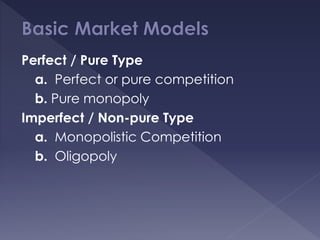
Perfect / Pure Type
a. Perfect or pure competition
b. Pure monopoly
Imperfect / Non-pure Type
a. Monopolistic Competition
b. Oligopoly
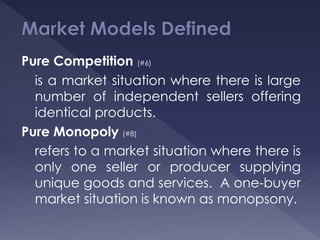
Pure Competition (#6)
is a market situation where there is large
number of independent sellers offering
identical products.
Pure Monopoly (#8)
refers to a market situation where there is
only one seller or producer supplying
unique goods and services. A one-buyer
market situation is known as monopsony.
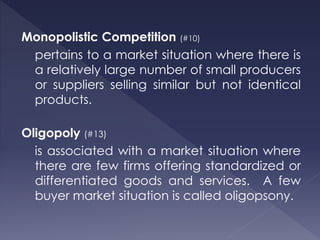
Monopolistic Competition (#10)
pertains to a market situation where there is
a relatively large number of small producers
or suppliers selling similar but not identical
products.
Oligopoly (#13)
is associated with a market situation where
there are few firms offering standardized or
differentiated goods and services. A few
buyer market situation is called oligopsony.
Pure Competition
1. There is large number of independent
sellers.
2. Products are identical or
homogeneous. Examples are farm
products like rice, corn, fruits,
vegetables, etc.
3. No single seller and no single buyer can influence
the change in market price of a product. There
are thousands of sellers selling millions of identical
products.
4. It is easy for new firms or sellers to enter the market
and for existing firms or sellers to leave the market.
There are no significant barriers like legal, financial,
or technical requirements.
5. There is no non-price competition like advertising,
sales promotion, or packaging. There is no need
for such non-price competition because the
products are identical which means they have the
same features.
Pure Monopoly (#4)
1. There is only one producer or seller.
2. Products are unique in the sense that
there are no good or close substitutes
available. Most public utilities
supplying water, electric and
telephone service are monopolists.
Examples, MERALCO, PLDT and
among others.
3. The monopolists makes the price. Since he is the
only supplier, he can reduce his output in order to
increase his price or he can increase his supply if
this means an increase in his total profit.
4. It is extremely difficult for new firms to enter the
market. There are several formidable barriers like
very big capital and very keen competition.
5. There may be or no extensive advertising or sales
promotion depending on the goods or services of
the monopolists. In case there is advertising, it is
only for public relations or goodwill to induce
more people to buy their products or improve
their public image.
Monopolistic Competition (#5)
1. There is a large number of sellers acting
independently. Such number means about 100
firms or sellers more or less, while in the case of
pure competition, it indicates thousands or more
sellers.
2. Products are differentiated. This means physical
differences as well as variations in location of the
store, services of sales staff, packaging of the
product, credit conditions, advertisement, and
other sales promotion strategies. Examples are
banks, book publications, drugs, tailoring shops,
gasoline stations, among others.
3. There is limited control of price. It is possible for
some sellers to slightly reduce or increase their
prices because of the differences of their
products. Example, some banks have lower or
higher interest rates.
4. Entry of new firms in the market is relatively easy.
However, compared with pure competition, it is
more difficult for firms under the monopolistic
competition to put up their business. It requires
bigger capital and the competition is greater in
the sense that they have to offer better product
features and more effective sales promotion.
5. There is an aggressive non-price competition in
product quality, credit terms, services, locations
and physical appearance of the product. There is
extensive advertising to focus the distinct features
of the products of the sellers. For example:
“Nakasisiguro! Gamot ay laging bago”.
Oligopoly (#5)
1. There are very few firms which dominate the market.
Each firm produces a big portion of the total industry
output.
2. Products are identical or differentiated. Raw materials
like steel, zinc, lead, cement and other industrial raw
materials are identical products. Finished goods like
typewriter, airplanes, cars and sewing machines are
differentiated products.
3. There is a price agreement among the producers to
promote their own economic interests. The biggest
among the producers is the price leader. In the case of
OPEC (Organization of Petroleum Exporting Countries),
the price leader is Saudi Arabia which the biggest oil
producer.
4. The entry of new competitors in the market is
difficult. It requires enormous capital and large-
scale production. It is very difficult for a new firm
to compete with existing firms because these are
already well-established.
3. There is strong advertising among those who
produce differentiated products like cars,
cigarettes and appliances. However, in the case
of identical products like the industrial raw
materials, advertising is just for image building.
Determinants of Market Structure
1. Government laws and policies. The government controls
the degree of competition in the interest of the economy
and the consumers. For instance , in certain industries like
those which supply water and electricity, the government
requires only one company for each product and service.
2. Technology. Through technology good or better substitutes
have been developed. Example, the appearance of plastics,
abaca fibers versus synthetic fibers.
3. Business policies and practices. The presence of giant firms
discourage the entry of new firms with little resources.
4. Economic Freedom. The existence of economic freedom
have somehow changed market structure. The most efficient
firms remain in business. The inefficient firms and those with
little resources leave the market.
Questions
1. State some example of business industries/ firms that
describes the given market models. Explain
2. Why is it difficult to a new competitor to enter in the
market under OLIGOPOLY?
3. When can we say that such industry/business is under
pure monopoly. Explain with example.
4. Why is it easy for new firms or sellers to enter and leave
the market under pure competition?
5. Is there a need to advertise products under pure
competition? Explain.

Chap5 market structures

  • 1.
    Chapter 5 PRINCIPLES OFECONOMICS mmvidanes29@gmail.com
  • 2.
    the various marketstructures are represented by four basic market models. These are theoretical frameworks for existing firms and industries in the real world. Such market models describe the characteristics of the various market structures.
  • 3.
    Perfect / PureType a. Perfect or pure competition b. Pure monopoly Imperfect / Non-pure Type a. Monopolistic Competition b. Oligopoly
  • 4.
    Pure Competition (#6) isa market situation where there is large number of independent sellers offering identical products. Pure Monopoly (#8) refers to a market situation where there is only one seller or producer supplying unique goods and services. A one-buyer market situation is known as monopsony.
  • 5.
    Monopolistic Competition (#10) pertainsto a market situation where there is a relatively large number of small producers or suppliers selling similar but not identical products. Oligopoly (#13) is associated with a market situation where there are few firms offering standardized or differentiated goods and services. A few buyer market situation is called oligopsony.
  • 6.
    Pure Competition 1. Thereis large number of independent sellers. 2. Products are identical or homogeneous. Examples are farm products like rice, corn, fruits, vegetables, etc.
  • 7.
    3. No singleseller and no single buyer can influence the change in market price of a product. There are thousands of sellers selling millions of identical products. 4. It is easy for new firms or sellers to enter the market and for existing firms or sellers to leave the market. There are no significant barriers like legal, financial, or technical requirements. 5. There is no non-price competition like advertising, sales promotion, or packaging. There is no need for such non-price competition because the products are identical which means they have the same features.
  • 8.
    Pure Monopoly (#4) 1.There is only one producer or seller. 2. Products are unique in the sense that there are no good or close substitutes available. Most public utilities supplying water, electric and telephone service are monopolists. Examples, MERALCO, PLDT and among others.
  • 9.
    3. The monopolistsmakes the price. Since he is the only supplier, he can reduce his output in order to increase his price or he can increase his supply if this means an increase in his total profit. 4. It is extremely difficult for new firms to enter the market. There are several formidable barriers like very big capital and very keen competition. 5. There may be or no extensive advertising or sales promotion depending on the goods or services of the monopolists. In case there is advertising, it is only for public relations or goodwill to induce more people to buy their products or improve their public image.
  • 10.
    Monopolistic Competition (#5) 1.There is a large number of sellers acting independently. Such number means about 100 firms or sellers more or less, while in the case of pure competition, it indicates thousands or more sellers. 2. Products are differentiated. This means physical differences as well as variations in location of the store, services of sales staff, packaging of the product, credit conditions, advertisement, and other sales promotion strategies. Examples are banks, book publications, drugs, tailoring shops, gasoline stations, among others.
  • 11.
    3. There islimited control of price. It is possible for some sellers to slightly reduce or increase their prices because of the differences of their products. Example, some banks have lower or higher interest rates. 4. Entry of new firms in the market is relatively easy. However, compared with pure competition, it is more difficult for firms under the monopolistic competition to put up their business. It requires bigger capital and the competition is greater in the sense that they have to offer better product features and more effective sales promotion.
  • 12.
    5. There isan aggressive non-price competition in product quality, credit terms, services, locations and physical appearance of the product. There is extensive advertising to focus the distinct features of the products of the sellers. For example: “Nakasisiguro! Gamot ay laging bago”.
  • 13.
    Oligopoly (#5) 1. Thereare very few firms which dominate the market. Each firm produces a big portion of the total industry output. 2. Products are identical or differentiated. Raw materials like steel, zinc, lead, cement and other industrial raw materials are identical products. Finished goods like typewriter, airplanes, cars and sewing machines are differentiated products. 3. There is a price agreement among the producers to promote their own economic interests. The biggest among the producers is the price leader. In the case of OPEC (Organization of Petroleum Exporting Countries), the price leader is Saudi Arabia which the biggest oil producer.
  • 14.
    4. The entryof new competitors in the market is difficult. It requires enormous capital and large- scale production. It is very difficult for a new firm to compete with existing firms because these are already well-established. 3. There is strong advertising among those who produce differentiated products like cars, cigarettes and appliances. However, in the case of identical products like the industrial raw materials, advertising is just for image building.
  • 15.
    Determinants of MarketStructure 1. Government laws and policies. The government controls the degree of competition in the interest of the economy and the consumers. For instance , in certain industries like those which supply water and electricity, the government requires only one company for each product and service. 2. Technology. Through technology good or better substitutes have been developed. Example, the appearance of plastics, abaca fibers versus synthetic fibers. 3. Business policies and practices. The presence of giant firms discourage the entry of new firms with little resources. 4. Economic Freedom. The existence of economic freedom have somehow changed market structure. The most efficient firms remain in business. The inefficient firms and those with little resources leave the market.
  • 16.
    Questions 1. State someexample of business industries/ firms that describes the given market models. Explain 2. Why is it difficult to a new competitor to enter in the market under OLIGOPOLY? 3. When can we say that such industry/business is under pure monopoly. Explain with example. 4. Why is it easy for new firms or sellers to enter and leave the market under pure competition? 5. Is there a need to advertise products under pure competition? Explain.