12 Marketing Plans: Saying How You’ll Get Sales McGraw-Hill/Irwin  Copyright © 2009 by The McGraw-Hill Companies, Inc. All rights reserved.
Marketing Plan Marketing plan : a systematic written plan of all phases of marketing for a business, including information on the product, price, and distribution and promotion strategy, as well as a clear identification of the target market and competition Will help you articulate what it is that you are going to do Chapter 12 12-
Marketing research :  Can verify the size of the potential market Show what the competitors are doing correctly Also, their weaknesses Reveal where potential customers are likely to shop Primary research : gathered to answer a specific marketing question Chapter 12 12-
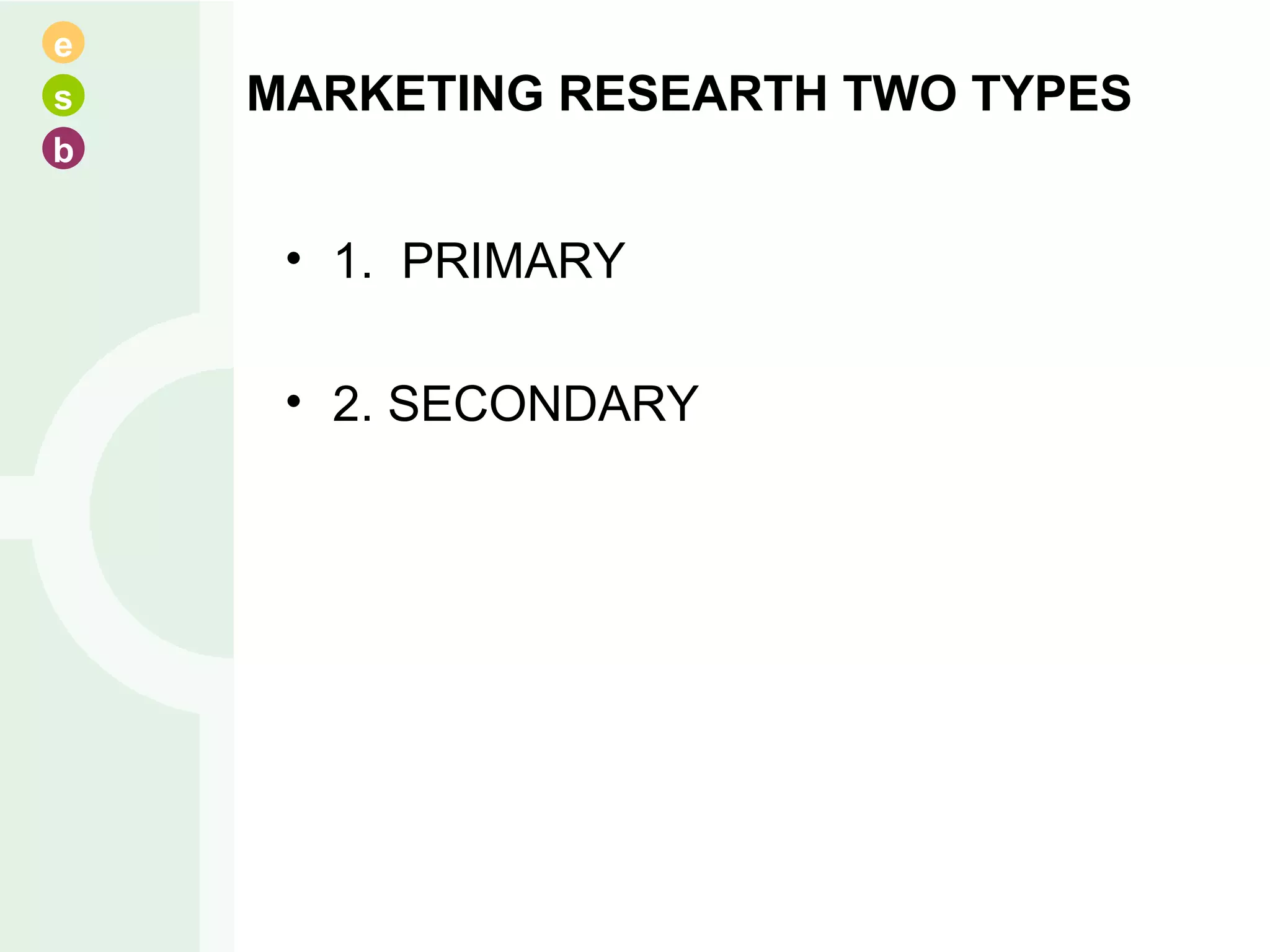
MARKETING RESEARTH TWO TYPES 1.  PRIMARY 2. SECONDARY
Secondary research : research for some other reason than your specific question Secondary data : information already collected for some other purpose than the current problem BizStats.com Economic Census: census.gov Business Expenses Survey:  www.census.gov/csd/bes/ Capital Expenditures Survey:  www.census.gov/csd/ace/ Chapter 12 12-
Primary data : information is extremely current Take some more time and money to gather it Marketing research firms can do this for you Zoomerang ( www.zoomerang.com ) Vista ( www.vanguardsw.com/vista ) Web hotlinks SCORE ( www.score.org ) Chapter 12 12-
Methods for gathering data : Ethnographic research : data gathered by simple observation – seeing what consumers do, rather than asking them Focus group : form of data gathering from a small group led by a moderator 8-20 people Make sure questions are asked the right way Participants paid for their time Chapter 12 12-
Survey : data collection method using a questionnaire In person  tends to be the most expensive Ask for clarification, or expand on the answer Mail  is the least expensive Has the lowest return, and does not allow much flexibility Internet surveys  are gaining in popularity Chapter 12 12-
Question types : Scalar questions : answered by some sort of scale “ On a scale of 1 to 5, how do you like this book?” Dichotomous questions : only two possible choices “ Have you shopped here before?” Categorical questions : answered by selecting the proper category “ What is your ethnicity?” Open-ended questions : allows respondents to express themselves Chapter 12 12-
Sales Forecasting One of the  most important  pieces of marketing plan Knowing what your sales will be Companies often base sales forecasts on historical sales, but new companies cannot do that Chapter 12 12-
Products or services are  tied to others Estimate total market Calculate what percentage of that market you can get Other products and services are  not tied  as neatly to others Good situation for some marketing research Next step  is to estimate average amount of sales per customer Chapter 12 12-
Creating a Sales Forecast Sales forecast sets the standard for expenses, profits and growth  Should show sales by month for the next 12 then by year for the following two to five years   Some tips to get you started: Develop a unit sales projection  Use past data if you have it  Use factors for a new product  Break the purchase down into factors  Be sure to project prices   Chapter 12 Example http://www.entrepreneur.com/startingabusiness/businessplans/businessplancoachtimberry/article77674.html  12-
Differential Advantage Differential advantage : characteristic that separates one company from another Competitive advantage Create a differential advantage with one of the parts of the marketing mix (Price, Product, Place, Promotion) Chapter 12 12-
The Marketing Plan Components : Discuss your  target market Explain your  current situation  (your competition) Marketing  strategy  and  objectives 4 P’s : Product, Promotion, Price, and Place Chapter 12 12-
Target market : Market segmentation : process of dividing the market into groups that have somewhat homogeneous needs for a product or service Geographic segmentation : many business choose to operate in one country Service industries have no choice but to segment geographically Chapter 12 12-
Target market : cont. Demographic segmentation : income, ethnicity, sex, education level, marital status, etc… Life cycle position Benefit segmentation : benefits they seek (speed, safety, capacity, and the like) Good value versus those more interested in reputation Chapter 12 12-
Target market : cont. Three targeting strategies : Undifferentiated : uses no segmentation; assumes that all consumers have virtually identical needs and can be reached by the same marketing mix Chapter 12 12-
Target market : cont. Three targeting strategies : cont. Differentiated : market selects two or more distinct groups of consumers and design specific marketing mixes to meet their needs Concentrated : marketer selects one specific group of consumers and designs a marketing mix specifically for that group Chapter 12 12-
Target market : cont. Why bother with targeting? Don’t waste a lot of effort and money Determine purchasing behavior Identifying the best ways of reaching these potential clients Also pays to think about secondary target markets  Chapter 12 12-
Current situation : what you have done over the past year and how effective these actions were Reflect on the political, economic, cultural, and other external environments SWOT analysis What things do you do very well and what things do you do less well Chapter 12 12-
Current situation : cont. Key component is considering your  competition Direct competition : other companies that make a similar product or provide a similar service Direct competition for Coca-Cola includes all other soft-drink providers Chapter 12 12-
Current situation : cont. Key component is considering your  competition Indirect competition : companies that provide alternates that are dissimilar to your product/service that consumers might choose to meet a similar need Indirect competition for Coca-Cola includes any other company providing items to quench thirst Chapter 12 12-
The 4 P’s :  Product, Promote, Price, Place When defining your product, describe all the details Features, options, sizes, service elements What improvements or changes do you foresee Price determined by cost structure How does it compare to that of the competition and industry? Chapter 12 12-
What  advertising tools  will you use? Flyers, Internet, print ads, television, radio, banners, and posters Schedule Distribution system : Mail order Boxes to local post office or UPS Daily or weekly Cost to ship, packing materials Chapter 12 12-
Written plan : specific details about your target market Present and near-future situation, including competitors Identify differential advantage May include financial projections Include budget Major overall goals Chapter 12 12-
Written plan : cont. What should the written plan look like? Software packages that help you work through the plan step-by-step Marketing Plan Pro:  www.marketingplanpro.com Consideration of whether the marketing plan is to be part of a business plan, or whether it is to stand alone See Table 12.2 Chapter 12 12-
Market Planning Checklist Use this list to develop your marketing plan: Have you analyzed the total market for your product or service? (features of your product?) Have you described how your product or service will benefit your clients?  Have you prepared a pricing schedule?  Have you prepared a sales forecast?  How will you distribute your product?   Chapter 12 Example http://www.entrepreneur.com/marketing/marketingbasics/marketingplan/article24610.html  12-
What’s Next? Successful businesses are constantly  tweaking  their marketing plan Decide what you want to accomplish next Revise your marketing plan to reflect this next step Low-cost help: www.sba.org www.score.org www.entrepreneur.com Chapter 12 12-

Chap012 bus230

  • 1.
    12 Marketing Plans:Saying How You’ll Get Sales McGraw-Hill/Irwin Copyright © 2009 by The McGraw-Hill Companies, Inc. All rights reserved.
  • 2.
    Marketing Plan Marketingplan : a systematic written plan of all phases of marketing for a business, including information on the product, price, and distribution and promotion strategy, as well as a clear identification of the target market and competition Will help you articulate what it is that you are going to do Chapter 12 12-
  • 3.
    Marketing research : Can verify the size of the potential market Show what the competitors are doing correctly Also, their weaknesses Reveal where potential customers are likely to shop Primary research : gathered to answer a specific marketing question Chapter 12 12-
  • 4.
    MARKETING RESEARTH TWOTYPES 1. PRIMARY 2. SECONDARY
  • 5.
    Secondary research :research for some other reason than your specific question Secondary data : information already collected for some other purpose than the current problem BizStats.com Economic Census: census.gov Business Expenses Survey: www.census.gov/csd/bes/ Capital Expenditures Survey: www.census.gov/csd/ace/ Chapter 12 12-
  • 6.
    Primary data :information is extremely current Take some more time and money to gather it Marketing research firms can do this for you Zoomerang ( www.zoomerang.com ) Vista ( www.vanguardsw.com/vista ) Web hotlinks SCORE ( www.score.org ) Chapter 12 12-
  • 7.
    Methods for gatheringdata : Ethnographic research : data gathered by simple observation – seeing what consumers do, rather than asking them Focus group : form of data gathering from a small group led by a moderator 8-20 people Make sure questions are asked the right way Participants paid for their time Chapter 12 12-
  • 8.
    Survey : datacollection method using a questionnaire In person tends to be the most expensive Ask for clarification, or expand on the answer Mail is the least expensive Has the lowest return, and does not allow much flexibility Internet surveys are gaining in popularity Chapter 12 12-
  • 9.
    Question types :Scalar questions : answered by some sort of scale “ On a scale of 1 to 5, how do you like this book?” Dichotomous questions : only two possible choices “ Have you shopped here before?” Categorical questions : answered by selecting the proper category “ What is your ethnicity?” Open-ended questions : allows respondents to express themselves Chapter 12 12-
  • 10.
    Sales Forecasting Oneof the most important pieces of marketing plan Knowing what your sales will be Companies often base sales forecasts on historical sales, but new companies cannot do that Chapter 12 12-
  • 11.
    Products or servicesare tied to others Estimate total market Calculate what percentage of that market you can get Other products and services are not tied as neatly to others Good situation for some marketing research Next step is to estimate average amount of sales per customer Chapter 12 12-
  • 12.
    Creating a SalesForecast Sales forecast sets the standard for expenses, profits and growth Should show sales by month for the next 12 then by year for the following two to five years Some tips to get you started: Develop a unit sales projection Use past data if you have it Use factors for a new product Break the purchase down into factors Be sure to project prices Chapter 12 Example http://www.entrepreneur.com/startingabusiness/businessplans/businessplancoachtimberry/article77674.html 12-
  • 13.
    Differential Advantage Differentialadvantage : characteristic that separates one company from another Competitive advantage Create a differential advantage with one of the parts of the marketing mix (Price, Product, Place, Promotion) Chapter 12 12-
  • 14.
    The Marketing PlanComponents : Discuss your target market Explain your current situation (your competition) Marketing strategy and objectives 4 P’s : Product, Promotion, Price, and Place Chapter 12 12-
  • 15.
    Target market :Market segmentation : process of dividing the market into groups that have somewhat homogeneous needs for a product or service Geographic segmentation : many business choose to operate in one country Service industries have no choice but to segment geographically Chapter 12 12-
  • 16.
    Target market :cont. Demographic segmentation : income, ethnicity, sex, education level, marital status, etc… Life cycle position Benefit segmentation : benefits they seek (speed, safety, capacity, and the like) Good value versus those more interested in reputation Chapter 12 12-
  • 17.
    Target market :cont. Three targeting strategies : Undifferentiated : uses no segmentation; assumes that all consumers have virtually identical needs and can be reached by the same marketing mix Chapter 12 12-
  • 18.
    Target market :cont. Three targeting strategies : cont. Differentiated : market selects two or more distinct groups of consumers and design specific marketing mixes to meet their needs Concentrated : marketer selects one specific group of consumers and designs a marketing mix specifically for that group Chapter 12 12-
  • 19.
    Target market :cont. Why bother with targeting? Don’t waste a lot of effort and money Determine purchasing behavior Identifying the best ways of reaching these potential clients Also pays to think about secondary target markets Chapter 12 12-
  • 20.
    Current situation :what you have done over the past year and how effective these actions were Reflect on the political, economic, cultural, and other external environments SWOT analysis What things do you do very well and what things do you do less well Chapter 12 12-
  • 21.
    Current situation :cont. Key component is considering your competition Direct competition : other companies that make a similar product or provide a similar service Direct competition for Coca-Cola includes all other soft-drink providers Chapter 12 12-
  • 22.
    Current situation :cont. Key component is considering your competition Indirect competition : companies that provide alternates that are dissimilar to your product/service that consumers might choose to meet a similar need Indirect competition for Coca-Cola includes any other company providing items to quench thirst Chapter 12 12-
  • 23.
    The 4 P’s: Product, Promote, Price, Place When defining your product, describe all the details Features, options, sizes, service elements What improvements or changes do you foresee Price determined by cost structure How does it compare to that of the competition and industry? Chapter 12 12-
  • 24.
    What advertisingtools will you use? Flyers, Internet, print ads, television, radio, banners, and posters Schedule Distribution system : Mail order Boxes to local post office or UPS Daily or weekly Cost to ship, packing materials Chapter 12 12-
  • 25.
    Written plan :specific details about your target market Present and near-future situation, including competitors Identify differential advantage May include financial projections Include budget Major overall goals Chapter 12 12-
  • 26.
    Written plan :cont. What should the written plan look like? Software packages that help you work through the plan step-by-step Marketing Plan Pro: www.marketingplanpro.com Consideration of whether the marketing plan is to be part of a business plan, or whether it is to stand alone See Table 12.2 Chapter 12 12-
  • 27.
    Market Planning ChecklistUse this list to develop your marketing plan: Have you analyzed the total market for your product or service? (features of your product?) Have you described how your product or service will benefit your clients? Have you prepared a pricing schedule? Have you prepared a sales forecast? How will you distribute your product? Chapter 12 Example http://www.entrepreneur.com/marketing/marketingbasics/marketingplan/article24610.html 12-
  • 28.
    What’s Next? Successfulbusinesses are constantly tweaking their marketing plan Decide what you want to accomplish next Revise your marketing plan to reflect this next step Low-cost help: www.sba.org www.score.org www.entrepreneur.com Chapter 12 12-

Editor's Notes

  • #4 Marketing research was also touched on in Chapter 10. Secondary data is cheaper and faster, but less than perfect.
  • #6 Primary research is more expensive and takes longer to do but can be tailored for your specific need. Most small companies will hire a professional to do this for them as they have more expertise and access to resources.
  • #8 Ethnographic research is gathered by observation. Various methods can be used such as video surveillance, secret shoppers, and even bar code tracking to see which products are naturally purchased together. Focus groups are paid groups brought in to a central place, using the research firm, to gain their thoughts and opinions on a product or campaign. Participants should be drawn from the target market and are usually paid. Many times the discussions are monitored and recorded for detailed analysis.
  • #9 Surveys are generally cheap and popular. As shown earlier phone surveys are more expensive than mail surveys. However, phone surveys allow more depth of information. Internet surveys are gaining in popularity for their ease of administration and data entry (which is automatic by the computer).
  • #11 So if you can’t use history what can you use? See the next slide.
  • #14 Your differential advantage makes you look different (I.e. superior) in the eyes of your customer. A lower price give the customers a reason to choose you. A lower cost structure allows you to either sell at a lower price, stealing market share, or at the same price, earning more profits.
  • #15 In you marketing plan you must discuss and describe your target market and their needs. Why are they unique? Why will they react in a similar manner? What are they missing? Your situation includes your company’s position in the market and that of competitors. Each of these components is discussed in turn.
  • #16 Geographic segmentation can be by state, region, county, or whatever makes sense for your company. By choosing to operate in the US only you have chosen one segment. Service industries by their nature segment geographically. People do not travel across the country to get their hair cut.
  • #17 Demographics are typically things we do not change, or do not easily change, about ourselves.
  • #25 Each advertising tool has it’s own advantages and disadvantages. Each is more or less appropriate in any given situation. When considering distribution remember USPS and UPS have programs specifically aimed at small businesses so make sure you get the information you need.
  • #28 Market Planning Checklist Use this list to develop your marketing plan: Have you analyzed the total market for your product or service? (features of your product?) Have you described how your product or service will benefit your clients? Have you prepared a pricing schedule? Have you prepared a sales forecast? Which media will you use in your marketing campaign? Do your marketing materials mention any optional accessories or added services that consumers might want to purchase? have you prepared clear operating-and-assembly instructions if required? What kind of warranty do you provide? How will you distribute your product?