7 Small Business Strategies: Imitation with a Twist McGraw-Hill/Irwin  Copyright © 2009 by The McGraw-Hill Companies, Inc. All rights reserved.
Strategy in the Small Business Strategy : the ideas and actions that explain how a firm will make its profit Good strategy leads to  greater chances  for survival and higher profits for small businesses What makes a strategy  “good”  is its fit to the particulars of your business and the resources you can bring to it Chapter 7 7-
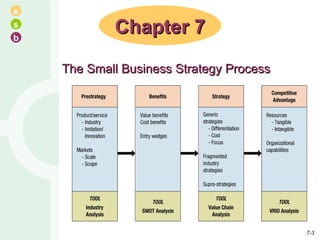
Chapter 7 The Small Business Strategy Process 7-
1.  Prestrategy: First Step of Strategic Planning Goal is deciding on  product or service  you intend to offer and the general nature of your intended market Industry : general name for line of product or service being sold, or the firms in that line of business Chapter 7 7-
Industry Key is selecting an industry that offers good potential for making a profit Also needs to offer attractive opportunities to work with a minimum of risk and competition http://www.census.gov/epcd/naics02/ Trade association : group of people in the same industry who band together to represent the industry to the public and government Chapter 7 7-
Market : business term for the population of customers for your product or service Scale : size of the market   Mass or Niche Scope : geographic range covered by the market Local to Global Chapter 7 7-
Scale : most industries have both  mass  and  niche  markets Mass market : large portions of the population Example: all men, all women, all teens, et al Mass market is  broad Niche market : narrowly defined segment of the population that is likely to share interests or concerns Example: Hallmark vs. SimplyShe Chapter 7 7-
3 Rules for Niche Marketing Niche marketing can be extremely cost-effective Niche marketing can be a low risk way to grow your business following 3 rules: Meet their unique needs  Say the right thing  Always test-market Chapter 7 Example http://www.entrepreneur.com/marketing/marketingcolumnistkimtgordon/article49608.html   7-
Scope :  local  or  global Can be local, regional, national, international, or global Scope is important for two reasons: Knowing your scope helps deciding where to  focus  sales and advertising efforts Knowing your target market gives you a way to know which  competitors  to worry about most, namely those within your market scope Chapter 7 7-
Imitative strategy : doing more or less what others are doing Classic  small business strategy Almost  2/3  of people starting business use this approach Advantages : existing technologies, possibility to buy existing businesses, customers already know what you are offering Chapter 7 7-
Degree of similarity : extent to which a product or service is like another Imitation is not likely to  match  precision or completeness or copying seen in franchising Imitation  plus one degree  of similarity: copying of existing businesses with the exception of one or two key aspects in hopes of improving them Pure innovation : new product or service, also with a unique setting Chapter 7 7-
Tool: Industry Analysis Industry analysis  (IA): a research process that provides the entrepreneur with key information about the industry, such as current situation and trends Helps to estimate possible financial returns Chapter 7 7-
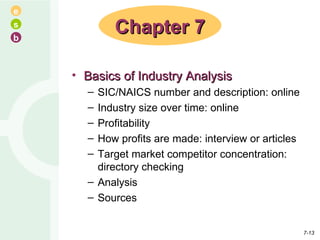
Basics of Industry Analysis SIC/NAICS number and description: online Industry size over time: online Profitability How profits are made: interview or articles Target market competitor concentration: directory checking Analysis Sources Chapter 7 7-
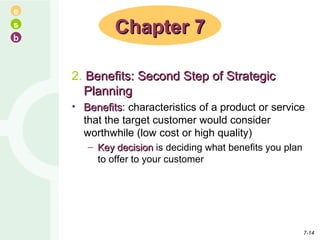
2.  Benefits: Second Step of Strategic Planning Benefits : characteristics of a product or service that the target customer would consider worthwhile (low cost or high quality) Key decision  is deciding what benefits you plan to offer to your customer Chapter 7 7-
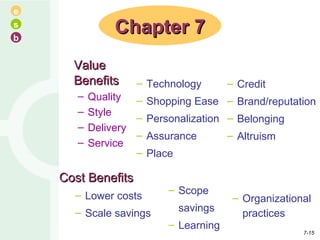
Value Benefits Quality Style Delivery Service Chapter 7 Technology Shopping Ease Personalization Assurance Place Credit Brand/reputation Belonging Altruism Cost Benefits Lower costs Scale savings Scope  savings Learning Organizational practices 7-
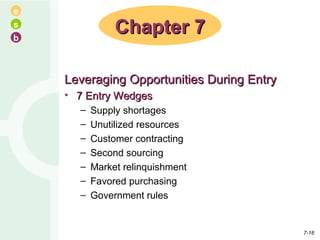
Leveraging Opportunities During Entry 7   Entry Wedges Supply shortages Unutilized resources Customer contracting Second sourcing Market relinquishment Favored purchasing Government rules Chapter 7 7-
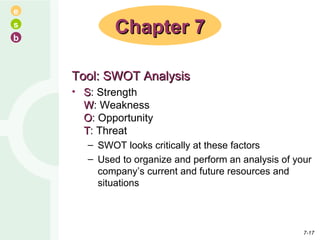
Tool: SWOT Analysis S : Strength W : Weakness O : Opportunity T : Threat SWOT looks critically at these factors Used to organize and perform an analysis of your company’s current and future resources and situations Chapter 7 7-
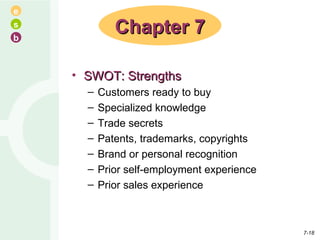
SWOT: Strengths Customers ready to buy Specialized knowledge Trade secrets Patents, trademarks, copyrights Brand or personal recognition Prior self-employment experience Prior sales experience Chapter 7 7-
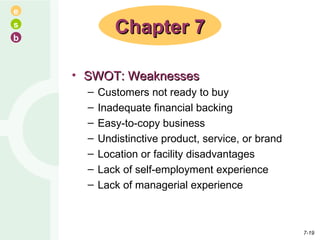
SWOT: Weaknesses Customers not ready to buy Inadequate financial backing Easy-to-copy business Undistinctive product, service, or brand Location or facility disadvantages Lack of self-employment experience Lack of managerial experience Chapter 7 7-
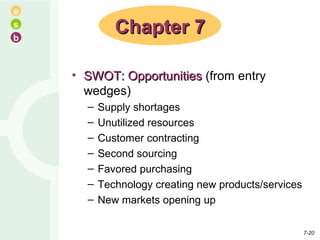
SWOT: Opportunities  (from entry wedges) Supply shortages Unutilized resources Customer contracting Second sourcing Favored purchasing Technology creating new products/services New markets opening up Chapter 7 7-
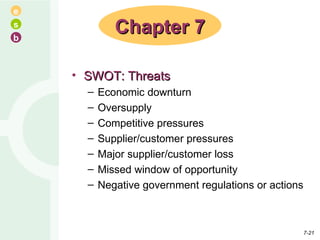
SWOT: Threats Economic downturn Oversupply Competitive pressures Supplier/customer pressures Major supplier/customer loss Missed window of opportunity Negative government regulations or actions Chapter 7 7-
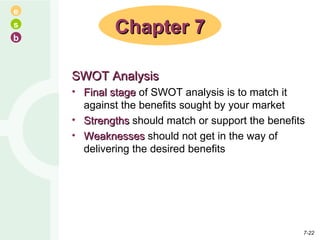
SWOT Analysis Final stage  of SWOT analysis is to match it against the benefits sought by your market Strengths  should match or support the benefits Weaknesses  should not get in the way of delivering the desired benefits Chapter 7 7-
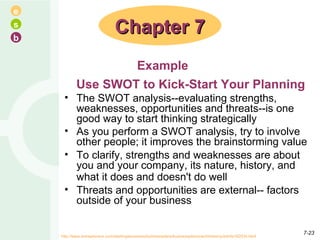
Use SWOT to Kick-Start Your Planning The SWOT analysis--evaluating strengths, weaknesses, opportunities and threats--is one good way to start thinking strategically  As you perform a SWOT analysis, try to involve other people; it improves the brainstorming value  To clarify, strengths and weaknesses are about you and your company, its nature, history, and what it does and doesn't do well   Threats and opportunities are external-- factors outside of your business  Chapter 7 Example http://www.entrepreneur.com/startingabusiness/businessplans/businessplancoachtimberry/article182034.html  7-
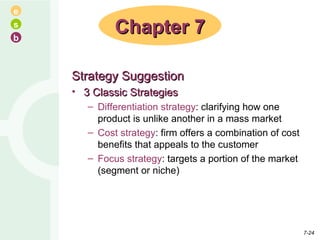
Strategy Suggestion 3 Classic Strategies Differentiation strategy : clarifying how one product is unlike another in a mass market Cost strategy : firm offers a combination of cost benefits that appeals to the customer Focus strategy : targets a portion of the market (segment or niche) Chapter 7 7-
7 Small Business Supra-Strategies Craftsmanship Customization Super-support Serving the underserved/interstices Elite Single-mindedness Comprehensiveness Chapter 7 7-
Competitive Advantage Resources : Any asset, capability, organizational process, information, or knowledge that contributes to the firm’s performance Tangible resources : easily identified Financial (cash), Physical (land) Intangible resources : typically informational and and expertise-based practices and routines that are not clearly evident Human (skill), Reputation (trust) Chapter 7 7-
Organizational capabilities : abilities, skills, and competencies used by the firm to make profits from tangible and intangible resources Transformational competencies : firm can make its product or service better in value Combinational competencies : combining tangible and intangible resources Vermont Bear Company’s  Bear-Gram Chapter 7 7-
The VRIO Analysis Test 1:  Value  – does the resource help you increase sales or decrease costs Test 2:  Rareness  – is the resource rare enough that you can charge more than competitors without the resource Test 3:  Imitability  – can the competition imitate the resource Test 4:  Organization  – can the firm make use of the resource Chapter 7 7-

Chap007 bus230

  • 1.
    7 Small BusinessStrategies: Imitation with a Twist McGraw-Hill/Irwin Copyright © 2009 by The McGraw-Hill Companies, Inc. All rights reserved.
  • 2.
    Strategy in theSmall Business Strategy : the ideas and actions that explain how a firm will make its profit Good strategy leads to greater chances for survival and higher profits for small businesses What makes a strategy “good” is its fit to the particulars of your business and the resources you can bring to it Chapter 7 7-
  • 3.
    Chapter 7 TheSmall Business Strategy Process 7-
  • 4.
    1. Prestrategy:First Step of Strategic Planning Goal is deciding on product or service you intend to offer and the general nature of your intended market Industry : general name for line of product or service being sold, or the firms in that line of business Chapter 7 7-
  • 5.
    Industry Key isselecting an industry that offers good potential for making a profit Also needs to offer attractive opportunities to work with a minimum of risk and competition http://www.census.gov/epcd/naics02/ Trade association : group of people in the same industry who band together to represent the industry to the public and government Chapter 7 7-
  • 6.
    Market : businessterm for the population of customers for your product or service Scale : size of the market Mass or Niche Scope : geographic range covered by the market Local to Global Chapter 7 7-
  • 7.
    Scale : mostindustries have both mass and niche markets Mass market : large portions of the population Example: all men, all women, all teens, et al Mass market is broad Niche market : narrowly defined segment of the population that is likely to share interests or concerns Example: Hallmark vs. SimplyShe Chapter 7 7-
  • 8.
    3 Rules forNiche Marketing Niche marketing can be extremely cost-effective Niche marketing can be a low risk way to grow your business following 3 rules: Meet their unique needs Say the right thing Always test-market Chapter 7 Example http://www.entrepreneur.com/marketing/marketingcolumnistkimtgordon/article49608.html 7-
  • 9.
    Scope : local or global Can be local, regional, national, international, or global Scope is important for two reasons: Knowing your scope helps deciding where to focus sales and advertising efforts Knowing your target market gives you a way to know which competitors to worry about most, namely those within your market scope Chapter 7 7-
  • 10.
    Imitative strategy :doing more or less what others are doing Classic small business strategy Almost 2/3 of people starting business use this approach Advantages : existing technologies, possibility to buy existing businesses, customers already know what you are offering Chapter 7 7-
  • 11.
    Degree of similarity: extent to which a product or service is like another Imitation is not likely to match precision or completeness or copying seen in franchising Imitation plus one degree of similarity: copying of existing businesses with the exception of one or two key aspects in hopes of improving them Pure innovation : new product or service, also with a unique setting Chapter 7 7-
  • 12.
    Tool: Industry AnalysisIndustry analysis (IA): a research process that provides the entrepreneur with key information about the industry, such as current situation and trends Helps to estimate possible financial returns Chapter 7 7-
  • 13.
    Basics of IndustryAnalysis SIC/NAICS number and description: online Industry size over time: online Profitability How profits are made: interview or articles Target market competitor concentration: directory checking Analysis Sources Chapter 7 7-
  • 14.
    2. Benefits:Second Step of Strategic Planning Benefits : characteristics of a product or service that the target customer would consider worthwhile (low cost or high quality) Key decision is deciding what benefits you plan to offer to your customer Chapter 7 7-
  • 15.
    Value Benefits QualityStyle Delivery Service Chapter 7 Technology Shopping Ease Personalization Assurance Place Credit Brand/reputation Belonging Altruism Cost Benefits Lower costs Scale savings Scope savings Learning Organizational practices 7-
  • 16.
    Leveraging Opportunities DuringEntry 7 Entry Wedges Supply shortages Unutilized resources Customer contracting Second sourcing Market relinquishment Favored purchasing Government rules Chapter 7 7-
  • 17.
    Tool: SWOT AnalysisS : Strength W : Weakness O : Opportunity T : Threat SWOT looks critically at these factors Used to organize and perform an analysis of your company’s current and future resources and situations Chapter 7 7-
  • 18.
    SWOT: Strengths Customersready to buy Specialized knowledge Trade secrets Patents, trademarks, copyrights Brand or personal recognition Prior self-employment experience Prior sales experience Chapter 7 7-
  • 19.
    SWOT: Weaknesses Customersnot ready to buy Inadequate financial backing Easy-to-copy business Undistinctive product, service, or brand Location or facility disadvantages Lack of self-employment experience Lack of managerial experience Chapter 7 7-
  • 20.
    SWOT: Opportunities (from entry wedges) Supply shortages Unutilized resources Customer contracting Second sourcing Favored purchasing Technology creating new products/services New markets opening up Chapter 7 7-
  • 21.
    SWOT: Threats Economicdownturn Oversupply Competitive pressures Supplier/customer pressures Major supplier/customer loss Missed window of opportunity Negative government regulations or actions Chapter 7 7-
  • 22.
    SWOT Analysis Finalstage of SWOT analysis is to match it against the benefits sought by your market Strengths should match or support the benefits Weaknesses should not get in the way of delivering the desired benefits Chapter 7 7-
  • 23.
    Use SWOT toKick-Start Your Planning The SWOT analysis--evaluating strengths, weaknesses, opportunities and threats--is one good way to start thinking strategically As you perform a SWOT analysis, try to involve other people; it improves the brainstorming value To clarify, strengths and weaknesses are about you and your company, its nature, history, and what it does and doesn't do well Threats and opportunities are external-- factors outside of your business Chapter 7 Example http://www.entrepreneur.com/startingabusiness/businessplans/businessplancoachtimberry/article182034.html 7-
  • 24.
    Strategy Suggestion 3Classic Strategies Differentiation strategy : clarifying how one product is unlike another in a mass market Cost strategy : firm offers a combination of cost benefits that appeals to the customer Focus strategy : targets a portion of the market (segment or niche) Chapter 7 7-
  • 25.
    7 Small BusinessSupra-Strategies Craftsmanship Customization Super-support Serving the underserved/interstices Elite Single-mindedness Comprehensiveness Chapter 7 7-
  • 26.
    Competitive Advantage Resources: Any asset, capability, organizational process, information, or knowledge that contributes to the firm’s performance Tangible resources : easily identified Financial (cash), Physical (land) Intangible resources : typically informational and and expertise-based practices and routines that are not clearly evident Human (skill), Reputation (trust) Chapter 7 7-
  • 27.
    Organizational capabilities :abilities, skills, and competencies used by the firm to make profits from tangible and intangible resources Transformational competencies : firm can make its product or service better in value Combinational competencies : combining tangible and intangible resources Vermont Bear Company’s Bear-Gram Chapter 7 7-
  • 28.
    The VRIO AnalysisTest 1: Value – does the resource help you increase sales or decrease costs Test 2: Rareness – is the resource rare enough that you can charge more than competitors without the resource Test 3: Imitability – can the competition imitate the resource Test 4: Organization – can the firm make use of the resource Chapter 7 7-

Editor's Notes

  • #3 Think about strategy in terms of football. The plays you run depend on the down, yards to go, strength and skills of your players, current score, time left in the game, and how you think the competing team will react. A strategy which works for one team will not necessarily work for another. However, a strategy is important. No good coach would show up to a game without his playbook.
  • #4 Each stage is discussed in further detail.
  • #5 Your first step is deciding what you are going into business to do. For example: I want to build a better mousetrap. This puts you in the extermination industry.
  • #6 Trade associations often have magazines, conventions, websites, and other resources available to help businesses in their industry. Sometimes companies may band together to perform functions. For example: In the sporting goods industry it is not uncommon for stores to band together to purchase items in larger quantities to be able to purchase from the manufacturer. Contacts are used in this process and store do not normally compete in the same geographic region. The Dairy Farmers of America band together for the “Got Milk” campaign which promotes the product but not a specific brand.
  • #7 Your potential market is anyone who could have a use for your product but who has not yet purchased. Your market is made up of those who purchase that type of product. Your target market is the subgroup you choose to focus on. Mass markets are everyone in the population. Coca-Cola mass markets to the entire US. Niche markets are small often underserved markets of people with a similar need and who act or purchase in similar ways. The scope of your market merely refers to how geographically large your market is and is outlined on the next two slide.
  • #9 3 Rules for Niche Marketing Niche marketing can be extremely cost-effective Niche marketing can be a low risk way to grow your business following 3 rules: Meet their unique needs Say the right thing Always test-market
  • #13 Often, industry analyses can be purchased from trade organizations or market research firms.
  • #14 Many of the basics can be found through simple online searches. While profitability may not be found quite so simply, the methods by which profits and sales are made come out in interviews with executives or articles on the industry.
  • #15 A key to succeeding in business is knowing what your customer wants and how to provide it to him or her at a profit. Some benefits may be possible to add but may also lower your profits. Add the benefits that customers will be willing to pay more for. For example, people pay more for leather seats in their car, or a DVD player.
  • #16 Some benefits to a customer are direct product features, others are services offered along with the purchase. Benefits can also come by saving customers time, money, or frustration.
  • #17 There are several situations during which you can enter a market. If there is currently a shortage of market supply, you can offer your alternative or substitute to fill the demand. If there are resources which could be used more efficiently, or to make a better product, this gives you an advantage coming in. Contracting with customers who currently use this type of service locks them in to your service. For example, contracting with a heating and A/C company to provide routine maintenance. Some companies like to have a primary supplier, but during busy times may need a secondary supplier. You can start as a secondary supplier but through superior offering, pricing, or service become their primary supplier. Other times a conglomerate may be willing to ‘give up’ a small niche market which you may be better able to serve. Government bids often give an advantage to women or minority businesses. So make sure they know you are one. Whatever your advantage is, make the most of it.
  • #18 Each of the four are discussed in turn. Strengths and weaknesses are internal to the company. Opportunities and threats come from outside the company.
  • #26 These are seven strategies which are unique to small businesses due to the nature of being small. Being able to customize quickly and well doesn’t happen when your machinery is best set for runs of 1,000 or more. Additionally large companies with thousands of customers cannot possibly know them all by name and provide individual service and support. Nor can they provide to the high class, high-end elite. Some customers value things simply because they are unique and not everyone bought one at Wal-Mart. They like to dress differently, show off their brands, and be above others because they have someone you can’t.
  • #28 Your competencies are what you do well. It may be you as a person, or you as a firm. Vermont Teddy Bear took a well made bear, and offered a unique customized service to create the Bear-Gram which is loved the country over. Botht the product and service side of the bear-gram are high quality, unique, desired, and thus profitable.
  • #29 When evaluating resources for use, whether it is a financial resource, marketing resource, or product component, it is important to ask four questions. If the test fails at any level, then the resource is truly not of value to the organization.