1-1 
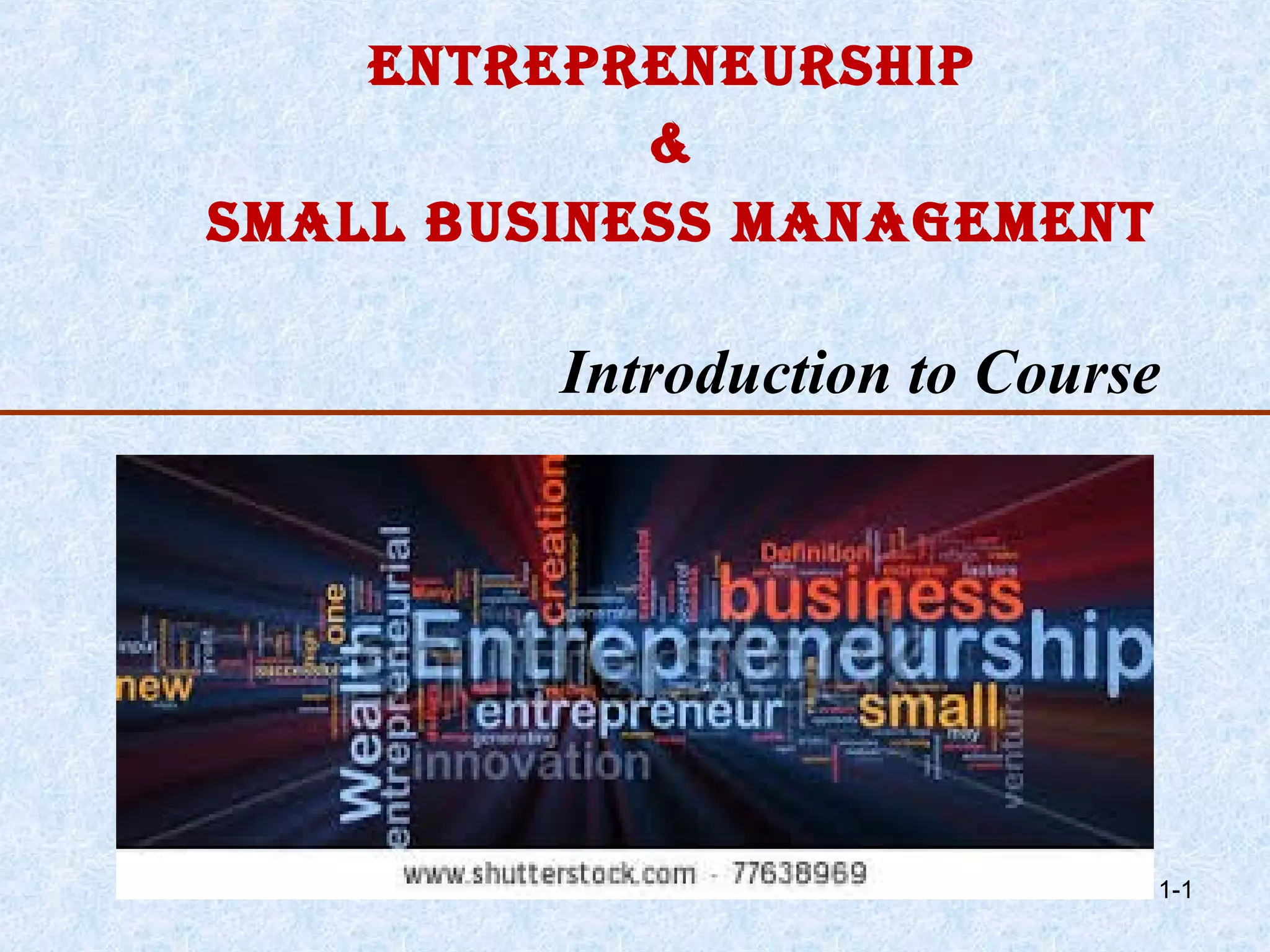
EntrEprEnEurship 
& 
small BusinEss managEmEnt 
Introduction to Course
Course Objectives 
1 of 2 
• To possess a well grounded understanding of essential 
entrepreneurial business principals. 
• To develop an understanding of important business 
issues as they relate to new ventures. 
• To identify, appreciate, and assess the knowledge, 
attitudes, and skills of an entrepreneur 
©2010 Pearson Education 1-2
Course Objectives 
2 of 2 
• To study and observe entrepreneurial settings and 
entrepreneurial role models through exposure to actual 
business settings and experiences 
• To have an expanded awareness of the resources 
available for creating a business plan 
• To establish a level of confidence in creating a business 
plan as a tool to assess, create and communicate a 
business concept. 
• 
©2010 Pearson Education 1-3
Resources 
Textbook 
Essentials of Entrepreneurship and Small Business Management, 
6th Edition, Scarborough, Norman M., Upper Saddle River, NJ: Pearson 
Prentice Hall Publishing Co., 2011 
Optional Software 
Business Plan Pro® by Palo Alto Software 
This software may be included with your text as an optional resource 
Business Feasibility Analysisä by Palo Alto Software This software may also be 
included with your text as an optional resource 
©2010 Pearson Education 1-4
Course Components 
 Case Assignments 
 Entrepreneur Interview 
 Group Project: Feasibility Study and Business Plan 
Development 
©2010 Pearson Education 1-5
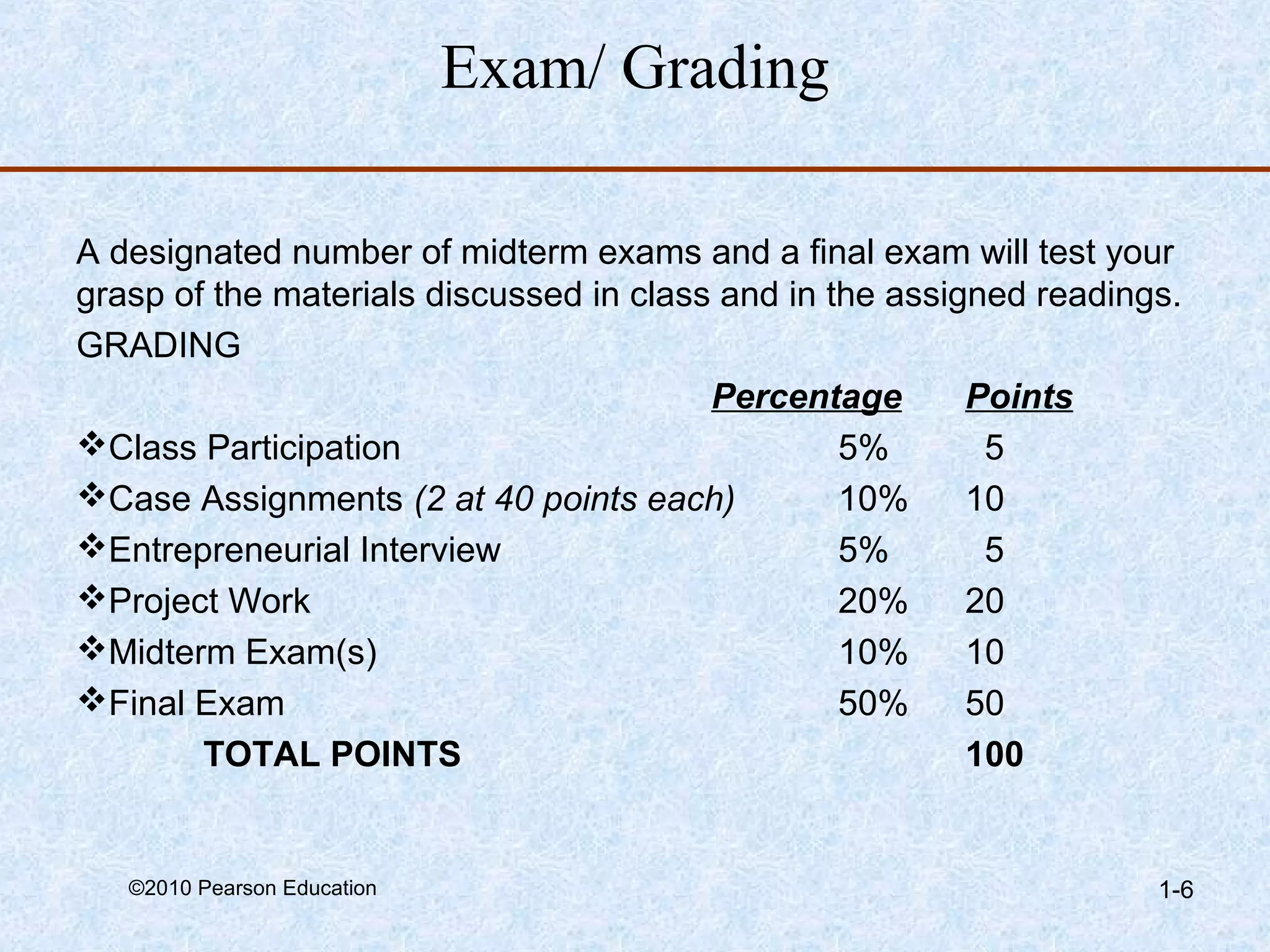
Exam/ Grading 
A designated number of midterm exams and a final exam will test your 
grasp of the materials discussed in class and in the assigned readings. 
GRADING 
Percentage Points 
Class Participation 5% 5 
Case Assignments (2 at 40 points each) 10% 10 
Entrepreneurial Interview 5% 5 
Project Work 20% 20 
Midterm Exam(s) 10% 10 
Final Exam 50% 50 
TOTAL POINTS 100 
©2010 Pearson Education 1-6
Introduction to Entrepreneurship 
There is tremendous 
interest in 
entrepreneurship in the 
U.S. and around the world. 
According to the 2007 GEM 
study, 9.6% of Americans 
are actively engaged in 
starting a business or are 
the owner/manager of a 
business that is less than 
three years old. 
©2010 Pearson Education 1-7
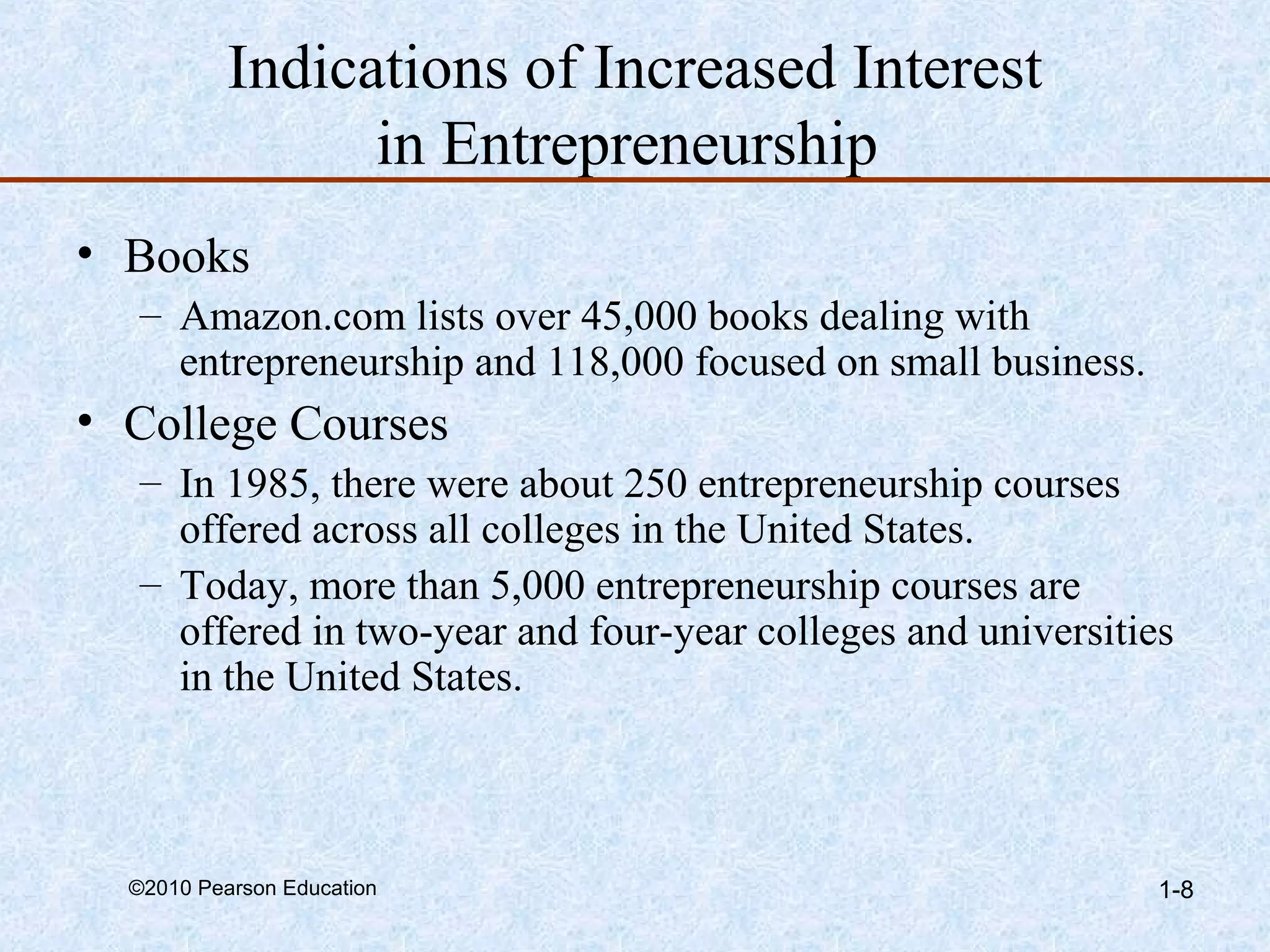
Indications of Increased Interest 
in Entrepreneurship 
• Books 
– Amazon.com lists over 45,000 books dealing with 
entrepreneurship and 118,000 focused on small business. 
• College Courses 
– In 1985, there were about 250 entrepreneurship courses 
offered across all colleges in the United States. 
– Today, more than 5,000 entrepreneurship courses are 
offered in two-year and four-year colleges and universities 
in the United States. 
©2010 Pearson Education 1-8
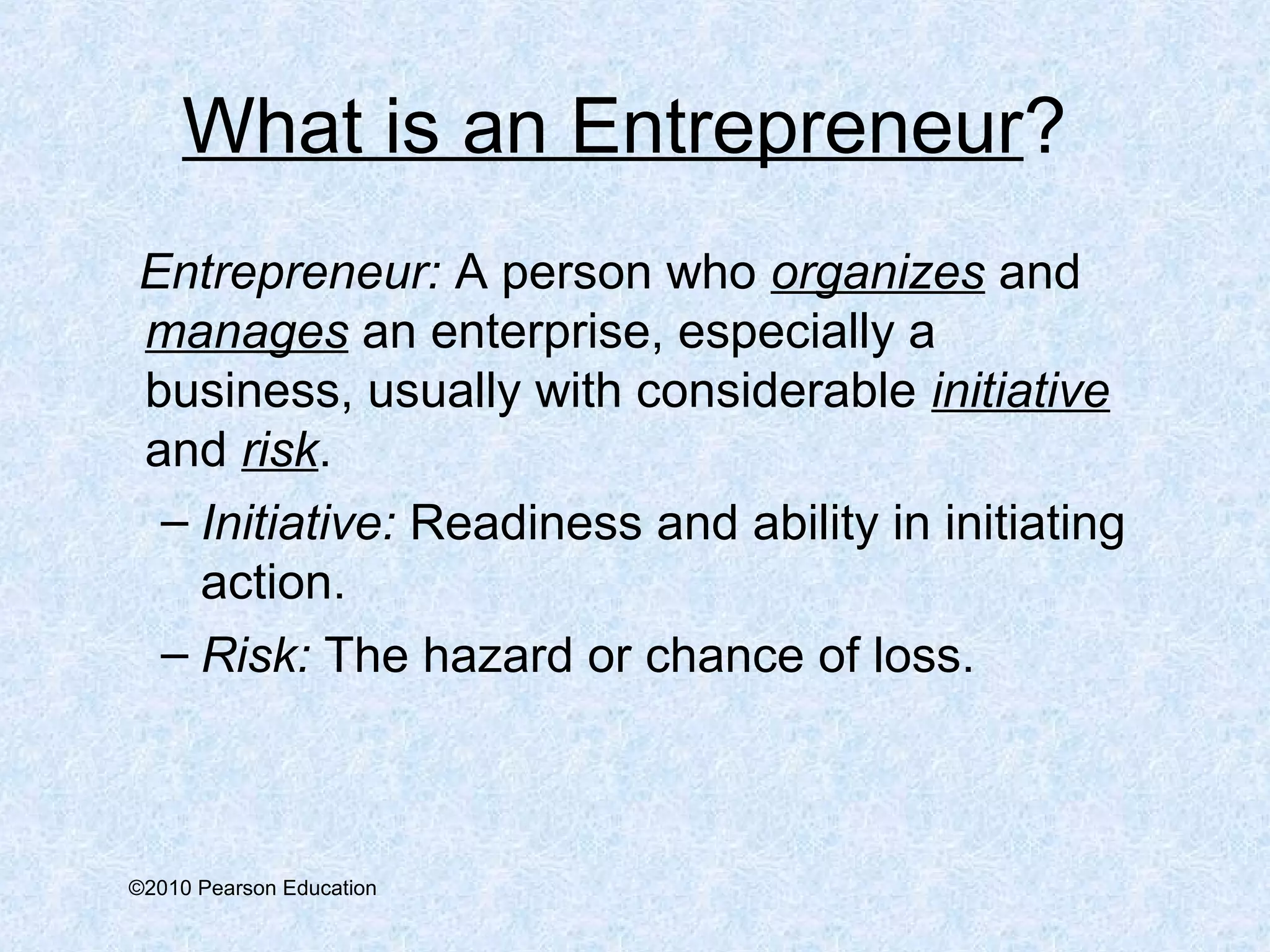
What is an Entrepreneur? 
Entrepreneur: A person who organizes and 
manages an enterprise, especially a 
business, usually with considerable initiative 
and risk. 
– Initiative: Readiness and ability in initiating 
action. 
– Risk: The hazard or chance of loss. 
©2010 Pearson Education
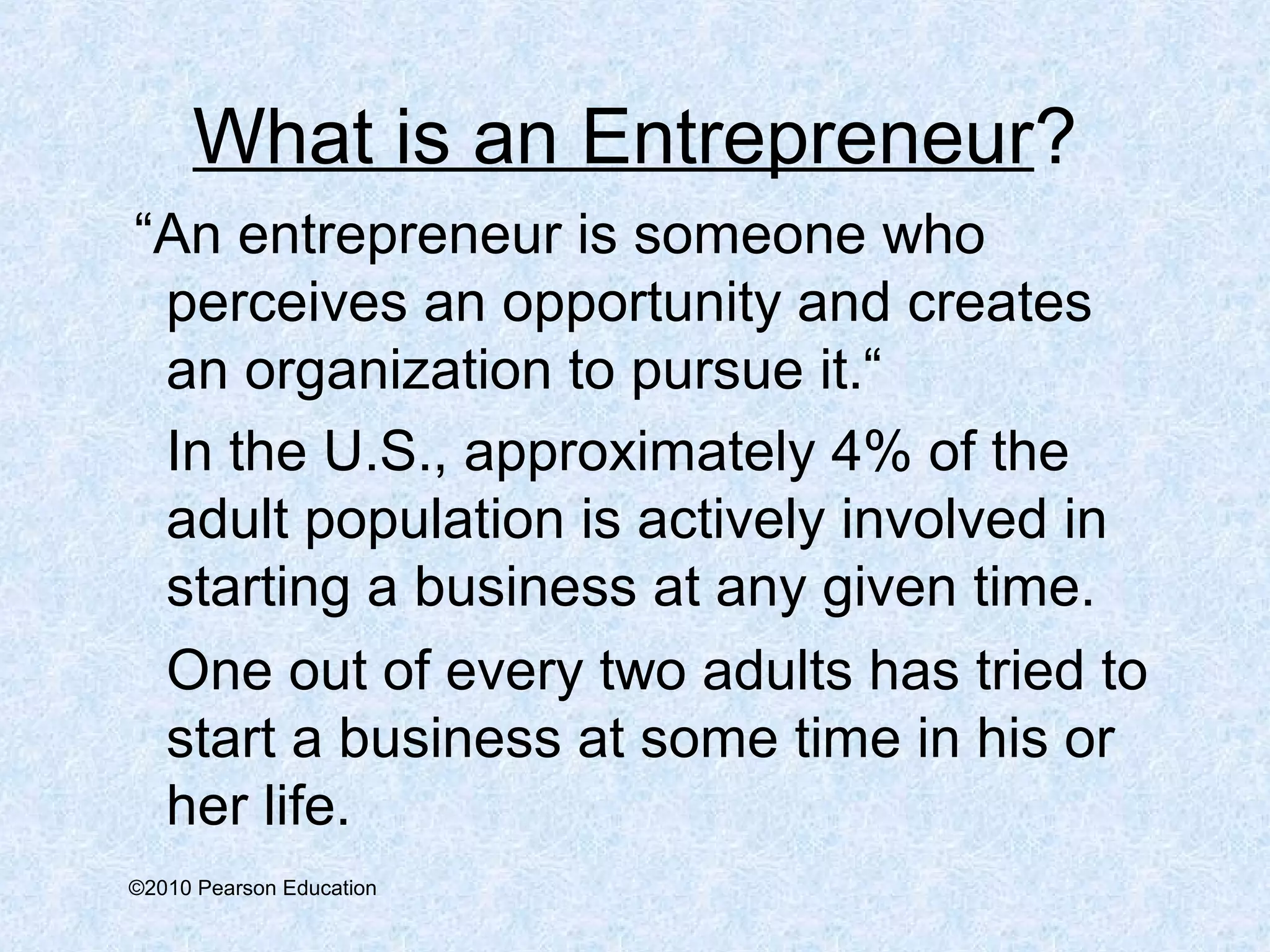
What is an Entrepreneur? 
“An entrepreneur is someone who 
perceives an opportunity and creates 
an organization to pursue it.“ 
In the U.S., approximately 4% of the 
adult population is actively involved in 
starting a business at any given time. 
One out of every two adults has tried to 
start a business at some time in his or 
her life. 
©2010 Pearson Education
What Does it Take to Be Successful? 
“In entrepreneurship, luck is where 
preparation and opportunity meet.” 
©2010 Pearson Education
What is Entrepreneurship? 
• Academic Definition (Stevenson & Jarillo) 
– Entrepreneurship is the process by which individuals pursue 
opportunities without regard to resources they currently 
control. 
• Venture Capitalist (Fred Wilson) 
– Entrepreneurship is the art of turning an idea into a 
business. 
• Explanation of What Entrepreneurs Do 
– Entrepreneurs assemble and then integrate all the resources 
needed –the money, the people, the business model, the 
strategy—needed to transform an invention or an idea into a 
viable business. 
©2010 Pearson Education 1-12
Corporate Entrepreneurship 
1 of 2 
• Corporate Entrepreneurship 
– Is the conceptualization of entrepreneurship at the firm 
level. 
– All firms fall along a conceptual continuum that ranges 
from highly conservative to highly entrepreneurial. 
– The position of a firm on this continuum is referred to as its 
entrepreneurial intensity. 
©2010 Pearson Education 1-13
Corporate Entrepreneurship 
2 of 2 
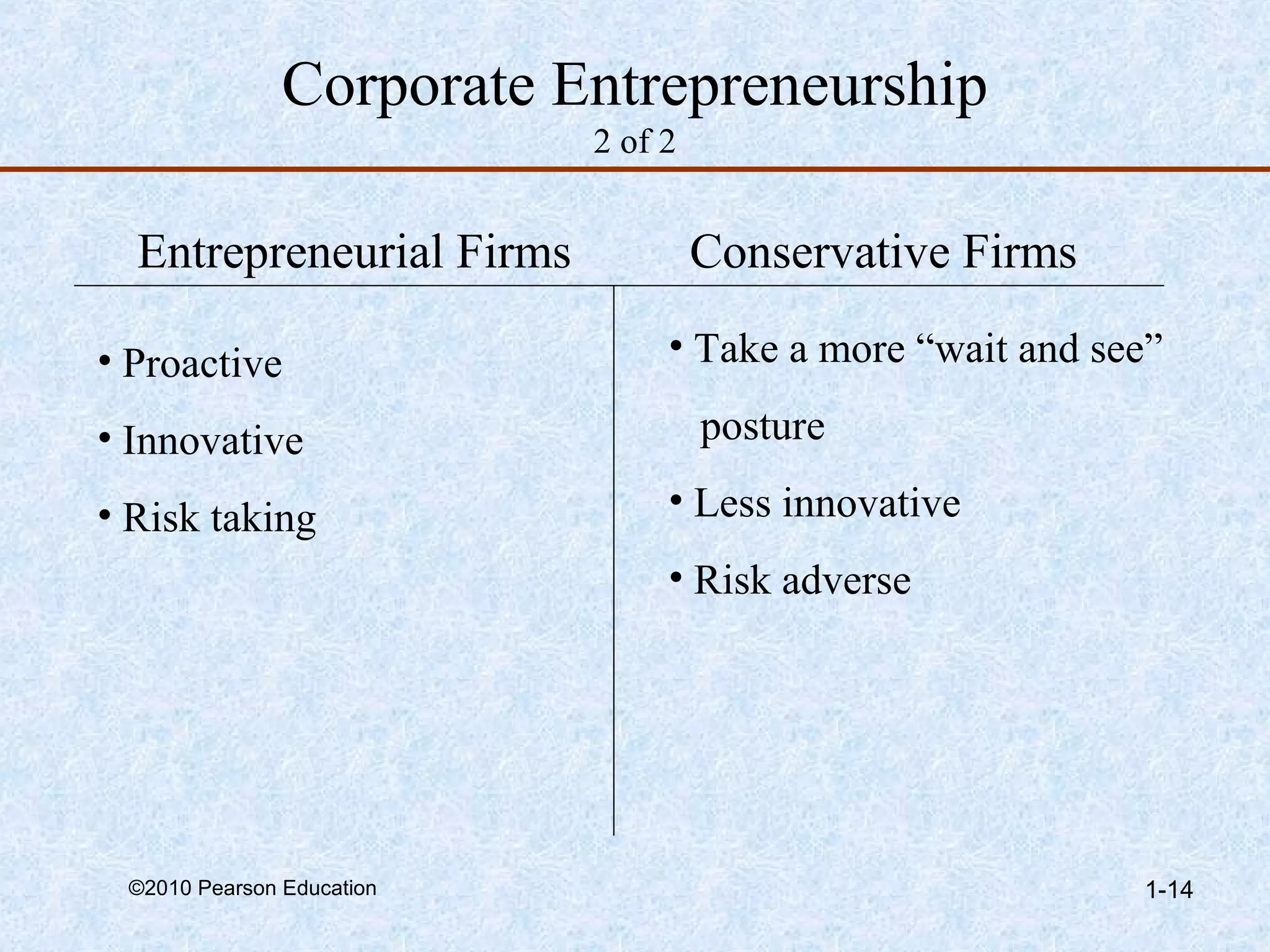
Entrepreneurial Firms Conservative Firms 
• Pro active 
• Innovative 
• Risk taking 
• Take a more “wait and see” 
posture 
• Less innovative 
• Risk adverse 
©2010 Pearson Education 1-14
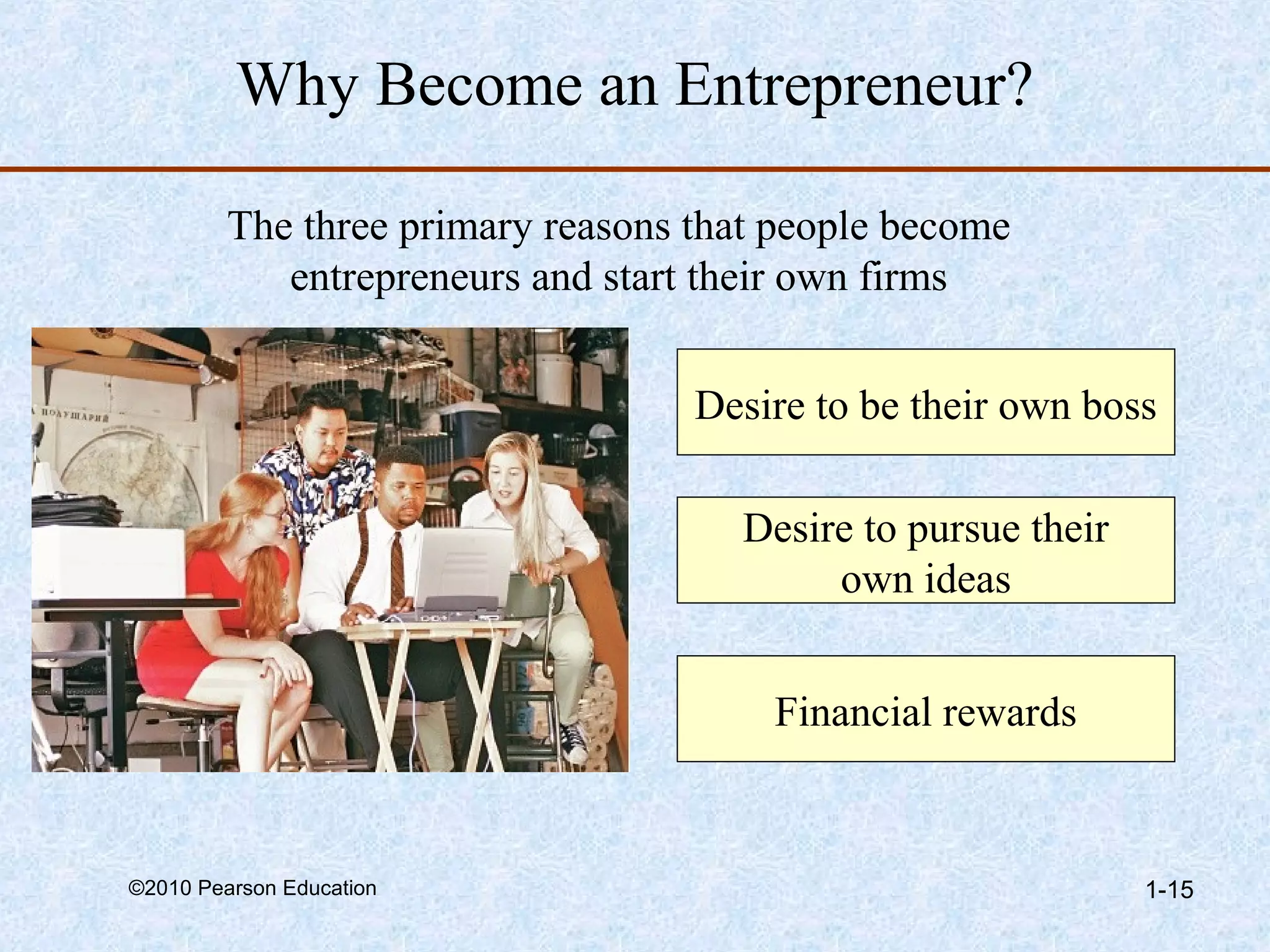
Why Become an Entrepreneur? 
The three primary reasons that people become 
entrepreneurs and start their own firms 
Desire to be their own boss 
Desire to pursue their 
own ideas 
Financial rewards 
©2010 Pearson Education 1-15
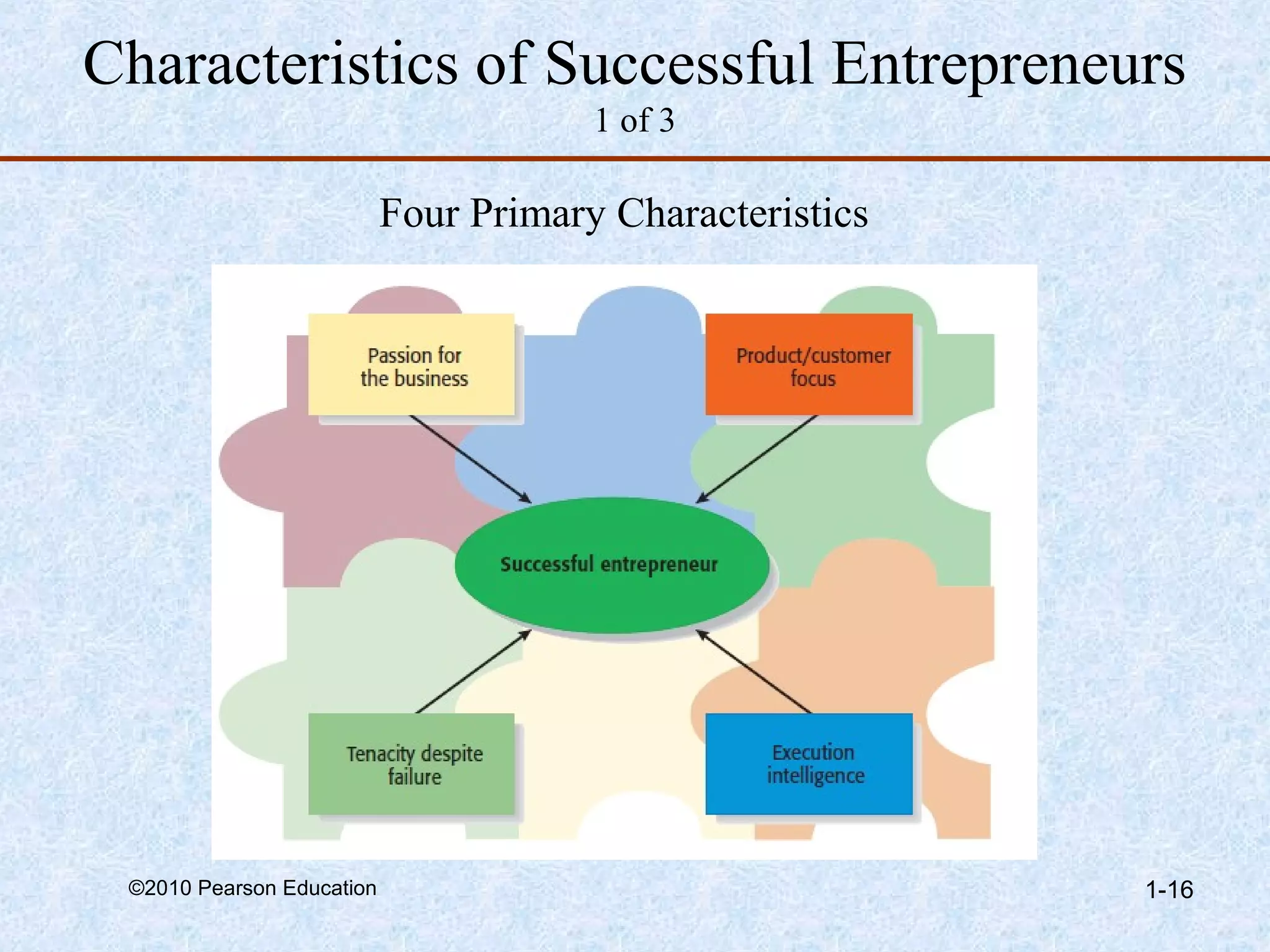
Characteristics of Successful Entrepreneurs 
1 of 3 
Four Primary Characteristics 
©2010 Pearson Education 1-16
Characteristics of Successful Entrepreneurs 
2 of 3 
• Passion for the Business 
– The number one characteristic shared by successful 
entrepreneurs is a passion for the business. 
– This passion typically stems from the entrepreneur’s belief 
that the business will positively influence people’s lives. 
• Product/Customer Focus 
– A second defining characteristic of successful 
entrepreneurs is a product/customer focus. 
– An entrepreneur’s keen focus on products and customers 
typically stems from the fact that most entrepreneurs are, at 
heart, craftspeople. 
©2010 Pearson Education 1-17
Characteristics of Successful Entrepreneurs 
3 of 3 
• Tenacity Despite Failure 
– Because entrepreneurs are typically trying something new, 
the failure rate is naturally high. 
– A defining characteristic for successful entrepreneurs’ is 
their ability to persevere through setbacks and failures. 
• Execution Intelligence 
– The ability to fashion a solid business idea into a viable 
business is a key characteristic of successful entrepreneurs. 
©2010 Pearson Education 1-18
Common Myths About Entrepreneurs 
1 of 5 
• Myth 1: Entrepreneurs Are Born Not Made 
– This myth is based on the mistaken belief that some people 
are genetically predisposed to be entrepreneurs. 
– The consensus of many studies is that no one is “born” to 
be an entrepreneur; everyone has the potential to become 
one. 
– Whether someone does or doesn’t become an entrepreneur, 
is a function of the environment, life experiences, and 
personal choices. 
©2010 Pearson Education 1-19
Common Myths About Entrepreneurs 
3 of 5 
• Myth 2: Entrepreneurs Are Gamblers 
– Most entrepreneurs are moderate risk takers. 
– The idea that entrepreneurs are gamblers originates from 
two sources: 
• Entrepreneurs typically have jobs that are less structured, and so 
they face a more uncertain set of possibilities than people in 
traditional jobs. 
• Many entrepreneurs have a strong need to achieve and set 
challenging goals, a behavior that is often equated with risk taking. 
©2010 Pearson Education 1-20
Common Myths About Entrepreneurs 
4 of 5 
• Myth 3: Entrepreneurs Are Motivated Primarily by 
Money. 
– While it is naïve to think that entrepreneurs don’t seek 
financial rewards, money is rarely the reason entrepreneurs 
start new firms. 
– In fact, some entrepreneurs warn that the pursuit of money 
can be distracting. 
©2010 Pearson Education 1-21
Common Myths About Entrepreneurs 
5 of 5 
• Myth 4: Entrepreneurs Should Be Young and 
Energetic. 
– The most active age for business ownership is 35 to 45 
years old. 
– While it is important to be energetic, investors often cite 
the strength of the entrepreneur as their most important 
criteria in making investment decisions. 
• What makes an entrepreneur “strong” in the eyes of an investor is 
experience, maturity, a solid reputation, and a track record of 
success. 
• These criteria favor older rather than younger entrepreneurs. 
©2010 Pearson Education 1-22
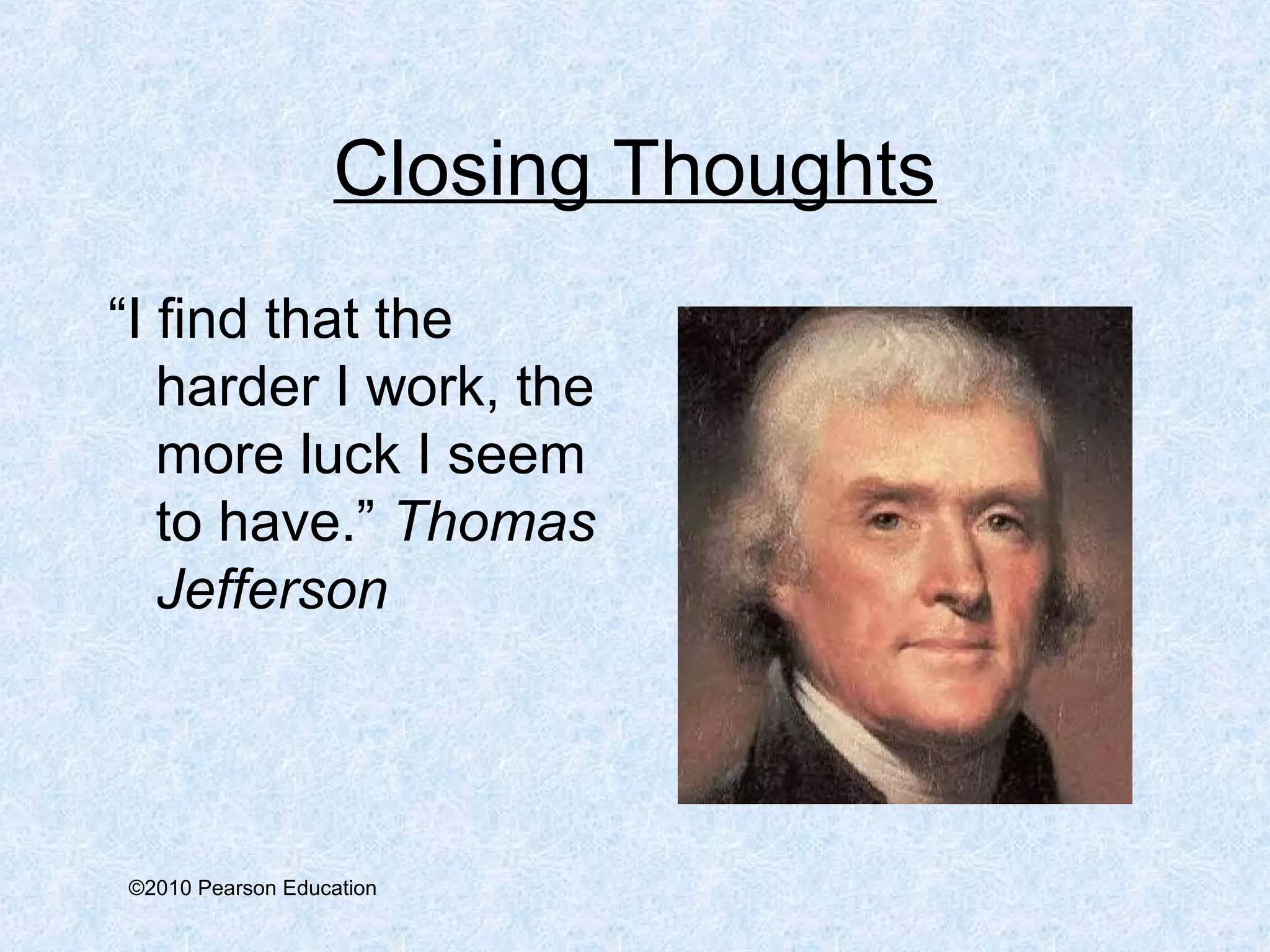
Closing Thoughts 
“I find that the 
harder I work, the 
more luck I seem 
to have.” Thomas 
Jefferson 
©2010 Pearson Education
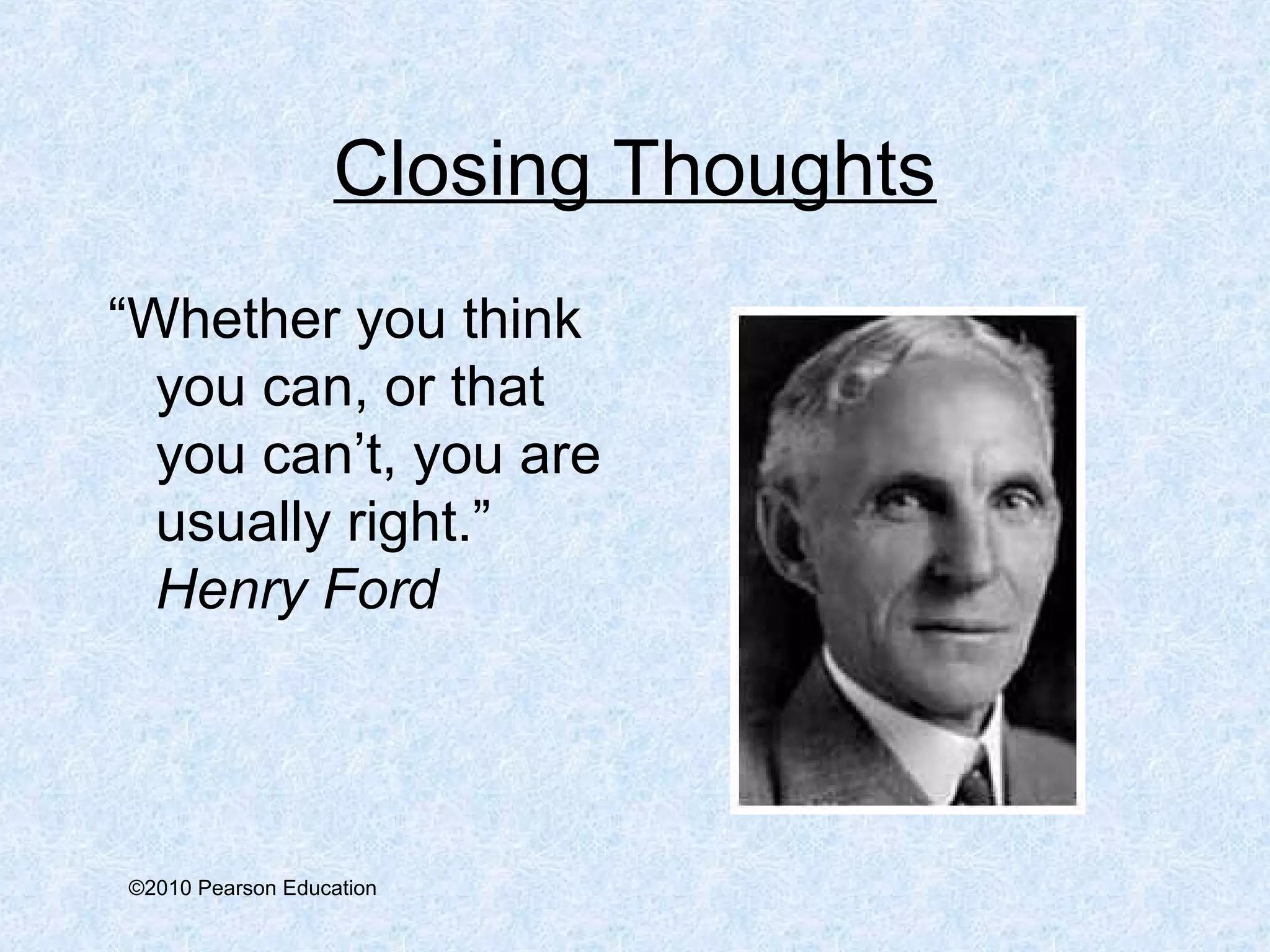
Closing Thoughts 
“Whether you think 
you can, or that 
you can’t, you are 
usually right.” 
Henry Ford 
©2010 Pearson Education

Introduction

  • 1.
    1-1 EntrEprEnEurship & small BusinEss managEmEnt Introduction to Course
  • 2.
    Course Objectives 1of 2 • To possess a well grounded understanding of essential entrepreneurial business principals. • To develop an understanding of important business issues as they relate to new ventures. • To identify, appreciate, and assess the knowledge, attitudes, and skills of an entrepreneur ©2010 Pearson Education 1-2
  • 3.
    Course Objectives 2of 2 • To study and observe entrepreneurial settings and entrepreneurial role models through exposure to actual business settings and experiences • To have an expanded awareness of the resources available for creating a business plan • To establish a level of confidence in creating a business plan as a tool to assess, create and communicate a business concept. • ©2010 Pearson Education 1-3
  • 4.
    Resources Textbook Essentialsof Entrepreneurship and Small Business Management, 6th Edition, Scarborough, Norman M., Upper Saddle River, NJ: Pearson Prentice Hall Publishing Co., 2011 Optional Software Business Plan Pro® by Palo Alto Software This software may be included with your text as an optional resource Business Feasibility Analysisä by Palo Alto Software This software may also be included with your text as an optional resource ©2010 Pearson Education 1-4
  • 5.
    Course Components Case Assignments  Entrepreneur Interview  Group Project: Feasibility Study and Business Plan Development ©2010 Pearson Education 1-5
  • 6.
    Exam/ Grading Adesignated number of midterm exams and a final exam will test your grasp of the materials discussed in class and in the assigned readings. GRADING Percentage Points Class Participation 5% 5 Case Assignments (2 at 40 points each) 10% 10 Entrepreneurial Interview 5% 5 Project Work 20% 20 Midterm Exam(s) 10% 10 Final Exam 50% 50 TOTAL POINTS 100 ©2010 Pearson Education 1-6
  • 7.
    Introduction to Entrepreneurship There is tremendous interest in entrepreneurship in the U.S. and around the world. According to the 2007 GEM study, 9.6% of Americans are actively engaged in starting a business or are the owner/manager of a business that is less than three years old. ©2010 Pearson Education 1-7
  • 8.
    Indications of IncreasedInterest in Entrepreneurship • Books – Amazon.com lists over 45,000 books dealing with entrepreneurship and 118,000 focused on small business. • College Courses – In 1985, there were about 250 entrepreneurship courses offered across all colleges in the United States. – Today, more than 5,000 entrepreneurship courses are offered in two-year and four-year colleges and universities in the United States. ©2010 Pearson Education 1-8
  • 9.
    What is anEntrepreneur? Entrepreneur: A person who organizes and manages an enterprise, especially a business, usually with considerable initiative and risk. – Initiative: Readiness and ability in initiating action. – Risk: The hazard or chance of loss. ©2010 Pearson Education
  • 10.
    What is anEntrepreneur? “An entrepreneur is someone who perceives an opportunity and creates an organization to pursue it.“ In the U.S., approximately 4% of the adult population is actively involved in starting a business at any given time. One out of every two adults has tried to start a business at some time in his or her life. ©2010 Pearson Education
  • 11.
    What Does itTake to Be Successful? “In entrepreneurship, luck is where preparation and opportunity meet.” ©2010 Pearson Education
  • 12.
    What is Entrepreneurship? • Academic Definition (Stevenson & Jarillo) – Entrepreneurship is the process by which individuals pursue opportunities without regard to resources they currently control. • Venture Capitalist (Fred Wilson) – Entrepreneurship is the art of turning an idea into a business. • Explanation of What Entrepreneurs Do – Entrepreneurs assemble and then integrate all the resources needed –the money, the people, the business model, the strategy—needed to transform an invention or an idea into a viable business. ©2010 Pearson Education 1-12
  • 13.
    Corporate Entrepreneurship 1of 2 • Corporate Entrepreneurship – Is the conceptualization of entrepreneurship at the firm level. – All firms fall along a conceptual continuum that ranges from highly conservative to highly entrepreneurial. – The position of a firm on this continuum is referred to as its entrepreneurial intensity. ©2010 Pearson Education 1-13
  • 14.
    Corporate Entrepreneurship 2of 2 Entrepreneurial Firms Conservative Firms • Pro active • Innovative • Risk taking • Take a more “wait and see” posture • Less innovative • Risk adverse ©2010 Pearson Education 1-14
  • 15.
    Why Become anEntrepreneur? The three primary reasons that people become entrepreneurs and start their own firms Desire to be their own boss Desire to pursue their own ideas Financial rewards ©2010 Pearson Education 1-15
  • 16.
    Characteristics of SuccessfulEntrepreneurs 1 of 3 Four Primary Characteristics ©2010 Pearson Education 1-16
  • 17.
    Characteristics of SuccessfulEntrepreneurs 2 of 3 • Passion for the Business – The number one characteristic shared by successful entrepreneurs is a passion for the business. – This passion typically stems from the entrepreneur’s belief that the business will positively influence people’s lives. • Product/Customer Focus – A second defining characteristic of successful entrepreneurs is a product/customer focus. – An entrepreneur’s keen focus on products and customers typically stems from the fact that most entrepreneurs are, at heart, craftspeople. ©2010 Pearson Education 1-17
  • 18.
    Characteristics of SuccessfulEntrepreneurs 3 of 3 • Tenacity Despite Failure – Because entrepreneurs are typically trying something new, the failure rate is naturally high. – A defining characteristic for successful entrepreneurs’ is their ability to persevere through setbacks and failures. • Execution Intelligence – The ability to fashion a solid business idea into a viable business is a key characteristic of successful entrepreneurs. ©2010 Pearson Education 1-18
  • 19.
    Common Myths AboutEntrepreneurs 1 of 5 • Myth 1: Entrepreneurs Are Born Not Made – This myth is based on the mistaken belief that some people are genetically predisposed to be entrepreneurs. – The consensus of many studies is that no one is “born” to be an entrepreneur; everyone has the potential to become one. – Whether someone does or doesn’t become an entrepreneur, is a function of the environment, life experiences, and personal choices. ©2010 Pearson Education 1-19
  • 20.
    Common Myths AboutEntrepreneurs 3 of 5 • Myth 2: Entrepreneurs Are Gamblers – Most entrepreneurs are moderate risk takers. – The idea that entrepreneurs are gamblers originates from two sources: • Entrepreneurs typically have jobs that are less structured, and so they face a more uncertain set of possibilities than people in traditional jobs. • Many entrepreneurs have a strong need to achieve and set challenging goals, a behavior that is often equated with risk taking. ©2010 Pearson Education 1-20
  • 21.
    Common Myths AboutEntrepreneurs 4 of 5 • Myth 3: Entrepreneurs Are Motivated Primarily by Money. – While it is naïve to think that entrepreneurs don’t seek financial rewards, money is rarely the reason entrepreneurs start new firms. – In fact, some entrepreneurs warn that the pursuit of money can be distracting. ©2010 Pearson Education 1-21
  • 22.
    Common Myths AboutEntrepreneurs 5 of 5 • Myth 4: Entrepreneurs Should Be Young and Energetic. – The most active age for business ownership is 35 to 45 years old. – While it is important to be energetic, investors often cite the strength of the entrepreneur as their most important criteria in making investment decisions. • What makes an entrepreneur “strong” in the eyes of an investor is experience, maturity, a solid reputation, and a track record of success. • These criteria favor older rather than younger entrepreneurs. ©2010 Pearson Education 1-22
  • 23.
    Closing Thoughts “Ifind that the harder I work, the more luck I seem to have.” Thomas Jefferson ©2010 Pearson Education
  • 24.
    Closing Thoughts “Whetheryou think you can, or that you can’t, you are usually right.” Henry Ford ©2010 Pearson Education