Entrepreneurship


SAE
What is an Entrepreneur?
• An Entrepreneur (ahn’tra pra nur)
  is a person who organizes and
  manages a business undertaking,
  assuming the risk for the sake of
  profit. Any person (any age) who
  starts and operates a business is an
  entrepreneur.
                                     SAE
Entrepreneurship
• Agricultural students have been
  entrepreneurs since the beginning
  of agricultural education.


                                      SAE
Entrepreneurship
• The Smith-Hughes Act of 1917
  (which provided federal funding
  for agricultural programs) required
  all students to have an
  entrepreneurship program – but
  they weren’t called entrepreneurs
  back then.
                                   SAE
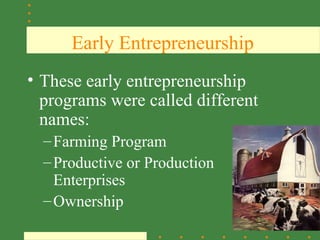
Early Entrepreneurship
• These early entrepreneurship
  programs were called different
  names:
  – Farming Program
  – Productive or Production
    Enterprises
  – Ownership
                                   SAE
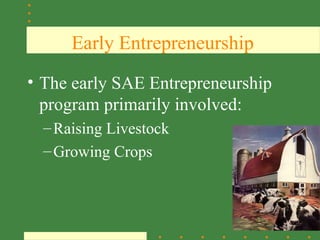
Early Entrepreneurship
• The early SAE Entrepreneurship
  program primarily involved:
  – Raising Livestock
  – Growing Crops


                                   SAE
Entrepreneurship Today
• Today, agricultural students are
  involved in many different types of
  entrepreneurial activities.
• Entrepreneurship in agriculture can
  still be raising livestock and
  growing crops, but it can be much,
  much more than that.
                                   SAE
Agricultural Entrepreneurship
• Entrepreneurship: The student plans,
  implements, operates and assumes financial
  risks in a farming activity or agricultural
  business. In entrepreneurship programs, the
  student owns the materials and other
  required inputs and keeps financial records
  to determine return to investments.

                                          SAE
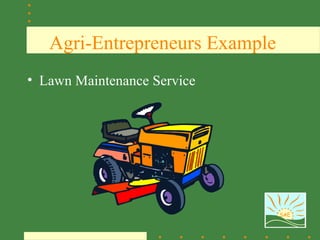
Agri-Entrepreneurs Example
• Lawn Maintenance Service


                                SAE
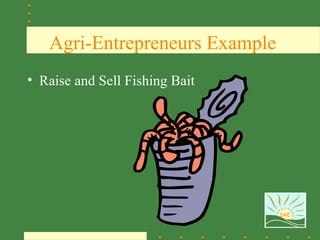
Agri-Entrepreneurs Example
• Raise and Sell Fishing Bait


                                SAE
Agri-Entrepreneurs Example
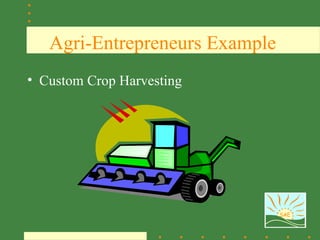
• Custom Crop Harvesting


                                SAE
Agri-Entrepreneurs Example
• Pet Sitting Service


                                SAE
Agri-Entrepreneurs Example
• Fishing Guide


                                SAE
Agri-Entrepreneurs Example
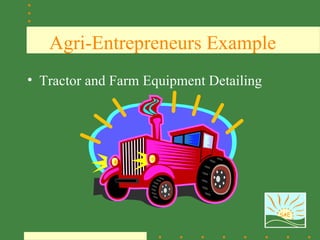
• Tractor and Farm Equipment Detailing


                                         SAE
Agri-Entrepreneurs Example
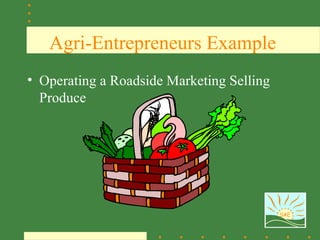
• Operating a Roadside Marketing Selling
  Produce


                                           SAE
Agri-Entrepreneurs Example
• Making and Selling Christmas Wreathes


                                          SAE
Agri-Entrepreneurs Example
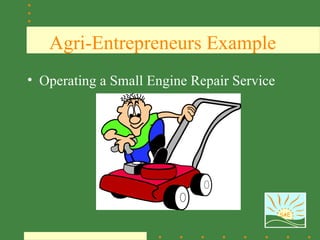
• Operating a Small Engine Repair Service


                                            SAE
Three Aspects of Entrepreneurship

• 1. The identification/recognition of market
  opportunity and the generation of a business
  idea (product or service) to address the
  opportunity


                                           SAE
Three Aspects of Entrepreneurship

• 2. The marshalling and commitment of
  resources in the face of risk to pursue the
  opportunity


                                                SAE
Three Aspects of Entrepreneurship

• 3. The creation of an operating business
  organization to implement the opportunity-
  motivated business idea


                                          SAE
Successful Entrepreneurs
• According to the Small Business
  Administration, successful
  entrepreneurs have five characteristics:
  – Drive, which is defined as the most important
    attribute. Entrepreneurs can expect long hours,
    high stress and endless problems, as they
    launch a new business.

                                                 SAE
Successful Entrepreneurs
• According to the Small Business
  Administration, successful
  entrepreneurs have five characteristics:
  – Thinking Ability, or the characteristic that
    encompasses creativity, critical thinking,
    analytical abilities and originality.


                                                   SAE
Successful Entrepreneurs
• According to the Small Business
  Administration, successful
  entrepreneurs have five characteristics:
  – Aptitude for Human Relations. This
    characteristic recognizes the importance of the
    ability to motivate employees, sell customers,
    negotiate with suppliers and convince lenders.
    Personality plays a big part in success in this
    area..
                                                 SAE
Successful Entrepreneurs
• According to the Small Business
  Administration, successful
  entrepreneurs have five characteristics:
  – Communication Skills, or the ability to make
    yourself understood.


                                                   SAE
Successful Entrepreneurs
• According to the Small Business
  Administration, successful
  entrepreneurs have five characteristics:
  – Technical Ability speaks to the need of the
    entrepreneur to know their product and their
    market. They must consider the long- and
    short-term implications of their decisions, their
    strengths and weaknesses, and their
    competition. In short, they need strategic
    management skills.                             SAE
Entrepreneurship
• Some advantages
 – You are your own boss
 – Enjoy the profits from you efforts
 – Sense of pride in your business
 – Flexibility in your work schedule

                                        SAE
Entrepreneurship
• Some disadvantages
  – Will need to put in long hours
  – Need money to start
  – Have to keep up with government rules and
    regulations
  – May have to mark hard decisions (hiring, firing,
    etc.)
  – May lose money
                                                 SAE
FFA and Entrepreneurship
• During the past decade the Kauffman
  Foundation has supported a new FFA
  initiative to support entrepreneurship
  activities
  – Awards program (and money)
  – Video “You’re the Boss”
  – Materials

                                           SAE
FFA Agri-Entrepreneurship Program

• Each state recognizes the agricultural
  student who has the best entrepreneurship
  program.
• There is cash award of $100 at the state
  level.
• All entries at the state level go on for
  national competition.
                                              SAE
FFA Agri-Entrepreneurship Program

• At the national level, 10 outstanding
  entrepreneurship students are recognized.
• There is cash award of $1000 for each
  national winner
• The FFA chapters of the national award
  winners each receive $500.

                                              SAE

Entrepreneurship

  • 1.
  • 2.
    What is anEntrepreneur? • An Entrepreneur (ahn’tra pra nur) is a person who organizes and manages a business undertaking, assuming the risk for the sake of profit. Any person (any age) who starts and operates a business is an entrepreneur. SAE
  • 3.
    Entrepreneurship • Agricultural studentshave been entrepreneurs since the beginning of agricultural education. SAE
  • 4.
    Entrepreneurship • The Smith-HughesAct of 1917 (which provided federal funding for agricultural programs) required all students to have an entrepreneurship program – but they weren’t called entrepreneurs back then. SAE
  • 5.
    Early Entrepreneurship • Theseearly entrepreneurship programs were called different names: – Farming Program – Productive or Production Enterprises – Ownership SAE
  • 6.
    Early Entrepreneurship • Theearly SAE Entrepreneurship program primarily involved: – Raising Livestock – Growing Crops SAE
  • 7.
    Entrepreneurship Today • Today,agricultural students are involved in many different types of entrepreneurial activities. • Entrepreneurship in agriculture can still be raising livestock and growing crops, but it can be much, much more than that. SAE
  • 8.
    Agricultural Entrepreneurship • Entrepreneurship:The student plans, implements, operates and assumes financial risks in a farming activity or agricultural business. In entrepreneurship programs, the student owns the materials and other required inputs and keeps financial records to determine return to investments. SAE
  • 9.
    Agri-Entrepreneurs Example • LawnMaintenance Service SAE
  • 10.
    Agri-Entrepreneurs Example • Raiseand Sell Fishing Bait SAE
  • 11.
  • 12.
  • 13.
  • 14.
    Agri-Entrepreneurs Example • Tractorand Farm Equipment Detailing SAE
  • 15.
    Agri-Entrepreneurs Example • Operatinga Roadside Marketing Selling Produce SAE
  • 16.
    Agri-Entrepreneurs Example • Makingand Selling Christmas Wreathes SAE
  • 17.
    Agri-Entrepreneurs Example • Operatinga Small Engine Repair Service SAE
  • 18.
    Three Aspects ofEntrepreneurship • 1. The identification/recognition of market opportunity and the generation of a business idea (product or service) to address the opportunity SAE
  • 19.
    Three Aspects ofEntrepreneurship • 2. The marshalling and commitment of resources in the face of risk to pursue the opportunity SAE
  • 20.
    Three Aspects ofEntrepreneurship • 3. The creation of an operating business organization to implement the opportunity- motivated business idea SAE
  • 21.
    Successful Entrepreneurs • Accordingto the Small Business Administration, successful entrepreneurs have five characteristics: – Drive, which is defined as the most important attribute. Entrepreneurs can expect long hours, high stress and endless problems, as they launch a new business. SAE
  • 22.
    Successful Entrepreneurs • Accordingto the Small Business Administration, successful entrepreneurs have five characteristics: – Thinking Ability, or the characteristic that encompasses creativity, critical thinking, analytical abilities and originality. SAE
  • 23.
    Successful Entrepreneurs • Accordingto the Small Business Administration, successful entrepreneurs have five characteristics: – Aptitude for Human Relations. This characteristic recognizes the importance of the ability to motivate employees, sell customers, negotiate with suppliers and convince lenders. Personality plays a big part in success in this area.. SAE
  • 24.
    Successful Entrepreneurs • Accordingto the Small Business Administration, successful entrepreneurs have five characteristics: – Communication Skills, or the ability to make yourself understood. SAE
  • 25.
    Successful Entrepreneurs • Accordingto the Small Business Administration, successful entrepreneurs have five characteristics: – Technical Ability speaks to the need of the entrepreneur to know their product and their market. They must consider the long- and short-term implications of their decisions, their strengths and weaknesses, and their competition. In short, they need strategic management skills. SAE
  • 26.
    Entrepreneurship • Some advantages – You are your own boss – Enjoy the profits from you efforts – Sense of pride in your business – Flexibility in your work schedule SAE
  • 27.
    Entrepreneurship • Some disadvantages – Will need to put in long hours – Need money to start – Have to keep up with government rules and regulations – May have to mark hard decisions (hiring, firing, etc.) – May lose money SAE
  • 28.
    FFA and Entrepreneurship •During the past decade the Kauffman Foundation has supported a new FFA initiative to support entrepreneurship activities – Awards program (and money) – Video “You’re the Boss” – Materials SAE
  • 29.
    FFA Agri-Entrepreneurship Program •Each state recognizes the agricultural student who has the best entrepreneurship program. • There is cash award of $100 at the state level. • All entries at the state level go on for national competition. SAE
  • 30.
    FFA Agri-Entrepreneurship Program •At the national level, 10 outstanding entrepreneurship students are recognized. • There is cash award of $1000 for each national winner • The FFA chapters of the national award winners each receive $500. SAE