Accounting in Action
CHAPTER 1
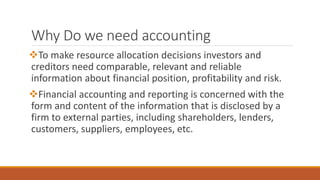
Why Do we need accounting
To make resource allocation decisions investors and
creditors need comparable, relevant and reliable
information about financial position, profitability and risk.
Financial accounting and reporting is concerned with the
form and content of the information that is disclosed by a
firm to external parties, including shareholders, lenders,
customers, suppliers, employees, etc.
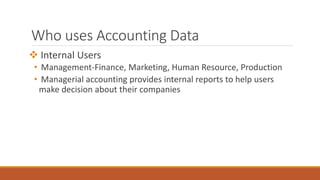
Who uses Accounting Data
 Internal Users
• Management-Finance, Marketing, Human Resource, Production
• Managerial accounting provides internal reports to help users
make decision about their companies
Who uses Accounting Data
 External Users
• Investors
• Creditors
• Customers
• Regulatory agencies
• Taxing Authority
Accounting
 Identifies
 Records
 Communicates
Accounting Standards
 GAAP
• USA, France, India
• Standard setting body: FASB, SEC (oversees)
 IFRS
• UK, Bangladesh, Australia
• Standard Setting body: IASB
Measurement Principles
 Historical Cost Principle
• Records assets at their cost
 Fair value Principle
• Records assets and liabilities at their fair value (the price received
to sell an asset or settle a liability)
 Depends on Relevance and Faithful representation
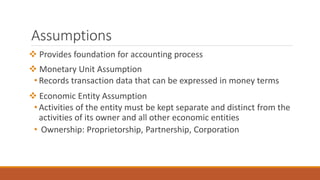
Assumptions
 Provides foundation for accounting process
 Monetary Unit Assumption
• Records transaction data that can be expressed in money terms
 Economic Entity Assumption
• Activities of the entity must be kept separate and distinct from the
activities of its owner and all other economic entities
• Ownership: Proprietorship, Partnership, Corporation
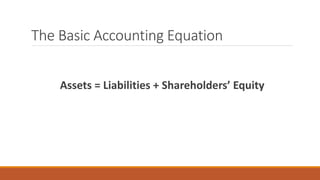
The Basic Accounting Equation
Assets = Liabilities + Shareholders’ Equity
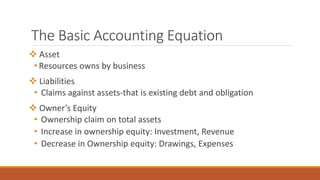
The Basic Accounting Equation
 Asset
• Resources owns by business
 Liabilities
• Claims against assets-that is existing debt and obligation
 Owner’s Equity
• Ownership claim on total assets
• Increase in ownership equity: Investment, Revenue
• Decrease in Ownership equity: Drawings, Expenses
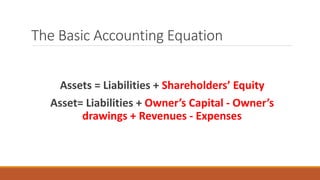
The Basic Accounting Equation
Assets = Liabilities + Shareholders’ Equity
Asset= Liabilities + Owner’s Capital - Owner’s
drawings + Revenues - Expenses
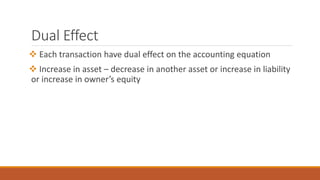
Dual Effect
 Each transaction have dual effect on the accounting equation
 Increase in asset – decrease in another asset or increase in liability
or increase in owner’s equity
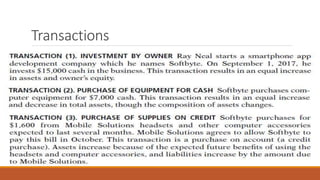
Transactions
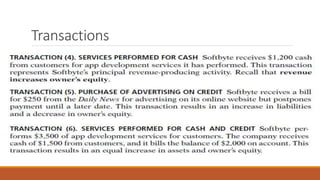
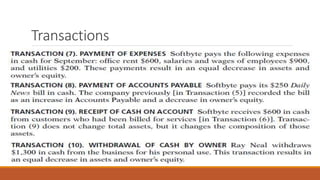
 Transaction 1 to 10
 Page: 10 - 15
Transactions
Transactions
Transactions
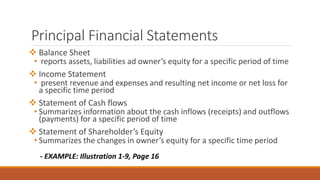
Principal Financial Statements
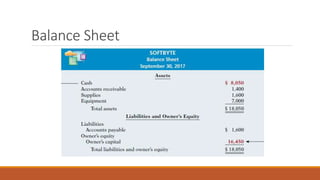
 Balance Sheet
• reports assets, liabilities ad owner’s equity for a specific period of time
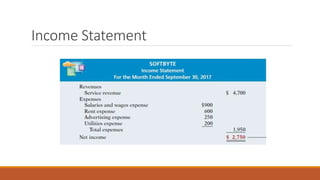
 Income Statement
• present revenue and expenses and resulting net income or net loss for
a specific time period
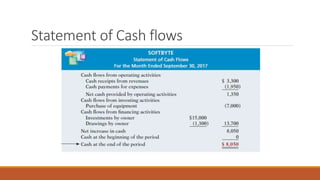
 Statement of Cash flows
• Summarizes information about the cash inflows (receipts) and outflows
(payments) for a specific period of time
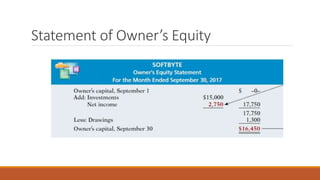
 Statement of Shareholder’s Equity
• Summarizes the changes in owner’s equity for a specific time period
- EXAMPLE: Illustration 1-9, Page 16
Income Statement
Statement of Owner’s Equity
Balance Sheet
Statement of Cash flows
Career opportunities in Accounting
 Public Accounting
 Private Accounting
 Governmental Accounting
 Forensic Accounting
End of chapter problems
 In class:
•Practice Exercises
•E1-7, E1-10, E1-11, E1-15, P1-3A, P1-4A
Next Class
The Recording Process

Chap 1

  • 1.
  • 2.
    Why Do weneed accounting To make resource allocation decisions investors and creditors need comparable, relevant and reliable information about financial position, profitability and risk. Financial accounting and reporting is concerned with the form and content of the information that is disclosed by a firm to external parties, including shareholders, lenders, customers, suppliers, employees, etc.
  • 3.
    Who uses AccountingData  Internal Users • Management-Finance, Marketing, Human Resource, Production • Managerial accounting provides internal reports to help users make decision about their companies
  • 4.
    Who uses AccountingData  External Users • Investors • Creditors • Customers • Regulatory agencies • Taxing Authority
  • 5.
  • 6.
    Accounting Standards  GAAP •USA, France, India • Standard setting body: FASB, SEC (oversees)  IFRS • UK, Bangladesh, Australia • Standard Setting body: IASB
  • 7.
    Measurement Principles  HistoricalCost Principle • Records assets at their cost  Fair value Principle • Records assets and liabilities at their fair value (the price received to sell an asset or settle a liability)  Depends on Relevance and Faithful representation
  • 8.
    Assumptions  Provides foundationfor accounting process  Monetary Unit Assumption • Records transaction data that can be expressed in money terms  Economic Entity Assumption • Activities of the entity must be kept separate and distinct from the activities of its owner and all other economic entities • Ownership: Proprietorship, Partnership, Corporation
  • 9.
    The Basic AccountingEquation Assets = Liabilities + Shareholders’ Equity
  • 10.
    The Basic AccountingEquation  Asset • Resources owns by business  Liabilities • Claims against assets-that is existing debt and obligation  Owner’s Equity • Ownership claim on total assets • Increase in ownership equity: Investment, Revenue • Decrease in Ownership equity: Drawings, Expenses
  • 11.
    The Basic AccountingEquation Assets = Liabilities + Shareholders’ Equity Asset= Liabilities + Owner’s Capital - Owner’s drawings + Revenues - Expenses
  • 12.
    Dual Effect  Eachtransaction have dual effect on the accounting equation  Increase in asset – decrease in another asset or increase in liability or increase in owner’s equity
  • 13.
    Transactions  Transaction 1to 10  Page: 10 - 15
  • 14.
  • 15.
  • 16.
  • 17.
    Principal Financial Statements Balance Sheet • reports assets, liabilities ad owner’s equity for a specific period of time  Income Statement • present revenue and expenses and resulting net income or net loss for a specific time period  Statement of Cash flows • Summarizes information about the cash inflows (receipts) and outflows (payments) for a specific period of time  Statement of Shareholder’s Equity • Summarizes the changes in owner’s equity for a specific time period - EXAMPLE: Illustration 1-9, Page 16
  • 18.
  • 19.
  • 20.
  • 21.
  • 22.
    Career opportunities inAccounting  Public Accounting  Private Accounting  Governmental Accounting  Forensic Accounting
  • 23.
    End of chapterproblems  In class: •Practice Exercises •E1-7, E1-10, E1-11, E1-15, P1-3A, P1-4A
  • 24.