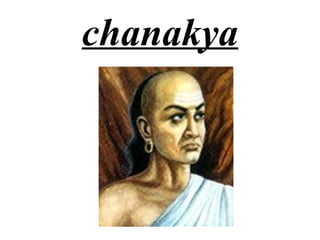
chanakya
About chanakya
  Chanakya, also known as Kautilya or Vishnugupta, was born in
Pataliputra, Magadh (modern Bihar), and later moved to Taxila, in
Gandhar province(now in Pakistan). He was a professor (acharya) of
political science at the Takshashila University and later the Prime
Minister of the Emperor Chandragupta Maurya. He is regarded as
one of the earliest known political thinkers, economists and king-
makers. He was the man to envision the first Indian empire by
unification of the then numerous kingdoms in the Indian sub-
continent and provide the impetus for fights against the Greek
conqueror Alexander.
Identity
   He is generally called Chanakya,but, in his capacity as author of the
Arthashastra, is generally referred to as Kautilya. The Arthashastra
identifies its author by the name Kautilya,except for one verse which
refers to him by the name Vishnugupta.One of the earliest Sanskrit
literature to explicitly identify Chanakya with Vishnugupta was Vishnu
Sarma's Panchatantra in the 3rd century BC
Legend
  Thomas R. Trautmann (An American historian & holds a Ph.D. from
the University of London. His studies focus on Ancient India and other
subjects. )lists the following elements as common to different forms of
the Chanakya legend :
  Chanakya was born with a complete set of teeth, a sign that he would
become king, which is inappropriate for a Brahmin like Chanakya.
Chāṇakya's teeth were therefore broken and it was prophesied that he
will rule through another.
  The Nanda King throws Chanakya out of his court, prompting
Chanakya to swear revenge.
  Chānakya searches for one worthy for him to rule through. Chanakya
encounters a young Chandragupta Maurya who is a born leader even as a
child.
Chanakya's initial attempt to overthrow Nanda fails, whereupon he
comes across a mother scolding her child for burning himself by eating
from the middle of a bun or bowl of porridge rather than the cooler edge.
Chanakya realizes his initial strategic error and, instead of attacking the
heart of Nanda territory, slowly chips away at its edges.
  Chanakya changed his alliance with the mountain king Parvata due to
his obstinance and non adherence to the principles of treaty as agreed .
   Chanakya enlists the services of a fanatical weaver to rid the kingdom
of rebels.
   Chānakya adds poison to the food eaten by Chandragupta, now king,
in order to make him immune. Unaware, Chandragupta feeds some of his
food to his queen, who is in her ninth month of pregnancy. In order to
save the heir to the throne, Chanakya cuts the queen open and extracts
the fetus, who is named Bindusāra because he was touched by a drop
(bindu) of blood or of poison.
  Chānakya's political rivalry with Subandhu leads to his death.
Some quotes from Chankya niti

 "A person should not be too honest. Straight trees are cut first and
honest people are screwed first.“

 "Even if a snake is not poisonous, it should pretend to be venomous."

  "The biggest guru-mantra is: Never share your secrets with anybody.
It will destroy you."

  "There is some self-interest behind every friendship. There is no
friendship without self-interests. This is a bitter truth."
"Before you start some work, always ask yourself three questions -
Why am I doing it, What the results might be and Will I be successful.
Only when you think deeply and find satisfactory answers to these
questions, go ahead."

 "As soon as the fear approaches near, attack and destroy it.“

  "The world's biggest power is the youth and beauty of a woman."

 "Once you start a working on something, don't be afraid of failure and
don't abandon it. People who work sincerely are the happiest."

Chanakya quotes (Indian politician,strategist and writer, 350 BC-275
BC)
Meaning of “common sense”
        by chanakya
  Taking the two words "common sense" right up to their highest
level,he has written:


      "Man's glory is in common sense,
           Dictating us the grace,
      That man is made to live and love
      The beauteous Heaven's embrace"
Works
Two books are attributed to Chanakya: Arthashastra and Nitishastra
which is also know as Chanakya Niti. The Arthashastra discusses
monetary and fiscal policies, welfare, international relations, and war
strategies in detail. Nitishastra is a treatise on the ideal way of life, and
shows Chanakya's in depth study of the Indian way of life.
Death of Chanakya
  Chanakya lived to ripe old age and died around 283 BC and was
cremated by his grandson/disciple Radhagupta who succeeded Rakshasa
Katyayan (great-grand son of Prabuddha Katyayan, who attained Nirvana
during the same period as Gautam Budhha) as Prime Minister of the
Maurya Empire and was instrumental in backing Ashoka to the throne.
There were three non-traditional belief paths in society those days, Jaina,
Buddhist and Ajivaka. Ajivaka practising Chanakya brought about the
downfall of the Jaina Nandas and their coterie of Jaina ministers.
(Chanakya 's uncle was Jain, too, and a group of Jains backed Chanakya in
his political machinations). Later on, Chandragupta Maurya took Jainism
on abdicating his throne which passed to his Son Bindusara who was an
Ajivaka. Even Ashoka was practising
Ajivaka who before accession to throne became Buddhist. Bindusara was
born before his father ever became Emperor so the below legend is
definitely not true. Ashoka's daughter was married in 265 BC and his son
Kunala was 18 years of age in 269 BC which means that even the princes
married early, Ashoka was born 310 BC and Bindusara around 330 BC.
Bindusara means one who encompasses all that is need to be known.
Media


Television series Chanakya portrayed the biography of Chanakya.
In modern India
The diplomatic enclave in New Delhi is named Chanakyapuri in honour
of Chanakya.
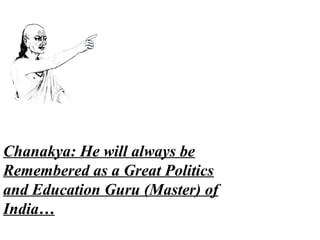
Chanakya: He will always be
Remembered as a Great Politics
and Education Guru (Master) of
India…

Chankaya; The Management Guru

  • 1.
  • 2.
    About chanakya Chanakya, also known as Kautilya or Vishnugupta, was born in Pataliputra, Magadh (modern Bihar), and later moved to Taxila, in Gandhar province(now in Pakistan). He was a professor (acharya) of political science at the Takshashila University and later the Prime Minister of the Emperor Chandragupta Maurya. He is regarded as one of the earliest known political thinkers, economists and king- makers. He was the man to envision the first Indian empire by unification of the then numerous kingdoms in the Indian sub- continent and provide the impetus for fights against the Greek conqueror Alexander.
  • 3.
    Identity He is generally called Chanakya,but, in his capacity as author of the Arthashastra, is generally referred to as Kautilya. The Arthashastra identifies its author by the name Kautilya,except for one verse which refers to him by the name Vishnugupta.One of the earliest Sanskrit literature to explicitly identify Chanakya with Vishnugupta was Vishnu Sarma's Panchatantra in the 3rd century BC
  • 4.
    Legend ThomasR. Trautmann (An American historian & holds a Ph.D. from the University of London. His studies focus on Ancient India and other subjects. )lists the following elements as common to different forms of the Chanakya legend : Chanakya was born with a complete set of teeth, a sign that he would become king, which is inappropriate for a Brahmin like Chanakya. Chāṇakya's teeth were therefore broken and it was prophesied that he will rule through another. The Nanda King throws Chanakya out of his court, prompting Chanakya to swear revenge. Chānakya searches for one worthy for him to rule through. Chanakya encounters a young Chandragupta Maurya who is a born leader even as a child.
  • 5.
    Chanakya's initial attemptto overthrow Nanda fails, whereupon he comes across a mother scolding her child for burning himself by eating from the middle of a bun or bowl of porridge rather than the cooler edge. Chanakya realizes his initial strategic error and, instead of attacking the heart of Nanda territory, slowly chips away at its edges. Chanakya changed his alliance with the mountain king Parvata due to his obstinance and non adherence to the principles of treaty as agreed . Chanakya enlists the services of a fanatical weaver to rid the kingdom of rebels. Chānakya adds poison to the food eaten by Chandragupta, now king, in order to make him immune. Unaware, Chandragupta feeds some of his food to his queen, who is in her ninth month of pregnancy. In order to save the heir to the throne, Chanakya cuts the queen open and extracts the fetus, who is named Bindusāra because he was touched by a drop (bindu) of blood or of poison. Chānakya's political rivalry with Subandhu leads to his death.
  • 6.
    Some quotes fromChankya niti "A person should not be too honest. Straight trees are cut first and honest people are screwed first.“ "Even if a snake is not poisonous, it should pretend to be venomous." "The biggest guru-mantra is: Never share your secrets with anybody. It will destroy you." "There is some self-interest behind every friendship. There is no friendship without self-interests. This is a bitter truth."
  • 7.
    "Before you startsome work, always ask yourself three questions - Why am I doing it, What the results might be and Will I be successful. Only when you think deeply and find satisfactory answers to these questions, go ahead." "As soon as the fear approaches near, attack and destroy it.“ "The world's biggest power is the youth and beauty of a woman." "Once you start a working on something, don't be afraid of failure and don't abandon it. People who work sincerely are the happiest." Chanakya quotes (Indian politician,strategist and writer, 350 BC-275 BC)
  • 8.
    Meaning of “commonsense” by chanakya Taking the two words "common sense" right up to their highest level,he has written: "Man's glory is in common sense, Dictating us the grace, That man is made to live and love The beauteous Heaven's embrace"
  • 9.
    Works Two books areattributed to Chanakya: Arthashastra and Nitishastra which is also know as Chanakya Niti. The Arthashastra discusses monetary and fiscal policies, welfare, international relations, and war strategies in detail. Nitishastra is a treatise on the ideal way of life, and shows Chanakya's in depth study of the Indian way of life.
  • 10.
    Death of Chanakya Chanakya lived to ripe old age and died around 283 BC and was cremated by his grandson/disciple Radhagupta who succeeded Rakshasa Katyayan (great-grand son of Prabuddha Katyayan, who attained Nirvana during the same period as Gautam Budhha) as Prime Minister of the Maurya Empire and was instrumental in backing Ashoka to the throne. There were three non-traditional belief paths in society those days, Jaina, Buddhist and Ajivaka. Ajivaka practising Chanakya brought about the downfall of the Jaina Nandas and their coterie of Jaina ministers. (Chanakya 's uncle was Jain, too, and a group of Jains backed Chanakya in his political machinations). Later on, Chandragupta Maurya took Jainism on abdicating his throne which passed to his Son Bindusara who was an Ajivaka. Even Ashoka was practising
  • 11.
    Ajivaka who beforeaccession to throne became Buddhist. Bindusara was born before his father ever became Emperor so the below legend is definitely not true. Ashoka's daughter was married in 265 BC and his son Kunala was 18 years of age in 269 BC which means that even the princes married early, Ashoka was born 310 BC and Bindusara around 330 BC. Bindusara means one who encompasses all that is need to be known.
  • 12.
    Media Television series Chanakyaportrayed the biography of Chanakya.
  • 13.
    In modern India Thediplomatic enclave in New Delhi is named Chanakyapuri in honour of Chanakya.
  • 14.
    Chanakya: He willalways be Remembered as a Great Politics and Education Guru (Master) of India…