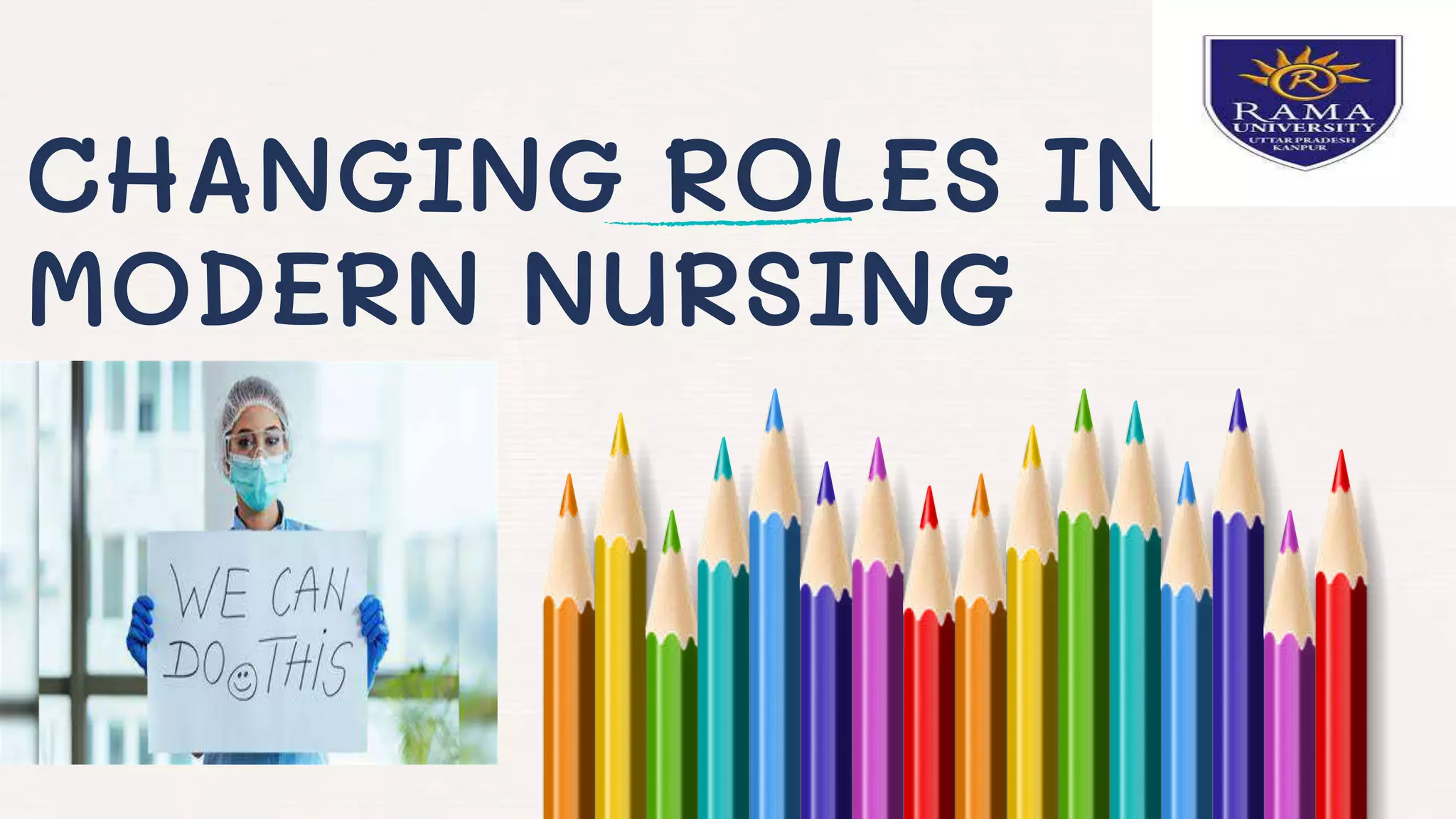
CHANGING ROLES IN
MODERN NURSING
By,
Prof.Jasmi Manu
Principal/Dean
Faculty of nursing
Rama university
2
INTRODUCTION
As healthcare technology evolves, nurses serve on the front lines of applying
the latest advancements to serve their patients with increasing efficiency
and effectiveness.
Technology continues to shift the nursing field in many ways, with the pace of
change expected to increase with time. Todays presentation, we will discuss
how this will take shape, whether nurses can expect to be replaced by
technology, and recent trends and advancements in healthcare, what are the
changing roles in Modern Nursing
There are many rapid changes taking place in the world today. This also applies
to the field of nursing care
3
INTRODUCTION
 As the year 2022 winds down, what is next on the
horizon for global health? We turned to our experts
for their takes on the most critical health issues to
watch in 2023
 We the nurses have reformational roles in Modern
era,as the global needs expected from the Nursing
Faternity
4
NEED OF THE DISCUSSIONS
✘ In redesigned health care systems, nurses are
assuming expanded roles for a broad range of
patients in ambulatory settings and community-
based care.
✘ New job titles and roles are emerging, particularly
in population health management, patient
coaching, informatics design and analysis, geriatric
care, and managing patient care transitions.
5
Nurses are increasingly employed as “boundary
spanners,” connecting patients with services in
health and community settings.
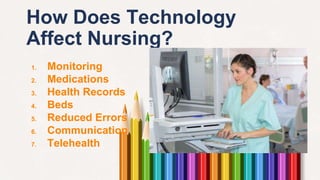
How Does Technology
Affect Nursing?
1. Monitoring
2. Medications
3. Health Records
4. Beds
5. Reduced Errors
6. Communication
7. Telehealth
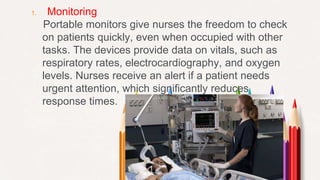
1. Monitoring
Portable monitors give nurses the freedom to check
on patients quickly, even when occupied with other
tasks. The devices provide data on vitals, such as
respiratory rates, electrocardiography, and oxygen
levels. Nurses receive an alert if a patient needs
urgent attention, which significantly reduces
response times.
Medications
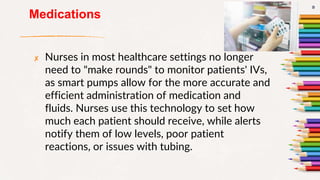
✘ Nurses in most healthcare settings no longer
need to "make rounds" to monitor patients' IVs,
as smart pumps allow for the more accurate and
efficient administration of medication and
fluids. Nurses use this technology to set how
much each patient should receive, while alerts
notify them of low levels, poor patient
reactions, or issues with tubing.
9
Communication
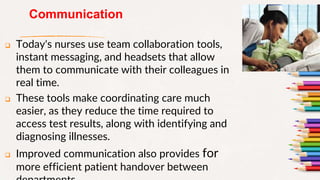
 Today's nurses use team collaboration tools,
instant messaging, and headsets that allow
them to communicate with their colleagues in
real time.
 These tools make coordinating care much
easier, as they reduce the time required to
access test results, along with identifying and
diagnosing illnesses.
 Improved communication also provides for
more efficient patient handover between
10
Reduced Errors
 Technology considerably reduces the likelihood of
error in logging patient information like allergies
to medications, medical history, and health
conditions and illnesses.
 Apps make the administration of medication
much less confusing or prone to human error.
 This, in turn, improves health outcomes and
reduces hospital re admission rates.
11
Beds
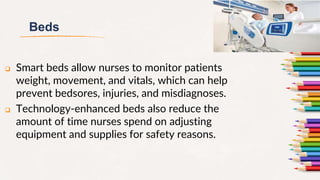
 Smart beds allow nurses to monitor patients
weight, movement, and vitals, which can help
prevent bedsores, injuries, and misdiagnoses.
 Technology-enhanced beds also reduce the
amount of time nurses spend on adjusting
equipment and supplies for safety reasons.
12
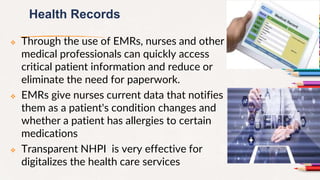
Health Records
 Through the use of EMRs, nurses and other
medical professionals can quickly access
critical patient information and reduce or
eliminate the need for paperwork.
 EMRs give nurses current data that notifies
them as a patient's condition changes and
whether a patient has allergies to certain
medications
 Transparent NHPI is very effective for
digitalizes the health care services
13
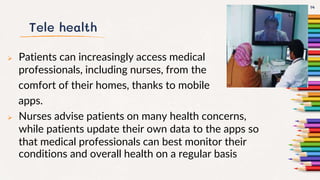
Tele health
 Patients can increasingly access medical
professionals, including nurses, from the
comfort of their homes, thanks to mobile
apps.
 Nurses advise patients on many health concerns,
while patients update their own data to the apps so
that medical professionals can best monitor their
conditions and overall health on a regular basis
14
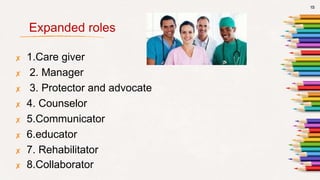
Expanded roles
✘ 1.Care giver
✘ 2. Manager
✘ 3. Protector and advocate
✘ 4. Counselor
✘ 5.Communicator
✘ 6.educator
✘ 7. Rehabilitator
✘ 8.Collaborator
15
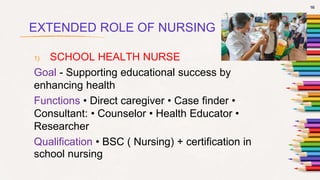
EXTENDED ROLE OF NURSING
1) SCHOOL HEALTH NURSE
Goal - Supporting educational success by
enhancing health
Functions • Direct caregiver • Case finder •
Consultant: • Counselor • Health Educator •
Researcher
Qualification • BSC ( Nursing) + certification in
school nursing
16
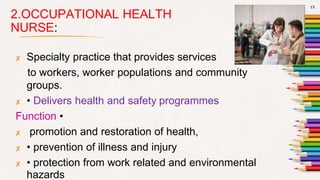
2.OCCUPATIONAL HEALTH
NURSE:
✘ Specialty practice that provides services
to workers, worker populations and community
groups.
✘ • Delivers health and safety programmes
Function •
✘ promotion and restoration of health,
✘ • prevention of illness and injury
✘ • protection from work related and environmental
hazards
17
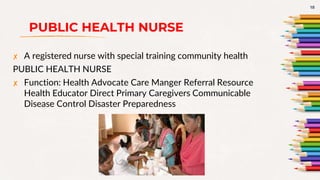
PUBLIC HEALTH NURSE
✘ A registered nurse with special training community health
PUBLIC HEALTH NURSE
✘ Function: Health Advocate Care Manger Referral Resource
Health Educator Direct Primary Caregivers Communicable
Disease Control Disaster Preparedness
18
19
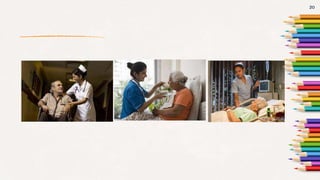
✘ PRIVATE DUTY NURSE Private duty nurse is a registered nurse
or a licensed practical nurse who provide nursing services to
patients at home or any other setting in accordance with
physician orders
✘ HOME CARE NURSE: Home care nurse is a nurse who provides
periodic . care to patients with in their home environment as
ordered by the physician
Function: Health Maintenance, Education, Illness prevention,
Diagnosis and treatment of disease. Palliation and rehabilitation
✘ HOSPICE NURSE: Hospice nurse is one who provides a family
centered care and allows clients to live and remain at homes
with comfort, independence and dignity, while alleviating the
strains caused by terminal phase i.e at the time of death
20
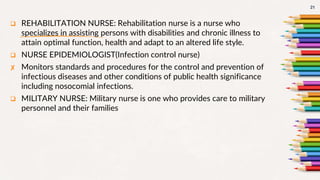
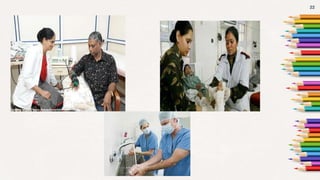
 REHABILITATION NURSE: Rehabilitation nurse is a nurse who
specializes in assisting persons with disabilities and chronic illness to
attain optimal function, health and adapt to an altered life style.
 NURSE EPIDEMIOLOGIST(Infection control nurse)
✘ Monitors standards and procedures for the control and prevention of
infectious diseases and other conditions of public health significance
including nosocomial infections.
 MILITARY NURSE: Military nurse is one who provides care to military
personnel and their families
21
22
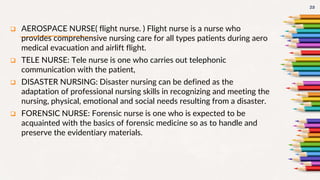
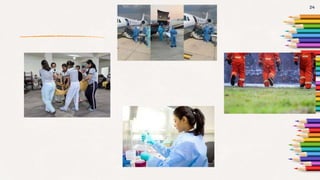
 AEROSPACE NURSE( flight nurse. ) Flight nurse is a nurse who
provides comprehensive nursing care for all types patients during aero
medical evacuation and airlift flight.
 TELE NURSE: Tele nurse is one who carries out telephonic
communication with the patient,
 DISASTER NURSING: Disaster nursing can be defined as the
adaptation of professional nursing skills in recognizing and meeting the
nursing, physical, emotional and social needs resulting from a disaster.
 FORENSIC NURSE: Forensic nurse is one who is expected to be
acquainted with the basics of forensic medicine so as to handle and
preserve the evidentiary materials.
23
24
✘ NURSE ANESTHETIST
✘ NURSE ENTREPRENEUR
✘ ONCOLOGY NURSE
✘ INFUSION NURSE
✘ RADIOLOGIC NURSE
 Prison nurse is a registered nurse who works in a prison.
✘ PEACE NURSE CORPS: Peace corps nurse is a nurse who performs variety
of nursing activities in remote areas of the world..
✘ Advanced Nurse practitioner Nurse
Advanced practice nurse is generally the most independent functioning
nurse.
25
What strategies can nurses use to improve
their competencies in modern era?
✘ Help to reach the pinnacle of your profession with these five ways to
improve your nursing skills.
1.Pursue lifelong learning. ...
2.Mentoring goes both ways. ...
3.Confidence is a vital nursing skill. ...
4.Enhance communication skills. ...
5.Get involved.
26
5 Ways to Improve Patient Care
1.Deliver Individualized Patient Care.
2.Empower Towards Self-Care. ...
3.Show Compassion. ...
4.Advance Your Education. ...
5.Offer Empathy
27
Leadership Strategies for
Navigating Change in Healthcare
✘ Recruit for New Roles.
✘ Train Existing Employees on Required Skills. ...
✘ Implement New Performance Goals. ...
✘ Optimize Processes Across New Entities. ...
✘ Sustain Employee Engagement in Times of Change. ...
✘ Develop the Leaders for Tomorrow
28
CONCLUSION
IN A NUT SHELL
 Strong leadership is critical if the vision of a transformed health care system is to be
realized. Yet not all nurses begin their career with thoughts of becoming a leader.
 It is concluded that now a day’s nurses are playing widest role in the field of nursing
to serve the general public especially under served and under privileged section of
the society.
 Their contributions have always made significant difference for patients.
 Nurses have seen many changes in their roles. Innovations in health care, expanding
health care systems and practice settings and the increasing needs of patients have
been achieved.
31
32

Changing Roles in Modern Nursing

  • 1.
  • 2.
  • 3.
    INTRODUCTION As healthcare technologyevolves, nurses serve on the front lines of applying the latest advancements to serve their patients with increasing efficiency and effectiveness. Technology continues to shift the nursing field in many ways, with the pace of change expected to increase with time. Todays presentation, we will discuss how this will take shape, whether nurses can expect to be replaced by technology, and recent trends and advancements in healthcare, what are the changing roles in Modern Nursing There are many rapid changes taking place in the world today. This also applies to the field of nursing care 3
  • 4.
    INTRODUCTION  As theyear 2022 winds down, what is next on the horizon for global health? We turned to our experts for their takes on the most critical health issues to watch in 2023  We the nurses have reformational roles in Modern era,as the global needs expected from the Nursing Faternity 4
  • 5.
    NEED OF THEDISCUSSIONS ✘ In redesigned health care systems, nurses are assuming expanded roles for a broad range of patients in ambulatory settings and community- based care. ✘ New job titles and roles are emerging, particularly in population health management, patient coaching, informatics design and analysis, geriatric care, and managing patient care transitions. 5
  • 6.
    Nurses are increasinglyemployed as “boundary spanners,” connecting patients with services in health and community settings.
  • 7.
    How Does Technology AffectNursing? 1. Monitoring 2. Medications 3. Health Records 4. Beds 5. Reduced Errors 6. Communication 7. Telehealth
  • 8.
    1. Monitoring Portable monitorsgive nurses the freedom to check on patients quickly, even when occupied with other tasks. The devices provide data on vitals, such as respiratory rates, electrocardiography, and oxygen levels. Nurses receive an alert if a patient needs urgent attention, which significantly reduces response times.
  • 9.
    Medications ✘ Nurses inmost healthcare settings no longer need to "make rounds" to monitor patients' IVs, as smart pumps allow for the more accurate and efficient administration of medication and fluids. Nurses use this technology to set how much each patient should receive, while alerts notify them of low levels, poor patient reactions, or issues with tubing. 9
  • 10.
    Communication  Today's nursesuse team collaboration tools, instant messaging, and headsets that allow them to communicate with their colleagues in real time.  These tools make coordinating care much easier, as they reduce the time required to access test results, along with identifying and diagnosing illnesses.  Improved communication also provides for more efficient patient handover between 10
  • 11.
    Reduced Errors  Technologyconsiderably reduces the likelihood of error in logging patient information like allergies to medications, medical history, and health conditions and illnesses.  Apps make the administration of medication much less confusing or prone to human error.  This, in turn, improves health outcomes and reduces hospital re admission rates. 11
  • 12.
    Beds  Smart bedsallow nurses to monitor patients weight, movement, and vitals, which can help prevent bedsores, injuries, and misdiagnoses.  Technology-enhanced beds also reduce the amount of time nurses spend on adjusting equipment and supplies for safety reasons. 12
  • 13.
    Health Records  Throughthe use of EMRs, nurses and other medical professionals can quickly access critical patient information and reduce or eliminate the need for paperwork.  EMRs give nurses current data that notifies them as a patient's condition changes and whether a patient has allergies to certain medications  Transparent NHPI is very effective for digitalizes the health care services 13
  • 14.
    Tele health  Patientscan increasingly access medical professionals, including nurses, from the comfort of their homes, thanks to mobile apps.  Nurses advise patients on many health concerns, while patients update their own data to the apps so that medical professionals can best monitor their conditions and overall health on a regular basis 14
  • 15.
    Expanded roles ✘ 1.Caregiver ✘ 2. Manager ✘ 3. Protector and advocate ✘ 4. Counselor ✘ 5.Communicator ✘ 6.educator ✘ 7. Rehabilitator ✘ 8.Collaborator 15
  • 16.
    EXTENDED ROLE OFNURSING 1) SCHOOL HEALTH NURSE Goal - Supporting educational success by enhancing health Functions • Direct caregiver • Case finder • Consultant: • Counselor • Health Educator • Researcher Qualification • BSC ( Nursing) + certification in school nursing 16
  • 17.
    2.OCCUPATIONAL HEALTH NURSE: ✘ Specialtypractice that provides services to workers, worker populations and community groups. ✘ • Delivers health and safety programmes Function • ✘ promotion and restoration of health, ✘ • prevention of illness and injury ✘ • protection from work related and environmental hazards 17
  • 18.
    PUBLIC HEALTH NURSE ✘A registered nurse with special training community health PUBLIC HEALTH NURSE ✘ Function: Health Advocate Care Manger Referral Resource Health Educator Direct Primary Caregivers Communicable Disease Control Disaster Preparedness 18
  • 19.
    19 ✘ PRIVATE DUTYNURSE Private duty nurse is a registered nurse or a licensed practical nurse who provide nursing services to patients at home or any other setting in accordance with physician orders ✘ HOME CARE NURSE: Home care nurse is a nurse who provides periodic . care to patients with in their home environment as ordered by the physician Function: Health Maintenance, Education, Illness prevention, Diagnosis and treatment of disease. Palliation and rehabilitation ✘ HOSPICE NURSE: Hospice nurse is one who provides a family centered care and allows clients to live and remain at homes with comfort, independence and dignity, while alleviating the strains caused by terminal phase i.e at the time of death
  • 20.
  • 21.
     REHABILITATION NURSE:Rehabilitation nurse is a nurse who specializes in assisting persons with disabilities and chronic illness to attain optimal function, health and adapt to an altered life style.  NURSE EPIDEMIOLOGIST(Infection control nurse) ✘ Monitors standards and procedures for the control and prevention of infectious diseases and other conditions of public health significance including nosocomial infections.  MILITARY NURSE: Military nurse is one who provides care to military personnel and their families 21
  • 22.
  • 23.
     AEROSPACE NURSE(flight nurse. ) Flight nurse is a nurse who provides comprehensive nursing care for all types patients during aero medical evacuation and airlift flight.  TELE NURSE: Tele nurse is one who carries out telephonic communication with the patient,  DISASTER NURSING: Disaster nursing can be defined as the adaptation of professional nursing skills in recognizing and meeting the nursing, physical, emotional and social needs resulting from a disaster.  FORENSIC NURSE: Forensic nurse is one who is expected to be acquainted with the basics of forensic medicine so as to handle and preserve the evidentiary materials. 23
  • 24.
  • 25.
    ✘ NURSE ANESTHETIST ✘NURSE ENTREPRENEUR ✘ ONCOLOGY NURSE ✘ INFUSION NURSE ✘ RADIOLOGIC NURSE  Prison nurse is a registered nurse who works in a prison. ✘ PEACE NURSE CORPS: Peace corps nurse is a nurse who performs variety of nursing activities in remote areas of the world.. ✘ Advanced Nurse practitioner Nurse Advanced practice nurse is generally the most independent functioning nurse. 25
  • 26.
    What strategies cannurses use to improve their competencies in modern era? ✘ Help to reach the pinnacle of your profession with these five ways to improve your nursing skills. 1.Pursue lifelong learning. ... 2.Mentoring goes both ways. ... 3.Confidence is a vital nursing skill. ... 4.Enhance communication skills. ... 5.Get involved. 26
  • 27.
    5 Ways toImprove Patient Care 1.Deliver Individualized Patient Care. 2.Empower Towards Self-Care. ... 3.Show Compassion. ... 4.Advance Your Education. ... 5.Offer Empathy 27
  • 28.
    Leadership Strategies for NavigatingChange in Healthcare ✘ Recruit for New Roles. ✘ Train Existing Employees on Required Skills. ... ✘ Implement New Performance Goals. ... ✘ Optimize Processes Across New Entities. ... ✘ Sustain Employee Engagement in Times of Change. ... ✘ Develop the Leaders for Tomorrow 28
  • 29.
  • 30.
    IN A NUTSHELL  Strong leadership is critical if the vision of a transformed health care system is to be realized. Yet not all nurses begin their career with thoughts of becoming a leader.  It is concluded that now a day’s nurses are playing widest role in the field of nursing to serve the general public especially under served and under privileged section of the society.  Their contributions have always made significant difference for patients.  Nurses have seen many changes in their roles. Innovations in health care, expanding health care systems and practice settings and the increasing needs of patients have been achieved.
  • 31.
  • 32.