www.flickr.com/photos/nishanthjois/5116863376/


CHANGING CONTENT,
CHANGING
CULTURE
sara
wachter-
boettcher
web visions
nyc 2013
‘‘
Every client, in my experience, has a
content problem.
              Mark Boulton, Web Directions South
‘‘
In traditional media, canvas dimensions
are a known constraint... With digital,
however, the canvas is an unknown.
Instead, we need to build on what we do
know: content.
           Chris Armstrong, “The Infinite Grid”
But do we actually know our content?
Good news! That’s what content
strategy is all about.
✦   Defines how content will meet business
    (or project) goals and users’ needs
✦   Guides decisions about content from
    discovery to deletion
✦   Sets benchmarks against which to
    measure the success of your content
                  Kristina Halvorson & Melissa Rach
It’s figuring out what we want to say...


                      Message architecture example
                      from Margot Bloomstein
And making more
realistic plans for
getting it done...


                      Page table example from
                           Relly Annett-Baker
and yet:

WE’VE STILL
GOT SO FAR
TO GO.
Inaccessible.
Missing.
Useless.
Even launching a new
homepage is hard.
‘‘
The Microsoft.com team built tools,
guidelines, and processes to help localize
everything from responsive images to
responsive content into approximately
100 different markets... They adapted
their CMS to allow Content Strategists to
program content on the site.
                                   Nishant Kothary,
              “The Story of the New Microsoft.com”
This is why mobile is so hard.
the web’s moving forward,

BUT OUR
CONTENT’S
STILL STUCK.
“just stick it up
    on the website”
www.flickr.com/photos/wordridden/6125516150/
We create content like this.


 CONTENT
GOES HERE.
So we can do this.


www.flickr.com/photos/76029035@N02/6829344565
So we can do this.

                     CONTENT
                      GOES
                      HERE.
www.flickr.com/photos/76029035@N02/6829344565
But we end up with this.


    CONTENT
     GOES
     HERE.
it’ll only get
                             worse


By Eva-Lotta Lamm
We don’t need more content. We need
content that does more.
content like
                                                  water
www.flickr.com/photos/briangaid/2909765394/
COPE: Create Once,
Publish Everywhere
But content doesn’t just
magically flow.
It takes infrastructure.
Which starts with content.
which takes
 care and craft


By Eva-Lotta Lamm
And a CMS to match
Of course,
   structured data
   isn’t new.


From Web Database Applications with PHP & MySQL
by Hugh E. Williams and David Lane (O’Reilly, 2003)
The results just weren’t always great.


What?


Huh?
  No
idea!
structure isn’t
       arbitrary


        www.melissaanddoug.com
It’s about taking our content knowledge...
and finding
                                                      patterns


www.flickr.com/photos/darkfoxprime/4348506299/
not just “pages”


www.flickr.com/photos/peroshenka/408997641
systems, not
just hierarchies
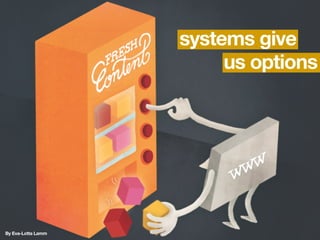
systems give
                         us options


By Eva-Lotta Lamm
We can’t manually manage
how each bit of content looks.
But every bit of structure gives us
the option to make a rule.
rules tell content
            what to do
structure helps
   content move
Now, for the hard part.
our content’s stuck

BECAUSE
WE ARE
STUCK.
it’s people,
    not just tech
3   CHALLENGES
    FOR OUR
    ORGANIZATIONS
1. mass-production
mentality
LIFE magazine archives
THE PROBLEM
People keep creating content
the same way they always
have: big WYSIWYG blobs.
WYSIWYG or
WYSIWTF?
THE REAL PROBLEM
Content-producing roles aren’t
tied to business strategy, goals,
or vision—so those working in
them see no reason to change.
that’s not my job! i just
                     keep the production
                          line moving.


www.flickr.com/photos/seattlemunicipalarchives/2710933334
A BETTER WAY
Content strategy bridges the
gap between executive vision
and daily execution, defining
how content will serve strategy
over time.
2. compartmentalized
teams
THE PROBLEM
Content-producing departments
don’t communicate, or are even
hostile to one another.
protect the
                fiefdom!


www.flickr.com/photos/domhill/7190797128/
Government is notorious for this.
This is duplicative and inefficient. Not
to mention confusing as hell.
THE REAL PROBLEM
Departments that are always
focused on themselves are not
thinking about their customers.
the underpants
                                                   problem
www.flickr.com/photos/red_devil/4728500604
‘‘
Customers don't know—and don't care to
know—how government is organized. So why
make them go from agency [website] to
agency [website] to get the full picture of
what gov't has to offer on any subject?
              Participant, National Dialogue on
              Improving Government Websites
A BETTER WAY
Transcend silos with cross-
department teams focused on
tackling a single issue. Empower
them to spread new ideas.
3. obsession with
control
www.flickr.com/photos/expertinfantry/5416964813
THE PROBLEM
Stakeholders don’t get digital—
they want everything fixed in
place, like print, before approval.
user control
  terrifies them
THE REAL PROBLEM
The organization isn’t built for
change—and suddenly, things
are changing fast. Rather than
adapt, it’s trying to stop the shift.
things will
   keep moving
A BETTER WAY
It’s not just dealing with mobile.
It’s becoming an organization
that’s adept at change.
good news!

WE CAN DO
SOMETHING
ABOUT THIS
“But I’m just the interaction designer!”
“But that’s just how executives think.”
“But that’s just the way clients are!”
STOP THAT
RIGHT NOW.
Caring about content is a pain, yes.
but it’s the only way
                                                 we’ll be satisfied


www.flickr.com/photos/yakobusan/3162940696
3   WAYS TO
    MAKE CHANGE
    HAPPEN
1   Make mobile an entry
    point, not the end point.
‘‘
Use mobile as a wedge to create a better
experience for ALL users.
                             Karen McGrane
Also true for changing organizations.
use mobile to
                                               break down doors
www.flickr.com/photos/justin-march/3720489344/
2   Don’t sell solutions.
    Invest more deeply.
we don’t
  save the day
You can’t just fix it.
You’ve got to be in it together.
it’s hard,
                                                       messy work


www.flickr.com/photos/trondheim_byarkiv/4773880876
3   Do less.
    Facilitate more.
After the CMS is updated...
Or the API is launched...
The content will still need help.
teach ‘em
 to fish...
Find the people your work affects,
and incorporate them from the start.
THANK YOU,
 WEBVISIONS NYC
                                      sarawb.com // @sara_ann_marie
                                      Content Everywhere is available now!
                                      http://rfld.me/content-everywhere


Flickr images used via CC-Attribution license unless otherwise noted.
Illustrations used with the permission of Eva-Lotta Lamm.

Changing Content, Changing Culture