Changes of the peri-implant soft
tissue thickness after grafting
with a collagen matrix
Presented by
Ashok kumar A
CRRI
Introduction :
Implant placement immediately after extraction is used to maximize
the preservation of these tissues. However, certain amounts of buccal
bone wall resorption and soft-tissue recession may occur, leading to an
unfavorable esthetic result.
Soft tissue augmentation can be successfully performed with The
use of connective tissue grafts (CTGs) prior, during, or after implant
placement can lead to an increase in soft-tissue thickness (STTh).
Disadvantages - second surgical site, increasing morbidity and
postoperative discomfort, and the limited amount of tissue that can be
harvested.
Recently, collagen-based matrices (CMs) have been introduced for
soft-tissue augmentation.Although these materials have been used to
increase the width of keratinized soft-tissue, no clinical study has
examined the use of CMs to enhance peri-implant STTh in humans.
Thus, the aim of this study was to determine the outcome of
treatment using a new monolayer CM (mCM) instead of autogenous
connective tissue to increase soft-tissue volume as a part of implant
site development.
Materials and Methods :
A total of 27 sites in 27 patients (18 males, 9 females; mean age
46.11 years, range 30–59 years) were included in this prospective,
randomized, examiner-blinded, controlled clinical study
Only patients requiring single implants in the premolar area of the
maxilla were included. Exclusion criteria were implant treatment needs
in the mandible, pregnancy, diabetes mellitus, systemic medication use,
drug abuse, and smoking ≥10 cigarettes/day.
Randomization and treatment :
First examiner performed tooth extractions and periodontal
treatment at least 6 months before the study began. Using
randomization software
Second examiner assigned patients to the test group, in which
mCMs were used for soft-tissue augmentation, and the control group,
which received no augmentative procedure.
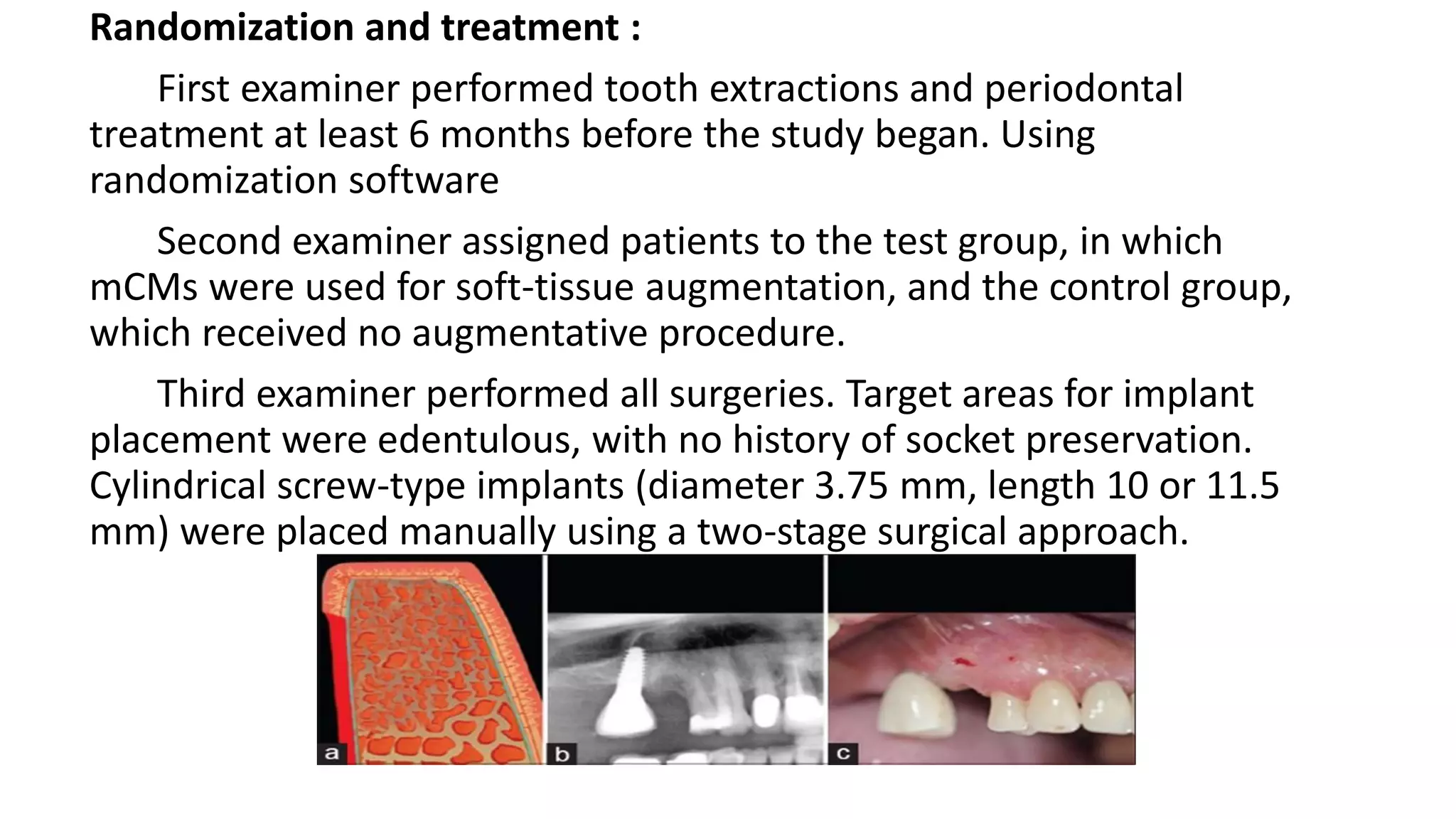
Third examiner performed all surgeries. Target areas for implant
placement were edentulous, with no history of socket preservation.
Cylindrical screw-type implants (diameter 3.75 mm, length 10 or 11.5
mm) were placed manually using a two-stage surgical approach.
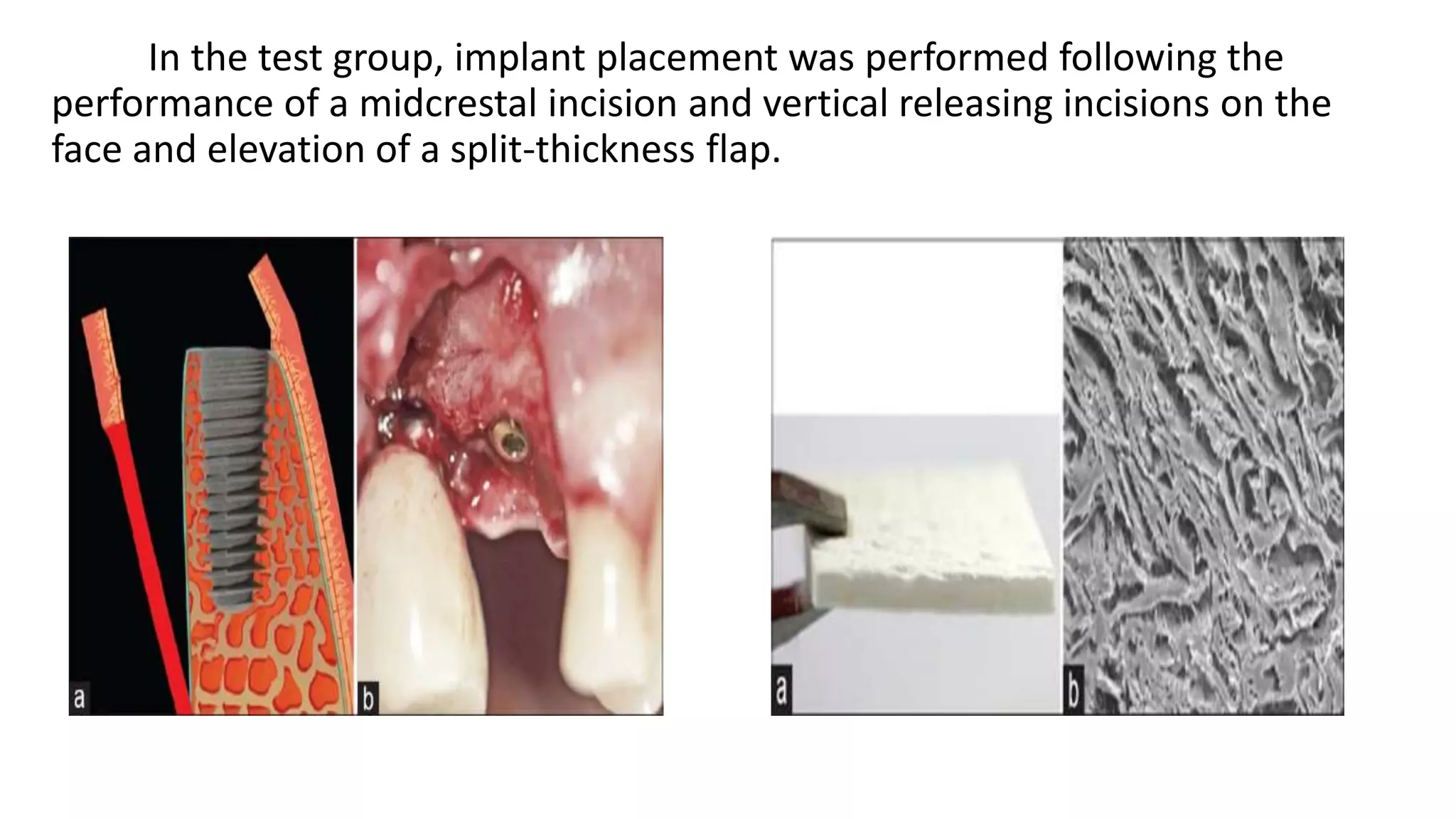
In the test group, implant placement was performed following the
performance of a midcrestal incision and vertical releasing incisions on the
face and elevation of a split-thickness flap.
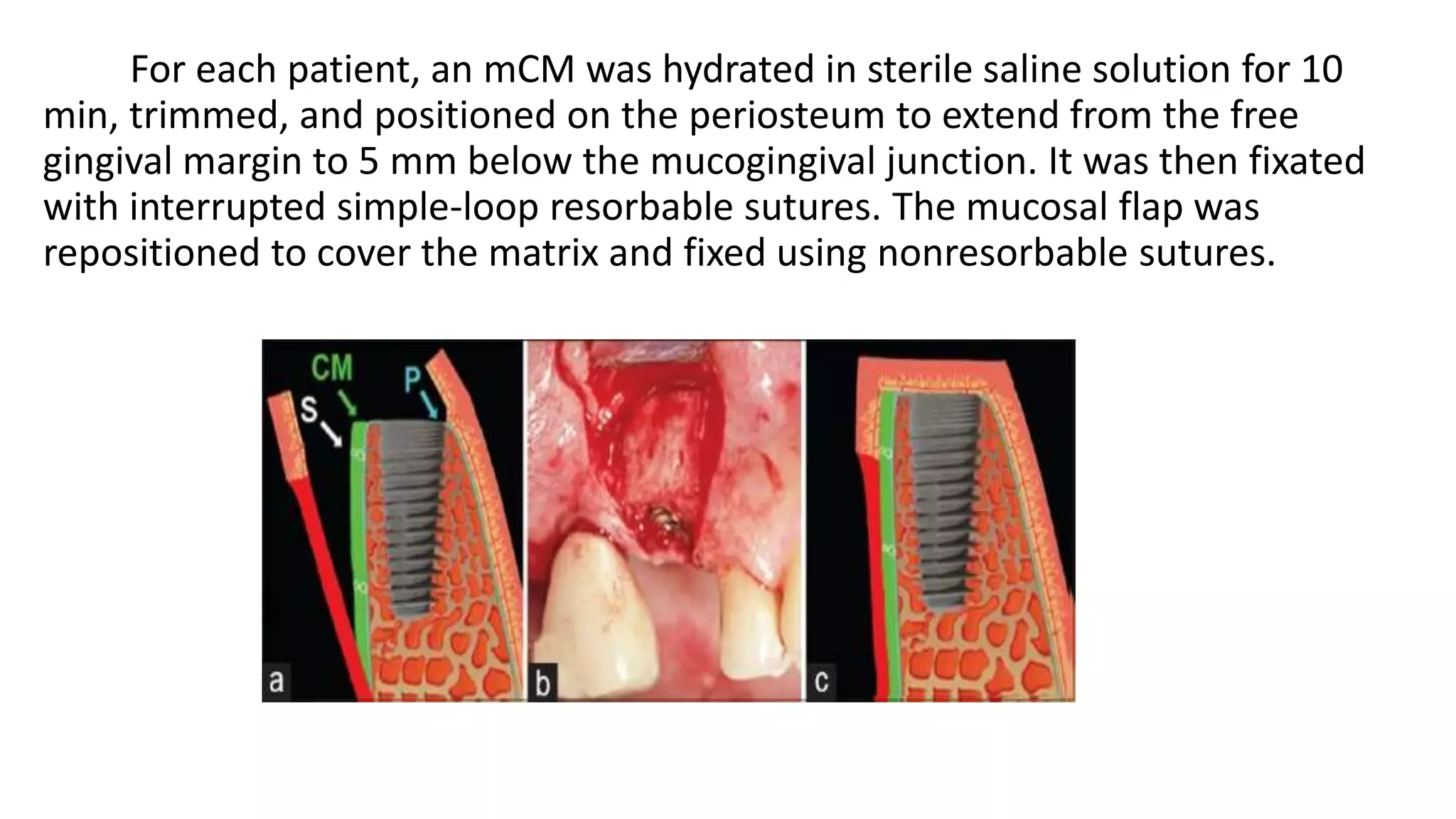
For each patient, an mCM was hydrated in sterile saline solution for 10
min, trimmed, and positioned on the periosteum to extend from the free
gingival margin to 5 mm below the mucogingival junction. It was then fixated
with interrupted simple-loop resorbable sutures. The mucosal flap was
repositioned to cover the matrix and fixed using nonresorbable sutures.
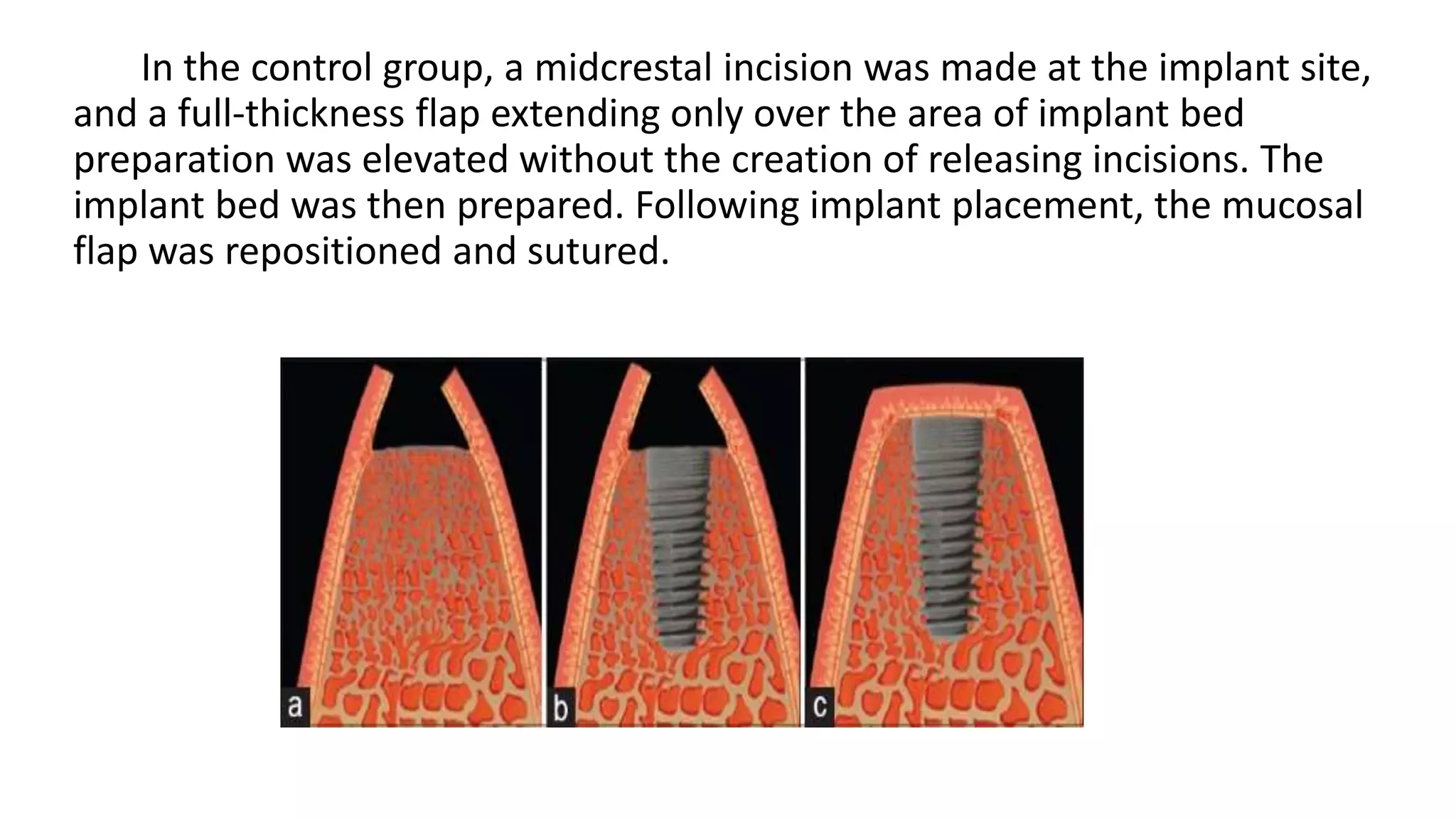
In the control group, a midcrestal incision was made at the implant site,
and a full-thickness flap extending only over the area of implant bed
preparation was elevated without the creation of releasing incisions. The
implant bed was then prepared. Following implant placement, the mucosal
flap was repositioned and sutured.
Measurements :
STTh measurements were performed preoperatively (T0) and 6 months
postoperatively (T1), before implants were uncovered and healing
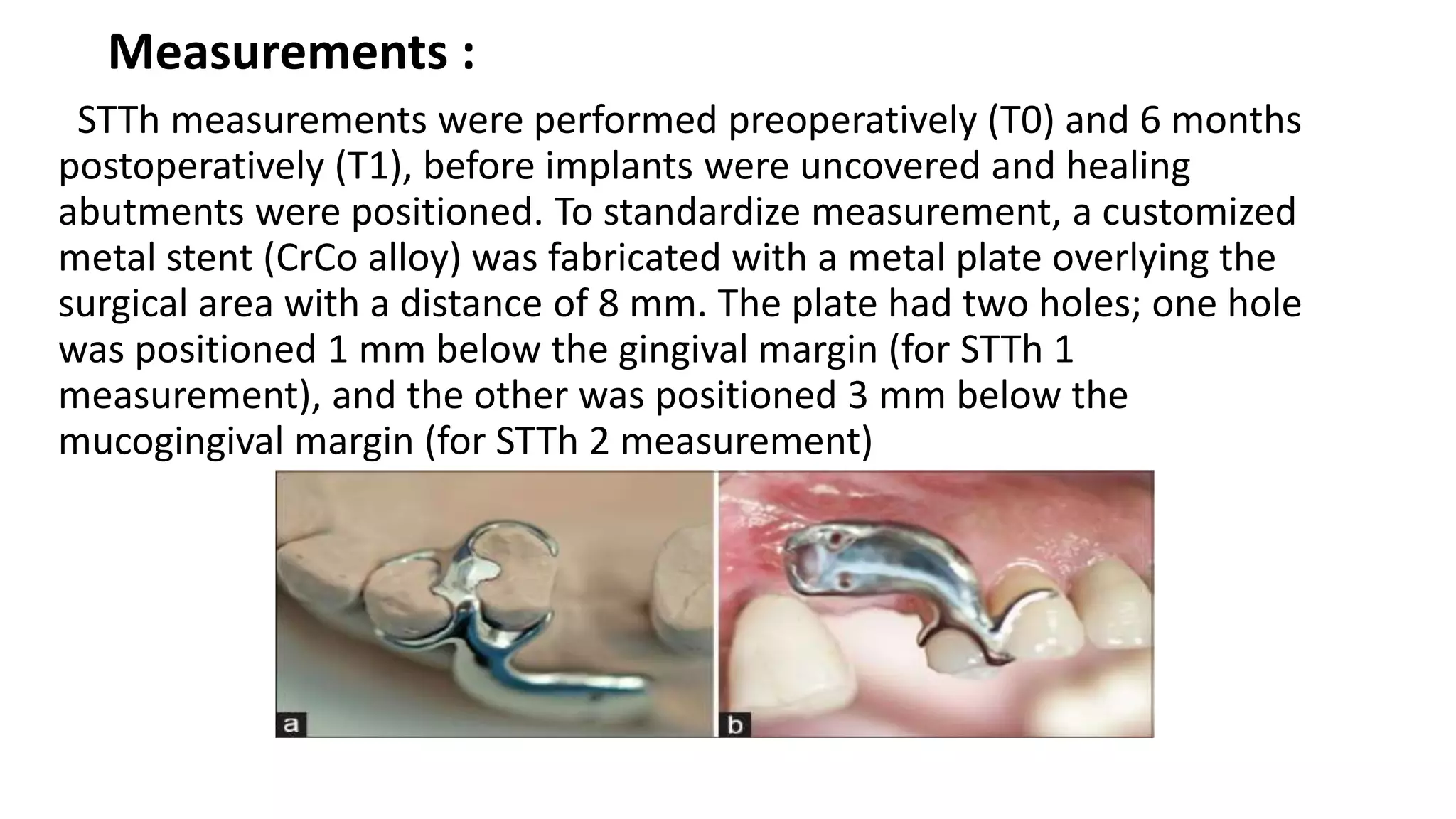
abutments were positioned. To standardize measurement, a customized
metal stent (CrCo alloy) was fabricated with a metal plate overlying the
surgical area with a distance of 8 mm. The plate had two holes; one hole
was positioned 1 mm below the gingival margin (for STTh 1
measurement), and the other was positioned 3 mm below the
mucogingival margin (for STTh 2 measurement)
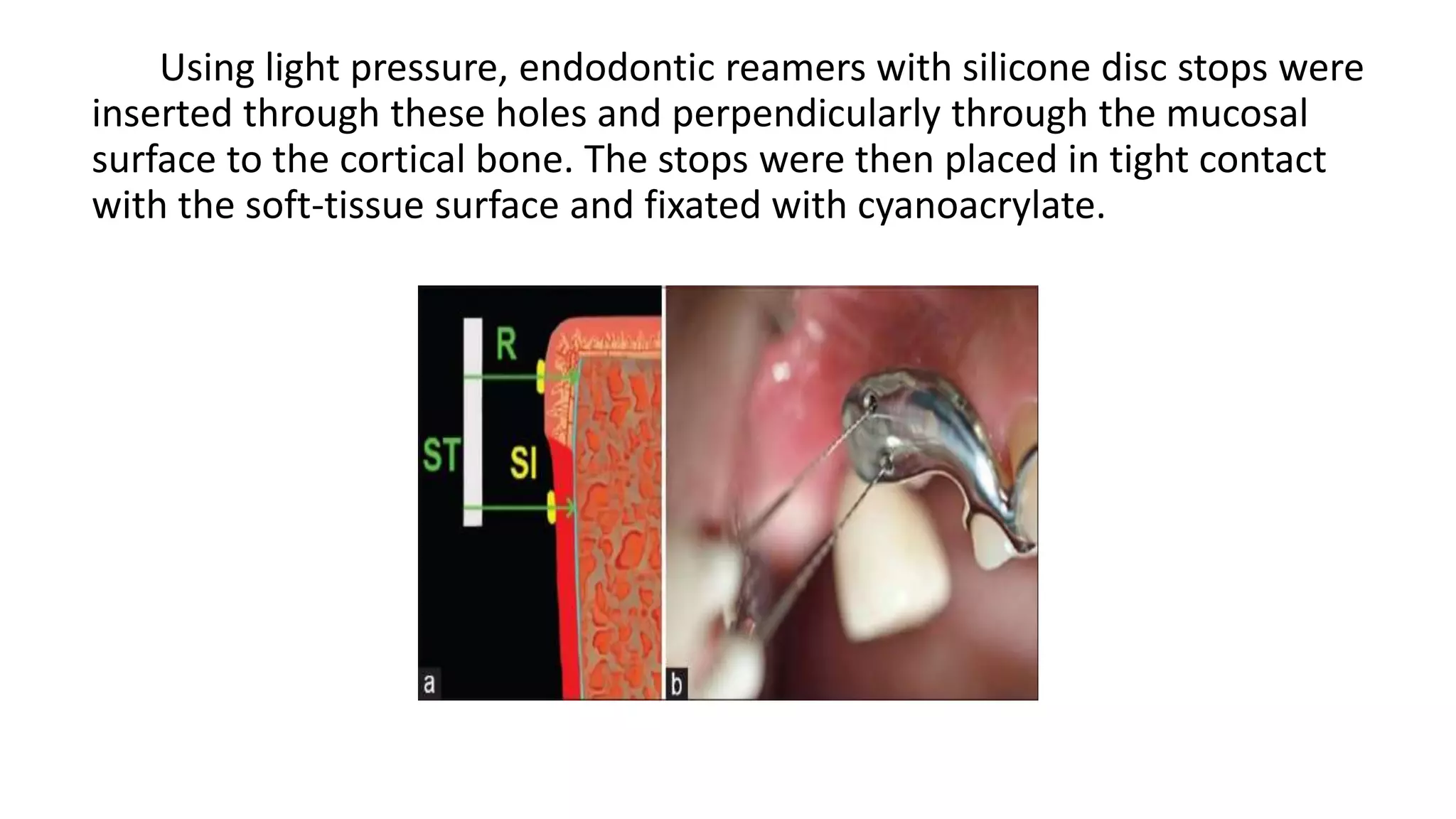
Using light pressure, endodontic reamers with silicone disc stops were
inserted through these holes and perpendicularly through the mucosal
surface to the cortical bone. The stops were then placed in tight contact
with the soft-tissue surface and fixated with cyanoacrylate.
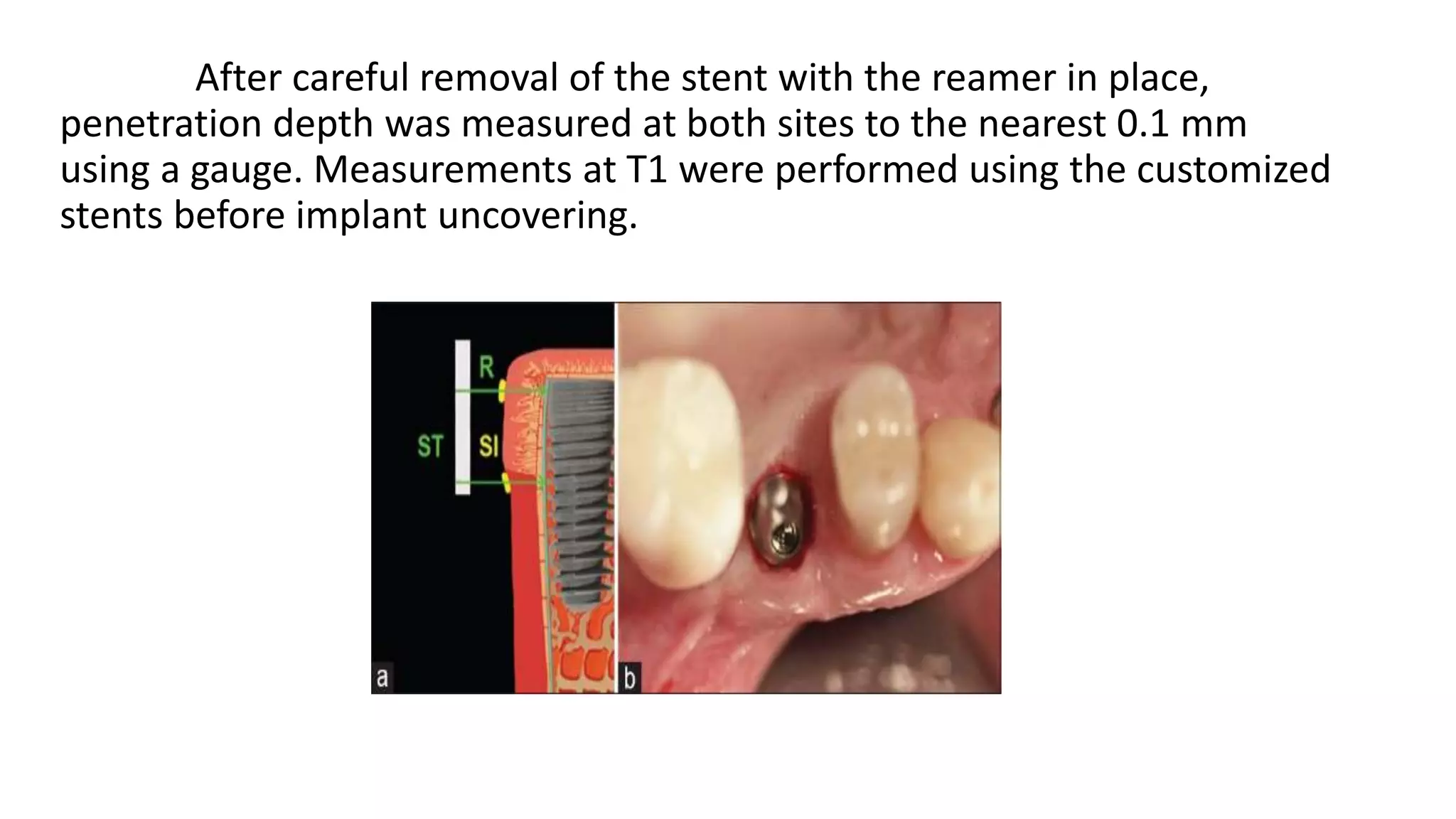
After careful removal of the stent with the reamer in place,
penetration depth was measured at both sites to the nearest 0.1 mm
using a gauge. Measurements at T1 were performed using the customized
stents before implant uncovering.
Histology
Soft tissue biopsy samples were collected at T1 after STTh
measurement, and submitted for histological evaluation. Half of each
tissue sample was stained with hematoxylin and eosin, and the other half
was stained with alpha-smooth-muscle actin (αSMA). Samples were
examined under a light microscope.
Postoperative care and restorative procedure
Patients were prescribed a chlorhexidine mouth rinse (0.1%
chlorhexamed fluid; GlaxoSmithKline, Buehl, Germany) twice daily for 2
weeks. Sutures were removed at 2 weeks. The implants were uncovered
and loaded 6 months after placement (T1). Porcelain fused metal crowns
were fabricated and fixed using temporary cement
Result :
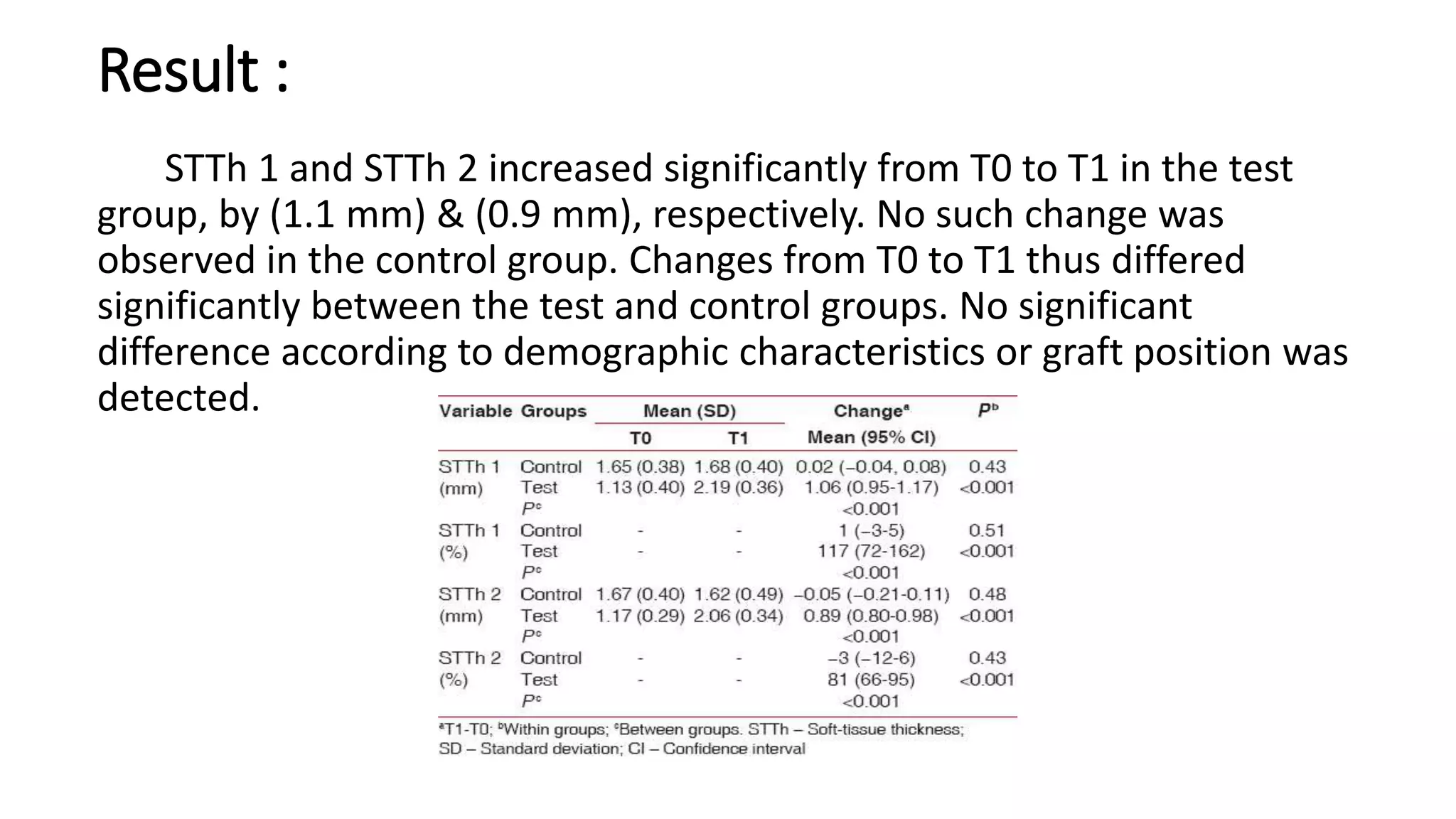
STTh 1 and STTh 2 increased significantly from T0 to T1 in the test
group, by (1.1 mm) & (0.9 mm), respectively. No such change was
observed in the control group. Changes from T0 to T1 thus differed
significantly between the test and control groups. No significant
difference according to demographic characteristics or graft position was
detected.
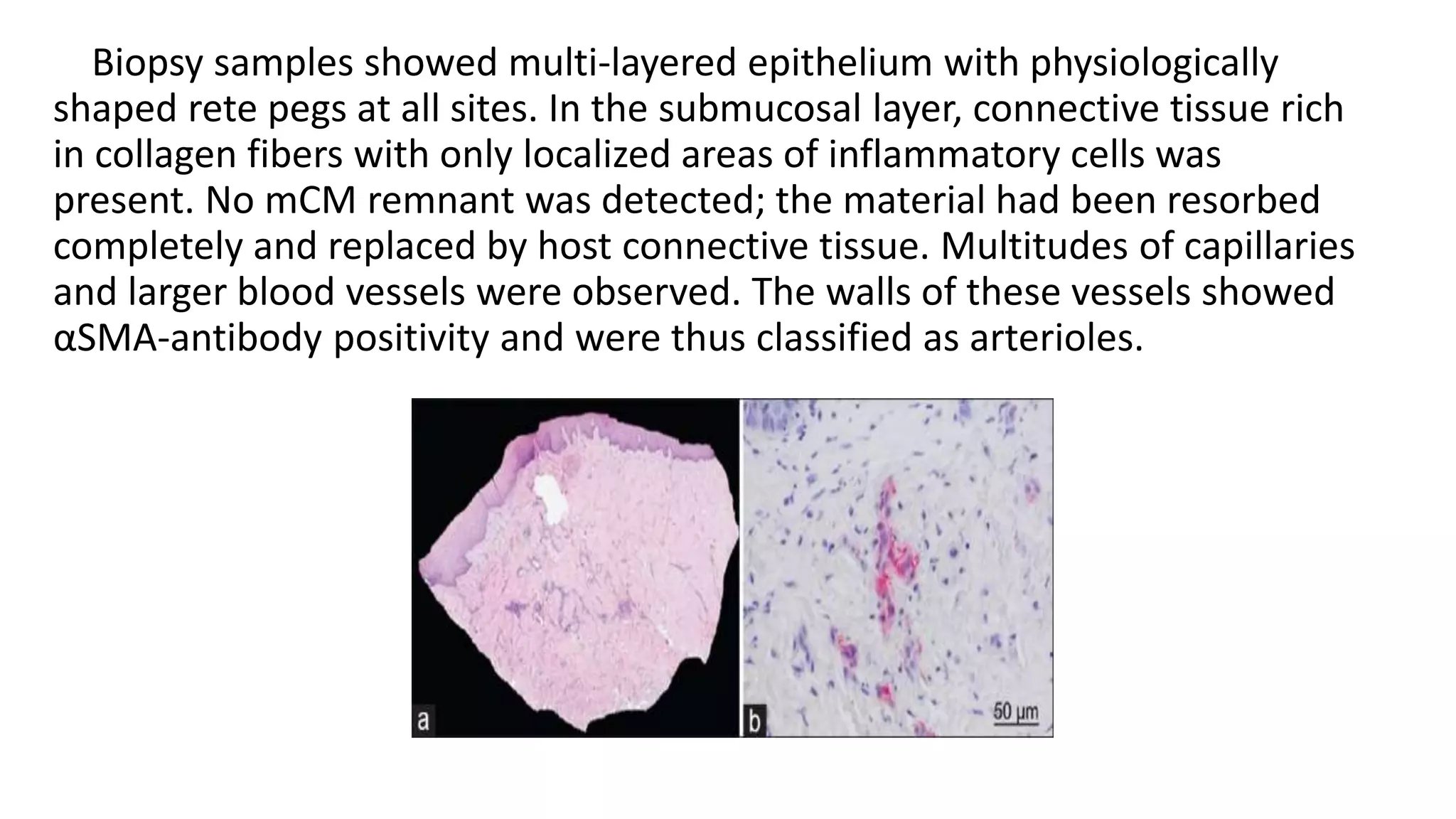
Biopsy samples showed multi-layered epithelium with physiologically
shaped rete pegs at all sites. In the submucosal layer, connective tissue rich
in collagen fibers with only localized areas of inflammatory cells was
present. No mCM remnant was detected; the material had been resorbed
completely and replaced by host connective tissue. Multitudes of capillaries
and larger blood vessels were observed. The walls of these vessels showed
αSMA-antibody positivity and were thus classified as arterioles.
Conclusion :
In this study, mCMs were used as a grafting material alternative to
host connective tissue for peri-implant soft tissue augmentation. The
procedure resulted in minimal pain and swelling, and a mean increase
in STTh of 1.06 mm was obtained.
It could be concluded that mCM leads to a significant increase of
peri-implant soft-tissue thickness, with good histological integration
and replacement by soft tissue and may serve as an alternative to
connective tissue grafting. Further controlled clinical studies with larger
samples are needed to validate these findings and to establish the best
treatment protocol.
THANK YOU

Changes of the peri implant soft tissue thickness after grafting with collagen matrix

  • 1.
    Changes of theperi-implant soft tissue thickness after grafting with a collagen matrix Presented by Ashok kumar A CRRI
  • 2.
    Introduction : Implant placementimmediately after extraction is used to maximize the preservation of these tissues. However, certain amounts of buccal bone wall resorption and soft-tissue recession may occur, leading to an unfavorable esthetic result. Soft tissue augmentation can be successfully performed with The use of connective tissue grafts (CTGs) prior, during, or after implant placement can lead to an increase in soft-tissue thickness (STTh). Disadvantages - second surgical site, increasing morbidity and postoperative discomfort, and the limited amount of tissue that can be harvested.
  • 3.
    Recently, collagen-based matrices(CMs) have been introduced for soft-tissue augmentation.Although these materials have been used to increase the width of keratinized soft-tissue, no clinical study has examined the use of CMs to enhance peri-implant STTh in humans. Thus, the aim of this study was to determine the outcome of treatment using a new monolayer CM (mCM) instead of autogenous connective tissue to increase soft-tissue volume as a part of implant site development.
  • 4.
    Materials and Methods: A total of 27 sites in 27 patients (18 males, 9 females; mean age 46.11 years, range 30–59 years) were included in this prospective, randomized, examiner-blinded, controlled clinical study Only patients requiring single implants in the premolar area of the maxilla were included. Exclusion criteria were implant treatment needs in the mandible, pregnancy, diabetes mellitus, systemic medication use, drug abuse, and smoking ≥10 cigarettes/day.
  • 5.
    Randomization and treatment: First examiner performed tooth extractions and periodontal treatment at least 6 months before the study began. Using randomization software Second examiner assigned patients to the test group, in which mCMs were used for soft-tissue augmentation, and the control group, which received no augmentative procedure. Third examiner performed all surgeries. Target areas for implant placement were edentulous, with no history of socket preservation. Cylindrical screw-type implants (diameter 3.75 mm, length 10 or 11.5 mm) were placed manually using a two-stage surgical approach.
  • 6.
    In the testgroup, implant placement was performed following the performance of a midcrestal incision and vertical releasing incisions on the face and elevation of a split-thickness flap.
  • 7.
    For each patient,an mCM was hydrated in sterile saline solution for 10 min, trimmed, and positioned on the periosteum to extend from the free gingival margin to 5 mm below the mucogingival junction. It was then fixated with interrupted simple-loop resorbable sutures. The mucosal flap was repositioned to cover the matrix and fixed using nonresorbable sutures.
  • 8.
    In the controlgroup, a midcrestal incision was made at the implant site, and a full-thickness flap extending only over the area of implant bed preparation was elevated without the creation of releasing incisions. The implant bed was then prepared. Following implant placement, the mucosal flap was repositioned and sutured.
  • 9.
    Measurements : STTh measurementswere performed preoperatively (T0) and 6 months postoperatively (T1), before implants were uncovered and healing abutments were positioned. To standardize measurement, a customized metal stent (CrCo alloy) was fabricated with a metal plate overlying the surgical area with a distance of 8 mm. The plate had two holes; one hole was positioned 1 mm below the gingival margin (for STTh 1 measurement), and the other was positioned 3 mm below the mucogingival margin (for STTh 2 measurement)
  • 10.
    Using light pressure,endodontic reamers with silicone disc stops were inserted through these holes and perpendicularly through the mucosal surface to the cortical bone. The stops were then placed in tight contact with the soft-tissue surface and fixated with cyanoacrylate.
  • 11.
    After careful removalof the stent with the reamer in place, penetration depth was measured at both sites to the nearest 0.1 mm using a gauge. Measurements at T1 were performed using the customized stents before implant uncovering.
  • 12.
    Histology Soft tissue biopsysamples were collected at T1 after STTh measurement, and submitted for histological evaluation. Half of each tissue sample was stained with hematoxylin and eosin, and the other half was stained with alpha-smooth-muscle actin (αSMA). Samples were examined under a light microscope. Postoperative care and restorative procedure Patients were prescribed a chlorhexidine mouth rinse (0.1% chlorhexamed fluid; GlaxoSmithKline, Buehl, Germany) twice daily for 2 weeks. Sutures were removed at 2 weeks. The implants were uncovered and loaded 6 months after placement (T1). Porcelain fused metal crowns were fabricated and fixed using temporary cement
  • 13.
    Result : STTh 1and STTh 2 increased significantly from T0 to T1 in the test group, by (1.1 mm) & (0.9 mm), respectively. No such change was observed in the control group. Changes from T0 to T1 thus differed significantly between the test and control groups. No significant difference according to demographic characteristics or graft position was detected.
  • 14.
    Biopsy samples showedmulti-layered epithelium with physiologically shaped rete pegs at all sites. In the submucosal layer, connective tissue rich in collagen fibers with only localized areas of inflammatory cells was present. No mCM remnant was detected; the material had been resorbed completely and replaced by host connective tissue. Multitudes of capillaries and larger blood vessels were observed. The walls of these vessels showed αSMA-antibody positivity and were thus classified as arterioles.
  • 15.
    Conclusion : In thisstudy, mCMs were used as a grafting material alternative to host connective tissue for peri-implant soft tissue augmentation. The procedure resulted in minimal pain and swelling, and a mean increase in STTh of 1.06 mm was obtained. It could be concluded that mCM leads to a significant increase of peri-implant soft-tissue thickness, with good histological integration and replacement by soft tissue and may serve as an alternative to connective tissue grafting. Further controlled clinical studies with larger samples are needed to validate these findings and to establish the best treatment protocol.
  • 16.