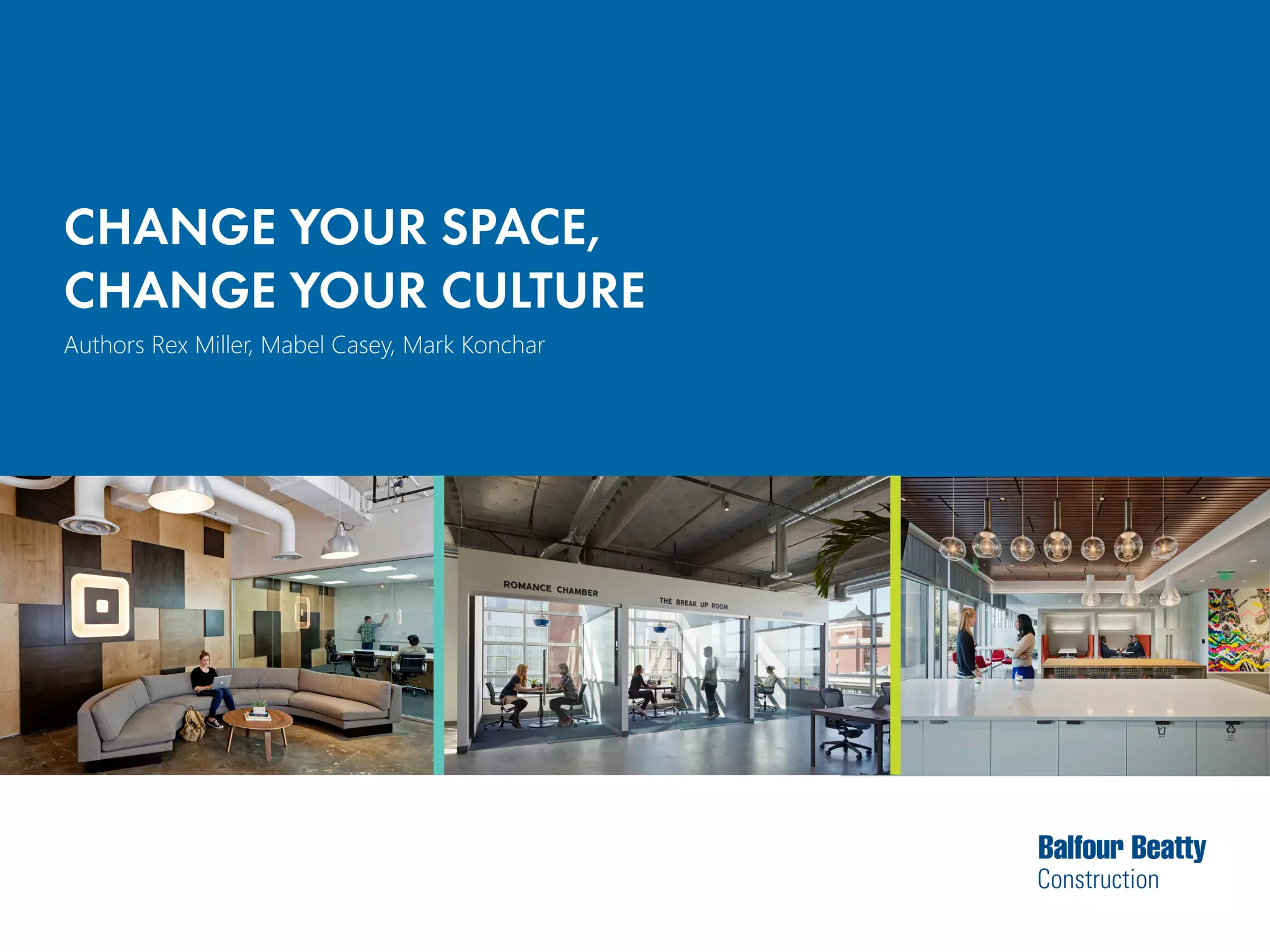
CHANGE YOUR SPACE,
CHANGE YOUR CULTURE
Authors Rex Miller, Mabel Casey, Mark Konchar
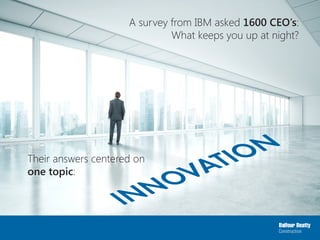
A survey from IBM asked 1600 CEO’s:
What keeps you up at night?
INNOVATIONTheir answers centered on
one topic:
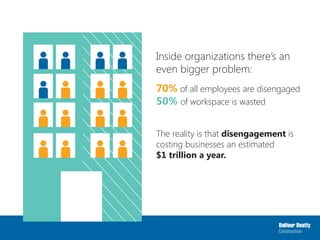
Inside organizations there’s an
even bigger problem:
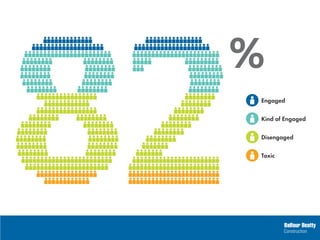
70% of all employees are disengaged
50% of workspace is wasted
The reality is that disengagement is
costing businesses an estimated
$1 trillion a year.
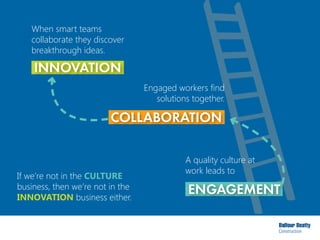
A quality culture at
work leads to
Engaged workers find
solutions together.
When smart teams
collaborate they discover
breakthrough ideas.
INNOVATION
COLLABORATION
ENGAGEMENT
If we’re not in the CULTURE
business, then we’re not in the
INNOVATION business either.
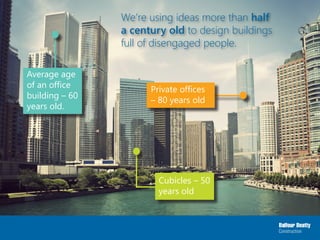
We’re using ideas more than half
a century old to design buildings
full of disengaged people.
Private offices
– 80 years old
Average age
of an office
building – 60
years old.
Cubicles – 50
years old
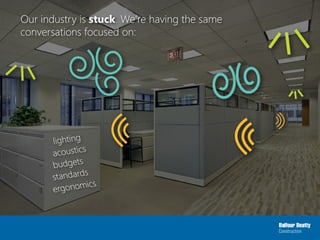
Our industry is stuck. We’re having the same
conversations focused on:
acoustics
lighting
budgets
standards
ergonomics
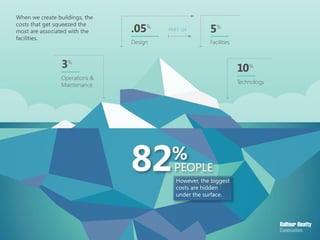
82%
PEOPLE
.05%
5%
10%
Design Facilities
Technology
3%
Operations &
Maintenance
PART OF
When we create buildings, the
costs that get squeezed the
most are associated with the
facilities.
However, the biggest
costs are hidden
under the surface.
%
Engaged
Kind of Engaged
Disengaged
Toxic
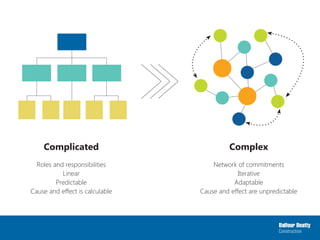
Complicated
Roles and responsibilities
Linear
Predictable
Cause and effect is calculable
Complex
Network of commitments
Iterative
Adaptable
Cause and effect are unpredictable
For the first time in history – today’s
workplace spans at least three generations.
1946
1930
1964
1980
2000
Greatest
1930-1946
11% of the
population
Boomers
1946-1964
25% of the
population
Gen X
1965-1980
14% of the
population
Millennial
1981-2000
27% of the
population
iGen
2000 -
23% of the
population
Digital Natives
Grew up with mobile
devices.
Technologically
Savvy
Grew up during the most
rapid change of the media
landscape.
Digital Immigrants
Digital media is a second
or third language.
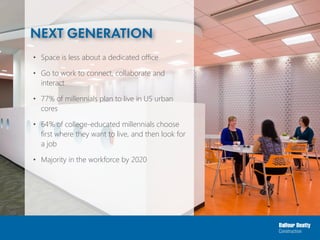
•	 Space is less about a dedicated office
•	 Go to work to connect, collaborate and
interact
•	 77% of millennials plan to live in US urban
cores
•	 64% of college-educated millennials choose
first where they want to live, and then look for
a job
•	 Majority in the workforce by 2020
NEXT GENERATION
It’s time to change the
conversation. We have to
design and build workspaces
for how life happens at work.
NPR Headquarters – Creating one central area where employees can interact with each other
fosters staff interaction and creates a feeling of a more connected organization.
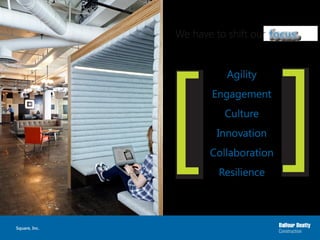
Agility
Engagement
Culture
Innovation
Collaboration
Resilience
We have to shift our focus.focus.
[ [
Square, Inc.
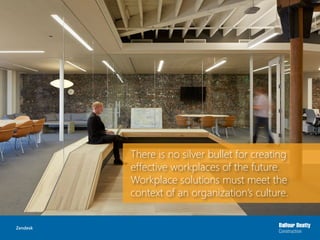
There is no silver bullet for creating
effective workplaces of the future.
Workplace solutions must meet the
context of an organization’s culture.
Zendesk
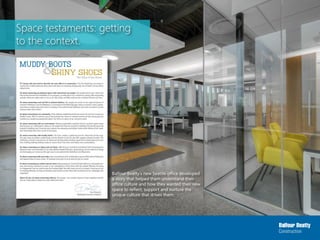
Space testaments: getting
to the context.
Balfour Beatty’s new Seattle office developed
a story that helped them understand their
office culture and how they wanted their new
space to reflect, support and nurture the
unique culture that drives them.
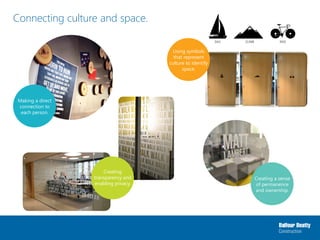
Using symbols
that represent
culture to identify
space.
Making a direct
connection to
each person.
Creating
transparency and
enabling privacy.
Creating a sense
of permanence
and ownership.
Connecting culture and space.
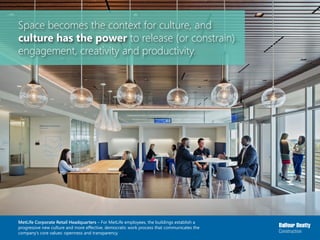
Space becomes the context for culture, and
culture has the power to release (or constrain)
engagement, creativity and productivity.
MetLife Corporate Retail Headquarters – For MetLife employees, the buildings establish a
progressive new culture and more effective, democratic work process that communicates the
company’s core values: openness and transparency.
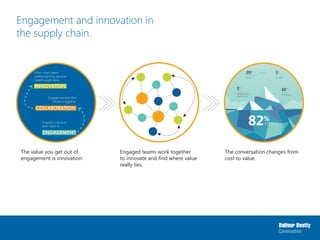
Engagement and innovation in
the supply chain.
A quality culture at
work leads to
Engaged workers find
solutions together.
When smart teams
collaborate they discover
breakthrough ideas.
INNOVATION
COLLABORATION
ENGAGEMENT
The value you get out of
engagement is innovation.
Engaged teams work together
to innovate and find where value
really lies.
The conversation changes from
cost to value.
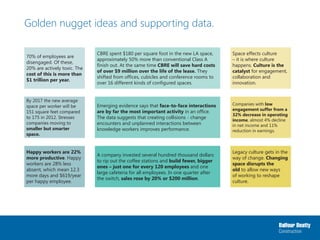
Golden nugget ideas and supporting data.
70% of employees are
disengaged. Of these,
20% are actively toxic. The
cost of this is more than
$1 trillion per year.
By 2017 the new average
space per worker will be
151 square feet compared
to 175 in 2012. Stresses
companies moving to
smaller but smarter
space.
Companies with low
engagement suffer from a
32% decrease in operating
income, almost 4% decline
in net income and 11%
reduction in earnings.
CBRE spent $180 per square foot in the new LA space,
approximately 50% more than conventional Class A
finish out. At the same time CBRE will save hard costs
of over $9 million over the life of the lease. They
shifted from offices, cubicles and conference rooms to
over 16 different kinds of configured spaces.
Emerging evidence says that face-to-face interactions
are by far the most important activity in an office.
The data suggests that creating collisions - change
encounters and unplanned interactions between
knowledge workers improves performance.
A company invested several hundred thousand dollars
to rip out the coffee stations and build fewer, bigger
ones – just one for every 120 employees and one
large cafeteria for all employees. In one quarter after
the switch, sales rose by 20% or $200 million.
Space effects culture
– it is where culture
happens. Culture is the
catalyst for engagement,
collaboration and
innovation.
Legacy culture gets in the
way of change. Changing
space disrupts the
old to allow new ways
of working to reshape
culture.
Happy workers are 22%
more productive. Happy
workers are 28% less
absent, which mean 12.3
more days and $619/year
per happy employee.
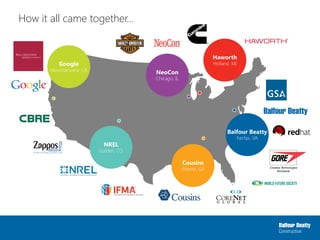
How it all came together...
Balfour Beatty
Fairfax, VA
Cousins
Atlanta, GA
NREL
Golden, CO
Google
Mountainview, CA
Haworth
Holland, MI
NeoCon
Chicago, IL
Change
your Space,
Change
your culture
How Engaging WorkspacEs
Lead to TransformaTion
and groWTh
ReX MILLeR
Mabel Casey
Mark konChar
MIller|Casey|konCharChangeyouRSpaCe,ChangeyouRCuLtuRe
$32.00 USA /$38.00 CAN
BUSINESS & ECONOMICS/General
Recent studies have exposed some scary and
dangerous realities about the workplace:
•	More than 70 percent of the workforce either
hates their job or they are just going through
the motions
•	Half of all office space is wasted
The dimensions of this crisis sparked a high drama
pursuit for answers. Like big city detectives, leaders
from well-known and respected American companies
raced to stop the killer of collaboration and creativity.
Then they discovered strategies to turn the workplace
into a landscape of innovation.
This book is the outcome.
We know that employee engagement is the key to
innovation; workers must care about the job at hand. But
what do you do when dreariness and disconnection are
baked into the workplace? How does business change
the culture, leading to places of creativity, resiliency and
growth?
The leaders behind this story learned that the answer
has been hiding in plain sight, that office space itself can
be the portal of significant change. Months of original
research and fieldwork all led to the breakthrough
insight that business must redesign the spaces where
old and dangerous habits live.
The authors expose deadly flaws in the way office space
is commonly approached, bid, and designed. The whole
process has been trapped in the sclerotic thinking of space
as “sunk costs.” Which leads to the practical conclusion that
design is not important, only minimizing the cost of design.
That has led to workplaces as soul-killing environments of
stressed, fragmented, and disengaged workers.
However, by designing space as a flexible, open,
and engaging workplace, employees reconnect with
the work.
Haworth
ewvISIon ofthe pRoduCtIve
nd InnovatIve woRkSpaCe
behind a complicated world that operated like a machine, to a much
world that operates more like an ecosystem,” he states, in a nutshell, the
workplaces that work in a hyper-connected world.”
enasy - Publisher / Editor in Chief at Metropolis Magazine
ating exploration of the multiple ways our work environments are hinder-
us get things done. Rex Miller has done a remarkable job of chronicling
hanges afoot in our culture and their impact on consciousness–a terrific
ower that form has on function.
author of Getting Things Done
n excellent treatise on a topic that has been long underserved. Every
personally involved in the design of the work environment, and this is
d if you want to understand why that’s important, what you should care
to proceed.
uthor, The Connected Company
pace will transform the way you think about workspace. An insipid work-
than a lost opportunity; it is a lodestone in a world where companies
to survive. This book offers actionable insights and real world exam-
strate how and why your workspace is critical for forming, shaping, and
rt of team and culture required for success. I found it so compelling that
incorporate the book into my “Building Innovation Teams and Cultures”
Kellogg.
Partner at Founder Equity and Digital Intent; teaches innovation at North-
sity Kellogg School of Management
For more information on creating engaging work places visit:
http://bbc.lookbookhq.com/InnovateSpace
Haley Smith
hsmith@balfourbeattyus.com
t. 615-872-1176

Change Your Space, Change Your Culture: Learn how workspace design can create cultures of innovation

  • 1.
    CHANGE YOUR SPACE, CHANGEYOUR CULTURE Authors Rex Miller, Mabel Casey, Mark Konchar
  • 2.
    A survey fromIBM asked 1600 CEO’s: What keeps you up at night? INNOVATIONTheir answers centered on one topic:
  • 3.
    Inside organizations there’san even bigger problem: 70% of all employees are disengaged 50% of workspace is wasted The reality is that disengagement is costing businesses an estimated $1 trillion a year.
  • 4.
    A quality cultureat work leads to Engaged workers find solutions together. When smart teams collaborate they discover breakthrough ideas. INNOVATION COLLABORATION ENGAGEMENT If we’re not in the CULTURE business, then we’re not in the INNOVATION business either.
  • 5.
    We’re using ideasmore than half a century old to design buildings full of disengaged people. Private offices – 80 years old Average age of an office building – 60 years old. Cubicles – 50 years old
  • 6.
    Our industry isstuck. We’re having the same conversations focused on: acoustics lighting budgets standards ergonomics
  • 7.
    82% PEOPLE .05% 5% 10% Design Facilities Technology 3% Operations & Maintenance PARTOF When we create buildings, the costs that get squeezed the most are associated with the facilities. However, the biggest costs are hidden under the surface.
  • 8.
  • 9.
    Complicated Roles and responsibilities Linear Predictable Causeand effect is calculable Complex Network of commitments Iterative Adaptable Cause and effect are unpredictable
  • 10.
    For the firsttime in history – today’s workplace spans at least three generations. 1946 1930 1964 1980 2000 Greatest 1930-1946 11% of the population Boomers 1946-1964 25% of the population Gen X 1965-1980 14% of the population Millennial 1981-2000 27% of the population iGen 2000 - 23% of the population Digital Natives Grew up with mobile devices. Technologically Savvy Grew up during the most rapid change of the media landscape. Digital Immigrants Digital media is a second or third language.
  • 11.
    • Space isless about a dedicated office • Go to work to connect, collaborate and interact • 77% of millennials plan to live in US urban cores • 64% of college-educated millennials choose first where they want to live, and then look for a job • Majority in the workforce by 2020 NEXT GENERATION
  • 12.
    It’s time tochange the conversation. We have to design and build workspaces for how life happens at work. NPR Headquarters – Creating one central area where employees can interact with each other fosters staff interaction and creates a feeling of a more connected organization.
  • 13.
  • 14.
    There is nosilver bullet for creating effective workplaces of the future. Workplace solutions must meet the context of an organization’s culture. Zendesk
  • 15.
    Space testaments: getting tothe context. Balfour Beatty’s new Seattle office developed a story that helped them understand their office culture and how they wanted their new space to reflect, support and nurture the unique culture that drives them.
  • 16.
    Using symbols that represent cultureto identify space. Making a direct connection to each person. Creating transparency and enabling privacy. Creating a sense of permanence and ownership. Connecting culture and space.
  • 17.
    Space becomes thecontext for culture, and culture has the power to release (or constrain) engagement, creativity and productivity. MetLife Corporate Retail Headquarters – For MetLife employees, the buildings establish a progressive new culture and more effective, democratic work process that communicates the company’s core values: openness and transparency.
  • 18.
    Engagement and innovationin the supply chain. A quality culture at work leads to Engaged workers find solutions together. When smart teams collaborate they discover breakthrough ideas. INNOVATION COLLABORATION ENGAGEMENT The value you get out of engagement is innovation. Engaged teams work together to innovate and find where value really lies. The conversation changes from cost to value.
  • 19.
    Golden nugget ideasand supporting data. 70% of employees are disengaged. Of these, 20% are actively toxic. The cost of this is more than $1 trillion per year. By 2017 the new average space per worker will be 151 square feet compared to 175 in 2012. Stresses companies moving to smaller but smarter space. Companies with low engagement suffer from a 32% decrease in operating income, almost 4% decline in net income and 11% reduction in earnings. CBRE spent $180 per square foot in the new LA space, approximately 50% more than conventional Class A finish out. At the same time CBRE will save hard costs of over $9 million over the life of the lease. They shifted from offices, cubicles and conference rooms to over 16 different kinds of configured spaces. Emerging evidence says that face-to-face interactions are by far the most important activity in an office. The data suggests that creating collisions - change encounters and unplanned interactions between knowledge workers improves performance. A company invested several hundred thousand dollars to rip out the coffee stations and build fewer, bigger ones – just one for every 120 employees and one large cafeteria for all employees. In one quarter after the switch, sales rose by 20% or $200 million. Space effects culture – it is where culture happens. Culture is the catalyst for engagement, collaboration and innovation. Legacy culture gets in the way of change. Changing space disrupts the old to allow new ways of working to reshape culture. Happy workers are 22% more productive. Happy workers are 28% less absent, which mean 12.3 more days and $619/year per happy employee.
  • 20.
    How it allcame together... Balfour Beatty Fairfax, VA Cousins Atlanta, GA NREL Golden, CO Google Mountainview, CA Haworth Holland, MI NeoCon Chicago, IL
  • 21.
    Change your Space, Change your culture HowEngaging WorkspacEs Lead to TransformaTion and groWTh ReX MILLeR Mabel Casey Mark konChar MIller|Casey|konCharChangeyouRSpaCe,ChangeyouRCuLtuRe $32.00 USA /$38.00 CAN BUSINESS & ECONOMICS/General Recent studies have exposed some scary and dangerous realities about the workplace: • More than 70 percent of the workforce either hates their job or they are just going through the motions • Half of all office space is wasted The dimensions of this crisis sparked a high drama pursuit for answers. Like big city detectives, leaders from well-known and respected American companies raced to stop the killer of collaboration and creativity. Then they discovered strategies to turn the workplace into a landscape of innovation. This book is the outcome. We know that employee engagement is the key to innovation; workers must care about the job at hand. But what do you do when dreariness and disconnection are baked into the workplace? How does business change the culture, leading to places of creativity, resiliency and growth? The leaders behind this story learned that the answer has been hiding in plain sight, that office space itself can be the portal of significant change. Months of original research and fieldwork all led to the breakthrough insight that business must redesign the spaces where old and dangerous habits live. The authors expose deadly flaws in the way office space is commonly approached, bid, and designed. The whole process has been trapped in the sclerotic thinking of space as “sunk costs.” Which leads to the practical conclusion that design is not important, only minimizing the cost of design. That has led to workplaces as soul-killing environments of stressed, fragmented, and disengaged workers. However, by designing space as a flexible, open, and engaging workplace, employees reconnect with the work. Haworth ewvISIon ofthe pRoduCtIve nd InnovatIve woRkSpaCe behind a complicated world that operated like a machine, to a much world that operates more like an ecosystem,” he states, in a nutshell, the workplaces that work in a hyper-connected world.” enasy - Publisher / Editor in Chief at Metropolis Magazine ating exploration of the multiple ways our work environments are hinder- us get things done. Rex Miller has done a remarkable job of chronicling hanges afoot in our culture and their impact on consciousness–a terrific ower that form has on function. author of Getting Things Done n excellent treatise on a topic that has been long underserved. Every personally involved in the design of the work environment, and this is d if you want to understand why that’s important, what you should care to proceed. uthor, The Connected Company pace will transform the way you think about workspace. An insipid work- than a lost opportunity; it is a lodestone in a world where companies to survive. This book offers actionable insights and real world exam- strate how and why your workspace is critical for forming, shaping, and rt of team and culture required for success. I found it so compelling that incorporate the book into my “Building Innovation Teams and Cultures” Kellogg. Partner at Founder Equity and Digital Intent; teaches innovation at North- sity Kellogg School of Management
  • 22.
    For more informationon creating engaging work places visit: http://bbc.lookbookhq.com/InnovateSpace Haley Smith hsmith@balfourbeattyus.com t. 615-872-1176