Best Practices for Database
Continuous Delivery
DBmaestro and Perforce
Joint-Webinar
October 21st, 2015
▪ You will be on mute for the duration of the event
▪ We are now talking so please type a message
in the Questions box in the Control Panel if you can’t
hear us (please check your speakers and
GoToWebinar audio settings first)
▪ There will be a Q+A session at the end, you can start submitting you
questions on the Q&A bar on your gotowebinar dashboard.
▪ A recording of the full webinar will be put up online
Before We Begin
Presenters
Mark Warren
Product Marketing Director, Perforce
Mark has over 20 years experience as a user and developer of tools to
improve software delivery processes.
Presenters
Yaniv Yehuda
Co-Founder & CTO at DBmaestro
Spent the last years raising awareness about the challenges around
database development and deployment, and how to support database
Continuous Delivery.
Outline
▪ The Adoption of Continuous Delivery
▪ The Reasons why the Database is Often Left Behind
▪ Single Source of Truth for your Database
▪ Best Practices for Including the Database in CD
▪ The Bigger Picture – Automation and Stopping the Line
▪ Q&A
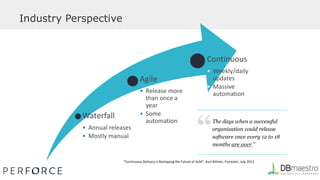
Industry Perspective
Waterfall
• Annual releases
• Mostly manual
Agile
• Release more
than once a
year
• Some
automation
Continuous
• Weekly/daily
updates
• Massive
automation
“The days when a successful
organization could release
software once every 12 to 18
months are over.”
“Continuous Delivery is Reshaping the Future of ALM”, Kurt Bittner, Forrester, July 2013
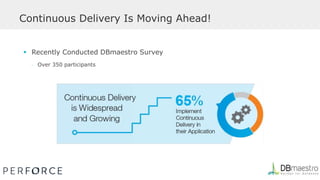
Continuous Delivery Is Moving Ahead!
 Recently Conducted DBmaestro Survey
• Over 350 participants
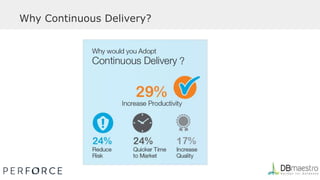
Why Continuous Delivery?
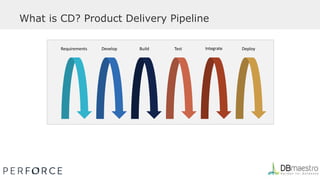
What is CD? Product Delivery Pipeline
Requirements Develop Build Test Integrate Deploy
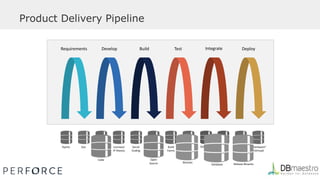
BuildRequirements Develop IntegrateTest Deploy
Rqmts Doc Licenses/
IP History
Social
Coding
Build
Farms
Database Scripts “Hardware”
(Virtual)
Code Open
Source
Binaries Release
Binaries
Code Open
Source Binaries
Release BinariesDatabase
Product Delivery Pipeline
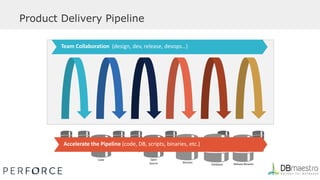
BuildRequirements Develop IntegrateTest Deploy
Rqmts Doc Licenses/
IP History
Social
Coding
Build
Farms
Scripts “Hardware”
(Virtual)
Code Open
Source
Team Collaboration (design, dev, release, devops…)
Binaries
Release BinariesDatabase
Accelerate the Pipeline (code, DB, scripts, binaries, etc.)
Product Delivery Pipeline
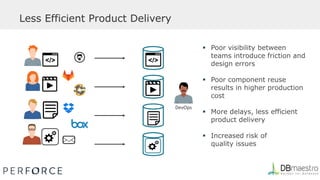
Less Efficient Product Delivery
 Poor visibility between
teams introduce friction and
design errors
 Poor component reuse
results in higher production
cost
 More delays, less efficient
product delivery
 Increased risk of
quality issues
DevOps
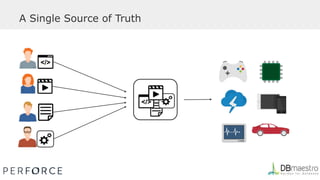
A Single Source of Truth
Continuous Delivery Best Practice
Keep everything in version control… this includes requirement
documents, test scripts, automated test cases, network
configuration scripts, deployment scripts, database creation…
- Continuous Delivery by Jez Humble and David Farley
“
“
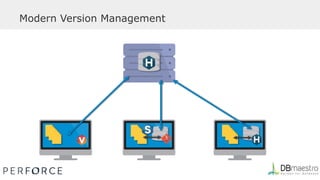
Modern Version Management
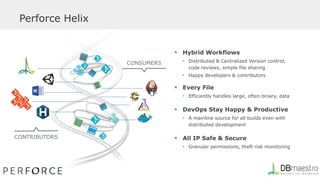
 Hybrid Workflows
• Distributed & Centralized Version control,
code reviews, simple file sharing
• Happy developers & contributors
 Every File
• Efficiently handles large, often binary, data
 DevOps Stay Happy & Productive
• A mainline source for all builds even with
distributed development
 All IP Safe & Secure
• Granular permissions, theft risk monitoring
Perforce Helix
CONTRIBUTORS
CONSUMERS
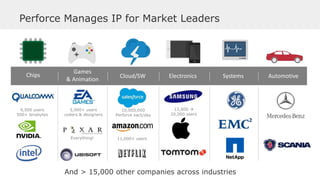
Perforce Manages IP for Market Leaders
13,000 
20,000 users
9,500 users
500+ terabytes
5,000+ users
coders & designers
10,000,000
Perforce xact/day
Everything! 11,000+ users
Chips
Games
& Animation
Cloud/SW Electronics Systems Automotive
And > 15,000 other companies across industries
Facts– Fortune 1000 (IDC)
▪ Average total cost of unplanned application downtime per year is
$1.25b - $2.5b
 Hourly cost of an infrastructure failure is $100K/hour to $500K – $1 M
 Average number of deployments/month is expected to double in two
years
 DevOps-led projects will accelerate the delivery of capabilities to the
customer by 15%–20%
 Continuous Delivery is required!
But…
what about the database?
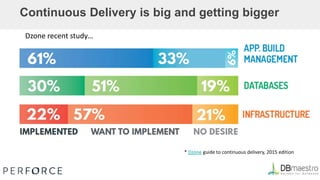
Continuous Delivery is big and getting bigger
Dzone recent study…
* Dzone guide to continuous delivery, 2015 edition
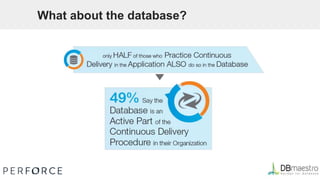
What about the database?
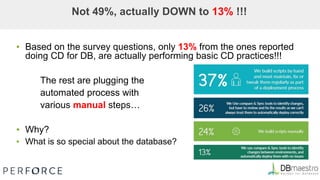
▪ Based on the survey questions, only 13% from the ones reported
doing CD for DB, are actually performing basic CD practices!!!
The rest are plugging the
automated process with
various manual steps…
▪ Why?
▪ What is so special about the database?
Not 49%, actually DOWN to 13% !!!
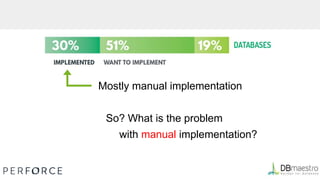
Mostly manual implementation
So? What is the problem
with manual implementation?
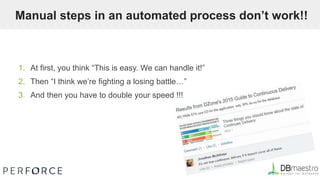
Manual steps in an automated process don’t work!!
1. At first, you think “This is easy. We can handle it!”
2. Then “I think we’re fighting a losing battle…”
3. And then you have to double your speed !!!
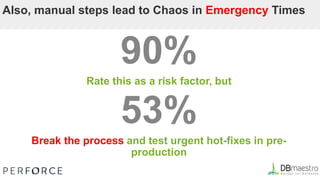
Also, manual steps lead to Chaos in Emergency Times
90%
Rate this as a risk factor, but
53%
Break the process and test urgent hot-fixes in pre-
production
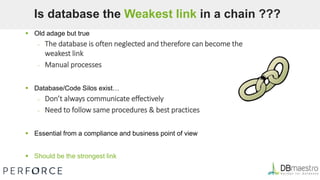
 Old adage but true
– The database is often neglected and therefore can become the
weakest link
– Manual processes
 Database/Code Silos exist…
– Don’t always communicate effectively
– Need to follow same procedures & best practices
 Essential from a compliance and business point of view
 Should be the strongest link
Is database the Weakest link in a chain ???
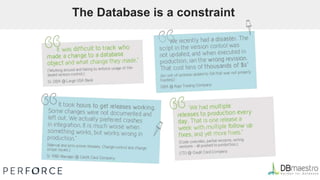
The Database is a constraint
What is the problem?
▪ Root Causes for issues:
− Challenging manual source control process
− Static deployments code overrides
− Dynamic deployments tools unaware of version control
− No release automation red-flags – don’t know when to stop the line…
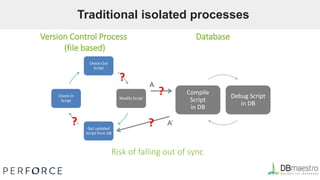
Version Control Process
(file based)
Database
Check-Out
Script
Modify Script
Get updated
Script from DB
Check-In
Script
Compile
Script
in DB
Debug Script
in DB
?
?
?
?
A
A’
Traditional isolated processes
Risk of falling out of sync
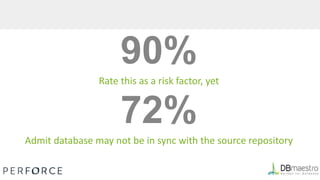
90%
Rate this as a risk factor, yet
72%
Admit database may not be in sync with the source repository
Scripts & version control
▪ Challenges:
− Code-overrides
− Working on the wrong revisions
− Scripts do not always find their way to the version control solution
− Out of process updates go unnoticed
− Hard to locate outdated update scripts
▪ Playing safe? What we really need:
− The upgrade script
− The actual code of the object
− A roll-back script
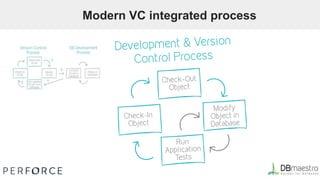
Modern VC integrated process
X
1.11.1.11.11.21.31.41.51.61.7
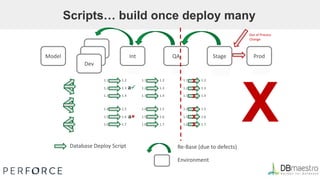
Scripts… build once deploy many
Int QA Stage Prod
Database Deploy Script
Environment
Re-Base (due to defects)
Dev
Dev
Dev
Model
1.1 1.2
1.2 1.3
1.3 1.4
1.4 1.5
1.5 1.6
1.6 1.7
1.11.11.41.7
1.1 1.2
1.2 1.3
1.3 1.4
1.4 1.5
1.5 1.6
1.6 1.7
1.1 1.2
1.2 1.3
1.3 1.4
1.4 1.5
1.5 1.6
1.6 1.7
Out of Process
Change
X
X
X
X
X
? 1.1.1
X
a
a
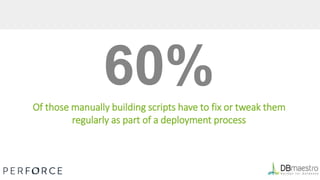
60%Of those manually building scripts have to fix or tweak them
regularly as part of a deployment process
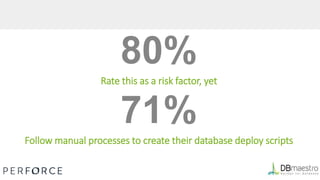
80%
Rate this as a risk factor, yet
71%
Follow manual processes to create their database deploy scripts
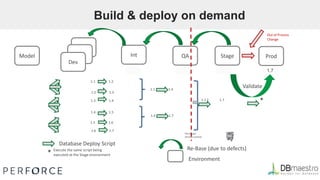
Build & deploy on demand
1.11.21.31.41.51.61.7
*
Int QA Stage Prod
Database Deploy Script
Environment
* Execute the same script being
executed at the Stage environment
Re-Base (due to defects)
Dev
Dev
Dev
Model
1.1 1.2
1.2 1.3
1.3 1.4
1.4 1.5
1.5 1.6
1.6 1.7
1.1 1.4
1.4 1.7
1.1.1 1.7
1.1 1.1 1.11.41.7
File Based
Version Control
Out of Process
Change
1.1.11.7 1.1.11.7
Validate
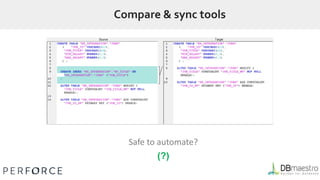
Safe to automate?
(?)
Compare & sync tools
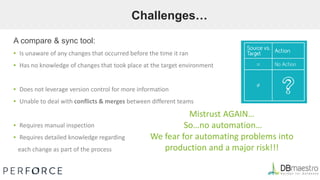
Challenges…
A compare & sync tool:
▪ Is unaware of any changes that occurred before the time it ran
▪ Has no knowledge of changes that took place at the target environment
▪ Does not leverage version control for more information
▪ Unable to deal with conflicts & merges between different teams
▪ Requires manual inspection
▪ Requires detailed knowledge regarding
each change as part of the process
Mistrust AGAIN…
So…no automation…
We fear for automating problems into
production and a major risk!!!
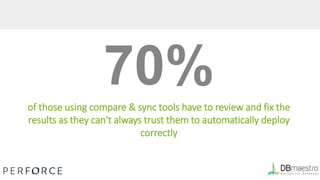
70%of those using compare & sync tools have to review and fix the
results as they can't always trust them to automatically deploy
correctly
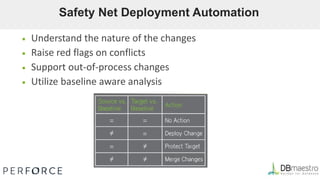
■ Understand the nature of the changes
■ Raise red flags on conflicts
■ Support out-of-process changes
■ Utilize baseline aware analysis
Safety Net Deployment Automation
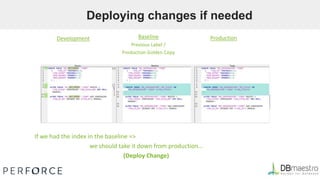
Deploying changes if needed
Development Baseline
Previous Label /
Production Golden Copy
Production
If we had the index in the baseline =>
we should take it down from production…
(Deploy Change)
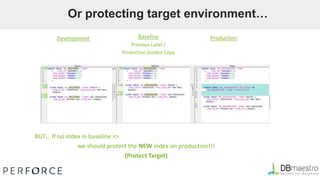
Or protecting target environment…
Development Baseline
Previous Label /
Production Golden Copy
Production
BUT… If no index in baseline =>
we should protect the NEW index on production!!!
(Protect Target)
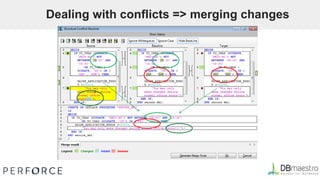
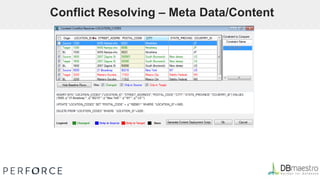
Dealing with conflicts => merging changes
Conflict Resolving – Meta Data/Content
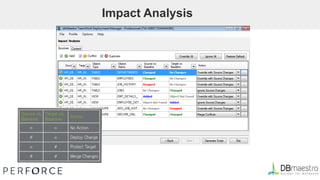
Impact Analysis
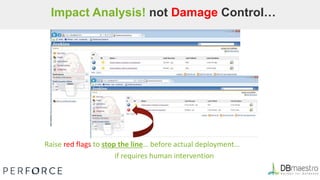
Impact Analysis! not Damage Control…
Raise red flags to stop the line… before actual deployment…
if requires human intervention
 Automate “everything”
– Package the deployment of database changes along with all your other
application components to give a unified picture
 Move the process upstream
– Easily promote the same package (including database changes!) from one
environment to the next, handling environment-specific differences
automatically
 Create the deployment pipeline
For successful CD:
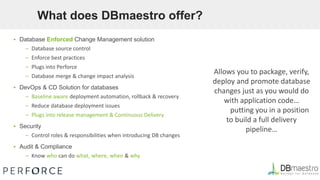
What does DBmaestro offer?
▪ Database Enforced Change Management solution
– Database source control
– Enforce best practices
– Plugs into Perforce
– Database merge & change impact analysis
▪ DevOps & CD Solution for databases
– Baseline aware deployment automation, rollback & recovery
– Reduce database deployment issues
– Plugs into release management & Continuous Delivery
▪ Security
– Control roles & responsibilities when introducing DB changes
▪ Audit & Compliance
– Know who can do what, where, when & why
Allows you to package, verify,
deploy and promote database
changes just as you would do
with application code…
putting you in a position
to build a full delivery
pipeline…
▪ Focusing on changes rather than managing changes and
dealing with re-work, boosted overall productivity of 250
developers. We estimate we were able to do 15% more with the
same resources.
▪We went from several fix-centric deployments a day, to one
feature-centric deployment a week.
▪The amount of incidents in production has declined as well. We
had 20% less incidents.
▪CIO @ Credit Card company
“
Testimonials - Efficiency
“
About DBmaestro
▪ The leading provider of DevOps for Database
▪ Database Development and Continuous Delivery
Thank you!
Q & A
Mark Warren Yaniv Yehuda
mwarren@perforce.com yanivy@dbmaestro.com
www.perforce.com www.dbmaestro.com

Challenges and best practices of database continuous delivery

  • 1.
    Best Practices forDatabase Continuous Delivery DBmaestro and Perforce Joint-Webinar October 21st, 2015
  • 2.
    ▪ You willbe on mute for the duration of the event ▪ We are now talking so please type a message in the Questions box in the Control Panel if you can’t hear us (please check your speakers and GoToWebinar audio settings first) ▪ There will be a Q+A session at the end, you can start submitting you questions on the Q&A bar on your gotowebinar dashboard. ▪ A recording of the full webinar will be put up online Before We Begin
  • 3.
    Presenters Mark Warren Product MarketingDirector, Perforce Mark has over 20 years experience as a user and developer of tools to improve software delivery processes.
  • 4.
    Presenters Yaniv Yehuda Co-Founder &CTO at DBmaestro Spent the last years raising awareness about the challenges around database development and deployment, and how to support database Continuous Delivery.
  • 5.
    Outline ▪ The Adoptionof Continuous Delivery ▪ The Reasons why the Database is Often Left Behind ▪ Single Source of Truth for your Database ▪ Best Practices for Including the Database in CD ▪ The Bigger Picture – Automation and Stopping the Line ▪ Q&A
  • 6.
    Industry Perspective Waterfall • Annualreleases • Mostly manual Agile • Release more than once a year • Some automation Continuous • Weekly/daily updates • Massive automation “The days when a successful organization could release software once every 12 to 18 months are over.” “Continuous Delivery is Reshaping the Future of ALM”, Kurt Bittner, Forrester, July 2013
  • 7.
    Continuous Delivery IsMoving Ahead!  Recently Conducted DBmaestro Survey • Over 350 participants
  • 8.
  • 9.
    What is CD?Product Delivery Pipeline Requirements Develop Build Test Integrate Deploy
  • 10.
    BuildRequirements Develop IntegrateTestDeploy Rqmts Doc Licenses/ IP History Social Coding Build Farms Database Scripts “Hardware” (Virtual) Code Open Source Binaries Release Binaries Code Open Source Binaries Release BinariesDatabase Product Delivery Pipeline
  • 11.
    BuildRequirements Develop IntegrateTestDeploy Rqmts Doc Licenses/ IP History Social Coding Build Farms Scripts “Hardware” (Virtual) Code Open Source Team Collaboration (design, dev, release, devops…) Binaries Release BinariesDatabase Accelerate the Pipeline (code, DB, scripts, binaries, etc.) Product Delivery Pipeline
  • 12.
    Less Efficient ProductDelivery  Poor visibility between teams introduce friction and design errors  Poor component reuse results in higher production cost  More delays, less efficient product delivery  Increased risk of quality issues DevOps
  • 13.
  • 14.
    Continuous Delivery BestPractice Keep everything in version control… this includes requirement documents, test scripts, automated test cases, network configuration scripts, deployment scripts, database creation… - Continuous Delivery by Jez Humble and David Farley “ “
  • 15.
  • 16.
     Hybrid Workflows •Distributed & Centralized Version control, code reviews, simple file sharing • Happy developers & contributors  Every File • Efficiently handles large, often binary, data  DevOps Stay Happy & Productive • A mainline source for all builds even with distributed development  All IP Safe & Secure • Granular permissions, theft risk monitoring Perforce Helix CONTRIBUTORS CONSUMERS
  • 17.
    Perforce Manages IPfor Market Leaders 13,000  20,000 users 9,500 users 500+ terabytes 5,000+ users coders & designers 10,000,000 Perforce xact/day Everything! 11,000+ users Chips Games & Animation Cloud/SW Electronics Systems Automotive And > 15,000 other companies across industries
  • 18.
    Facts– Fortune 1000(IDC) ▪ Average total cost of unplanned application downtime per year is $1.25b - $2.5b  Hourly cost of an infrastructure failure is $100K/hour to $500K – $1 M  Average number of deployments/month is expected to double in two years  DevOps-led projects will accelerate the delivery of capabilities to the customer by 15%–20%  Continuous Delivery is required!
  • 19.
  • 20.
    Continuous Delivery isbig and getting bigger Dzone recent study… * Dzone guide to continuous delivery, 2015 edition
  • 21.
    What about thedatabase?
  • 22.
    ▪ Based onthe survey questions, only 13% from the ones reported doing CD for DB, are actually performing basic CD practices!!! The rest are plugging the automated process with various manual steps… ▪ Why? ▪ What is so special about the database? Not 49%, actually DOWN to 13% !!!
  • 23.
    Mostly manual implementation So?What is the problem with manual implementation?
  • 24.
    Manual steps inan automated process don’t work!! 1. At first, you think “This is easy. We can handle it!” 2. Then “I think we’re fighting a losing battle…” 3. And then you have to double your speed !!!
  • 25.
    Also, manual stepslead to Chaos in Emergency Times 90% Rate this as a risk factor, but 53% Break the process and test urgent hot-fixes in pre- production
  • 26.
     Old adagebut true – The database is often neglected and therefore can become the weakest link – Manual processes  Database/Code Silos exist… – Don’t always communicate effectively – Need to follow same procedures & best practices  Essential from a compliance and business point of view  Should be the strongest link Is database the Weakest link in a chain ???
  • 27.
    The Database isa constraint
  • 28.
    What is theproblem? ▪ Root Causes for issues: − Challenging manual source control process − Static deployments code overrides − Dynamic deployments tools unaware of version control − No release automation red-flags – don’t know when to stop the line…
  • 29.
    Version Control Process (filebased) Database Check-Out Script Modify Script Get updated Script from DB Check-In Script Compile Script in DB Debug Script in DB ? ? ? ? A A’ Traditional isolated processes Risk of falling out of sync
  • 30.
    90% Rate this asa risk factor, yet 72% Admit database may not be in sync with the source repository
  • 31.
    Scripts & versioncontrol ▪ Challenges: − Code-overrides − Working on the wrong revisions − Scripts do not always find their way to the version control solution − Out of process updates go unnoticed − Hard to locate outdated update scripts ▪ Playing safe? What we really need: − The upgrade script − The actual code of the object − A roll-back script
  • 32.
  • 33.
    X 1.11.1.11.11.21.31.41.51.61.7 Scripts… build oncedeploy many Int QA Stage Prod Database Deploy Script Environment Re-Base (due to defects) Dev Dev Dev Model 1.1 1.2 1.2 1.3 1.3 1.4 1.4 1.5 1.5 1.6 1.6 1.7 1.11.11.41.7 1.1 1.2 1.2 1.3 1.3 1.4 1.4 1.5 1.5 1.6 1.6 1.7 1.1 1.2 1.2 1.3 1.3 1.4 1.4 1.5 1.5 1.6 1.6 1.7 Out of Process Change X X X X X ? 1.1.1 X a a
  • 34.
    60%Of those manuallybuilding scripts have to fix or tweak them regularly as part of a deployment process
  • 35.
    80% Rate this asa risk factor, yet 71% Follow manual processes to create their database deploy scripts
  • 36.
    Build & deployon demand 1.11.21.31.41.51.61.7 * Int QA Stage Prod Database Deploy Script Environment * Execute the same script being executed at the Stage environment Re-Base (due to defects) Dev Dev Dev Model 1.1 1.2 1.2 1.3 1.3 1.4 1.4 1.5 1.5 1.6 1.6 1.7 1.1 1.4 1.4 1.7 1.1.1 1.7 1.1 1.1 1.11.41.7 File Based Version Control Out of Process Change 1.1.11.7 1.1.11.7 Validate
  • 37.
  • 38.
    Challenges… A compare &sync tool: ▪ Is unaware of any changes that occurred before the time it ran ▪ Has no knowledge of changes that took place at the target environment ▪ Does not leverage version control for more information ▪ Unable to deal with conflicts & merges between different teams ▪ Requires manual inspection ▪ Requires detailed knowledge regarding each change as part of the process Mistrust AGAIN… So…no automation… We fear for automating problems into production and a major risk!!!
  • 39.
    70%of those usingcompare & sync tools have to review and fix the results as they can't always trust them to automatically deploy correctly
  • 40.
    ■ Understand thenature of the changes ■ Raise red flags on conflicts ■ Support out-of-process changes ■ Utilize baseline aware analysis Safety Net Deployment Automation
  • 41.
    Deploying changes ifneeded Development Baseline Previous Label / Production Golden Copy Production If we had the index in the baseline => we should take it down from production… (Deploy Change)
  • 42.
    Or protecting targetenvironment… Development Baseline Previous Label / Production Golden Copy Production BUT… If no index in baseline => we should protect the NEW index on production!!! (Protect Target)
  • 43.
    Dealing with conflicts=> merging changes
  • 44.
    Conflict Resolving –Meta Data/Content
  • 45.
  • 46.
    Impact Analysis! notDamage Control… Raise red flags to stop the line… before actual deployment… if requires human intervention
  • 47.
     Automate “everything” –Package the deployment of database changes along with all your other application components to give a unified picture  Move the process upstream – Easily promote the same package (including database changes!) from one environment to the next, handling environment-specific differences automatically  Create the deployment pipeline For successful CD:
  • 48.
    What does DBmaestrooffer? ▪ Database Enforced Change Management solution – Database source control – Enforce best practices – Plugs into Perforce – Database merge & change impact analysis ▪ DevOps & CD Solution for databases – Baseline aware deployment automation, rollback & recovery – Reduce database deployment issues – Plugs into release management & Continuous Delivery ▪ Security – Control roles & responsibilities when introducing DB changes ▪ Audit & Compliance – Know who can do what, where, when & why Allows you to package, verify, deploy and promote database changes just as you would do with application code… putting you in a position to build a full delivery pipeline…
  • 49.
    ▪ Focusing onchanges rather than managing changes and dealing with re-work, boosted overall productivity of 250 developers. We estimate we were able to do 15% more with the same resources. ▪We went from several fix-centric deployments a day, to one feature-centric deployment a week. ▪The amount of incidents in production has declined as well. We had 20% less incidents. ▪CIO @ Credit Card company “ Testimonials - Efficiency “
  • 50.
    About DBmaestro ▪ Theleading provider of DevOps for Database ▪ Database Development and Continuous Delivery
  • 51.
    Thank you! Q &A Mark Warren Yaniv Yehuda mwarren@perforce.com yanivy@dbmaestro.com www.perforce.com www.dbmaestro.com

Editor's Notes

  • #3 Hi everybody and welcome to our webinar, thank you for taking the time to be here with us. Today we will be hearing from Bob Aiello and Yaniv Yehuda, who will be discussing DevOps for Database. But first I would like to go over a few details: Please note you will be on mute during the event. If you can't hear me now, please check your speakers and GoToWebinar audio settings. We will have a Q&A session at the end of the presentation, but you can start submitting you questions on twitter, using the hashtag #DevOps4db or the Q&A bar on your gotowebinar dashboard.
  • #18 Opportunity to poll – how many of you use products from samsung? How many from apple? How many use Amazon? How many use services from google? You touch products built on Perforce, daily… Click…. We have 10000+ customers across the globe. This is a proven platform for delivering a diverse set of products.
  • #19 IT organizations that have tried to custom adjust current tools to meet DevOps practices have a failure rate of 80%, thus making tool replacement and/or addition a critical requirement The average cost percentage (per year) of a single application's development, testing, deployment, and operations life cycle considered wasteful and unnecessary is 25% Development teams are the leading sponsors of DevOps teams, with operations and architecture teams close behind There are significant acceleration advantages for IT leaders that decide to create a DevOps team or center of excellence versus a less-organized DevOps organizational approach