▪ You will be on mute for the duration of the event
▪ Please type a message in the Questions box in the
Control Panel if you can’t hear us (please check your
speakers and GoToWebinar audio settings first)
▪ If you have questions during the session, please submit
them on the Q&A bar on your GoToWebinar dashboard
and we will address them at the end
▪ A recording of the full webinar will be put up online
Before we Begin
Yaniv Yehuda
Co-Founder & CTO at DBmaestro
Spent the last years raising awareness about the challenges around database
development and deployment, and how to support database Continuous Delivery.
Joined NessPRO as a product manager for the line of SAP complementary products and
DevOps solutions for the DB.
Shachar Furman
Product Manager, Central Systems, NessPRO
About the presenters
Outline
▪ The Adoption of Continuous Delivery
▪ The Reasons why the Database is Often Left Behind
▪ Single Source of Truth for your Database
▪ Best Practices for Including the Database in CD
▪ The Bigger Picture – Automation and Stopping the Line
▪ Q&A
NessPRO is Ness Technologies’ products group and the sole representative in
Israel of more than 30 international and Israeli organizations which develop
software products designated for the enterprise market.
About NessPRO
About DBmaestro
The leading provider of DevOps for Database
Database development and deployment automation
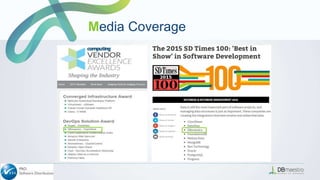
Media Coverage
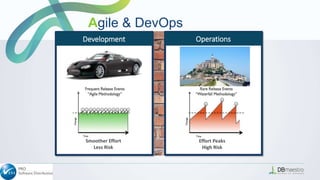
OperationsDevelopment
Smoother Effort
Less Risk
Effort Peaks
High Risk
Agile & DevOps
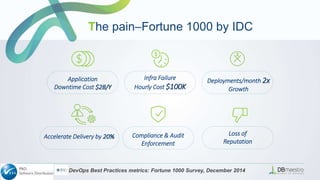
The pain–Fortune 1000 by IDC
Application
Downtime Cost $2B/Y
Deployments/month 2x
Growth
Accelerate Delivery by 20% Compliance & Audit
Enforcement
Infra Failure
Hourly Cost $100K
IDC DevOps Best Practices metrics: Fortune 1000 Survey, December 2014
Loss of
Reputation
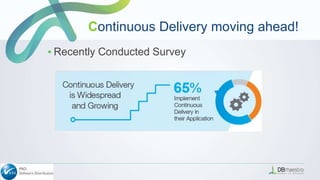
▪ Recently Conducted Survey
Continuous Delivery moving ahead!
▪ Every business is an IT business
▪ Customers demand that you deliver new features faster
− Agile Development
− Process Automation
− DevOps
▪ Can’t wait 6 months for that next waterfall release…
▪ If you don’t, your competitor probably will
DevOps & CD: a must for every company
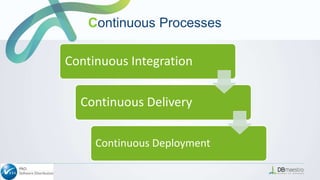
Continuous Integration
Continuous Delivery
Continuous Deployment
Continuous Processes
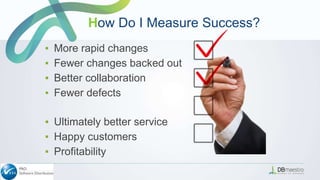
▪ More rapid changes
▪ Fewer changes backed out
▪ Better collaboration
▪ Fewer defects
▪ Ultimately better service
▪ Happy customers
▪ Profitability
How Do I Measure Success?
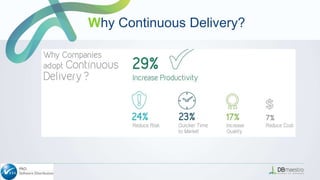
Why Continuous Delivery?
15
But…
what about the database?
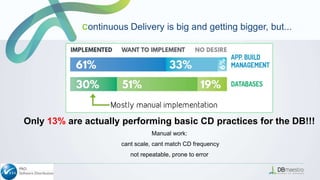
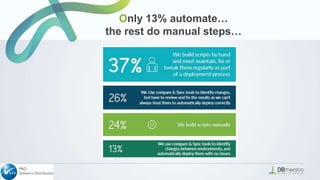
Only 13% are actually performing basic CD practices for the DB!!!
Manual work:
cant scale, cant match CD frequency
not repeatable, prone to error
Continuous Delivery is big and getting bigger, but...
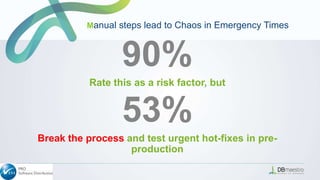
Manual steps lead to Chaos in Emergency Times
90%
Rate this as a risk factor, but
53%
Break the process and test urgent hot-fixes in pre-
production
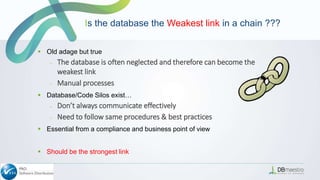
 Old adage but true
– The database is often neglected and therefore can become the
weakest link
– Manual processes
 Database/Code Silos exist…
– Don’t always communicate effectively
– Need to follow same procedures & best practices
 Essential from a compliance and business point of view
 Should be the strongest link
Is the database the Weakest link in a chain ???
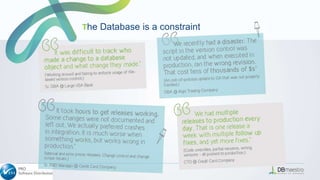
The Database is a constraint
Only 13% automate…
the rest do manual steps…
What is the problem?
▪ Root Causes for issues:
− Challenging manual source control process
− Static deployments code overrides and configuration drift
− Dynamic deployments tools unaware of version control
− No release automation red-flags – don’t know when to stop the line…
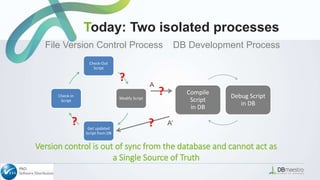
File Version Control Process
Today: Two isolated processes
DB Development Process
Check-Out
Script
Modify Script
Get updated
Script from DB
Check-In
Script
Compile
Script
in DB
Debug Script
in DB
?
?
?
?
A
A’
Version control is out of sync from the database and cannot act as
a Single Source of Truth
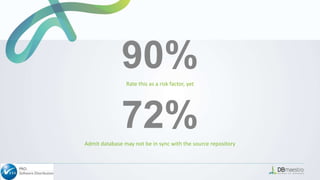
90%Rate this as a risk factor, yet
72%Admit database may not be in sync with the source repository
▪ Challenges:
■ Code-overrides
■ Working on the wrong revisions
■ Scripts do not always find their way to the version control solution
■ Out of process updates go unnoticed
■ Hard to locate outdated update scripts
▪ Playing safe? What we really need:
■ The upgrade script
■ The actual code of the object
■ A roll-back script
Scripts & version control
X
1.11.1.11.11.21.31.41.51.61.7
Int QA Stage Prod
Database Deploy Script
Dev
Dev
Dev
Model
1.1 1.2
1.2 1.3
1.3 1.4
1.4 1.5
1.5 1.6
1.6 1.7
1.11.11.41.7
1.1 1.2
1.2 1.3
1.3 1.4
1.4 1.5
1.5 1.6
1.6 1.7
1.1 1.2
1.2 1.3
1.3 1.4
1.4 1.5
1.5 1.6
1.6 1.7
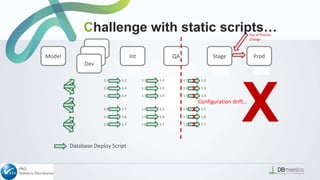
Out of Process
Change
X
X
X
X
X
? 1.1.1
X
Challenge with static scripts…
Configuration drift…
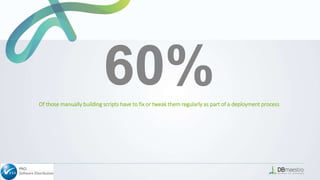
60%Of those manually building scripts have to fix or tweak them regularly as part of a deployment process
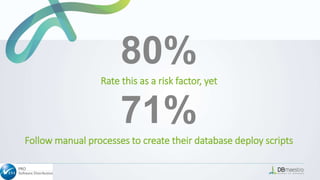
80%
Rate this as a risk factor, yet
71%
Follow manual processes to create their database deploy scripts
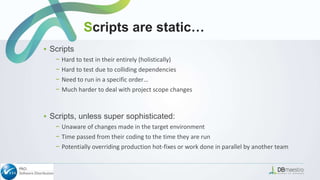
▪ Scripts
− Hard to test in their entirely (holistically)
− Hard to test due to colliding dependencies
− Need to run in a specific order…
− Much harder to deal with project scope changes
▪ Scripts, unless super sophisticated:
− Unaware of changes made in the target environment
− Time passed from their coding to the time they are run
− Potentially overriding production hot-fixes or work done in parallel by another team
Scripts are static…
Test cases using compare & sync tools:
An index exists in source (QA) but not in target (Production)
What should we do? Add the index or not?
Using tools
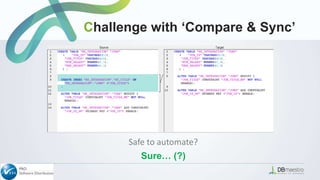
Safe to automate?
Sure… (?)
Challenge with ‘Compare & Sync’
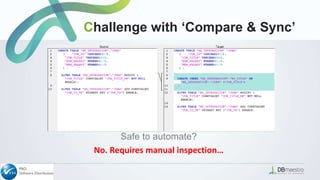
Safe to automate?
No. Requires manual inspection…
Challenge with ‘Compare & Sync’
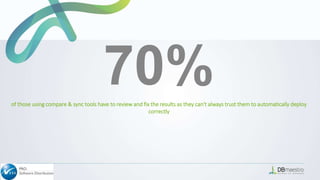
70%of those using compare & sync tools have to review and fix the results as they can't always trust them to automatically deploy
correctly
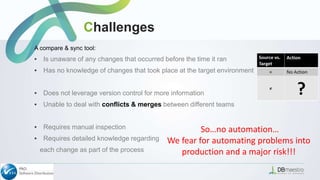
A compare & sync tool:
▪ Is unaware of any changes that occurred before the time it ran
▪ Has no knowledge of changes that took place at the target environment
▪ Does not leverage version control for more information
▪ Unable to deal with conflicts & merges between different teams
▪ Requires manual inspection
▪ Requires detailed knowledge regarding
each change as part of the process
So…no automation…
We fear for automating problems into
production and a major risk!!!
Challenges
The Solution to the challenges
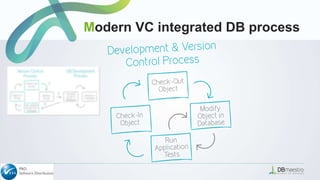
Modern VC integrated DB process
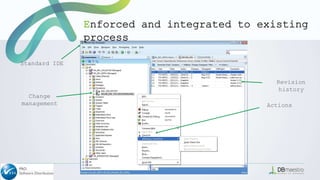
Revision
history
Actions
Standard IDE
Change
management
Enforced and integrated to existing
process
Leverage
Version control knowledge
into
Deployment decisions
1.11.21.31.41.51.61.7
*
Int QA Stage Prod
Dev
Dev
Dev
Model
1.1 1.2
1.2 1.3
1.3 1.4
1.1 1.7
1.1.1 1.7
1.1 1.1 1.11.41.7
Out of Process
Change
1.1.11.7 1.1.11.7
Validate
1.4 1.5
1.5 1.6
1.6 1.7
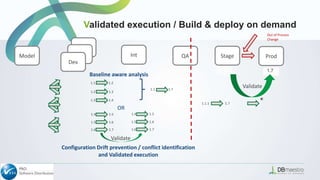
Configuration Drift prevention / conflict identification
and Validated execution
1.4 1.5
1.5 1.6
1.6 1.7
OR
Baseline aware analysis
Validated execution / Build & deploy on demand
Validate
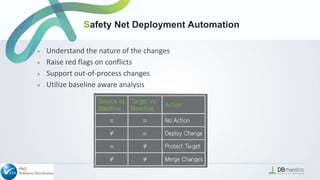
■ Understand the nature of the changes
■ Raise red flags on conflicts
■ Support out-of-process changes
■ Utilize baseline aware analysis
Safety Net Deployment Automation
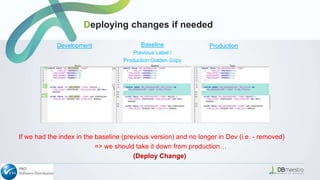
If we had the index in the baseline (previous version) and no longer in Dev (i.e. - removed)
=> we should take it down from production…
(Deploy Change)
Deploying changes if needed
Development Baseline
Previous Label /
Production Golden Copy
Production
Development Baseline
Previous Label /
Production Golden Copy
Production
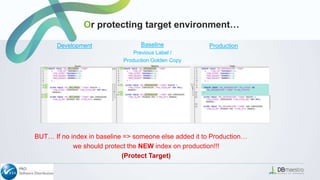
BUT… If no index in baseline => someone else added it to Production…
we should protect the NEW index on production!!!
(Protect Target)
Or protecting target environment…
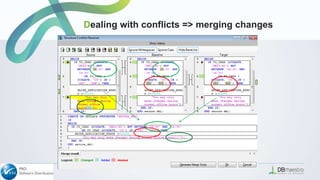
Dealing with conflicts => merging changes
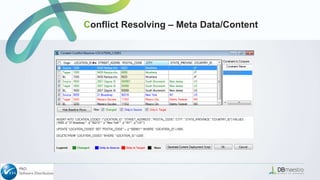
Conflict Resolving – Meta Data/Content
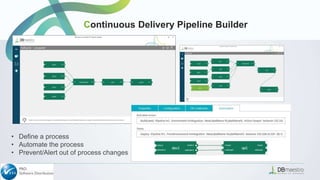
Continuous Delivery Pipeline Builder
• Define a process
• Automate the process
• Prevent/Alert out of process changes
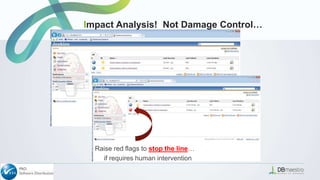
Raise red flags to stop the line…
if requires human intervention
Impact Analysis! Not Damage Control…
 Automate “everything”
– Package the deployment of database changes along with all your other
application components to give a unified picture
 Move the process upstream
– Easily promote the same package (including database changes!) from one
environment to the next, handling environment-specific differences automatically
 Create the deployment pipeline
For successful CD:
▪ Requited integrations into entire continuous delivery pipeline:
■ IDEs (Oracle, Microsoft, MySQL in dev)
■ Source control (MsTFS, Git, Subversion etc.)
■ Task based development and ticketing systems (Jira, MsTFS, IBM RTC
etc.)
■ Build tools (Jenkins, bamboo etc.)
■ ARA tools (IBM uDeploy, CA release automation, Chef etc.)
Integrated CD world…
▪ Focusing on changes rather than managing changes and
dealing with re-work, boosted overall productivity of 250
developers. We estimate we were able to do 15% more with the
same resources.
▪We went from several fix-centric deployments a day, to one
feature-centric deployment a week.
▪The amount of incidents in production has declined as well. We
had 20% less incidents.
▪CIO @ Credit Card company
“
Testimonials - Efficiency
“
▪ Regulation requirement - SOX and derived 357
▪Auditing - change management approach with change
management auditing. You have to do it anyway, do it
automatically and efficiently.
▪Change management in production itself is regulatory
required (ITIL). But you cannot ensure it without managing
the whole process starting at Dev.
▪We have to comply with regulation - but the business
benefits from it.
▪CIO @ Credit Card company
“
Testimonials - Regulation
Thank you!
Q & A
Shachar Furman Yaniv Yehuda
Shachar.Furman@ness-tech.co.il yanivy@dbmaestro.com
www.ness-tech.co.il www.dbmaestro.com

Challenges and Best Practices of Database Continuous Delivery

  • 2.
    ▪ You willbe on mute for the duration of the event ▪ Please type a message in the Questions box in the Control Panel if you can’t hear us (please check your speakers and GoToWebinar audio settings first) ▪ If you have questions during the session, please submit them on the Q&A bar on your GoToWebinar dashboard and we will address them at the end ▪ A recording of the full webinar will be put up online Before we Begin
  • 3.
    Yaniv Yehuda Co-Founder &CTO at DBmaestro Spent the last years raising awareness about the challenges around database development and deployment, and how to support database Continuous Delivery. Joined NessPRO as a product manager for the line of SAP complementary products and DevOps solutions for the DB. Shachar Furman Product Manager, Central Systems, NessPRO About the presenters
  • 4.
    Outline ▪ The Adoptionof Continuous Delivery ▪ The Reasons why the Database is Often Left Behind ▪ Single Source of Truth for your Database ▪ Best Practices for Including the Database in CD ▪ The Bigger Picture – Automation and Stopping the Line ▪ Q&A
  • 5.
    NessPRO is NessTechnologies’ products group and the sole representative in Israel of more than 30 international and Israeli organizations which develop software products designated for the enterprise market. About NessPRO
  • 6.
    About DBmaestro The leadingprovider of DevOps for Database Database development and deployment automation
  • 7.
  • 8.
  • 9.
    The pain–Fortune 1000by IDC Application Downtime Cost $2B/Y Deployments/month 2x Growth Accelerate Delivery by 20% Compliance & Audit Enforcement Infra Failure Hourly Cost $100K IDC DevOps Best Practices metrics: Fortune 1000 Survey, December 2014 Loss of Reputation
  • 10.
    ▪ Recently ConductedSurvey Continuous Delivery moving ahead!
  • 11.
    ▪ Every businessis an IT business ▪ Customers demand that you deliver new features faster − Agile Development − Process Automation − DevOps ▪ Can’t wait 6 months for that next waterfall release… ▪ If you don’t, your competitor probably will DevOps & CD: a must for every company
  • 12.
  • 13.
    ▪ More rapidchanges ▪ Fewer changes backed out ▪ Better collaboration ▪ Fewer defects ▪ Ultimately better service ▪ Happy customers ▪ Profitability How Do I Measure Success?
  • 14.
  • 15.
  • 16.
    Only 13% areactually performing basic CD practices for the DB!!! Manual work: cant scale, cant match CD frequency not repeatable, prone to error Continuous Delivery is big and getting bigger, but...
  • 17.
    Manual steps leadto Chaos in Emergency Times 90% Rate this as a risk factor, but 53% Break the process and test urgent hot-fixes in pre- production
  • 18.
     Old adagebut true – The database is often neglected and therefore can become the weakest link – Manual processes  Database/Code Silos exist… – Don’t always communicate effectively – Need to follow same procedures & best practices  Essential from a compliance and business point of view  Should be the strongest link Is the database the Weakest link in a chain ???
  • 19.
    The Database isa constraint
  • 20.
    Only 13% automate… therest do manual steps…
  • 21.
    What is theproblem? ▪ Root Causes for issues: − Challenging manual source control process − Static deployments code overrides and configuration drift − Dynamic deployments tools unaware of version control − No release automation red-flags – don’t know when to stop the line…
  • 22.
    File Version ControlProcess Today: Two isolated processes DB Development Process Check-Out Script Modify Script Get updated Script from DB Check-In Script Compile Script in DB Debug Script in DB ? ? ? ? A A’ Version control is out of sync from the database and cannot act as a Single Source of Truth
  • 23.
    90%Rate this asa risk factor, yet 72%Admit database may not be in sync with the source repository
  • 24.
    ▪ Challenges: ■ Code-overrides ■Working on the wrong revisions ■ Scripts do not always find their way to the version control solution ■ Out of process updates go unnoticed ■ Hard to locate outdated update scripts ▪ Playing safe? What we really need: ■ The upgrade script ■ The actual code of the object ■ A roll-back script Scripts & version control
  • 25.
    X 1.11.1.11.11.21.31.41.51.61.7 Int QA StageProd Database Deploy Script Dev Dev Dev Model 1.1 1.2 1.2 1.3 1.3 1.4 1.4 1.5 1.5 1.6 1.6 1.7 1.11.11.41.7 1.1 1.2 1.2 1.3 1.3 1.4 1.4 1.5 1.5 1.6 1.6 1.7 1.1 1.2 1.2 1.3 1.3 1.4 1.4 1.5 1.5 1.6 1.6 1.7 Out of Process Change X X X X X ? 1.1.1 X Challenge with static scripts… Configuration drift…
  • 26.
    60%Of those manuallybuilding scripts have to fix or tweak them regularly as part of a deployment process
  • 27.
    80% Rate this asa risk factor, yet 71% Follow manual processes to create their database deploy scripts
  • 28.
    ▪ Scripts − Hardto test in their entirely (holistically) − Hard to test due to colliding dependencies − Need to run in a specific order… − Much harder to deal with project scope changes ▪ Scripts, unless super sophisticated: − Unaware of changes made in the target environment − Time passed from their coding to the time they are run − Potentially overriding production hot-fixes or work done in parallel by another team Scripts are static…
  • 29.
    Test cases usingcompare & sync tools: An index exists in source (QA) but not in target (Production) What should we do? Add the index or not? Using tools
  • 30.
    Safe to automate? Sure…(?) Challenge with ‘Compare & Sync’
  • 31.
    Safe to automate? No.Requires manual inspection… Challenge with ‘Compare & Sync’
  • 32.
    70%of those usingcompare & sync tools have to review and fix the results as they can't always trust them to automatically deploy correctly
  • 33.
    A compare &sync tool: ▪ Is unaware of any changes that occurred before the time it ran ▪ Has no knowledge of changes that took place at the target environment ▪ Does not leverage version control for more information ▪ Unable to deal with conflicts & merges between different teams ▪ Requires manual inspection ▪ Requires detailed knowledge regarding each change as part of the process So…no automation… We fear for automating problems into production and a major risk!!! Challenges
  • 34.
    The Solution tothe challenges
  • 35.
  • 36.
  • 37.
  • 38.
    1.11.21.31.41.51.61.7 * Int QA StageProd Dev Dev Dev Model 1.1 1.2 1.2 1.3 1.3 1.4 1.1 1.7 1.1.1 1.7 1.1 1.1 1.11.41.7 Out of Process Change 1.1.11.7 1.1.11.7 Validate 1.4 1.5 1.5 1.6 1.6 1.7 Configuration Drift prevention / conflict identification and Validated execution 1.4 1.5 1.5 1.6 1.6 1.7 OR Baseline aware analysis Validated execution / Build & deploy on demand Validate
  • 39.
    ■ Understand thenature of the changes ■ Raise red flags on conflicts ■ Support out-of-process changes ■ Utilize baseline aware analysis Safety Net Deployment Automation
  • 40.
    If we hadthe index in the baseline (previous version) and no longer in Dev (i.e. - removed) => we should take it down from production… (Deploy Change) Deploying changes if needed Development Baseline Previous Label / Production Golden Copy Production
  • 41.
    Development Baseline Previous Label/ Production Golden Copy Production BUT… If no index in baseline => someone else added it to Production… we should protect the NEW index on production!!! (Protect Target) Or protecting target environment…
  • 42.
    Dealing with conflicts=> merging changes
  • 43.
    Conflict Resolving –Meta Data/Content
  • 44.
    Continuous Delivery PipelineBuilder • Define a process • Automate the process • Prevent/Alert out of process changes
  • 45.
    Raise red flagsto stop the line… if requires human intervention Impact Analysis! Not Damage Control…
  • 46.
     Automate “everything” –Package the deployment of database changes along with all your other application components to give a unified picture  Move the process upstream – Easily promote the same package (including database changes!) from one environment to the next, handling environment-specific differences automatically  Create the deployment pipeline For successful CD:
  • 47.
    ▪ Requited integrationsinto entire continuous delivery pipeline: ■ IDEs (Oracle, Microsoft, MySQL in dev) ■ Source control (MsTFS, Git, Subversion etc.) ■ Task based development and ticketing systems (Jira, MsTFS, IBM RTC etc.) ■ Build tools (Jenkins, bamboo etc.) ■ ARA tools (IBM uDeploy, CA release automation, Chef etc.) Integrated CD world…
  • 48.
    ▪ Focusing onchanges rather than managing changes and dealing with re-work, boosted overall productivity of 250 developers. We estimate we were able to do 15% more with the same resources. ▪We went from several fix-centric deployments a day, to one feature-centric deployment a week. ▪The amount of incidents in production has declined as well. We had 20% less incidents. ▪CIO @ Credit Card company “ Testimonials - Efficiency “
  • 49.
    ▪ Regulation requirement- SOX and derived 357 ▪Auditing - change management approach with change management auditing. You have to do it anyway, do it automatically and efficiently. ▪Change management in production itself is regulatory required (ITIL). But you cannot ensure it without managing the whole process starting at Dev. ▪We have to comply with regulation - but the business benefits from it. ▪CIO @ Credit Card company “ Testimonials - Regulation
  • 50.
    Thank you! Q &A Shachar Furman Yaniv Yehuda Shachar.Furman@ness-tech.co.il yanivy@dbmaestro.com www.ness-tech.co.il www.dbmaestro.com

Editor's Notes

  • #6 נספרו הינה קבוצת מוצרי התוכנה של נס טכנולוגיות והנציגה הבלעדית בישראל של למעלה מ-30 חברות בינלאומיות וישראליות המפתחות מוצרי תוכנה המיועדים לשוק הארגוני. הקבוצה פעילה בשוק הישראלי למעלה מ-40 שנה ומשרתת מאות לקוחות. בנוסף למכירת מוצרי התוכנה במודלים עסקיים שונים. מתמחה נספרו גם באינטגרציה, שיווק, שירות, הדרכה ותחזוקה של מוצרים אלו. אנחנו מייצגים פתרונות ממגוון רחב של תחומים – DevOps, Cloud solutions, Mobile, אבטחת מידע, שיווק דיגיטלי, משלימים עבור SAP, העולם הפיננסי, ניהול ידע ועוד. להלן חלק מהיצרנים אותם נספרו מייצגת. בין החברות אותנו אנו מייצגים ניתן למצוא את DBmaestro, EPI-USE, CA, דוקומנטום של EMC, Evolven, Sybase ועוד רבים נוספים.
  • #7 הצלחה עסקית - מוכרים בהצלחה ליותר מלקוחות 500 - 2000 הגדולים בעולם
  • #8 IT organizations that have tried to custom adjust current tools to meet DevOps practices have a failure rate of 80%, thus making tool replacement and/or addition a critical requirement The average cost percentage (per year) of a single application's development, testing, deployment, and operations life cycle considered wasteful and unnecessary is 25% Development teams are the leading sponsors of DevOps teams, with operations and architecture teams close behind There are significant acceleration advantages for IT leaders that decide to create a DevOps team or center of excellence versus a less-organized DevOps organizational approach
  • #10 Average total cost of unplanned application downtime per year is $1.25b - $2.5b Hourly cost of an infrastructure failure is $100K/hour to $500K – $1 M Average number of deployments/month is expected to double in two years DevOps-led projects will accelerate the delivery of capabilities to the customer by 15%–20% Over the next two years, DevOps will adopt security, compliance, and audit The average cost percentage (per year) of a single application's development, testing, deployment, and operations life cycle considered wasteful and unnecessary is 25% Development teams are the leading sponsors of DevOps teams, with operations and architecture teams close behind There are significant acceleration advantages for IT leaders that decide to create a DevOps team or center of excellence versus a less-organized DevOps organizational approach
  • #22 הצלחה עסקית - מוכרים בהצלחה ליותר מלקוחות 500 - 2000 הגדולים בעולם