• Emerasoft srl
• Mission
• Vision
• Market & Solutions
Gian Giacomo Ermacora
26 marzo 2015
Chi siamo
Data di nascita: 2005
Dove siamo:
 via Po, 1 – Torino
 via del Poggio Laurentino, 118 - Roma
Creare valore per i nostri clienti
implementando soluzioni
che aumentano la produttività,
facilitando la collaborazione.
La nostra mission:
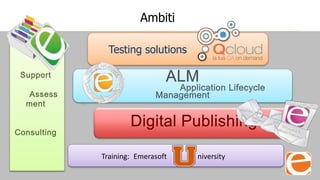
Ambiti
Testing solutions
Training: Emerasoft niversity
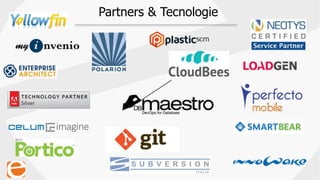
Partners & Tecnologie
Alcuni clienti
6
In Database Automation
We Trust!
(Or do we?)
7
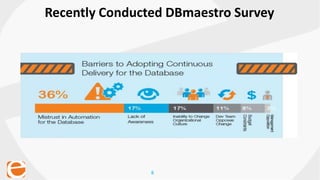
• Over 150 Companies
• Over 200 participants
– Continuous Delivery is on the rise!
– Database Automation meets mistrust…
– Why?
– What can be done?
Recently Conducted DBmaestro Survey
8
Recently Conducted DBmaestro Survey
9
Why automation?
• What is Continuous Delivery?
• Why is it important?
Automation
10
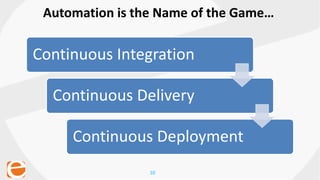
Continuous Integration
Continuous Delivery
Continuous Deployment
Automation is the Name of the Game…
11
• A process, not a tool…
• Focus on streamlining development
– Developers integrate code into shared repository
– Each check-in is verified
– Automated builds
– Automated tests
– A feedback loop
– High visibility
• Easier & quicker to prevent and find problems, less back
tracks => short integrations
What is Continuous Integration?
12
• Next step after continuous integration
• Becoming lean, and even more Agile
– Make sure each change is releasable
• Develop-> build-> test-> move to staging-> acceptance test
– Build a process to release with a push of a button
• Deploy to production-> test production
• Actual deployment to production is manually actuated
=> Ensure risk mitigation and high efficiency
And Continuous Delivery?
13
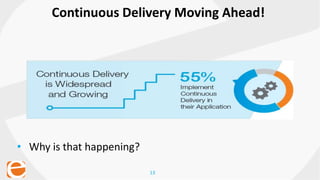
• Why is that happening?
Continuous Delivery Moving Ahead!
14
• Doing better with less
• Reacting quickly to market needs
• Getting ahead of competition
• Just can’t wait 6 months for that next release…
– Agile Development
– Process Automation
– DevOps
Living in an Agile world…
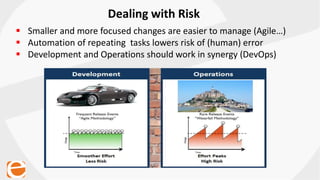
Dealing with Risk
 Smaller and more focused changes are easier to manage (Agile…)
 Automation of repeating tasks lowers risk of (human) error
 Development and Operations should work in synergy (DevOps)
16
• Rapid changes
• Reacting quickly to market needs
• Getting ahead of competition
• Fewer changes backed out
• Better collaboration
• Fewer defects
• Ultimately better service
• Happy customers
• Profitability
Why Continuous Delivery?
17
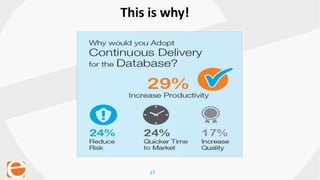
This is why!
18
But…
19
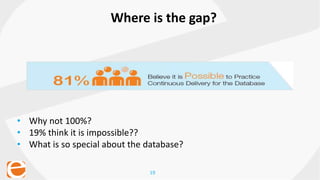
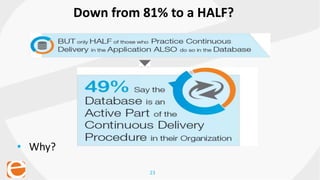
• Why not 100%?
• 19% think it is impossible??
• What is so special about the database?
Where is the gap?
20
• The database holds your essential information
• Any changes can impact the entire system
• Need to be synchronized with other changes
• Often overlooked
Database is a Key Component
21
• There is more to a database than SQL scripts
– Schema structure
– Code
– Content and meta-content
– Internal dependencies
– …
• Ensure that changes are not made without
authorization
• Ensure no out-of-process changes
Reaching Inside the Database
22
• Old adage but true
• The database is often neglected and therefore can
become the weakest link
• Essential from a compliance and business point of view
• Should be the strongest link
The Weakest Link In a Chain
23
• Why?
Down from 81% to a HALF?
24
• Silos exist…
• Don’t always communicate effectively
• Need to share knowledge
• Need to follow same procedures & best practices
Developers and DBAs
25
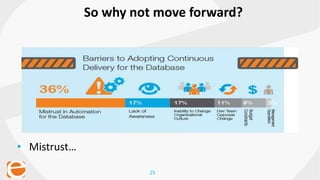
• Mistrust…
So why not move forward?
26
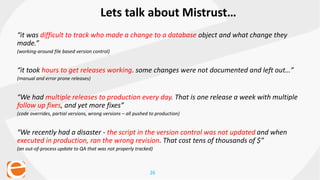
Lets talk about Mistrust…
“it was difficult to track who made a change to a database object and what change they
made.”
(working-around file based version control)
“it took hours to get releases working. some changes were not documented and left out…”
(manual and error prone releases)
“We had multiple releases to production every day. That is one release a week with multiple
follow up fixes, and yet more fixes”
(code overrides, partial versions, wrong versions – all pushed to production)
“We recently had a disaster - the script in the version control was not updated and when
executed in production, ran the wrong revision. That cost tens of thousands of $”
(an out-of-process update to QA that was not properly tracked)
27
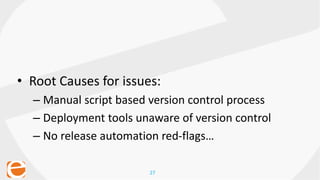
• Root Causes for issues:
– Manual script based version control process
– Deployment tools unaware of version control
– No release automation red-flags…
28
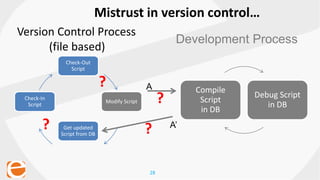
Mistrust in version control…
Version Control Process
(file based)
Development Process
Check-Out
Script
Modify Script
Get updated
Script from DB
Check-In
Script
Compile
Script
in DB
Debug Script
in DB
?
?
?
?
A
A’
29
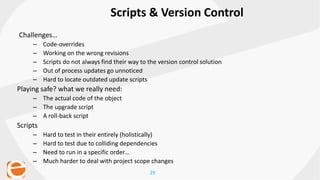
Scripts & Version Control
Challenges…
– Code-overrides
– Working on the wrong revisions
– Scripts do not always find their way to the version control solution
– Out of process updates go unnoticed
– Hard to locate outdated update scripts
Playing safe? what we really need:
– The actual code of the object
– The upgrade script
– A roll-back script
Scripts
– Hard to test in their entirely (holistically)
– Hard to test due to colliding dependencies
– Need to run in a specific order…
– Much harder to deal with project scope changes
30
X
1.11.1.1
1.11.21.31.41.51.61.7
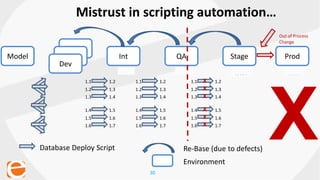
Mistrust in scripting automation…
Int QA Stage Prod
Database Deploy Script
Environment
Re-Base (due to defects)
Dev
Dev
Dev
Model
1.1 1.2
1.2 1.3
1.3 1.4
1.4 1.5
1.5 1.6
1.6 1.7
1.11.11.41.7
1.1 1.2
1.2 1.3
1.3 1.4
1.4 1.5
1.5 1.6
1.6 1.7
1.1 1.2
1.2 1.3
1.3 1.4
1.4 1.5
1.5 1.6
1.6 1.7
Out of Process
Change
X
X
X
X
X
?
1.1.1
X
31
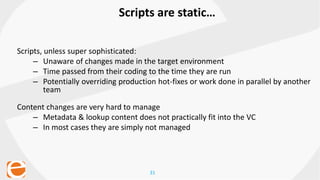
Scripts are static…
Scripts, unless super sophisticated:
– Unaware of changes made in the target environment
– Time passed from their coding to the time they are run
– Potentially overriding production hot-fixes or work done in parallel by another
team
Content changes are very hard to manage
– Metadata & lookup content does not practically fit into the VC
– In most cases they are simply not managed
32
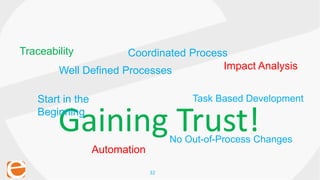
Gaining Trust!
Coordinated ProcessTraceability
Start in the
Beginning
No Out-of-Process Changes
Impact Analysis
Automation
Task Based Development
Well Defined Processes
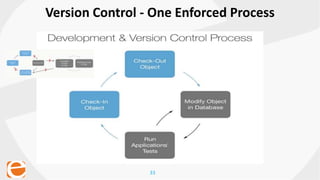
33
Version Control - One Enforced Process
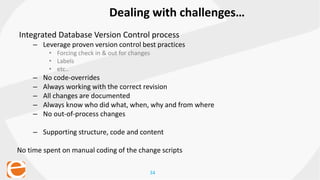
34
Dealing with challenges…
Integrated Database Version Control process
– Leverage proven version control best practices
• Forcing check in & out for changes
• Labels
• etc..
– No code-overrides
– Always working with the correct revision
– All changes are documented
– Always know who did what, when, why and from where
– No out-of-process changes
– Supporting structure, code and content
No time spent on manual coding of the change scripts
35
Bonus Points
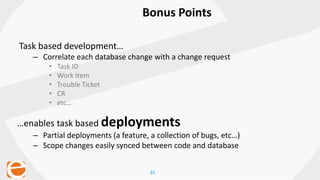
Task based development…
– Correlate each database change with a change request
• Task ID
• Work Item
• Trouble Ticket
• CR
• etc…
…enables task based deployments
– Partial deployments (a feature, a collection of bugs, etc…)
– Scope changes easily synced between code and database
For deployment automation we need:
Repeatability & Safety
Using tools make sense …
37
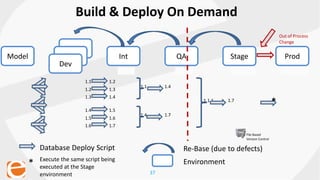
1.11.21.31.41.51.61.7
Build & Deploy On Demand
*
Int QA Stage Prod
Database Deploy Script
Environment* Execute the same script being
executed at the Stage
environment
Re-Base (due to defects)
Dev
Dev
Dev
Model
1.1 1.2
1.2 1.3
1.3 1.4
1.4 1.5
1.5 1.6
1.6 1.7
1.1 1.4
1.4 1.7
1.1.1 1.7
1.1 1.1 1.11.41.7
File Based
Version Control
Out of Process
Change
1.1.11.7 1.1.11.7
Using tools
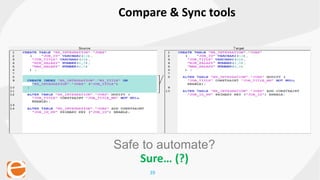
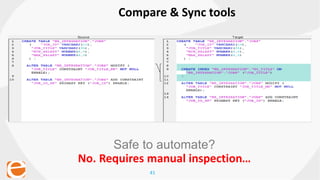
Test cases using compare & sync tools:
An index exists in source (QA) but not in target (Production)
What should we do? Add the index or not?
39
Compare & Sync tools
Safe to automate?
Sure… (?)
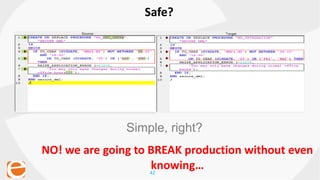
Deployment Automation
An index exists in Target (Production) but not in source (QA)
What should we do? Drop the index or not?
41
Compare & Sync tools
Safe to automate?
No. Requires manual inspection…
42
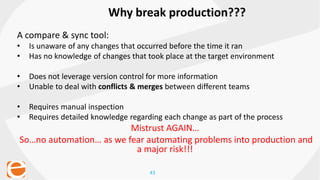
Safe?
Simple, right?
NO! we are going to BREAK production without even
knowing…
43
Why break production???
A compare & sync tool:
• Is unaware of any changes that occurred before the time it ran
• Has no knowledge of changes that took place at the target environment
• Does not leverage version control for more information
• Unable to deal with conflicts & merges between different teams
• Requires manual inspection
• Requires detailed knowledge regarding each change as part of the process
Mistrust AGAIN…
So…no automation… as we fear automating problems into production and
a major risk!!!
44
We need to leverage version control into
deployment decisions…
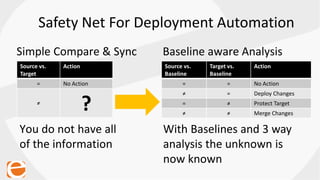
Safety Net For Deployment Automation
Source vs.
Target
Action
= No Action
≠
?
Source vs.
Baseline
Target vs.
Baseline
Action
= = No Action
≠ = Deploy Changes
= ≠ Protect Target
≠ ≠ Merge Changes
You do not have all
of the information
With Baselines and 3 way
analysis the unknown is
now known
Simple Compare & Sync Baseline aware Analysis
46
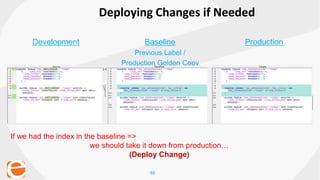
Deploying Changes if Needed
Development Baseline
Previous Label /
Production Golden Copy
Production
If we had the index in the baseline =>
we should take it down from production…
(Deploy Change)
47
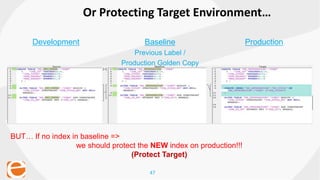
Or Protecting Target Environment…
Development Baseline
Previous Label /
Production Golden Copy
Production
BUT… If no index in baseline =>
we should protect the NEW index on production!!!
(Protect Target)
Deployment Automation
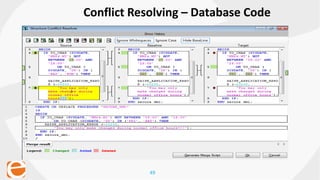
And Merge!!!
49
Conflict Resolving – Database Code
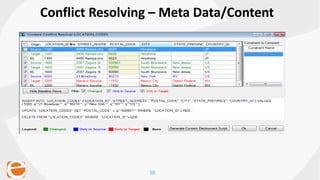
50
Conflict Resolving – Meta Data/Content
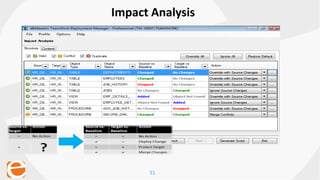
51
Impact Analysis
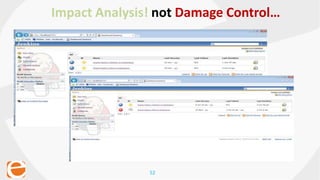
52
Impact Analysis! not Damage Control…
53
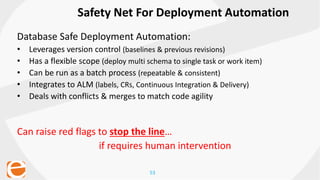
Safety Net For Deployment Automation
Database Safe Deployment Automation:
• Leverages version control (baselines & previous revisions)
• Has a flexible scope (deploy multi schema to single task or work item)
• Can be run as a batch process (repeatable & consistent)
• Integrates to ALM (labels, CRs, Continuous Integration & Delivery)
• Deals with conflicts & merges to match code agility
Can raise red flags to stop the line…
if requires human intervention
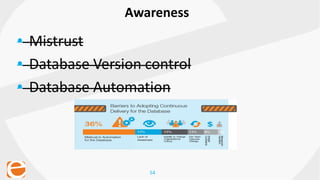
54
• Mistrust
• Database Version control
• Database Automation
Awareness
Summary - What is DBmaestro TeamWork?
• Database Enforced Change Management solution
+ Database version control
+ Enforce best practices
+ Plugs into the ALM (change request, tickets & work items)
+ Database merge & change impact analysis
+ Know who can do what, where, when & why
• DevOps Solution for databases
+ Baseline aware deployment automation, rollback & recovery
+ Reduce database deployment issues
+ Plugs into release management & Continuous Delivery
Contenuti disponibili su:
Canale slideshare di Emerasoft
Canale Youtube Emerasoft
www.emerasoft.com
Q&A
What’s next
Segui i nostri
canali …
www.emerasoft.com
sales@emerasoft.com
Emerasoft Srl
via Po, 1 – 10124 Torino
via del Poggio Laurentino, 118 – 00144 Roma
T +39 011 0120370
T +39 06 87811323
F +39 011 3710371
Grazie…
Contatti

Webinar: "DBMaestro: Database Enforced Change Management (DECM) tool"

  • 1.
    • Emerasoft srl •Mission • Vision • Market & Solutions Gian Giacomo Ermacora 26 marzo 2015
  • 2.
    Chi siamo Data dinascita: 2005 Dove siamo:  via Po, 1 – Torino  via del Poggio Laurentino, 118 - Roma Creare valore per i nostri clienti implementando soluzioni che aumentano la produttività, facilitando la collaborazione. La nostra mission:
  • 3.
  • 4.
  • 5.
  • 6.
    6 In Database Automation WeTrust! (Or do we?)
  • 7.
    7 • Over 150Companies • Over 200 participants – Continuous Delivery is on the rise! – Database Automation meets mistrust… – Why? – What can be done? Recently Conducted DBmaestro Survey
  • 8.
  • 9.
    9 Why automation? • Whatis Continuous Delivery? • Why is it important? Automation
  • 10.
    10 Continuous Integration Continuous Delivery ContinuousDeployment Automation is the Name of the Game…
  • 11.
    11 • A process,not a tool… • Focus on streamlining development – Developers integrate code into shared repository – Each check-in is verified – Automated builds – Automated tests – A feedback loop – High visibility • Easier & quicker to prevent and find problems, less back tracks => short integrations What is Continuous Integration?
  • 12.
    12 • Next stepafter continuous integration • Becoming lean, and even more Agile – Make sure each change is releasable • Develop-> build-> test-> move to staging-> acceptance test – Build a process to release with a push of a button • Deploy to production-> test production • Actual deployment to production is manually actuated => Ensure risk mitigation and high efficiency And Continuous Delivery?
  • 13.
    13 • Why isthat happening? Continuous Delivery Moving Ahead!
  • 14.
    14 • Doing betterwith less • Reacting quickly to market needs • Getting ahead of competition • Just can’t wait 6 months for that next release… – Agile Development – Process Automation – DevOps Living in an Agile world…
  • 15.
    Dealing with Risk Smaller and more focused changes are easier to manage (Agile…)  Automation of repeating tasks lowers risk of (human) error  Development and Operations should work in synergy (DevOps)
  • 16.
    16 • Rapid changes •Reacting quickly to market needs • Getting ahead of competition • Fewer changes backed out • Better collaboration • Fewer defects • Ultimately better service • Happy customers • Profitability Why Continuous Delivery?
  • 17.
  • 18.
  • 19.
    19 • Why not100%? • 19% think it is impossible?? • What is so special about the database? Where is the gap?
  • 20.
    20 • The databaseholds your essential information • Any changes can impact the entire system • Need to be synchronized with other changes • Often overlooked Database is a Key Component
  • 21.
    21 • There ismore to a database than SQL scripts – Schema structure – Code – Content and meta-content – Internal dependencies – … • Ensure that changes are not made without authorization • Ensure no out-of-process changes Reaching Inside the Database
  • 22.
    22 • Old adagebut true • The database is often neglected and therefore can become the weakest link • Essential from a compliance and business point of view • Should be the strongest link The Weakest Link In a Chain
  • 23.
    23 • Why? Down from81% to a HALF?
  • 24.
    24 • Silos exist… •Don’t always communicate effectively • Need to share knowledge • Need to follow same procedures & best practices Developers and DBAs
  • 25.
    25 • Mistrust… So whynot move forward?
  • 26.
    26 Lets talk aboutMistrust… “it was difficult to track who made a change to a database object and what change they made.” (working-around file based version control) “it took hours to get releases working. some changes were not documented and left out…” (manual and error prone releases) “We had multiple releases to production every day. That is one release a week with multiple follow up fixes, and yet more fixes” (code overrides, partial versions, wrong versions – all pushed to production) “We recently had a disaster - the script in the version control was not updated and when executed in production, ran the wrong revision. That cost tens of thousands of $” (an out-of-process update to QA that was not properly tracked)
  • 27.
    27 • Root Causesfor issues: – Manual script based version control process – Deployment tools unaware of version control – No release automation red-flags…
  • 28.
    28 Mistrust in versioncontrol… Version Control Process (file based) Development Process Check-Out Script Modify Script Get updated Script from DB Check-In Script Compile Script in DB Debug Script in DB ? ? ? ? A A’
  • 29.
    29 Scripts & VersionControl Challenges… – Code-overrides – Working on the wrong revisions – Scripts do not always find their way to the version control solution – Out of process updates go unnoticed – Hard to locate outdated update scripts Playing safe? what we really need: – The actual code of the object – The upgrade script – A roll-back script Scripts – Hard to test in their entirely (holistically) – Hard to test due to colliding dependencies – Need to run in a specific order… – Much harder to deal with project scope changes
  • 30.
    30 X 1.11.1.1 1.11.21.31.41.51.61.7 Mistrust in scriptingautomation… Int QA Stage Prod Database Deploy Script Environment Re-Base (due to defects) Dev Dev Dev Model 1.1 1.2 1.2 1.3 1.3 1.4 1.4 1.5 1.5 1.6 1.6 1.7 1.11.11.41.7 1.1 1.2 1.2 1.3 1.3 1.4 1.4 1.5 1.5 1.6 1.6 1.7 1.1 1.2 1.2 1.3 1.3 1.4 1.4 1.5 1.5 1.6 1.6 1.7 Out of Process Change X X X X X ? 1.1.1 X
  • 31.
    31 Scripts are static… Scripts,unless super sophisticated: – Unaware of changes made in the target environment – Time passed from their coding to the time they are run – Potentially overriding production hot-fixes or work done in parallel by another team Content changes are very hard to manage – Metadata & lookup content does not practically fit into the VC – In most cases they are simply not managed
  • 32.
    32 Gaining Trust! Coordinated ProcessTraceability Startin the Beginning No Out-of-Process Changes Impact Analysis Automation Task Based Development Well Defined Processes
  • 33.
    33 Version Control -One Enforced Process
  • 34.
    34 Dealing with challenges… IntegratedDatabase Version Control process – Leverage proven version control best practices • Forcing check in & out for changes • Labels • etc.. – No code-overrides – Always working with the correct revision – All changes are documented – Always know who did what, when, why and from where – No out-of-process changes – Supporting structure, code and content No time spent on manual coding of the change scripts
  • 35.
    35 Bonus Points Task baseddevelopment… – Correlate each database change with a change request • Task ID • Work Item • Trouble Ticket • CR • etc… …enables task based deployments – Partial deployments (a feature, a collection of bugs, etc…) – Scope changes easily synced between code and database
  • 36.
    For deployment automationwe need: Repeatability & Safety Using tools make sense …
  • 37.
    37 1.11.21.31.41.51.61.7 Build & DeployOn Demand * Int QA Stage Prod Database Deploy Script Environment* Execute the same script being executed at the Stage environment Re-Base (due to defects) Dev Dev Dev Model 1.1 1.2 1.2 1.3 1.3 1.4 1.4 1.5 1.5 1.6 1.6 1.7 1.1 1.4 1.4 1.7 1.1.1 1.7 1.1 1.1 1.11.41.7 File Based Version Control Out of Process Change 1.1.11.7 1.1.11.7
  • 38.
    Using tools Test casesusing compare & sync tools: An index exists in source (QA) but not in target (Production) What should we do? Add the index or not?
  • 39.
    39 Compare & Synctools Safe to automate? Sure… (?)
  • 40.
    Deployment Automation An indexexists in Target (Production) but not in source (QA) What should we do? Drop the index or not?
  • 41.
    41 Compare & Synctools Safe to automate? No. Requires manual inspection…
  • 42.
    42 Safe? Simple, right? NO! weare going to BREAK production without even knowing…
  • 43.
    43 Why break production??? Acompare & sync tool: • Is unaware of any changes that occurred before the time it ran • Has no knowledge of changes that took place at the target environment • Does not leverage version control for more information • Unable to deal with conflicts & merges between different teams • Requires manual inspection • Requires detailed knowledge regarding each change as part of the process Mistrust AGAIN… So…no automation… as we fear automating problems into production and a major risk!!!
  • 44.
    44 We need toleverage version control into deployment decisions…
  • 45.
    Safety Net ForDeployment Automation Source vs. Target Action = No Action ≠ ? Source vs. Baseline Target vs. Baseline Action = = No Action ≠ = Deploy Changes = ≠ Protect Target ≠ ≠ Merge Changes You do not have all of the information With Baselines and 3 way analysis the unknown is now known Simple Compare & Sync Baseline aware Analysis
  • 46.
    46 Deploying Changes ifNeeded Development Baseline Previous Label / Production Golden Copy Production If we had the index in the baseline => we should take it down from production… (Deploy Change)
  • 47.
    47 Or Protecting TargetEnvironment… Development Baseline Previous Label / Production Golden Copy Production BUT… If no index in baseline => we should protect the NEW index on production!!! (Protect Target)
  • 48.
  • 49.
  • 50.
    50 Conflict Resolving –Meta Data/Content
  • 51.
  • 52.
    52 Impact Analysis! notDamage Control…
  • 53.
    53 Safety Net ForDeployment Automation Database Safe Deployment Automation: • Leverages version control (baselines & previous revisions) • Has a flexible scope (deploy multi schema to single task or work item) • Can be run as a batch process (repeatable & consistent) • Integrates to ALM (labels, CRs, Continuous Integration & Delivery) • Deals with conflicts & merges to match code agility Can raise red flags to stop the line… if requires human intervention
  • 54.
    54 • Mistrust • DatabaseVersion control • Database Automation Awareness
  • 55.
    Summary - Whatis DBmaestro TeamWork? • Database Enforced Change Management solution + Database version control + Enforce best practices + Plugs into the ALM (change request, tickets & work items) + Database merge & change impact analysis + Know who can do what, where, when & why • DevOps Solution for databases + Baseline aware deployment automation, rollback & recovery + Reduce database deployment issues + Plugs into release management & Continuous Delivery
  • 56.
    Contenuti disponibili su: Canaleslideshare di Emerasoft Canale Youtube Emerasoft www.emerasoft.com Q&A What’s next
  • 57.
    Segui i nostri canali… www.emerasoft.com sales@emerasoft.com Emerasoft Srl via Po, 1 – 10124 Torino via del Poggio Laurentino, 118 – 00144 Roma T +39 011 0120370 T +39 06 87811323 F +39 011 3710371 Grazie… Contatti

Editor's Notes

  • #2 Contenuto del webinar: panoramica generale dei criteri di selezione dei prodotti e successiva descrizione tecnica dei prodotti di test. Emerasoft si occupa di analizzare il mercato e di selezionare le migliori tecnologie per rispondere al meglio alle esigenze dei clienti.. Attraverso nuove metodologie e strumenti vuole favorire la crescita di modelli di Business e di Sviluppo più efficaci a costi e investimenti ridotti.
  • #6 Some customer in Italy Market.